

Two of the most serious accusations in Ontario tenancy law travel on a single form. The N6 — Notice to End your Tenancy for Illegal Acts or Misrepresenting Income in a Rent-Geared-to-Income Rental Unit — covers exactly what its long name says: illegal acts at a rental property, and knowingly misrepresented income in subsidized housing. It carries the shortest first-notice periods anywhere in the LTB stack — as few as 10 days — and, unlike the N4 or N5, it offers the tenant no window to fix anything.
Both sides routinely misread it. Landlords see "no remedy period" and assume a fast, sure win — then trip over a proof burden that is heavier here than for any other notice. Tenants see a termination date ten days out and assume they must be gone by then — they don't; an N6 is a notice, not an eviction order, and nothing ends a tenancy except an LTB order enforced by the sheriff.
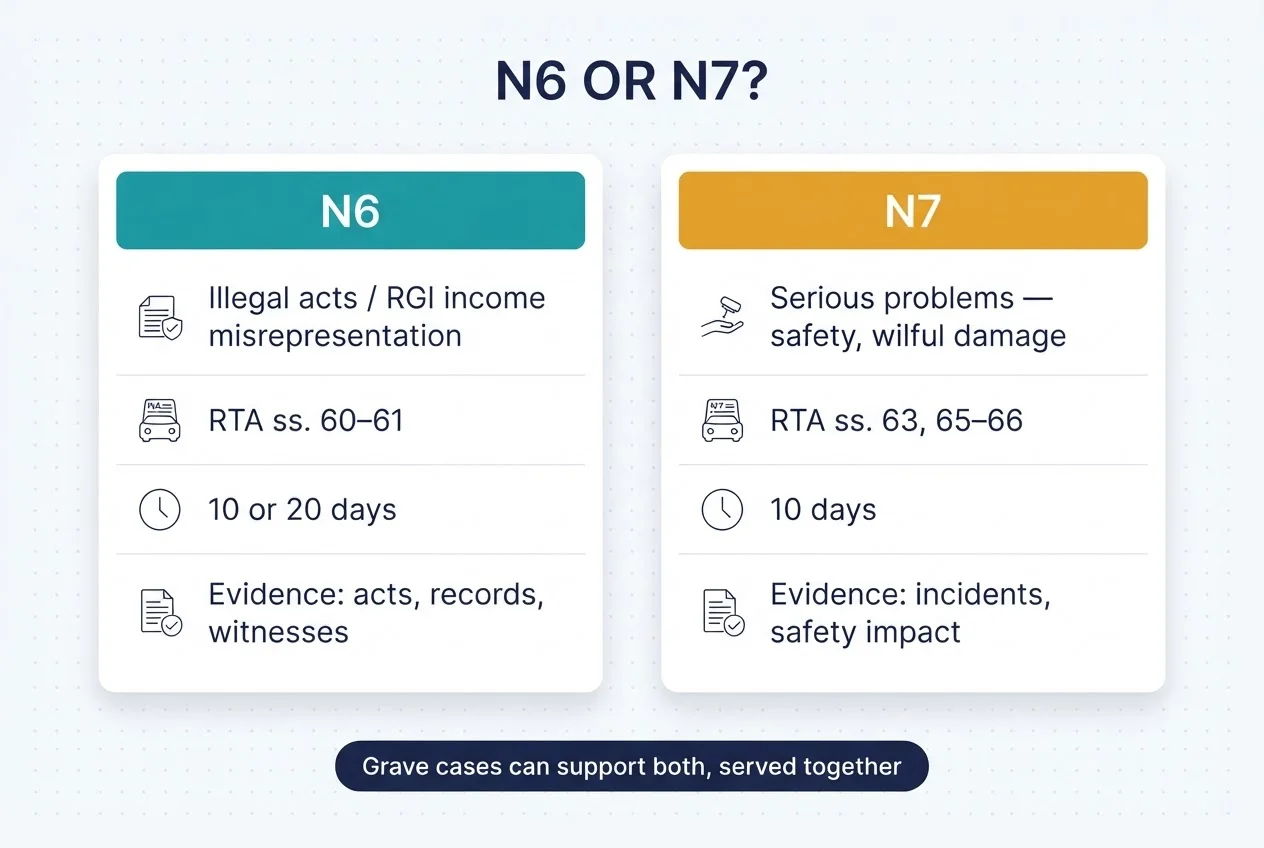
One clarification before anything else: the N6 is not the notice for safety-impairing behaviour or wilful damage — that's the N7, a sibling with different statutory tests. This guide covers the N6's two grounds, what a landlord must actually prove, the tenant's rights at every stage, and the procedural traps that sink applications. It's general information, not legal advice — and N6 situations are serious enough that both sides should usually get professional advice early.
Got an N6 Notice? Your Step-by-Step Response Plan (17 Steps to Protect Your Tenancy)
An N6 is a notice, not an eviction order. Learn exactly what to do in the first 48 hours, what the landlord must prove, how to build your file, and how to raise fairness at your LTB hearing. Free tenant PDF.
Get Free PDF →What the N6 Covers: Two Grounds, One Form
The N6 bundles two distinct sections of the Residential Tenancies Act:
- Section 61 — illegal acts. A landlord may give notice if the tenant or another occupant commits an illegal act or carries on an illegal trade, business or occupation — or permits someone else to do so — in the rental unit or the residential complex.
- Section 60 — misrepresented income in RGI housing. This ground exists only in social housing: it applies where the tenant has knowingly and materially misrepresented their income, or the income of family members living in the unit.
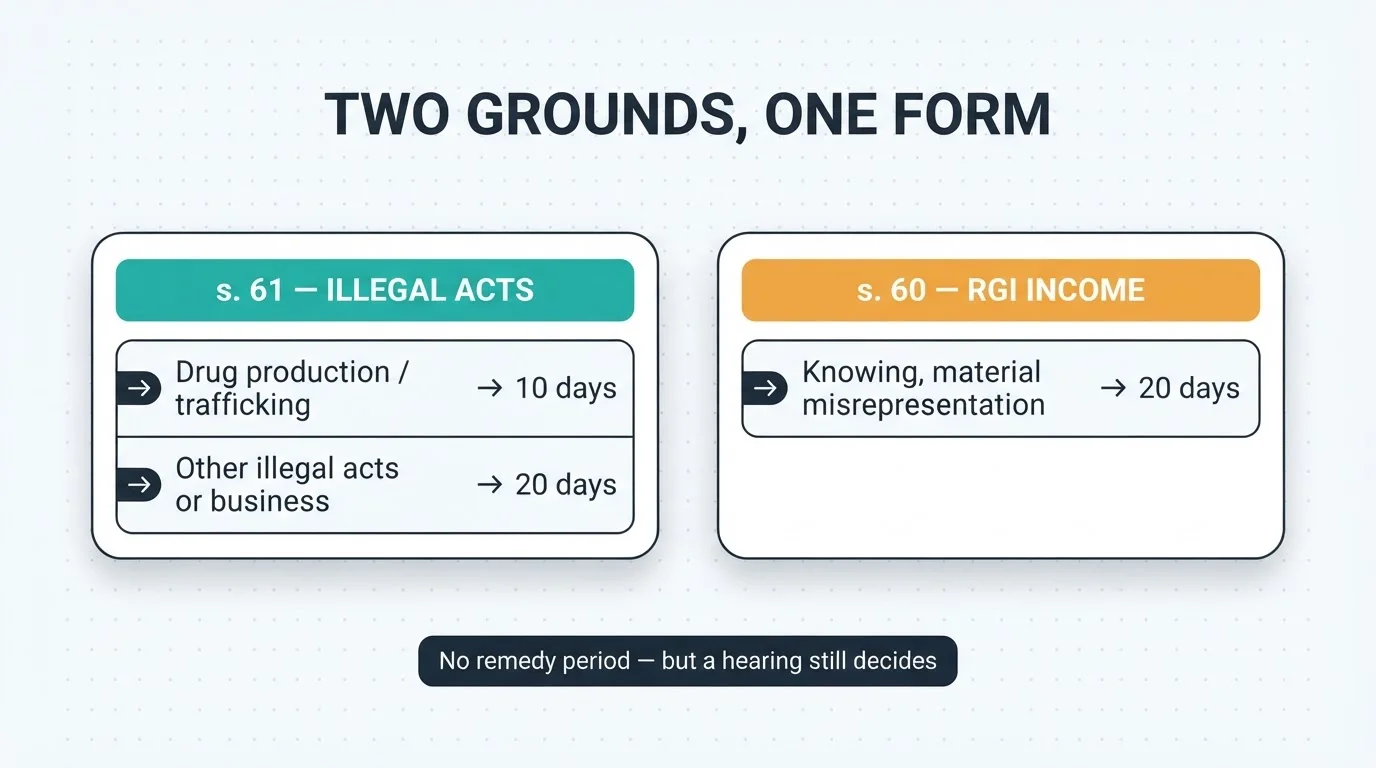
The notice periods track the gravity of the allegation. The termination date must be at least 10 days out where the illegal act involves producing an illegal drug, trafficking, or possession for the purposes of trafficking — and at least 20 days out for every other illegal act and for the RGI income ground. The Board has no power to shorten these; a date even one day short can invalidate the notice.
Location is a hard requirement: the act must occur in the rental unit or the residential complex, which includes common areas like the laundry room and parking lot. The LTB's own guideline makes the point vividly — a tenant charged with robbing the convenience store across the street hasn't triggered s. 61; robbing other units in the building has. And know what the N6 is not: interference and damage cases belong to the N5, and unauthorized subletting is generally its own topic — though there's a notable crossover: Ontario's Divisional Court has treated repeatedly re-renting a unit at above-lawful rent without consent as an illegal business under s. 61, the short-term-rental-arbitrage pattern covered in our guide to subletting vs assignment.
What the Landlord Must Actually Prove
Here's the counterweight to those short notice periods: the N6 is the most demanding notice in the stack to prove, and the burden sits entirely on the landlord.
Start with the standard. Under s. 75 of the RTA, no criminal conviction is required — the Board decides on a balance of probabilities ("more likely than not"), the civil standard, not "beyond a reasonable doubt." That cuts in both directions, and both audiences should hear it plainly. Landlords: you don't have to wait for criminal court, and you can't simply file a charge sheet and rest — the Board makes its own findings on evidence. Tenants: dropped charges or an acquittal don't automatically end the LTB case, because the standards differ — and equally, an LTB finding is not a criminal finding and doesn't give you a record.
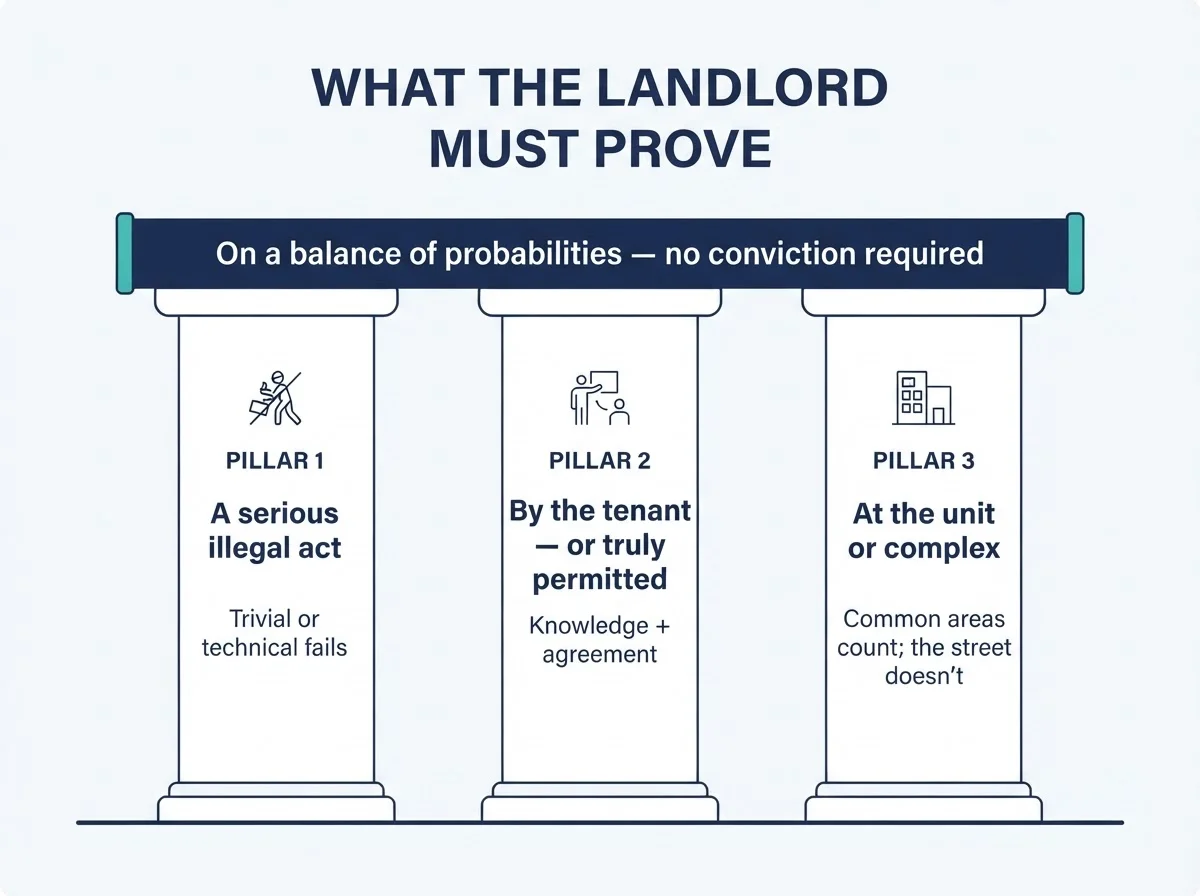
Then the seriousness test. "Illegal" isn't defined in the RTA. The LTB's Interpretation Guideline 9 fills the gap: it means a serious violation of a federal, provincial or municipal law, and trivial or technical illegality may not be serious enough to warrant eviction. The court-made yardstick, from Samuel Property Management v. Nicholson, asks whether the act has the potential to affect the character of the premises or disturb others' reasonable enjoyment. This test has real teeth: in one Toronto case, the Board dismissed an N6 built on the tenant merely living in a commercially zoned unit — technically offside the bylaw, but not a sufficiently serious violation. By contrast, tampering with a hydro meter and running an unlicensed rooming house have been upheld as serious illegal acts — the ground reaches well beyond drugs.
Then the right actor. The act must be committed by the tenant or an occupant — or by someone the tenant permitted. In Musse v. 6965083 Canada Inc. (2021), the Divisional Court overturned an eviction where a guest had spat on the building superintendent (an assault) while the tenant stood nearby. Permission, the court held, involves a state of mind: knowledge of what is going to happen and a voluntary agreement that it be done. Mere presence — or merely having let the person into the building — is not permission. For the 10-day drug ground, Guideline 9 also notes what evidence can carry the day without a conviction: possession for the purpose of trafficking may be inferred from circumstances like a large quantity of drugs, cash, and scales.

The RGI ground has its own elements: the misrepresentation must be knowing and material, and it covers the income of family members in the unit, not just the tenant's own. The evidence is documentary — what was declared to the housing provider versus what the records show. An honest mistake or a trivial discrepancy is a defence worth raising; a pattern of concealed income is what the ground was written for.
The Process: Non-Voidable, But Not Self-Executing
The N6's defining duality deserves its own section, because each half protects a different reader.
For landlords — no remedy period, but every procedural rule intact. There is nothing for the tenant to "cure," so under s. 71 you can file your L2 application immediately after serving — no waiting. But the outer deadline is unforgiving: the L2 must be filed no later than 30 days after the termination date, with a copy of the served N6 and a Certificate of Service. And the notice itself must survive scrutiny under Guideline 10: specific events with dates and times, a correct termination date (check yours with the Termination Date Calculator), and proper service. Vague allegations, short dates, door-posted or texted notices, and late filings all end the same way — dismissal, and a restart at the back of the LTB queue.
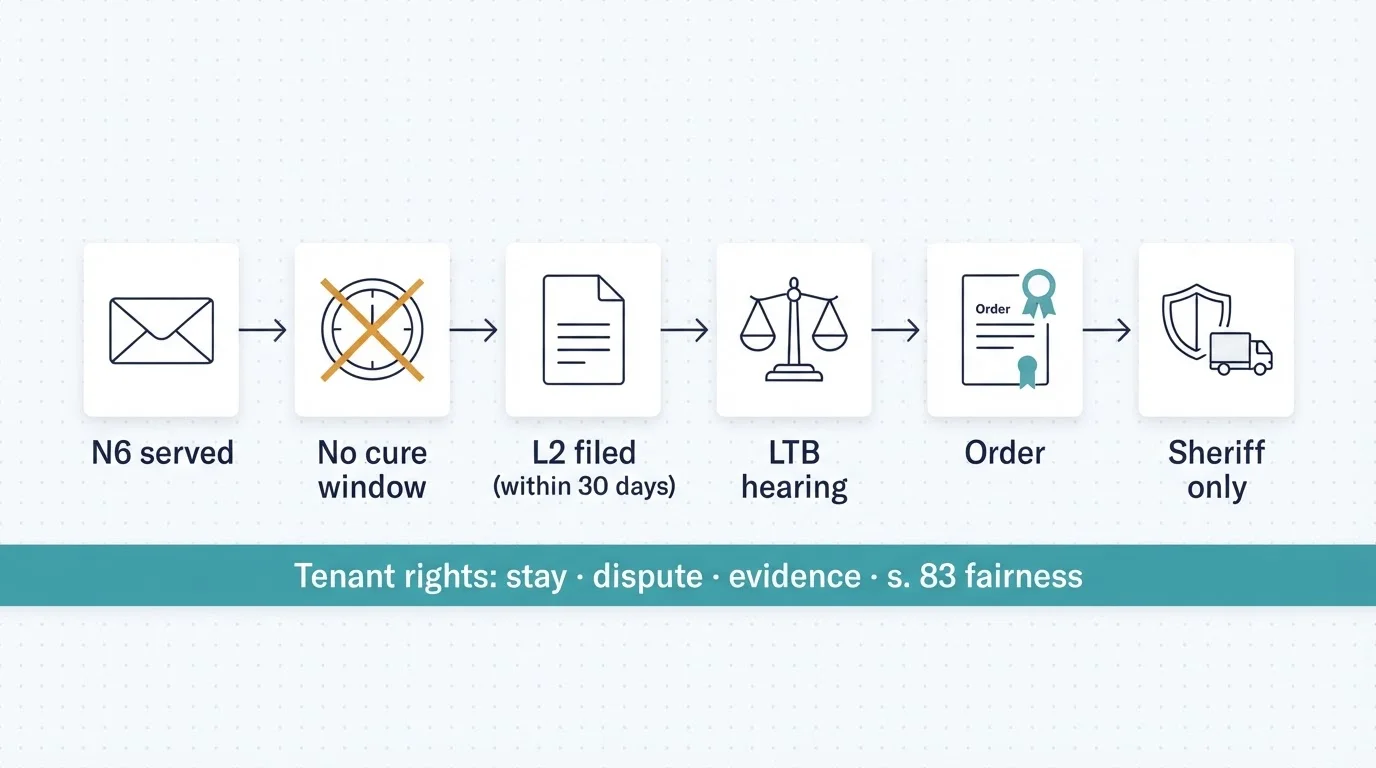
For tenants — the notice is not the outcome. You do not have to move out by the termination date. You have the right to stay pending the hearing, dispute the allegations, bring your own evidence and witnesses, and get help — Ontario's community legal clinics handle exactly these cases, and Tenant Duty Counsel may be available on hearing day. Even where a ground is proven, section 83 requires the Board to consider whether eviction is fair in all the circumstances — length of tenancy, household members, health, and the events themselves — and relief can mean refusing the eviction or delaying it. Only the sheriff can enforce an eviction order; a landlord who changes locks or removes belongings is breaking the law. One more reason to act fast rather than wait: if you're in RGI housing, an eviction on the income ground reportedly can affect your eligibility for subsidized housing for up to five years — get advice before the hearing date, not after.
Two procedural notes round out the picture. On the 10-day drug ground, s. 84 directs the Board, if it orders eviction, to ask the sheriff to expedite enforcement — the legislature built speed into this ground at every step. And under s. 68, a further contravention more than 7 days but less than 6 months after a first notice supports a second, non-voidable notice — repeat situations move faster for everyone.
N6 or N7? Getting the Choice Right in 2026
The N6's most common cousin-confusion is with the N7 — Ontario's notice for serious problems: seriously impairing safety, wilful damage, and similar conduct. The two overlap at the edges (both carry 10-day floors on their gravest grounds) but run on different statutory tests, and picking the wrong one — or blurring grounds within one notice — invites dismissal under Guideline 10's clarity requirement. Genuinely grave fact patterns can support both: in one 2017 Toronto case, a police search that uncovered a handgun and large drug quantities led to an N6 and N7 served together, eviction, and expedited sheriff enforcement.
A 2026 status note: the Bill 60 and Bill 97 amendments rolling out this year reworked several notice mechanics — most prominently the N4's timelines — but as of July 2026, nothing indicates changes to sections 60 or 61 or the N6's periods. The Phase 2 changes landing September 21, 2026 are the item to watch. Practical posture for both sides is the same: these are the highest-stakes, most technical notices in the stack, and early professional help — a paralegal or lawyer for landlords, a community legal clinic for tenants — is rarely wasted money. For where the L2 fits among the Board's applications, see L1 vs L2 applications.
Practical Takeaways
For landlords, seven moves:
- Match the ground to the facts — s. 61 illegal act (10 or 20 days) or s. 60 RGI misrepresentation (20 days) — and honestly consider whether the N7, or the N5's lower bar, fits better or belongs alongside.
- Confirm the location and the actor: at the unit or complex, by the tenant or someone they truly permitted (knowledge + agreement).
- Test seriousness before serving — trivial or technical illegality loses.
- Fill the N6 with specifics: dates, times, detailed events. Vague notices get dismissed.
- Serve properly and complete a Certificate of Service the same day.
- File the L2 early — allowed immediately, dead after 30 days past the termination date.
- Arrive hearing-ready: evidence file assembled, and s. 83 fairness arguments anticipated.
For tenants, four: an N6 is a notice, not an order — you can stay and dispute it; get legal help fast, especially in RGI housing where future eligibility is at stake; gather your own timeline, documents and witnesses; and remember the Board must weigh fairness under s. 83 even if the ground is proven. The authoritative references are the Tribunals Ontario N6 form and instructions and Interpretation Guideline 9.
Got an N6 Notice? Your Step-by-Step Response Plan (17 Steps to Protect Your Tenancy)
An N6 is a notice, not an eviction order. Learn exactly what to do in the first 48 hours, what the landlord must prove, how to build your file, and how to raise fairness at your LTB hearing. Free tenant PDF.
Get Free PDF →The Bottom Line
The N6 is the sharpest notice in Ontario's stack — the shortest periods, no cure, expedited enforcement on its gravest ground. It is also the most demanding to prove: a genuinely serious illegal act, by the right person, at the right place, established on evidence before a Board that must still weigh fairness under s. 83. Landlords who treat the form as the outcome lose on procedure or proof; tenants who treat the form as the outcome give up rights the law deliberately preserved for them. Neither should. Landlords: document first, serve second. Tenants: get advice before the hearing date, not after. This is general information, not legal advice — for a live N6 situation on either side, speak with a licensed paralegal, lawyer, or community legal clinic promptly.
Serious Notices Demand Serious Paperwork
Tenon10 generates LTB notices with the details the Board expects, tracks the 30-day L2 window automatically, and keeps your evidence file with the tenancy record.
Free • No signup required • Updated for the Bill 60 changes in force 21 Sep 2026
Frequently Asked Questions
What is an N6 notice in Ontario?
It's the LTB notice for ending a tenancy over illegal acts at the rental property (RTA s. 61) or knowingly misrepresented income in rent-geared-to-income housing (s. 60). The termination date must be at least 10 days out for drug-related grounds and at least 20 days out for everything else.
Does the tenant need a criminal conviction for an N6 to succeed?
No. Section 75 of the RTA says no conviction is required — the Board decides on a balance of probabilities, the civil standard. That cuts both ways: a landlord doesn't have to wait for criminal court, and dropped charges don't automatically end the LTB case. An LTB finding is not a criminal finding.
Can the tenant fix the problem to void an N6?
No — unlike the N4 and N5, the N6 has no remedy period. But it's still only a notice: the tenant can stay in the unit, dispute the allegations, and require the landlord to prove the case at a hearing before anything ends the tenancy.
What's the difference between an N6 and an N7?
The N6 targets illegal acts and RGI income misrepresentation; the N7 targets serious problems like safety-impairing behaviour and wilful damage. They share a 10-day floor on their gravest grounds but run on different statutory tests — and some grave fact patterns support both notices served together.
How fast can an N6 eviction actually happen?
The drug-related ground allows a termination date just 10 days out, the L2 can be filed immediately after service, and if the Board orders eviction on that ground it must ask the sheriff to expedite enforcement. But the hearing gates everything — no order, no eviction, and only the sheriff can enforce one.
What if a guest committed the illegal act?
The landlord must prove the tenant permitted it — meaning knowledge of what was going to happen plus voluntary agreement that it be done. The Divisional Court has held that mere presence, or simply having let the person in, is not permission.


