

Update, 26 Sep 2026: The changes this article looked ahead to are now in force. As the LTB's September 21 operational update confirms, the N4 notice period is 7 days (down from 14 for monthly and yearly tenancies) for notices given on or after September 21, 2026, and an updated N4 form is available. The half-the-arrears rule also took effect: on an L1 filed on or after September 21, 2026, a tenant who wants to raise maintenance or other issues at the hearing must pay half the arrears claimed at least seven days before the hearing, directly to the landlord (not to the LTB in trust). Where the text below says a rule is not yet in force, read it as written before that date.
The single most-felt change in Ontario's entire rental-law overhaul isn't the doubled fines or the renoviction rules. It's one number on the province's most-served form. On September 21, 2026, the N4's waiting period drops from 14 days to 7 for monthly tenancies — and with roughly 60% of everything the Landlord and Tenant Board does being arrears cases, this change will touch more Ontarians than every other Bill 60 item combined.
It's also the most misreported. Half the internet already says the 7-day rule is in force — it isn't, and a short-dated notice served today is defective. The other half calls it a "7-day eviction" — it isn't that either; it's a payment window at the front of a process still measured in months. Both errors are expensive, in opposite directions.
This is the final deep-dive in our Bill 60/97 series: the real date, what the seven days actually are, the void ladder that survives untouched, the honest pipeline math, the companion rules arriving alongside, and the transition trap waiting on both sides. For the form itself — how to complete, serve, or respond to an N4 — our landlord guide and tenant guide are the hubs; this piece covers the change. General information, not legal advice.
The 7-Day N4 Playbook: The New Clock, the Void Ladder, and the Transition Trap
One free PDF, both seats: the real start date, the serving rules, the three-rung void ladder, and the day-one tenant playbook.
Get Free PDF →What Changes — and Exactly When
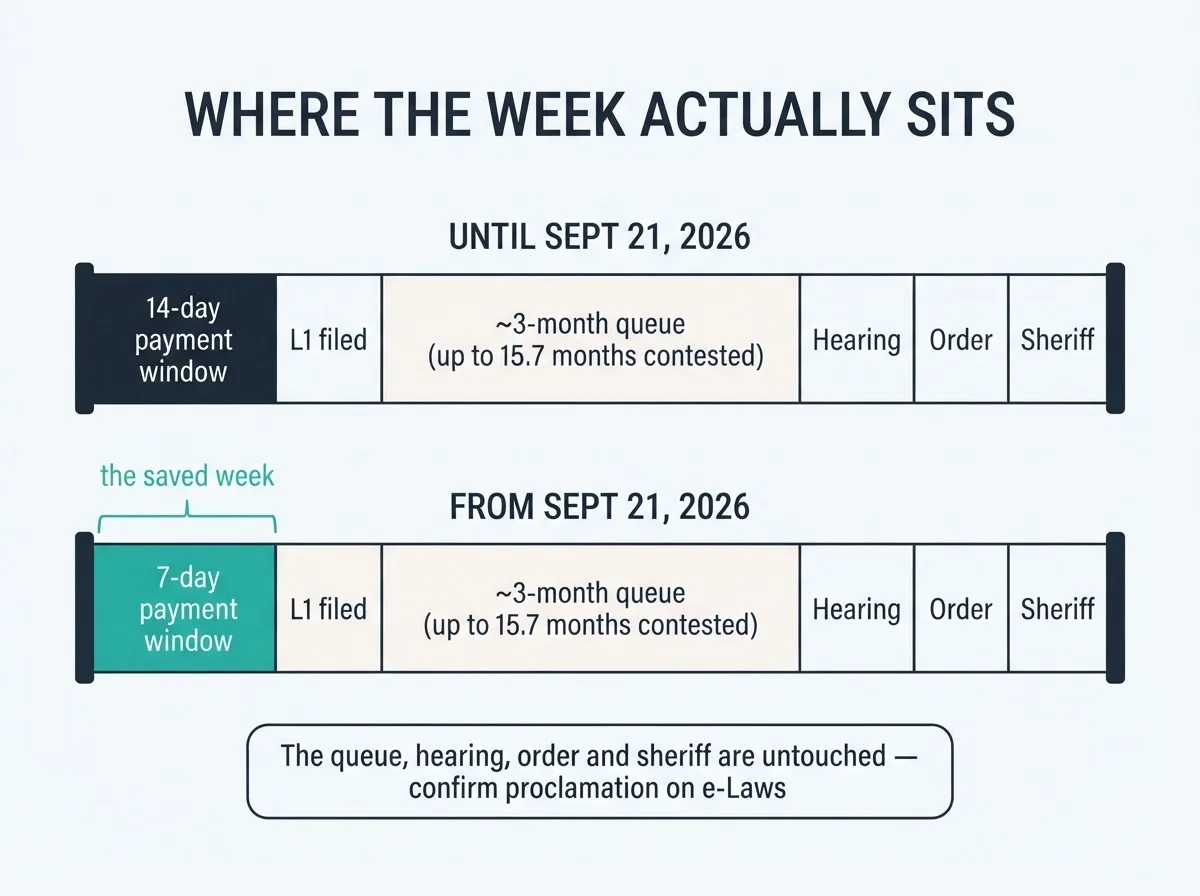
The amendment itself is one line: the minimum gap between serving an N4 and its termination date drops from 14 days to 7 for monthly and yearly tenancies. A precision point almost nobody makes: weekly and daily tenancies already had a 7-day period before Bill 60 — this change equalizes the timelines, it doesn't halve everything. Practitioner coverage also reports carve-outs for non-profit housing and certain care homes, so operators in those sectors should confirm their specific rules.
The date, precisely: The 7-day N4 arrives with the second proclamation wave, expected September 21, 2026 — not the July 1 wave that brought the doubled fines and the 15-day review window. It is not in force today, whatever some guides claim in the present tense: Bill 60's royal assent in November 2025 was not proclamation, the same discipline this series applied to the 120-day N12. Until proclamation is confirmed on Ontario's e-Laws, the 14-day rule governs — that was the position when this was written. The change took effect on September 21, 2026: an N4 given on or after that date needs a termination date at least 7 days out, and one given before it needed at least 14 days for a monthly or yearly tenancy.
Why did the government do it? The official logic is delay-fighting: with arrears dominating the Board's docket, a shorter front-end gets legitimate cases into the queue faster. The critics' answer is equally compact: the system's failure was never notice length — it was resolution capacity, hearings that took ten months at the worst of the backlog. Both things can be true, and the honest version of this article holds both: the week is real, and the queue behind it is untouched.
What the 7 Days Actually Are: A Payment Window, Not a Countdown
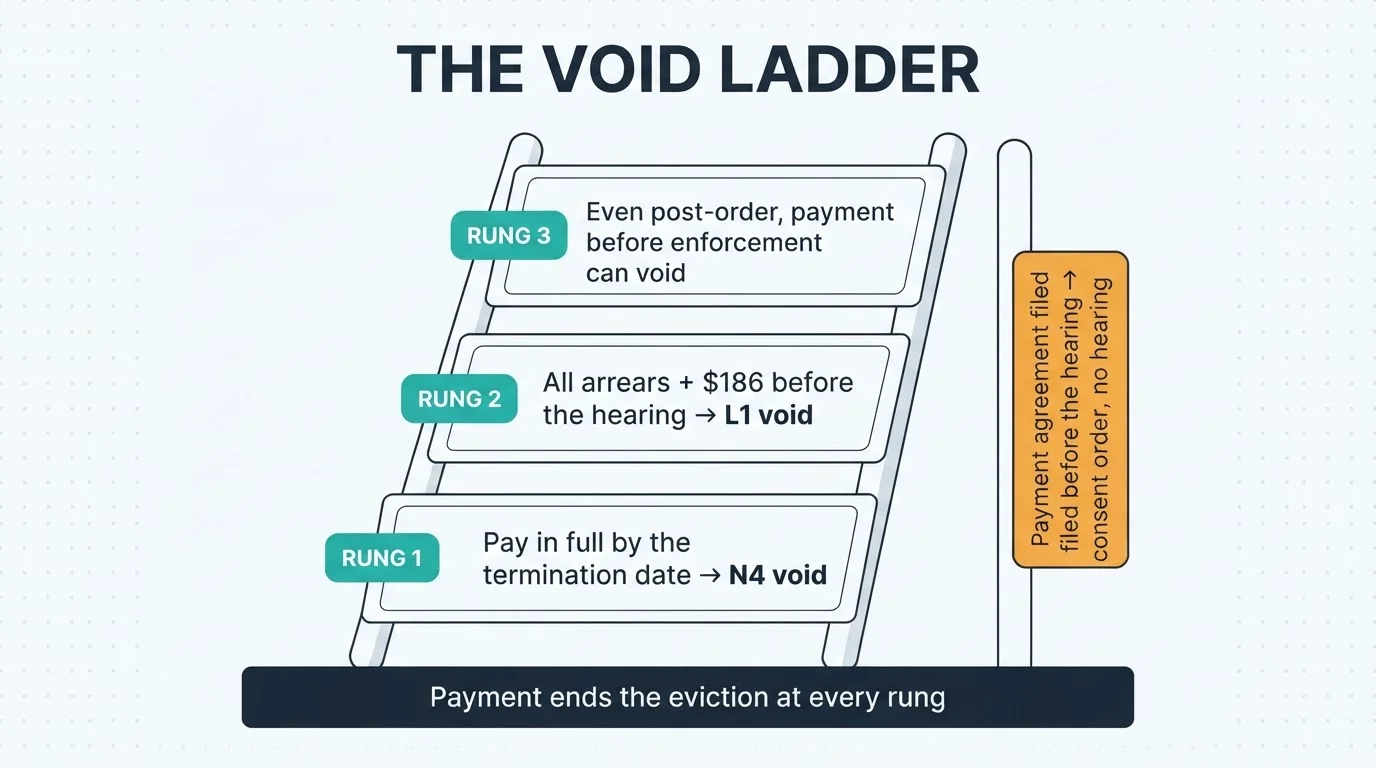
Here's the mechanics chain. Rent is late at 11:59 p.m. on the day it's due; the N4 can be served the very next day; and the notice's termination date must sit at least 7 days out (14 until proclamation). But the only immediate legal effect of that notice is to open a payment window — because the N4's defining feature, untouched by Bill 60, is that payment kills it. In fact, payment kills the process at three separate rungs:
- Rung one: pay everything owing by the termination date, and the N4 is void. The tenancy continues; nothing is filed anywhere.
- Rung two: if the landlord files an L1 ($186), paying all arrears plus that $186 any time before the hearing voids the application.
- Rung three: even after an eviction order, payment before enforcement can void it — the most expensive rung, but it exists.
And there's a parallel rail: a payment agreement signed and filed before the hearing can become a consent order with no hearing at all — often the calmest exit for both sides.
For tenants, the reassurance is real and worth stating plainly: even after an L1 is filed, a hearing is months away; arrears can be paid at any point along the way; and a first-time arrears case where the rent is paid before the hearing almost never ends in eviction. The Board also keeps its s. 83 fairness discretion and its hearing-day payment plans. For landlords, the mirror is just as true: the ladder isn't a bug — a paying tenant restored is the system working. The N4's job is payment. Patterns of chronic lateness are a different notice's job entirely — the N8, with its own 60-day timeline and its own evidence test.

The Honest Math — and the Rules Arriving With It
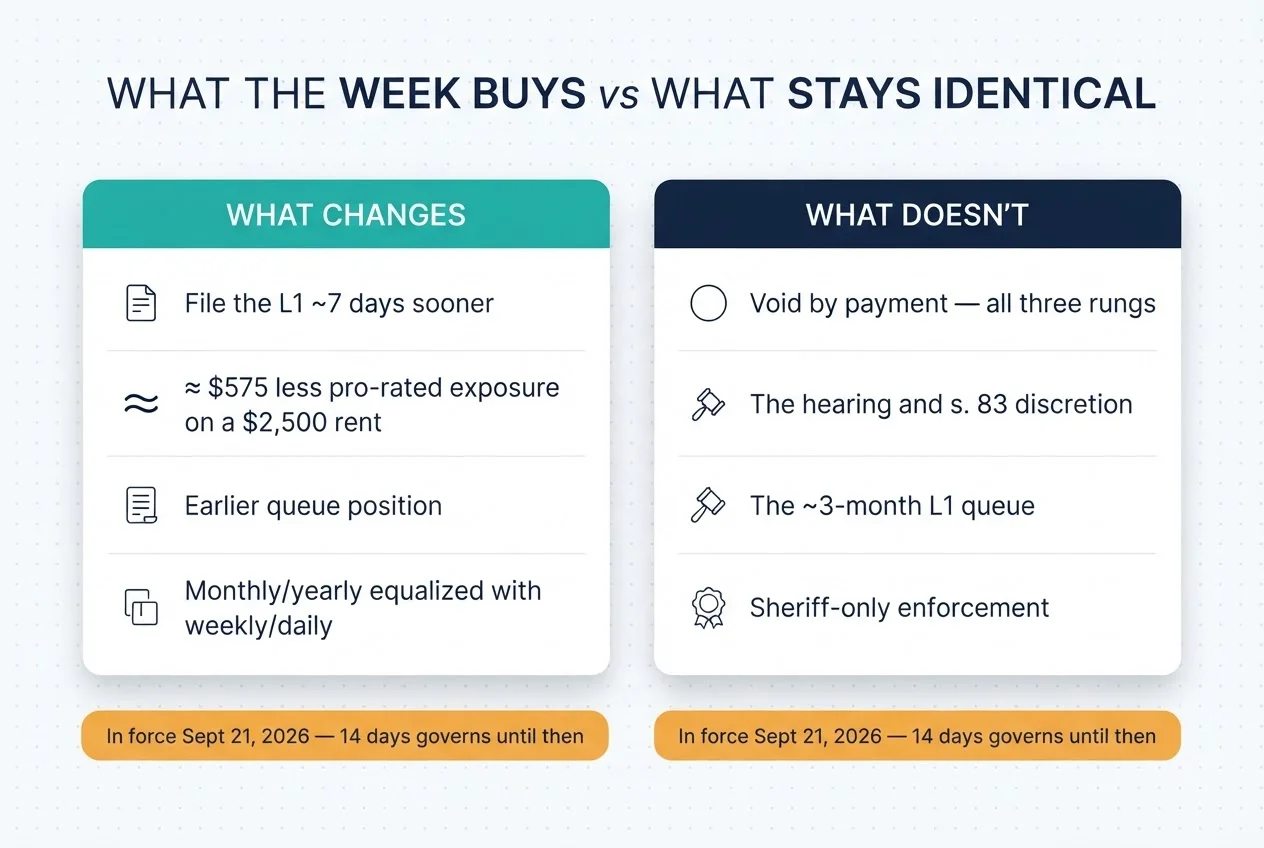
What is the week actually worth? On a $2,500 rent, filing seven days sooner trims roughly $575 of pro-rated exposure per file, plus an earlier position in the queue — real money across a portfolio, and genuine help for a landlord carrying a mortgage on a non-paying unit. What it isn't is a revolution: L1 applications currently schedule in about 3 months on average (longer in the GTA), observed data puts 80% of contested arrears cases between 2.7 and 15.7 months, and a fully contested case on a $2,000 tenancy still runs north of $20,000 all-in. The bottleneck was never the notice. Which means the real landlord lever hasn't moved either: error-free paperwork. Exact arrears math with rent only in the arrears box, exact names, proper service with a Certificate of Service — because one typo on a 7-day N4 sets you back months, and the faster system is less forgiving of restarts than the old one ever was.
Two companion changes arrive in the same package and belong in the same mental model:
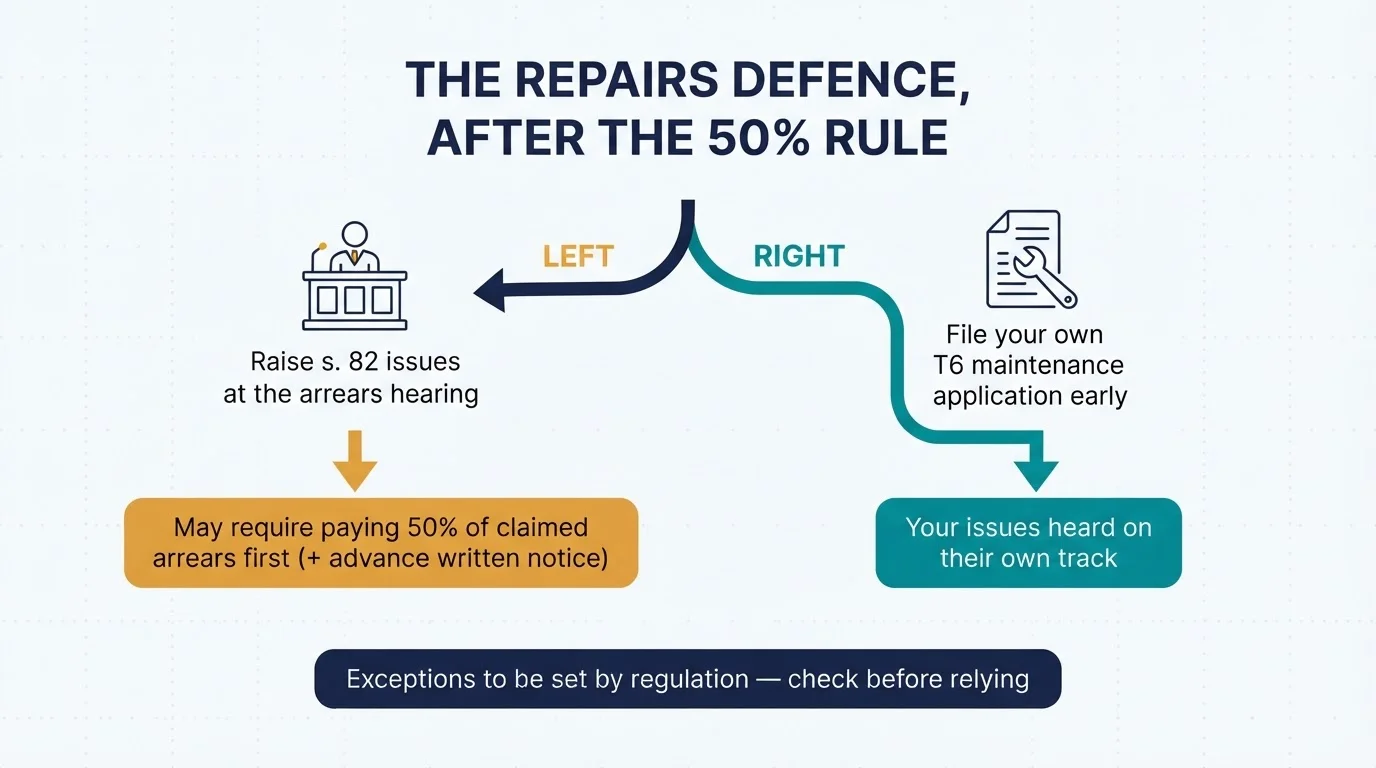
The 50% rule. Tenants have long been able to raise maintenance failures (s. 82) as a defence at an arrears hearing. Under the new framework, doing so may require paying 50% of the claimed arrears first — to the Board or the landlord — subject to exceptions still to be set by regulation, on top of advance written notice of the issues. The landlord bar frames this as ending "trial by ambush"; tenant advocates counter that it prices legitimate repair defences out of reach for the very tenants most likely to face disrepair. Both framings are worth knowing. The strategic upshot for tenants is the same either way: file your own T6 maintenance application early rather than saving repair issues for the arrears hearing — your issues get their own track, no 50% toll attached.
The 15-day review window. In force since July 1: a request to review an LTB order must now come within 15 days, not 30 — in either seat, if a decision goes against you and you believe it's wrong, move immediately. Rounding out the package: decisions made in a party's absence are now harder to set aside, which converts "attend every hearing" from good advice into something closer to a survival rule.
The Transition Trap, Both Ways
Every proclamation date creates a trap on each side of it, and this one is no exception. (The scenarios below are constructed illustrations.)
The landlord trap: it's September 10. A landlord who's read that "Bill 60 cut the N4 to 7 days" serves a notice dated seven days out. That notice is short-dated and defective — the rule isn't in force yet — and the defect surfaces months later when the L1 is dismissed. The cost of a wrong date is a season. The discipline: an N4 given before September 21, 2026 needed 14 days, and one given on or after it needs at least 7; from that date, download the new N4 form version expected with the change the day you serve, and validate the termination date with the calculator either way.
The tenant trap: it's September 25, rent went unpaid on the 1st of the month, and an N4 arrives. A tenant working from the old rule waits a week before acting — but the window is now seven days, and the landlord may already be eligible to file. The new-era playbook compresses everything to day one: contact the landlord immediately, apply to your municipal rent bank the same day (interest-free help exists, but processing takes days the window no longer contains), know rung two exists, and never skip the hearing — duty counsel there is free.
Expect a lively autumn: a wave of notices in late September, disputes over notices straddling the date, the 50%-rule exceptions regulation, and the updated form. We'll track all of it — and once the amendments have real mileage, this series gets its capstone: what six months of the new system actually changed.
Practical Takeaways
Landlords and property managers:
- The 7-day N4 applies to notices given on or after September 21, 2026 — an N4 given before that date needed 14 days for a monthly or yearly tenancy, so don't build an L1 on an earlier short-dated notice.
- After September 21: new form version, same discipline — rent-only arrears box, exact math and names, proper service, Certificate of Service, L1 within a year of the termination date.
- Budget the honest timeline: 7 days plus a roughly 3-month queue, longer in the GTA — and remember payment at any rung ends the eviction (an L9 collects debt without one).
- Treat the saved week as earlier certainty, not a faster ending — first-time arrears paid before the hearing almost never ends in eviction, and that's the system working.
- Chronic lateness is the N8's job, not a stack of N4s.
Tenants:
- Check the date your N4 was given — on or after September 21, 2026, the minimum is 7 days; a notice given before that date needed 14 days for a monthly or yearly tenancy.
- After the change: act on day one — landlord contact and rent-bank application immediately.
- Learn the ladder: pay by the termination date (notice void); all arrears + $186 before the hearing (L1 void); even post-order payment can void before enforcement.
- Raising repairs? File your own T6 early — the 50% rule now tolls the ambush route.
- Attend every hearing, and remember the review window is 15 days now, not 30.
The 7-Day N4 Playbook: The New Clock, the Void Ladder, and the Transition Trap
One free PDF, both seats: the real start date, the serving rules, the three-rung void ladder, and the day-one tenant playbook.
Get Free PDF →The Bottom Line
One number changes; the architecture doesn't. The 7-day N4 starts the same ladder a week sooner — payment still voids it at three rungs, the hearing still decides it, the sheriff alone still ends it, and the queue behind it is still measured in months. For landlords, the week is worth real money and demands sharper paperwork than ever. For tenants, the week demands day-one urgency and rewards knowing the ladder cold. Calendar September 21, and until then, remember which rules are actually in force. General information, not legal advice — for a live arrears file in either seat, a licensed paralegal, lawyer, duty counsel, or community legal clinic is the right next call.
The Right N4, for the Rules in Force
Tenon10 generates the current N4, validates the termination date against the law in force on the day you serve, and tracks the void and filing clocks automatically.
Free • No signup required • Updated for the Bill 60 changes in force 21 Sep 2026
Frequently Asked Questions
When does the 7-day N4 rule start in Ontario?
September 21, 2026, subject to proclamation — it is not in force before then, whatever some guides claim. It did take effect that day, for N4s given on or after September 21, 2026; an N4 given before then needed at least 14 days for a monthly or yearly tenancy, and a shorter-dated one is defective. Confirm the status on e-Laws before serving or responding.
How many days do I have to pay after getting an N4?
Until the termination date on the notice — at least 7 days for a notice given on or after September 21, 2026, and at least 14 days for a notice given before that date in a monthly or yearly tenancy (weekly and daily tenancies were already at 7). Pay the full arrears by that date and the notice is void.
Is an N4 an eviction order?
No. It's a notice that opens a payment window. Eviction requires the landlord to file an L1, wait months for a hearing, win an order, and have the sheriff enforce it — and payment can void the process at multiple stages along the way.
Can I stop an eviction by paying the rent?
Usually, yes: pay everything owing by the termination date and the N4 is void; pay all arrears plus the $186 filing fee before the hearing and the L1 is void; even after an order, payment before enforcement can void it. Each later rung costs more, so earlier is always better.
What happens if my landlord serves a 7-day N4 before September 21, 2026?
For a monthly or yearly tenancy, the notice is short-dated and defective — every N4 given before September 21, 2026 needed at least 14 days; the 7-day period applies only to notices given on or after that date (weekly and daily tenancies were already at 7). A defective notice can't support an L1; landlords should restart with a proper notice, and tenants can raise the defect.
Do I have to pay 50% of the arrears to raise maintenance issues at my hearing?
Under the new framework, tenants raising section 82 maintenance issues at a non-payment hearing may be required to pay 50% of the claimed arrears first, subject to exceptions to be set by regulation — plus advance written notice of the issues. Filing your own T6 maintenance application early is the cleaner route.


