

On July 1, 2026, the price of breaking Ontario's tenancy law doubled overnight. The maximum fine for an offence under the Residential Tenancies Act is now $100,000 for an individual and $500,000 for a corporation — up from $50,000 and $250,000, under section 238 of the RTA.
Most landlords have read exactly one paragraph about this, buried inside an omnibus roundup of the 2026 changes — and that paragraph often gets the details wrong: which bill did it, which section it lives in, who actually prosecutes, and whether the money goes to the tenant (it doesn't). So let's get the attribution right in one sentence and move on: the doubling was carried by Bill 97, the Helping Homebuyers, Protecting Tenants Act, 2023, which sat unproclaimed for three years before landing on July 1 alongside the Bill 60 reforms — which is why everyone, reasonably, talks about it as part of one package.
This is Deep-Dive #3 in our Bill 60/97 series, and it covers what the roundups skip: the full catalogue of offences these numbers price, the offences that need no intent at all, the personal exposure of directors and officers, the three separate penalty tracks that can stack on a single incident — and an honest look at how often any of this actually gets enforced. General information, not legal advice.
The RTA Compliance Audit: 20 Checks That Keep Ontario's Doubled Fines Theoretical
Run the one-afternoon audit, brief your team on the red lines, and know exactly what to do if enforcement calls. Free landlord PDF.
Get Free PDF →The New Numbers — and What Kind of Law This Is
RTA offences are provincial offences — sometimes called quasi-criminal or regulatory offences. They're prosecuted under the Provincial Offences Act before a Justice of the Peace in the Ontario Court of Justice, not in criminal court. A conviction means a fine, not a criminal record, and there's no jail exposure — though a victim fine surcharge stacks on top (in a 2026 Toronto case, it added 25% to the fine). Authorities have two years to lay charges after learning of an offence.
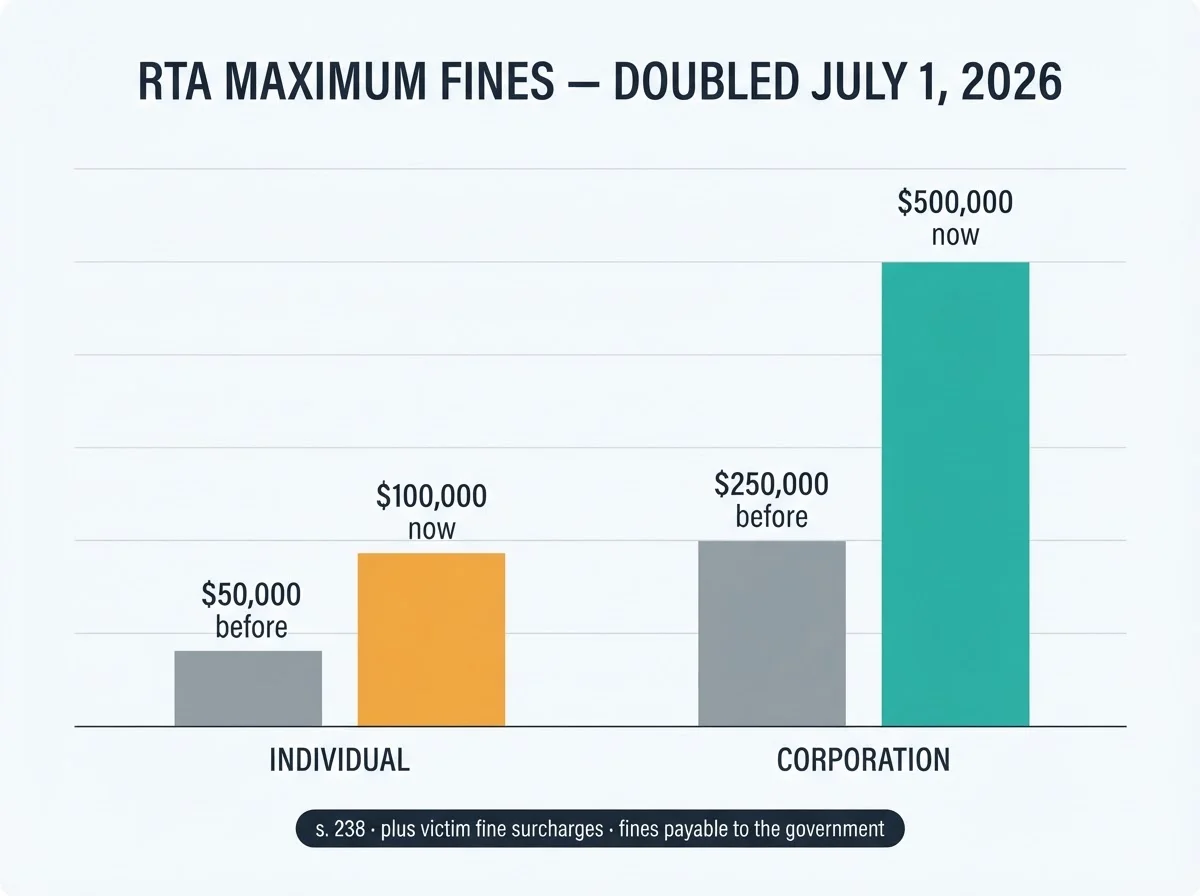
The policy logic behind the jump is the through-line of the whole 2026 package. Bill 60 made the system faster for landlords — the 7-day N4, tighter queues, quicker paths to possession. The doubled maximums are the other side of that bargain: speed for the compliant, a doubled cost of being wrong for everyone else. If your portfolio sits in a corporation, note that the ceiling that concerns you is now half a million dollars per conviction — and, as we'll see, incorporation shields the people behind it less than most assume.
What Actually Gets You Fined: The Offence Catalogue
Section 238 doesn't create offences — it prices them. The offences themselves run from section 233 onward, and the split that matters most for compliance is the mental element: some offences require the prosecution to prove you acted knowingly, and some don't.
The "knowingly" offences are the red lines most landlords already sense: changing locks without giving the tenant a key; giving false information in or about an eviction notice — the bad-faith N12 and N13 territory; recovering possession of a unit without following the RTA; harassing or threatening a tenant to make them leave; and withholding or interfering with vital services — heat, electricity, water. (Air conditioning, parking, and storage are not vital services, though cutting them invites other claims.)
The strict-liability offences need no intent at all — and this is where careful landlords get surprised: entering a unit illegally; failing to pay annual interest on the last month's rent deposit; refusing a rent receipt on request; collecting illegal charges like damage deposits or key money; failing to make an evicted tenant's property available for 72 hours; and denying the post-renovation right of first refusal (the subject of Deep-Dive #5 in this series). "I didn't know" is not a defence to these. Only routines are — the same routines covered in our guides to the 24-hour entry rule and the five things landlords can't do.

Two ancillary provisions round out the exposure. Attempting any of these offences is itself an offence under section 236. And section 237 delivers the corporate-veil surprise: every director or officer of a corporation who knowingly concurs in an offence is personally guilty — with the $100,000 individual maximum applying to them directly. For property management firms and incorporated portfolios, that turns compliance from a policy question into a governance one: the numbered company doesn't absorb this for you.
Who Enforces This — and How Often, Honestly
Here's the section the one-paragraph roundups never write. Ontario actually runs three separate penalty tracks, and they're chronically confused with one another:
- Prosecutions under s. 238 — investigated by the Rental Housing Enforcement Unit (RHEU) at the Ministry of Municipal Affairs and Housing, charged before a Justice of the Peace. Fines go to the government, not the tenant.
- LTB administrative fines — ordered by the Board inside tenant applications under Interpretation Guideline 16, reserved for "blatant disregard" of the RTA and payable to the Minister of Finance. These are rare: reporting found just 13 issued since 2020, most under $3,000.
- Tenant compensation — damages and abatements through T2 and T5 applications, payable to the tenant and stacking on top of either fine track.

Now the honest denominator. The RHEU receives roughly 18,400 calls a year, opens about 1,500 cases, sends around 200 to investigation — and fewer than one per cent end in a conviction. In 2023, the province's total was $121,800 in fines across 17 convictions: an average around $7,000, nowhere near even the old maximums. The old regime's poster child was a 2021 Cobourg case where a corporate landlord paid $1,500 for leaving a tenant without electricity for more than three months — a number tenant advocates cite, fairly, as the reason the ceilings needed doubling at all.

So why does the doubling matter? Four reasons. The rare cases that do proceed now have real headroom — a Justice of the Peace sentencing an egregious lockout campaign is no longer capped at numbers a large portfolio can shrug off. Practitioners expect the higher stakes to bring more active investigation. Every conviction is published — the Ministry has distributed conviction bulletins to local media since 2017, so the reputational fine arrives regardless of the dollar figure. And the tracks stack: the prosecution fine, the LTB fine, and the tenant's compensation can all flow from one incident.
The pattern enforcement actually targets is visible in the live 2026 example. Caran Properties Group Inc., a Toronto corporate landlord, served three N13 notices, lost all three applications at the Board — and then let construction begin anyway, displacing the tenant. Result: a guilty plea to unlawfully recovering possession, an $8,000 fine plus a $2,000 victim surcharge, and a published bulletin carrying the company's name. That is precisely the self-help instinct the new ceilings exist to price: losing at the Board and proceeding anyway.
The Compliance File That Keeps the New Numbers Theoretical
Reframe the whole topic for a moment: for a landlord who follows the sheriff-only rule and keeps the paperwork basics tidy, July 1 changed nothing. The exposure concentrates in exactly two places — self-help instincts under pressure, and strict-liability housekeeping nobody assigned to anyone.
The audit takes an afternoon: confirm annual interest is paid on every last month's rent deposit; issue rent receipts on request, same day, every time; strip anything resembling a damage deposit or key money from your move-in package; run entries on written 24-hour notice between 8 a.m. and 8 p.m., logged; never change a lock without new keys in the tenant's hands; treat heat, electricity, and water as untouchable through every dispute; keep evicted tenants' property available for 72 hours; and serve only notices whose statements you can prove — if a renovation termination is in play, the documentation duties and right of first refusal covered later in this series carry offence exposure of their own.

Then make it institutional. Train every superintendent and agent on the red lines and get a sign-off; put "sheriff only" in writing as policy; brief directors and officers on their section 237 exposure; and keep the defence file — dated notices, entry logs, repair records, communications — for at least two years past every tenancy, matching the charge-laying window. Between now and the fall, add one calendar entry: the Phase 2 changes arriving September 21, 2026 expand the adjacent compliance surface, and the remaining deep-dives in this series will cover them as they land.
Practical Takeaways
- Possession by sheriff only — always. After a dismissed application, after apparent abandonment, after everything: the 2026 conviction on the books is a landlord who proceeded after losing at the Board.
- Truthful notices only. False statements in or about an N12 or N13 are "knowingly" offences, with T5 compensation exposure besides.
- Run the strict-liability audit: deposit interest, receipts, no illegal charges, entry discipline, keys with every lock change — no intent required to convict on any of them.
- Vital services stay on through every dispute and every arrears file.
- Keep evicted tenants' property available for 72 hours.
- Train your people and paper your policies — their conduct is your exposure, and s. 240 means your records must be able to answer the prosecution's.
- Incorporated? Brief the board. Section 237 makes knowing concurrence personally punishable at the $100,000 individual maximum.
The authoritative references are ontario.ca's rental housing offences page and the RHEU's complaint process, plus LTB Interpretation Guideline 16 for the Board's own fines. For the wider 2026 picture, start with our Bill 60 landlord overview.
The RTA Compliance Audit: 20 Checks That Keep Ontario's Doubled Fines Theoretical
Run the one-afternoon audit, brief your team on the red lines, and know exactly what to do if enforcement calls. Free landlord PDF.
Get Free PDF →The Bottom Line
The ceilings doubled; the offences didn't change. Enforcement remains a narrow funnel — but the cases that get through are published, the penalty tracks stack, and the conduct that attracts them is unambiguous: improvised possession, lockouts, cut services, and false notices. Against a $100,000 personal and $500,000 corporate ceiling, the entire cost of compliance is an afternoon's audit, a one-page staff memo, and the discipline to let the sheriff do the one job only the sheriff can do. This is general information, not legal advice — if the RHEU has contacted you or a charge is live, speak to a licensed paralegal or lawyer before your next step.
Make the Compliance File Automatic
Tenon10 generates correct notices, logs entries and communications with dates attached, and keeps every tenancy's records organized — so your defence file exists before you ever need one.
Free • No signup required • Updated for the Bill 60 changes in force 21 Sep 2026
Frequently Asked Questions
What are the maximum RTA fines in Ontario now?
As of July 1, 2026, up to $100,000 for an individual and $500,000 for a corporation per conviction, under section 238 of the RTA — double the previous maximums. Victim fine surcharges are added on top.
Did Bill 60 double the fines?
Technically, no — the amendment was carried by Bill 97 (2023) and proclaimed into force on July 1, 2026, the same day as several Bill 60 changes. Because the packages landed together, coverage commonly bundles them as one set of reforms.
Do RTA fines go to the tenant?
No. Fines from prosecutions are payable to the government, and the LTB's administrative fines go to the Minister of Finance. Tenants pursue compensation separately through T2 or T5 applications — and that compensation can stack on top of either fine.
Can a landlord go to jail for an RTA offence?
No. RTA offences are provincial offences, not crimes — a conviction means a fine (plus surcharge) and no criminal record. The non-monetary consequence is publication: the Ministry publishes conviction bulletins to local media.
Who investigates landlords in Ontario?
The Rental Housing Enforcement Unit at the Ministry of Municipal Affairs and Housing. It resolves most complaints at the compliance stage without any application process; unresolved cases can proceed to investigation and charges before a Justice of the Peace. The LTB separately handles tenant applications and its own administrative fines.
Do I have to intend to break the law to be convicted?
Not always. Offences like illegal entry, unpaid interest on the last month's rent deposit, refused rent receipts, and collecting illegal charges are strict liability — the prosecution doesn't need to prove intent. The "knowingly" standard applies to offences like lockouts, false eviction notices, and harassment.


