

Updated September 3, 2026: this guide has been fully rewritten for the confirmed September 21 effective date and O. Reg. 240/26 — the 60-day move-in deadline arriving the same day as the 120-day path.
From September 21, 2026, Ontario's own-use N12 has two prices. The one every landlord knows: at least 60 days' notice plus one month's rent in compensation. And the new one, under s.48.1(2) of the Residential Tenancies Act: give at least 120 days' notice, ending on the last day of a rental period, and the compensation doesn't apply — trade the cheque for the calendar.
But the province priced the discount in scrutiny, and the same proclamation day delivers the other half of the bargain: under O. Reg. 240/26, the person named in the notice must actually move in within 60 days, or the law presumes bad faith and leaves you to prove otherwise. This guide is the whole decision — who the waiver covers, the serve-date gate that decides which price applies, when each path genuinely wins, and the discipline the new presumption demands — from all four chairs at the table. This is general information, not legal advice. As of September 3, 2026.
The 120-Day N12 Planner
Both paths against your own numbers — the serve-date gate, the date math, and the new 60-day move-in checklist with its evidence file. Two pages, free.
The two paths — same N12, same last-day rule
The standard path is today's default, and it survives September 21: at least 60 days' notice, a termination date on the last day of a rental period or fixed term, and one month's rent in compensation paid before the termination date — or an acceptable alternative unit offered instead. One practice note worth knowing: some Board decisions have tolerated compensation paid late while the tenant remains, but unpaid compensation risks the application being dismissed outright. Treat the deadline as real.
The 120-day path exists only for own-use N12s served on or after September 21, 2026: at least 120 days' notice, the same last-day rule, and no compensation. The form is the same N12, and every other requirement is untouched. The trade, stated plainly: sixty extra days for one month's rent — and the rest of this guide is when that trade wins, and what it never buys.
Count the notice period properly on either path. It runs from the day after service; mailbox or under-door service is effective five days after you leave it, so the 60 or 120 days count from the effective service date, not the drop date; and because the termination date must land on a period or term end, the calendar rounds up — sometimes by most of a month. In practice, "120 days" usually means four-and-a-bit months.
The serve-date gate: which price applies to your notice
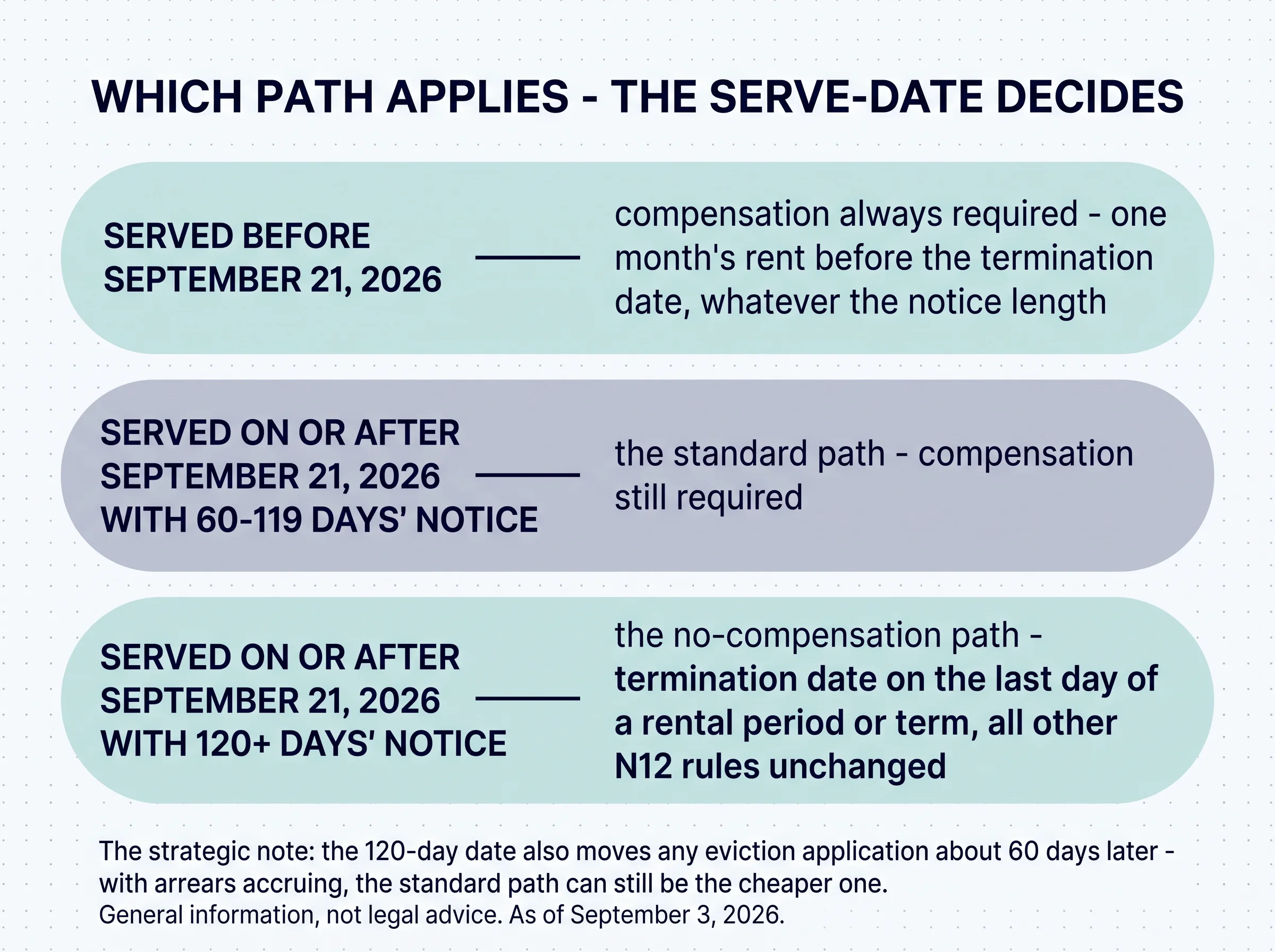
Three rows decide everything, and the gate reads only two facts — the serve date and the notice length. Served before September 21, 2026: compensation is always required, whatever the notice length. Served on or after September 21 with 60–119 days: the standard path — the month is still owed. Served on or after September 21 with 120 or more days: the no-compensation path.
Who the waiver covers — and who it doesn't
The own-use path belongs to a specific list: the landlord, the landlord's spouse, a child or parent of the landlord or their spouse, or a caregiver for one of them — genuinely moving in. The new subsection lives in s.48.1, the own-use compensation section, and that placement is the answer to the question circulating in fast coverage: purchaser N12s are not included. When a landlord serves because a buyer or the buyer's family will move in, the compensation lives in its own section — s.49.1 — and it is unchanged: budget the month as before. The purchaser lane's own gate stands too: a signed agreement of purchase and sale before service, or the notice is invalid. Some sources read the waiver more broadly; when sources conflict about money, the conservative reading is the one you can't be burned by.
And one boundary never moves: a corporation can never claim own use. If the landlord on the lease is a corporation, there is no s.48 path at any notice length — the human shareholders' plans don't transfer to the company's notice.
New the same day: the 60-day move-in rule (O. Reg. 240/26)

On July 21, 2026, Ontario filed the other half of the September 21 bargain. Under O. Reg. 240/26, the person named in the N12 — the landlord, the family member, or the purchaser, whichever the notice names — must actually move in within 60 days, and missing the window raises a rebuttable presumption of bad faith: the burden becomes the landlord's to displace at the Board. "Within a reasonable time" is no longer the standard; the reasonable time now has a number. (One digit worth double-checking in anything you read or file: O. Reg. 240/26 is this rule — its neighbour, 241/26, is the same day's persistent-late-payment test. One digit apart, two different laws.)
The 60-day clock has two starting points. If the tenant vacates on or before the termination date in the notice, the clock runs from the termination date. If the tenant leaves later, it runs from the day they actually vacate. Notice the subtle trap in the first row: if the tenant left on time, the clock may already be running before you have keys in hand.
The discipline that answers it: evidence the move-in as it happens — utilities in the occupant's name, the driver's-licence and CRA address changes, dated photos of the move, the first months' pattern of actual occupation. The presumption flips the burden; a contemporaneous file flips it back. And read the two September 21 rules together, because the design is visible: the own-use N12 got cheaper and more scrutinized in the same breath — a discount priced in scrutiny.
The decision: when each path wins
The 120-day path wins when the move was planned months out anyway — a closing date, a family member arriving on a known timeline — because the path pays you a month's rent for patience already in the plan; when the tenancy is current, with nothing accruing while you wait; and when the saved month is real money kept. The standard path still wins when arrears are accruing — sixty extra days of unpaid rent can cost more than the month you save; when the need is soon and the earlier termination date beats the cheque; and when hearing timing matters, because the later termination date also pushes any L2 filing and hearing roughly two months later.
Worked through, illustratively: on a $2,800 unit, the 120-day path keeps $2,800 and delays possession about two months — a clear win with a current tenant and a planned move. Run the same unit with two months of arrears already accruing, and the "saved" month evaporates into unpaid rent before the longer notice even expires. The math is your tenancy's, not the province's.
What the long notice never buys
Every guardrail survives both paths. Good faith: the person named must genuinely intend to occupy the unit as their primary residence for at least twelve months — our complete N12 guide walks the requirement end to end. The paperwork: the affidavit or declaration of the person moving in, and the two-year disclosure of prior N12 and N13 use, both filed with the L2 — the Board rejects applications missing either. The tenant's position: the tenancy ends only by agreement, the tenant leaving, or a Board order — never the notice alone — and a tenant who suspects bad faith has the T5 remedy for twelve months after moving out, as our bad-faith N12 guide covers.
One practitioner point on the tenant side: an N12 opens the tenant's early exit — an N9 on ten days' notice once an N12 is in hand — and the prevailing practitioner view is that the landlord's notice-attached obligations aren't erased by the tenant leaving early. Plan the money accordingly on the standard path.
For landlords — the move-in evidence file: Utilities in the occupant's name, the licence and CRA address changes, dated photos of the move, the first months' pattern of actual occupation — assembled as it happens, never reconstructed at a hearing. Start the file the day the tenant hands back the keys — the 60-day clock is already running, and may have started at the termination date, before the keys.
For tenants — reading a 120-day N12: The longer notice changes the money, not your rights. The person named must still genuinely move in — and from September 21, must arrive within 60 days of your leaving, or bad faith is presumed in your favour. Keep the notice and note who it names; if the unit reappears for rent or sits empty past the deadline, the T5 window runs twelve months from your move-out. And if you're served with 60–119 days' notice on or after September 21, the month's compensation is still owed to you.
Practical takeaways
- From September 21, 2026, an own-use N12 with 120+ days' notice ending on a period's last day owes no compensation — the serve-date gate decides which price applies.
- Before that date, or at 60–119 days, the month is owed as always — paid before the termination date.
- The waiver is the own-use path's: purchaser N12s budget compensation under s.49.1 as before, and corporations never have an own-use path.
- The same day tightens the honesty test: the person named must move in within 60 days of vacancy or bad faith is presumed — and the clock can start at the termination date, before you have keys.
- The trade is real both ways: arrears and hearing timing can make the shorter path cheaper than the saved month.
- Either path: good faith, the affidavit, the disclosure, the last-day rule, and the Board-order-only ending are unchanged.
The 120-Day N12 Planner
The serve-date gate, your numbers, the date math, and the 60-day move-in checklist with both clock-start rows — two pages.
The cheque or the calendar
Choose with the gate, the scope, and the presumption in view. Serve on the right side of September 21 at the right notice length; budget the purchaser lane as if nothing changed, because for compensation nothing did; write the path choice into the file the day you serve; and build the move-in record as it happens — because the day the discount arrives, so does the deadline that tests it. The rest of the September 21 wave — the 7-day N4, the persistent-late test, the renoviction documentation duties — is mapped in our Bill 60 and Bill 97 guide. As of September 3, 2026 — confirm the provisions on e-Laws at use. This is general information, not legal advice.
Serve the right notice for the rules in force
Tenon10 generates current Ontario notices, validates termination dates against the rules in force, and keeps the file with the tenancy.
Free • No signup required • Bill 60 aware
Related resources
- Ontario N12 Notices: The Complete Guide — the whole own-use framework.
- Bad-Faith N12: How the LTB Decides — the tenant's remedy and the landlord's exposure.
- The 7-Day N4 — the wave's other headline.
- Bill 60 & Bill 97: The Complete Guide — every September 21 change, mapped.
Frequently asked questions
Do I still have to pay N12 compensation after September 21, 2026?
On the own-use path, not if the notice is served on or after that date with at least 120 days' notice ending on a rental period's last day. With 60–119 days — or any notice served before the date — the month is owed as always, before the termination date.
Does the 120-day waiver apply to purchaser N12s?
Treat it as own-use only: purchaser compensation lives in its own section, s.49.1, which is unchanged — budget the month, get the agreement of purchase and sale signed before serving, and take specific advice before assuming otherwise.
What happens if the person named doesn't move in within 60 days?
From September 21, 2026, a rebuttable presumption of bad faith arises under O. Reg. 240/26 — the landlord must then prove the eviction was genuine. The clock runs from the termination date if the tenant left on or before it, or from the actual move-out date if later. Keep move-in evidence as it happens.
Can I pick any termination date 120 days out?
No — the date must land on the last day of a rental period or fixed term, counted from the day after service (mailbox or under-door service adds five days). The calendar rounds up, sometimes by most of a month.
Does long notice prove good faith?
No. The 120-day path skips the cheque, never the test: the person named must genuinely intend to live in the unit as their primary residence for at least twelve months — and now must actually arrive within 60 days of the tenant vacating.


