

The landlord said his daughter needed the unit. The tenants — eleven years in the same apartment — packed up and left. Seven days later, the unit was on a listing site at $525 more per month. What happened next is the part most landlords don't know and most tenants don't believe: Ontario law presumed the eviction was in bad faith, the burden of proof flipped onto the landlord — and the order came to $14,673.68.
Own-use evictions run on a promise the tenant can't verify at the time. The T5 application is how the law audits that promise afterward — with a presumption that turns public rental listings into evidence, a remedy stack that can exceed a year's rent without a single receipt, and honest defences that work only if they're documented. Tenants under-claim it; landlords underestimate it; property managers inherit its paperwork. This guide covers the genuine-intention test (and what it does not require), the 12-month presumption and burden flip, the full remedy stack with the three penalty figures people confuse kept straight, and both sides' playbooks. Lane placement: our N12 guide covers the notice itself, and the T1 covers unpaid compensation — this is the bad-faith determination. General information, not legal advice.
The T5 Bad-Faith Evidence Kit: What to Do the Day You Hand Back the Keys
If your old unit is re-listed within 12 months of an N12 move-out, Ontario law presumes bad faith — and the landlord must prove otherwise. This free kit walks the two dates to diarize, the monthly screenshot ritual, the full remedy stack (including the no-receipts compensation worth up to a year's rent), and what to lead with at the hearing.
Get Free PDF →The Test: Genuine Intention, Measured at Notice Time
"Bad faith" has a precise legal meaning here, built over thirty years of case law — Feeney v. Noble (1994), Salter v. Beljinac (2001), Fava v. Harrison (2014, Divisional Court). The question is assessed at the time the N12 was given, and it has two parts: did the landlord genuinely intend the named person would occupy the unit — and did the named person genuinely intend to move in?
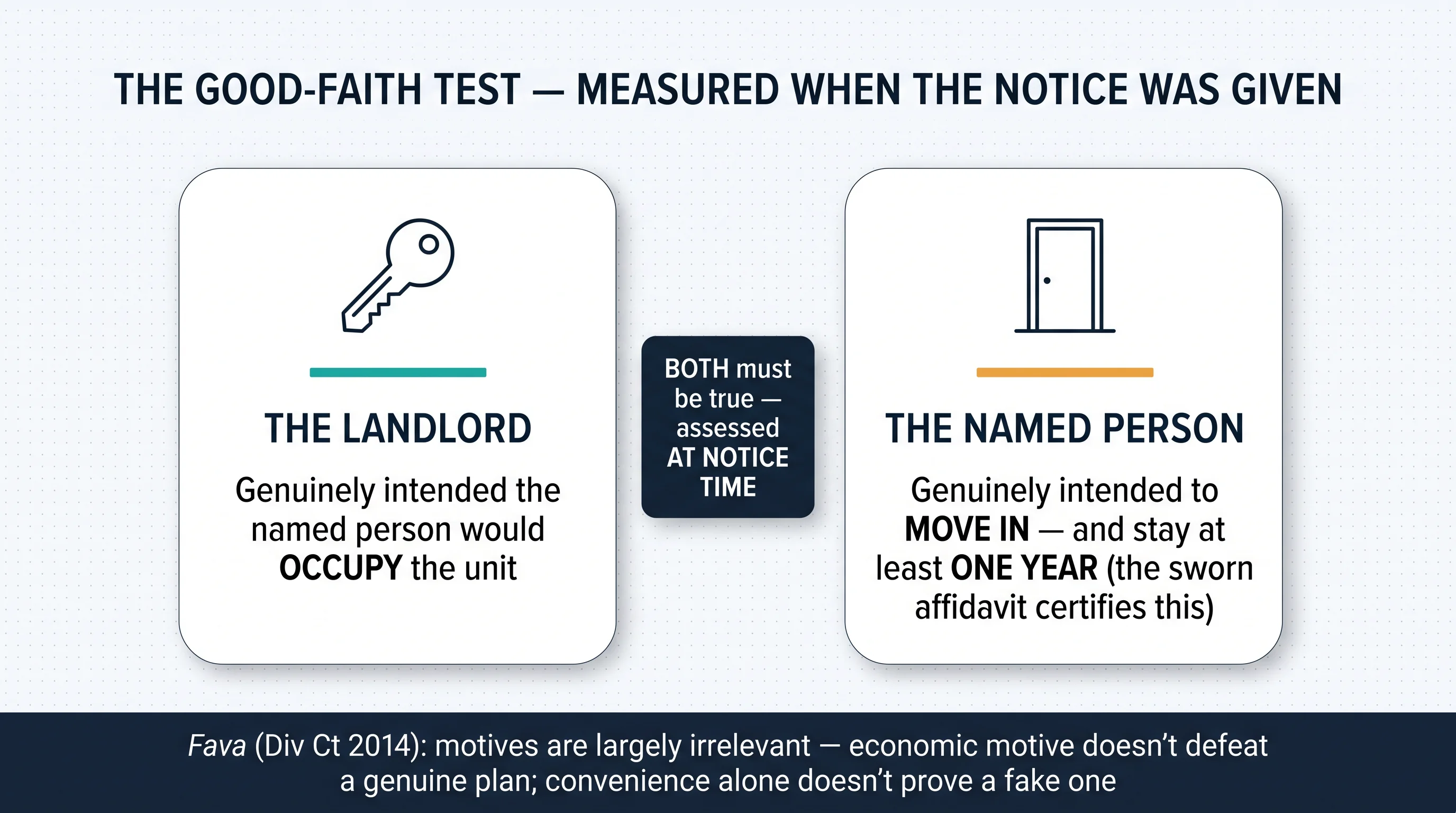
Now the balance point that both sides of the hearing room routinely misread. Fava held that motives are largely irrelevant. A landlord can have economic motives alongside a genuine plan to reside — the law doesn't ask whether moving in was their smartest financial decision. And a tenant can't win merely by showing the eviction was financially convenient for the landlord. The question is the sincerity of the occupancy plan, full stop. Intent is subjective, but the Board infers it objectively: the named person's testimony, the landlord's prior N12/N13 history (the Board's own guideline says past notices and occupancy patterns count), and — critically — events after the notice. The named person is expected to genuinely intend at least one year's occupancy; that's precisely what the sworn affidavit certifies, and three months in followed by a re-rental is itself evidence of bad faith. Who can bring the audit: former tenants who vacated on an N12 (landlord's own use, or a purchaser's) or an N13, filing the T5 within one year of moving out — $48 on the portal.
The Presumption: When the Burden Flips
Here is the machinery that decides most modern cases. Under s. 57(5)–(6), if within 12 months of the tenant vacating the landlord advertises the unit for rent, re-rents it, advertises the complex for sale, demolishes it, or takes renovation steps inconsistent with the claimed use — bad faith is presumed. The tenant no longer has to prove the promise was false; the landlord must now prove it was true, on a balance of probabilities.
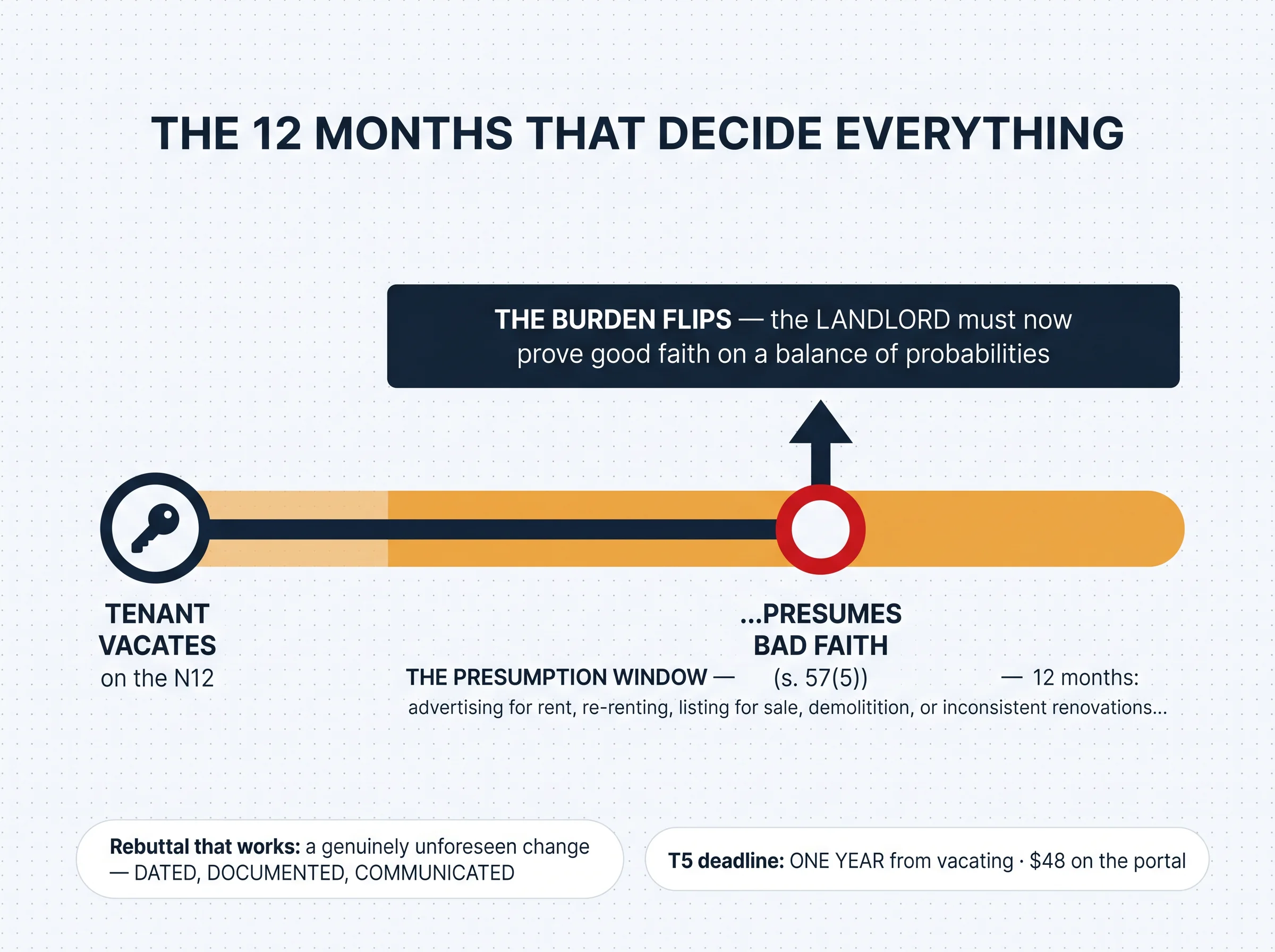
Watch it work in the case from our opening. Eleven-year tenancy; N12 for family; the unit re-listed within a week at +$525 a month. Presumption engaged. The landlord's explanation didn't hold, and the order assembled piece by piece: the rent differential, the moving costs, the children's added school-travel costs, lost wages for packing an eleven-year home in two weeks, and general damages — $14,673.68. In another order, the Board priced its fine off the landlord's expected gain: $525 × 12 = $6,300 of intended benefit became the deterrence yardstick. The market-rent gap that motivates a bad-faith N12 is exactly what the Board knows how to measure.
Now the other side of the coin, because it deserves equal weight: the honest defence exists. A landlord serves an N12 for his mother; two weeks after the tenant vacates, she suffers a stroke and enters long-term care. The landlord documents the diagnosis date, notifies the former tenant in writing, and only then re-rents. At the T5, the re-rental engages the presumption — and the dated, documented, communicated change rebuts it. A genuinely unforeseen change of circumstances is a complete answer. But notice what it looks like: paperwork. An unexplained pivot followed by a listing is the case against you; the same pivot, dated and communicated, is the defence. And one subtlety for both sides: an intention that quietly changed before the tenant even moved out, never communicated, grounds the remedy too.

The Remedy Stack — and the Three Penalties People Confuse
The T5's remedies stack, and the biggest one needs no receipts. The menu: (1) the rent differential — [new rent − old rent] × 12 months; (2) general compensation up to 12 months of your last rent, available "regardless of whether the former tenant has incurred any actual expenses" — the most under-claimed remedy on the form (on a $2,200 unit, that ceiling alone is $26,400); (3) moving and storage costs; (4) abatement of rent you paid; and (5) any other order — including one almost nobody knows exists: the Board can order the former tenant back into the unit if it hasn't been re-rented.
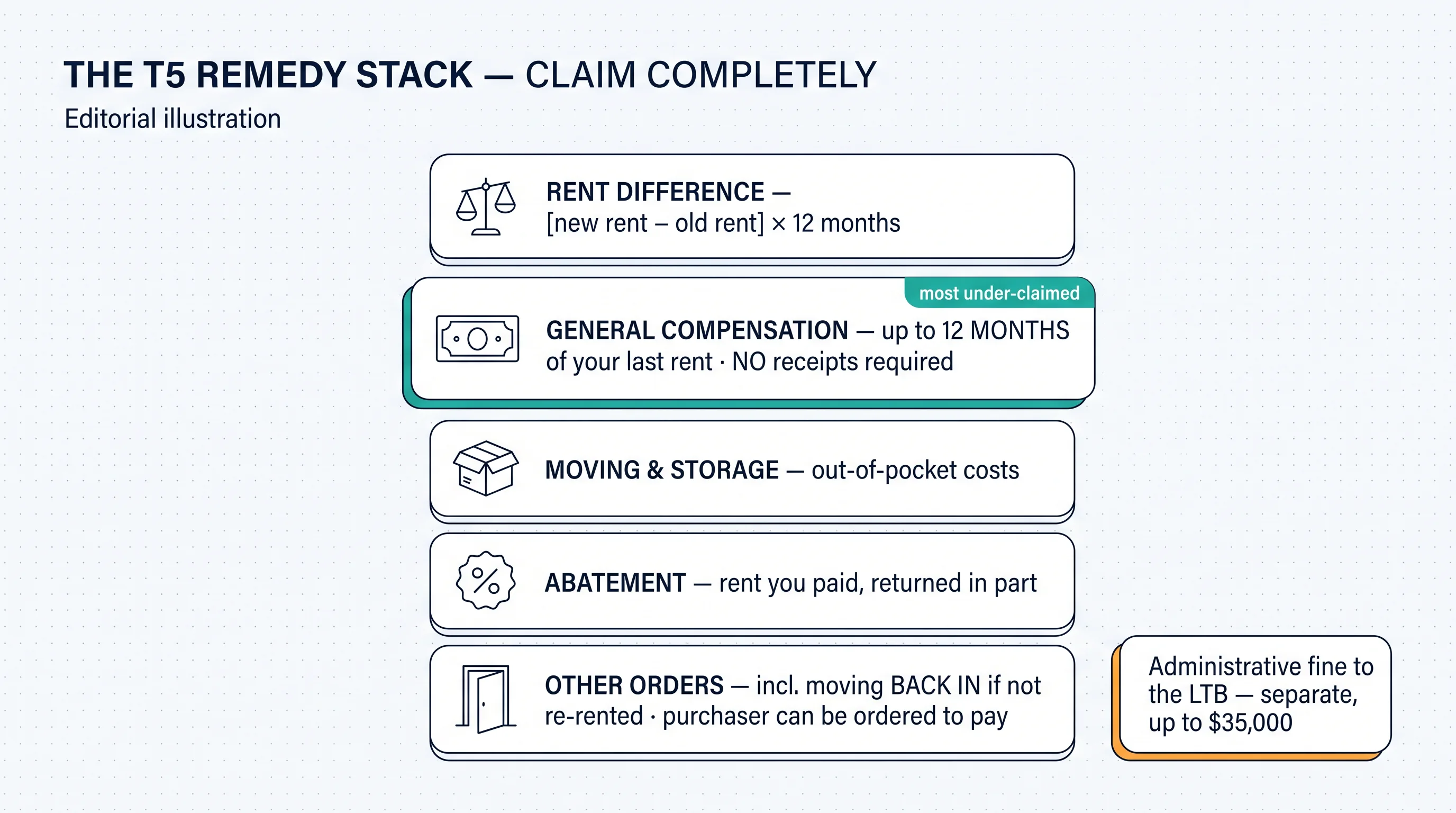
Then there are the penalties — three different figures that get blurred constantly, so here they are kept straight. Compensation (the differential, the general compensation, the moving costs) is paid to the tenant. The administrative fine is paid to the LTB — up to the greater of $35,000 or the Small Claims ceiling; the $10,000 figure still floating around older commentary is stale. And prosecution fines — up to $50,000 for individuals and $250,000 for corporations, with maximums rising under Bill 60 as covered in our Bill 60 guide — are a separate provincial-offence lane entirely. Different payers, different payees, different proceedings.

Three wrinkles complete the picture. On purchaser N12s, the purchaser goes on the Schedule of Parties — the hearing may not proceed without them noticed — and the Board can find the landlord, the purchaser, or both liable; sellers and buyers share the exposure. The renoviction lane: an N13 tenant who gave written notice to reoccupy after the repairs, and was never offered the unit back, has their own T5 reason. And the under-claim: tenants routinely win on liability and ask only for moving costs, leaving the no-receipts remedy — five figures on most rents — on the table. Ask completely. One lane check while you do: the one-month N12 compensation that was never paid is the T1's job, not the T5's.
Both Playbooks — and What's Coming
For landlords and the property managers who run their files, the compliance stack is short and unforgiving. The sworn affidavit from the person moving in — certifying a genuine need of at least one year — is filed with the L2; the Board won't take the application without it. The two-year disclosure lists every N12 and N13 the landlord served in the past two years, any unit — omission sinks the application. Compensation is paid by the termination date, or the 120-day/$0 route from our Bill 60 and Bill 97 coverage is used deliberately. The named person moves in promptly, with occupancy you can prove — utilities, licence, mail. And the golden rule: if plans change, date it, document it, and tell the former tenant in writing before re-renting. For PMs specifically: affidavit custody, disclosure accuracy, and service proofs are your deliverables regardless of whose intention it is — calendar the client's 12-month occupancy commitment like a compliance deadline, because that's what it is.
Tenants keep three counter-moves in reserve: after receiving an N12, you can leave early on 10 days' written notice (N9); you can stay put and test good faith at the L2 hearing — where the Board retains discretion to refuse or delay eviction even against a technically perfect case; and the T5 waits a full year afterward. Looking ahead: Bill 60's 120-day/$0 compensation route will likely raise N12 volume, which means the post-vacancy window draws more T5 scrutiny, not less — and the affidavit-at-filing practice is tightening the paper trail on both sides. The promises are getting sworn earlier; the audits are getting easier to run.
Practical Takeaways
For tenants:
- Diarize two dates the day you hand back the keys: the 12-month presumption window and the one-year T5 deadline.
- Run the monthly listing check — dated screenshots with URLs.
- Claim the full stack, especially the no-receipts general compensation.
- On purchaser N12s, name the purchaser on the Schedule of Parties.
- Route unpaid one-month compensation through the T1, not the T5.
For landlords:
- Paper the occupancy plan before serving — affidavit early, two-year disclosure ready.
- The named person moves in promptly and stays the year, with provable occupancy.
- If circumstances genuinely change: document the date and reason, and notify the former tenant in writing before any re-rental.
- Never list, sell, or renovate inside the 12-month window without that documented explanation.
For property managers: treat affidavit custody, disclosure accuracy, and service proofs as your deliverables regardless of whose intention it is — and calendar the client's 12-month occupancy commitment like the compliance deadline it is.
The T5 Bad-Faith Evidence Kit: What to Do the Day You Hand Back the Keys
If your old unit is re-listed within 12 months of an N12 move-out, Ontario law presumes bad faith — and the landlord must prove otherwise. This free kit walks the two dates to diarize, the monthly screenshot ritual, the full remedy stack (including the no-receipts compensation worth up to a year's rent), and what to lead with at the hearing.
Get Free PDF →The Bottom Line
The own-use eviction is a promise, and the T5 is the audit. The test is sincerity at notice time — motives are largely irrelevant, in both directions. The presumption makes the post-vacancy year the most legally consequential twelve months in that unit's life: public listings become exhibits, and the burden lands on whoever made the promise. The remedies can exceed a year's rent without a single receipt; the defences are real but live or die on dated paperwork. Both sides win the same way — by writing things down. General information, not legal advice; for a live dispute, a community legal clinic, licensed paralegal, or lawyer is worth the conversation. Next in this series: "substantial interference" — the vaguest phrase in the RTA, and how the Board actually applies it.
Promises on Paper, From Day One
Tenon10 keeps notices, affidavits, compensation records, and every critical date organized from the moment an N12 is drafted — so whichever side of the audit you're on, the file is already built.
Free • No signup required • Updated for the Bill 60 changes in force 21 Sep 2026
Frequently Asked Questions
What happens if my landlord re-rents after an N12?
If it happens within 12 months of you vacating, the law presumes the N12 was given in bad faith — and the burden shifts to the landlord to prove otherwise. File a T5 within one year of moving out; remedies include the rent difference for a year, general compensation up to 12 months of your old rent, moving costs, and an administrative fine.
How much compensation can I get for a bad-faith eviction in Ontario?
The stack adds up: the difference between your new and old rent for 12 months, general compensation up to 12 months of your last rent (no receipts required), moving and storage costs, and abatement of rent you paid. In one real order, a re-listing a week after move-out produced $14,673.68 — and the Board can separately fine the landlord up to $35,000.
How long does the landlord or their family member have to live in the unit after an N12?
The named person must genuinely intend to occupy for at least one year — that's what the sworn affidavit certifies. Moving in briefly and re-renting within the year is itself evidence of bad faith, and re-listing within 12 months of the tenant vacating triggers the presumption.
Can I move back in after a bad-faith eviction?
Possibly. Among the T5's remedies, the Board can order that you be allowed back into the unit if it hasn't already been rented to a new tenant — and N13 renoviction tenants who gave written notice to reoccupy have their own T5 reason when the unit was never offered back.
How do I prove my landlord evicted me in bad faith?
Often you don't have to — the re-listing does. Keep the N12 and all communications, diarize your move-out date, screenshot rental listings monthly with dates, and note signs of occupancy (or its absence). Inside the 12-month window, advertising or re-renting presumes bad faith and makes the landlord explain.
What if the landlord's plans genuinely changed after I moved out?
That defence is real: a genuinely unforeseen change — a job transfer, a health crisis, a collapsed purchase — can rebut the presumption. But the Board expects proof: when it happened, why it was unforeseeable, and ideally that the landlord communicated it in writing before re-renting. An unexplained pivot followed by a listing is the case against them.


