

Somewhere in Ontario today, the same eleven words will be quoted in three different disputes: by a landlord evicting a tenant whose parties won't stop, by a tenant whose landlord keeps "dropping by," and by a tenant whose landlord shrugs at the neighbour's 2 a.m. noise. "Substantially interfered with the reasonable enjoyment" is the Residential Tenancies Act's vaguest phrase — and its busiest.
The vagueness is the design. The phrase is a standard, not a rule, and the Board has spent twenty-five years drawing its lines through two Divisional Court pillars: Ball v. Metro Capital (2002), the case that voids more eviction notices than any other, and Hassan v. Niagara Housing Authority (2000), the case that makes landlords answer for neighbours they never bothered to deal with. Everyone in the triangle misunderstands at least one edge of it. This guide covers the three directions the phrase cuts, the regular-vs-substantial threshold with real findings, Ball's particulars doctrine (and why a defective notice can never be fixed), the 7-day void as strategy, Hassan's triangle with the reasonable-steps ladder, and the T2's remedy menu. Arc placement: our bad-faith N12 guide covered the good-faith standard; this is the interference standard; the N5 guide owns the notice mechanics. General information, not legal advice.
The Substantial Interference Playbook: One Standard, Three Sides, All the Paper
Ontario's busiest legal phrase cuts three directions — the landlord's N5, the tenant's 7-day void, and the T2 back. This free playbook covers every corner of the triangle: the complaint log that wins Hassan claims, the Ball-proof notice test, the void-window traps, and the T2's full remedy menu.
Get Free PDF →One Phrase, Three Directions — and the Threshold That Filters Everything
Start with the symmetry, because it explains why everyone gets this wrong from at least one angle. Section 64 makes the phrase the landlord's sword: the N5 can be served when a tenant's conduct — or an occupant's, or a guest's — substantially interferes with the reasonable enjoyment, or another lawful right, privilege or interest, of the landlord or another tenant. The first N5's mechanics make it the tenant's shield: a 7-day void window — stop the conduct within seven days of receiving the notice, and the notice dies (a second N5 within six months has no void window, and the landlord can file the L2 immediately). And section 22 makes it the tenant's sword back: the T2 aims the identical standard at landlord conduct. Same words, three blades. One variant worth knowing: a landlord who lives in a building of three or fewer units has a faster s. 65 lane for conduct interfering with the landlord — 10 days, no void window.

In every direction, the modifier does the work: the interference must be substantial — more than the ordinary friction of shared walls. The lens is objective: what would a reasonable person experience, not the most sensitive occupant or the most defensive respondent. Frequency and severity both count — persistent moderate conduct and a single severe incident can each qualify. What has the Board actually found substantial? Second-hand smoke at volumes genuinely affecting a neighbouring tenant. Hoarding that created a fire hazard. Refusing to prepare a unit for pest-control treatment. Bolting structures to the building's exterior. Even balcony clutter that cost the landlord its insurance quote — interference with a financial interest counts. And the other side of the line, stated kindly: footsteps, plumbing, children playing, the occasional gathering — shared buildings have sounds, and annoyance alone is not a ground. That's also how smoke disputes reach the Board even without a lease clause (our smoking policies guide covers the clause side): the question is volume and impact, not the habit.
Ball v. Metro Capital: The Case That Voids More Notices Than Any Other
In 2002, a landlord served an N5 alleging the tenant had "harassed building staff and office employees to the point of inhibiting them from performing their daily duties." No dates. No times. No described incidents. The Divisional Court voided the notice and dismissed the eviction — and gave the instruction the Board has quoted ever since: particulars "should include dates and times of the alleged offensive conduct together with a detailed description of the alleged conduct."
Understand why, because it's fairness, not technicality — and it protects both sides of the room. A tenant facing eviction must know the case to meet. But more than that: because a first N5 is voidable, the tenant must know exactly what to stop. A vague notice functionally strips the void right. And the rule has teeth: a defective N5 cannot be cured — not by amendment, not by later disclosure. As a 2021 order put it, "at the hearing it is simply too late." The fix is drafting, not disclosure.
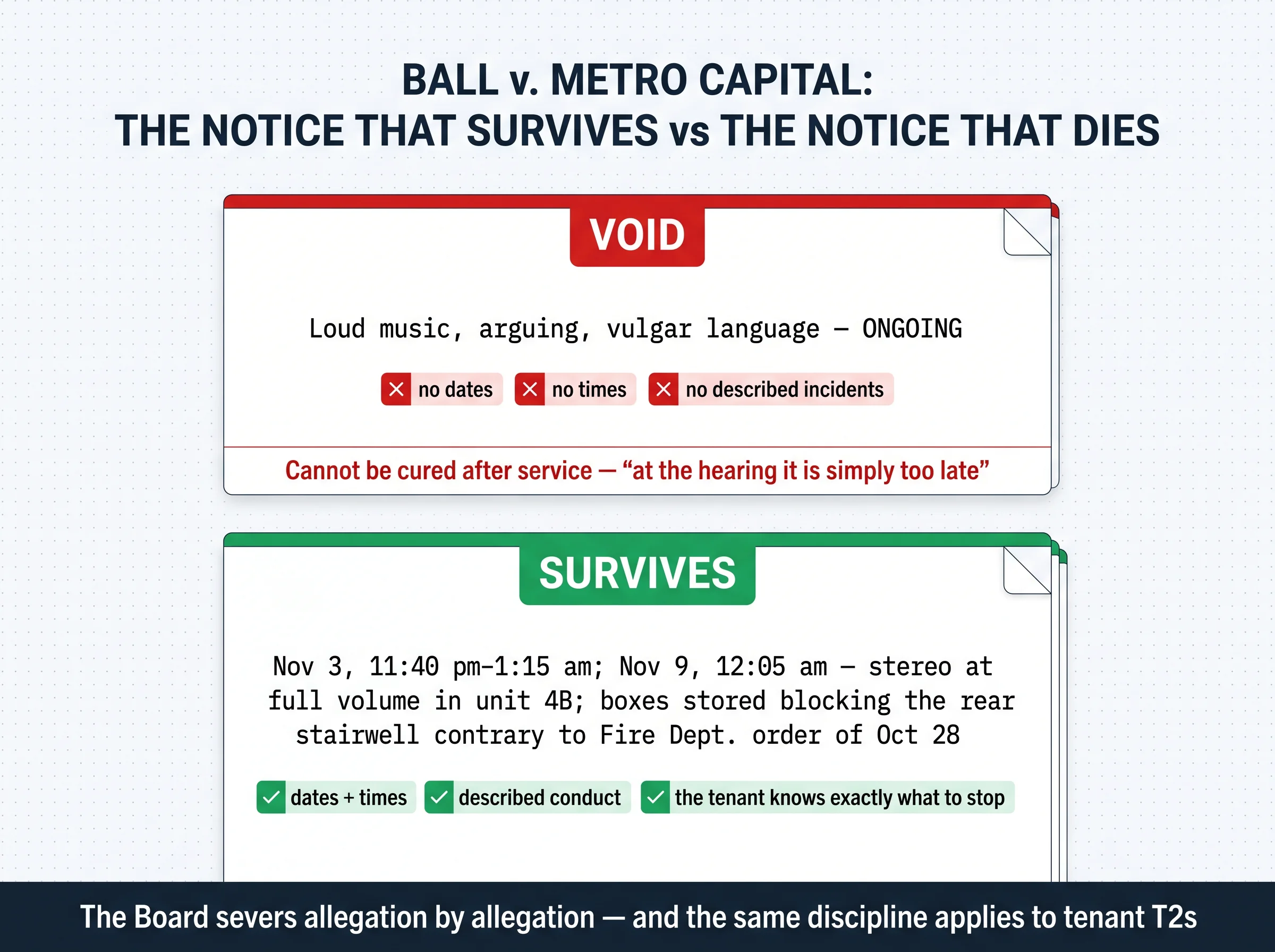
Watch the Board apply it, allegation by allegation, inside a single real notice. One N5 alleged "loud music, arguing loud, using vulgar language" with the dates and times listed as "ongoing" — struck for insufficiency. The same notice's other allegation — storage blocking a stairwell contrary to the fire department's instructions, with particulars — survived and carried the case. That's the severance practice: vague allegations die individually while detailed ones live, which means one sloppy line doesn't sink a notice, but no sloppy line ever wins. The nuance is preserved too — the Court said "should," not "must," and the ultimate question is whether a reasonable person understands the notice and their options; a long history between the parties has saved imperfect wording, and damage discovered after the fact may lack exact times. But nobody should draft to the exception.

Now the shield in action. An N5 for hoarding that blocked pest treatment; the tenant cleared access within seven days — notice void, tenancy survives, and the Board noted that "admittedly annoying" conduct is not the same as substantial interference. That's the void window working as designed: for the tenant it kills the notice; for the landlord it is the compliance the notice demanded, with the six-month window standing guard. And one trap from a real file: a first N5 served on the 13th (void window running to the 20th), and a second N5 built on an incident from the 19th — inside the first notice's void window. The landlord's own documents defeated the second notice. Ball levels in both directions, too: the same particulars discipline strikes unparticularized tenant T2 allegations. Dates, times, description — the universal currency, exactly the evidence habit our T6 guide preaches for maintenance files.
Hassan's Triangle: When Your Neighbour's Noise Becomes Your Landlord's Problem
The second pillar answers the question tenants ask most: "My landlord won't do anything about my neighbour — what can I do?" In Hassan v. Niagara Housing Authority (2000), a family suffered repeated harassment by a neighbouring tenant's children — verbal and physical abuse, property damage — and their written complaints escalated for months. The Tribunal dismissed their claim because the landlord hadn't intended any interference. The Divisional Court reversed: no intent is required. In the sentence every property manager should memorize: "It is not that the other tenant's actions are imputed to the landlord — rather, the landlord's legal responsibility to provide quiet enjoyment gives rise to the responsibility to take reasonable steps to correct the intrusion." The question is never whether the neighbour substantially interfered. It's whether the landlord, through inaction, did. That doctrine is cited in more than 76 Board rulings — it's everyday law.
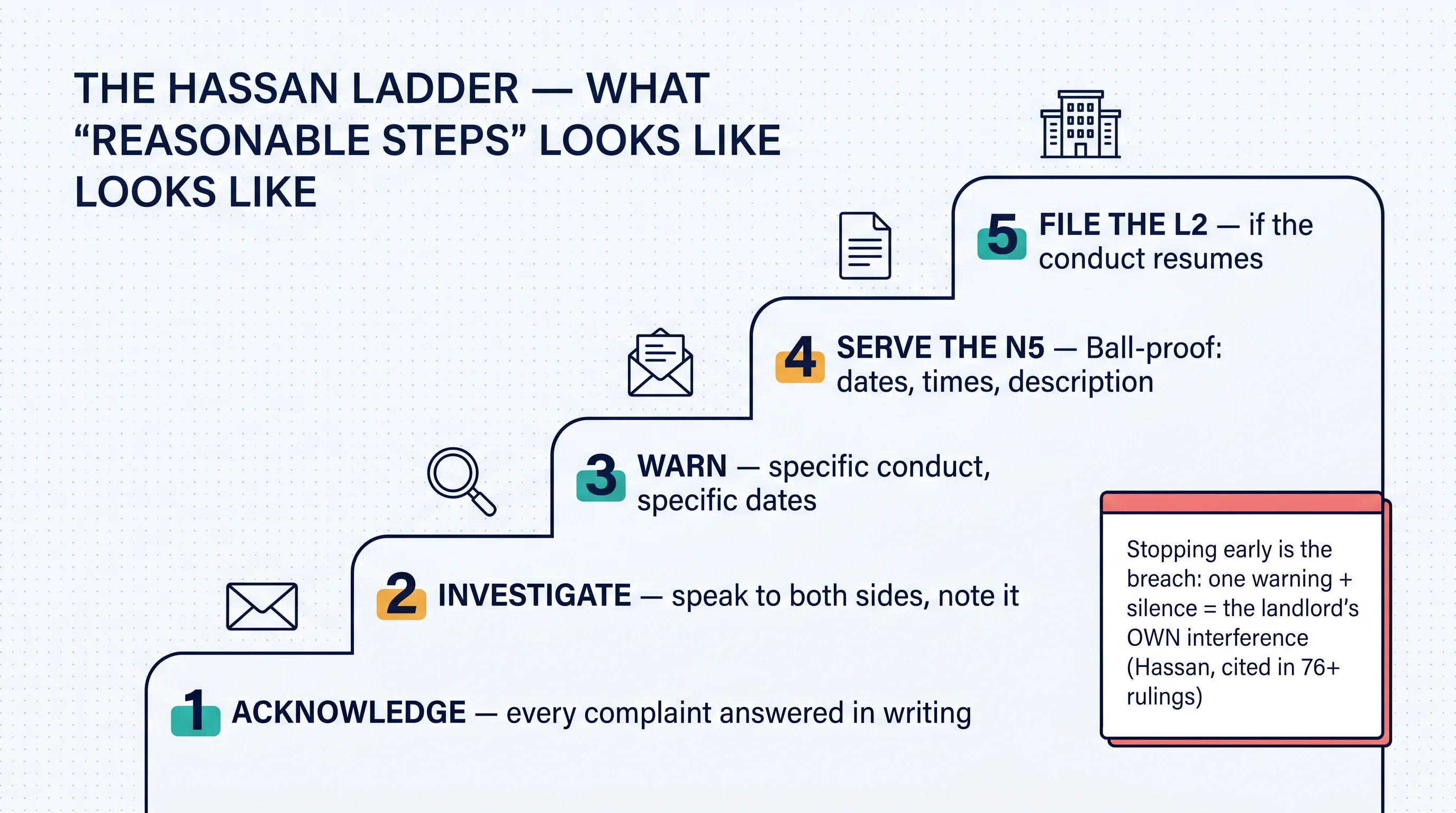
What do "reasonable steps" look like? A ladder: acknowledge → investigate → warn → serve the N5 on the offender → file the L2 if it continues. The breach looks like this real file: dozens of written noise complaints over a year; the landlord speaks to the offending tenants once, serves one N5, and never follows through — filing an arrears-only application instead. The complaining tenant's T2 succeeded, with rent abated: the landlord's inaction had become the substantial interference. Now run the same facts with a landlord who documents every rung — acknowledgment letters, investigation notes, a Ball-proof N5, the L2 when the conduct resumes. The victim's T2 fails against the ladder, and the offender faces the eviction instead. Same complaints, opposite outcomes; the difference was paper.
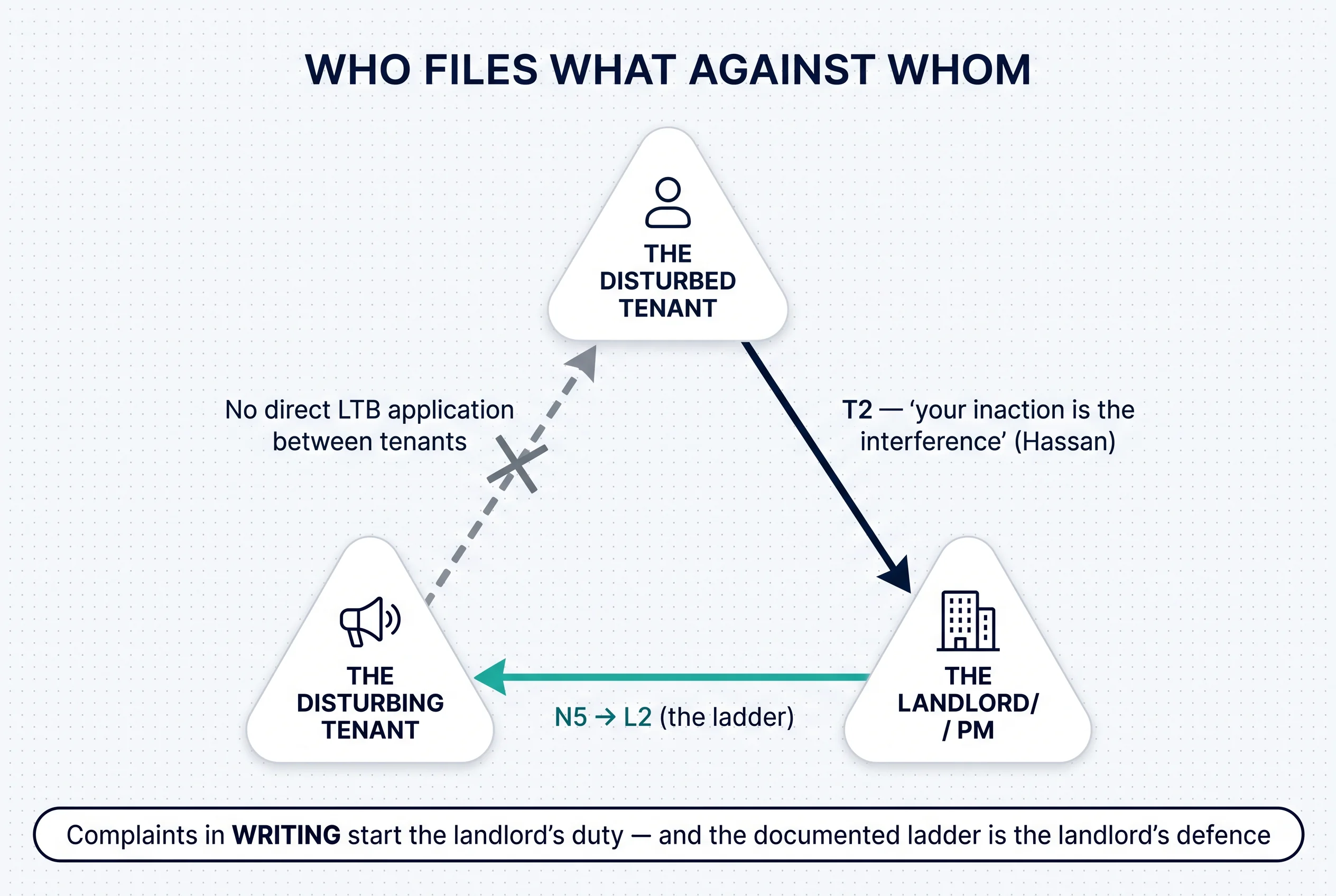
The squeeze completes the circuit. In one smoking case, the Board found a tenant's smoke substantially interfered with a neighbour but declined to evict — and the Divisional Court reversed because the Board hadn't weighed the landlord's duty to the other tenants. Shrug, and you face the victim's T2; act, and your notice must still survive Ball. Both pressures are real, and documentation is the only exit. Complainants carry discipline too: complaints must be in writing, dated, ongoing, with copies kept — in one striking file, an incident serious enough for the police produced no written complaint to the landlord, and it undercut the remedy. One triage note: thin walls are a maintenance problem (s. 20 — the duty-to-repair lane, via the T6), while an unaddressed neighbour is the T2 — the two often run together but need different answers.
The T2's Machinery — and Where This Is Heading
The T2's grounds live in s. 29(1): substantial interference (s. 22), harassment (s. 23), illegal entry (the 24-hour entry rule's enforcement arm), lock changes, and vital services — and a landlord's service disruption can be pleaded under s. 21 and s. 22 together. Mechanics: $48 on the portal ($53 paper, fee waivers available); a one-year limitation from the conduct; hearings currently running roughly 3–6 months by region. Name every respondent — superintendents and agents can be personally named, and the Board cannot make orders against anyone who isn't.
The remedy menu: rent abatement (the instructions' own convention — a percentage of rent times the months affected, e.g., 25% × 3 months); an administrative fine to the LTB of up to the greater of $35,000 or the Small Claims ceiling; an order ending your tenancy; and if the conduct drove you out — the rent differential at your new place for one year plus moving and storage costs, the same induced-to-vacate logic the T5 uses. Lock-change cases can add a move-back order. On the overall cap, honest handling: the T2 instructions in circulation state $35,000, while the sibling tenant applications' live pages have all moved to $50,000 — verify the current figure when you file. Looking ahead: hearing backlogs (our next piece measures them) are pushing more interference files into mediated behaviour agreements — settlements whose s. 78 enforcement mechanics our L4 guide covers — and documentation standards keep tightening on every side of the triangle.
Practical Takeaways
For landlords and property managers:
- Acknowledge every complaint in writing and document the full ladder — the complaining tenant's T2 will audit it.
- Draft N5s Ball-proof: dates, times, described conduct — vague allegations die individually.
- Calendar both clocks — the 7-day void and the 6-month window — and never build a second notice on void-window conduct.
- When conduct resumes, file the L2. An arrears application is not a response to a conduct problem.
For tenants complaining about a neighbour:
- Put every complaint in writing, dated, copies kept — verbal history is invisible at a hearing.
- Give the ladder reasonable time, then file the T2 against the landlord (the neighbour isn't the respondent) within one year.
- Claim the abatement math explicitly: a percentage of rent times the months affected.
For tenants who received an N5: read it against Ball — dates, times, detailed description — and use the 7 days: stopping the conduct kills a first notice outright. If it's vague, the insufficiency argument waits for the hearing, because a defective notice can't be cured.
The Substantial Interference Playbook: One Standard, Three Sides, All the Paper
Ontario's busiest legal phrase cuts three directions — the landlord's N5, the tenant's 7-day void, and the T2 back. This free playbook covers every corner of the triangle: the complaint log that wins Hassan claims, the Ball-proof notice test, the void-window traps, and the T2's full remedy menu.
Get Free PDF →The Bottom Line
The vagueness is the point. "Substantial interference" is a standard the Board fills with evidence, and twenty-five years of case law have made the fills predictable. Ball demands that whoever alleges must particularize. Hassan demands that whoever manages must act. The threshold demands that whatever's alleged must actually be substantial. Every party in the triangle holds one blade and faces two — and the winners, on every edge, are the ones with the dated paper: the complaint log, the acknowledgment letters, the Ball-proof notice, the documented ladder. General information, not legal advice; for a live dispute, a community legal clinic, licensed paralegal, or lawyer is worth the conversation. Next in this series: why every application in this cluster now waits months — the LTB backlog, measured.
The Dated Paper, Kept For You
Tenon10 keeps complaints, notices, warnings, and response timelines documented from the first message — so whichever corner of the triangle you're standing in, the record is already built.
Free • No signup required • Updated for the Bill 60 changes in force 21 Sep 2026
Frequently Asked Questions
What counts as substantial interference in Ontario?
More than ordinary annoyance — conduct a reasonable person would find genuinely disruptive to living in or running the building. Real findings include second-hand smoke seriously affecting a neighbour, hoarding that created a fire hazard, refusing entry for pest treatment, and clutter that cost the landlord its insurance. Footsteps, plumbing, and children playing are the ordinary sounds of shared buildings and don't qualify.
Can my landlord evict me for noise complaints?
Only through the N5 process, and only if the noise is substantial rather than ordinary living sound. A first N5 must detail the dates, times, and conduct — and gives you 7 days to stop, which voids the notice entirely. A second N5 within six months has no void window, so lasting quiet after the first notice is the real protection.
My landlord ignores my complaints about my neighbour — what can I do?
Under Hassan v. Niagara Housing, a landlord who fails to take reasonable steps against a disruptive tenant substantially interferes with YOUR rights — no bad intent required. Keep complaining in writing with dates, give the landlord reasonable time to act (warn, serve an N5, escalate), and if nothing happens, file a T2 against the landlord within one year. Remedies include rent abatement.
How detailed does an N5 have to be?
Per Ball v. Metro Capital, particulars should include dates and times of the conduct plus a detailed description — enough that a reasonable person knows exactly what's alleged and what to stop. "Ongoing noise" doesn't cut it, the Board strikes vague allegations one by one, and a defective notice cannot be fixed later.
What happens if I stop the behaviour after getting an N5?
The first N5 becomes void — the eviction process ends. But if the same conduct resumes within six months, the landlord can serve a second N5 with no void window and apply to the Board immediately. Stopping permanently, not pausing, is the protection.
Can I file against my noisy neighbour at the LTB?
Not directly — the Board makes orders against landlords, not neighbouring tenants. Your application is the T2 against your landlord for failing to act; your neighbour faces the landlord's N5 and possible eviction. That triangle is why written complaints to the landlord matter so much: they start the clock on the landlord's duty.


