

In 2018, an Ontario landlord filing over unpaid rent could expect an order in about 32 days. By 2023, the same file took 342 days — ten times longer. Today it's back to roughly three months. But averages are not promises: in the most recent observed data, 80% of arrears cases were heard anywhere between 2.7 and 15.7 months — and a tenant waiting on a maintenance application waits roughly four times longer than a landlord waiting on an eviction.
Every guide in this series ends the same way: "…and then you wait." This one measures the wait — what the queue actually looks like in 2026, how Ontario's busiest tribunal fell from 32-day orders to a 53,000-case backlog, what the recovery fixed and didn't, what Bill 60 changed on July 1 versus what arrives September 21, and the toolkit that keeps your file from waiting longer than it must. The application guides cover the how; this covers the when. Wait-time figures below are posted or reported averages as of mid-2026 and change — verify current timelines at tribunalsontario.ca. General information, not legal advice.
The Tenant's LTB Wait Survival Kit: File Into the Right Lane, Never Miss a Clock
Tenant applications wait longest at the LTB — some maintenance files take six months or more, while genuine emergencies can be heard in weeks. This free kit shows you which lane your case belongs in, how to stay adjournment-proof, the September rule change that rewards filing early, and the new 15-day review clock.
Get Free PDF →The Wait in 2026: Real Numbers, Real Ranges
Start with what's posted. As of this spring, Tribunals Ontario's averages run roughly: 3 months to schedule an arrears application (L1/L9); 5–7 months for most other applications — the L2, and the tenant applications this series has covered (T1, T3, T5, T6, non-urgent T2s); and orders typically within 30 days of the hearing (if 60 days pass, chase your file at [email protected]). There's also a lane most people don't know exists: urgent matters — illegal lockouts, vital-service cutoffs — schedule in roughly 5–6 weeks from receipt.
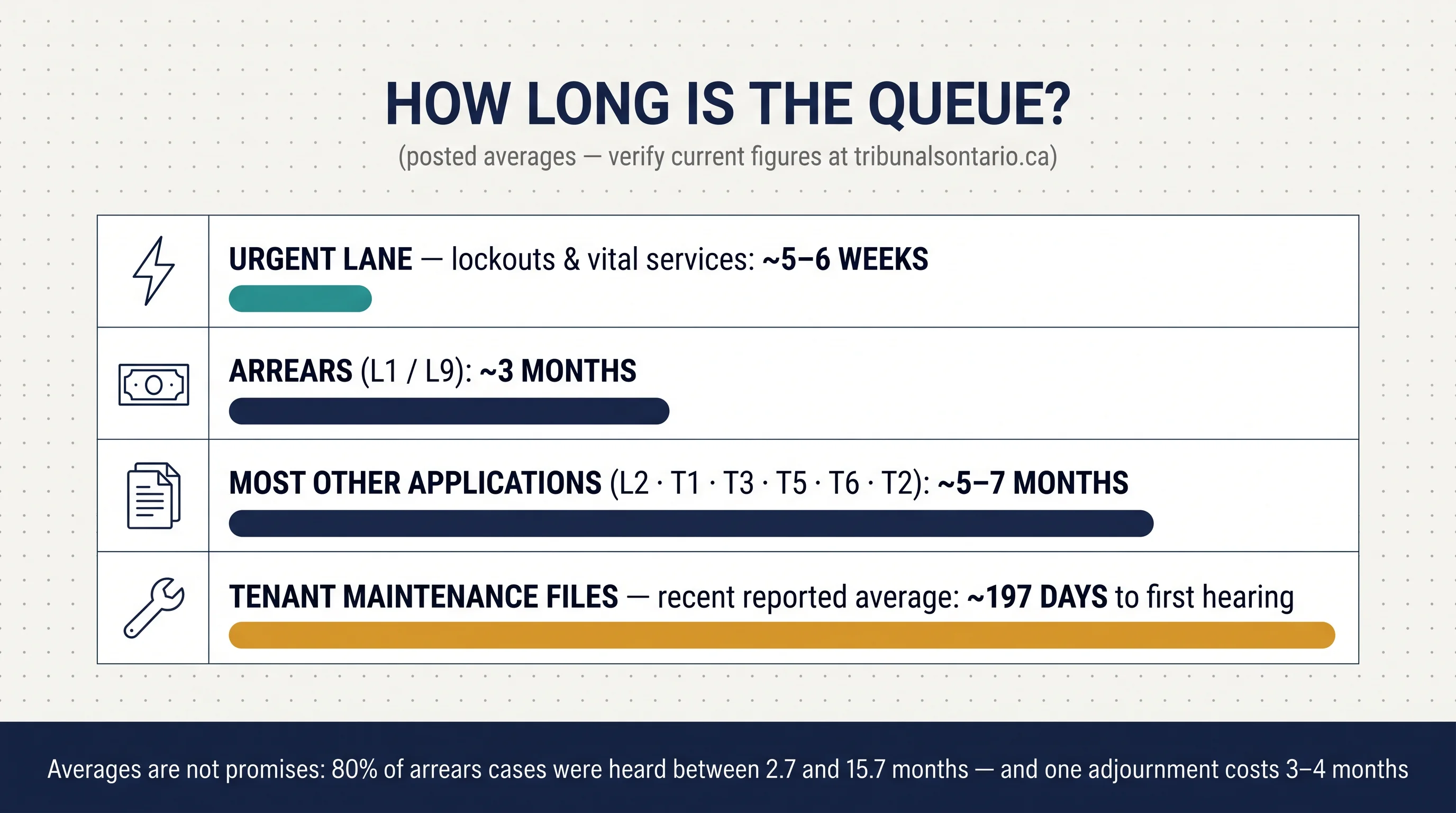
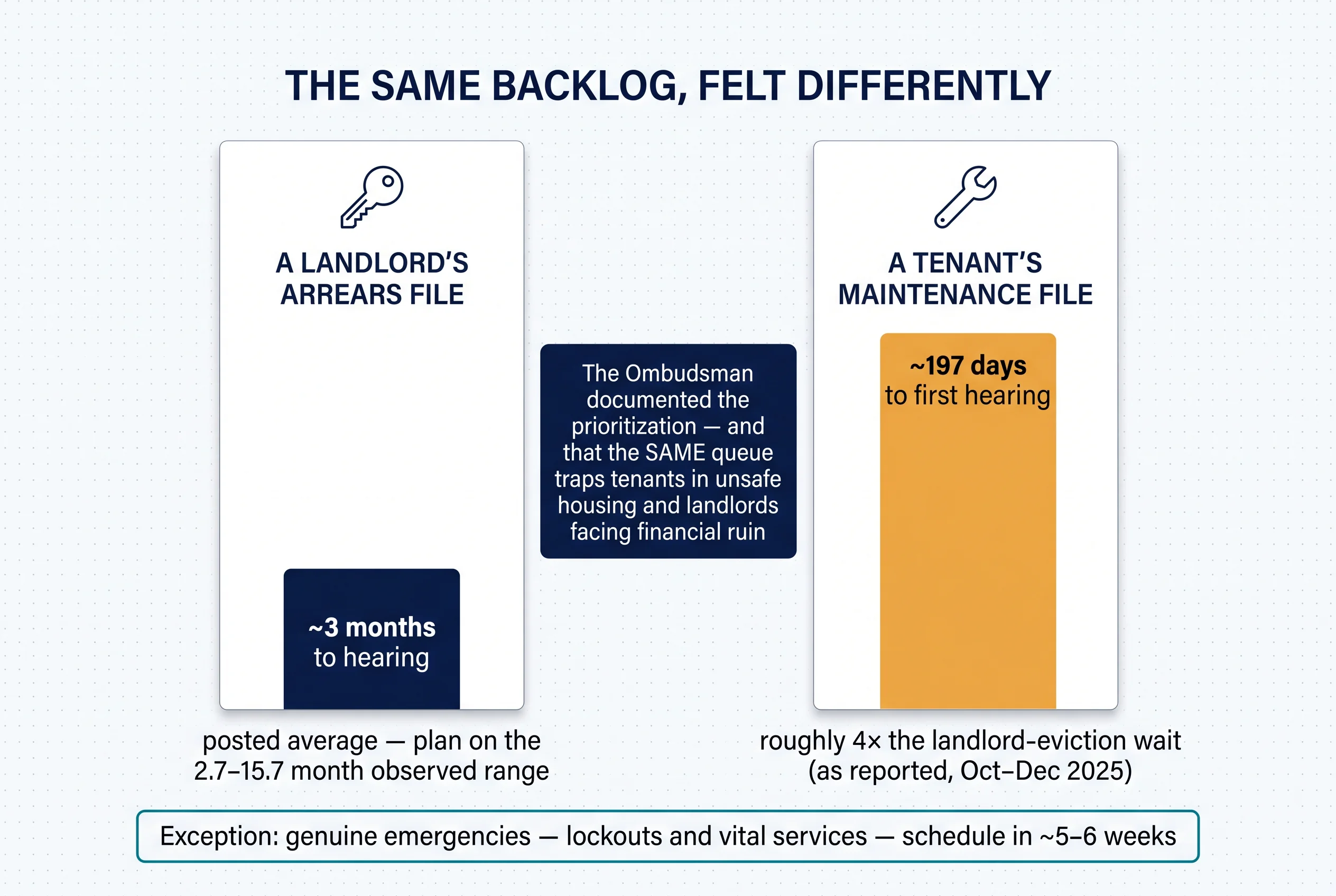
Now the part the posted numbers hide. Observed order data from this January found 80% of arrears cases heard anywhere between 2.7 and 15.7 months — the average is a midpoint, not a promise, and a single adjournment typically costs 3–4 months. Plan cash flow and housing decisions on the range. And the asymmetry deserves plain statement: in the most recent reported window, tenant maintenance applications averaged 197 days to a first hearing — roughly four times the landlord-eviction wait — and the Ombudsman's report documented that landlord applications are often prioritized. A landlord's three months and a tenant's six-plus are both "the backlog," experienced very differently. (One attributed note: the advocacy group Tribunal Watch Ontario has reported that some figures in the most recent Annual Report were changed after tabling without notation — their claim, worth knowing when you see competing numbers.)
How It Got This Way: Three Eras in the Numbers
Era one — the functioning Board (2010–2018). For nearly a decade, GTA filing-to-outcome hovered around 50 days. Arrears orders averaged about 32 days; tenant applications resolved in about 70. The Board received 82,095 applications in 2018–19 and resolved 79,476 — roughly the 300 decisions per working day it needed to stay afloat.
Era two — the collapse (2019–2023). The staffing cliff came first: by late 2019, the Board was down to 33 full-time and 7 part-time adjudicators, a shortage both the Ombudsman and Tribunals Ontario identified as the core driver — before COVID. A 20,000-case backlog already existed when the pandemic closed offices, paused evictions, and forced a rocky digital transition. The ledger at the bottom, 2022/23: 73,208 applications received, 52,986 resolved, 53,507 outstanding. Peak waits: 342 days for an arrears order, 427 days for a tenant application filing-to-order, with some maintenance files taking over two years. The Ombudsman had opened an investigation on January 9, 2020 after 190+ complaints; his May 2023 report — Administrative Justice Delayed, Fairness Denied — found the Board "fundamentally failing," its virtual hearings often chaotic (one fiscal year: 11 in-person hearings against 36,699 electronic). And his portrait of the queue is the balance this piece keeps: it trapped tenants "forced to live in unsafe and substandard conditions" and landlords "facing financial ruin" — including small landlords renting space in their own homes. The same queue, injuring both directions.
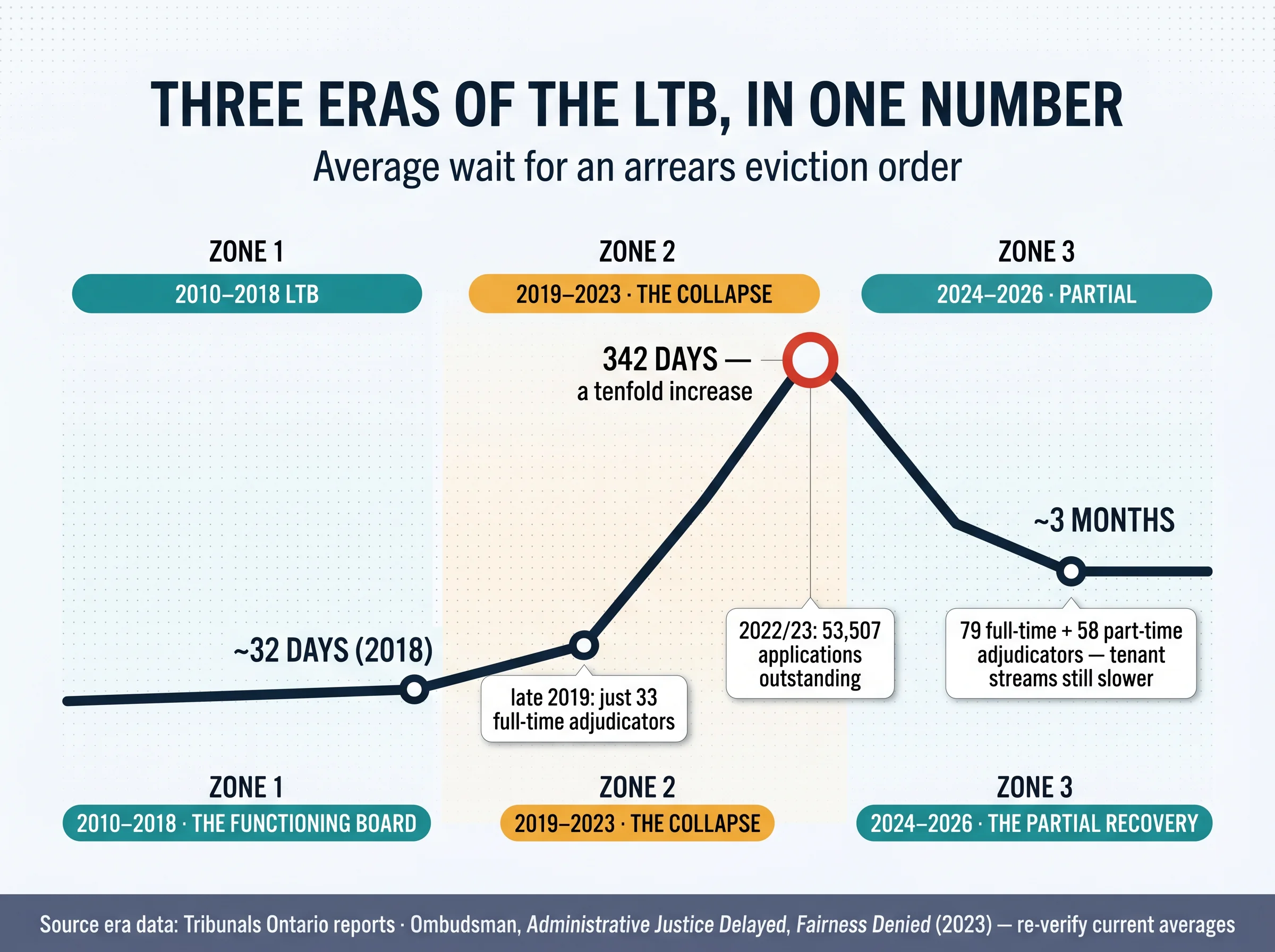
Era three — the partial recovery (2024–2026). A $6.5-million investment brought 40 new adjudicators, lifting the complement to 79 full-time and 58 part-time. Arrears scheduling fell from roughly 10 months in 2023 to roughly 3. The Board's stated goal is a 90-day cycle for all applications — approached on the landlord arrears streams, not yet on the tenant streams, with the active caseload still estimated above 30,000. Recovery, real; even, no.
Bill 60: What Changed July 1, What Changes September 21
Live now. Since July 1, 2026, the window to request a review of an LTB order is 15 days, down from 30. The Board can extend it where "just and appropriate," but don't build a plan on that — and remember reviews are serious-error screens, not re-hearings. The practical rule for every seat: diarize the review deadline the day the order arrives.

Coming September 21. Two changes from our Bill 60 and Bill 97 coverage land together: the N4 notice period drops from 14 days to 7, and the s. 82 pay-in gate arrives — a tenant raising maintenance or harassment counter-issues at an arrears hearing must first pay 50% of the claimed arrears (regulations may allow payment into the Board instead). The strategy shifts cut both ways. Tenants holding genuine repair or rights claims should file them early and separately — a T6 or T2 filed in August beats one gated in October. Landlords should expect fewer day-of surprises but more separate tenant applications in the queue. And a caution for landlord expectations: filing a week sooner does not move the hearing date — filing speed is not hearing speed — and a tenant who pays before the hearing still typically receives a conditional order rather than eviction, the s. 78 world our L4 guide covers.
Both framings, so you have them: the government's case is throughput — fewer adjournments, faster filings, tighter reviews. The critics' case (the Human Rights Commission, tenant advocates, housing researchers) is capacity — rules aren't adjudicators; the gate may push tenant issues into the slower tenant queue or suppress defences that only surface at hearings. Reform options reportedly under discussion run as far as restructuring the Board itself. The queue will render the verdict.
The Toolkit: How to Protect Your Case From the Queue
You can't move the queue. You can stop losing months to it — and the biggest variable is the one you control: the file. A valid notice (dates, times, and described conduct where it's conduct-based), proof of service, evidence indexed and exchanged early — thin files invite the adjournments that cost a season. File on the portal, always: it's cheaper, it shows status live, and paper filing is self-inflicted delay.
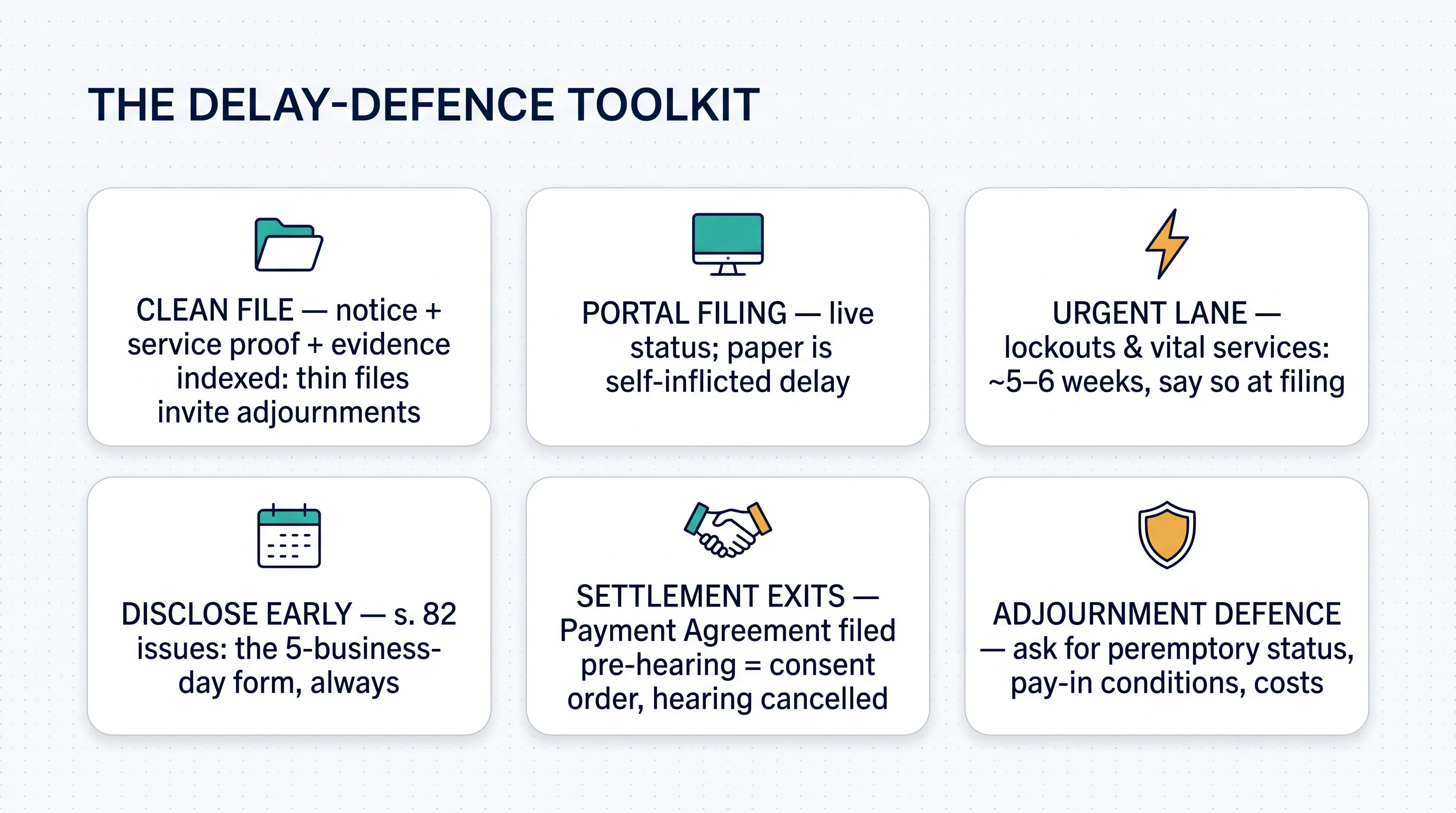
Then use the lanes. Emergencies are a different queue: lockouts and vital-service cutoffs schedule in ~5–6 weeks — but only if the Board can see the urgency, so say it plainly at filing and attach the proof; a misfiled emergency waits like an ordinary file. A Request to Shorten Time exists for documented urgency — the Board weighs prejudice and reasons — but it's one shot: refused, you can't ask again without a significant change in circumstances. On arrears files, the settlement exits recover months for both sides: a Payment Agreement filed before the hearing becomes a consent order and the hearing is cancelled; full payment supports a discontinuance. While the pre-September rules run, tenants raising issues at an arrears hearing must serve the "Issues a Tenant Intends to Raise" form 5 business days ahead, with evidence — surprise issues get adjourned, not heard. And when the other side seeks an unnecessary adjournment, oppose it with conditions the Board can attach: a peremptory new date (no further adjournments), payments into the Board, or costs.
Finally, order hygiene: most orders arrive within ~30 days; clerical mistakes are fixed free with a Request to Amend; chase silence at 60 days. And the order is not the finish line — after the review window comes enforcement, and an eviction order is enforced only by the Court Enforcement Office. That queue — the Sheriff's — is its own story, coming later in this series.
Practical Takeaways
For landlords:
- File portal-clean and immediately — file quality is the delay variable you own.
- Plan cash flow on the observed range (2.7–15.7 months), not the 3-month headline.
- Evaluate the Payment Agreement exit before every arrears hearing.
- Diarize the 15-day review window the day any order arrives.
For tenants:
- Emergencies go in the urgent lane — say so when filing, with proof.
- File maintenance and rights claims early and separately, especially after September 21.
- Raising issues at an arrears hearing? The 5-business-day disclosure form, always.
- Get review advice within days of an adverse order — the window is 15 days now.
For property managers: set client expectations in dated ranges, never single numbers — and calendar every window in a file's life: void periods, the six-month second-notice window, the 15-day review, the s. 78 twelve months.
The Tenant's LTB Wait Survival Kit: File Into the Right Lane, Never Miss a Clock
Tenant applications wait longest at the LTB — some maintenance files take six months or more, while genuine emergencies can be heard in weeks. This free kit shows you which lane your case belongs in, how to stay adjournment-proof, the September rule change that rewards filing early, and the new 15-day review clock.
Get Free PDF →The Bottom Line
The backlog is real, measured, and asymmetric — and it is not weather. It has causes: a staffing cliff, then a pandemic, then a recovery that reached some queues before others. And it has levers: the urgent lane, the settlement exits, the disclosure discipline, the clean file. The parties who treat the queue as a fixed fact suffer it; the parties who treat it as a system navigate it. Bill 60 re-timed the front of the process this month and re-times it again in September; the hearing rooms will decide whether the queue itself moves. Either way, the winning posture is the one this whole series teaches: file clean, disclose early, calendar everything, and never learn a deadline after it passes. General information, not legal advice. Next in this series: the people in the hearing room — representing yourself at the LTB, landlord edition and tenant edition — and then the wait after the order: the Sheriff.
Hearing-Ready From Day One
Tenon10 keeps notices valid, evidence organized, and every deadline calendared — so however long the queue runs, your file never adds to the wait.
Free • No signup required • Updated for the Bill 60 changes in force 21 Sep 2026
Frequently Asked Questions
How long does an LTB hearing take to get in 2026?
Posted averages: about 3 months for non-payment applications (L1/L9), and roughly 5–7 months for most other applications, with orders typically issued within 30 days of the hearing. But observed data shows 80% of arrears cases heard anywhere between 2.7 and 15.7 months — treat the average as a midpoint, not a promise.
Why is the LTB taking so long?
The short version: a staffing shortage that began before the pandemic (33 full-time adjudicators by late 2019 against ~82,000 applications a year), then COVID closures and a rocky digital transition, producing a 53,000-case backlog by 2022/23. A $6.5M investment and 40 new adjudicators have brought arrears cases back to ~3 months, but tenant applications still wait far longer.
How can I speed up my LTB case?
You can't move the queue, but you can stop losing time to it: file on the portal with a complete file, label genuine emergencies (lockouts, vital services) as urgent — they schedule in about 5–6 weeks — disclose any issues 5 business days before an arrears hearing, consider a filed Payment Agreement that cancels the hearing entirely, and oppose unnecessary adjournments, which cost 3–4 months each. A Request to Shorten Time exists for documented urgency, but you get one shot.
Do tenants really wait longer than landlords at the LTB?
On average, yes. In the most recent reported window, tenant maintenance applications waited about 197 days to a first hearing — roughly four times the landlord-eviction wait — and the Ombudsman documented that landlord applications are often prioritized. Genuine emergencies are the exception: the urgent lane schedules in weeks.
What is the deadline to request a review of an LTB order now?
15 days, as of July 1, 2026 — cut from 30 by Bill 60. The Board can extend it where "just and appropriate," but don't count on that: diarize the deadline the day the order arrives, and remember reviews require serious error, not just disagreement.
What happens if my LTB hearing is adjourned?
Expect to lose roughly 3–4 months. Adjournments are granted for reasons like surprise issues, missing disclosure, or accommodation needs — and the Board can attach conditions: making the new date peremptory (no further adjournments), requiring arrears payments into the Board, or awarding costs. The best protection is a hearing-ready file and early evidence exchange.


