

Most hearings at the Landlord and Tenant Board involve at least one party with no lawyer and no paralegal — the Board is built for it. And yet the Board dismisses landlord applications every day, not on the merits, but on a miscalculated termination date, an arrears figure twelve dollars off the ledger, or service that can't be proven.
Both things are true, and together they define what self-representation actually is: legal, common, and completely workable — if you treat it as a discipline rather than a default. The Member cannot advise you. The tenant may have just left a free session with Duty Counsel. The file you bring is the case you have. This guide covers who can stand at your podium (and the agent-authority trap that can bind you to settlements you never saw), the Rule 19 evidence machine with its 7-day and 5-day clocks, the update sheet the Board can refuse to proceed without, section 83 — the part self-represented landlords never see coming — hearing-day mechanics, and the honest math on when a paralegal pays for itself. General information, not legal advice — and on this topic, that line matters more than usual.
The Self-Rep Landlord's LTB Hearing Kit: The File, the Clocks, and the Day Itself
The Board dismisses landlord applications every day on a date, a dollar, or a missing proof of service — and the Member can't advise you. This free kit turns self-representation into a discipline: the ledger and service checks, the day −7 and day −5 clocks, the update sheet the Board won't proceed without, your section 83 story, and the 15-day review deadline.
Get Free PDF →Who Can Stand at Your Podium
You can always represent yourself — the Board's rules are applied so parties can participate effectively with or without counsel. But understand the Member's role precisely: procedural guidance, yes; advice, strategy, or advocacy, never. Beyond yourself, a landlord can be represented by an LSO-licensed lawyer or paralegal (who may be asked for a licence number), or by an unlicensed "Landlord's Agent" within the Law Society's exemptions: an unpaid friend or family member (not if compensated, and not past three matters a year), or a full-time employee, officer, or shareholder of a corporate landlord. A paid friend can't appear; neither can a professional who serves you but isn't your employee — the Board's own example is a leasing realtor. Any unlicensed agent needs a signed written agency authorization filed before or at the hearing, or they may be refused audience entirely.
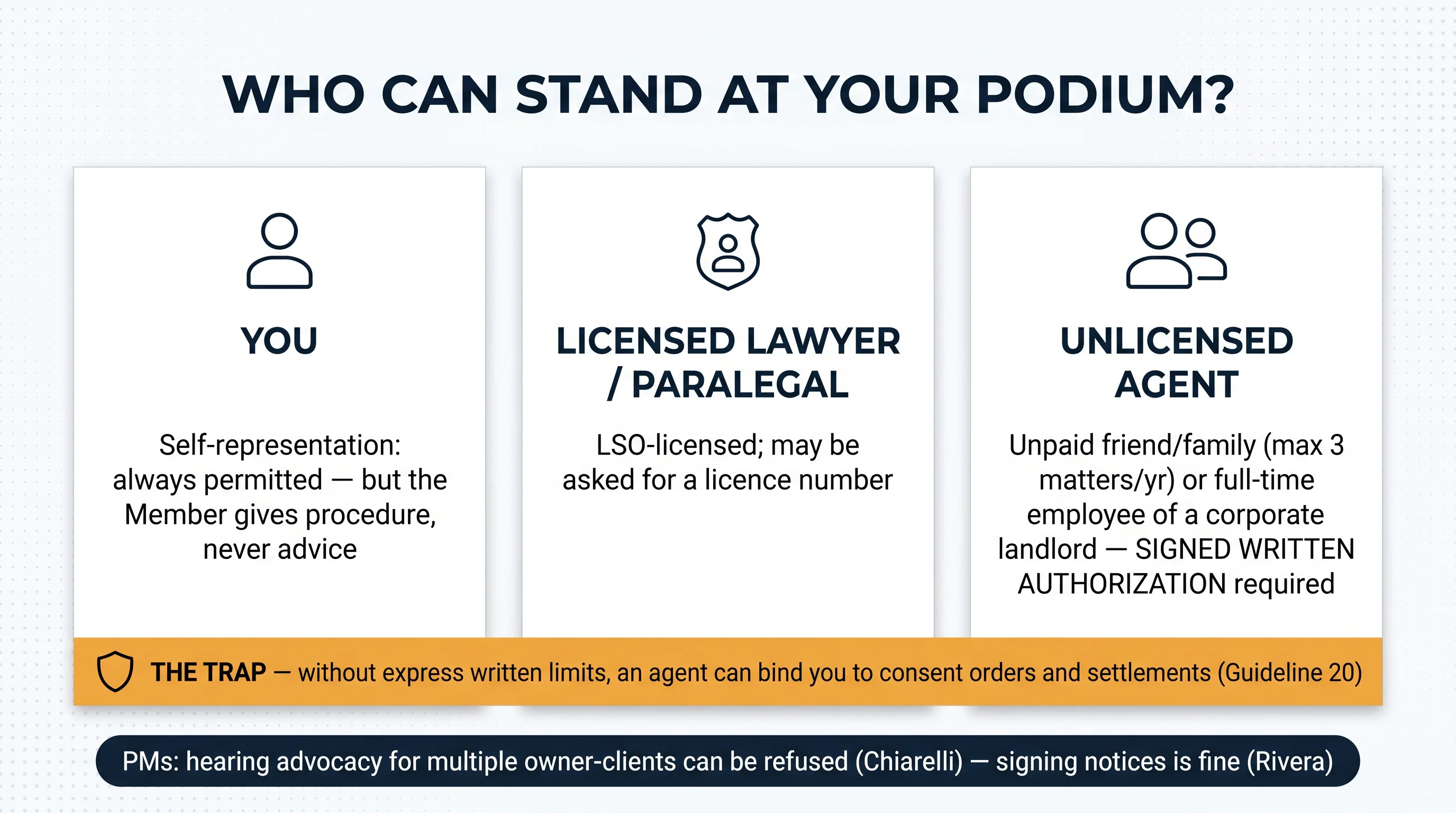
Now the trap. Under the Board's Guideline 20, unless you give the Board evidence of an express limitation on your agent's authority, that agent acts in your place for all purposes — giving evidence, making submissions, and entering consent orders and mediated agreements that legally bind you. Picture the superintendent sent "just to ask for an adjournment" who, pressed in day-of mediation, signs an agreement waiving half the arrears. It binds. The fix costs one sentence in the authorization: "may not consent to final orders or settlements without my instructions."
Property managers get their own line to walk. In Law Society v. Chiarelli (Ontario's Court of Appeal, 2014), a PM running hearing advocacy for multiple owner-clients as a business was providing legal services without a licence — and PMs in that position can be refused standing, leaving an unprepared owner holding the file. Contrast Rivera v. Eleveld (Divisional Court, 2022): merely signing a notice of termination as an agent needs no licence. Managing property and signing paperwork is fine; being the hearing advocate for a book of clients is a licensed activity. One more planning fact: Tenant Duty Counsel offers tenants free legal help on hearing day, and there is no landlord equivalent — the Landlord's Self-Help Centre provides excellent information and modules, but not day-of representation. Prepare as though the other side just got free advice, because they may have.
The Evidence Machine: Rule 19 and the Update Sheet
The disclosure clocks are simple and unforgiving. Your evidence goes to the tenant and the Board at least 7 days before the hearing; responding evidence — including your answer to any issues the tenant disclosed — lands at least 5 days before. Packages must be readable, consecutively page-numbered, and indexed if there's more than one item; audio or video must be playable by you at the hearing. Miss the deadline and Rule 19.7 says you may not be permitted to rely on the evidence — it's discretionary, which means late with a written explanation beats never. Two things should never enter the package: mediation discussions (confidential, always) and case law (that's argument, not evidence — hand it up at the hearing).
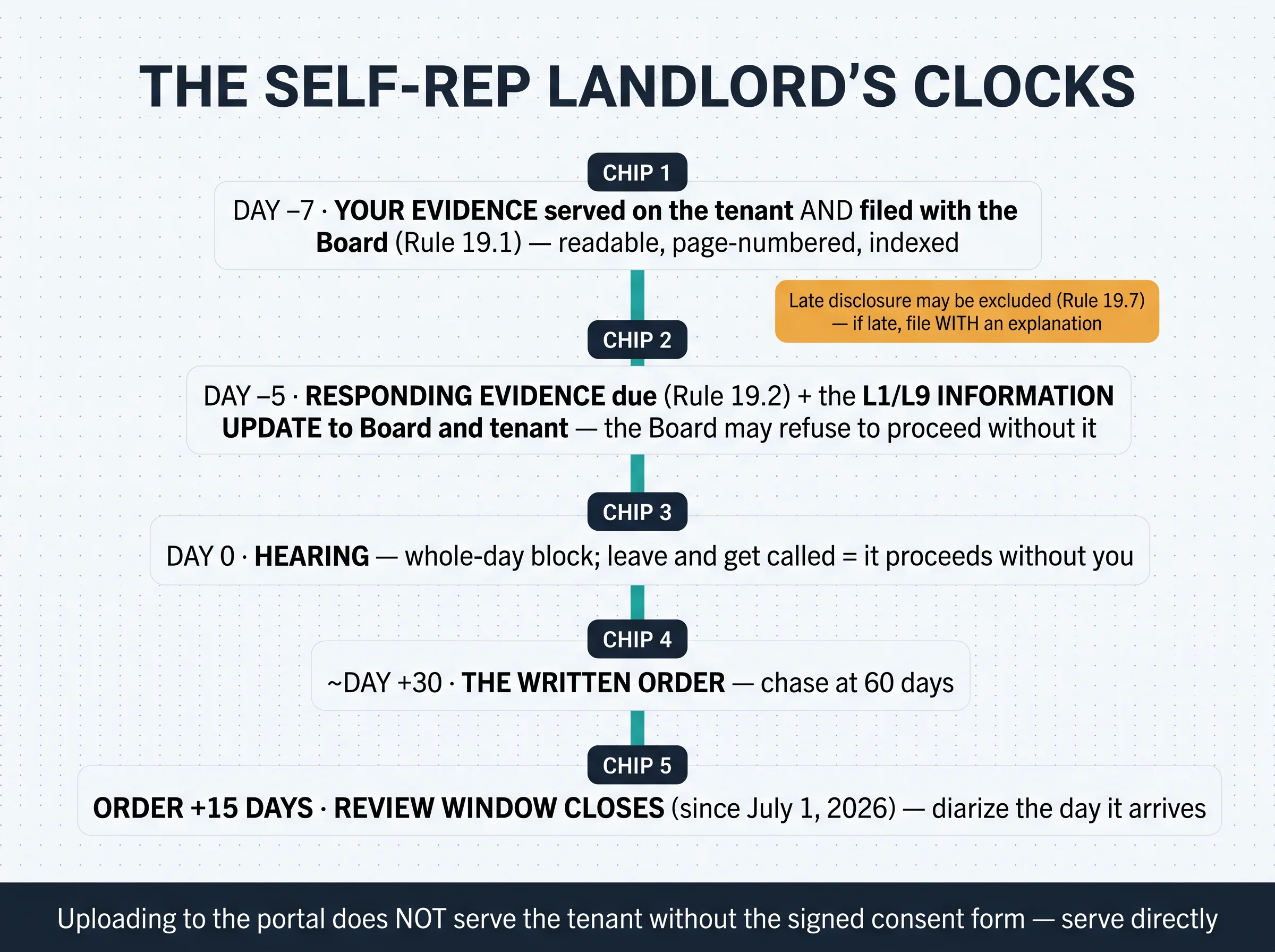
On non-payment files there's one more filing self-represented landlords miss more than any other: the L1/L9 Information Update, delivered to the Board and the tenant no later than 5 days before the hearing. It reconciles every payment received since you filed, the new rent periods that came due, and the deposit — the arithmetic the Member will actually order from — and it carries a section for your own section 83 circumstances. Miss it and the Board may refuse to proceed: an adjournment of three to four months, entirely self-inflicted. And reconcile ruthlessly. Consider the $12 dismissal: the ledger says $8,412, the application says $8,400 — a forgotten NSF-fee reversal — and the discrepancy unravels credibility until the application is dismissed. Three months of queue time lost to twelve dollars. The trio that wins arrears files is unglamorous: a ledger reconciled to the dollar, a valid notice with calculator-checked dates, and proof of service.

Section 83 and the Hearing Itself
Here is the part self-represented landlords never see coming. In every eviction application, section 83 requires the Member to consider all the circumstances — and permits refusing or delaying the eviction even where you have proven your case. Some refusals are mandatory, such as where the notice was retaliation for a tenant asserting their rights. On arrears files, the Board also considers whether you attempted to negotiate a payment agreement: so attempt one, document it — dates, terms, responses — and file the attempts as evidence. The difference is dramatic. The landlord who arrives with two documented payment-plan offers has pre-empted the fairness narrative; the conditional order that issues tends to issue on their proposed schedule. The landlord who arrives with nothing discovers that the only sympathy in the room points one direction.
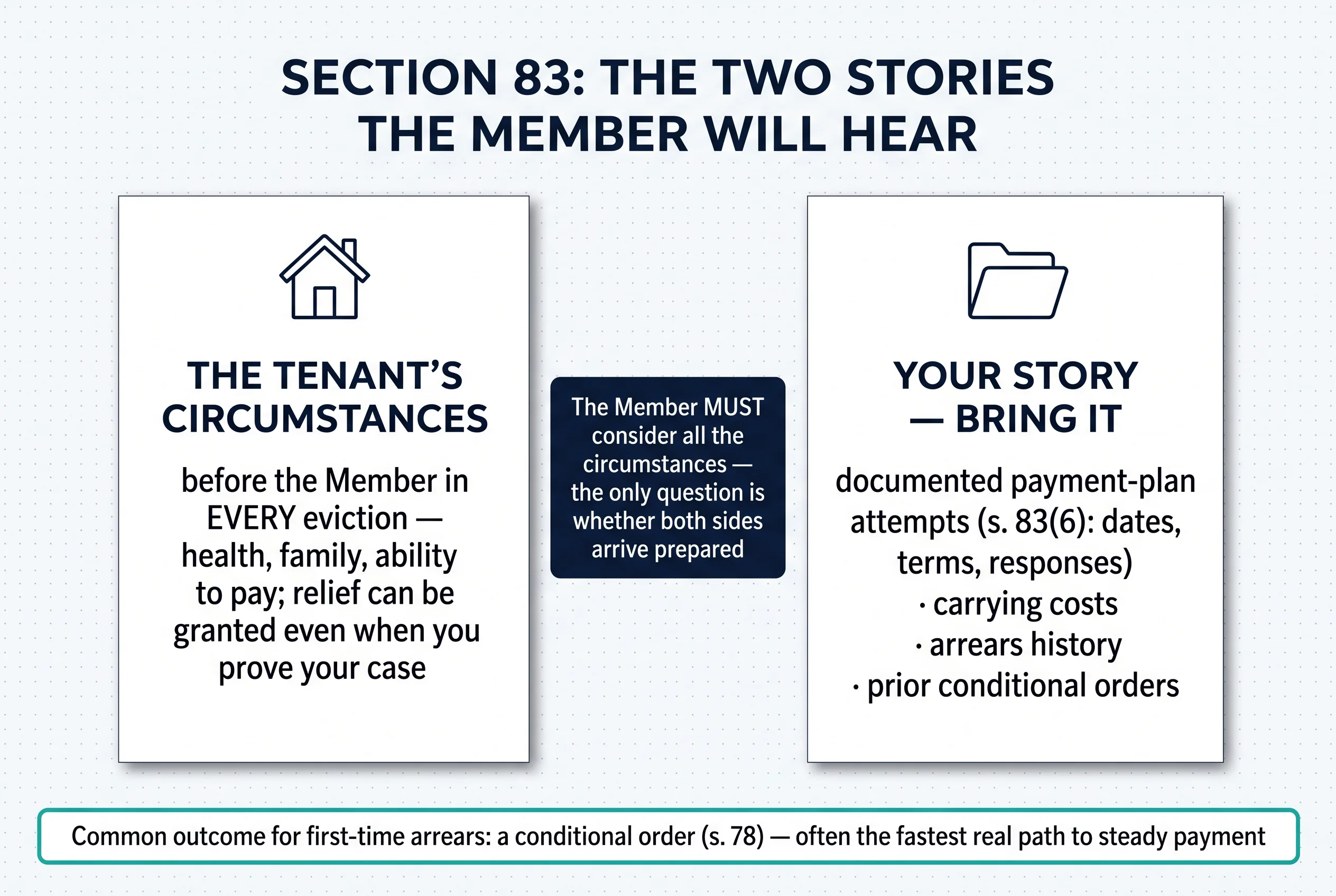
Set expectations accordingly: first-time arrears with payment before the hearing usually ends in a section 78 conditional order, not eviction — and as our L4 guide explains, that's often the fastest real-world path to steady payment, because a breach skips straight to an ex parte eviction application.
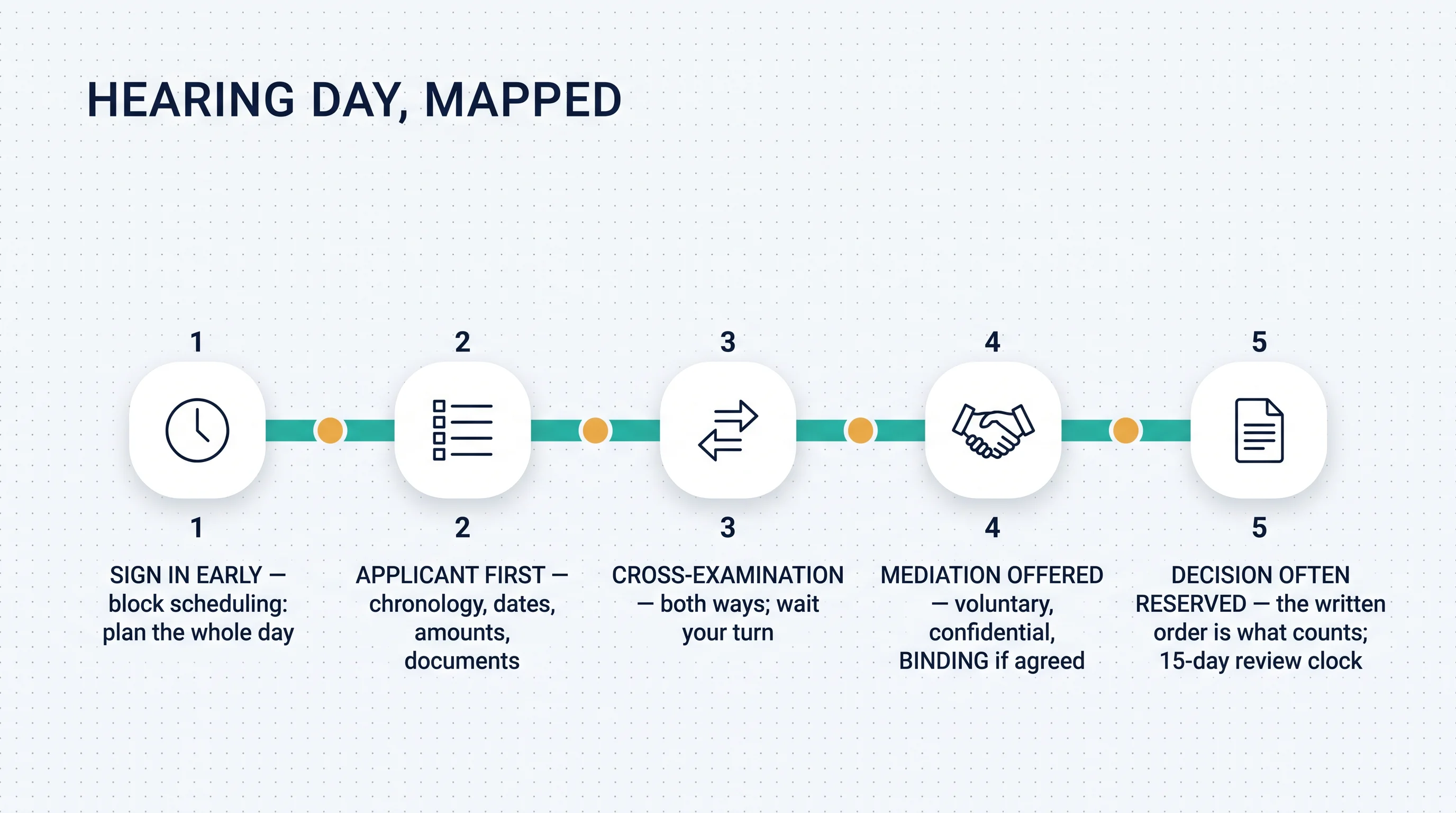
Then there's the day itself. Hearings run in blocks — multiple files, one sitting — so plan for the whole day; step away and get called, and the hearing proceeds without you. The default is virtual: test your technology, have documents open and shareable, and request accommodations early. Before your date, do the single highest-value thing almost nobody does: watch a hearing block. They're public — email the Board for a link — and an hour of observation teaches more about pace, tone, and what Members actually ask than any guide. As applicant you present first: chronology, dates, amounts, documents — not grievances. Expect cross-examination both ways. Bring three copies of everything for any in-person element, and if a witness's attendance is doubtful, request a summons ahead of time. If mediation is offered, treat it deliberately: it's voluntary and confidential, but anything agreed is binding — know your walk-away numbers before you say yes to anything. Afterward, the decision is often reserved; the written order is what counts, and the moment it arrives, the 15-day review window (cut from 30 as of July 1, 2026) starts running. Clerical mistakes are fixed free within 30 days. And the order is not possession — the Sheriff's queue comes next, and it gets its own guide later in this series.
The Honest Math: Self-Rep or Representation
The filing fee (~$201 for most landlord applications) is never the real cost — the real money is the months of rent riding on file quality, because a dismissal-and-refile costs the whole queue again. And clear one myth now: winning does not make the tenant pay your paralegal. You typically recover the filing fee; representation costs are capped at $700 and awarded only in narrow circumstances like the other side's unreasonable conduct. Budget professional help as your own cost — then weigh it honestly.
The rational split looks like this. Self-representation suits the clean, single-path file — an N4→L1 with a tight ledger, or an L3 on a signed N9 or N11 — backed by genuine preparation time. Representation tends to pay for itself where the stakes are high or the file is messy: tenant counter-issues at the hearing, credibility contests, or an N12's good-faith inquiry. Free entry points exist either way: the Law Society Referral Service offers a free 30-minute consultation, and the Landlord's Self-Help Centre's modules are built for exactly this audience. One timing note: on September 21, the Bill 60 changes bring the 7-day N4 and the s. 82 pay-in gate — faster filing and likely more separate tenant applications in the system. The discipline in this guide matters more after that date, not less. The full hire-or-not framework — fee structures, flat-fee vs staged billing, and what to ask before retaining anyone — is coming in this series as its own guide.
Practical Takeaways
- Reconcile the ledger to the dollar before filing — the application must match it exactly.
- Prove service or don't bother: a Certificate of Service for every notice and document.
- Serve evidence at day −7, respond at day −5 — and never rely on the portal alone to serve.
- The L1/L9 Information Update at day −5, always — the Board may refuse to proceed without it.
- Build the section 83 file both ways: documented payment-plan attempts plus your own circumstances.
- Any agent appears with a signed authorization and express written limits on their authority.
- Diarize the 15-day review window the day the order arrives.
The Self-Rep Landlord's LTB Hearing Kit: The File, the Clocks, and the Day Itself
The Board dismisses landlord applications every day on a date, a dollar, or a missing proof of service — and the Member can't advise you. This free kit turns self-representation into a discipline: the ledger and service checks, the day −7 and day −5 clocks, the update sheet the Board won't proceed without, your section 83 story, and the 15-day review deadline.
Get Free PDF →The Bottom Line
The LTB was built for self-represented parties, and landlords win there every day — the ones who treat the hearing as the last step of a paper discipline, not a performance. The Member can't help you; the ledger, the dates, the service proof, and the disclosure clocks are the case. Prepare both section 83 stories, paper any agent with express limits, file the update sheet, and walk in having watched the room work. And keep the honest limit in view: some files deserve a professional, and recognizing which ones is a skill too. General information, not legal advice. Next in this series: the same guide from the other chair — representing yourself as a tenant — then paralegals vs lawyers, and the wait after the order: the Sheriff.
Walk In With the File Already Won
Tenon10 keeps your ledger reconciled, your notices valid, and every disclosure clock calendared — so the case you bring is the case you prove.
Free • No signup required • Updated for the Bill 60 changes in force 21 Sep 2026
Related Resources
- L1 vs L2 LTB Applications: Understanding the Difference — pick the right application before you prepare for its hearing.
- How to Use the N4 Notice in Ontario — the notice most self-rep hearings stand on (7-day notice period from September 21).
- The LTB Backlog: Real Wait Times, Root Causes, and How to Protect Your Case — what a dismissed application really costs, and the delay-defence toolkit.
- The L4 Application: When a Settlement Is Breached — why conditional orders and mediated agreements have real teeth.
- Ontario Rental Law Changes Coming July 1 and September 21, 2026 — the Bill 60 timeline behind the 15-day review window and the September changes.
- Certificate of Service and the Termination Date Calculator — the two tools that prevent the two most common dismissals.
Frequently Asked Questions
Do I need a lawyer or paralegal for the LTB?
No — any party may self-represent, and most hearings involve at least one self-represented party. Whether you should depends on the file: clean single-path applications (like an N4→L1 with a reconciled ledger) reward preparation; messy or high-stakes files often justify professional help, since a dismissed application costs months of queue time.
Can my property manager represent me at an LTB hearing?
Sometimes — and this is a real trap. A full-time employee of a corporate landlord can appear as an agent, but a property manager running hearing advocacy for multiple owner-clients as a business may be providing legal services without a licence and can be refused standing (the Chiarelli case). Signing notices as your agent is different — that needs no licence.
What is the L1/L9 Information Update sheet?
A mandatory filing on non-payment files: it reconciles payments received since you filed, new rent that came due, and the deposit — delivered to the Board AND the tenant at least 5 days before the hearing. Miss it and the Board may refuse to proceed, which costs you an adjournment.
What are the LTB evidence deadlines?
Under Rule 19: your evidence goes to the other party and the Board at least 7 days before the hearing; responding evidence at least 5 days before. Packages must be readable, page-numbered, and indexed. Uploading to the portal alone does not serve the other side unless both parties signed the consent form. Late evidence may be excluded — if you're late, file anyway with an explanation.
Can the LTB refuse an eviction even if I prove the rent is owed?
Yes. Section 83 requires the Member to consider all the circumstances in every eviction and permits refusing or delaying it; some refusals are mandatory (like retaliation). On arrears files the Board also considers whether you attempted a payment plan — document your attempts. First-time arrears commonly end in a conditional order rather than eviction.
If I win, does the tenant pay my legal costs?
Almost never. You typically recover the filing fee; representation costs are capped at $700 and awarded only in narrow circumstances such as unreasonable conduct. Budget for representation as your own cost.


