

When people finally decide to get help at the Landlord and Tenant Board, most of them ask the wrong first question. "Should I get a lawyer or just a paralegal?" assumes a hierarchy that, at the Board, doesn't exist: both hold licences from the same regulator, carry the same mandatory insurance, answer to the same complaints process, and have the same right to appear at your hearing. The word "just" is doing bad work.
The real decision runs on three axes nobody explains. Scope — there is exactly one hard line, and it's the courthouse door. Depth — the practitioner who lives at the tribunal versus the one who visits. And fee structure — because what a flat fee actually includes decides the real price. This guide covers all three: the scope map, the honest money (market ranges, the what's-included question, and the $700-vs-15% recovery asymmetry), the specialist test, the three-seat framework, and the five-step diligence protocol to run before retaining anyone — licence check included. One rule carries over from both of our self-representation guides and comes first, always: exhaust the free layers before spending a dollar. General information, not legal advice — and not a recommendation of any profession or provider.
The LTB Hiring Kit: Paralegal, Lawyer, or Neither — the Seat-Mapper, the Four Questions, and the Honest Money
At the LTB, both licences carry the same regulator, insurance, and right to appear — so the hiring decision is scope, depth, and fee structure, never prestige. This free kit maps your file to the right seat, gives you the licence check and the four questions to ask before retaining anyone, and runs the honest money: market ranges, the what's-included trap, and the $700-vs-15% recovery math.
Get Free PDF →Two Licences, One Regulator, One Hard Line
Start with the equal footing, because it dissolves half the anxiety. The Law Society of Ontario licenses and regulates both professions — lawyers since 1797, paralegals since regulation began in 2007–08. Both carry mandatory professional liability insurance. Both answer to the LSO's Complaint Service. Both back onto the Compensation Fund for clients harmed by dishonest licensees. Both can be disciplined, suspended, or revoked, and both owe you confidentiality. As one practitioner puts it: the accountability structure is the same — what differs is scope and cost. The education differs too, of course — a law degree plus articling versus an accredited paralegal program plus licensing exam — but at the Board specifically, tribunal depth outweighs educational breadth, and we'll come back to that.
The paralegal scope (the P1 licence) covers the LTB in full: arrears and evictions, above-guideline increases, tenant applications, harassment claims, and reviews of orders — plus Small Claims Court up to $50,000 including trial and enforcement, provincial offences, and specified tribunals. Within that scope, a licensed paralegal can do everything representation means: give legal advice, draft documents, negotiate, and advocate at your hearing. The lawyer's scope is unrestricted — every court up to the Supreme Court of Canada, every area of law. At the Board, the lawyer's distinctive edge is not the venue but the overlap: files that cross into Human Rights claims, fraud allegations, corporate or commercial threads, or multiple tribunals at once.
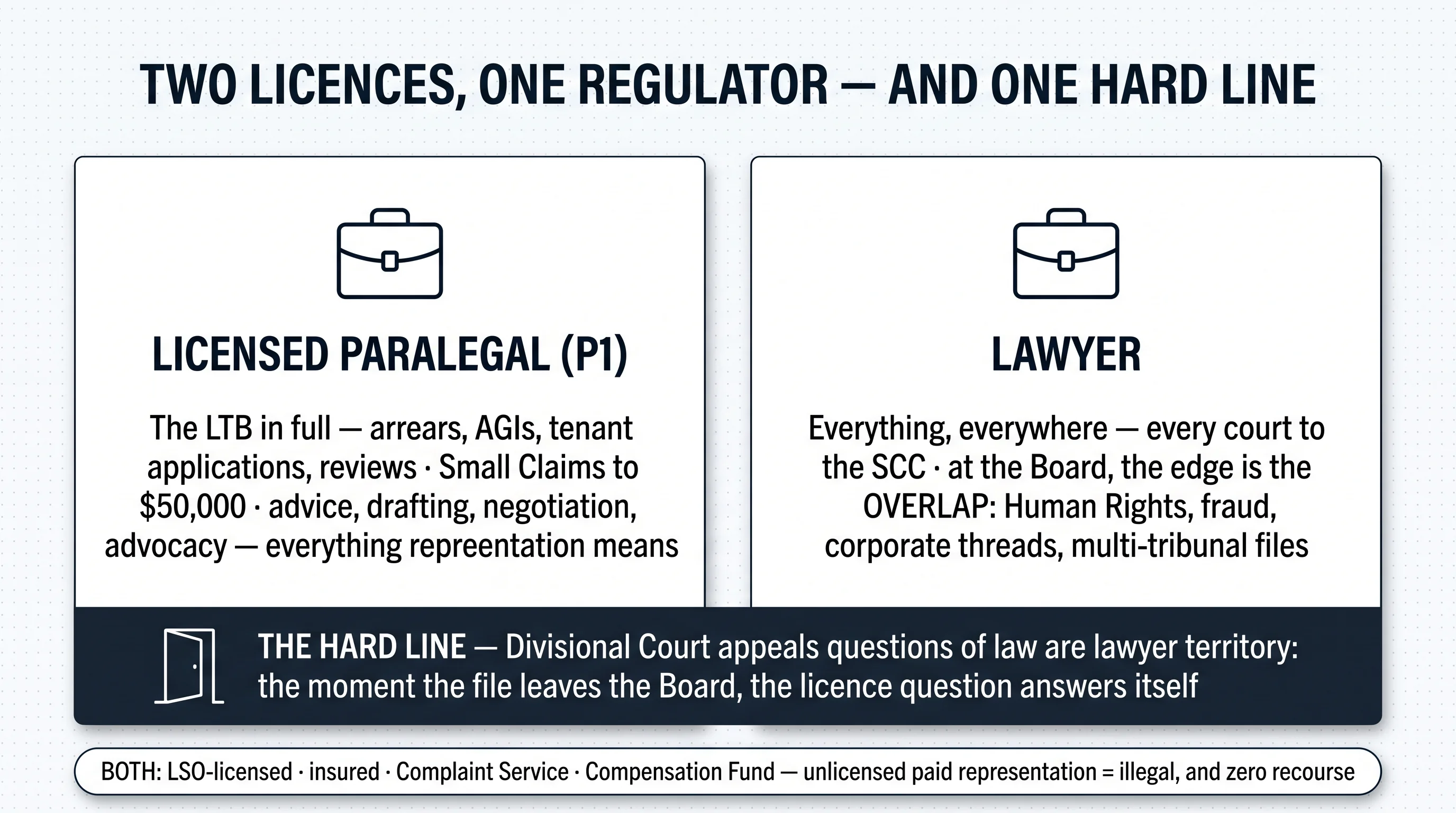
And the hard line? Divisional Court. A paralegal can seek a review of an order at the Board itself, but the appeal — questions of law, within 30 days, with an automatic stay — is lawyer territory: formal court rules, factums, strict procedure, and corporate parties generally needing counsel there regardless. The rule of thumb writes itself: the moment the file leaves the Board, the licence question answers itself. One more line worth drawing — the floor. Selling legal representation without a licence is illegal (the property-manager trap we covered in the landlord's self-rep edition), and a client of an unlicensed provider has zero professional recourse: no insurance, no complaints process, no fund. The one legitimate unpaid lane remains the friend or family member acting as your agent with a signed authorization.
The Honest Money
Here are the market ranges — ranges, not quotes, and always worth confirming. Paralegals commonly bill $100–$250 per hour; lawyers doing litigation commonly bill $250–$600 — and a contested hearing can consume 4 to 10 billable hours before anyone counts preparation. On full files, the typical LTB comparison runs roughly $500–$2,000 for paralegal representation versus $3,000–$10,000+ at lawyer rates, with consumer guides putting the typical in-scope saving at 50–70%. The structural difference matters as much as the numbers: most LTB work can be quoted flat-fee — real price certainty for discrete tasks like an N4-plus-L1 prep-and-file or a single T2 hearing — while genuinely messy files stay on hourly or staged billing.
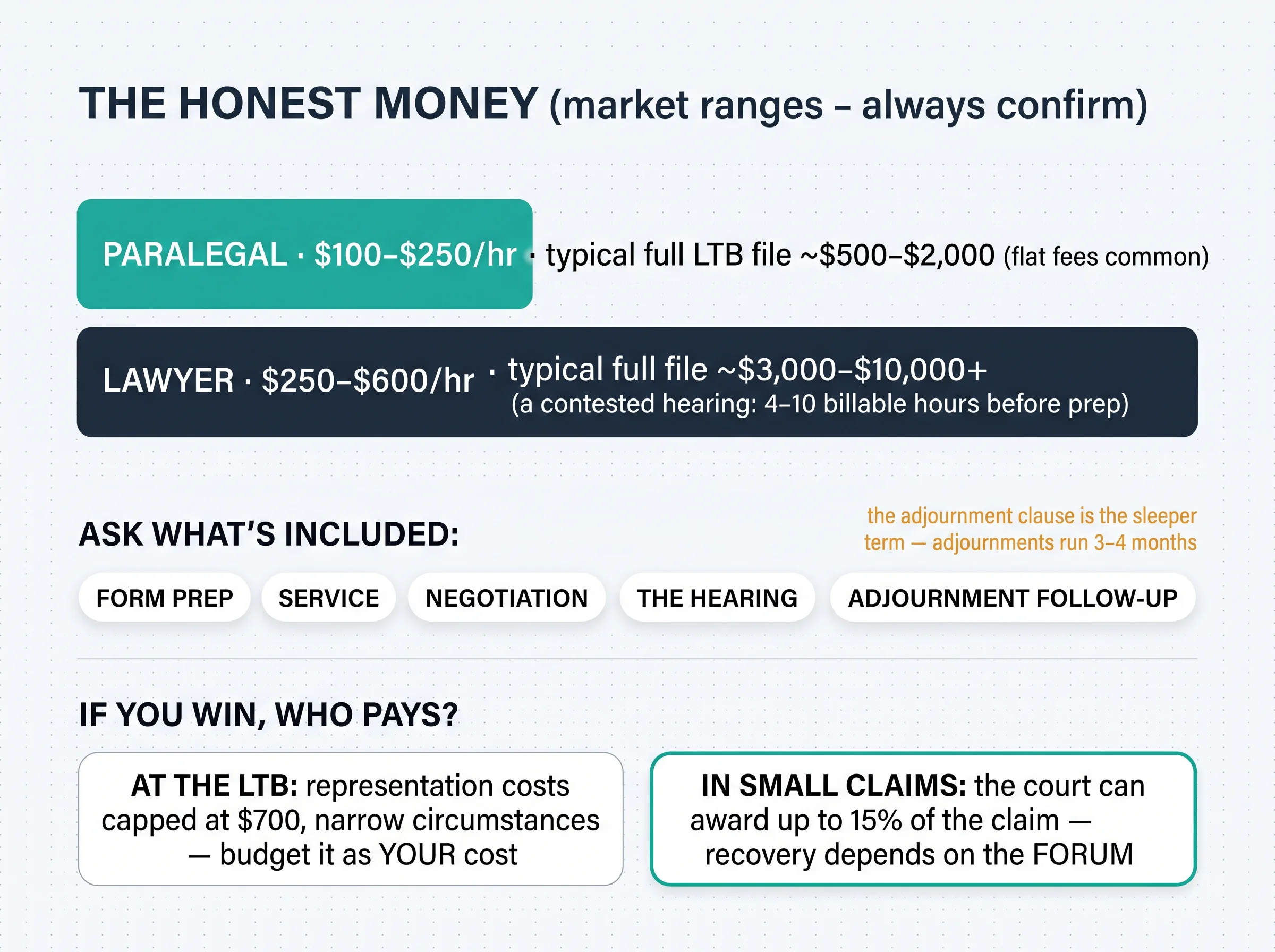
There's also a middle path most people never hear about: limited-scope (unbundled) retainers — paying for coaching, document drafting, or hearing-only representation while self-representing the rest. Ask whether it's offered. Whatever you agree to, get a written retainer before work begins: scope, fees, obligations. And now the signature fact of this whole comparison — the recovery asymmetry. Win at the LTB and you typically recover the filing fee; representation costs are capped at $700, and only in narrow circumstances like the other side's unreasonable conduct. Win in Small Claims Court and the judge can award a representation fee of up to 15% of the claim. Recovery depends on the forum, not the effort — so budget LTB representation as your own cost, and factor the forum into any money-claim strategy (the L10 world, where claims can live in either lane). Finally, run the real denominator: the fee is never the real number. The months of rent or housing riding on file quality are — and as our backlog guide showed, a dismissal-and-refile costs the whole queue again. The honest cost-benefit is fee weighed against stakes and the probability shift good representation buys, not fee alone.
The Specialist Test and the Three Seats
Now the depth axis, stated honestly in both directions. An LTB-focused paralegal lives in that tribunal every day — adjudicator tendencies, procedural shortcuts, the arguments that land, every form error already seen a hundred times. Within scope, that specialist is often better equipped than a generalist lawyer who visits the Board twice a year; multiple independent sources converge on exactly this point. But the inversions are just as real: housing-specialist lawyers and clinic lawyers carry the same tribunal depth plus court reach, and a paralegal who merely dabbles at the LTB has neither the depth nor, often, the price advantage. Which yields the test that beats every title: the real test is the practitioner, not the profession. How often are you at the LTB? At which regions? What outcomes on files like mine?
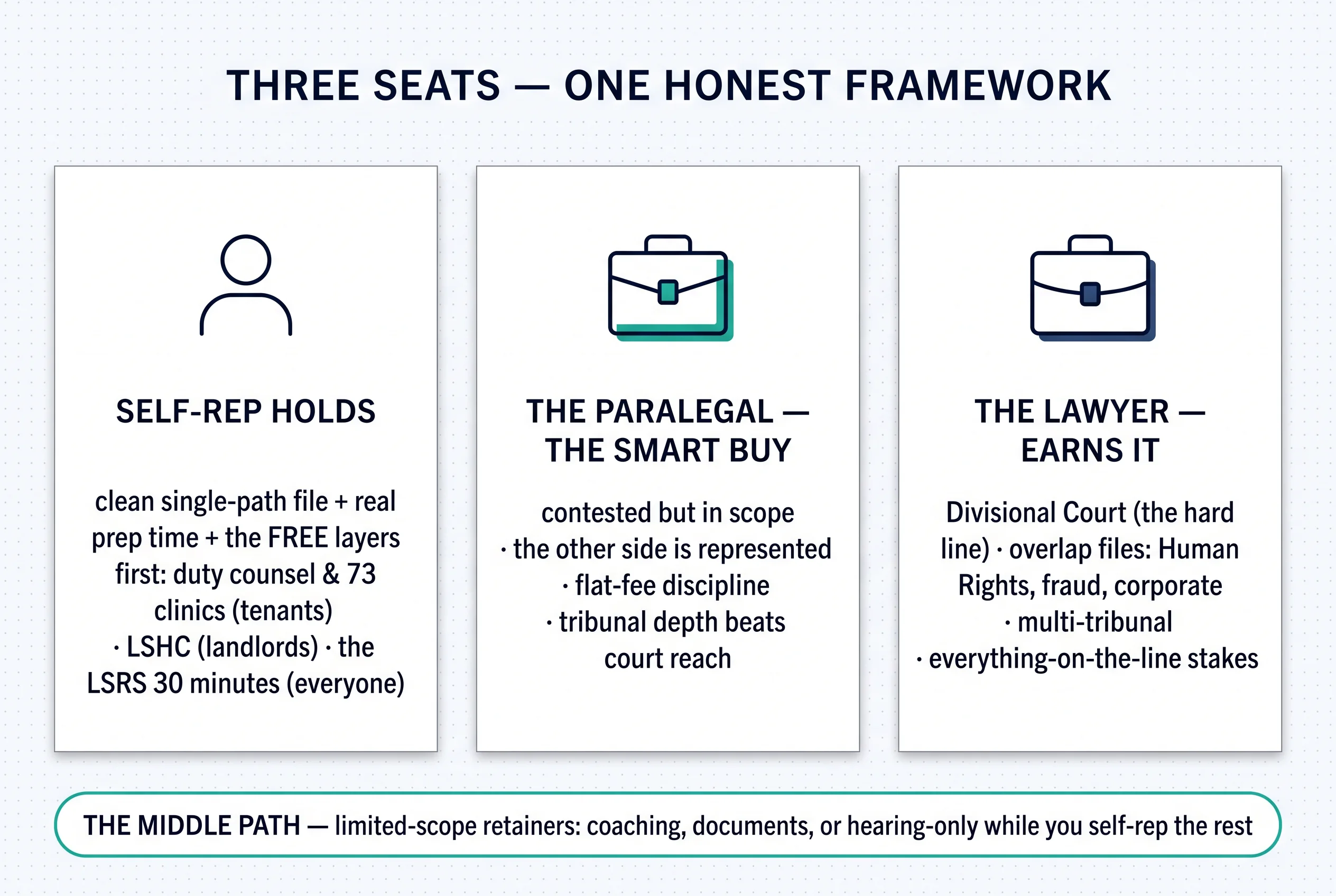
The framework, then, has three seats. Seat one — self-rep holds: a clean single-path file (an N4→L1 on a reconciled ledger, an L3 on a signed N9) plus real preparation time, backed by the free layers — tenants have Duty Counsel and 73 community legal clinics, small landlords have the Landlord's Self-Help Centre, and everyone has the Law Society Referral Service's free 30-minute consult. Sometimes the free layer is the answer: the tenant who books the LSRS consult intending to hire and leaves with a duty-counsel plan and a payment-plan budget has answered the hire question for $0. Seat two — the paralegal is the smart buy: contested-but-in-scope files, hearings where the other side is represented, volume landlords wanting flat-fee discipline — anywhere tribunal depth beats court reach. Picture the small landlord with a clean arrears file choosing between a $900 flat fee and a $6,000 retainer: the lawyer's quote wasn't wrong, just mis-fitted. Seat three — the lawyer earns it: Divisional Court (the hard line), overlap files, multi-tribunal matters, and everything-on-the-line stakes that justify court-grade advocacy. The T2 harassment claim entangled with a Human Rights application and a fraud allegation is a lawyer's file — and when the paralegal who took the first call refers it up, that's not a failure; honest referral in either direction is a quality signal. One timing note ties the seats together: since July 1, the review window at the Board is 15 days (either licence can run it) while the Divisional Court appeal window is 30 (lawyer only) — on a file with a genuine legal error, the smart play is the two-clock scramble: review filed at the Board while the appeal consultation runs in parallel.
The Diligence Protocol (and the Fall That's Coming)
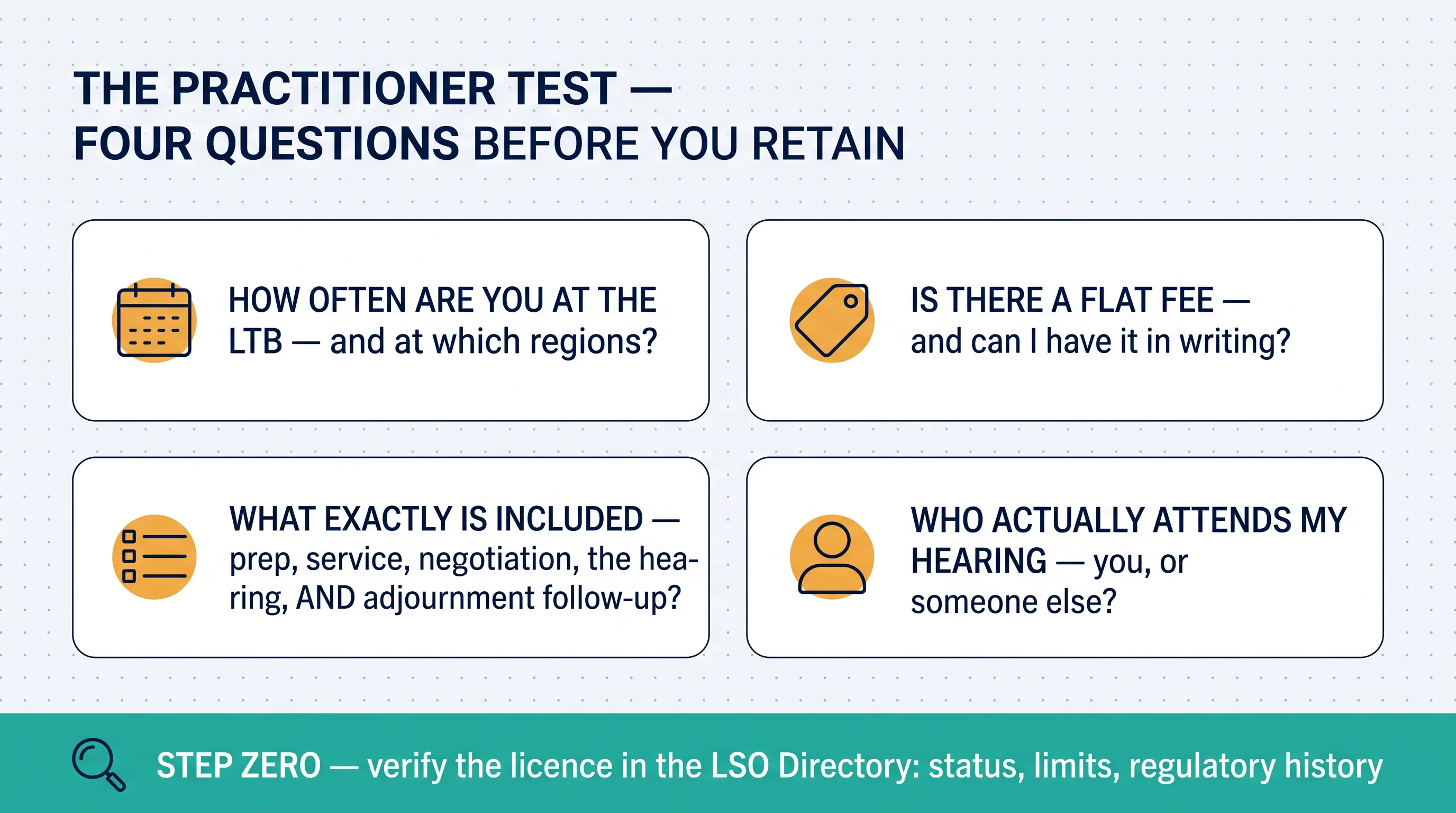
Whoever you're leaning toward, run five steps before retaining anyone. One: verify the licence in the LSO Lawyer and Paralegal Directory — status, practice limits, regulatory history (and expanded transparency fields arrive September 1, 2026). Not listed? Walk away and report it. Two: ask the four questions — how often are you at the LTB, and at which regions? Is there a flat fee, in writing? What exactly is included — through adjournments? And who actually attends my hearing? Three: written retainer before work begins. Four: know the protections behind both licences — the Complaint Service, the Compensation Fund, mandatory insurance — none of which exists behind an unlicensed provider. Five: start free — the Law Society Referral Service offers up to 30 minutes with a lawyer or paralegal at no cost (lsrs.lso.ca or 1-800-268-8326, with language requests supported).
A note for property managers, continuing a line from the landlord's edition: signing notices and managing files is fine, but hearing advocacy for multiple owner-clients is licensed work — buy it licensed, or your client pays for the standing challenge at the worst possible moment. And a note on timing for everyone: September 21 brings the Bill 60 changes — the 7-day N4 and the s. 82 pay-in gate — which means faster landlord filings, more separate tenant applications, busier contested calendars, and, in all likelihood, more demand for representation on both sides of the room. Decide your framework now, not in the queue.

Practical Takeaways
- Free layers first — duty counsel and clinics for tenants, the LSHC for small landlords, the LSRS 30 minutes for everyone.
- Map the file to a seat: clean = self-rep, contested-in-scope = paralegal, Divisional Court / overlap / high-stakes = lawyer.
- Verify every licence in the LSO Directory before the first dollar.
- Ask the four questions — and make "what's included if it's adjourned?" non-negotiable.
- Get the retainer in writing; ask about limited-scope options.
- Do the forum math: $700 capped at the Board versus up to 15% of the claim in Small Claims.
- Pre-plan the after-order clocks: 15-day review (either licence), 30-day appeal (lawyer).
The LTB Hiring Kit: Paralegal, Lawyer, or Neither — the Seat-Mapper, the Four Questions, and the Honest Money
At the LTB, both licences carry the same regulator, insurance, and right to appear — so the hiring decision is scope, depth, and fee structure, never prestige. This free kit maps your file to the right seat, gives you the licence check and the four questions to ask before retaining anyone, and runs the honest money: market ranges, the what's-included trap, and the $700-vs-15% recovery math.
Get Free PDF →The Bottom Line
At the Board, the licence question has a calmer answer than the marketing suggests. Both professions are regulated, insured, and accountable to the same body. The paralegal's edge is depth and price inside the tribunal; the lawyer's is reach beyond it and command of the overlap; and the one hard line — Divisional Court — draws itself. So hire the practitioner, not the title: verified in the Directory, questioned on frequency and inclusions, retained in writing, with the hearing and its adjournments inside the price. And keep the sequence that runs through this whole series: free layers first, limited scope where it fits, full representation where the stakes demand it. General information, not legal advice. Next in this series: the wait after the order — the Sheriff — and then the pillar guide that maps the whole LTB process end to end.
Whoever Presents It, the File Decides It
Self-rep, paralegal, or lawyer — Tenon10 keeps the ledger, the documents, and every deadline hearing-ready for whoever stands at your podium.
Free • No signup required • Updated for the Bill 60 changes in force 21 Sep 2026
Related Resources
- Representing Yourself at the LTB: The Landlord's Edition — the seat-one manual for landlords: the file, the clocks, and the day itself.
- Representing Yourself at the LTB: The Tenant's Edition — the tenant's seat-one manual, including the free-help map this guide builds on.
- The LTB Backlog: Real Wait Times and How to Protect Your Case — the queue math behind the real denominator: what a dismissed file actually costs.
- L1 vs L2 LTB Applications: Understanding the Difference — pick the right application before pricing anyone to run it.
- The L10 Application: Collecting Money a Former Tenant Owes — where the forum math matters most: claims that can live at the Board or in Small Claims.
- Ontario Rental Law Changes Coming July 1 and September 21, 2026 — the timeline behind the 15-day review and the September demand surge.
- The Ontario LTB Forms Hub — whichever seat you choose, the file starts here.
Frequently Asked Questions
Should I hire a paralegal or a lawyer for an LTB hearing?
For matters inside the Board, both are fully licensed to represent you, and an LTB-focused paralegal is often the better-fitted, better-priced choice — typically $500–$2,000 flat-fee versus $3,000–$10,000+ at lawyer rates. A lawyer becomes the right call when the file involves a Divisional Court appeal, overlapping claims (Human Rights, fraud, corporate issues), or stakes that justify court-grade advocacy. The honest test is the practitioner: how often do they appear at the LTB?
How much does a paralegal cost for an LTB matter in Ontario?
Market ranges: roughly $100–$250 per hour, with most discrete LTB tasks quoted flat-fee — commonly $500–$2,000 for a full file depending on complexity. Always ask what's included: form preparation, service, negotiation, hearing attendance, and follow-up if the matter is adjourned. A low headline price that excludes the hearing itself is not a bargain.
Can a paralegal appeal an LTB decision?
A paralegal can seek a review of the order at the Board itself (now within 15 days, on grounds set by regulation). But an appeal to Divisional Court — questions of law, within 30 days — is lawyer territory: formal court rules, factums, and strict procedure. The moment the file leaves the Board, the licence question answers itself.
If I win at the LTB, does the other side pay my legal fees?
Almost never. You typically recover the filing fee, and representation costs are capped at $700 in narrow circumstances. Contrast Small Claims Court, where a winner can be awarded a representation fee of up to 15% of the claim — recovery depends on the forum, not the effort. Budget LTB representation as your own cost.
How do I check whether someone is actually licensed?
Search the LSO Lawyer and Paralegal Directory — it shows licence status, any practice limits, and regulatory history (with expanded transparency fields from September 1, 2026). If the person isn't listed, don't hire them, and report the concern to the Law Society: unlicensed paid representation is illegal and carries no insurance, no complaints process, and no compensation fund.
Is there a free way to get advice before deciding?
Yes — several. The Law Society Referral Service offers a free consultation of up to 30 minutes with a lawyer or paralegal (lsrs.lso.ca or 1-800-268-8326, with language requests). Tenants also have Tenant Duty Counsel on hearing day and 73 community legal clinics; small landlords have the Landlord's Self-Help Centre. Exhaust the free layers first — they may answer the hire question for $0.


