

The most expensive misunderstanding in Ontario's eviction process happens after the landlord wins. An LTB eviction order is not possession — it's a ticket to another queue. Only the Court Enforcement Office (the Sheriff) can physically enforce it, the Sheriff's calendar runs roughly two to eight weeks behind depending on region, and the order itself effectively expires if it sits in a drawer for six months.
The final mile has its own clocks, fees, and rules that almost nobody explains until they're standing in them: the filing package and where it goes, the wait, the day itself (which the landlord cannot miss), the 72-hour belongings rule with its five-figure penalties — and, on the tenant's side, three conditions that can still stop everything. This guide covers the whole after-the-order world from both chairs: the enforcement playbook, the honest costs, eviction day step by step, the 72-hour rule done right, the stop conditions, and Bill 60's least-covered fix — temporary enforcement officers aimed at exactly this stage. It completes the timeline this series has been building: notice → application → the queue → the hearing → the order → the Sheriff. General information, not legal advice.
The After-the-Order Kit: The Sheriff, the Two Clocks, and Eviction Day
An LTB eviction order is not possession — only the Sheriff can enforce it, the queue runs 2–8 weeks, and the order expires in six months. This free kit covers the final mile for both sides: the two clocks to diarize the day the order arrives, the filing package and the real costs, eviction-day discipline, the 72-hour belongings rule with its five-figure penalties, and the three things that can still stop everything.
Get Free PDF →Only the Sheriff (No Exceptions, No Shortcuts)
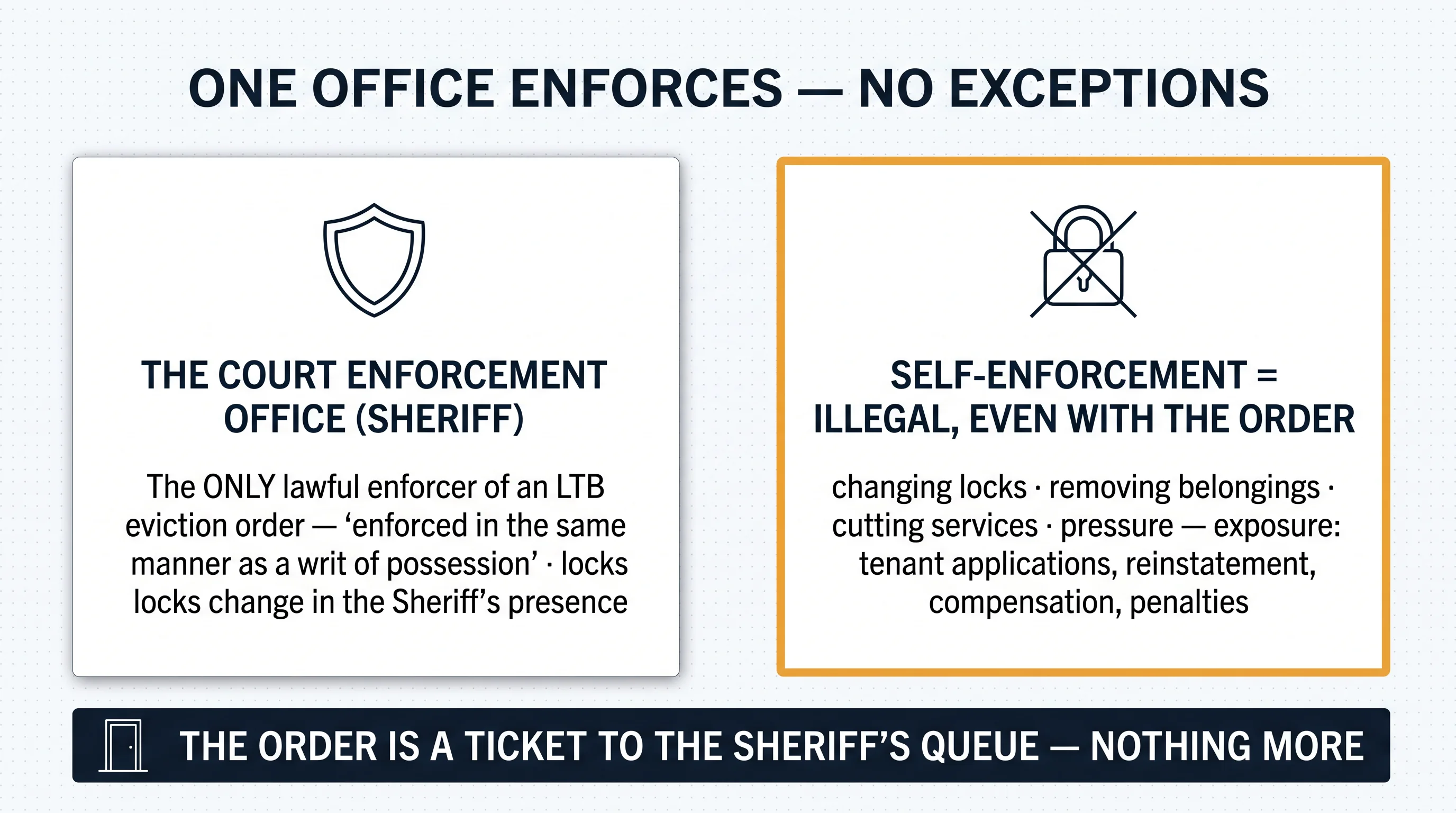
Start with the rule everything else hangs on. The Residential Tenancies Act provides that an eviction order "shall have the same effect, and shall be enforced in the same manner, as a writ of possession" — which means it is enforced by the Court Enforcement Office of the Superior Court of Justice, colloquially the Sheriff, and by no one else. Not the landlord. Not a property manager. Not a private security company. One office holds the authority, full stop.
This is the trap that catches winners. Self-enforcement is illegal even with the order in hand — changing the locks, moving the tenant's belongings, shutting off services, or pressuring the tenant out are all unlawful at every stage of the process, order or no order. The exposure is real: tenant applications (a T2 for illegal lockout runs in the LTB's urgent lane, heard in roughly five to six weeks), potential reinstatement of the tenancy, compensation, and penalties. The order is a ticket to the Sheriff's queue — nothing more. And the mirror rule for tenants is just as absolute: a lockout without a Sheriff is illegal no matter what stage the file is at; if it happens, it's an emergency T2 and a call to the Rental Housing Enforcement Unit.
Why does the system work this way? Because a neutral officer at the door protects everyone — including the landlord. Possession handed over by the Sheriff is unimpeachable: no dispute about the manner of the eviction, no counterclaim about force or timing, no cloud over the unit. The landlords who resent the queue the most are often the ones the queue protects the best.
Filing, the Money, and the Wait
The order states a termination date. If that date passes with the tenant still in place, the filing window opens the next day — and the practitioner's speed move is to be ready before it does: email the enforcement office in advance to confirm the exact fee and any local requirements, so the package can go in the day the window opens. Where you file matters as much as when: the order goes to the Court Enforcement Office with territorial jurisdiction over the unit (the Ministry of the Attorney General's locator finds it), and the wrong office is a restart. The package itself is short: one certified copy of the LTB order, a copy, the completed Eviction Information Request Sheet, and payment.
The honest money: a filing fee, plus a flat enforcement fee commonly cited in the $318–$333 range, plus a per-kilometre mileage charge from the courthouse to the unit, plus your locksmith — and a cancelled attendance is billed all over again. Then the signature fact of this entire stage, the quietest deadline in the process: the six-month clock. File the order with the Sheriff within six months of issuance, or go back to the Board and reapply. Picture the landlord who wins in March, decides to "wait for spring cleaning," and walks into the enforcement office in October — outside the window, back to the queue that took months the first time. The discipline is simple: diarize both clocks the day the order arrives — day 15, when the review window closes and the stay risk largely ends, and month 6, when the enforcement right expires.
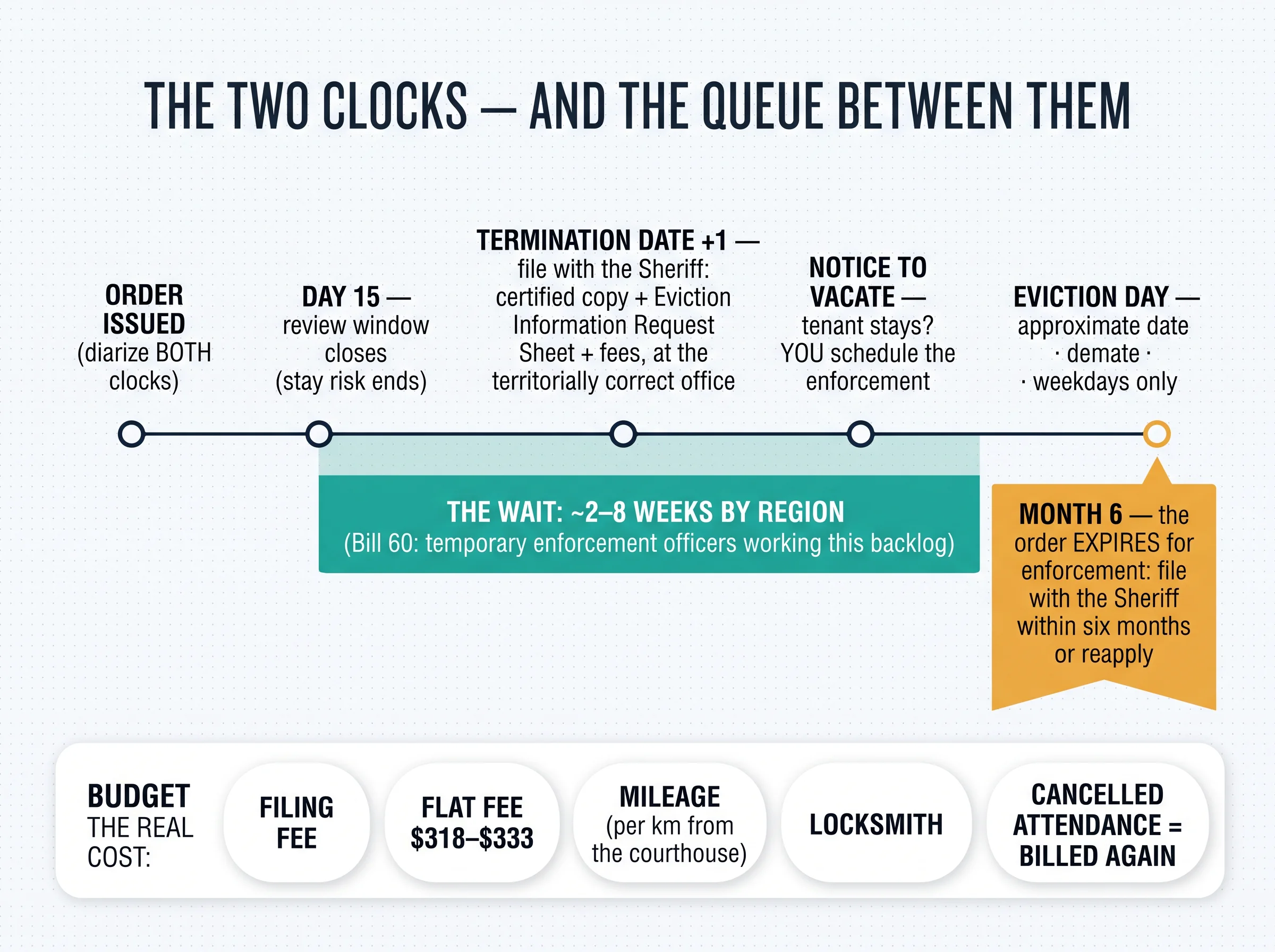
Once filed, the sequence runs like this: the office issues a Notice to Vacate with a vacate date (both parties receive instructions — follow them exactly). If the tenant stays past that date, the landlord must contact the office to schedule the physical enforcement — it doesn't happen automatically — and the office provides an approximate date and time. The wait is regionally variable, typically two to eight weeks depending on how busy that enforcement office is, and enforcements happen on weekdays only. One genuinely under-reported development helps here: among the Bill 60 changes, the province is adding temporary enforcement officers specifically to work down the eviction-enforcement backlog — the least-covered fix in the entire bill, aimed at exactly this final stage. Paired with the shortened 15-day review window, the path from order to Sheriff is structurally shorter than it was a year ago.
Eviction Day — and the 72 Hours After
Eviction day is an appointment the landlord cannot miss. The landlord (or an agent) must be present to give the Sheriff access to the unit — no access means the eviction is cancelled, the fees are billed again, and the file goes back into the queue for weeks. Picture the landlord stuck in traffic with no agent on site and no locksmith booked: the Sheriff leaves, and the whole wait starts over. The rest of the day's discipline is short: a locksmith standing by (locks are changed in the Sheriff's presence, not before); a plan for pets (the Humane Society or SPCA, if the enforcement office hasn't arranged it); and for the landlord — document the unit's condition immediately with dated photos or video, let the Sheriff handle anyone who refuses to leave, and say little. Possession passes when the enforcement is executed.

For a tenant facing the day, the practical list is just as concrete, and it matters more with each passing hour: pack documents, ID, medication, and essentials first; photograph your belongings and the locks; arrange transport or storage; and call your community legal clinic or the duty-counsel lines early — the stop conditions in the next section narrow quickly once the Sheriff has attended.
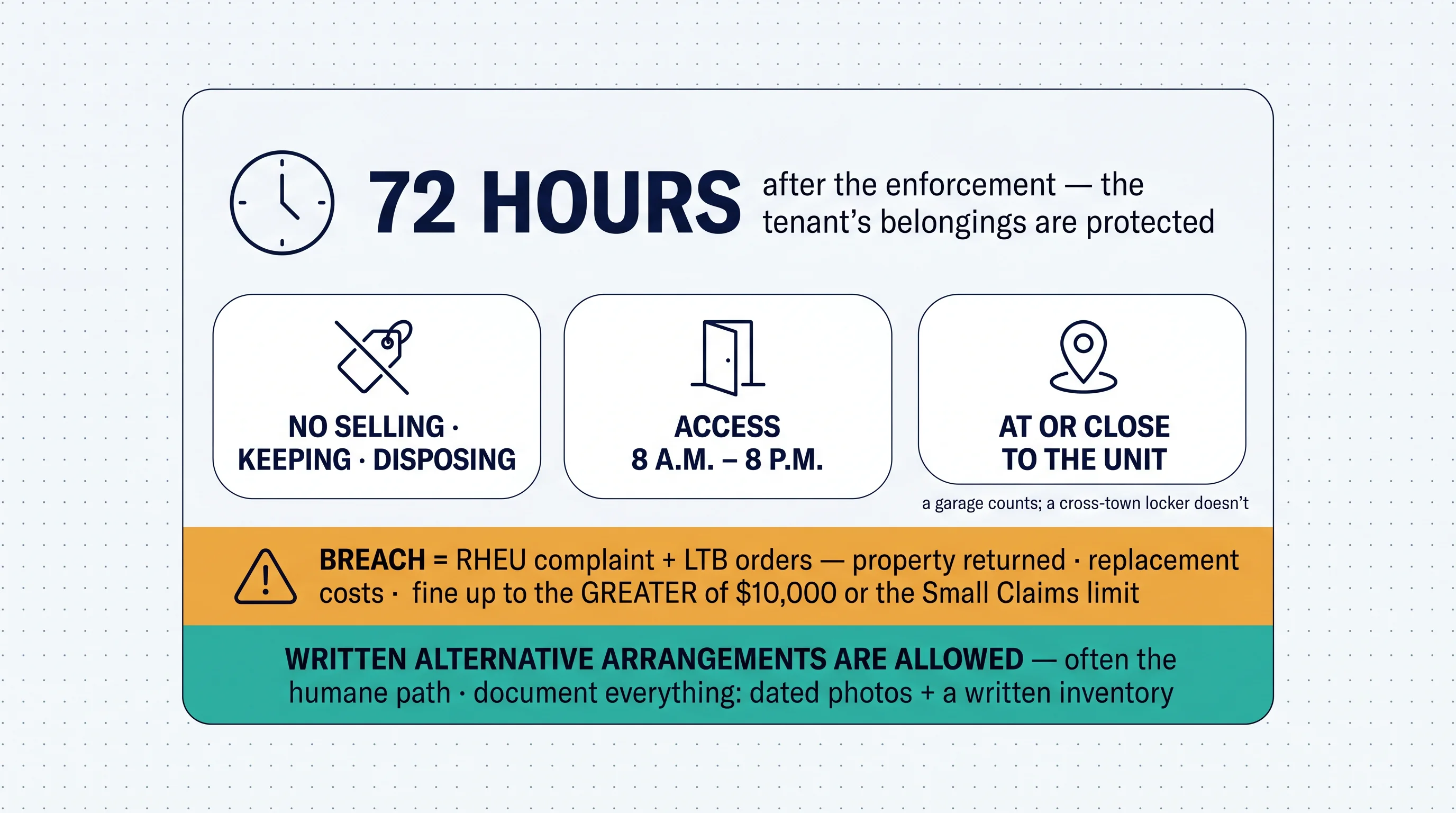
Then come the 72 hours that decide whether a won case stays won. Under section 41 of the RTA, for 72 hours after the enforcement, the landlord cannot sell, keep, or dispose of the tenant's property — and must make it available for retrieval between 8 a.m. and 8 p.m., at the rental unit or a location close to it. A garage on the property counts; a storage locker across town doesn't. The parties can agree in writing to different arrangements — a set appointment, a longer window, a storage handoff — and that written path is often the calmest and most humane option for both sides.
One more separation to keep clean: possession and collection are different problems. The Sheriff returns the unit; the Sheriff does not collect the money. Arrears and damages live in their own lanes — enforcing the order's monetary terms through Small Claims processes, or the L10 application for money a former tenant owes.
What Can Still Stop It (and Where This Is Heading)
Three things can still stop a scheduled enforcement — and both sides should know all three, because each one has a clock. Stop one: payment. On arrears orders, paying everything owed plus the landlord's filing fee before the order is executed voids the eviction and saves the tenancy. Orders carry a pay-to-void window (commonly around eleven days), but the escape hatch genuinely runs to the courthouse steps: a tenant who pays in full two days before the scheduled enforcement keeps their home — and a landlord who keeps clean records of the payment and the Sheriff cancellation keeps their file unimpeachable. Stop two: a stayed review. A Request to Review filed within 15 days can include a stay request, and if granted, the enforcement office cannot act while it runs. Since July 1, the grounds are enumerated by regulation — the review lane rewards precision and speed, or nothing. Stop three: the Divisional Court appeal. An appeal on questions of law, filed within 30 days, triggers an automatic stay — the certificate of stay is delivered to the Sheriff's office, and the eviction freezes until the stay is lifted. As our hiring guide explains, that lane is lawyer territory — paralegals cannot appear at Divisional Court. A landlord facing a day-22 certificate of stay isn't out of moves either: fast responding materials, an early case conference, and a request for interim terms (like ongoing rent payment while the appeal runs) are the counter-play.
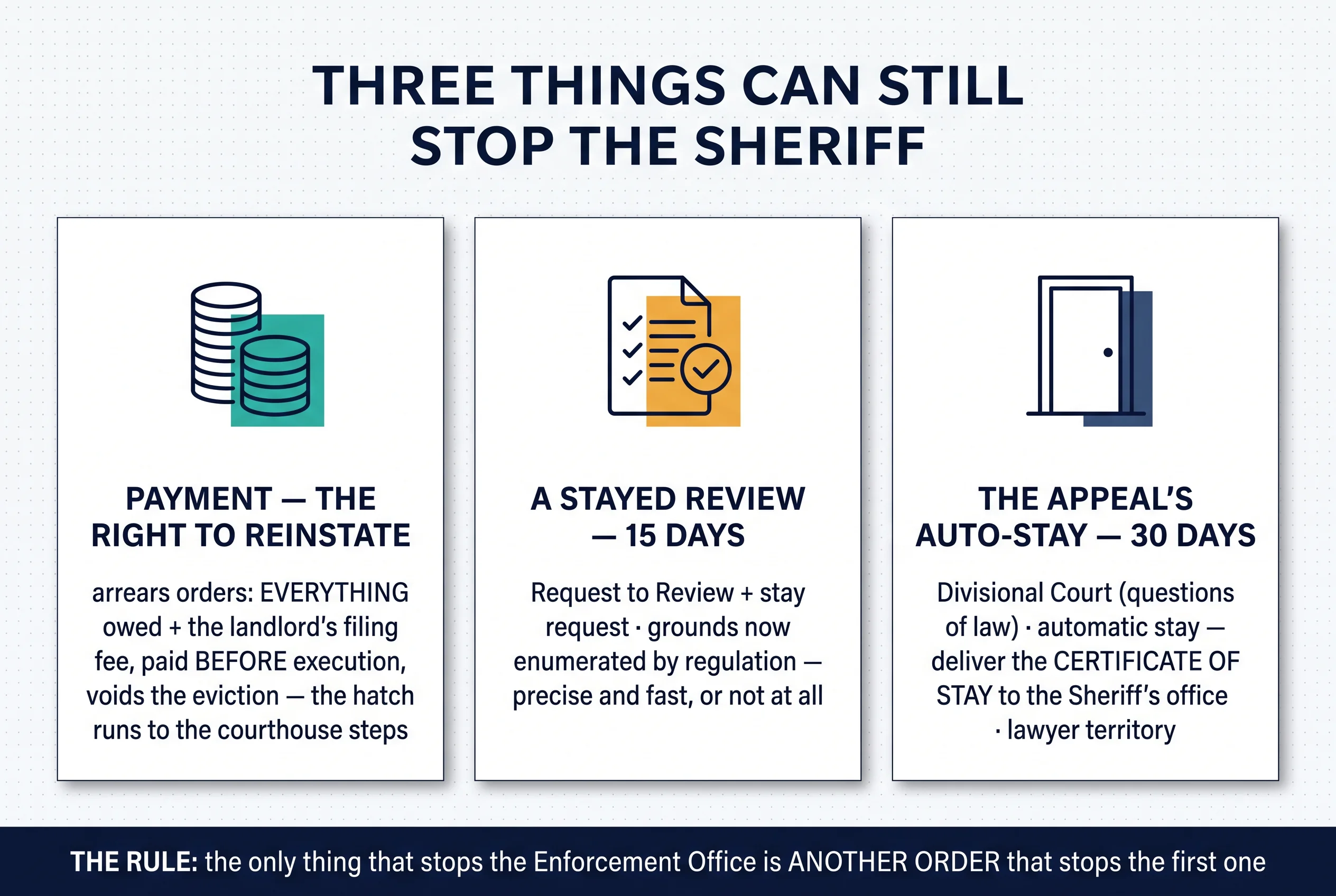
The Federation of Metro Tenants' Associations puts the organizing rule plainly: once an eviction order exists, the only thing that will stop the Enforcement Office is another order that stops the first one. That rule is worth internalizing on both sides — hopes, arguments, and phone calls don't stop a scheduled enforcement; payments, stays, and orders do. And the direction of travel is clear: Bill 60 created regulation-making authority for prescribed criteria governing when adjudicators can postpone evictions and when set-asides can be granted — the discretion that once allowed open-ended delays is being framed by rule. Add the temporary enforcement officers working the backlog and the September 21 volume changes upstream, and the after-order period is becoming shorter and more mechanical. For everyone, the lesson is the same: decide and act inside the windows, because the windows are what's left.
Practical Takeaways
- Never self-enforce — with or without an order. Only the Sheriff changes possession.
- Diarize both clocks the day the order arrives: day 15 (review window) and month 6 (enforcement expiry).
- File the full package — certified copy + Eviction Information Request Sheet + fees — at the territorially correct office the day the window opens.
- Budget the real cost: flat fee + per-km mileage + locksmith + a possible re-attendance.
- Treat eviction day as an unmissable appointment: presence, locksmith, a plan for pets, dated photos, few words.
- Run the 72 hours by the book: access 8-to-8, at or close to the unit, written inventory, dated photos — nothing sold or tossed early.
- Tenants: assess the three stops the day the order arrives — payment before execution, a stayed review in 15 days, the appeal's auto-stay in 30 (with a lawyer).
The After-the-Order Kit: The Sheriff, the Two Clocks, and Eviction Day
An LTB eviction order is not possession — only the Sheriff can enforce it, the queue runs 2–8 weeks, and the order expires in six months. This free kit covers the final mile for both sides: the two clocks to diarize the day the order arrives, the filing package and the real costs, eviction-day discipline, the 72-hour belongings rule with its five-figure penalties, and the three things that can still stop everything.
Get Free PDF →The Bottom Line
The order is the beginning of the last chapter, not the end of the story. One office enforces; two clocks run; one day cannot be missed; seventy-two hours must be honoured; and three doors can still stop everything. Landlords who treat the final mile with the same discipline as the hearing get possession cleanly — and keep it unimpeachable. Tenants who know the stop conditions and the 72-hour rights lose less in the hardest week of the process. Everything here is general information, not legal advice — and the day-specific details, fees, and waits are always worth confirming with your local enforcement office before you rely on them. Next in this series, the finale: the pillar guide that maps the entire LTB process end to end.
The After-Order File Is Still a File
The order, the two clocks, the receipts, the photos, the inventory — Tenon10 keeps the final mile as organized as the hearing that won it.
Free • No signup required • Updated for the Bill 60 changes in force 21 Sep 2026
Related Resources
- The LTB Backlog: Real Wait Times and How to Protect Your Case — the queue before this one: what the hearing wait actually looks like in 2026.
- Representing Yourself at the LTB: The Landlord's Edition — the hearing playbook that produces the order this guide enforces.
- Representing Yourself at the LTB: The Tenant's Edition — the tenant's hearing manual, including the free-help map to call the day an order arrives.
- Paralegals vs Lawyers at the LTB: Who to Hire, and When — why the Divisional Court stay is lawyer territory, and how to hire for it.
- The L10 Application: Collecting Money a Former Tenant Owes — possession is not collection: the money lane after the Sheriff returns the unit.
- Ontario Rental Law Changes Coming July 1 and September 21, 2026 — the Bill 60 timeline behind the 15-day review and the enforcement-stage fixes.
- 5 Things Your Landlord CAN'T Do in Ontario — the tenant's baseline: lockouts without a Sheriff are illegal at every stage.
Frequently Asked Questions
How long does the Sheriff take after an LTB eviction order?
After the landlord files the order with the Court Enforcement Office, the Sheriff issues a Notice to Vacate; if the tenant stays, the landlord schedules the enforcement. Regional queues typically add about 2–8 weeks, and enforcements happen on weekdays only. Bill 60 is adding temporary enforcement officers to work down exactly this backlog.
Can a landlord change the locks after getting an eviction order?
No — not until the Sheriff enforces it. An eviction order must be enforced like a writ of possession, by the Court Enforcement Office only. A landlord who changes locks, removes belongings, or cuts services — even with an order in hand — faces tenant applications, potential reinstatement, and penalties. Locks change in the Sheriff's presence, on enforcement day.
What happens to a tenant's belongings after a Sheriff eviction?
For 72 hours after enforcement, the landlord cannot sell, keep, or dispose of the tenant's property, and must make it available for retrieval between 8 a.m. and 8 p.m. at or close to the unit. Breaching this can mean orders to return property, pay replacement costs, and an administrative fine up to the greater of $10,000 or the Small Claims limit. After 72 hours honoured properly, disposal becomes lawful.
How can a tenant stop a Sheriff eviction in Ontario?
Three ways: pay everything owed plus the landlord's filing fee before the order is executed (arrears files — this voids the eviction); win a stay alongside a Request to Review filed within 15 days on the regulation's grounds; or file a Divisional Court appeal within 30 days, which triggers an automatic stay — deliver the certificate of stay to the Sheriff's office. The appeal requires a lawyer.
How much does the Sheriff cost for an eviction?
Expect a filing fee plus a flat enforcement fee — commonly cited in the $318–$333 range — plus a per-kilometre mileage charge from the courthouse to the unit, and your locksmith. A cancelled attendance (for example, if the landlord isn't there to provide access) is billed again. Email your local enforcement office for the exact amount before filing.
Does the eviction order expire?
Effectively, yes — the landlord must file it with the Sheriff within six months, or go back to the Board and reapply. Diarize that deadline the day the order arrives, alongside the 15-day review window.


