

Here is something most tenants walking into a Landlord and Tenant Board hearing don't know: your chair comes with free help. A Legal Aid lawyer is stationed at most hearing blocks specifically for tenants — no appointment, no cost — and 73 community legal clinics across Ontario give free housing-law advice before the day ever arrives. And here is the second thing: none of it finds you. You claim it, or you go in alone.
Self-representation is how most tenants appear at the Board, and it's completely workable — but it runs on quiet deadlines that don't announce themselves: the 7-day disclosure that decides whether your repair evidence is heard at all, the payment-plan proposal that routinely converts evictions into conditional orders, a September rule change that closes a useful lane behind a 50% gate, and after-the-order clocks that now run in 15 and 10 days. This guide maps all of it: the free-help layers (and the exact sentence to say if your file is called early), the evidence machine, the arrears playbook built on arithmetic rather than pleas, the access rights almost nobody knows exist — including the Board's loaner-phone program — and the narrowed safety nets after an order. General information, not legal advice; and if you're the landlord in this story, the other chair's edition is here.
The Self-Rep Tenant's LTB Hearing Kit: Claim the Free Help, Serve the Evidence, Bring the Plan
Your chair at the LTB comes with free help — Duty Counsel on the day, 73 legal clinics before it — but none of it finds you. This free kit maps the help layers, the 7-day evidence rule that decides whether you're heard, the payment plan that converts evictions into conditional orders, and the 15- and 10-day clocks after an order.
Get Free PDF →The Free Help Map: Claim It Before You Need It
Layer one, hearing day: Tenant Duty Counsel. These are Legal Aid Ontario–funded lawyers, independent of the Board, available at most hearing blocks — in person at all LTB offices except Sudbury, in virtual hearing rooms, and by phone in parts of Northwestern Ontario. No appointment: sign in 30 minutes before the block starts. Know the triage, because it isn't first-come-first-served — tenants facing eviction and emergencies are seen first. And memorize the golden line: if your file is called before you've had your consult, tell the Member "I'd like to speak to duty counsel before we proceed." Duty counsel can advise you on the spot — and may speak on your behalf at the hearing.
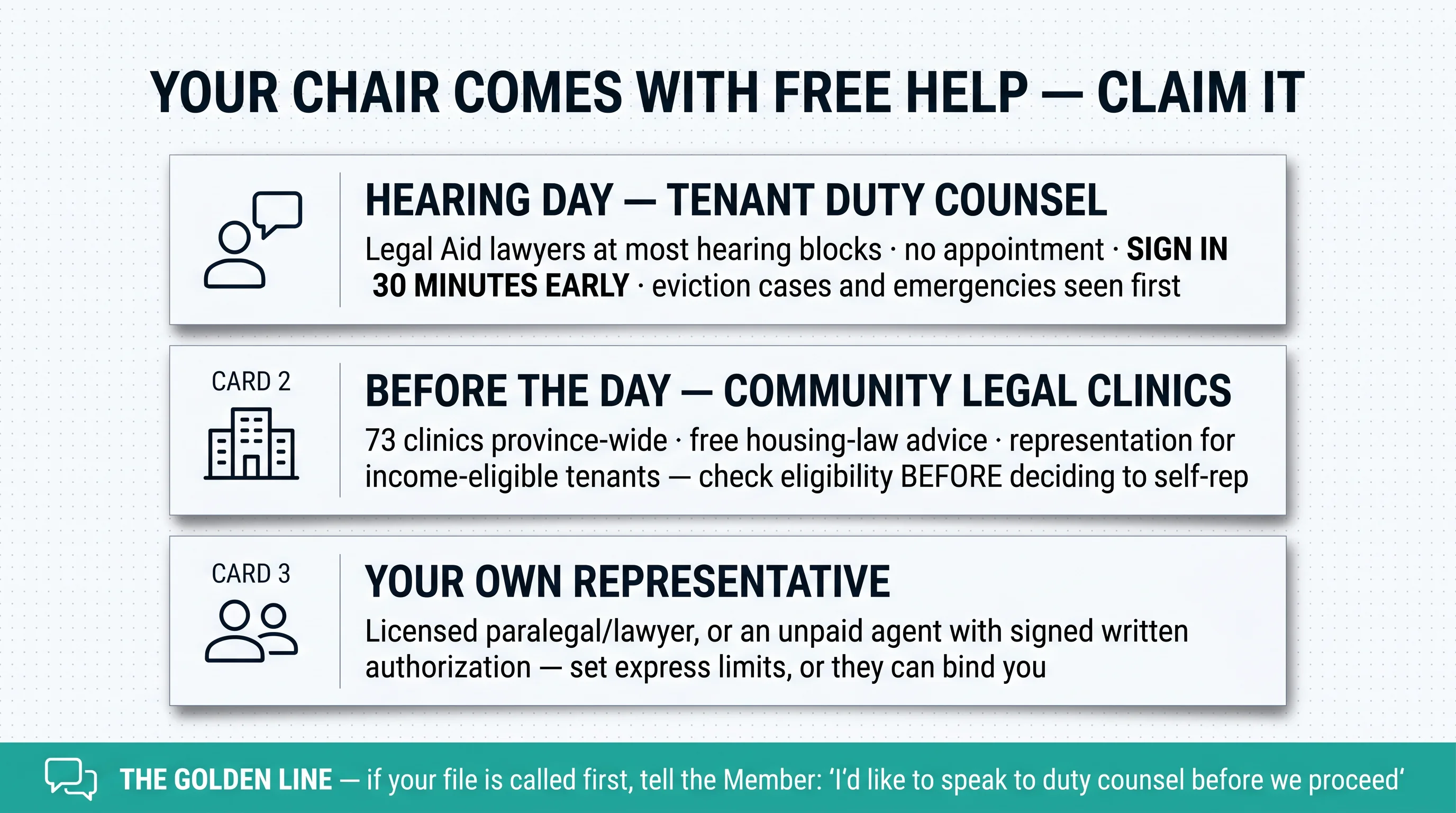
Layer two, before the day: community legal clinics. Legal Aid Ontario funds 73 of them across the province, and housing law is core work — free advice for tenants, and representation for those who are income-eligible. Which produces the first rule of this whole guide: check your clinic eligibility before deciding to self-represent. The seat may come with free counsel. While you're at it, read the ACTO Tenant Tip Sheets (acto.ca, under "For Tenants") — payment plans, mediation, and hearing preparation, written by the Duty Counsel Program itself. Layer three: a representative of your own — a licensed lawyer or paralegal, or an unpaid friend or family member acting as your agent with a signed written authorization filed with the Board. One trap travels with that last option: unless you set express limits in writing, an agent can bind you — including to mediated agreements you never approved. A support person, by contrast, can simply sit with you without any paperwork (but can't also be your witness). One limit applies across all of it: the Member gives procedural guidance only, never advice — the free advice lives in layers one and two. And a note on tone for the day itself: the landlord across the room may well be a self-represented small owner; the Board decides the RTA, not a sympathy contest.
The Evidence Machine and the s. 82 Lane
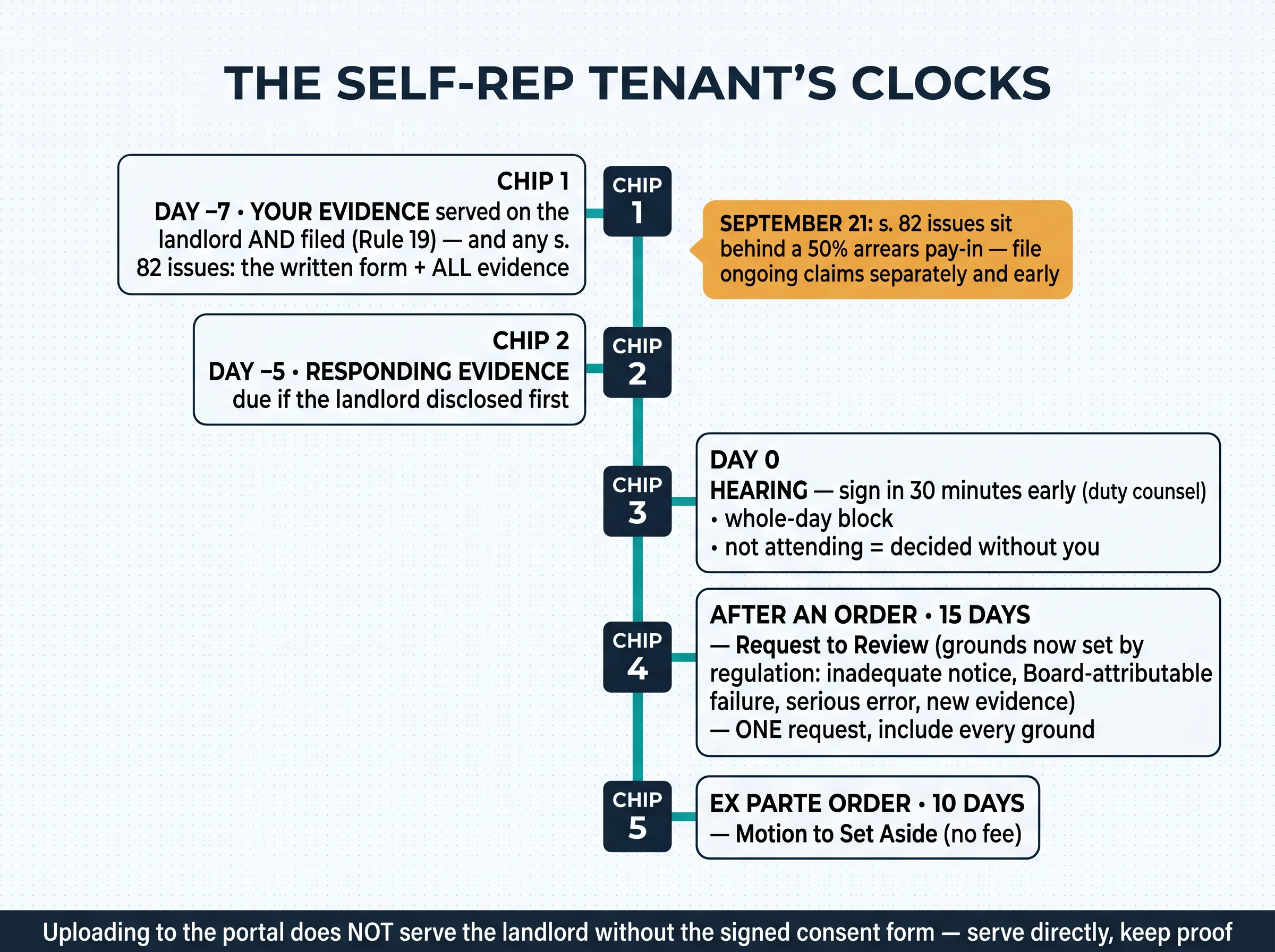
The disclosure clocks are the same ones the landlord faces. If you've filed your own application, your evidence goes to the landlord and the Board at least 7 days before the hearing; responding evidence lands at 5 days. Packages must be readable, page-numbered, and labelled — "Exhibit A: photo of leak under kitchen sink, March 3" beats forty unlabelled images. Phone photos and videos are perfectly good evidence, but they must be playable by you at the hearing — test everything the night before. And the trap that catches both chairs: uploading to the Tribunals Ontario Portal does not serve the other side unless you've both signed the consent form. Serve directly, and keep proof — a Certificate of Service works for evidence too. Late evidence may be excluded, but the discretion is real: late with a written explanation beats never.
Now the lane worth knowing while it's open. Under section 82, at the landlord's arrears hearing you can raise anything you could have filed your own application about — maintenance failures, harassment, illegal charges — and the Member decides everything in one order, with abatements offsetting arrears. The price is disclosure: a written description of each issue plus all your supporting evidence, to the landlord and the Board, at least 7 days before. The optional form ("Issues a Tenant Intends to Raise at a Rent Arrears Hearing") arrives with your Notice of Hearing — use it. Miss the disclosure and the issues aren't heard unless you convince the Member you couldn't comply. And here is the September fork: from September 21, 2026, raising s. 82 issues requires first paying 50% of the arrears claimed. The strategy writes itself — use the lane while it's open, and for genuine ongoing claims, file the T6, T2, or T1 separately and early, so your claim exists regardless of the gate. Picture the mould file: served with the issues form in August, it offsets a chunk of the arrears in one order; the same facts in October sit behind the 50% gate — unless the parallel T6, filed in July, is already alive in the queue.

The Arrears Playbook, the Hearing, and the Rights Nobody Mentions
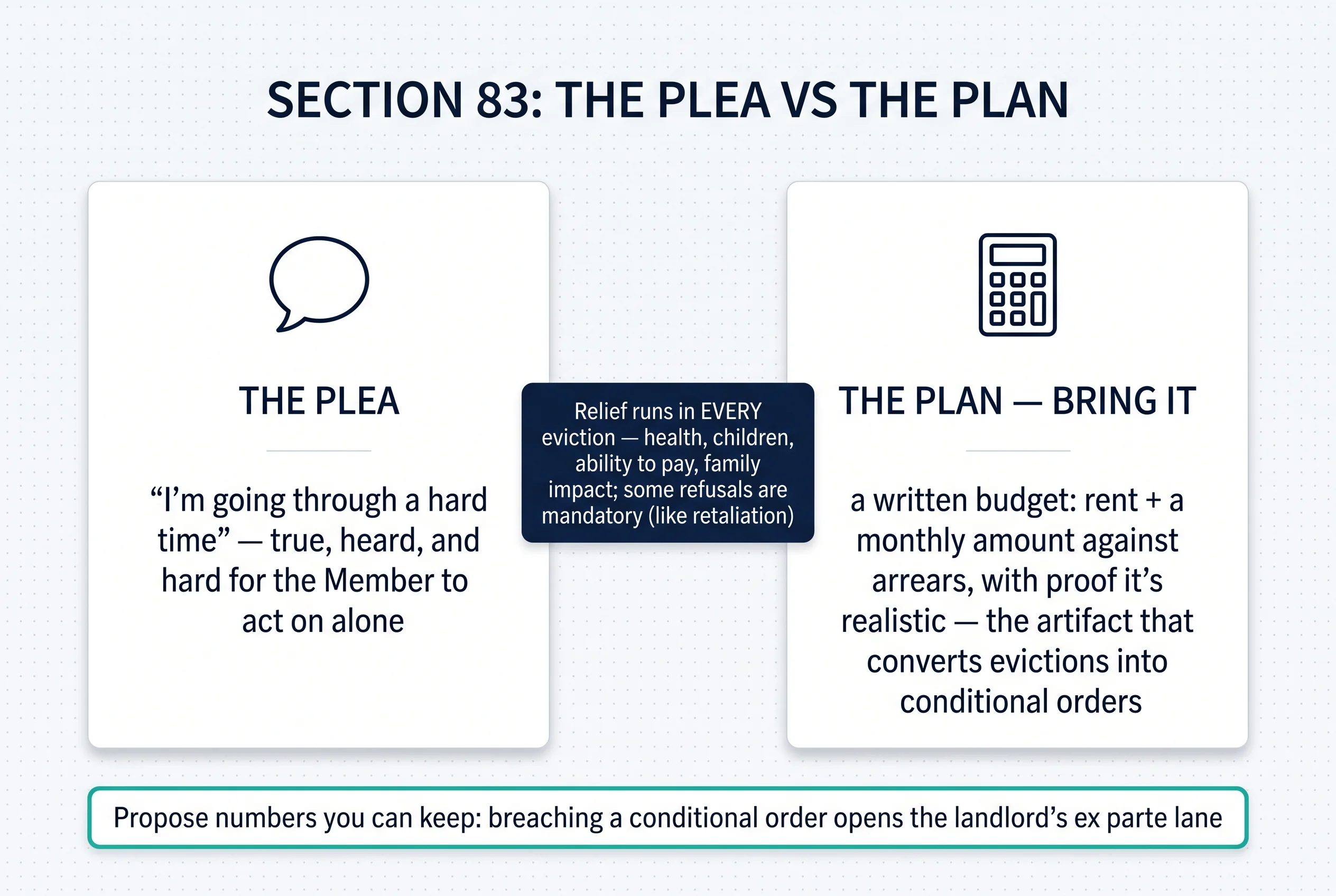
Start from the structure of the thing: the landlord must prove the case — a valid notice, proper service, and a ledger that adds up — and you have the right to question every witness and challenge every number. Check their math against your own records; ledger errors are defences, and landlords fear exactly this scrutiny. Then bring the artifact that changes outcomes. Section 83 requires the Member to consider all your circumstances in every eviction — health, children, ability to pay, how eviction would affect your family — and some refusals are mandatory, like retaliation for asserting your rights. But circumstances land hardest with numbers attached: the best s. 83 story is arithmetic. A written payment-plan budget — rent plus a monthly amount against the arrears, with proof it's realistic — routinely converts an eviction into a section 78 conditional order that lets you stay on terms. Propose numbers you can keep: breaching a conditional order opens the landlord's ex parte lane, with no second hearing first. And remember the late-game escape: paying everything owed plus the landlord's filing fee before enforcement can still stop an arrears eviction — though earlier is always cheaper. If filing fees themselves are the barrier, tenants receiving OW, ODSP, or OAS-with-GIS may qualify for a fee waiver.
Hearing day runs on attendance discipline. Join early — video 30 minutes ahead, phone 15, in person 30 (and find duty counsel) — and plan for the whole day, because hearings run in blocks: step away and get called, and it proceeds without you; don't attend at all, and it's decided in your absence, with only narrow recovery paths waiting. Present in chronology — dates, documents, receipts, not grievances. If mediation is offered, know its nature: voluntary, confidential, and binding if agreed — have duty counsel review any proposed agreement before you sign it.
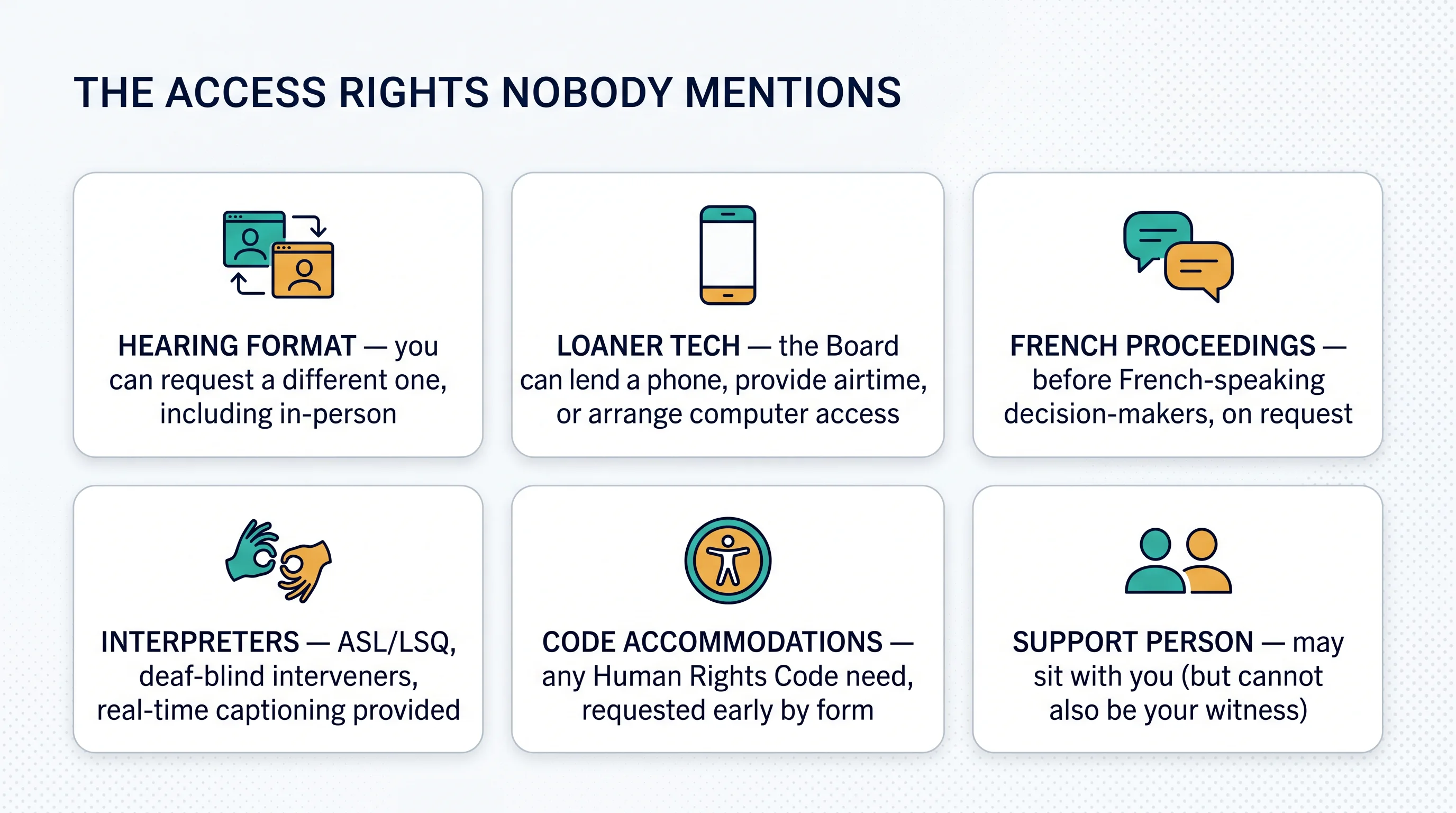
And then there are the rights almost nobody mentions. You can request a different hearing format, including in person. If you lack the technology to participate, the Board can loan you a phone, provide airtime minutes, or arrange computer access near where you live — a program most tenants never hear about. French speakers can request proceedings before French-speaking decision-makers. ASL and LSQ interpreters, deaf-blind interveners, and real-time captioning are provided on request, and interpreters for other languages may be available. Any Human Rights Code–related need can be accommodated. The single rule uniting all of it: ask early, using the accommodation and French-language services forms — not on the morning of.
After the Order: The Narrowed Safety Nets
The written order is what counts — and the moment it arrives, the clocks start. Since July 1, 2026, a Request to Review must be filed within 15 days, and the grounds are no longer open-ended: a new regulation (O. Reg. 178/26) enumerates them. The Board may review only where a party was not reasonably able to participate for the regulation's listed reasons — including inadequate notice of the hearing or its issues, and failures attributable to the Board itself — or where there was a serious error, or new evidence that couldn't have been obtained before and would likely have changed the result. The process runs in two stages, starting with a paper review, and you get one request only — include every ground, and ask for a stay so the order can't be enforced while it's considered. (An appeal to Divisional Court — questions of law only, within 30 days — stays the order automatically.) The practical meaning is stark: the same missed hearing, grounded precisely in inadequate notice at day 4, survives; filed at day 20 with "I forgot," it dies twice — too late and outside the grounds.
Two more nets, each with its own clock. If the order was made without any hearing — an ex parte order, which follows things like a breached settlement — the fix is a Motion to Set Aside, filed within 10 days of the order date, no fee. If you signed a mediated agreement and the other side breached it, or you were misled into signing, a Request to Re-open (no fee, within one year) is the lane. Clerical mistakes in an order are fixed free within 30 days, and if an order hasn't arrived at all, chase it at 60. One more thing the order is not: possession. Only the Sheriff enforces an eviction — never the landlord — and the wait between order and enforcement is the next guide in this series. Last, the September recap for tenants: the Bill 60 changes arriving September 21 bring the 7-day N4 — so act faster on notices — and the s. 82 gate. The discipline in this guide matters more this fall, not less.
Practical Takeaways
- Check community legal clinic eligibility this week — before deciding to self-represent.
- Hearing day: sign in 30 minutes early for duty counsel, and use the golden line if your file is called first.
- Serve everything — 7 days for your evidence, 5 for responses — labelled, playable, with proof of delivery; never rely on the portal alone.
- Raising issues at an arrears hearing: the written form plus all evidence, 7 days out — and file ongoing claims separately, especially before September 21.
- Bring the budget, not just the story — a written payment plan converts evictions into conditional orders.
- Claim access rights early: hearing format, interpreter, accommodation, loaner tech.
- Diarize the after-order clocks the day the order arrives — 15 days for review (on the regulation's grounds), 10 for an ex parte set-aside.
The Self-Rep Tenant's LTB Hearing Kit: Claim the Free Help, Serve the Evidence, Bring the Plan
Your chair at the LTB comes with free help — Duty Counsel on the day, 73 legal clinics before it — but none of it finds you. This free kit maps the help layers, the 7-day evidence rule that decides whether you're heard, the payment plan that converts evictions into conditional orders, and the 15- and 10-day clocks after an order.
Get Free PDF →The Bottom Line
The Board was built for people without lawyers, and the tenant's chair comes better-supplied than most tenants ever discover — duty counsel on the day, clinics before it, fee waivers, interpreters, loaner phones, format requests. But none of it is automatic, and the deadlines don't wait for you to learn them: 7 days for disclosure, 30 minutes for the sign-up sheet, 15 and 10 days after an order. Claim the help, serve the evidence, bring the budget, and treat every date like the case depends on it — because it does. And when the file is genuinely beyond self-help — credibility wars, complex claims, everything on the line — getting real representation is not giving up; it's strategy. General information, not legal advice. Next in this series: who to hire when you do hire — paralegals versus lawyers — and the wait after the order: the Sheriff.
Walk In With the Case Already Built
Tenon10 keeps your payment records, your documents, and every deadline organized — so when it matters, your evidence is served and your story adds up.
Free • No signup required • Updated for the Bill 60 changes in force 21 Sep 2026
Related Resources
- Representing Yourself at the LTB: The Landlord's Edition — the same room from the other chair; knowing their playbook sharpens yours.
- Got an N4 Notice? Here's What to Do (Don't Panic) — the step before the hearing, with the paying-to-void math.
- The T6 Application: Making Maintenance Claims That Win — the separate-filing move that survives the September gate.
- The Substantial Interference Standard (and the T2) — when the problem is conduct, not repairs.
- The LTB Backlog: Real Wait Times and How to Protect Your Case — the queue you're filing into, including the urgent lane for lockouts and vital services.
- 5 Things Your Landlord CAN'T Do in Ontario — the rights baseline behind every application above.
- The T2 form and the Certificate of Service — the application and the proof-of-delivery habit that makes evidence count.
Frequently Asked Questions
How do I get free legal help at the LTB?
Two layers: before your hearing, contact your local community legal clinic (Legal Aid Ontario funds 73 across the province; housing law is core work, and income-eligible tenants can get advice and sometimes representation). On hearing day, Tenant Duty Counsel is available at most hearing blocks — no appointment; sign in 30 minutes before the start, and if your file is called before you've spoken to them, tell the Member you'd like to speak to duty counsel first.
Can I raise repair problems at my eviction hearing?
Yes — under section 82, you can raise anything at the landlord's arrears hearing that you could have filed your own application about, but you must serve a written description of each issue plus all your evidence on the landlord and the Board at least 7 days before. Important: from September 21, 2026, raising these issues requires first paying 50% of the claimed arrears — so file genuine ongoing claims (like a T6) separately and early.
What happens if I can't pay all the rent I owe?
You're not automatically evicted. Section 83 requires the Member to consider all your circumstances, and a realistic written payment plan — rent plus a monthly amount against the arrears, with proof you can carry it — routinely converts an eviction into a conditional order that lets you stay on terms. Paying everything owed plus the landlord's filing fee can also stop an arrears eviction before it's enforced.
What happens if I miss my LTB hearing?
It usually proceeds without you, and the recovery paths are narrow: a Request to Review must be filed within 15 days and now runs on grounds set by regulation — such as inadequate notice of the hearing, a Board-attributable failure, a serious error, or genuinely new evidence. You get one request, so include every ground and get advice within days. If the order was made without any hearing (ex parte), a Motion to Set Aside must be filed within 10 days.
What if I don't have a computer or my English isn't strong?
The Board must accommodate you — and can do more than most people know: you can request a different hearing format (including in-person), the tribunal can loan you a phone, provide airtime minutes, or arrange computer access, French speakers can request proceedings before French-speaking decision-makers, and sign-language interpreters and real-time captioning are provided on request. Ask early, using the accommodation and French-language services forms.
Do I need a paralegal for my LTB hearing?
Not necessarily — most tenants self-represent, the free-help layers exist, and clean files reward preparation. Representation makes the most sense when the stakes are severe and the file is complex: credibility contests, multiple claims, or everything-on-the-line evictions. Exhaust the free layers first; our upcoming paralegals-vs-lawyers guide covers the hiring decision in full.


