

In Ontario, rent famously travels one direction. The guideline nudges it up — 2.1% this year — and above-guideline increases push harder. But this January, the City of Ottawa mailed roughly 57,000 tenants a letter saying the opposite: as of December 31, your rent went down. Automatically. No application, no hearing, no landlord permission required. The law has two down-escalators, and most tenants have never heard of either one.
Here's the idea both run on: rent buys a package — the unit plus the parking, the laundry room, the storage locker, the security service, the pool. When the landlord shrinks the package, the Residential Tenancies Act says the rent shrinks with it. And when the property taxes quietly baked into your rent shrink past a threshold, the rent shrinks by itself. The T3 is the application that makes the first kind happen; section 131 is the version that happens on its own. Both are quiet, deadline-bound, and widely missed. This guide covers the two reasons, the broken-vs-removed line that keeps you out of the wrong lane, the valuation math and its honest limit, the automatic tax machine with the live Ottawa fight, and why the reset compounds in your favour every year afterward. In this series' terms: the T6 compensates the past, the T1 recovers what was taken — the T3 changes the number going forward. General information, not legal advice.
The T3 Rent Reduction Kit: When the Package Shrinks, So Should the Rent
Lost parking, a laundry room turned into storage, property taxes that quietly dropped — Ontario law says your rent should shrink with the package, permanently. This free kit walks the lane check, the 12-month window, the valuation math, the automatic tax reduction most tenants never claim, and the filing steps.
Get Free PDF →Rent Buys a Package — and the Law Knows It
Start with what makes the T3 different from every other money remedy in this series: it isn't a payout, it's a reset. A T3 order changes your lawful rent — and because every future guideline increase calculates from the new, smaller base, the win compounds year after year. The T1 has its sleeper remedy looking backward through a tangled rent history; the T3 is that same power aimed forward.
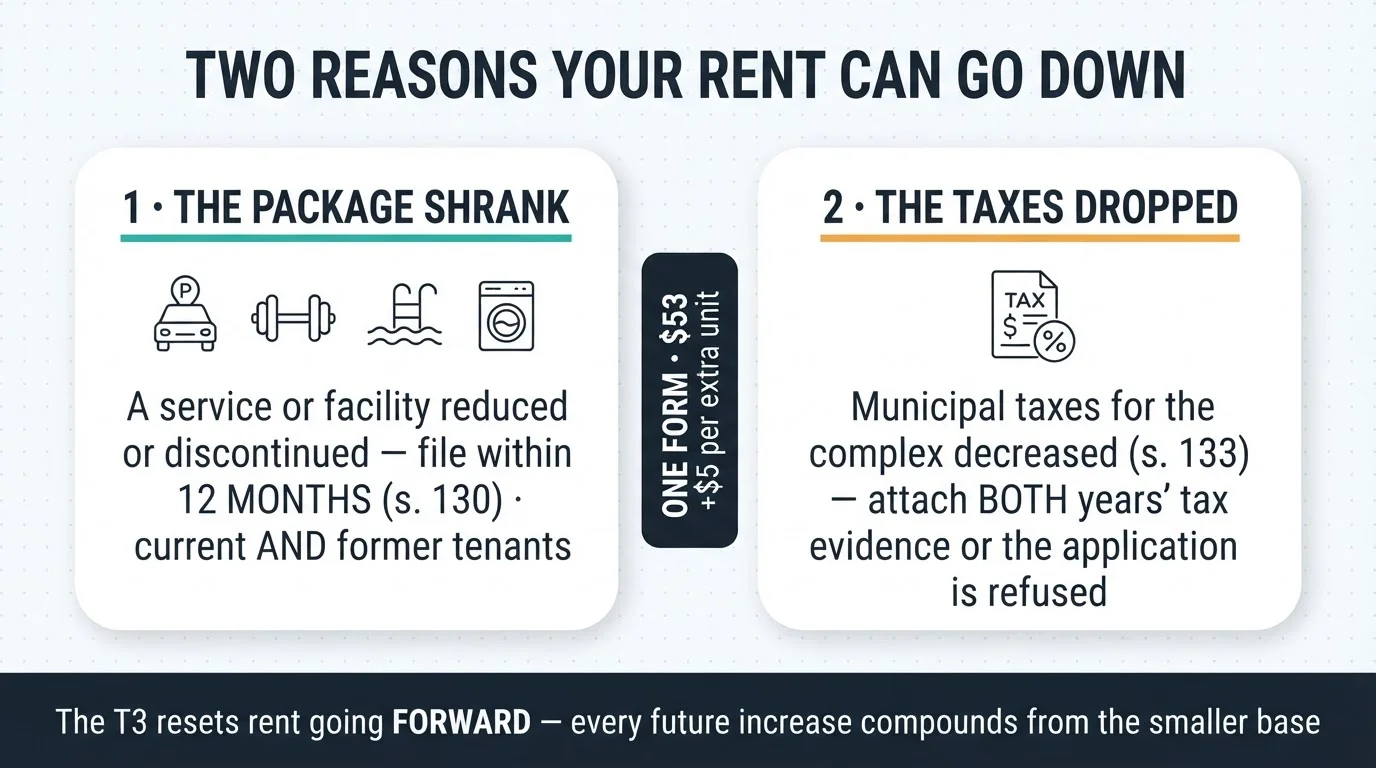
There are exactly two reasons on the form. Reason 1: your landlord reduced or discontinued a service or facility in the last 12 months (s. 130) — and both current and former tenants can file, as long as former tenants were affected while still living there. Reason 2: the municipal taxes and charges for your building decreased (s. 133) — current tenants only. What counts as "the package"? The Act's definition covers parking, laundry, storage, security, recreation facilities, and the like — and Board case law goes further: in one parking-removal case, years of uncontested guest parking counted as part of the tenancy even though the lease never mentioned it. Conduct counts, not just paper.
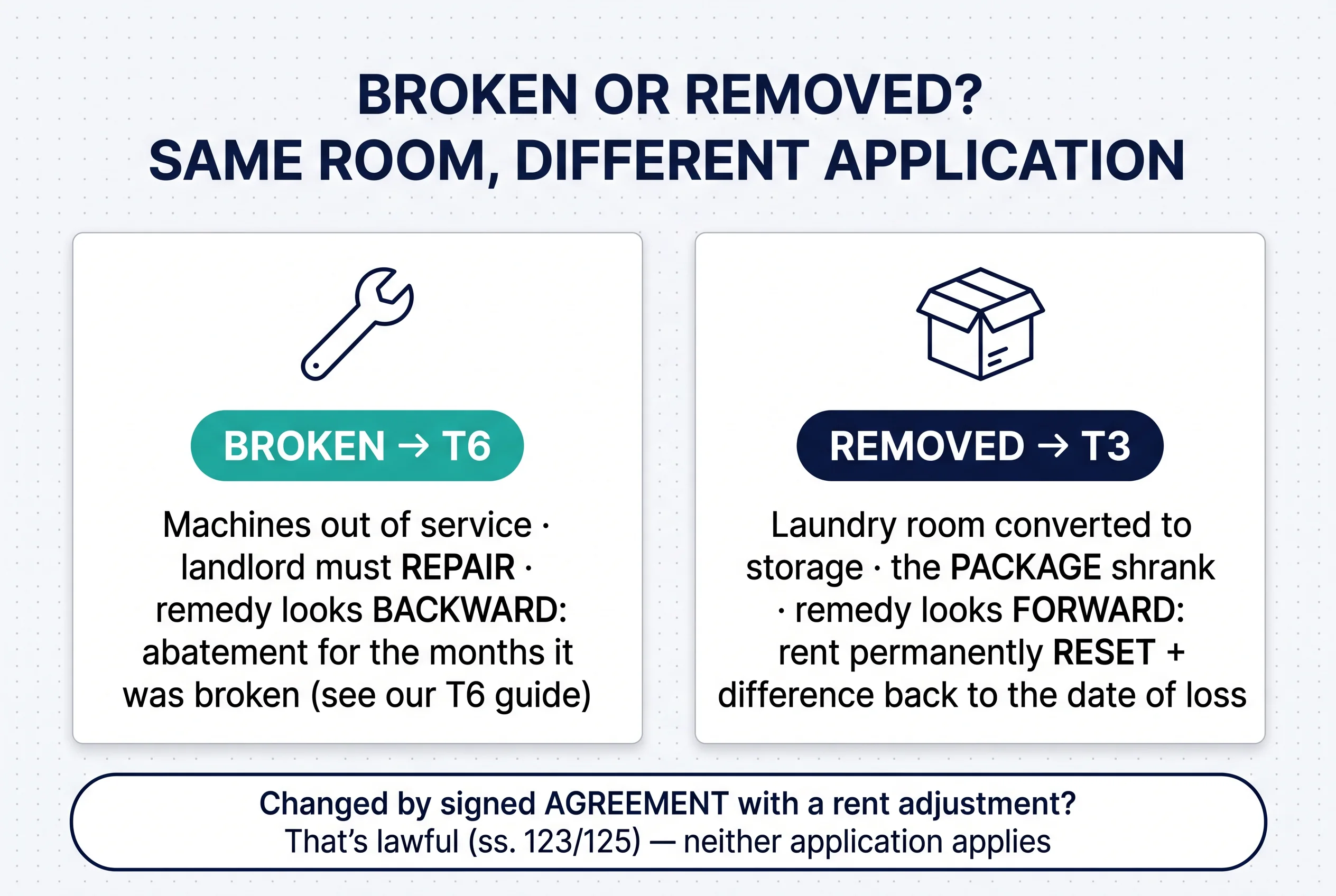
Now the line that decides everything, because it's where most people file the wrong form: broken versus removed. A laundry room full of broken machines is a maintenance problem — the landlord must repair, and the T6 compensates you for the months it sat broken. A laundry room converted into storage is a smaller package — that's the T3. And there's a third lane, stated plainly: landlords can lawfully remove a service by agreement, with a proportionate rent adjustment under sections 123 and 125. The T3 exists for the unilateral version — the package that shrank without your signature. (One exclusion to flag: utility and suite-meter changes run under an entirely different regime and don't belong on this form.)
The Services Reason: Valuing What Vanished
Date the loss precisely — the 12-month window runs from the day the service was reduced or removed, and it's firm. Then comes the math, set by regulation: a discontinued service reduces rent by the service's value; a reduced service, by a reasonable proportion of that value. The order typically does two things at once — resets the rent going forward and returns the overpaid difference back to the date of loss.

Two disciplines keep the number honest. First, value objectively. In First Ontario Realty v. Deng, the Court of Appeal faulted a valuation built entirely on what the tenants had asked for — and noted the landlord's collateral improvements to other facilities (paired with a forgone above-guideline increase) offset the loss entirely. So anchor your number in the market: the monthly rate at the lot down the street for vanished parking, commercial wash-and-dry costs times your household's loads for a lost laundry room. And if a new gym appeared two floors up the same month the laundry vanished, expect the offset argument. Second, respect the honest limit: under s. 39(7) of the regulation, a temporary discontinuance of reasonable duration yields no reduction at all. The pool closed six weeks for re-tiling, with notices posted? That's a $53 lesson, not a case. It rhymes with the principle from our T6 guide: the Board compensates a smaller package, not a brief inconvenience.

The Tax Machine: When Rent Drops Automatically
Most tenants never see the property taxes inside their rent — but the law does. Under section 131, when a building's municipal property taxes fall by more than 2.49% year-over-year, every rent in the complex reduces automatically on December 31 of that year. No application. No order. No landlord permission. The formula: the percentage tax decrease multiplied by 20% of rent in buildings with seven or more units, or 15% in smaller ones — those being the average shares of rent that go to property tax. Taxes down 10% in a big building means rent down 2%.
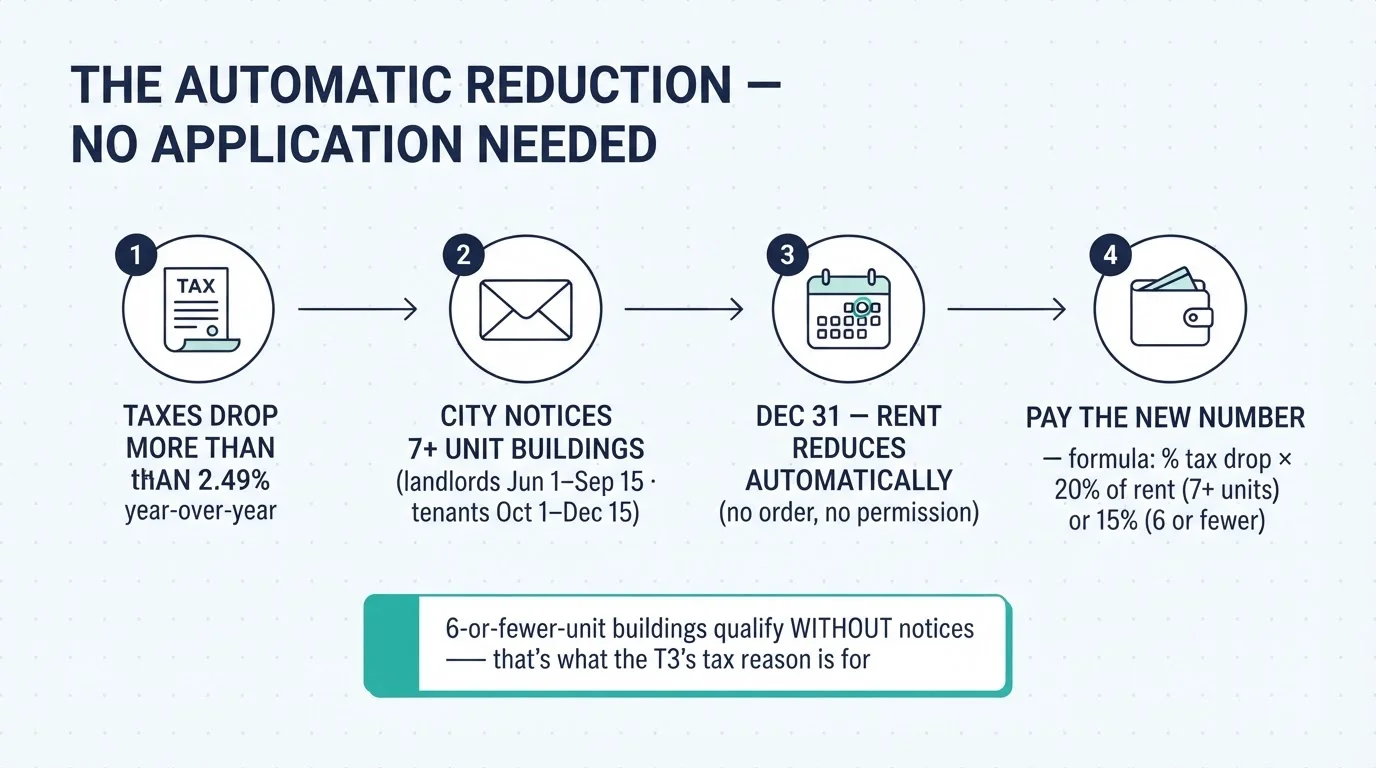
The machinery is running live right now. Ottawa's taxes crossed the trigger, and the city noticed ~57,000 tenants and 1,016 building owners of a 0.89% reduction effective this January — about $16 a month on $2,000 rent. Then came the counterpunch: landlords wrote tenants urging them to keep paying full rent pending LTB challenges, pointing to per-unit garbage fees that jumped from $91 to $167. Who's right? The reduction took effect December 31 regardless — a challenge doesn't pause it. The play tenant lawyers recommended, and the one worth memorizing: pay the reduced amount and save the difference. If a variance application (the A4 — $53 for tenants, $201 for landlords, decided by written hearing) later adjusts the number, the delta gets squared then, and you're covered in both directions.
So where does the T3's tax reason fit? In the gaps. Municipalities only have to send notices for seven-plus unit buildings — but the automatic rules apply to six-or-fewer-unit buildings too. A fourplex whose taxes fell 6% qualifies for 6% × 15% = 0.9% off rent from December 31 — and if the landlord never adjusted, the T3 (Reason 2) is how you claim it. One filing rule with teeth: attach the municipality's tax figures for both the base year and the reference year, or the application is refused — the T3's version of complete-or-refused.
Filing, the Fine Print, and What's Coming
Mechanics: the fee is $53, plus $5 per additional unit to a $450 maximum — the same group design as the T1, so a whole building can file together. Pay online and email your receipt with the application to [email protected], or mail or courier it to an LTB office; the T3 isn't currently filed through the Tribunals Ontario Portal, so confirm the channel when you file. Fee waivers exist. The cap is $50,000 under the current instructions — the $35,000 in older PDFs is stale — false filings are an offence, and costs can be ordered either way. Ask completely: the reset plus the retroactive difference back to the date of loss.
Anticipate the three defences before the hearing: "it was temporary and reasonable" (answer with the timeline — how long, what notice, what alternatives); "we improved something else" (the Deng offset — answer with your objective comparables); and "it was never part of the tenancy" (answer with the conduct history — photos, years of use, the landlord's own past notices). For landlords reading along, the prevention playbook is short: change the package by agreement with a proportionate rent adjustment; notice and time-box genuine temporary closures — s. 39(7) protects real repairs; and when the city's tax notice arrives, apply the reduction on December 31 and dispute the amount through the A4, not through letters asking tenants to overpay. Looking ahead: reassessment-driven tax decreases mean more automatic reductions and more A4 skirmishes through 2026–27 — the Ottawa garbage-fee fight is the one to watch — and our Bill 60 and Bill 97 coverage tracks the LTB's continuing operational updates.
Practical Takeaways
For tenants:
- Run the lane check first: broken is a T6, removed is a T3, and a signed agreed change with a rent adjustment is lawful.
- Date the loss and diarize the 12-month window — it runs from the day the service vanished.
- Build the conduct file: photos, the landlord's notices, and the history of the perk — informal arrangements can count.
- Value objectively with market comparables; the Board won't simply adopt your ask.
- Tax claims: attach both years' municipal tax evidence — or be refused.
- After an automatic reduction, pay the reduced amount and save the difference.
- Ask for the reset plus the retroactive difference — the smaller base compounds in your favour every year after.
For landlords, stated plainly: change the package by agreement with a proportionate rent adjustment, and time-box and notice genuine temporary closures — s. 39(7) protects real repairs. When the tax notice arrives, apply it December 31 and dispute the amount through the A4, not through letters asking tenants to overpay.
The T3 Rent Reduction Kit: When the Package Shrinks, So Should the Rent
Lost parking, a laundry room turned into storage, property taxes that quietly dropped — Ontario law says your rent should shrink with the package, permanently. This free kit walks the lane check, the 12-month window, the valuation math, the automatic tax reduction most tenants never claim, and the filing steps.
Get Free PDF →The Bottom Line
Rent in Ontario isn't a one-way street — it's a price for a package, and the law polices both directions. When the package shrinks, the T3 resets the number; when the taxes inside it shrink past 2.49%, the rent resets itself. The deadlines are quiet (twelve months; March 31), the math is precise (values, proportions, 20% and 15%), and the honest limits are real (temporary closures yield nothing; offsets are arguable). The tenants who win are the ones who dated the loss, kept the comparables, and paid the lawful number without waiting for permission. General information, not legal advice — a community legal clinic or licensed paralegal is worth the conversation for a contested valuation. Next in this series: the T5 — when the N12 that ended your tenancy turns out to have been given in bad faith.
Keep the Whole Package on the Record
Tenon10 keeps lease terms, notices, and payment histories organized from day one — so when the package changes, the proof of what it used to include is already filed.
Free • No signup required • Always current rules
Frequently Asked Questions
Can my rent go down in Ontario?
Yes, two ways. If your landlord reduces or removes a service or facility that came with your rent — parking, laundry, storage — you can file a T3 within 12 months for a permanent rent reduction. And if the building's property taxes drop by more than 2.49% year-over-year, rent reduces automatically on December 31 under section 131, no application needed.
My landlord took away parking — can I pay less rent?
Not unilaterally — file a T3 within 12 months of the change instead. The Board values the lost facility objectively (nearby parking rates are the usual anchor), resets your rent downward, and typically orders the overpaid difference returned back to the date the parking disappeared. Long-standing informal parking arrangements can count even if the lease is silent.
What's the difference between a T3 and a T6?
Broken versus removed. A laundry room full of broken machines is a maintenance problem — that's the T6, which compensates you for the past. A laundry room converted into storage is a smaller rental package — that's the T3, which changes your rent going forward.
My city sent me a rent reduction notice — but my landlord says keep paying full rent. Who's right?
The reduction took effect automatically on December 31; a landlord's challenge at the LTB doesn't pause it. The practical play, echoed by tenant lawyers in Ottawa's 2026 dispute: pay the reduced amount and save the difference, so you're covered whichever way any variance application lands.
Do small buildings get automatic rent reductions?
Yes. Municipalities only have to send notices for buildings with seven or more units, but the automatic rules apply to six-or-fewer-unit buildings too — the formula there is the percentage tax decrease multiplied by 15% of rent. If your landlord never adjusted, the T3's tax reason exists precisely for that gap; attach both years' municipal tax evidence or the application will be refused.
How much does a T3 cost and how do I file it?
$53, plus $5 per additional unit to a $450 maximum when neighbours file together, with fee waivers available. Pay online and email your receipt with the application to [email protected], or mail or courier it to an LTB office — the T3 isn't currently filed through the portal, so confirm the current channel when you file. The most the Board can order is $50,000.


