

Ontario's renoviction fight has moved from arguments to paperwork. Under the newly proclaimed rules, a landlord who wants a unit empty for renovations needs a professional's report saying so, a building permit, a written estimate of when the work will finish, written updates whenever that estimate moves, and a written notice when the job is done — at which point the tenant gets a minimum of 60 days to come back, at a rent as if they'd never left.
Both sides are working from fragments. Landlords know "something changed" but not which document is due when — or that Toronto, Hamilton, and London run an entire second licensing trail on top of the provincial one. Tenants know they "have rights" but not which papers they can actually demand, or that the trail keeps running long after the moving truck leaves.
This is Deep-Dive #5 in our Bill 60/97 series: the complete document map — every paper, who produces it, who can demand it, and when — plus the municipal layer and what enforcement looks like now that fines have doubled. For the broader renoviction picture, our general renoviction guide is the hub; this piece goes narrow and deep on the paperwork. General information, not legal advice — and note up front that these rules are phasing in through 2026, so confirm specifics on e-Laws.
The N13 Document File: What Landlords Must Produce — and What Tenants Can Demand
One free PDF, both seats: the qualified-person report, permits, the written timeline duties, municipal licence trails, and the 60-day return window.
Get Free PDF →The Baseline Trail Every N13 Already Runs On
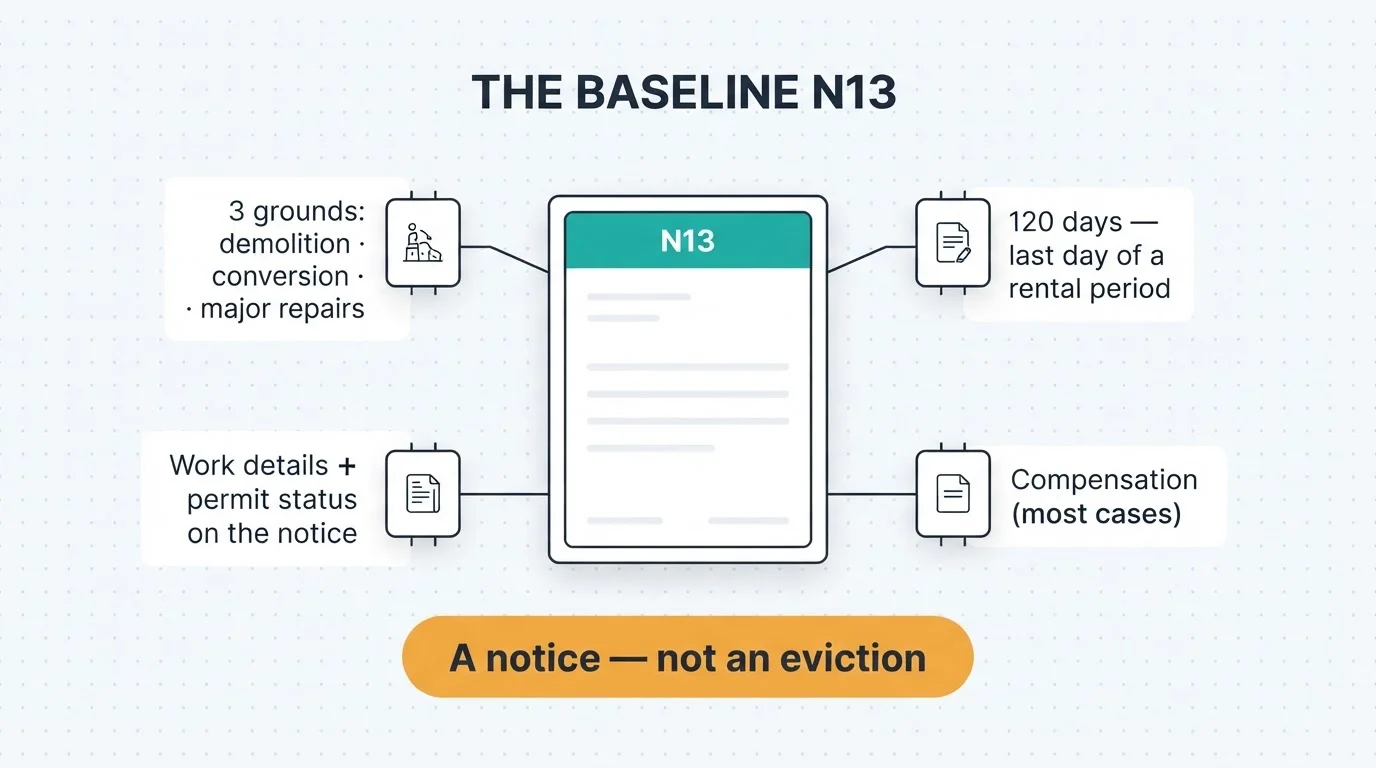
Start with what hasn't changed. The N13 is the notice for three grounds only: demolishing the unit, converting it to non-residential use, or repairs and renovations so extensive that they require a building permit and vacant possession. If the work can reasonably happen around the tenant, the repair ground fails — that's been the law all along.
The existing paperwork is already substantial: at least 120 days' notice ending on the last day of a rental period, specific details of the planned work and permit status on the notice itself, compensation in most cases (the amount varies with building size and, for repairs, how long the work takes — and isn't owed where a government authority ordered the work), and a Certificate of Service. And a foundational point for every tenant reading: letters, emails, texts, buyout offers, and threats are not notices. Neither is the N13 itself an eviction — the landlord must file an L2, prove the case at a hearing, and only the sheriff can enforce an order. The standing reminder of what happens otherwise: a Toronto corporate landlord was convicted and publicly named in 2026 after starting construction despite three dismissed N13 applications.
How big is this problem, honestly? The LTB received about 1,100 renoviction-related applications in 2023–24 province-wide. In Ottawa, N13s average around 28 a year across 147,000+ rental units — vanishingly rare as a share of stock, which industry groups fairly point out. Tenant advocates fairly counter that formal notices undercount informal displacement, and that each case is someone's home. Both things sit atop a real driver: nearly a third of Ottawa's rental stock needs repairs, 11,500 units seriously. Ontario genuinely needs renovations to happen — the documentation regime exists to let the real ones proceed and make the fake ones fail on paper.
The New Provincial Paper Trail: Five Documents
The renovation package passed under Bills 97 and 60 has now been proclaimed — Orders in Council 616, 617 and 618 of 2026 bring it into force through this year. Here's the trail, document by document:
1. The qualified-person report. A landlord claiming the work requires vacant possession must back that claim with a report from a qualified professional — a licensed engineer or architect. This is the document that kills the bare "trust me, you need to leave": necessity of vacancy becomes an expert question with a paper answer, before anyone packs a box.
2. The written completion estimate. An estimated completion date, in writing, at the outset — the tenant leaves knowing when they should expect to come back.
3. Written change notices. Renovations slip; the law now assumes it. When the estimate moves, the tenant hears about it in writing.
4. The completion notice. Written notification when the work is done and the unit is ready for re-occupancy.
5. The return window. A minimum of 60 days for the tenant to return after that notice — at a rent no higher than what could lawfully have been charged had the tenancy never been interrupted. (The full mechanics of the right of first refusal — how tenants preserve it, and the one-year s. 57.1 application when it's denied — get their own deep-dive next in this series.)
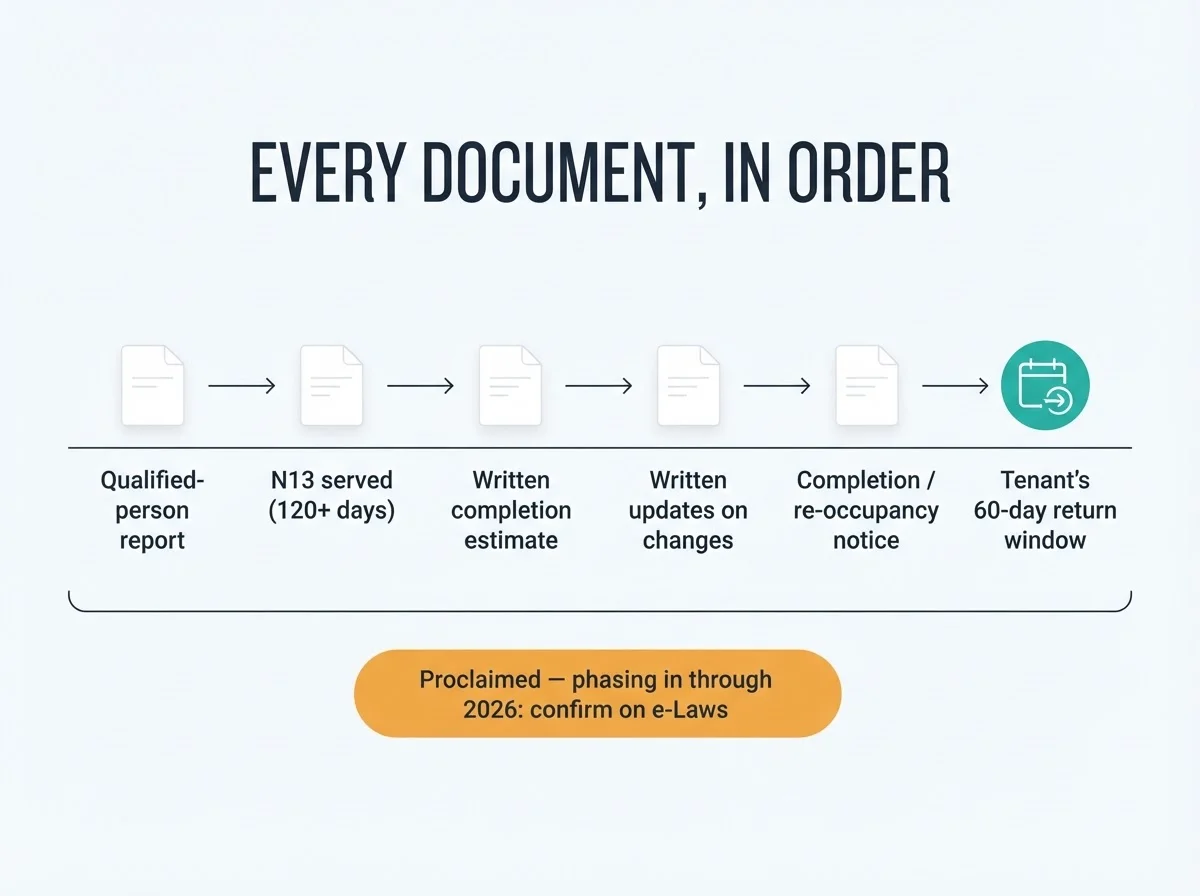
Phasing honesty: The package is proclaimed, but its duties are phasing in through 2026 rather than landing on one clean day — and the N13 form itself is expected to update as they do. Before relying on a duty (landlords) or invoking one (tenants), confirm its in-force status on Ontario's e-Laws or get advice — and always download the current form from Tribunals Ontario the day you act.
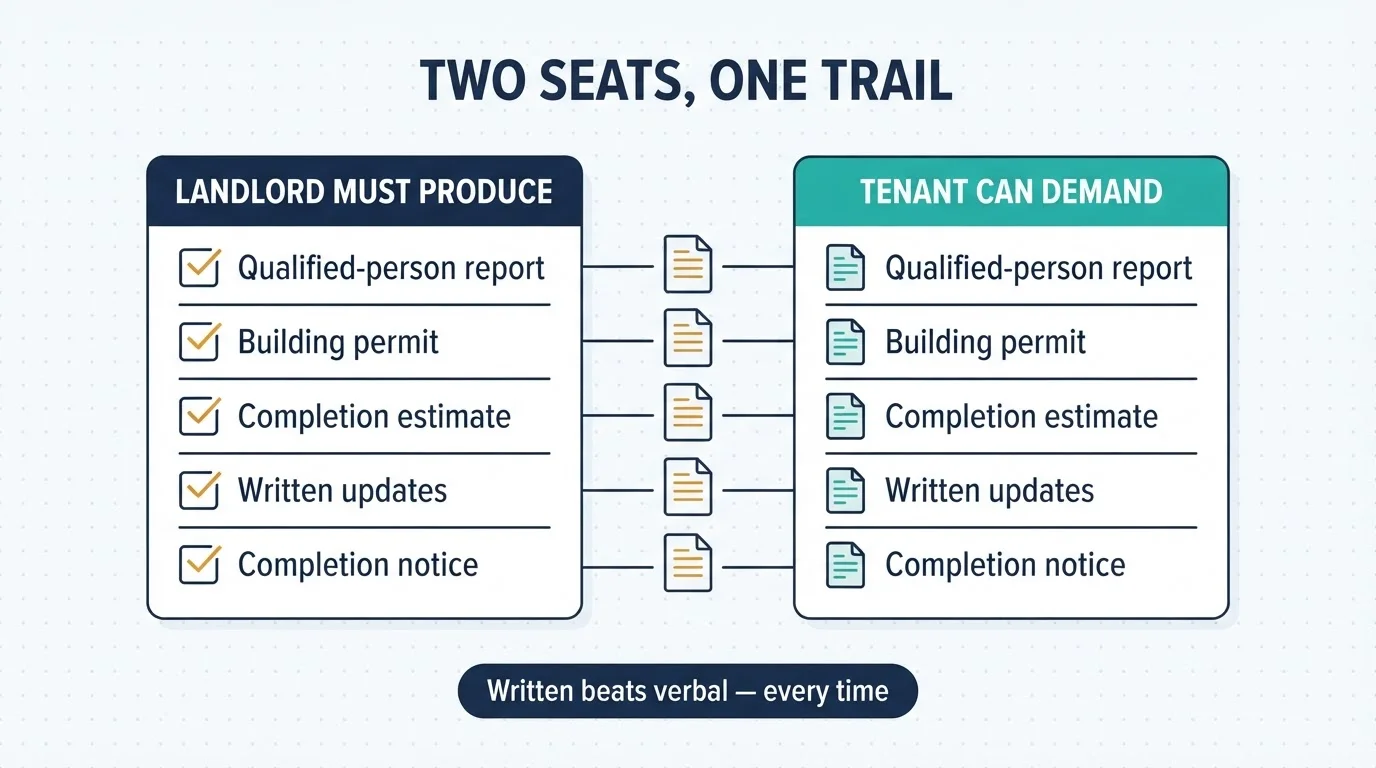
The through-line for landlords is one habit: a single written log per project. Notice, service proof, permits, contractor records, the estimate, every update, the completion notice — dated, in one place. As one property-management analysis put it, a casual communication process creates long-tail LTB risk; the log is also the entire defence file if anything is challenged. The through-line for tenants is the mirror image: every duty above is a demand you can make in writing — and the registered-mail habit legal clinics have preached for years is now the enforcement backbone of the whole regime.

The Second Layer: Municipal Licence Trails
Where you renovate now determines how many trails you run. As of July 2026, three Ontario cities operate renovation-licensing bylaws on top of the provincial regime:
- Toronto (Rental Renovation Licence, since July 2025): a licence application within 7 days of serving the N13 (~$700), requiring the qualified-person report (defined locally as a PEO- or OAA-licensed professional), confirmation of building permits, and a posted Tenant Information Notice — plus tenant entitlements: temporary comparable housing at similar rent or monthly rent-gap payments, and moving allowances of $1,500 (studio/one-bedroom) or $2,500 (two-bedroom-plus).
- Hamilton (since January 2025): a licence at $715 per unit plus a $125 annual renewal, a city-prepared information package to tenants, and bylaw fines from $500 to $10,000.
- London (since March 2025): the Rental Unit Repair License.
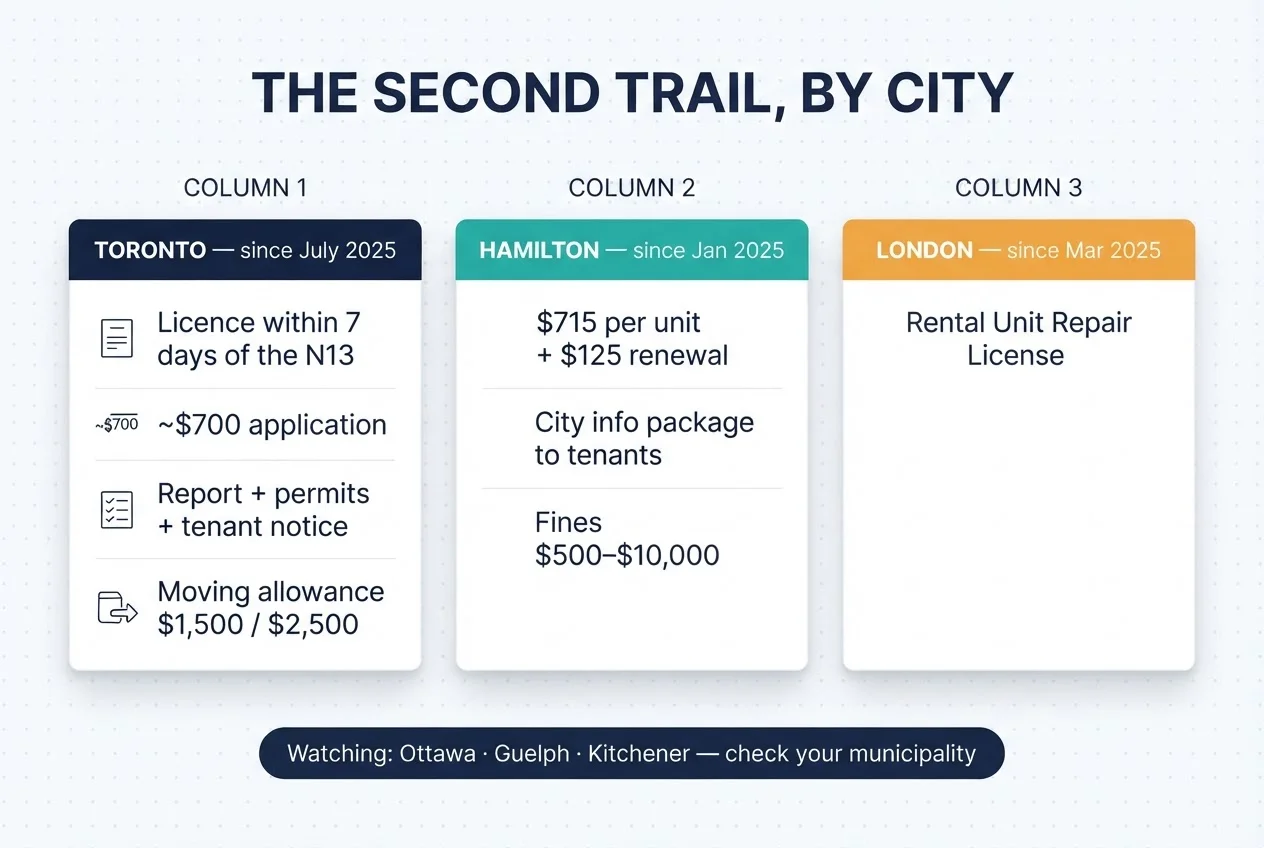
Ottawa, Guelph, and Kitchener are weighing their own — Ottawa is actively deciding whether to proceed or rely on the strengthened provincial framework instead. That decision sits inside a live policy debate worth knowing on both sides: industry groups argue a patchwork of differing municipal rules creates confusion and drives up costs, and that a consistent province-wide framework should govern; tenant advocates credit the municipal bylaws with forcing the provincial reforms into existence at all. Wherever that lands, the practical rule is simple: check your municipality the week you plan the work — these bylaws carry their own deadlines, fees, and fines, and Toronto's 7-day clock starts the moment the N13 is served.
Enforcement — and the Mirrored Checklists
What does a broken trail cost now? For landlords: dismissal and a 120-day restart at minimum; municipal fines where bylaws apply; provincial prosecution exposure — false statements in or about an N13 and unlawful recovery of possession are offences, with ceilings of $100,000 personal and $500,000 corporate since July 1 — and tenant remedies for bad faith, including abatement, moving costs, and the rent differential. For tenants whose return is refused or whose unit reappears on a listing site: the refused-first-refusal application runs on a one-year window, covered fully in the next deep-dive.
Practical Takeaways
Landlords and property managers:
- Obtain the qualified-person report before drafting the N13 — and confirm a building permit is genuinely required, because no permit-requiring work means no repair-ground notice.
- Serve right: 120+ days, last day of a rental period, work details on the notice, Certificate of Service — then check your municipal layer within days (Toronto's licence clock runs 7 days from service).
- Issue the written completion estimate at the outset, and update it in writing every single time it moves.
- Send the written completion notice, honour the 60-day return at the uninterrupted rent, and keep the whole log for 2+ years.
Tenants:
- Don't move on the notice date — the hearing decides, and the challenge lanes are real: is the work genuine, does it truly require vacancy, is a permit actually required?
- Send your first-refusal letter by registered mail before you vacate, and keep your address current in writing.
- Ask in writing for the report, permit status, and estimate; expect written updates and a written completion notice — then use your 60-day window.
- Refused return or a re-rented unit? Document everything and get clinic or paralegal help early — the application window runs one year.
The N13 Document File: What Landlords Must Produce — and What Tenants Can Demand
One free PDF, both seats: the qualified-person report, permits, the written timeline duties, municipal licence trails, and the 60-day return window.
Get Free PDF →The Bottom Line
The renoviction question used to be argued in adjectives — "extensive," "necessary," "genuine." Now it's answered in documents: a professional's report, a permit, an estimate, updates, a completion notice, a return window. For honest renovations, the trail is an afternoon of admin spread across a project — and it protects the landlord at the hearing exactly as much as it protects the tenant's return. For dishonest ones, it's a wall. That's the point. Landlords: start the log before you serve. Tenants: send the registered letter before you move. And both seats: these rules are phasing in through 2026 — confirm the specific duty on e-Laws before you lean on it. General information, not legal advice; for a live file, a licensed paralegal, lawyer, or community legal clinic is the right next call.
Keep the Whole N13 File in One Place
Tenon10 holds the notice, service proof, permits, timeline updates, and re-occupancy notices together — with the 120-day, 7-day, and 60-day clocks tracked automatically.
Free • No signup required • Updated for the Bill 60 changes in force 21 Sep 2026
Frequently Asked Questions
Does my landlord need an engineer's report to evict for renovations?
Under the newly proclaimed rules, a landlord claiming the work requires vacant possession must back that with a report from a qualified professional such as a licensed engineer or architect. The package is phasing in through 2026, so confirm the duty's in-force status on e-Laws — and in Toronto, the municipal bylaw has required such a report since July 2025 regardless.
Do I have to move out if I get an N13?
No. An N13 is a notice, not an order — the landlord must apply to the LTB, prove the case at a hearing (permits, genuineness, necessity of vacancy), and only the sheriff can enforce an eviction order. Texts, letters, and buyout offers aren't notices at all.
How long do I have to move back in after renovations?
Under the new rules, a minimum of 60 days after the landlord's written notice that the work is complete — at a rent no higher than if your tenancy had never been interrupted. Protect this by giving written first-refusal notice before you vacate (registered mail) and keeping your address current.
What documents does a landlord need for an N13 in 2026?
The qualified-person report, the building permit (or proof it's coming), an N13 with specific work details served 120+ days out on the last day of a rental period, compensation where required, a written completion estimate, written updates on changes, and a written completion notice — plus a municipal licence in Toronto, Hamilton, or London.
Which Ontario cities require a renovation licence?
Toronto (since July 2025 — apply within 7 days of serving the N13), Hamilton (since January 2025), and London (since March 2025). Ottawa, Guelph, and Kitchener are considering their own; check your municipality before serving.
Are all these rules in force right now?
The provincial package is proclaimed under Orders in Council 616–618/2026 and phasing in through 2026. Before relying on — or invoking — any specific duty, confirm its status on Ontario's e-Laws or get advice, and always use the current N13 form from Tribunals Ontario.


