

Ontario's rent increase guideline for 2026 is 2.1% — the lowest in four years. For the owner of a 1970s walk-up staring at a $90,000 boiler quote, that number doesn't come close. The Residential Tenancies Act's answer is the Above-Guideline Increase (AGI): a legal path past the cap. But it's a narrow path — three grounds in, a 3% annual ceiling, a hearing at the end, and, in the part most landlord guides quietly skip, an expiry date built into every capital-cost increase.
AGI content tends to split into sales pitches ("recover every dollar you spent!") and alarms ("AGIs are out of control!"). Neither helps a landlord decide whether a real project justifies a real application — or helps a tenant understand what they actually owe, and when. This guide is the process straight through: the grounds, the math, the clock, the brakes, a six-step decision framework, and the proposed bill that could reshape all of it. (The L5 form's filing mechanics get their own guide; this is the piece you read before the contractor is booked.) General information, not legal advice.
The AGI Decision Kit: Six Checks Before You File
Grounds, evidence windows, the caps, the hearing, and the sunset most guides never mention — one free landlord PDF.
Get Free PDF →The Three Grounds — and Only Three
Section 126 of the RTA opens exactly three doors, and everything else stays outside:
1. Extraordinary municipal taxes and charges. "Extraordinary" has a precise meaning: an increase greater than the guideline plus 50% of the guideline — in 2026, anything above roughly 3.15%. This ground carries no 3% AGI cap, but in practice these applications typically seek only 0.5–1.0% and usually resolve by written submissions rather than oral hearings.
2. Eligible capital expenditures. The big one: extraordinary or significant renovation, repair, replacement, or addition with an expected benefit of at least five years. Work qualifies when it's necessary to protect or restore the building's physical integrity, maintain health, safety, or housing standards, or maintain major systems — plumbing, heating, electrical, ventilation, air conditioning. And here's the nuance most guides miss: work that wasn't strictly necessary can still qualify if it promotes energy or water conservation, or accessibility. What never qualifies, at any price: routine maintenance and cosmetic work.
3. Security services. New or increased costs for security at the complex — provided by someone who isn't the landlord's employee, with the service still running at hearing time.
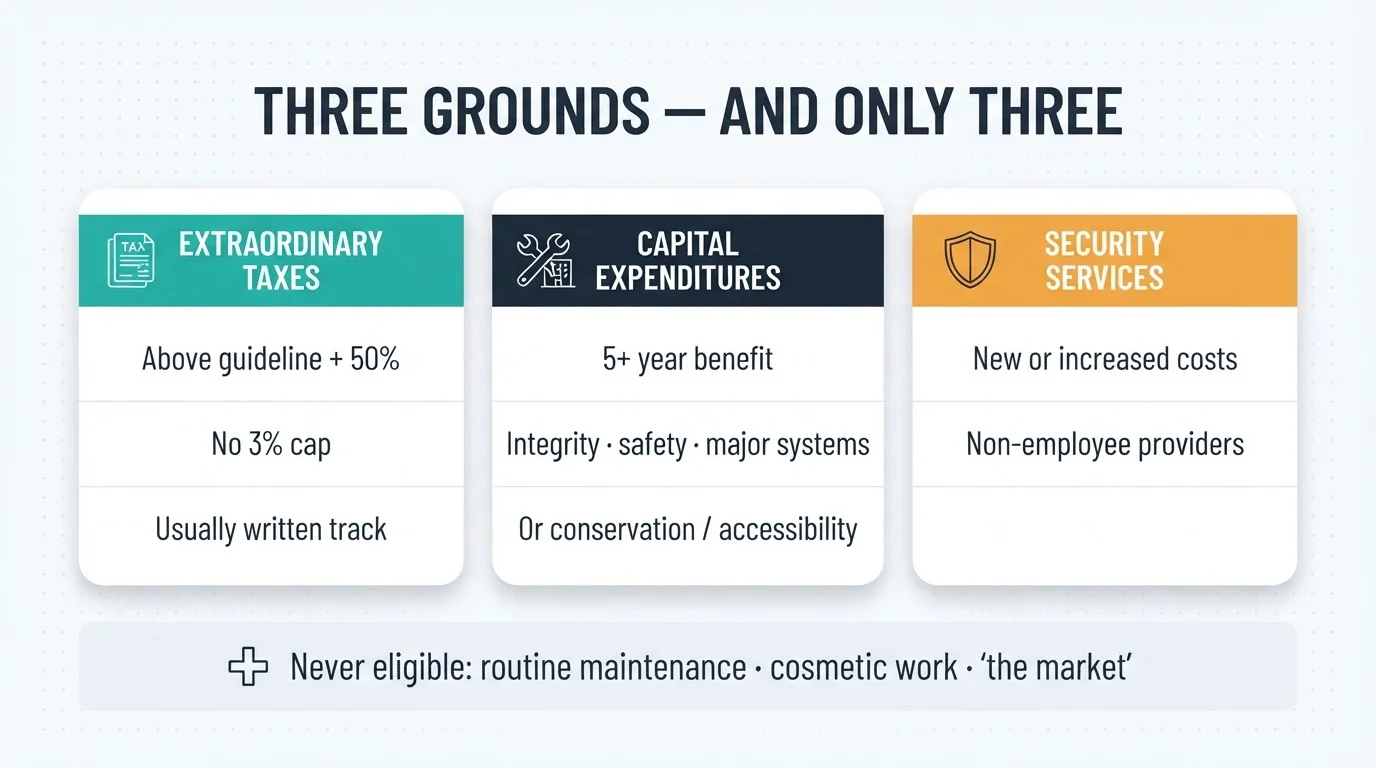
What isn't a ground: inflation, mortgage renewals, "the market," or renovations for renovation's sake. And one boundary before any of this matters — check that the unit is rent-controlled at all. Units first occupied for residential use after November 15, 2018 are exempt from the guideline entirely and don't use the AGI framework; different form, different rules.
The Caps, the Math, and the Clock
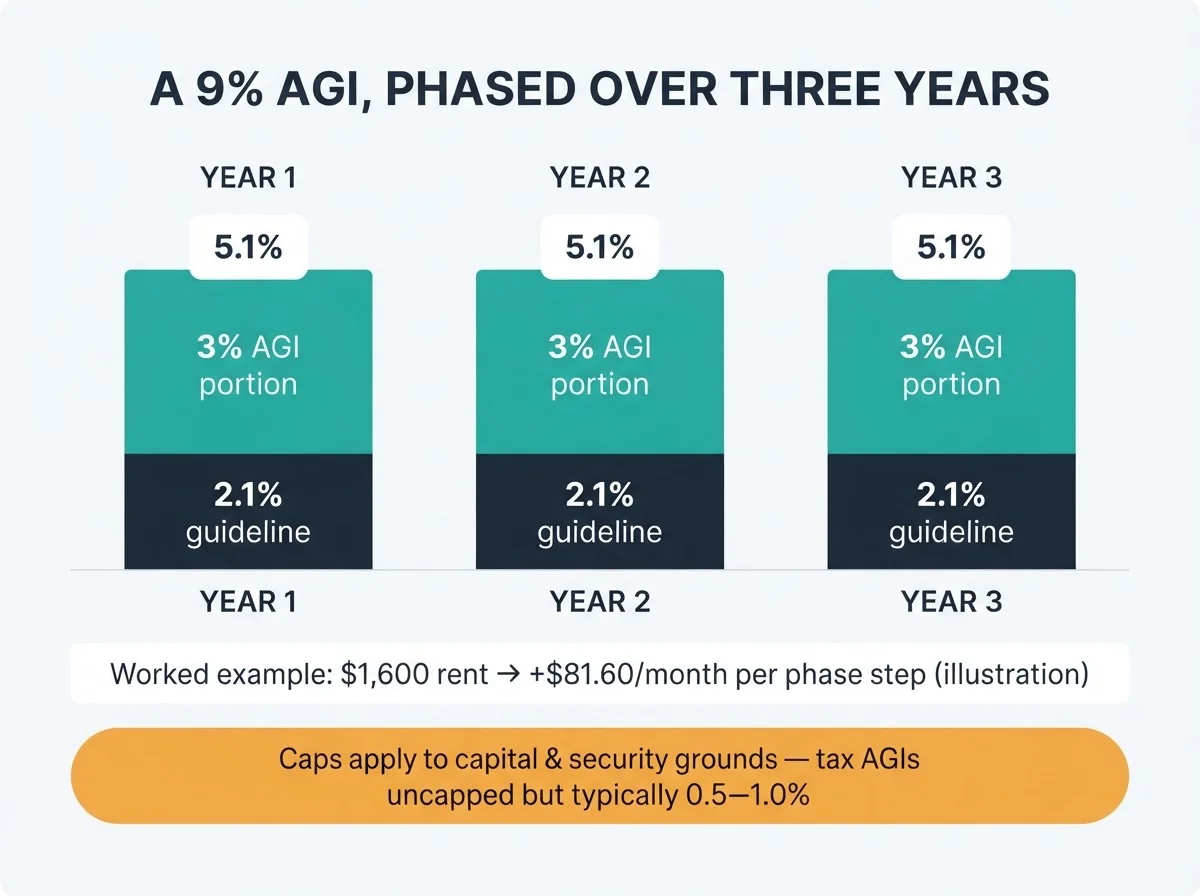
For the capital and security grounds, the LTB generally cannot allow more than 3% above the guideline in any single year. In 2026 that means a typical single-year maximum of 2.1% + 3% = 5.1%. A larger justified amount — up to roughly 9% per application — phases over three years at 3% above guideline each year. (Worked illustration, not a real case:) a 12-unit 1972 building averaging $1,600 rents completes an eligible $180,000 boiler-and-roof project justifying ~9%. Each phase step adds about $81.60 per unit per month; at full phase-in the building recovers roughly $11,750 a year — real money, earned slowly, against the professional fees, the filing fee, the hearing time, and the sunset coming in the next section.
The clock is unforgiving in both directions. The L5 must be filed at least 90 days before the First Effective Date, the increase must respect the normal 12-month rule, and tenants receive an N1 showing the higher amount. On the project side, capital work must be completed within an 18-month window ending 90 days before that first increase — and fully paid before filing (construction-lien holdbacks excepted). Evidence goes in with the application: the Board can refuse documents filed late, which means an AGI is effectively won or lost at the project stage, not the filing stage. Capital-expenditure files also get a mandatory Case Management Hearing — a landlord who doesn't attend is dismissed as abandoned, and the mediated settlement route available there caps at guideline + 3%.
One line of history explains why this terrain is contested: the 1992 rules let landlords recover 50% of capital costs through rent; the 2006 RTA made it 100%, capped at roughly 9% over three years. AGIs have been argued about ever since.
The Brakes: What Landlord Guides Don't Tell You
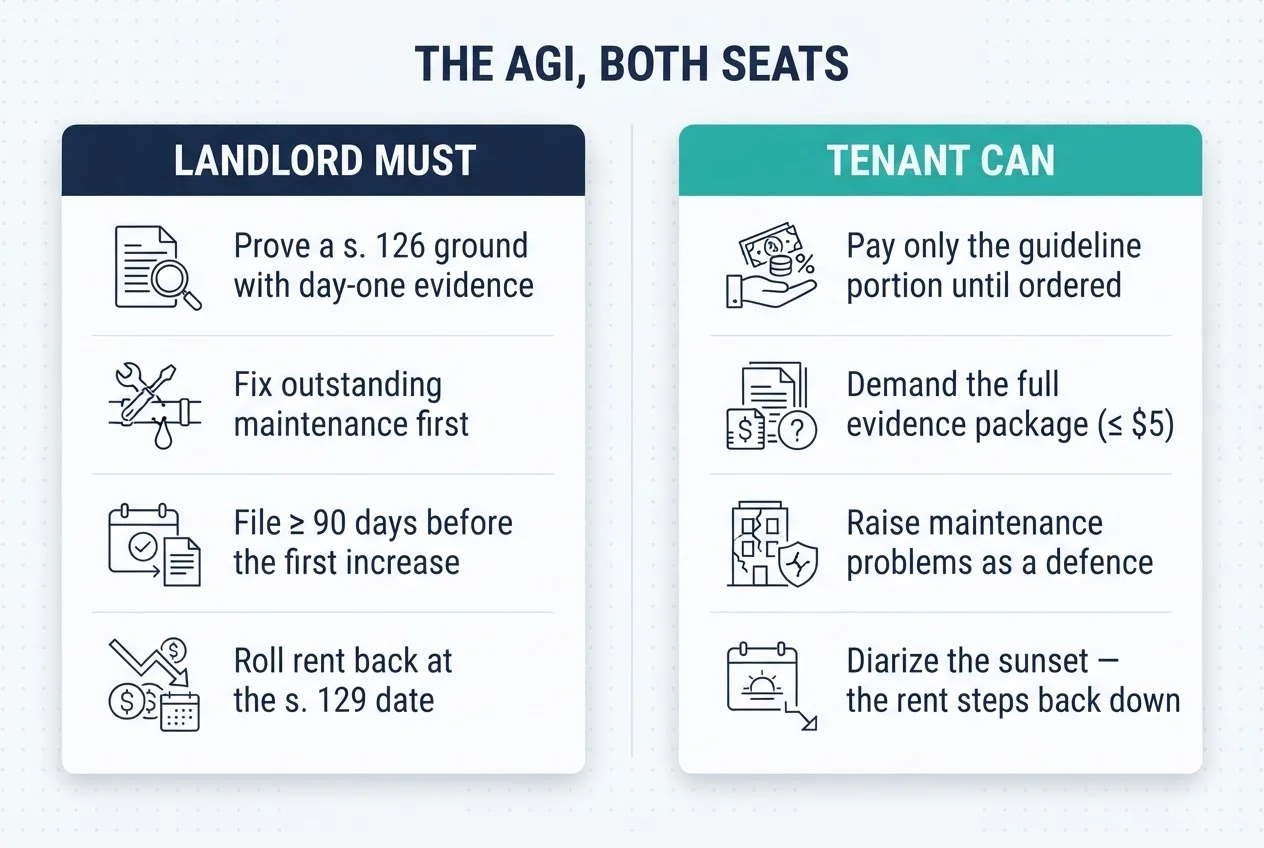
The maintenance bar. If serious maintenance problems are outstanding, the LTB may dismiss the application for the affected units — or order that the increase can't take effect until the work is done. Unfinished ordered elevator repairs can block an AGI outright. The order of operations is non-negotiable: fix first, file second.
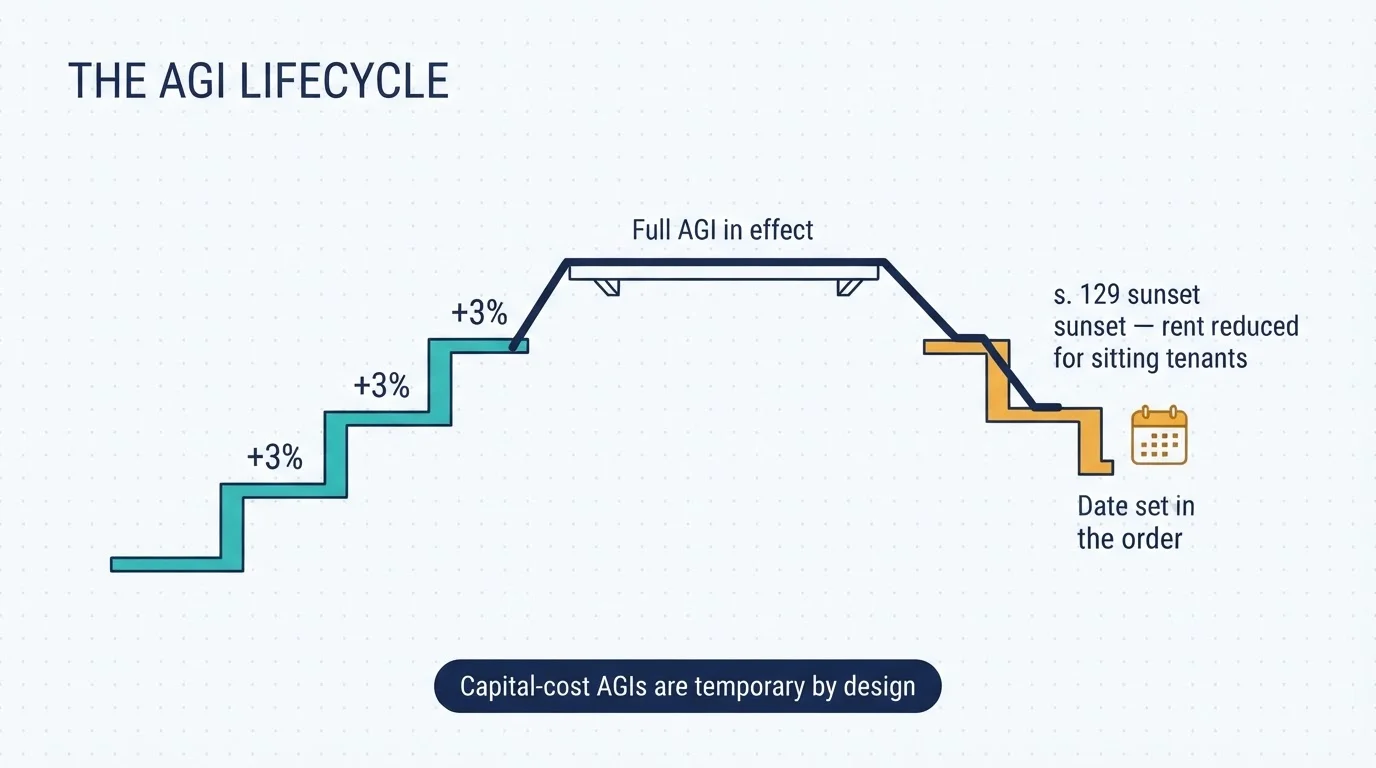
The s. 129 sunset — the headline brake. Every capital-expenditure AGI order must specify the percentage attributable to the work and a future date on which sitting tenants' rents must be reduced by that percentage, once the work's weighted useful life has elapsed. Read that again: capital AGIs are temporary by design. The boiler gets paid for, and then the increase comes off. A landlord who misses the rollback date is overcharging — and inviting T1 applications for the difference.
What the Board can't consider: either side's financial circumstances or ability to pay, income-tax treatment of the expenses, or the guideline itself. The case is evidence about the work — nothing else.
And the tenant-side rules, stated plainly — because a process piece that hides them isn't a process piece. Until the LTB issues an order, tenants owe only the guideline portion, even when the N1 shows more; the one caveat is that an approval can reach back to the First Effective Date, so back-rent may be owed later. Some tenants pay the higher amount and await a refund if the AGI fails; others hold and budget for the catch-up — both are legitimate strategies. Tenants can also demand the complete evidence package for $5 or less, attend the hearing, and raise maintenance problems as a live defence. In Toronto specifically, city-funded tenant outreach helps buildings organize against AGIs — a landlord filing there should assume the other side will read every page of the file, because they will.
The critique deserves its paragraph too: policy researchers have shown that under the regulation's formula, a $1.5-million renovation can return roughly $2.4 million once guideline increases compound on the AGI portion, and some institutional landlords openly list AGI filings as a revenue strategy in investor materials. Whatever one thinks of the framework, that's the reputational weather around every application — one more reason the well-evidenced, genuinely necessary project is the only kind worth filing.
The Decision Framework — and the Bill on the Radar
Six checks, in order, before an L5 is worth anyone's time:
- Is the unit rent-controlled at all? Post-November 15, 2018 first occupancy → the framework doesn't apply.
- Does a true s. 126 ground exist? Routine and cosmetic spend is dead on arrival.
- Is the maintenance file clean? Outstanding orders can sink everything.
- Does the math clear? Recovery vs. fees, hearing time, the sunset — and, in Toronto, the organized-response factor.
- Is the evidence complete on day one? Invoices, payment proof, the five-year-benefit case, a consistent allocation method.
- Would the file survive a necessity test? That's the sixth check — and the reason for what follows.
On the radar — Bill 82 (proposed, not law): A bill before the legislature would reshape capital-expenditure AGIs: an engineering or professional report demonstrating the work's necessity would be required with the application; cosmetic, routine, grant-funded, and related-party costs would be excluded; the Board would gain an undue-hardship dismissal power weighing tenant income share, local vacancy, and rent pressure; and applications could be paused or dismissed for any landlord breach. It would take effect four months after passage, with pending files grandfathered. Check its current status before relying on either today's rules or tomorrow's — but notice the direction of travel across Ontario rental law: professional evidence replacing bare assertions, exactly as the renoviction rules now demand a qualified-person report. A file built to that standard today wins under either regime.
Practical Takeaways
Landlords and property managers:
- Confirm the unit is rent-controlled before anything else — exempt units use a different framework entirely.
- Match the project to a real ground and screen out cosmetic and routine spend before the contractor is booked.
- Fix outstanding maintenance first — then file, at least 90 days before the First Effective Date, with day-one-complete evidence.
- Run the math with the sunset included, attend the CMH, and consider the mediated route (guideline + 3% cap).
- Collect only the guideline portion until the order issues — then diarize the s. 129 rollback like the legal deadline it is.
Tenants (quick reference): a higher N1 isn't an order — the guideline portion is all that's owed until the LTB decides, with the back-rent caveat if it's approved; request the evidence package (≤$5) and attend the hearing, where maintenance problems are a live defence; and diarize the sunset date in any capital AGI order, because the rent comes back down.
The AGI Decision Kit: Six Checks Before You File
Grounds, evidence windows, the caps, the hearing, and the sunset most guides never mention — one free landlord PDF.
Get Free PDF →The Bottom Line
The AGI is neither a loophole nor a scandal — it's a narrow, evidence-heavy, temporary exception with three doors in and one guaranteed step back down. Landlords who respect its architecture — a real ground, a clean maintenance file, complete day-one evidence, and an honoured sunset — recover major costs lawfully. Landlords who treat it as a rent-raising hack fund hearings instead of boilers. Run the six checks before the contractor is booked, build the file as the work happens, and hold both dates sacred: the one 90 days before the increase, and the one where it comes back off. General information, not legal advice — for a live application on either side, a licensed paralegal or lawyer who knows Guideline 14 is worth every dollar.
Guideline Increases Done Right — AGI Files Kept Ready
Tenon10 tracks the annual guideline, generates compliant N1 notices, and keeps your capital-project evidence with the building record — ready if an AGI ever makes sense.
Free • No signup required • Always current rules
Frequently Asked Questions
How much can a landlord raise rent above the guideline in Ontario?
For capital expenditures and security services, at most 3% above the guideline in any year — a 5.1% total in 2026 — with larger justified amounts phased over up to three years (about 9% per application). Extraordinary municipal-tax AGIs carry no 3% cap but typically add only 0.5–1.0%.
Do I have to pay an AGI before it's approved?
No — until the LTB issues an order, only the guideline portion is owed, even if the N1 shows more. One caveat: if the AGI is approved back to its first effective date, the difference can be owed retroactively, so budget for both outcomes.
What counts as a capital expenditure for an AGI?
Extraordinary or significant work with at least a five-year benefit that protects the building's integrity, maintains health and safety standards, or maintains major systems — or work that promotes energy or water conservation or accessibility. Routine maintenance and cosmetic work never qualify, regardless of cost.
Can an AGI be denied because of maintenance problems?
Yes. Serious outstanding maintenance can get the application dismissed for affected units or the increase delayed until the work is complete — and unfinished ordered elevator repairs can block the AGI outright.
How long does an above-guideline increase last?
Capital-expenditure AGIs are temporary: the order sets a future date when rent for sitting tenants must be reduced by the AGI percentage, once the work's weighted useful life has elapsed. Landlords who miss the rollback face tenant applications for the overcharge.
Is the law around AGIs changing?
A proposed bill — Bill 82 — would require professional necessity reports with capital-expenditure AGIs, exclude cosmetic, grant-funded, and related-party costs, and let the Board weigh tenant hardship. It isn't law; check its current status. But it signals the direction of Ontario rental law: evidence-backed necessity over bare assertions.


