

"Can my partner move in?" is one of the most common questions in Ontario renting — and it looks like a yes/no when it's actually a which-of-three-things. A guest, an occupant, and a co-tenant can all sleep under the same roof, but they live in different legal universes: one owes the landlord nothing, one has no rights under the Residential Tenancies Act at all, and one is on the hook for every dollar of the rent.
Most "add someone to the lease" content is American, tenant-only, or wrong about the one thing that matters most — whether new paperwork resets the rent. (It doesn't, and attempting it creates liability rather than revenue.) This guide covers both seats at the table: the status ladder, the two correct ways to paper an addition and the only price it can lawfully carry, the accidental-tenant trap, the spouse rules, and the exit nobody plans for. General information, not legal advice.
The Add-a-Co-Tenant Kit: Add a Name to Your Ontario Lease the Right Way
Partner moving in? Roommate joining? This free kit walks the whole addition: the right status, the two correct paperwork routes, the only lawful price ($0), the rent-reset trap to refuse, and the exit rules to understand before anyone signs.
Get Free PDF →Guest, Occupant, Co-Tenant: The Status Ladder
A guest visits — no rights, no obligations. An occupant lives in the unit but isn't a party to the tenancy agreement: they have no RTA rights against the landlord and no rent obligation to them, and the named tenant answers for their conduct. A co-tenant is a party to the agreement — full rights, full liability. That last word is where the value and the risk both live.
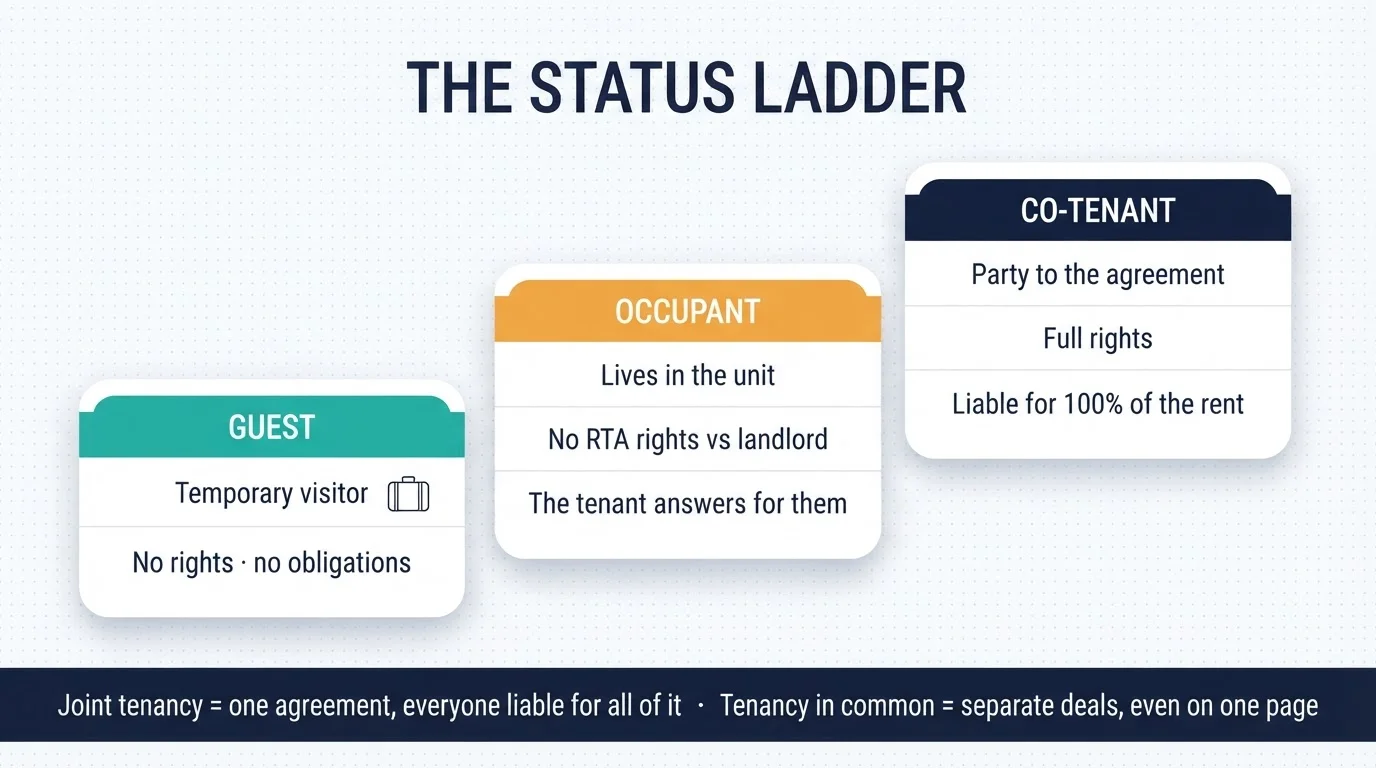
Here's the precision most guides miss, straight from the LTB's own interpretation guideline. In a joint tenancy, there is one agreement, and every tenant is jointly and severally liable — the landlord can pursue any one of them for the entire rent and all damages, not their "share." In a tenancy in common, each tenant has a separate agreement with the landlord and is responsible only for their own portion — even if everyone signed a single document. The Board decides which arrangement exists by looking at the real substance of the relationship, not the label on the page. That's why the words "jointly and severally liable" earn their place in the paperwork: they're the difference between adding a second fully-responsible payor and accidentally slicing one tenancy into per-room deals.
One boundary before going further: adding a person is neither an assignment (replacing a tenant — a consent process with its own rules) nor a sublet (a tenant leaving temporarily). If someone is moving out as someone moves in, you're in different legal territory with different forms.
The Right Way to Add a Name — and the Only Lawful Price
Ontario has no official "add a tenant" form. There are two correct routes. Route A — a written amendment: all current tenants, the newcomer, and the landlord sign a short document stating the new person is added as a tenant, everyone is jointly and severally liable, all other terms are unchanged, and the rent is restated. It's the cleanest possible proof that the same tenancy continues. Route B — a fresh Ontario Standard Lease signed by everyone: common practice and perfectly fine — at the same lawful rent.
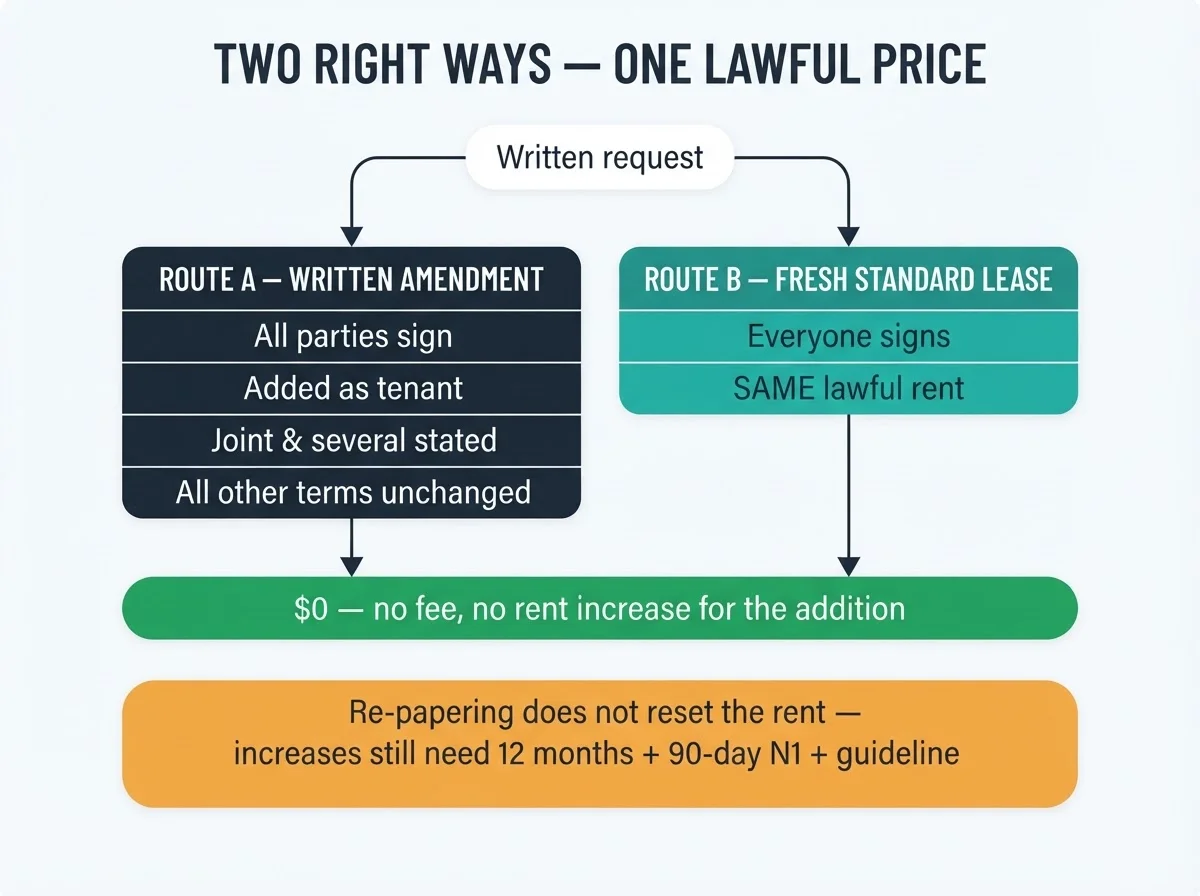
And the price: $0. No admin fee, no "processing charge," and no rent increase is lawful for the addition itself — first and last month's rent and a refundable key deposit are the only charges the RTA ever permits, and they were collected long ago. The normal increase machinery (12 months since the last increase, a 90-day N1, the guideline) simply continues on its existing schedule.
Can the landlord say no? Only for legitimate reasons — genuine overcrowding under local occupancy standards is the classic example. Screening an added name is fair game and good practice: same application, same credit and reference standards, and the same Human Rights Code limits as any applicant. Done right, the whole transaction looks like this: the tenant asks in writing, the landlord screens the partner, everyone signs a one-page amendment, and the household gains a member while the rent, the anniversary date, and everyone's status stay exactly where the law left them. Cost: nothing and an hour.

The Accidental Tenant (and the Spouse Rules)
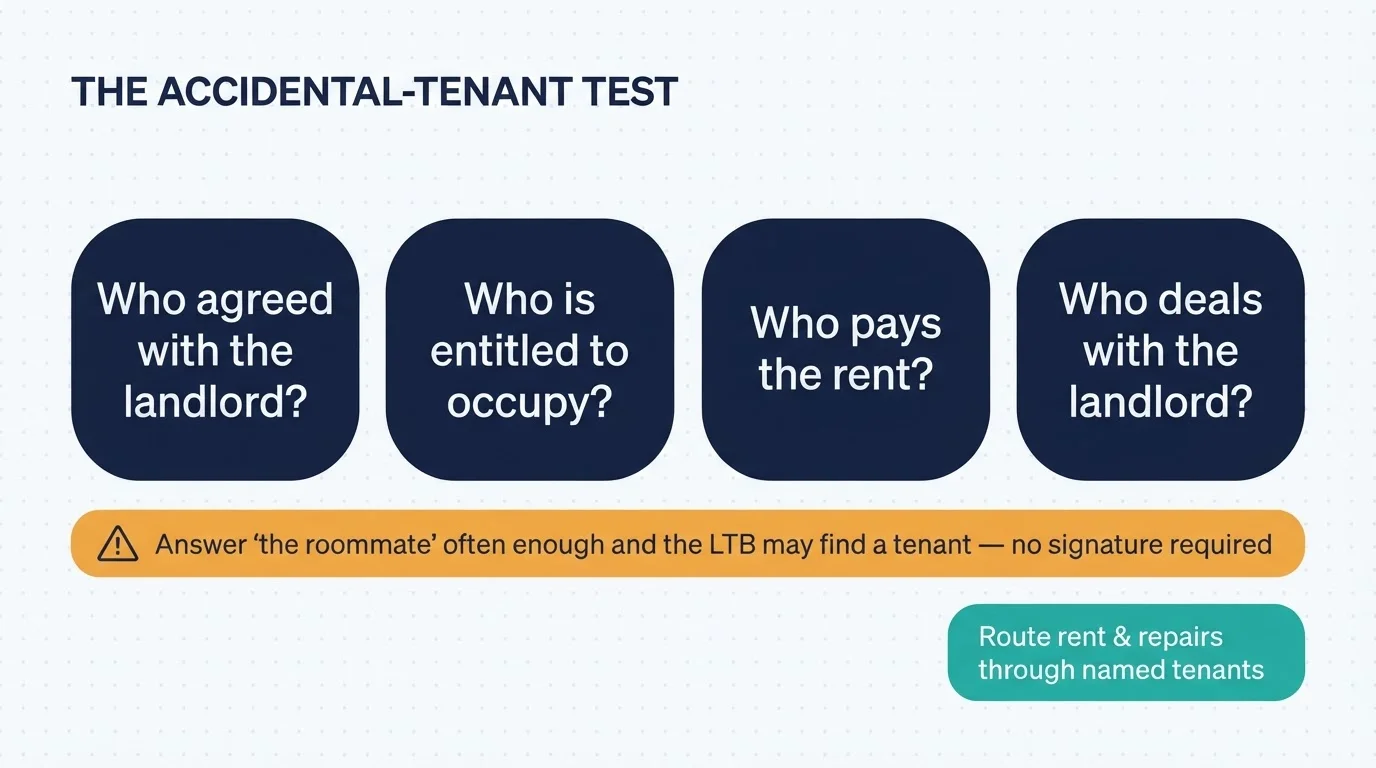
Now the trap that runs the other direction. When paperwork is unclear — or absent — the LTB decides who is a tenant using four factors: who entered the agreement with the landlord, who is entitled to occupy the unit, who pays the rent, and who deals with the landlord on tenancy matters. Conduct can make a tenant where no signature exists.
Picture it: the boyfriend moves in informally. The landlord starts accepting his e-transfers because they arrive on time. Two years of texts about the furnace follow. When the named tenant eventually moves out, the landlord discovers the boyfriend may already be a tenant on the four-factor test — unscreened, unsigned, and fully protected by the RTA. The fix is upstream, and it's simple: route rent and repair dealings through named tenants only — unless you intend an addition, in which case paper it properly and enjoy the benefits. This is the sibling of the 60-day rule that turns unauthorized occupants into tenants — Ontario law fills paperwork vacuums, and rarely in the landlord's favour.
One special case deserves precision: spouses. Under O. Reg. 516/06, if a tenant dies leaving a spouse who was only an occupant, the spouse is included in the definition of "tenant" unless they vacate. And if a tenant moves out without notice or an agreement, leaving their spouse living in the unit, the spouse becomes the tenant too — except in three narrow cases: the building has three or fewer units and the landlord lives in it; the spouse leaves within 60 days; or the departed tenant owed no arrears and the spouse fails to tell the landlord they intend to stay before an eviction order issues. In other words: sometimes the law adds the co-tenant for you, whether or not anyone signed.
The Exit Nobody Plans For (and the Guarantor Fine Print)
Joint tenancy is easy to enter and hard to leave — and the honest version of this article says so at the entrance. A co-tenant is liable for as long as they're named on the agreement. Moving out doesn't end it. An N9 notice is invalid unless all tenants sign it, so one person can't terminate alone — and there is no mechanism for removing one name while the lease stays intact. Release requires the landlord's agreement and new paperwork among the remaining or replacement tenants. The couple who added each other in year one and split in year three learn this the hard way: the one who leaves keeps the liability until the paper changes. The time to explain that is at the add — landlords should disclose it, and tenants should hear it before anyone signs.
The same completeness rule governs guarantors. A guarantor on a joint lease backs the whole lease, not one person's share — and only the guarantors who actually signed. In one student-house fire, the landlord could pursue the three parents who had signed as guarantors for the insurance deductible; the fourth parent, whose signature was never collected, was unreachable. If a guarantee matters to the deal, the guarantor's signature goes on the new paper too. And for the tenants themselves: a roommate agreement — who pays what, who leaves how — doesn't bind the landlord, but it decides the small-claims fight if things go wrong later. Write it while everyone's friendly.
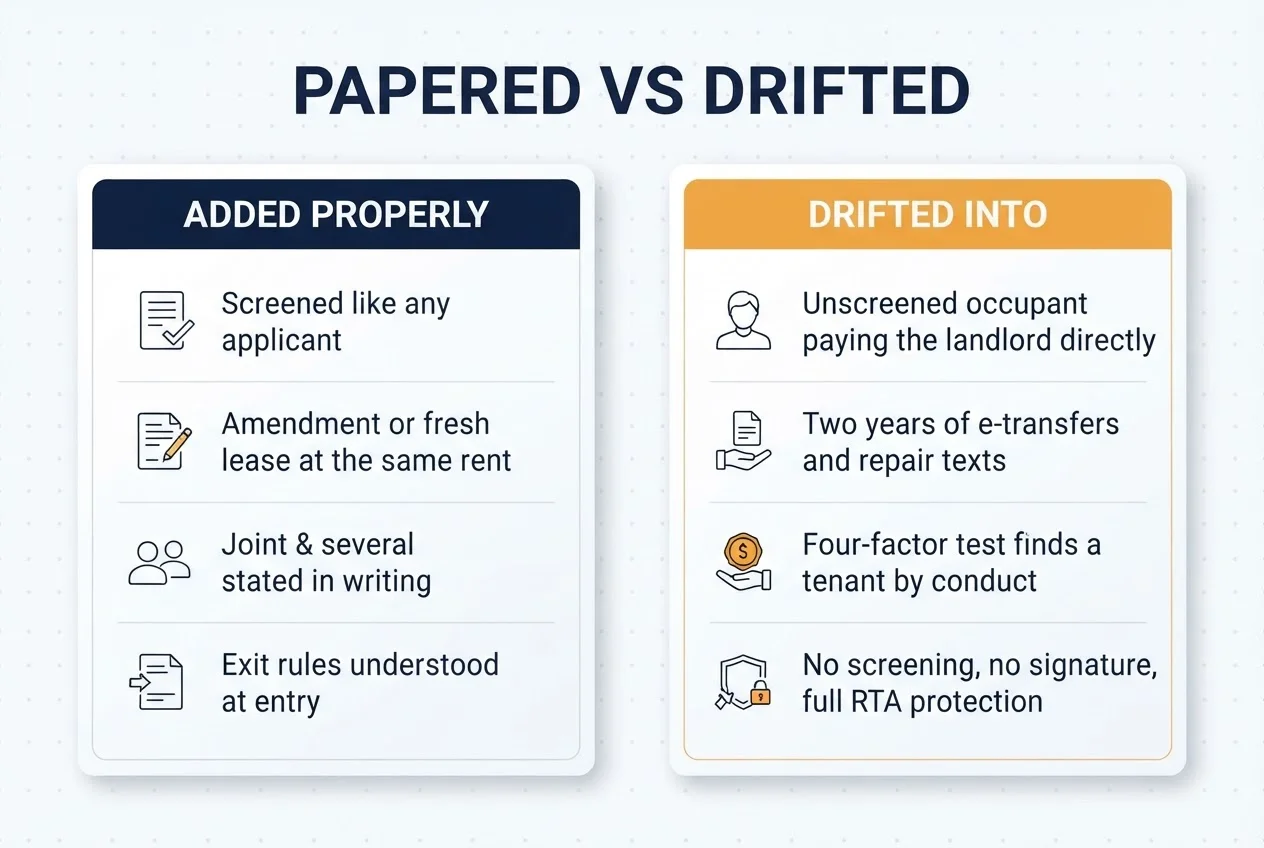
Which points to the landlord's decision framework, and it's short: the rational default is "yes, properly papered." A screened co-tenant costs nothing and adds a second person fully liable for the rent. Refusing a reasonable request doesn't make the partner disappear — it pushes the household informal, where unscreened occupants pay you e-transfers, answer your repair texts, and may become tenants by conduct without a single signature. (When occupancy genuinely goes wrong, there's an LTB enforcement path — we'll cover it in our upcoming applications series.)
Practical Takeaways
Landlords:
- Respond to addition requests in writing, and screen added names like applicants — same standards, same Human Rights Code limits.
- Paper it: a written amendment or a fresh Standard Lease at the same lawful rent, with joint-and-several liability stated expressly.
- Charge nothing for the addition — and leave the 12-month/90-day increase machinery on its existing schedule.
- If a guarantor matters, collect the guarantor's actual signature on the new paper.
- Never drift: rent and repairs through named tenants only, unless you intend an addition.
Tenants and occupants: know which status you're requesting before you ask; the addition lawfully costs $0; don't sign a higher-rent "new lease" to get a name added without advice; and understand the exit before the entrance — liable while named, no solo N9 — then write a roommate agreement while everyone's friendly.
The Add-a-Co-Tenant Kit: Add a Name to Your Ontario Lease the Right Way
Partner moving in? Roommate joining? This free kit walks the whole addition: the right status, the two correct paperwork routes, the only lawful price ($0), the rent-reset trap to refuse, and the exit rules to understand before anyone signs.
Get Free PDF →The Bottom Line
Adding a co-tenant is the rare landlord-tenant transaction where the right answer is usually yes for both sides: more protection for the household, more coverage for the landlord, at a lawful price of zero. The entire skill is in the paper — the right status, named; the same lawful rent, restated; joint-and-several, spelled out; the exit, understood at the entrance. Get those four things in writing and the addition takes an hour. Skip them and Ontario law will fill the vacuum on its own terms — with conduct-made tenants, automatic spouses, and liabilities that outlast relationships. General information, not legal advice — for a contested situation on either side, a community legal clinic or licensed paralegal is the right next call.
Every Amendment, Every Signature, One Tenancy Record
Tenon10 stores the lease, tracks the lawful rent, and keeps every amendment and signature with the tenancy record — so additions stay clean and exits stay provable.
Free • No signup required • Always current rules
Frequently Asked Questions
Can a landlord charge a fee or raise the rent to add someone to the lease?
No. Adding an occupant or roommate permits no fee and no rent increase — first and last month's rent and a refundable key deposit are the only charges the RTA ever allows. The normal increase rules (12 months, 90-day N1, guideline) continue on their existing schedule.
Does signing a new lease let the landlord set a new rent?
Not for a continuing tenant. Market rent is set at turnover — when a tenancy ends and a new tenant agrees to a new rent. A sitting tenant who signs fresh paperwork remains the same tenant, the rent rules follow the tenancy, and an increase smuggled in through re-papering is recoverable through a T1 application within 12 months.
Is my partner a tenant if they live with me and pay rent?
Not automatically. An unnamed partner is usually an occupant — no RTA rights against the landlord, no rent obligation to them. But if the landlord takes rent directly from them and deals with them on tenancy matters, the LTB's four-factor test can find they've become a tenant by conduct.
Can a landlord refuse to add someone to the lease?
Only for legitimate reasons — genuine overcrowding under local occupancy standards is the classic example. Screening an added name follows the same standards and the same Human Rights Code limits as screening any applicant.
How does a co-tenant get off the lease later?
Not unilaterally. They remain liable while named; an N9 is invalid unless every tenant signs it; and release requires the landlord's agreement plus new paperwork among the remaining or replacement tenants. Understand this before joining, not after.
What happens if my spouse isn't on the lease and I die or move out?
Ontario regulation can add them automatically: a deceased tenant's spouse-occupant becomes the tenant unless they vacate, and a departed tenant's remaining spouse becomes the tenant except in three narrow cases — small owner-occupied buildings, leaving within 60 days, or failing to notify the landlord where no arrears exist.


