

Every week, somewhere in Ontario, a landlord searches "standard lease vs custom lease" as if weighing two products. Here's the uncomfortable answer: for most private residential tenancies signed since April 30, 2018, there is no "vs." The Standard Lease — Form 2229E — is mandatory, and the real question isn't which lease to use. It's whether your rental sits inside the mandate, and what it costs to pretend it doesn't.
The "vs" framing survives because the territory around the rule is genuinely confusing. Real exemptions exist. Verbal tenancies exist. Pre-2018 leases still roll along untouched. And at this moment, an official-looking website is telling Ontario tenants they can withhold rent month after month over a missing form — which is false, and we'll correct it below. This guide is the decision frame: the mandate, the three-zone map of where custom paper is actually lawful, the 51-day enforcement timeline drawn precisely, and the honest thesis that the Standard Lease is the custom lease. (For the form's section-by-section walkthrough, see our complete Ontario Standard Lease guide.) General information, not legal advice.
The Lease Zone Finder: Which Paper Does Your Ontario Rental Actually Need?
"Standard vs custom" was settled in 2018 — what's left is a map question. This free kit locates your rental in the right zone, walks the Standard Lease done right, shows where genuine custom agreements are lawful, and defuses the 51-day timeline before a tenant ever plays it.
Get Free PDF →The Mandate: One Form, Most Rentals, Since 2018
The history fits in a paragraph. The Rental Fairness Act, 2017 added section 12.1 to the RTA; O. Reg. 9/18 defined who it covers; and from April 30, 2018, every new written tenancy agreement for most private residential rentals — houses, apartments, condos, basement units — has had to be on the government's Standard Lease. The goals were plain language, fewer illegal clauses, and fewer LTB disputes. "Mandatory" means exactly that: every standard section is fixed and unalterable, every section gets completed (write N/A rather than leaving blanks the Board may read against you), and customization lives in one place — Section 15.
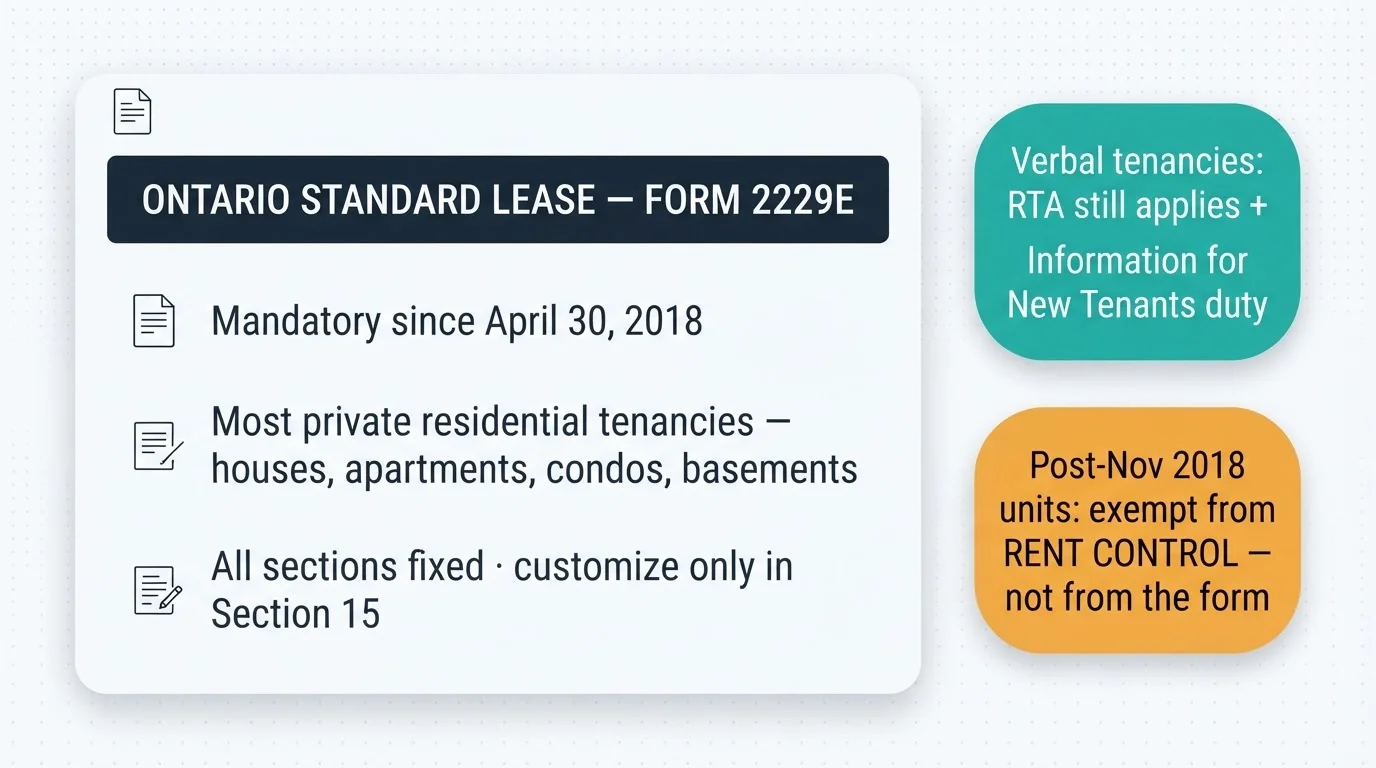
Three precision points most guides miss. First, the trigger is when the agreement was entered, not when the tenancy began — an LTB member found a verbal deal struck April 3, 2018 for a May 1 move-in escaped the mandate entirely, because the agreement predated the cutoff. Second, the verbal corner: Ontario has never required a written lease, and the RTA binds written, oral, and implied tenancies alike. Where no standard form is used, the landlord owes the tenant the LTB's "Information for New Tenants" on or before day one — and any written lease that does exist must be copied to the tenant within 21 days of signing. Third, the confusion to kill early: units first occupied after November 15, 2018 are exempt from rent control. That is a rent rule. It does not exempt anyone from the Standard Lease, which turns on the signing date, not the building's age.
And pre-2018 tenancies? They roll month-to-month on their original terms without triggering anything — until the day a new agreement is signed. That includes re-papering to add a co-tenant: the new signature brings the form mandate with it.
The Three-Zone Map: Where Custom Paper Is Actually Lawful
Zone 1 — Covered. Most private rentals. Form 2229E, full stop, with Section 15 as the drafting table.
Zone 2 — Form-exempt, RTA-governed. O. Reg. 9/18 carves out care homes, mobile home parks and land-lease communities, and most social, supportive, and rent-geared-to-income housing. A custom agreement is lawful here — but the RTA still governs the tenancy, so the custom paper can't override its protections. The government has signalled purpose-built standard forms for these classes; watch for them.
Zone 3 — Outside the RTA entirely. Section 5 of the Act lists them: living arrangements where the occupant must share a kitchen or bathroom with the owner; genuinely temporary or seasonal stays; farm-employment housing; combined business-and-residential premises under a single lease; institution-run student residences; and most non-profit co-ops, which live under co-op law. Here, the contract and the common law are all the parties have — a careful custom agreement isn't just permitted, it's essential, because there's no statutory safety net beneath it.

The shared-kitchen exemption deserves its own paragraph, because it's the most claimed and the most litigated. It applies only where sharing with the owner — or the owner's spouse, child, or parent — is a required condition, and that person lives in the building. Three traps follow from the case law. Jurisdiction is fixed when the tenancy commences: an owner who moves in after the tenant doesn't strip away RTA protection. An undisclosed resident family member may not create the exemption either — courts have declined it where tenants were never told. And "allowed to share if necessary" isn't "required to share." Get the exemption right and a plain-language custom agreement governs; get it wrong and you're holding a non-compliant lease in Zone 1, with everything the next section describes.
One last mapping rule: labels lose to substance. Calling a true tenancy a "licence," or the renter a "roommate," doesn't move it out of the Act — exclusive possession for rent makes a tenancy whatever the paper says. (The genuine exception runs the other way: a renter's deal with a sole leaseholder really is licensee territory, not an RTA tenancy — our co-tenant guide's status ladder covers it.)
The 51-Day Timeline: What Custom Paper Costs in the Covered Zone
Here's what makes this mandate different from most compliance rules: enforcement is self-executing. No LTB application is needed to start it. A tenant entitled to the Standard Lease and never given one simply demands it in writing. From there: the landlord has 21 days to provide a signed Standard Lease. Miss it, and the tenant may withhold one month's rent. Go another 30 days without providing the lease, and the tenant keeps that month permanently. Day 51 is when the money is gone for good — and this isn't theoretical: an LTB order confirmed a tenant who withheld $2,000 exactly this way, kept it lawfully.
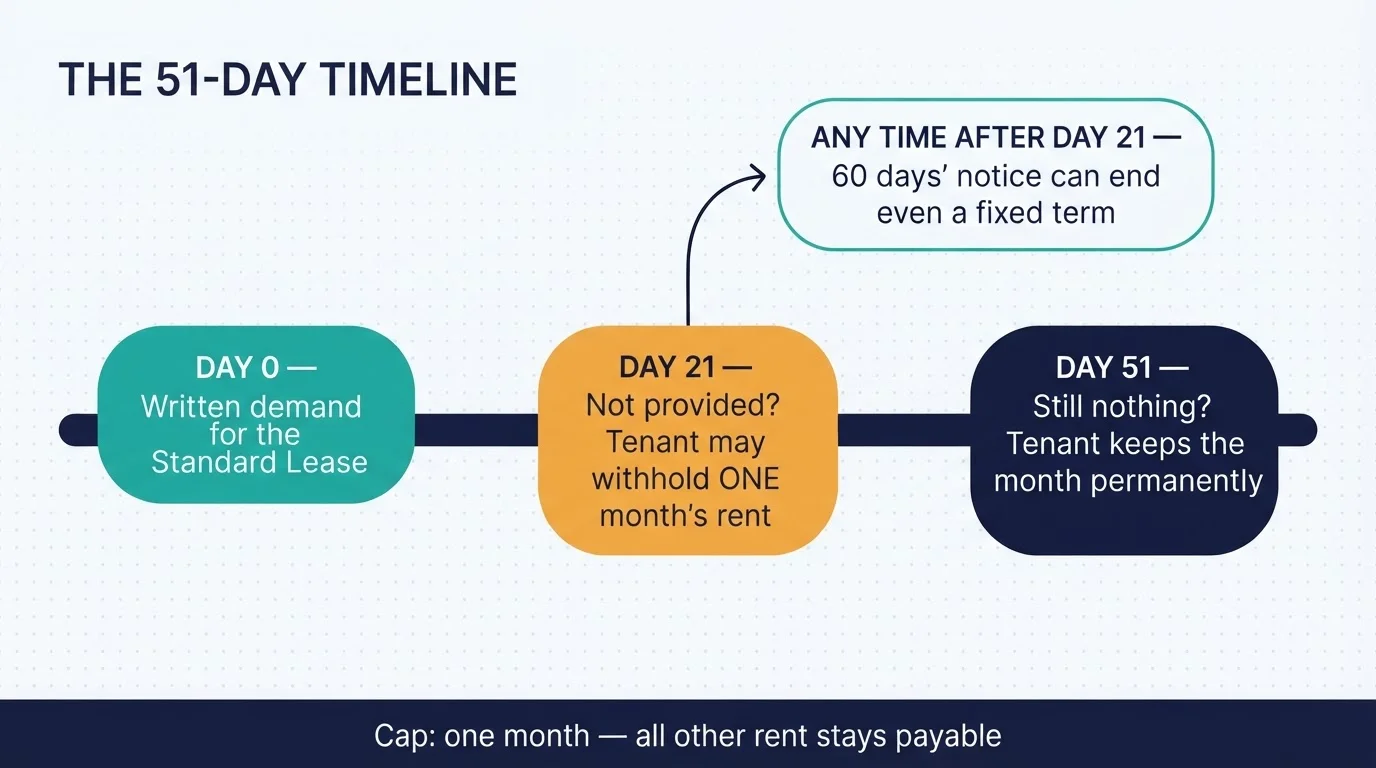
Now the precision that matters, because misinformation is circulating: one month is the cap. An official-looking aggregator site currently tells tenants they can withhold a second month if non-compliance continues — that's wrong. Ontario.ca and the LTB are unambiguous: one month maximum, all other rent stays payable on time, and if the landlord complies within the 30-day window, the withheld month is repayable. Tenants who withhold beyond that expose themselves to an N4 for arrears.
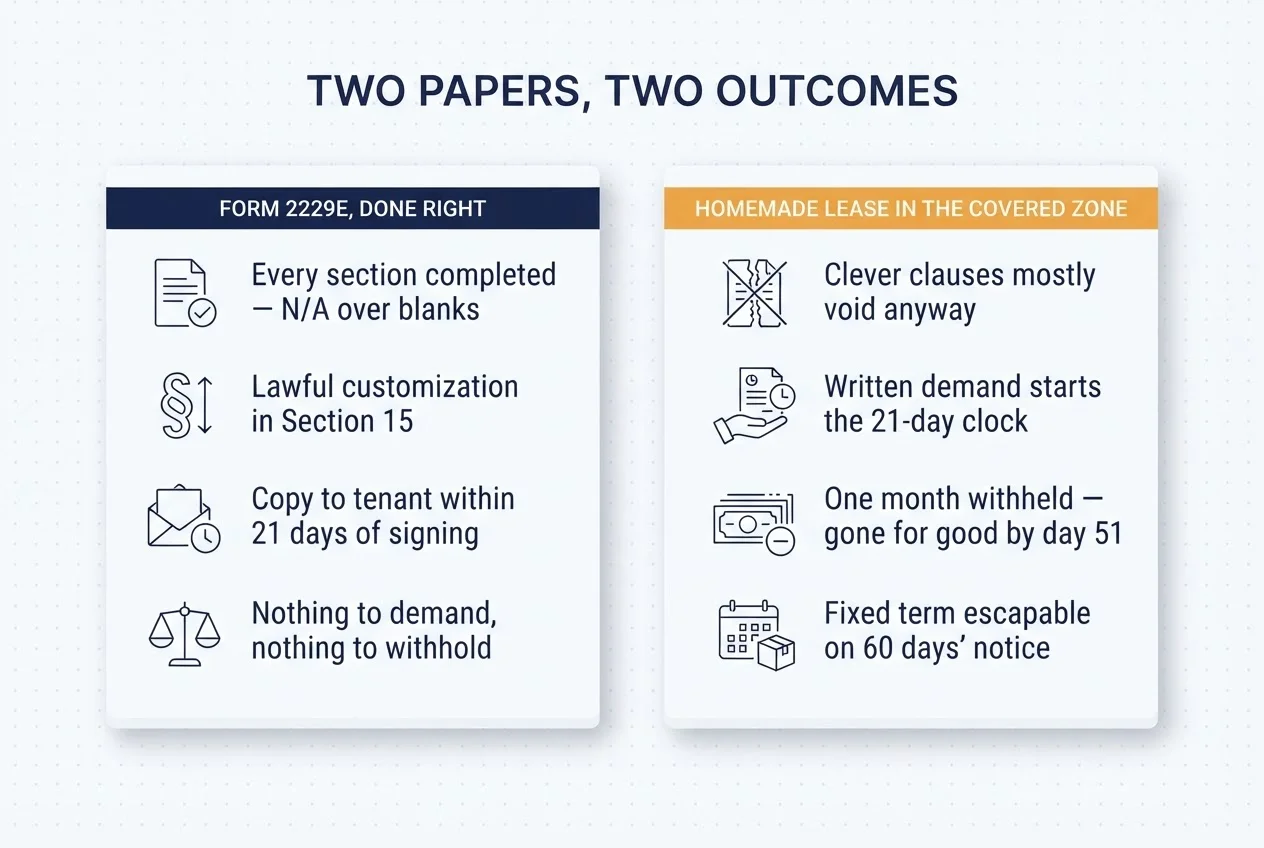
Frame the cost honestly. The fine backdrop exists — RTA offences run to $50,000 for individuals and $250,000 for corporations, with Bill 60 administrative penalties of $500 to $10,000 — but prosecutions are rare and demands are not. The everyday exposure is the timeline above, plus one more indignity: the clever clauses that motivated the custom lease were mostly void anyway — no-pets clauses, damage deposits, guest restrictions, and rights waivers all fail whether or not anyone signed them. A homemade lease buys nothing enforceable and sells a month's rent short. Compliance is cheaper than cleverness. (Inherited a tenanted property with somebody else's homemade lease? Audit it — the previous owner's improvisation is now your 51-day exposure.)
Section 15 Is the Custom Lease
Here's the reframe that settles the whole "vs" question: conscientious landlords don't lose customization under the mandate — they relocate it. Section 15's additional terms carry everything a lawful custom lease ever did: parking arrangements, condo rules (the corporation can't enforce at the LTB — the unit owner must, so surfacing the rules in the lease matters), tenant-insurance requirements, a smoking policy within the law, maintenance logistics, communication preferences. The form is the floor; Section 15 is the drafting table. It obeys exactly one law: nothing inconsistent with the RTA survives, signed or not.
Practical Takeaways
Landlords:
- Map the rental before choosing paper — zone first, form second.
- In the covered zone: the current Form 2229E, every section completed (N/A over blanks), customization in Section 15 only — and a copy to the tenant within 21 days of signing.
- Running a verbal tenancy? The RTA still applies, and the Information for New Tenants brochure is owed on day one.
- Claiming the shared-kitchen exemption? Owner-first residence, required sharing, documented disclosure — and put the exemption basis in the agreement itself.
- If a written demand arrives, treat it as day zero and comply within 21 days — day 51 is when the month is gone and the fixed term becomes optional.
Tenants, stated plainly: entitled to the form and never given it? Demand it in writing and diarize 21 days. The withholding right is one month — not a monthly subscription — and everything else stays payable. And if no compliant lease comes, or the one that arrives isn't what you agreed to, the 60-day early-exit path exists even mid-fixed-term, using an N9 with the right timing.
The Lease Zone Finder: Which Paper Does Your Ontario Rental Actually Need?
"Standard vs custom" was settled in 2018 — what's left is a map question. This free kit locates your rental in the right zone, walks the Standard Lease done right, shows where genuine custom agreements are lawful, and defuses the 51-day timeline before a tenant ever plays it.
Get Free PDF →The Bottom Line
"Standard vs custom" was settled in April 2018 — what remains is a map question. Inside the mandate, the Standard Lease is the custom lease and Section 15 is where the drafting happens; in the exempt zones, a genuine custom agreement is both lawful and necessary; and pretending to be in the wrong zone costs a month's rent, a fixed term, and credibility at the Board. Locate the rental, use the paper the zone requires, and put the craft where the law allows it. General information, not legal advice — for a genuinely ambiguous arrangement, a licensed paralegal or lawyer can zone it definitively before the paper gets signed. Next in this series: lease renewal strategies — what actually happens when the fixed term ends, and what's worth negotiating.
The Right Form, Every Section, Every Time
Tenon10's Standard Lease flow keeps Form 2229E current, walks every section so nothing's left blank, and keeps your additional terms on the lawful side of Section 15.
Free • No signup required • Always current rules
Frequently Asked Questions
Can a landlord use their own lease in Ontario?
For most private residential tenancies signed since April 30, 2018 — no. The Standard Lease (Form 2229E) is mandatory, with customization allowed only through its additional-terms section. Genuine exceptions exist: care homes, mobile home parks, and most social housing (still RTA-governed), plus arrangements outside the RTA entirely, like owner-shared kitchen or bathroom rentals.
What happens if my landlord won't give me the standard lease?
Demand it in writing. After 21 days you may withhold one month's rent; if the lease still hasn't arrived 30 days after that, you keep the withheld month. The cap is one month — all other rent stays payable — and you also gain the right to end even a fixed-term tenancy on 60 days' notice.
Is a verbal lease legal in Ontario?
Yes — the RTA binds written, oral, and implied tenancy agreements alike. Where no standard form is used, the landlord must give the tenant the LTB's "Information for New Tenants" on or before the tenancy starts, and any written lease that does exist must be copied to the tenant within 21 days of signing.
Does the standard lease apply if I share a kitchen with my landlord?
Usually not — but precisely. The exemption requires that sharing with the owner (or their spouse, child, or parent) be a required condition, and that they live in the building from before you moved in. An owner who moves in later doesn't remove your RTA protection, and labels like "licence" don't change the substance.
My unit is newer than November 2018 — am I exempt from the standard lease?
No. That date governs the rent-control exemption, which is a separate rule. The Standard Lease mandate turns on when the agreement was signed (April 30, 2018 onward), not when the building was first occupied.
Do old leases have to be converted to the standard form?
No — tenancies signed before April 30, 2018 continue and roll month-to-month on their original terms without triggering the demand right. But the day any new agreement is signed — including re-papering to add a co-tenant — the Standard Lease is required.


