

Here's a sentence that would have sounded insane in 2023: this year, the smartest renewal move for many Ontario landlords is not taking the rent increase. GTHA vacancy hit 5.4% in early 2026 — the highest since 2021 — Toronto asking rents fell 7.9% year-over-year, and nearly half of new buildings are dangling two months free. Meanwhile, the sitting tenant in a rent-controlled unit is holding a $362-a-month discount just for staying put.
Most "lease renewal" content splits into two camps: legal explainers that cover what converts mechanically, and retention platitudes that say be nice to your tenants. Neither joins the law, the 2026 numbers, and the fact that the same term-end serves three different interests. This guide does — the legal floor in one paragraph, then the real decision (month-to-month or a new fixed term, and what each seat actually buys and sells), the landlord and PM retention playbook with real turnover math, and the tenant's renewal leverage, split by unit type. For the mechanics of what happens when a fixed-term lease in Ontario ends, start with our conversion guide. This is general information, not legal advice, and market figures are as of mid-2026.
The Renewal Decision Kit: Your Rights and Leverage When the Lease Term Ends
Your lease ending decides nothing — you can't be made to sign, and in 2026 you have more renewal leverage than tenants have held in years. This free kit walks your rights, your market leverage by unit type, and the month-to-month vs new-fixed-term decision.
Get Free PDF →The Floor, and the 2026 Moment
The entire legal floor fits in one paragraph. In Ontario, a fixed term that ends converts automatically to a month-to-month tenancy on the same terms — no paperwork, no action, no "expiry." The tenant cannot be required to sign a new lease, cannot be evicted or penalized for declining, and cannot be handed new terms at conversion. And rent increases run on their own machinery — 12 months since the last increase, a 90-day N1, and the guideline for rent-controlled units (an N2 for exempt ones) — regardless of what is or isn't signed. "Sign or leave" is not a lawful position. Everything after this paragraph is strategy, not law.
And the strategy landscape in 2026 is unlike anything in recent memory. Vacancy across the GTHA reached 5.4% in the first quarter, with a record 8% of units flagged as becoming available. The national average asking rent hit a 33-month low after more than seventeen straight months of year-over-year declines. Two-thirds of new rental buildings are offering incentives; 47% are offering two full months free. Net of those incentives, Toronto effective rents fell 3.8% in a year.
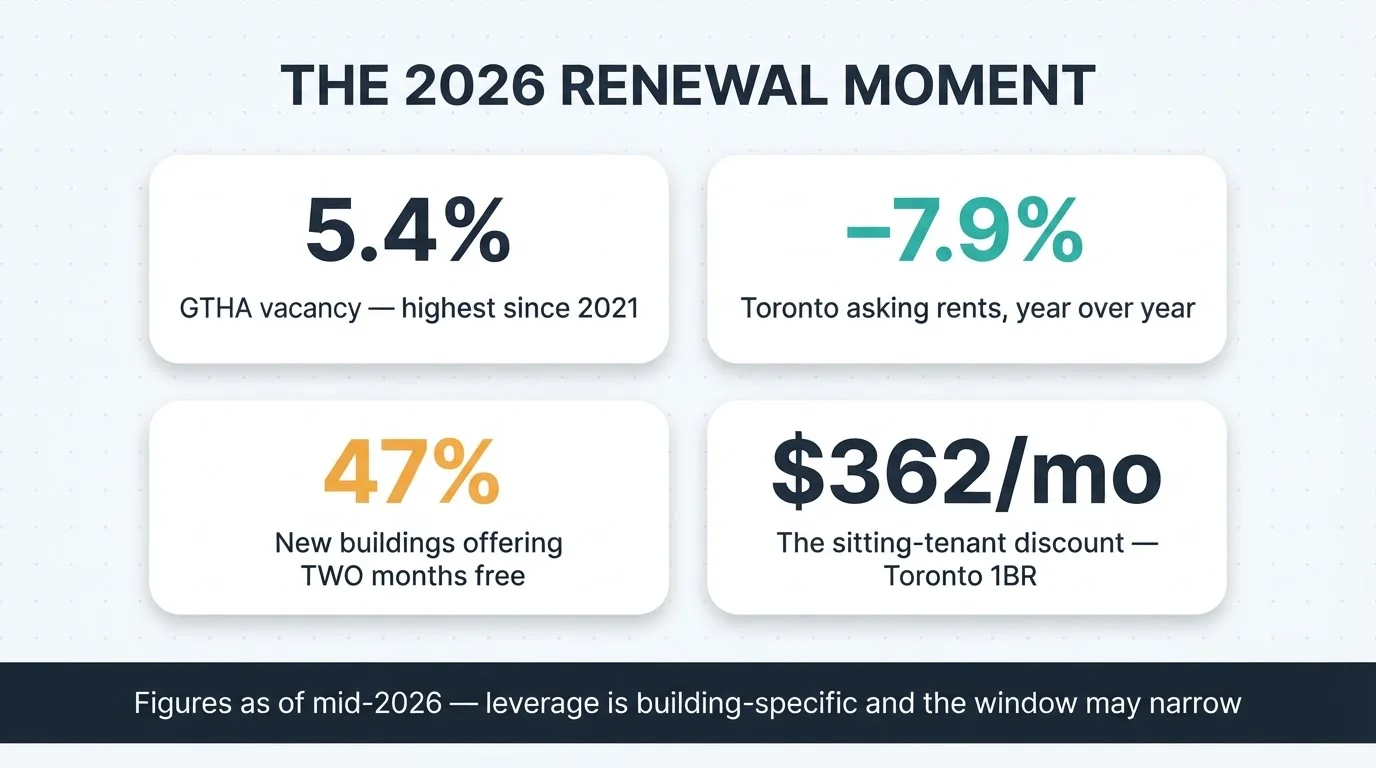
Two numbers frame every renewal conversation this year. First, the sitting-tenant discount: a Toronto one-bedroom rents for about $2,073 at turnover but $1,711 to the tenant already living there — $362 a month, or 21%, just for staying. Second, the turnover bill: a realistic tenant turnover now runs $5,000–$10,000 or more — four to six weeks of vacancy, cleaning, painting, minor repairs, and a leasing fee of a month plus HST — before counting the risk of re-letting $100–$400 a month below the departing lease in soft submarkets. One caveat keeps everything honest: leverage is building-specific. CMHC finds vacancies concentrated in post-2020 towers and near campuses, while older family-sized stock stays tight — and it expects renter leverage to narrow as demand rebounds. Strategy should carry a date.
The Real Choice: Month-to-Month or a New Fixed Term
Since staying requires nothing, "renewal" really means one question: should either side want fresh paper? A new fixed term is lawful only when both sides agree — and it must live in the Ontario Standard Lease framework, not a homemade renewal sheet, for all the reasons our standard-vs-custom guide covers.
Here's the trade, stated honestly. What the tenant buys with a new fixed term is no-fault insulation: an N12 (own use, including a purchaser's) or N13 (renovation or demolition) termination date cannot land before the term ends, and the N8 for persistent late payment is an end-of-term ground too. A signed year is a year no sale, own-use claim, or renovation can interrupt. What the landlord buys is income predictability, a scheduled tenancy rhythm — and, subtly, scheduled N8 windows that month-to-month never provides. What both sides sell is flexibility: the tenant's exit math locks to sixty days from the term's end, and the landlord locks away sale, renovation, and own-use options for the duration. The constraint cuts both ways — which is exactly why the sale-minded landlord prefers month-to-month and the stability-minded tenant proposes the fixed term.
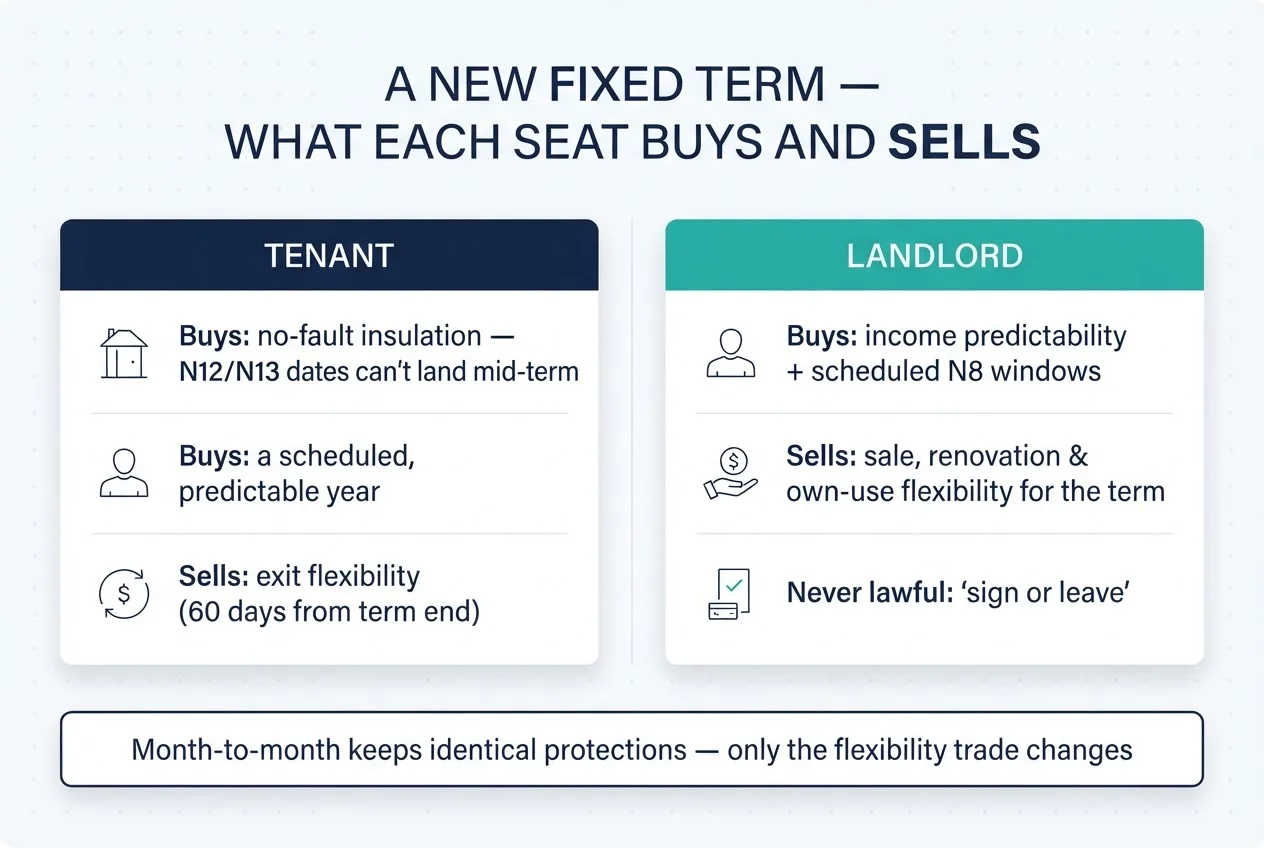
A worked example, built from these rules: a building is rumoured to be for sale. The tenant, wanting insulation, proposes a fresh 12-month Standard Lease at the same rent — if signed, no purchaser's N12 can take effect inside that year. The landlord, wanting to keep options open for the sale, declines and counters with month-to-month plus a modest incentive to stay. Both positions are lawful; the negotiation is real. (Renewal moments are also when households change shape — if a partner is moving in, our guide to adding a co-tenant covers doing it without resetting anything.)
Two misconceptions die here. "Month-to-month is precarious" — no: protections are identical; only notice flexibility changes. And "a new lease only helps the landlord" — also no: it's the tenant who gains the mid-term immunity, and the landlord who gives up flexibility to grant it.
The Landlord and PM Playbook: Retention Economics
The 2026 consensus among practitioners has genuinely flipped: the landlords performing well right now are not the ones pushing the maximum allowable increase at every renewal — they're the ones retaining. Vacancy is the competition, and there's more of it than at any point since the pandemic.
The maximization question fits in one line: is $36 a month — the 2.1% guideline on a $1,700 rent — worth a $5,000–$10,000 turnover risk in a 5.4%-vacancy market? Run the constructed example both ways. The maximization mistake: the landlord takes the full increase; the excellent tenant, courted by two-months-free offers nearby, leaves. Five weeks vacant (about $2,000), paint and cleaning ($1,800), a leasing fee ($1,850 plus HST), and re-letting at $1,650 in the soft market. Year-one cost of chasing $432: roughly $6,000, plus a $50-a-month gap that keeps compounding. The retention play: same unit — the landlord opens the conversation 90 days out, fixes the balky dishwasher first, and offers renewal at a freeze with a $200 goodwill credit. The tenant stays, the sitting-tenant discount keeps working for them, and roughly $20,000 of annual revenue stays intact for the price of a dishwasher and a credit.
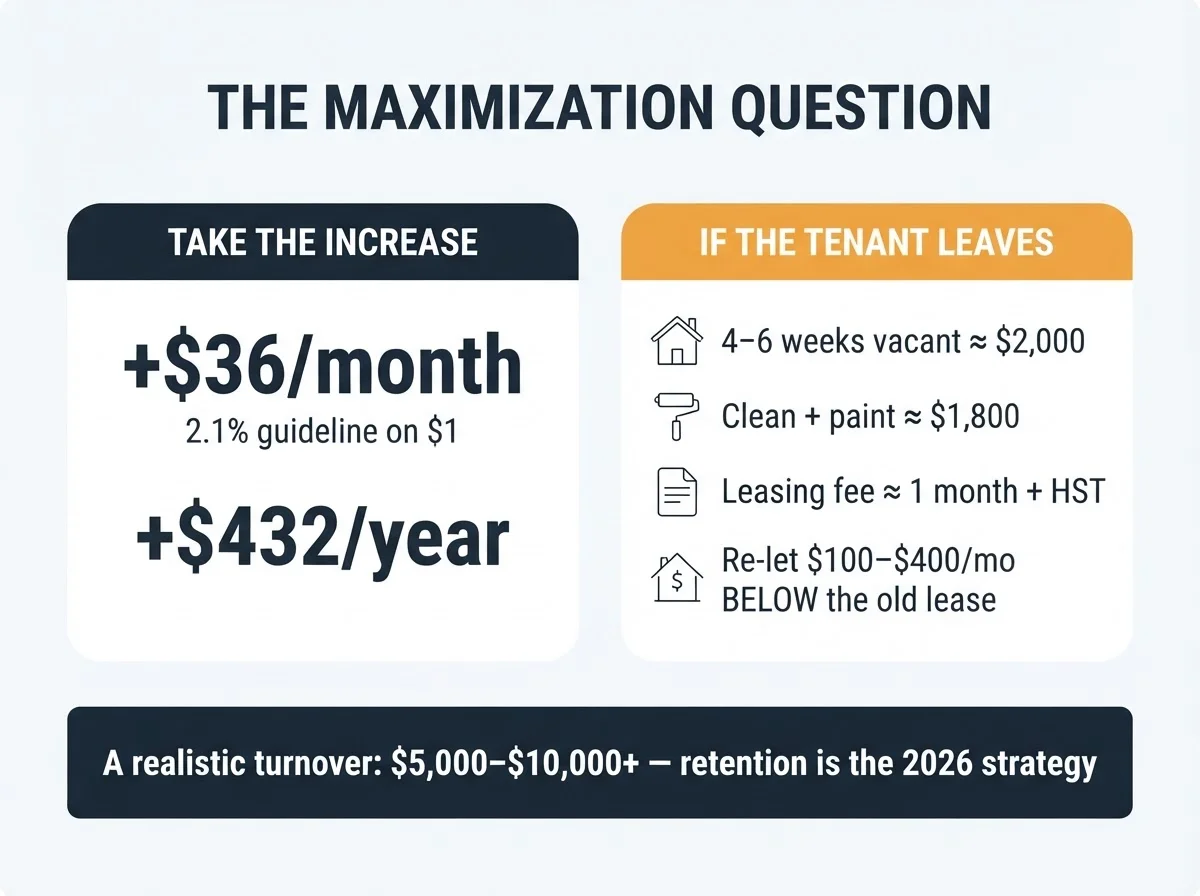
The playbook itself is short. Open the conversation two to three months before the term ends. Resolve outstanding maintenance before the renewal ask — tenants weigh the cost of moving against the experience of staying, and an open repair ticket tilts that scale. Make the offer simple and written. And price from per-unit math — sitting rent, current market rent, realistic turnover estimate — not from habit or from what the unit "should" earn. In controlled units, that math mostly says hold or go nominal this year; in exempt units, it says price to honest comparables. For increases beyond the guideline, the AGI process is its own disciplined path.
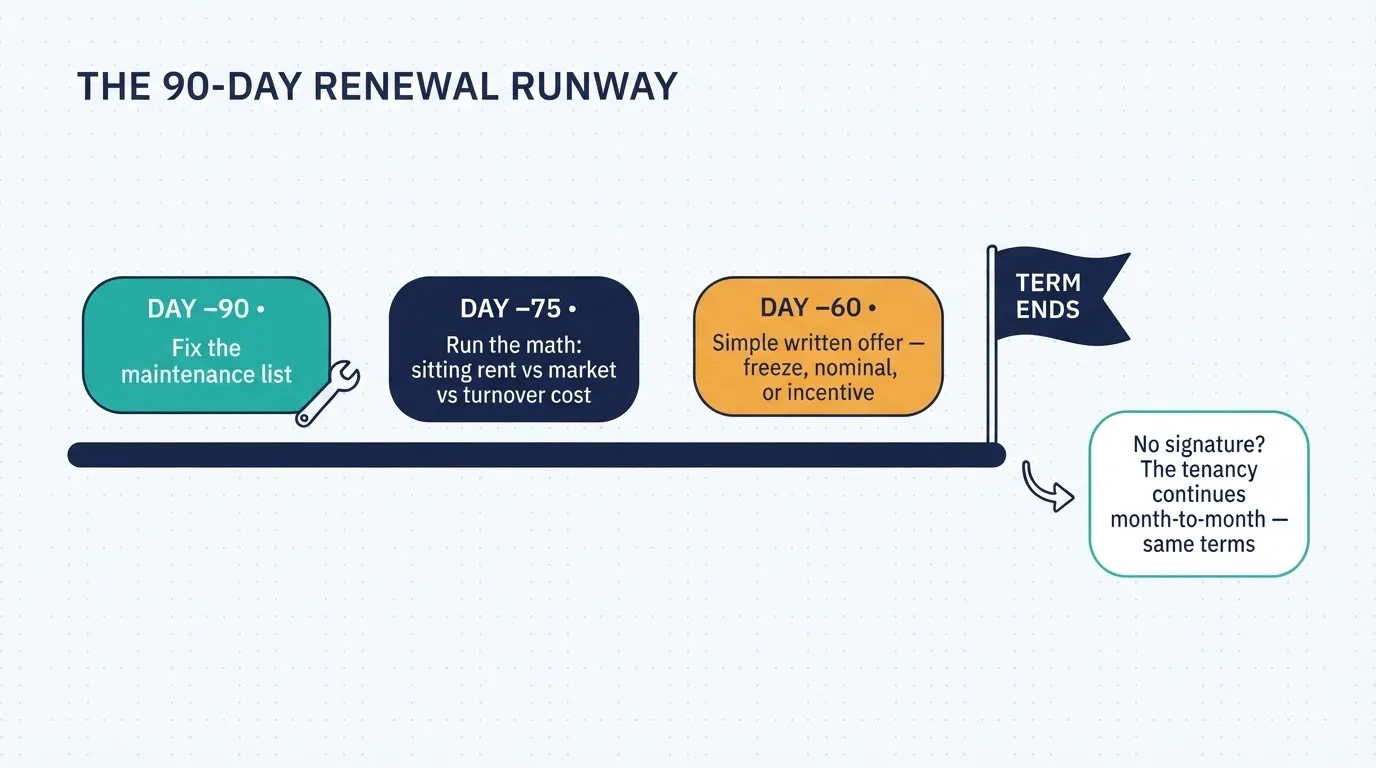
For property managers, scale the same logic: a 90-day renewal calendar across the portfolio, a one-page per-unit math sheet, maintenance resolution sequenced ahead of every renewal conversation, and every offer documented in writing. Incentives get priced against vacancy, not pride.
The Tenant Playbook: Leverage by Zone
Start from the posture the law gives you: you never have to sign to stay, and declining costs you nothing. Every renewal conversation begins on that floor.
In a rent-controlled unit (first occupied on or before November 15, 2018), your leverage is the $362-a-month moving premium working in your favour — your landlord knows replacing you costs thousands and may mean re-letting for less. Reasonable renewal asks: outstanding repairs completed, an upgrade, a freeze instead of the guideline bump, or the fixed term if stability matters to you. The guideline caps any increase whether or not you sign — check the math with the Rent Increase Calculator.

In an exempt unit (first occupied after November 15, 2018), there's no guideline cap — renewal is a genuine market negotiation, and in 2026 the comparables are your evidence. A constructed example from this year's conditions: the landlord of a post-2019 tower opens at +6%; the tenant brings three comparable listings priced 8% lower with a month free; they settle at a freeze plus included parking. Bring data, not hope. And if the conversation turns to "sign this or move out," stay calm — the demand itself is unlawful. Decline in writing, keep paying normally, and know that increases smuggled into renewal paperwork remain challengeable. If you're leaving instead, it's 60 days' written notice on an N9 to a period-end date.
Practical Takeaways
Landlords and PMs:
- Run the per-unit math before pricing any renewal — sitting rent, market rent, turnover estimate.
- Open the conversation 60–90 days out, with maintenance resolved first.
- In 2026: hold or go nominal on good tenants in controlled units; price exempt units to real comparables.
- Any new fixed term goes on the Standard Lease framework — never a homemade renewal sheet.
- For tenancies you won't renew, use the lawful doors — never "sign or leave."
Tenants:
- You never have to sign to stay — and can't be punished for declining.
- Know your zone before negotiating: controlled (the moving premium is your leverage) or exempt (comparables are).
- If stability matters, propose the fixed term — no-fault termination dates can't land inside it.
- If leaving, an N9 with 60 days' notice to a period-end date.
Everyone: date your strategy. This market favours renters as of mid-2026 — and CMHC expects the window to narrow.
The Renewal Decision Kit: Your Rights and Leverage When the Lease Term Ends
Your lease ending decides nothing — you can't be made to sign, and in 2026 you have more renewal leverage than tenants have held in years. This free kit walks your rights, your market leverage by unit type, and the month-to-month vs new-fixed-term decision.
Get Free PDF →The Bottom Line
In Ontario, a term's end decides nothing — which is exactly what makes it a strategy moment. The tenancy continues by default; the only question is whether fresh paper serves you. For landlords in 2026, the math mostly says retain: the guideline's $36 can cost a $6,000 turnover. For tenants, the moment carries leverage most never use — and, if stability matters, a fixed term that no N12 or N13 can interrupt. For property managers, it's a calendar and a math sheet, ninety days at a time. This piece completes our Lease Basics series — the AGI process, adding a co-tenant, standard vs custom paper, and now the renewal decision. General information, not legal advice — for a high-stakes renewal, a licensed paralegal or lawyer can pressure-test the plan.
Never Get Surprised by a Term End Again
Tenon10 tracks every tenancy's term dates, guideline room, and lawful-rent history — so the renewal conversation starts on time, with the math already done.
Free • No signup required • Always current rules
Frequently Asked Questions
Do I have to sign a new lease when mine ends in Ontario?
No. The tenancy converts automatically to month-to-month on the same terms, you can't be required to sign a new lease, and you can't be evicted or penalized for declining. A new fixed term happens only if both sides agree.
Can rent go up if I renew my lease?
Only through the normal machinery — 12 months since the last increase, a 90-day N1, and the guideline for rent-controlled units — regardless of what's signed. Exempt units (first occupied after November 15, 2018) have no guideline cap, making renewal a genuine negotiation there.
Should I sign a new fixed term or go month-to-month?
It's a trade. A fixed term gives the tenant insulation — no-fault termination dates (N12, N13) can't land inside it — and gives the landlord predictability; both give up flexibility. Month-to-month keeps identical protections with easier exits on both sides' schedules.
How much does tenant turnover actually cost a landlord?
In today's market, a realistic turnover runs $5,000–$10,000 or more — four to six weeks of vacancy, cleaning, painting, and a leasing fee — before counting the risk of re-letting $100–$400 a month below the departing lease. That's why holding a good tenant often beats a $36-a-month guideline increase.
When should a landlord send a renewal offer?
Start the conversation two to three months before the term ends — after resolving any outstanding maintenance, because tenants weigh the experience of staying against the cost of moving. Keep the offer simple, written, and priced from real per-unit math.
Does a new lease protect me from an N12?
During the term, largely yes — an N12 or N13 termination date cannot be earlier than the end of a fixed term. It doesn't erase those grounds; it schedules when they can take effect, which is exactly the stability a fixed term buys.


