Here's a fact that surprises both sides of a tenancy: Ontario's Landlord and Tenant Board can issue an eviction order without holding a hearing — but only through two applications, and the L3 is one of them. It exists for the strangest scenario in residential tenancy: the tenant gave notice, or signed an agreement to leave... and then simply stayed.
An N9 or N11 doesn't end anything by itself. If the tenant remains, it's just paper — and paper with a fuse: both documents become void if no application is filed within 30 days of the termination date. Landlords lose exits by waiting. Tenants get blindsided by orders that arrive in the mail with no hearing attached. This guide walks both sides through it: for landlords, the conversion — the two doorways in, the fuse, the five-element affidavit that is the case, and what the order does and doesn't permit; for tenants, exactly how the ex parte lane works and the 10-day Motion to Set Aside that freezes everything automatically. (Our N11 guide covers how the agreement gets made; this is what happens when it isn't honoured.) General information, not legal advice.
The L3 Tenant's Kit: Your 10-Day Counterweight to a No-Hearing Eviction Order
In Ontario, notice you gave — or an agreement you signed — can become an eviction order without a hearing. This free kit walks your exact rights: the Motion to Set Aside that freezes enforcement automatically, the grounds that win, and what the landlord can never lawfully do.
Get Free PDF →Two Doorways In: the N9 and the N11
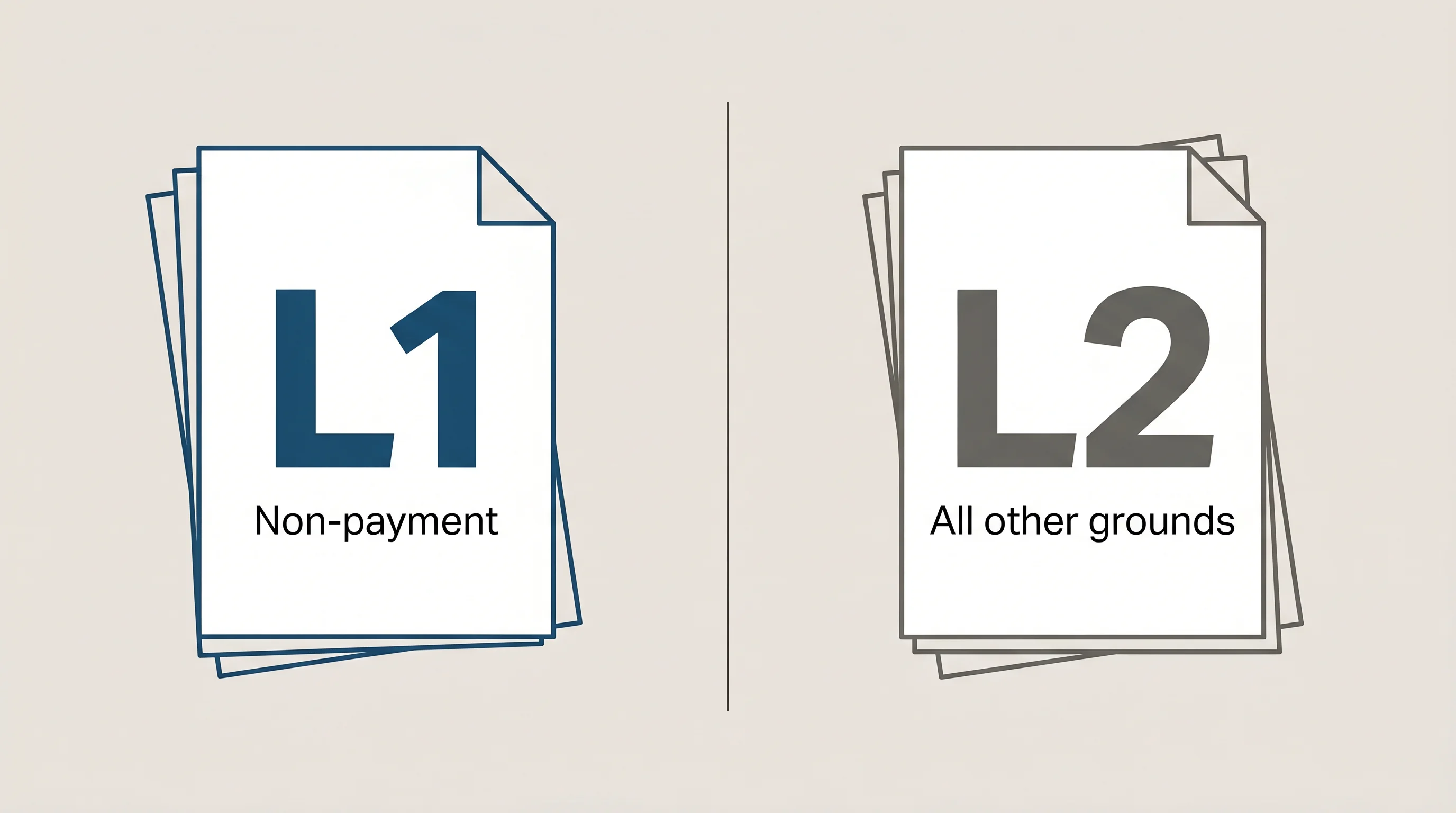
The L3 lives in section 77 of the Residential Tenancies Act, and it's unlike every other eviction application: there's no allegation and no fault. The tenant's own paperwork is the entire basis. That paperwork comes in exactly two forms. (If you're ending a tenancy over arrears or conduct instead, you're in different territory — see our L1 vs L2 guide.)
Doorway one: the N9, the tenant's notice to end the tenancy — with real math attached. A monthly tenancy needs at least 60 days' notice, ending on the last day of a rental period; weekly and daily tenancies need 28; a fixed term can't be ended early this way. And a text message saying "I'm moving out" is not an N9 — the form matters, because everything downstream is built on it. Doorway two: the N11, the mutual agreement to end the tenancy, signed by all parties, effective on whatever date they chose.
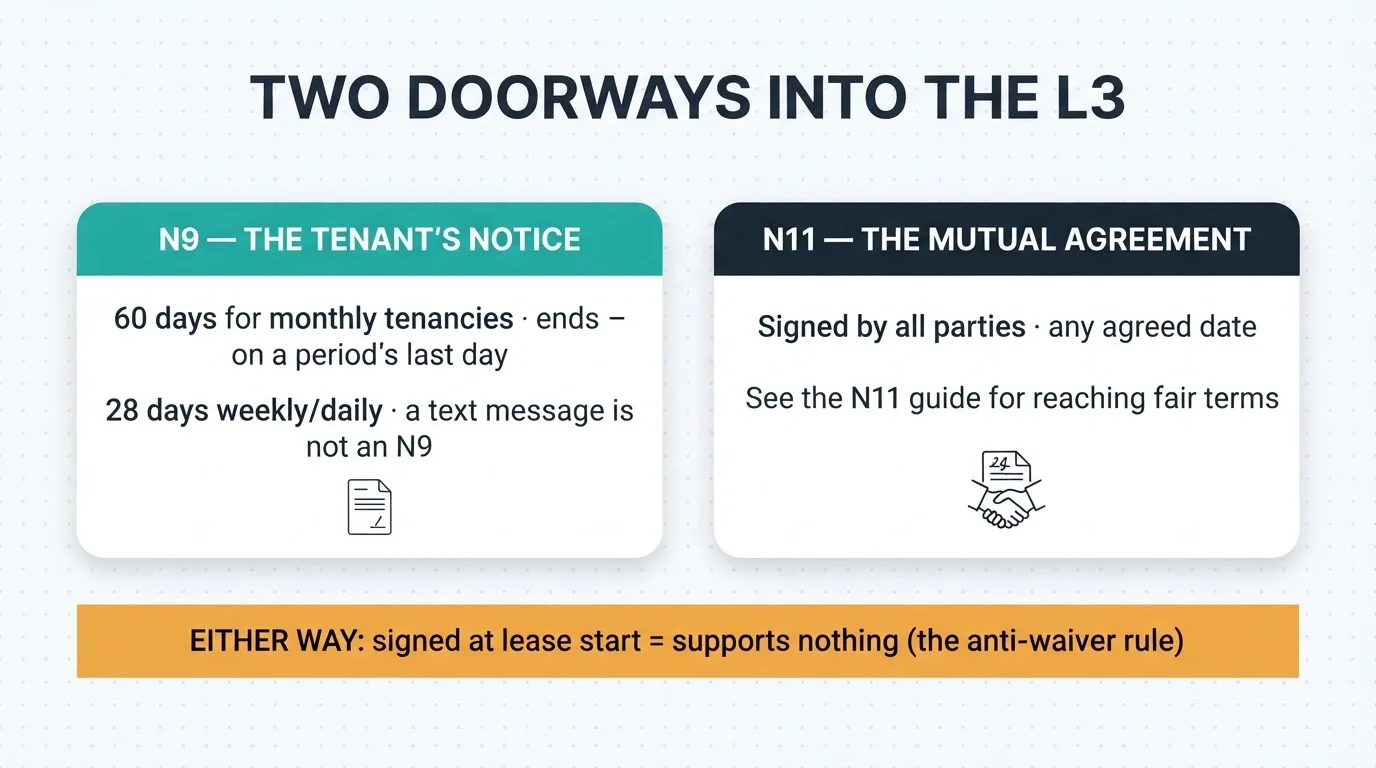
One rule arches over both doorways: an N9 or N11 signed at the same time as the lease supports nothing. Ontario law doesn't let tenants be made to pre-surrender their tenancy as a move-in "formality." Keep that rule in mind — it resurfaces twice below, once as a required statement in the landlord's own affidavit and once as a tenant's winning argument. In today's market it's worth saying that most notices end in genuine move-outs — with GTHA vacancy at 5.4%, tenants who give notice usually have somewhere to go. The L3 is insurance for the exception, and at $186 it's the cheapest application in the L-series to run.
The Conversion: Filing the L3 Before the Fuse
The deadline first, because it has no mercy: the L3 must be filed no later than 30 days after the termination date in the N9 or N11 — or both documents become void and the tenancy simply continues. There's no revival; a new notice or a new agreement starts from scratch, months later.
But here's the asymmetry that saves prepared landlords: you can file the moment the paper lands. There's no requirement to wait for the termination date — the LTB won't end the tenancy before that date regardless, so early filing costs nothing and buys months of margin. Compare two landlords: the first receives a valid N9 on March 1 for April 30 and files on the portal March 3; an ex parte order issues in April, the tenant returns the keys on schedule, and the order is never needed. The second "waits to see" — the tenant's N9 terminates May 31, June passes, and the L3 goes in on July 8, day 38. Dismissed as out of time, N9 void, tenancy continues. The waiting cost the entire exit.
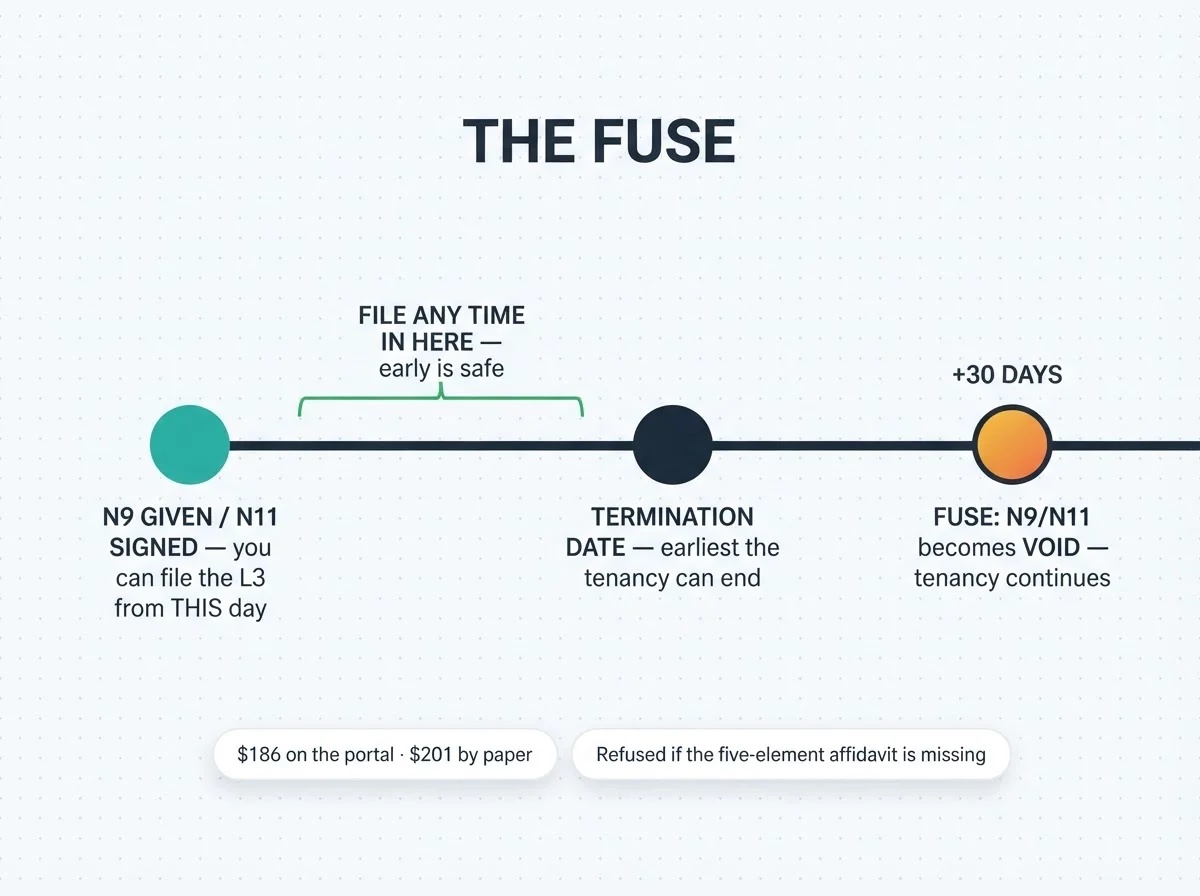
The package is short but strict — the application is refused if anything is missing: the L3 itself (which basis, which termination date); a copy of the N9 or N11; the fee; and the document that actually decides the case — a signed declaration or sworn affidavit with five required elements: the date the tenancy agreement was entered into, the termination date, the date(s) the N9/N11 was signed, the name(s) of who signed it, and the affirmative statement that it was not made at the time the lease was signed. For N11s, add one more: that no later agreement changed or replaced it. In a process where an adjudicator may never hold a hearing, this affidavit is the entire evidentiary record.
Channel and cost: the L3 files through the Tribunals Ontario Portal — $186 online versus $201 by mail, courier, or in person — with immediate payment and status tracking. (A tidy contrast with its cluster sibling: the L5 application skips the portal entirely; the L3 lives on it.) Add a Schedule of Parties where there's more than one landlord or more than two tenants, and disclose any unresolved related file numbers.

The Ex Parte Lane — and the Tenant's 10-Day Counterweight
"Ex parte" means an adjudicator reviews the filed papers and may issue the order without holding a hearing — the L3 and L4 are the only two LTB applications where that's possible. It's a privilege, not a default: files that raise questions get routed to an ordinary hearing instead. One real-world version: an L3 arrives with a photocopied N9 missing a signature date; the adjudicator declines the fast lane and directs a hearing — six extra weeks that a complete first filing would have avoided. Either way, the order is mailed to both landlord and tenant.
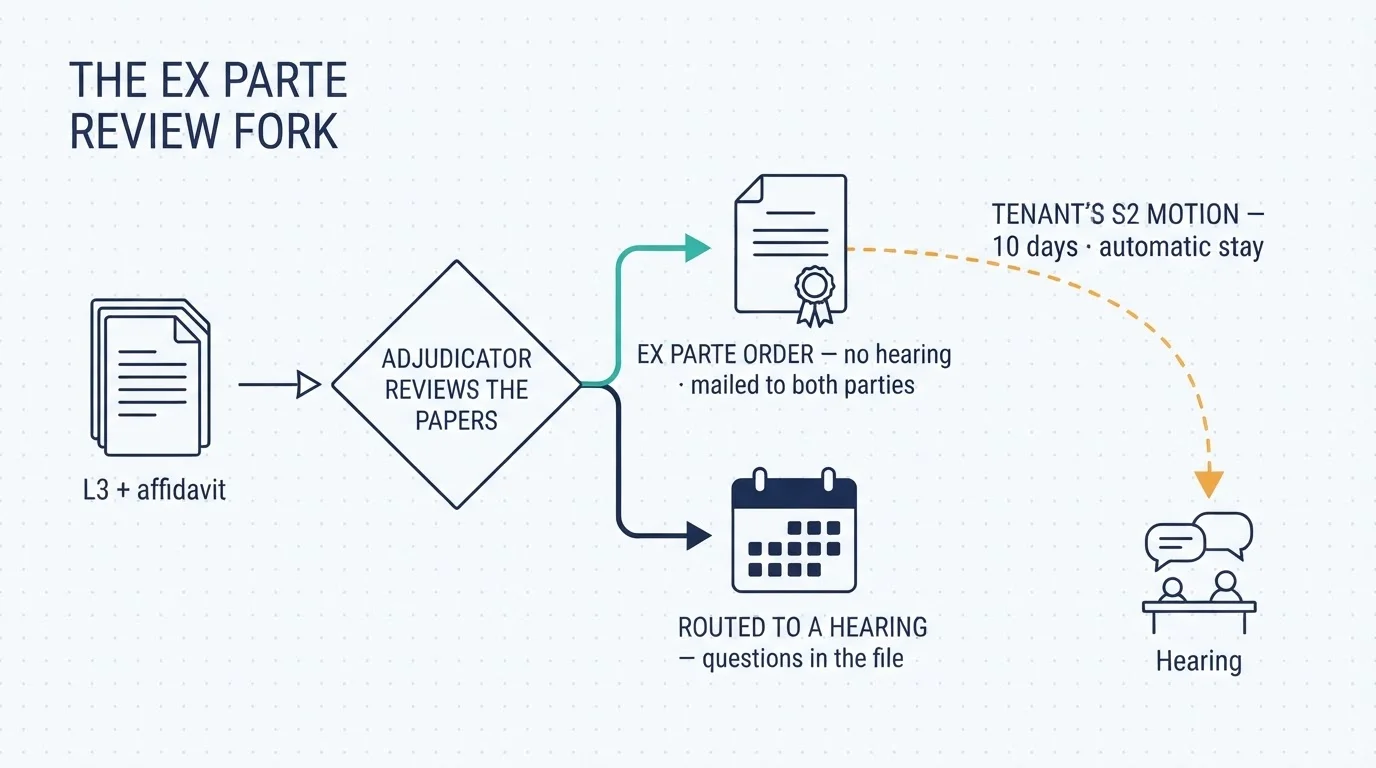
Now the tenant's side, at equal depth — because an ex parte order can arrive as a genuine surprise. The counterweight is the Motion to Set Aside an Ex Parte Order (Form S2), filed within 10 days of the date the order was issued. Filing on time does something powerful: it automatically stays the order. Nothing can be enforced — not by the landlord, not by the Sheriff — until a hearing decides the motion. Past 10 days? Still file, attaching a Request to Extend Deadline with an honest explanation.
Real grounds belong in the S2's explanation box: the N9 was never actually given; a signature isn't yours; the N11 was signed the same day as the lease — the anti-waiver rule's second appearance; a later agreement changed or replaced the exit; or you and the landlord made a new arrangement (which is why any "sure, stay until spring" conversation should become a confirming email the same day). Here's how it plays out: a landlord files an L3 on an N11, and the ex parte order issues. The tenant files an S2 on day six, swearing the N11 was signed alongside the lease at move-in. Automatic stay; at the hearing, the order is set aside — and the landlord's affidavit, which had quietly omitted the signing-date statement, is the reason the file slipped through review in the first place. French-language services and Human Rights Code accommodations are available throughout, and it's worth knowing that documents filed with the LTB become public records, subject to limited exceptions.
After the Order: Enforcement, and What This Isn't
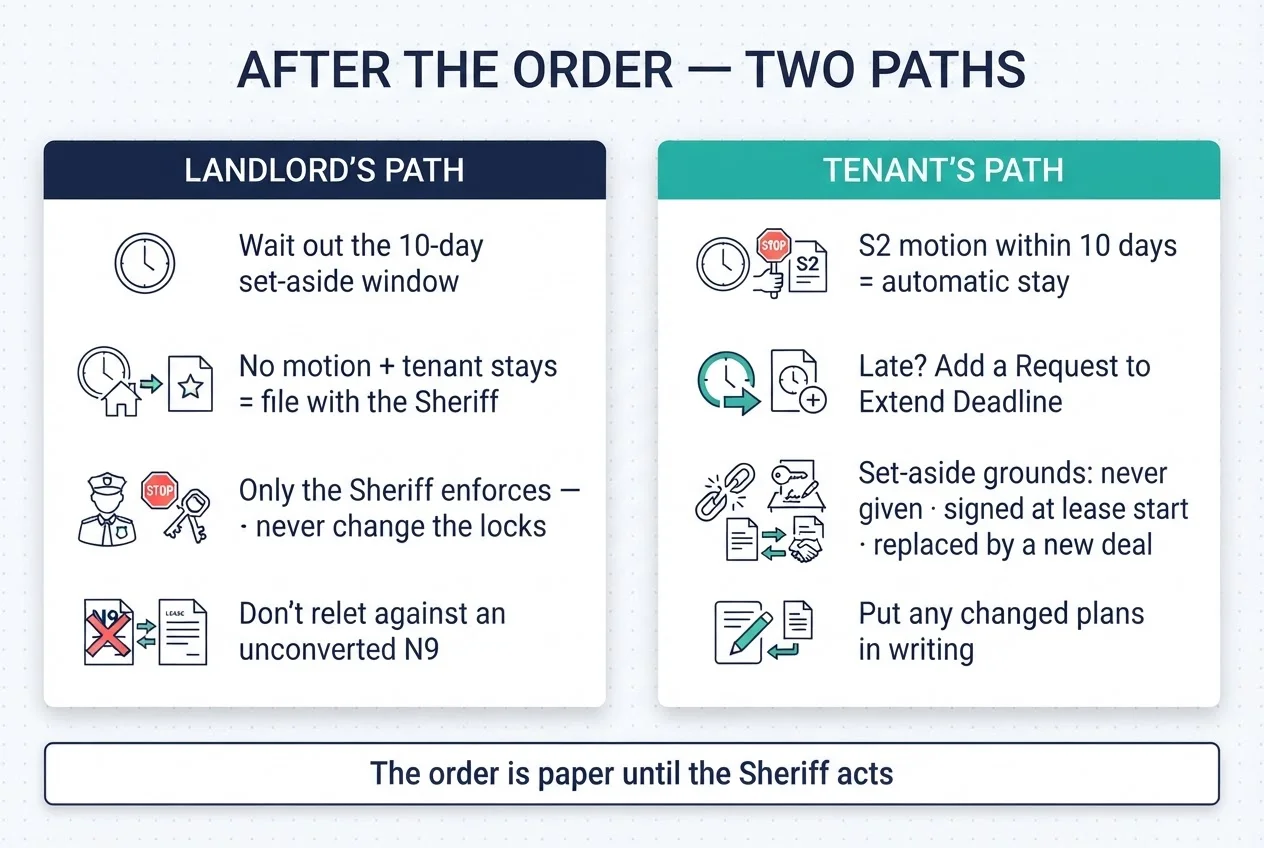
The landlord's path: order in hand, respect the 10-day set-aside window before taking any enforcement step. If the tenant stays past the order's date and no motion is filed, the order goes to the Court Enforcement Office — the Sheriff — the only party in Ontario who can lawfully enforce an eviction. The Sheriff delivers a Notice to Vacate with instructions. Never self-help: changing the locks with an order in your hand is still an illegal lockout, and it hands the tenant a T2 application. (The Sheriff process gets its own guide later in this series.) One planning note that saves real money: never sign the next lease against an unconverted N9 approaching its fuse — if the L3 misses the window, you're double-booked in a market where reletting is already slow.
The tenant's path: a timely motion holds the stay through the hearing, where the order is either set aside (the tenancy continues) or the stay is lifted (the order stands). No motion, and the Sheriff's notice — not the landlord's word — sets the real timeline.
And be clear on what the L3 isn't: it's not a money application — arrears travel by L1, L9, or, after move-out, the L10; it's not a contested-eviction vehicle — that's the L1/L2 world; and it's not a substitute for the negotiation the N11 stage is meant to be. Looking ahead, Bill 60 and Bill 97's operational updates took effect July 1, 2026 and continue nudging the LTB portal-first — always confirm you're on the current form version before filing.
Practical Takeaways
Landlords:
- Calendar two dates the moment an N9/N11 lands: the termination date, and termination-plus-30 — the fuse.
- File early on the portal ($186) rather than waiting to see; early filing costs nothing.
- Build the affidavit with all five elements — in an ex parte process, it's the whole case.
- Expect the no-hearing lane only for clean, complete files.
- Respect the 10-day set-aside window before any enforcement step.
- Enforcement belongs to the Sheriff alone — never change the locks.
Tenants:
- Know what you've signed — a valid N9 or N11 can become an eviction order without a hearing.
- Anything signed at lease start is challengeable; keep proof of when you signed.
- The S2 motion within 10 days freezes enforcement automatically — calendar day 10 the moment an order arrives.
- Put any changed plans with your landlord in writing; one confirming email converts goodwill into evidence.
- Lockouts are illegal regardless of any order — only the Sheriff enforces, and a T2 is your remedy.
The L3 Tenant's Kit: Your 10-Day Counterweight to a No-Hearing Eviction Order
In Ontario, notice you gave — or an agreement you signed — can become an eviction order without a hearing. This free kit walks your exact rights: the Motion to Set Aside that freezes enforcement automatically, the grounds that win, and what the landlord can never lawfully do.
Get Free PDF →The Bottom Line
The L3 is the quiet application — no fault, no fight, often no hearing. Its entire drama lives in three numbers: 30 days for the landlord's fuse, 5 elements in the affidavit, 10 days for the tenant's counterweight. The tenant's own paperwork does the talking; the affidavit makes it admissible; the S2 keeps the whole system honest. Handle your side's number well and the process is close to painless — miss it, and you're either restarting an exit from zero or reading a Sheriff's notice you could have frozen with one form. General information, not legal advice; for anything contested, a community legal clinic, paralegal, or lawyer is worth the call. Next in this series: the L4 — for when the paperwork that didn't hold is a mediated settlement or an LTB order itself.
Never Watch a Fuse Burn Again
Tenon10 tracks notices, termination dates, and filing deadlines automatically — so the 30-day window is a calendar entry, not a discovery.
Free • No signup required • Always current rules
Frequently Asked Questions
What happens if a tenant gives notice and doesn't leave in Ontario?
The tenancy continues unless the landlord converts the notice into an eviction order by filing an L3 with the LTB. The N9 (or N11) alone changes nothing if the tenant stays — and it becomes void if no application is filed within 30 days after the termination date.
How long does a landlord have to file an L3?
No later than 30 days after the termination date in the N9 or N11 — but filing can happen as early as the day the notice is received or the agreement is signed. Early filing is safe because the LTB won't end the tenancy before the termination date anyway.
Can the LTB evict without a hearing?
Only through two applications — the L3 and the L4 — where an adjudicator can issue an ex parte order based on the filed documents alone. The adjudicator can also decide to send the application to a hearing instead, and the tenant can force one afterward with a timely Motion to Set Aside.
How do I set aside an ex parte order from the LTB?
File a Motion to Set Aside an Ex Parte Order (Form S2) within 10 days of the date the order was issued. Filing on time automatically stays the order — it can't be enforced until a hearing decides the motion. If you're past 10 days, file the S2 together with a Request to Extend Deadline explaining the delay.
Is an N11 signed with the lease valid?
No — an N9 or N11 made at the time the tenancy agreement was entered into can't support an L3. The landlord's own supporting affidavit must state the document wasn't signed at lease start, and an agreement that was is a strong ground for setting an order aside.
How much does it cost to file an L3 in Ontario?
$186 through the Tribunals Ontario Portal, or $201 by mail, courier, or in person. The fee is non-refundable, payable at filing, and a fee waiver can be requested.