

Rental income can qualify you for a much bigger mortgage — but the bank only counts part of it, and how you file your taxes decides whether it counts at all. If you're buying or refinancing an investment property, using rental income to qualify for a mortgage in Canada comes down to a specific set of rules most investors only half-understand.
Most people assume all their rent gets added to their income. In reality, lenders use one of two very different methods, count only a fraction of the rent, run it through debt ratios and a stress test — and, thanks to a 2026 OSFI headline, a lot of borrowers now wrongly believe rental income barely counts anymore. None of that is quite right.
This guide walks the actual math: the two methods, how much rent counts by property type, the ratios and the stress test, what the 2026 OSFI change really did, and how to document your rent so a lender can use it. It's general information, not financial advice — lender policies vary, so confirm the specifics with a licensed mortgage broker.
The Rental Income Mortgage-Qualifying Cheat-Sheet
Offset vs add-back, how much counts, the ratios, and the documents that make rent count — on one page.
Get Free PDF →The Two Methods: Offset vs Add-Back
Lenders factor rental income into your application one of two ways, and the difference is bigger than it sounds. The offset method (sometimes called net rental) applies a percentage of the rent — commonly around 50% — against the property's carrying costs, meaning its principal, interest, taxes, and heat. Any shortfall between the discounted rent and those costs counts as debt in your ratios. Because it reduces the cost side rather than inflating income, the offset method often qualifies you for more in a higher-rate environment. The add-back method (or inclusion) instead adds a percentage of gross rent — commonly 50% to 80% — straight onto your qualifying income. It looks more generous on paper and is more common at B-lenders and some credit unions.

The crucial point is that the method and the percentage vary from lender to lender, so the same deal can qualify very differently at two banks. Consider an $800,000 duplex with a suite renting for $2,200 a month: at a lender using a 50% offset, that rent cuts the required qualifying income from roughly $154,000 to about $120,000 — some $34,000 less income needed to buy the same property. That's why "the first no is rarely the only answer," and why asking every lender "offset or add-back, and what percentage?" is the single most useful question you can lead with.
How Much Counts, and the Ratios It Runs Through

How much of your rent counts depends on the property type. For an owner-occupied two-unit home — you live in one unit, rent the other — CMHC may allow up to 100% of gross rent. Three- and four-unit properties use up to 50% of gross rent or a net-rental calculation. A straight investment property that you don't live in typically has 50% to 80% counted, and some lenders apply a roughly 10% haircut for vacancy. Assuming the full 100% always counts is the classic investor mistake.
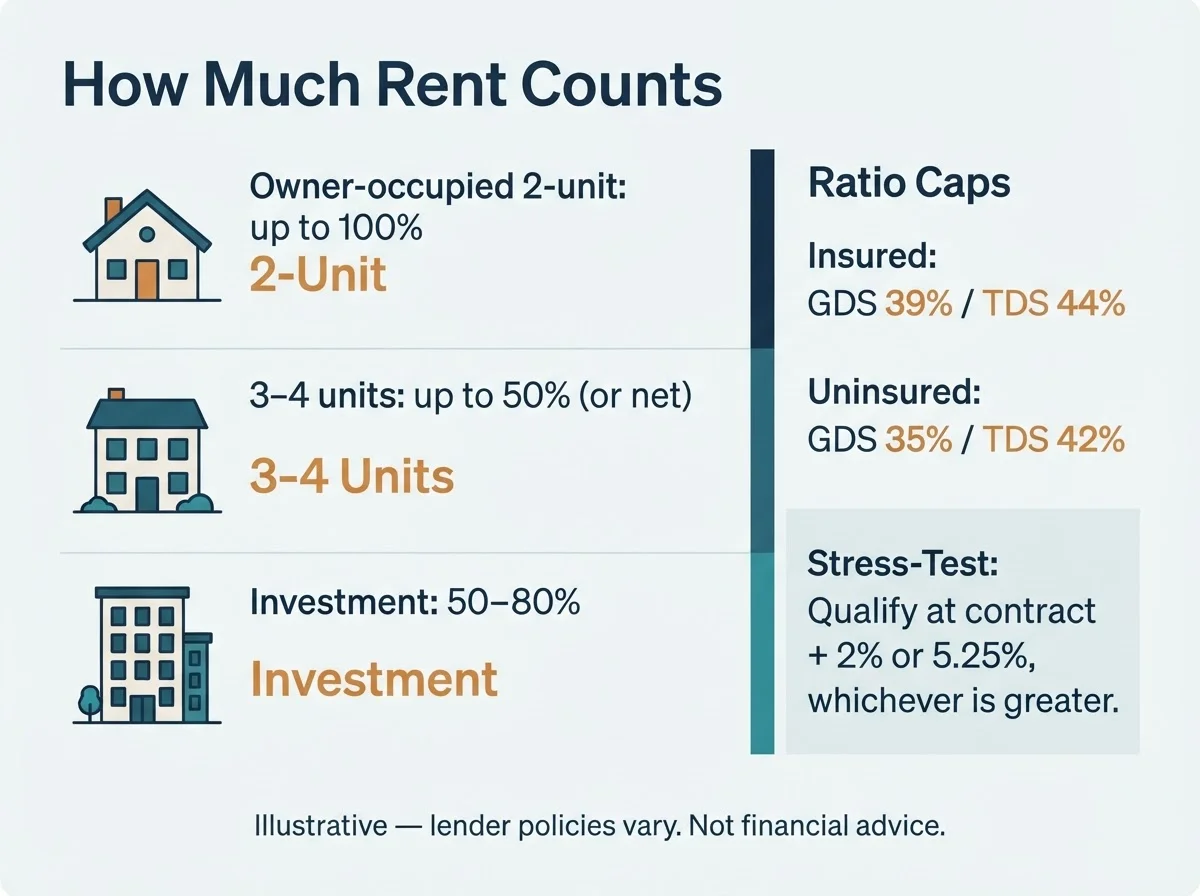

Whatever counts then flows through two debt-service ratios. Your gross debt service (GDS) ratio compares housing costs — principal, interest, property tax, heat, and half of any condo fees — to your gross income. Your total debt service (TDS) ratio adds every other monthly obligation, like car loans and credit cards. For an insured mortgage (less than 20% down) lenders generally cap GDS around 39% and TDS around 44%; for an uninsured mortgage (20% or more down) those tighten to about 35% and 42%. Neither ratio uses your credit score. On top of that sits the stress test: you have to qualify at the greater of your contract rate plus 2% or 5.25%. The 5.25% floor rarely binds in today's rates — in mid-2026 the effective qualifying rate sits around 6.49% — and this is exactly where counted rental income earns its keep, because lowering your ratios is what lets you pass at that higher stressed rate.
The 2026 OSFI Myth, the Cash-Flow Route, and the Portfolio Wall
In 2026 a wave of headlines left investors thinking OSFI had banned or gutted the use of rental income to qualify. It didn't. OSFI's 2026 update was to its capital rules — how much capital a bank must hold against certain mortgages — not to Guideline B-20, which governs how borrowers qualify. OSFI confirmed in late 2025 that lenders can still use rental income to qualify borrowers, including investors with more than one property.

What actually changed is capital classification — whether a mortgage sits in the general residential bucket or the higher-risk income-producing bucket that ties up more of the bank's capital. The practical knock-on for portfolio builders is that the same income can't be re-used to classify multiple mortgages as lower-risk, which can nudge pricing and lender appetite as you scale — but it doesn't touch your basic ability to use rental income. When your personal ratios do max out, there's another route: some lenders qualify on the property's cash flow instead, using a Debt Coverage Ratio (often a minimum around 1.2, meaning the property's income covers its debt payments by at least 20%). Canada still applies the stress test, unlike US DSCR programs, but this cash-flow approach is how many investors get past what's often called the portfolio wall — the point where each additional property adds so much to your TDS, and only part of the rent counts, that the conventional math simply blocks the next mortgage no matter how well your properties perform.
Making Rent Count: The Documents (and the Tax Tie-In)
None of this matters if you can't document the rent — and this is where your taxes come back around. To use existing rental income, a lender generally wants a signed lease and bank statements showing the deposits, plus your T1 and T776 and Notice of Assessment. Unreported rent doesn't count, so declaring your rental income on your T776 each year is literally what turns it into borrowing power — the same records that keep you onside with the CRA are the ones that qualify you for financing. (If you're not sure what's reportable, the deductions deep-dive covers the income and expense side.)
If you're buying a property with a suite that's empty, an appraiser's market-rent letter can stand in for a lease so you can use the projected income before a tenant signs. A few things reliably kill the deal, though: cash rent with no paper trail, informal family arrangements without a lease, an unpermitted or illegal suite (which won't qualify no matter how reliable the tenant), and overstated rent, since lenders know market rents and realistic vacancy. On the cash side, remember a non-owner-occupied rental needs at least 20% down — there's no insured option for a pure investment property — while owner-occupied purchases follow the standard tiers, the insured-mortgage cap sits at $1.5 million, and you should budget another 1.5% to 4% for closing costs. And if your ratios still cap out, that's the moment to shop the method across lenders or ask a broker about a B-lender or the cash-flow route.
Keep the paper trail that qualifies you
Leases, rent deposits, and clean income records in one place — the same trail your lender and the CRA both want to see.
Free • No signup required • Built for Ontario
Key Takeaways
- Lenders use one of two methods — offset (cuts costs) or add-back (adds income); offset often qualifies you for more in a high-rate market.
- Only part of your rent counts: up to 100% for some owner-occupied homes, typically 50–80% for investments.
- It all runs through GDS/TDS ratios at a stress-tested rate — counted rent lowers those ratios and helps you pass.
- The 2026 OSFI change was about bank capital, not your ability to qualify on rental income.
- Rent only counts if it's documented and declared — your T776 is what turns it into borrowing power.
Conclusion
Rental income is a powerful qualifying tool, but the math is specific. Lenders use offset or add-back, count only a fraction — 50% to 80% for an investment, up to 100% for some owner-occupied homes — run it through GDS and TDS at a stress-tested rate, and only if it's documented and declared. The 2026 OSFI change didn't touch your ability to qualify; it changed how banks hold capital. Know the method, document the rent, and shop the lender, because the same deal can swing tens of thousands in required income from one bank to the next.
This is general information, not financial advice — lender policies and rates change, so gather your leases and T776, confirm your suite is legal, and take the deal to a licensed mortgage broker who can shop it across lenders.
Frequently Asked Questions
How do lenders calculate rental income for a mortgage in Canada?
They use one of two methods: the offset method applies a percentage of rent (commonly ~50%) against the property's carrying costs, and the add-back method adds a percentage of gross rent (commonly 50–80%) to your income. The method and percentage vary by lender.
Does all my rental income count toward a mortgage?
Usually not. Investment (non-owner-occupied) properties typically have 50–80% of rent counted; only some owner-occupied cases, like a two-unit home, reach up to 100%. Some lenders also apply a vacancy haircut.
Did OSFI change the rental income mortgage rules in 2026?
No. OSFI's 2026 update changed capital rules — how much capital banks hold against certain mortgages — not Guideline B-20, which governs how borrowers qualify. Lenders can still use rental income to qualify, including for investors with multiple properties.
How much down payment do I need for a rental property in Canada?
A non-owner-occupied rental generally requires at least 20% down; there's no insured option for a pure investment property. Owner-occupied homes follow the standard tiers, and the insured-mortgage cap is $1.5 million.
Can I use basement suite income to qualify for a mortgage?
Often yes — if the suite is legal and permitted. Lenders can use a signed lease, or an appraiser's market-rent estimate for an unrented unit, but an unpermitted suite usually won't qualify.
Does the mortgage stress test apply to rental income?
Yes. You qualify at the greater of your contract rate plus 2% or 5.25%. Counted rental income lowers your debt ratios, which helps you pass at that higher qualifying rate.


