Most Ontario tenancies that end never see a hearing room — and the law is built that way on purpose. While the formal eviction road runs three to seven months through the LTB queue, the Residential Tenancies Act quietly provides four exits that skip the queue entirely: the mutual agreement, the tenant's own notice, the assignment, and the negotiated deal wrapped around them.
The folklore around these exits fails both sides. Landlords hear that cash-for-keys is a legal grey area (it isn't), or that a little pressure speeds things up (it destroys everything). Tenants sign in a panic without knowing the statutory floor they're already standing on. This guide maps all four legal lanes as a decision framework — what each one costs, the enforcement backstop that makes agreements real, the coercion and bad-faith lines that void them, and the honest cases where the formal road is still the better answer. One promise throughout: the deal gets priced from both chairs. General information, not legal advice.
The Clean-Exit Kit: Ending a Tenancy Without Eviction — Four Legal Lanes, the Deal Math, and Every Backstop Clock
Most Ontario tenancies that end never see a hearing room. This free kit maps all four legal exits — the N11 mutual agreement, cash-for-keys, the tenant's N9, and assignment — with the deal priced from both chairs: the landlord's ceiling, the tenant's statutory floor, the side-agreement contents, the L3 backstop's 30-day and 10-day clocks, and the pressure lines that void everything. Two printable pages for a clean, voluntary exit.
Get Free PDF →Why These Exits Exist — and the Four Lanes
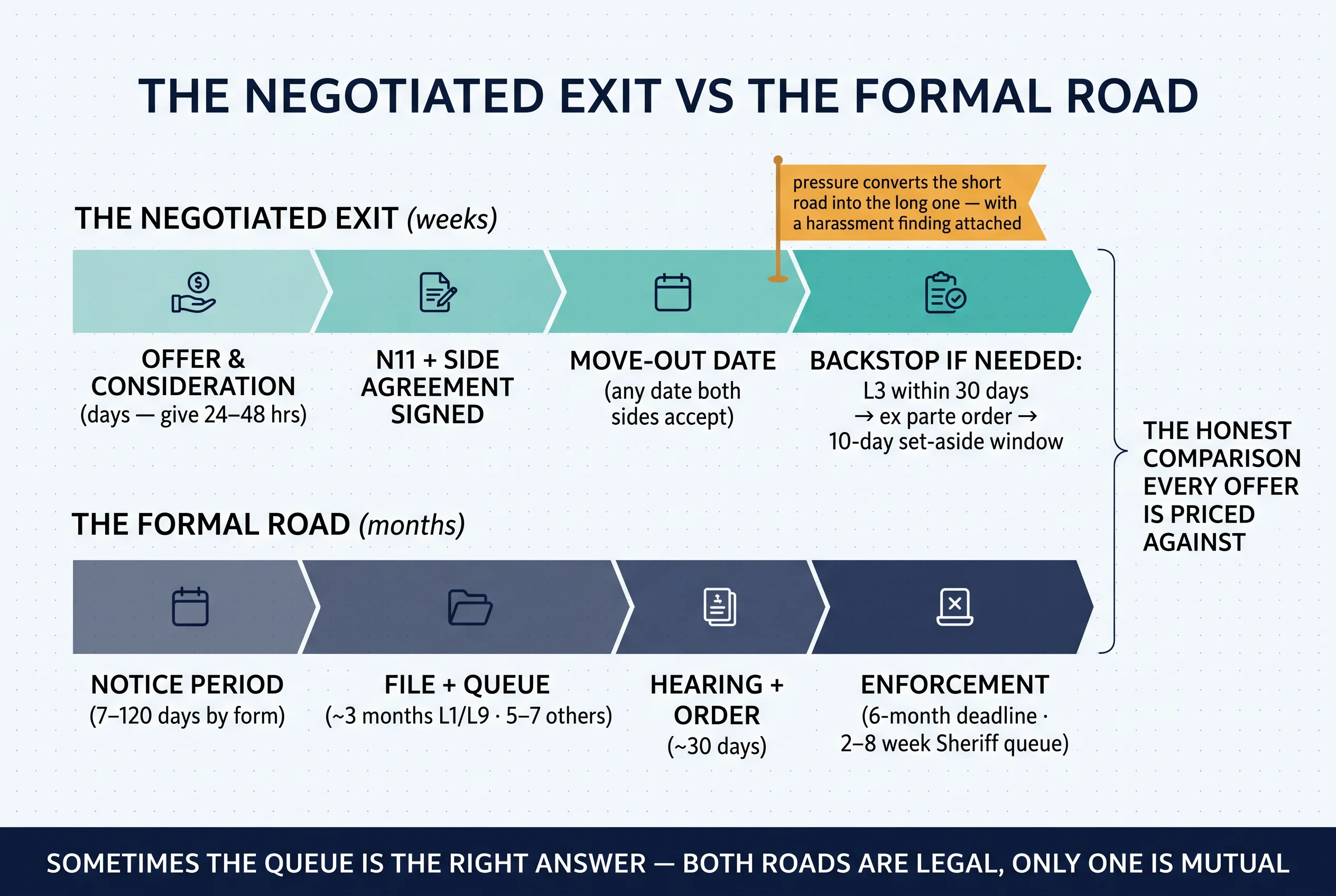
Start with the legal frame, because it corrects the biggest misconception in this space. Section 37 of the RTA says a tenancy ends only in accordance with the Act — and the Act itself then provides the non-eviction lanes: termination by agreement, termination by the tenant's notice, and assignment. These aren't workarounds or loopholes. They are the statute's own front doors, sitting right beside the eviction road everyone knows about. What they're racing is the queue: roughly 3 months for L1/L9 arrears files, 5–7 months for most other applications, with adjournments adding 3–4 months more. A negotiated exit is measured in weeks; the formal road is measured in seasons. (For the whole formal road end to end, see our LTB process pillar.)

The four lanes, in brief. Lane one: the N11 mutual agreement — a contract, not a notice. There's no minimum notice period; the tenancy ends on whatever future date both sides accept. Every tenant on the lease must sign (or the tenancy continues for whoever didn't), it costs nothing to make, and nothing gets filed with the Board unless enforcement is later needed. One hard restriction: an N11 signed at the start of a tenancy is void — it must be a genuine, later agreement. Lane two: the tenant's own N9 notice — 60 days for monthly tenancies, 28 for daily or weekly, landing on the last day of a rental period. Lane three: assignment under section 95 — the tenant leaves, but the tenancy itself transfers to a new person unchanged. Lane four: the negotiated deal — cash-for-keys — which usually rides on lane one. And one principle binds them all, straight from Ontario's Court of Appeal: once a termination agreement is made, neither side can unilaterally renege. It binds in both directions.
The Cash-for-Keys Deal — Pricing It From Both Chairs
Let's state the legality flat: cash-for-keys is fully legal in Ontario and standard practice in 2026. The structure that survives scrutiny has two documents. The N11 ends the tenancy — and carries no payment terms at all. A separate written side agreement carries the deal: the amount, the payment schedule, the condition of the unit at handover, a confirmation that the tenant is signing voluntarily, and the consideration period they were given. Keeping the money off the form isn't pedantry; it's what documents, months later, that the agreement was a genuine bargain rather than a pressured signature.
Now the pricing — from both chairs, because a deal priced from one chair is how deals fail. The landlord's math is the queue's true cost: the months of waiting multiplied by the market gap or accumulating arrears, plus the $186 filing fee, plus representation, plus enforcement costs at the end ($318–$333 and extras), plus the risk that a defect dismisses the file and restarts the whole road. That total is the ceiling for a fair offer. The tenant's math starts from the statutory floor: the formal road pays compensation anyway — one month's rent for an N12, up to three months for an N13 — so any offer must beat that floor plus moving costs plus the market-rent gap being surrendered. Where deals actually land: typically one to six months' rent, with three to four common in the GTA — $2,000 to $10,000-plus in dollars, occasionally far more for long, deep-below-market tenancies.
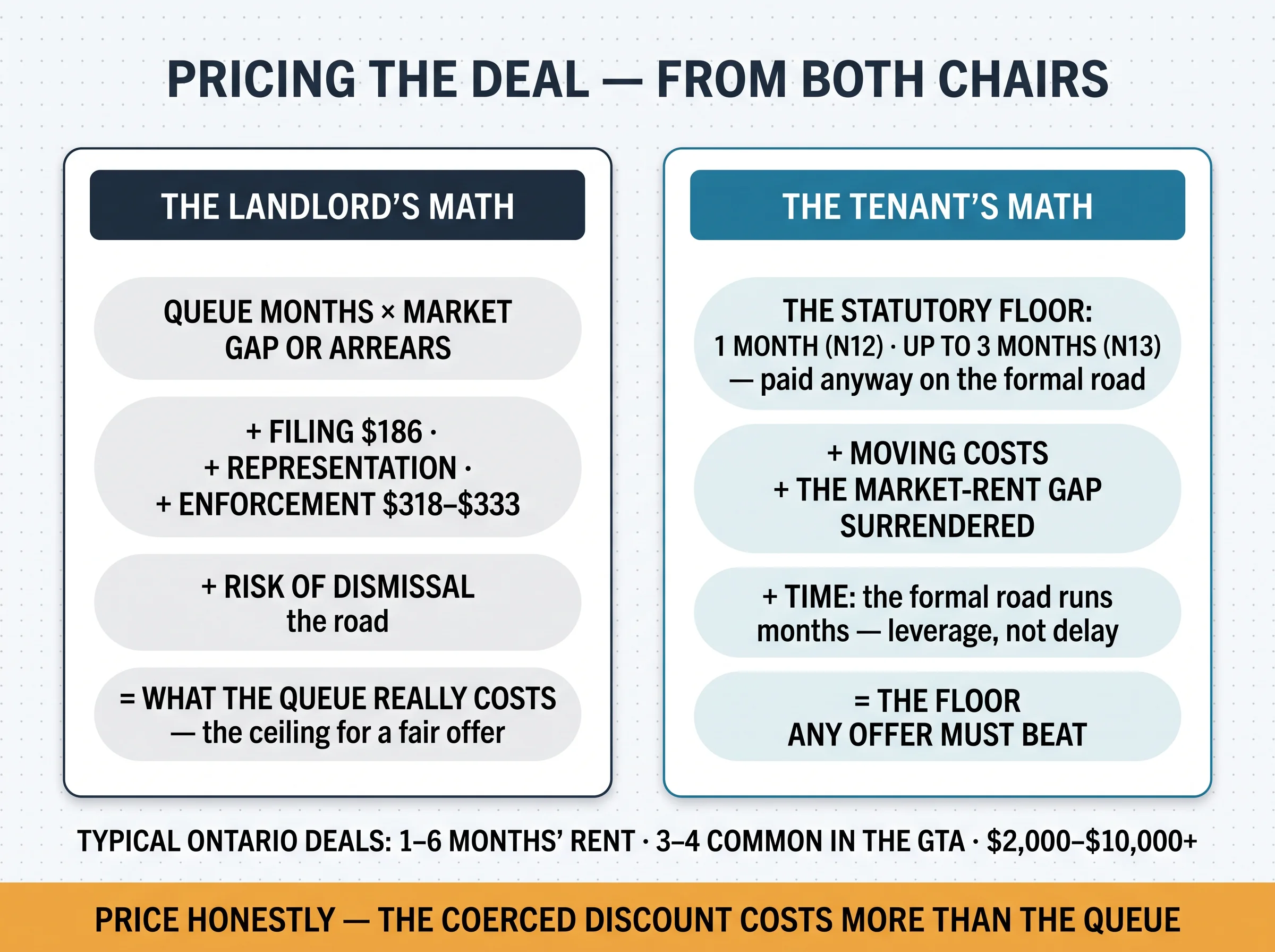
The discipline that keeps a good deal good: payment by traceable methods only (e-transfer or cheque), split between signing and broom-swept key handover, receipts for everything. And on the tenant's side: know the floor before answering, take 24–48 hours (a clean deal always includes time to think), and talk to duty counsel or a community legal clinic before signing — refusing an offer is always allowed, and simply returns everyone to the formal road. Picture the deal priced right: a long, below-market tenancy; the landlord offers four months plus moving costs against an eight-month contested N12 road; the tenant checks the floor, takes two days, counters, and signs the N11 with the side agreement. Split payment. Keys at month two. Nobody saw a hearing room.

The Backstop and the Perimeter — What Makes It Real, and What Voids It
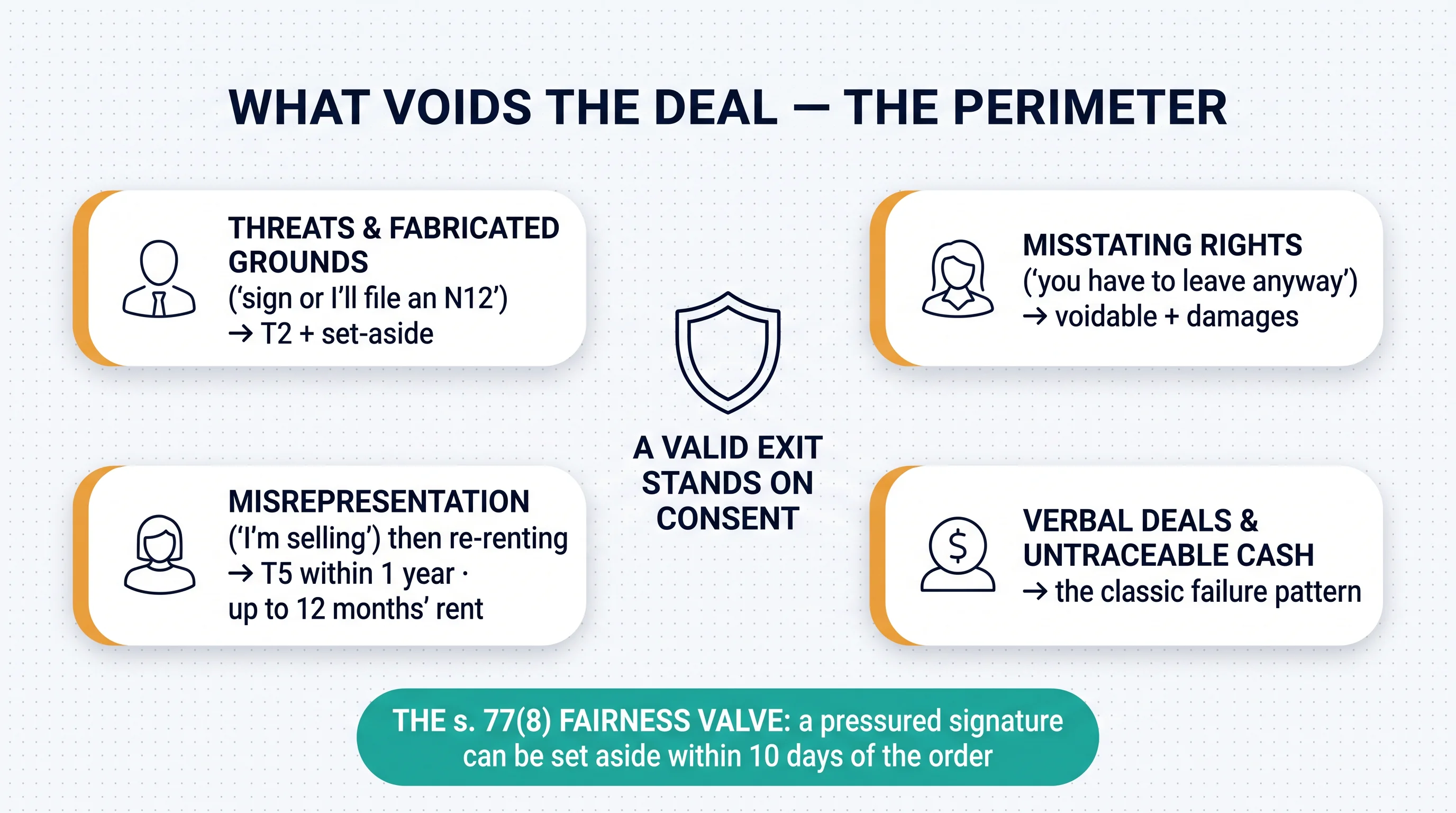
The backstop is section 77. With a signed N11 (or a tenant's N9) in hand, a landlord can apply to the Board through the L3 application — without notice to the tenant, supported by an affidavit verifying the agreement. The Board usually issues the order without a hearing. Two clocks control everything. First, the L3 must be filed no later than 30 days after the termination date, or the N11 becomes void for enforcement — diarize this the day the agreement is signed (and if the tenant's intentions are uncertain, the L3 can be filed the moment the ink dries). Second, the tenant has 10 days after the order issues to move to set it aside — and the motion stays enforcement automatically until it's heard. The set-aside test is section 77(8): the Board sets aside if there was no genuine agreement, or if enforcing would be unfair in all the circumstances. In practice, the backstop that works looks quiet: N11 signed, tenant stays past the date, L3 filed on day three, ex parte order, no motion — and the tenant leaves the week the order arrives. The full L3 mechanics live here.
The perimeter is where deals die. Coercion makes an N11 voidable, and the patterns are well-worn: threatening fabricated grounds ("sign this or I'll file an N12 for my sister" — when no qualifying sister exists), misstating rights ("you have to leave anyway" — when the tenant has full RTA protections), or harassment — repeated calls, showing up unannounced, "making life difficult." That conduct engages section 23, supports a T2 application with damages, and can even end in a reinstated tenancy. Misrepresentation that feeds the deal is its own trap: "I'm selling" or "family is moving in," followed by re-renting at a higher rate, opens the T5 bad-faith lane for a full year — with exposure up to twelve months' rent. And the mundane failure pattern behind most disputes: verbal deals and untraceable cash. Every term in writing, before any money moves.
The Quieter Lanes — the 10-Day Pivot, Assignment, and When the Formal Road Wins
Two lanes get far less attention than they deserve. The tenant's 10-day pivot: a tenant served an N12 or N13 doesn't have to wait out the landlord's termination date — they can respond with their own N9 on just 10 days' notice, leaving on their own timeline while keeping the statutory compensation intact. Found a new place fast after an N13 landed? Gone in a week and a half, compensation preserved, no hearing for anyone. Assignment: under section 95, the tenant leaves but the tenancy transfers to a new person unchanged — same terms, same rent, no vacancy decontrol. The landlord must respond to a request within 7 days and can't unreasonably refuse a specific assignee; refusal of general consent (or silence past the 7 days) hands the tenant an accelerated exit on just 30 days' notice. The landlord lens is worth stating plainly: refusing an assignment isn't a veto — consenting keeps the rent flowing with no vacancy and no queue at all. (The assignment-vs-sublet distinction matters here — and so does the 60-day unauthorized-occupant trap next door.)
And the honest section: sometimes the formal road wins. With clear, provable grounds and a tenant who won't engage, the L1/L2 road exists for exactly that case. When the fair offer would exceed the queue's true cost, file instead. What never works is running both dishonestly — the N12-threat-to-extract-a-cheap-N11 pattern is precisely the one that loses everything. One forward flag: September 21's N12 changes shift the compensation floor that anchors every deal — re-price before you offer.
Practical Takeaways
- Choose the lane deliberately: N11 (mutual), N9 (the tenant's timeline), assignment (the tenancy continues), or the formal road.
- N11 basics: every tenant on the lease signs, the date is certain, and it's never signed at the start of a tenancy.
- Money in a separate written side agreement — traceable payment, split at broom-swept handover, receipts kept.
- Price against the statutory floor (1 month N12 / up to 3 months N13) and state the comparison honestly.
- Zero pressure: time to seek advice is part of a clean deal, not a threat to it.
- Diarize the backstop: the L3 within 30 days of the termination date; the 10-day set-aside respected.
- Answer assignment requests within 7 days, in writing, with reasonable grounds for any refusal.
The Clean-Exit Kit: Ending a Tenancy Without Eviction — Four Legal Lanes, the Deal Math, and Every Backstop Clock
Most Ontario tenancies that end never see a hearing room. This free kit maps all four legal exits — the N11 mutual agreement, cash-for-keys, the tenant's N9, and assignment — with the deal priced from both chairs: the landlord's ceiling, the tenant's statutory floor, the side-agreement contents, the L3 backstop's 30-day and 10-day clocks, and the pressure lines that void everything. Two printable pages for a clean, voluntary exit.
Get Free PDF →The Bottom Line
The RTA gives landlords and tenants four legal ways to part company without a hearing — and one rule that governs them all: voluntary means voluntary. A clean deal beats the queue; a pressured deal loses to it twice — once at the set-aside, and once on the formal road that follows with a harassment finding attached. Landlords who price honestly and paper properly get vacancy in weeks. Tenants who know their floor either negotiate well or walk away whole. And sometimes the honest answer really is the queue — the guides for that road are one click away below. General information, not legal advice — and the market ranges and compensation floors on this page deserve a fresh check before any real offer, especially with September 21's changes approaching.
A Clean Exit Starts With Clean Paperwork
The N11, the side agreement, the Certificate of Service, the L3 backstop clocks — Tenon10 keeps every document and deadline of a voluntary exit organized and enforceable.
Free • No signup required • Updated for the Bill 60 changes in force 21 Sep 2026
Related Resources
- N11 Mutual Agreements: How Parties Reach Fair End-of-Tenancy Terms — the deep negotiation guide this piece builds on
- The L3 Application: When the Tenant Gave Notice or Agreed to Leave — the enforcement backstop in full
- Bad-Faith N12s and the T5 Application — what misrepresentation costs
- The LTB Backlog: Real Wait Times · The LTB Process, End to End — the road every deal is priced against
- Subletting vs Assignment in Ontario · The 60-Day Rule
- Ontario LTB Forms Hub · Termination Date Calculator
Frequently Asked Questions
Is cash for keys legal in Ontario?
Yes — fully legal and increasingly common. A landlord may offer a tenant money to end the tenancy by mutual agreement, and a tenant may accept, refuse, or counter-offer. The agreement is documented on an N11 (Agreement to End the Tenancy), with the payment terms in a separate written side agreement. What's illegal is pressure: threats, harassment, or misrepresentation can void the agreement and expose the landlord to a T2 or T5 application.
How much should a cash-for-keys offer be?
There's no statutory amount — it's negotiation. Typical Ontario offers run one to six months' rent, with three to four months common in the GTA ($2,000–$10,000+, occasionally more for long, deep-below-market tenancies). Tenants should price any offer against the statutory floor they'd receive anyway on the formal road — one month's rent for an N12, up to three months for an N13 — plus moving costs and the market-rent gap they're giving up.
What happens if a tenant doesn't move out after signing an N11?
The landlord files an L3 application, usually decided without a hearing (ex parte), supported by an affidavit and the signed N11 — but it must be filed within 30 days of the termination date or the N11 becomes void for enforcement. The tenant then has 10 days to move to set the order aside, which stays enforcement until the motion is heard; the Board sets aside if there was no genuine agreement or if enforcing would be unfair in the circumstances.
Can a tenant back out of an N11 agreement?
Not unilaterally — Ontario's courts have held that once a termination agreement is made, neither side can simply cancel it. But an N11 signed under pressure, threats, or misrepresentation is different: the tenant can move to set aside the resulting order within 10 days, and coercion can support a T2 application with damages. The voluntariness of the signature is the whole foundation.
Can I end my lease early if my landlord refuses a lease assignment?
Often, yes. Under section 95, a landlord must respond to an assignment request within 7 days and cannot unreasonably refuse a specific assignee. If the landlord refuses general consent or doesn't respond within 7 days, the tenant can terminate on just 30 days' notice — half the standard 60 — provided the notice is given within 30 days of the request.