

The money you pull out of a rental refinance is tax-free — but keep it away from your personal life, or you'll lose the interest deduction that made refinancing worth it. When it comes to refinancing a rental property and the tax implications in Canada, that one distinction does most of the heavy lifting.
Investors love a cash-out refinance because it unlocks equity without selling and without a tax bill on the cash itself. But two things trip them up: the interest deduction depends entirely on what you do with the money — not on the fact that a rental secures the loan — and the capital-gains math waiting at sale doesn't change just because you pulled equity out. Meanwhile, a lot of landlords assume refinancing lets them do something with the tenant. It doesn't.
This guide covers the CRA's "use of funds" rule that makes or breaks your interest deduction, the tracing discipline that protects it, the two traps investors miss, and what refinancing does (nothing) to your tenant and their lease. It's general information, not financial or tax advice — talk to a licensed mortgage broker and a CPA before you refinance.
The Rental Refinance Tax-Smart Checklist
The use-of-funds rule, good vs bad tracing, the two traps, and the lease side — on one page.
Get Free PDF →The Cash Is Tax-Free — But the Interest Depends on What You Do With It
Start with the good news: the cash you pull out isn't income. A cash-out refinance or a HELOC draw is borrowed money, so it comes out tax-free. That's the core advantage of refinancing over selling — a sale crystallizes a capital gain and a tax bill, while a refinance lets you access the same equity without triggering that tax. The confusion starts when people collapse two separate questions into one. Question one: is the cash taxable? No. Question two: is the interest on the new borrowing deductible? That's where it gets specific.

Interest deductibility follows what the borrowed money is used for, not what property secures the loan — the CRA's tracing principle, set out in Income Tax Folio S3-F6-C1. The rental being the collateral is irrelevant. Use the money for the rental, for improvements to it, or to buy another income-producing investment, and the interest is deductible. Use it personally — a down payment on your own home, a child's first house, a car — and that interest isn't deductible, even though a rental secures the loan. The CRA spells this out in its own examples: a landlord who refinanced a rental to fund a down payment on a personal residence is told plainly, "No. You are making personal use of the funds." The same logic denies the deduction to parents who refinance a rental to help a child buy a home.
Keeping the Deduction Clean: Tracing, Mixed Use, and Multiple Refis

Because deductibility rides on the use of funds, the paper trail is everything. Good tracing is a direct line: you borrow, and the money goes straight to the rental's lawyer or the purchase of the next property. Bad tracing is commingling — the borrowed money lands in your personal chequing account, then some goes to the rental and some to a car, and now the rental portion's deduction is messy and easy for the CRA to deny.
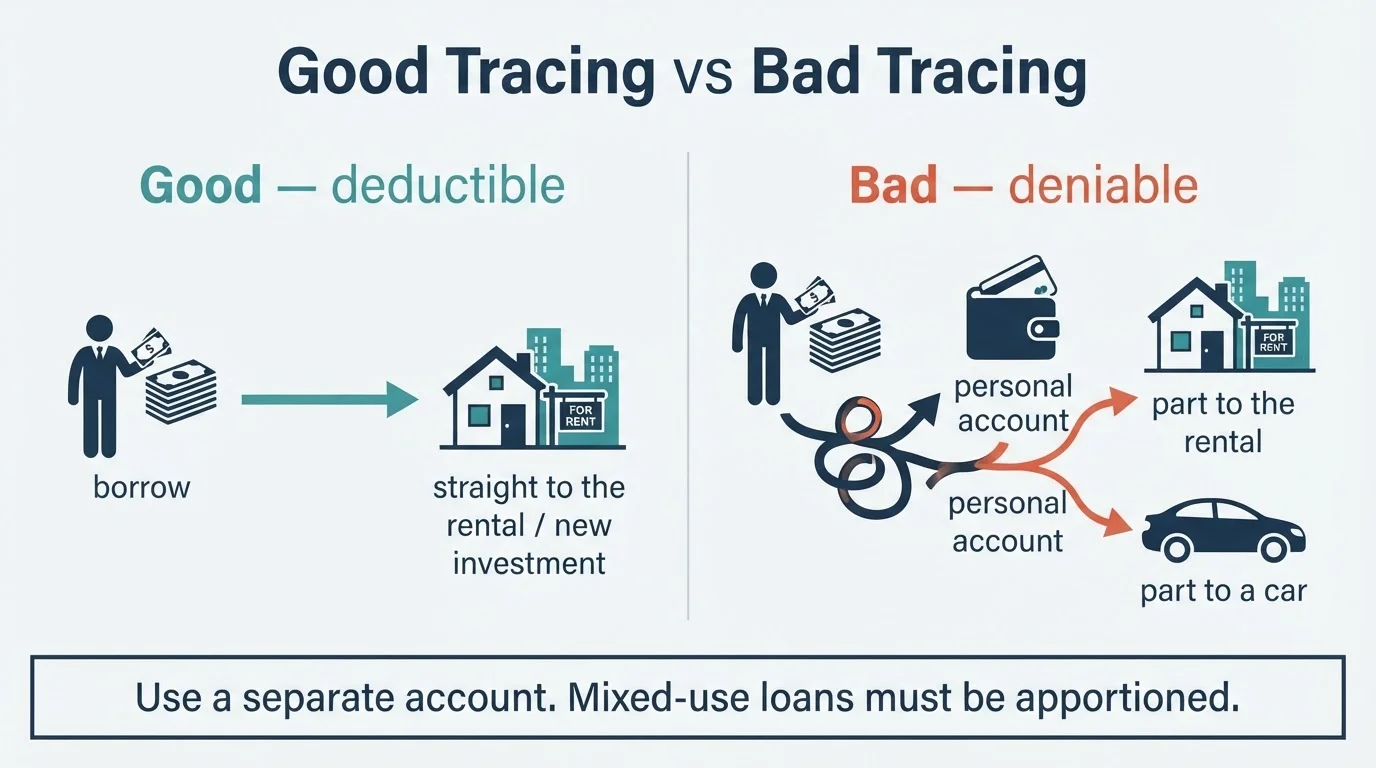
If a loan genuinely serves both purposes, only the rental-use portion's interest is deductible, and you have to be able to show the split. The practical discipline is simple: use a separate HELOC or account just for the rental, keep the funds tied to income-producing use, and hold onto records, because an undocumented deduction can be disallowed. The upside of doing it right is that you can refinance repeatedly — each refinance is a separate event, so you just apply the same use-of-funds test each time. Pull equity from one property and deploy it directly into another income-producing property and the interest stays deductible; that's the capital-recycling engine behind the "BRRRR" strategy. (Financing fees on the new loan, by the way, are deducted over five years at 20% a year, and rentals typically refinance or draw a HELOC up to about 75–80% of value.)
Two Traps Investors Miss: Cash Flow vs Tax, and the ACB Long Game
Even done cleanly, refinancing carries two traps that rarely make the sales pitch. The first is the cash-flow-versus-tax trade. Refinancing to a lower rate means you pay less interest — which sounds purely good until you remember interest is a deduction. Less interest means a smaller deduction, which means potentially higher taxable net rental income. You end up with more cash in hand each month but a slightly bigger tax bill, so "lower rate equals strictly better" isn't quite true; model both sides.
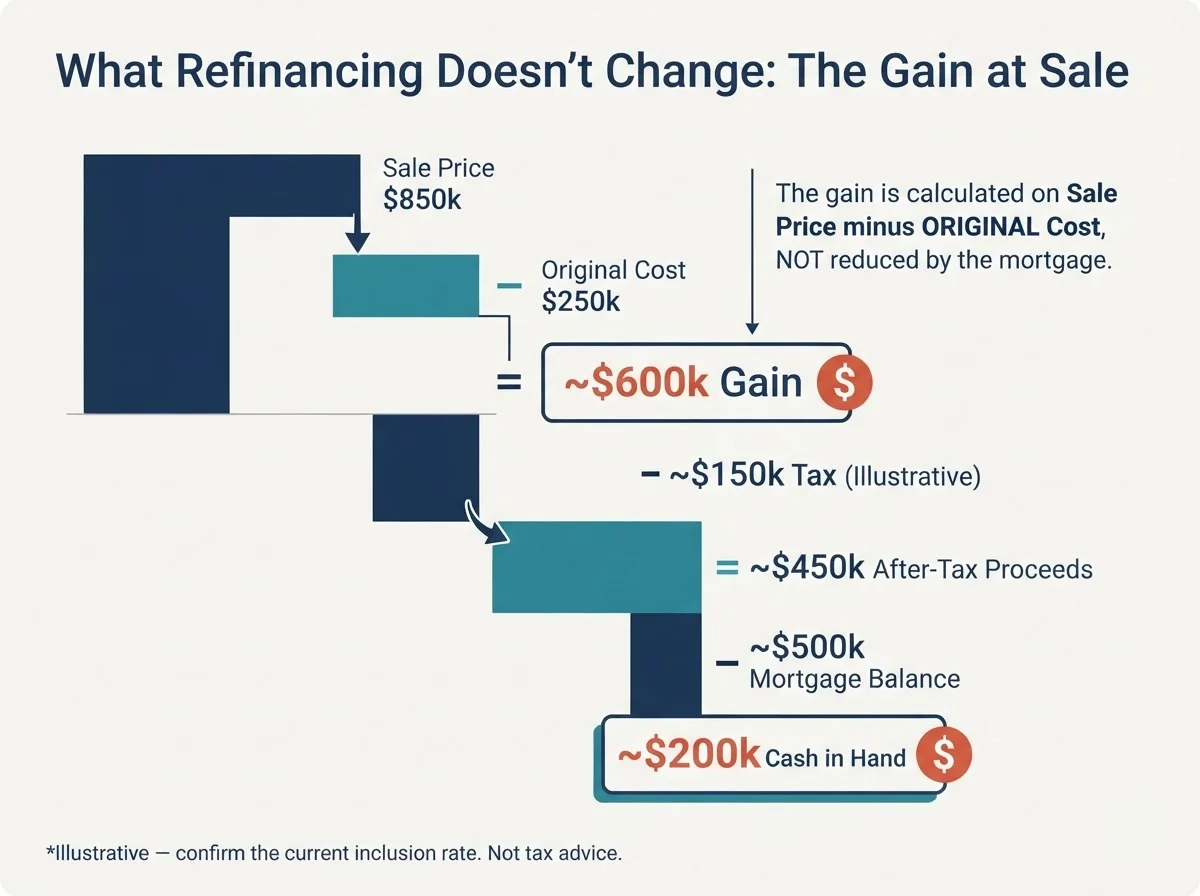
The second trap is the long game. Refinancing does not reset your adjusted cost base. Over years of appreciation you might pull out far more than you originally invested, but when you sell, the capital gain is calculated on the sale price minus your original cost — completely independent of how big your mortgage is. Picture a property bought for $250,000, refinanced up to a $500,000 mortgage over the years, and sold for $850,000. The gain is roughly $600,000, the tax on it might be around $150,000 (illustratively, at a high marginal rate and the current inclusion rate), and after the mortgage and the tax you're left with about $200,000 — a good deal less than the "equity" felt like on paper. Refinancing is a loan you repay and a gain you'll still owe on, so plan the exit, not just the draw. The CCA guide covers the cost-base and recapture side of a sale in more depth.
The Lease Side: Refinancing Doesn't Touch Your Tenant
Here's the part that reassures tenants and surprises some landlords: refinancing changes nothing about the tenancy. A refinance is purely the landlord's financing arrangement — the owner of the property doesn't even change, only the mortgage — so the lease continues on its exact terms and the tenant keeps every right they had under the Residential Tenancies Act.
That means you can't use a refinance as a reason to raise the rent or end the tenancy. Rent increases still require the provincial guideline and a Form N1 with 90 days' notice, no more than once every 12 months, and ending a tenancy still needs a valid reason under the RTA — a new mortgage isn't one of them. If you want proof of how protected the lease is, consider that even a full sale — an actual change of owner — doesn't break it: the buyer inherits the lease and the landlord's obligations, and a fixed-term lease runs to its end. If a change of owner can't disturb the tenancy, a refinance certainly can't, and your lender's mortgage terms don't override the RTA. The one practical overlap is that your lender may ask to see the lease or a rent roll as part of underwriting — a paperwork step, not a change to the tenancy.
Keep the trail that keeps the deduction
Leases, rent records, and a clean expense trail in one place — the documentation your lender and the CRA both want to see.
Free • No signup required • Built for Ontario
Key Takeaways
- The cash from a refinance is tax-free — it's borrowed money, not income.
- Interest is deductible only if the funds are used for income-producing purposes; the CRA traces the use, not the collateral.
- Keep a clean, direct trail and a separate account; apportion any mixed-use loan.
- Two traps: a lower rate shrinks your deduction, and refinancing never reduces the capital gain at sale.
- Refinancing changes nothing for your tenant — it's never a reason to raise rent or end a tenancy.
Conclusion
A rental refinance hands you tax-free cash, but the interest deduction depends entirely on what you do with the money — income use keeps it, personal use loses it, and the CRA traces the funds. Keep a clean trail, apportion mixed use, and hold the two traps in mind: a lower rate shrinks your deduction, and refinancing never reduces the capital gain waiting at sale. On the lease side, refinancing is invisible to your tenant.
Used deliberately — funds kept invested, records kept clean — refinancing is how investors recycle equity and grow. Used carelessly, it quietly costs you the deduction. This is general information, not financial or tax advice, so decide your use of funds, set up a separate account, and take the plan to a licensed mortgage broker and a CPA before you sign.
Frequently Asked Questions
Is the money from refinancing my rental property taxable?
No. A cash-out refinance or HELOC draw is borrowed money, not income, so it isn't taxed when you receive it — unlike selling, which triggers a capital gain. What matters for tax is whether the interest on the new borrowing is deductible.
Is the interest on a rental refinance tax-deductible?
It depends on what you use the money for, not on the fact that a rental secures the loan. Funds used for the rental or another income-producing investment keep the interest deductible; funds used personally do not.
Can I deduct the interest if I refinance my rental to buy my own home?
No. That's personal use of the funds, so the additional interest isn't deductible — even though your rental is the collateral. The CRA traces the use of the money.
Does refinancing my rental reduce the capital gains tax when I sell?
No. Refinancing doesn't change your adjusted cost base. Your capital gain at sale is based on the sale price minus your original cost, regardless of how large your mortgage is.
Can my landlord raise my rent or evict me after refinancing in Ontario?
No. Refinancing is the landlord's financing and doesn't change the tenancy. Rent can only rise by the guideline with 90 days' notice once every 12 months, and ending a tenancy requires a valid reason under the Residential Tenancies Act — a new mortgage isn't one.
How many times can I refinance my rental property?
There's no fixed limit — you can refinance repeatedly (typically up to 75–80% loan-to-value). Each refinance is a separate event, so apply the same use-of-funds test to keep the interest deductible each time.


