

As of August 2, 2026. For a decade, advertising an Ontario rental was a formality — at one per cent vacancy, three lines and two dark photos rented units in a weekend. That era is over. Today's listing competes against professional inventory offering months of free rent, in a market where asking rents are only just finding their feet — and the difference between a listing that works and one that doesn't is measured in vacancy days, at your expense.
The good news: advertising well is a learnable five-step sequence. Confirm the unit can lawfully be listed. Price it to the market that exists. Build a listing that survives both a tenant's skepticism and a Human Rights reading. Choose platforms by audience. Win the response window. This is the complete guide — one evening per step, one legal layer running under all of them, and a series of deeper guides beneath every section.
The Listing Launch Checklist
Five evenings and one launch hour on a single page — the legality checks, the three pricing numbers, the lawful ad language, and the 72-hour response disciplines.
Get Free PDF →Why advertising matters again
The market inverted. For years the scarce thing was units; now the scarce thing is qualified attention. Per CMHC's mid-year update, rental concessions have intensified to as much as several months of free rent, and the national rent series shows asking rents stabilizing rather than climbing — Toronto's June print turned positive month-over-month for the first time in two years, a signal our market check covers in full. Your listing now competes, on effective rent, against professionally marketed inventory with incentive budgets.
Which makes the arithmetic blunt: at any realistic Ontario rent, a single extra vacant week costs more than every improvement in this guide combined. The 2021-era ad — three lines, dark photos, "won't last!" — isn't thrifty anymore. It's a vacancy subsidy, paid weekly, to whoever wrote a better listing across the street. (What an empty unit actually costs per day gets its own piece in this series.) And the competition is asymmetric in a way small landlords underrate: the tower across the street has a marketing budget, professional photos, and an incentive line approved in advance — but it also has a hundred identical units and a corporate voice. A specific, honest, fast-answering individual listing beats generic professional inventory more often than the budgets suggest, precisely because it can say true things about one real unit.
Step one: confirm the unit can lawfully be listed
Everything downstream inherits this evening, so it comes first. The city three-check [our licensing guide]: does your municipality license this unit type's ordinary operation? Do the renoviction regimes matter to your plans (they trigger only on an N13)? Do short-term rules apply? Ten minutes on the city's page, date-stamped into the unit's file. The date-stamp isn't ceremony: councils legislated all year, the renoviction regimes phased in city by city, and "I checked once" ages badly — a dated check tells future-you exactly when the answer was last true, which is the difference between re-verifying in ten minutes and re-researching from zero.
Unit status: a second suite needs its registration and the fire-code and zoning boxes before any ad — advertising an illegal unit is publishing evidence, and our basement-apartment guide in this series covers the legality sequence in depth. And the money line [the deposit rules]: the ad may promise to collect exactly three things — first month's rent, a last-month's-rent deposit, and a refundable key deposit at actual cost. A "damage deposit required" line advertises an illegal term, in writing, with your name on it.
One rent-control note completes the evening: at vacancy, the advertised rent is freely set — that's vacancy decontrol — and the guideline governs increases only after the tenancy begins, with the post-2018 exemption's own rules. Our rent-increase coverage carries that machinery; the listing-stage version publishes in this series.
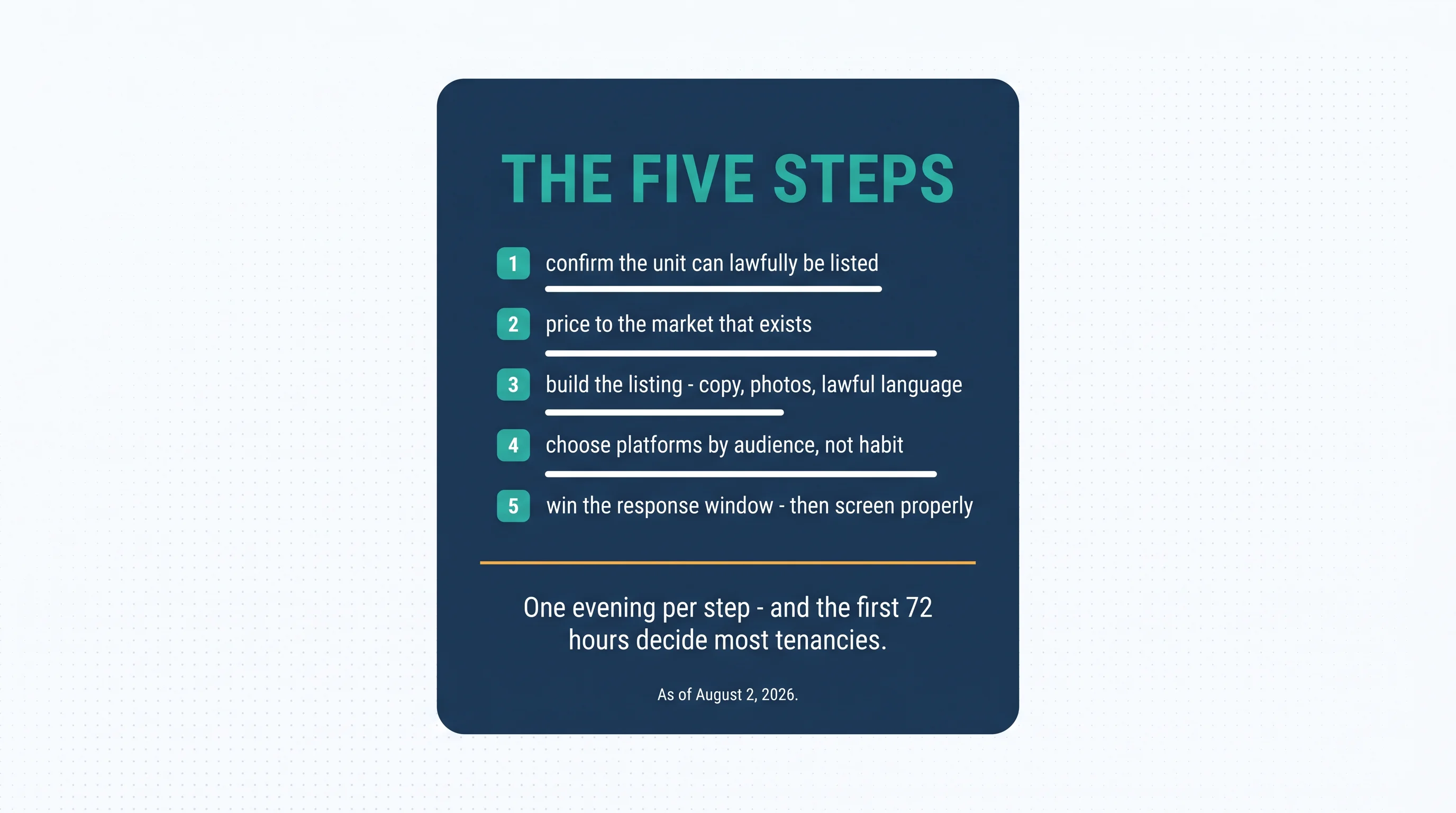
Step two: price to the market that exists
Benchmark by source and month, never blended — and matched to your segment: a condo tower prices against condo-lease data; a basement suite against listings medians. Our market check and its benchmark table carry the current numbers; the full pricing method publishes as this series' companion pillar.
Then treat incentives as what they are: price. In this market, a clearly stated free month can beat a vaguely lower ask — a $2,300 listing with one month free is $2,108 effective on a twelve-month lease, and stating it plainly wins both the effective-rent-literate tenants and the ones you just taught. The same literacy protects you in reverse: when a prospective tenant compares your $2,200 against a competitor's "$2,050," knowing the competitor's price carries no incentive while yours could — and saying so — keeps the comparison honest. Incentives are the market's current language; listings that speak it clearly get read correctly. Seasonal honesty belongs in the same evening: demand peaks July–September and April–June; a winter listing prices for thinner demand or the vacancy times itself toward a peak.
💡 For landlords: The pricing evening produces three written numbers — the ask, the incentive you'll offer before touching the ask, and the floor that triggers a strategy rethink. Write all three down before the listing goes live. Mid-vacancy improvisation always lands lower, because it negotiates against the vacancy-day meter instead of a plan.
Step three: build the listing — copy, photos, and the language law reads
Copy that works is specific. "700 square feet with nine-foot ceilings" outperforms "spacious" every time it's tried; the filterable facts go up front (utilities, parking, laundry, storage, pet position) because tenants filter before they read; and the ad states its own process — application instructions plus a response-time promise. The headline formula: beds, type, neighbourhood, one genuine hook. And the response-time promise deserves its own sentence of justification: stating "applications acknowledged within 24 hours" in the ad does three jobs at once — it signals a professional process to strong applicants, it filters out the mass-blast enquiries that never read ads, and it commits you to the discipline that step five will demand anyway. Full copy craft and ready templates publish in this series.
Photos with a phone are enough — twelve images minimum, in decision order: kitchen, living, bedrooms, bath, exterior, extras. Daylight, verticals for mobile, and nothing that misrepresents — a photo that oversells buys you showings that convert to nothing, which is the most expensive kind of traffic. The phone-photography guide publishes in this series.
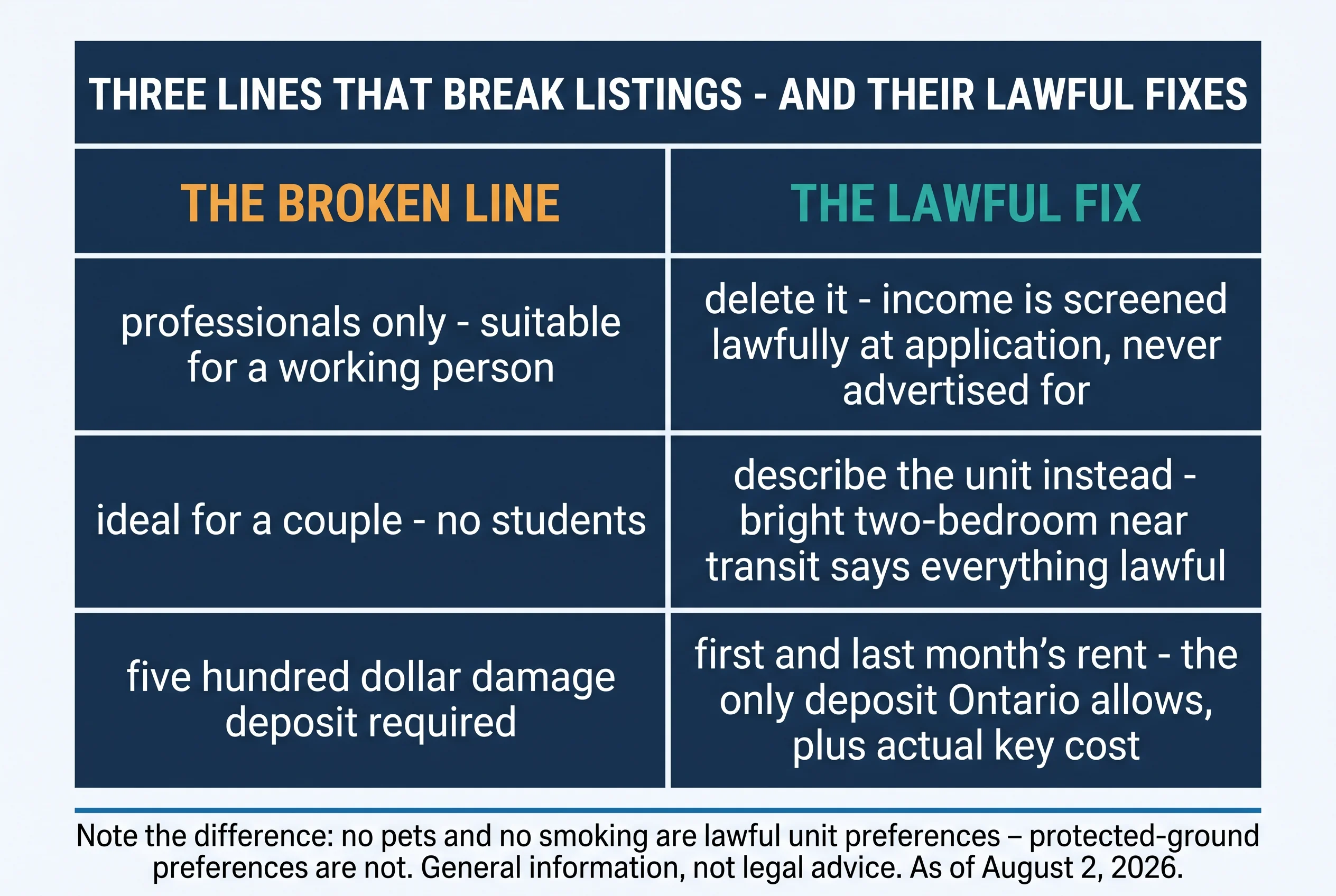
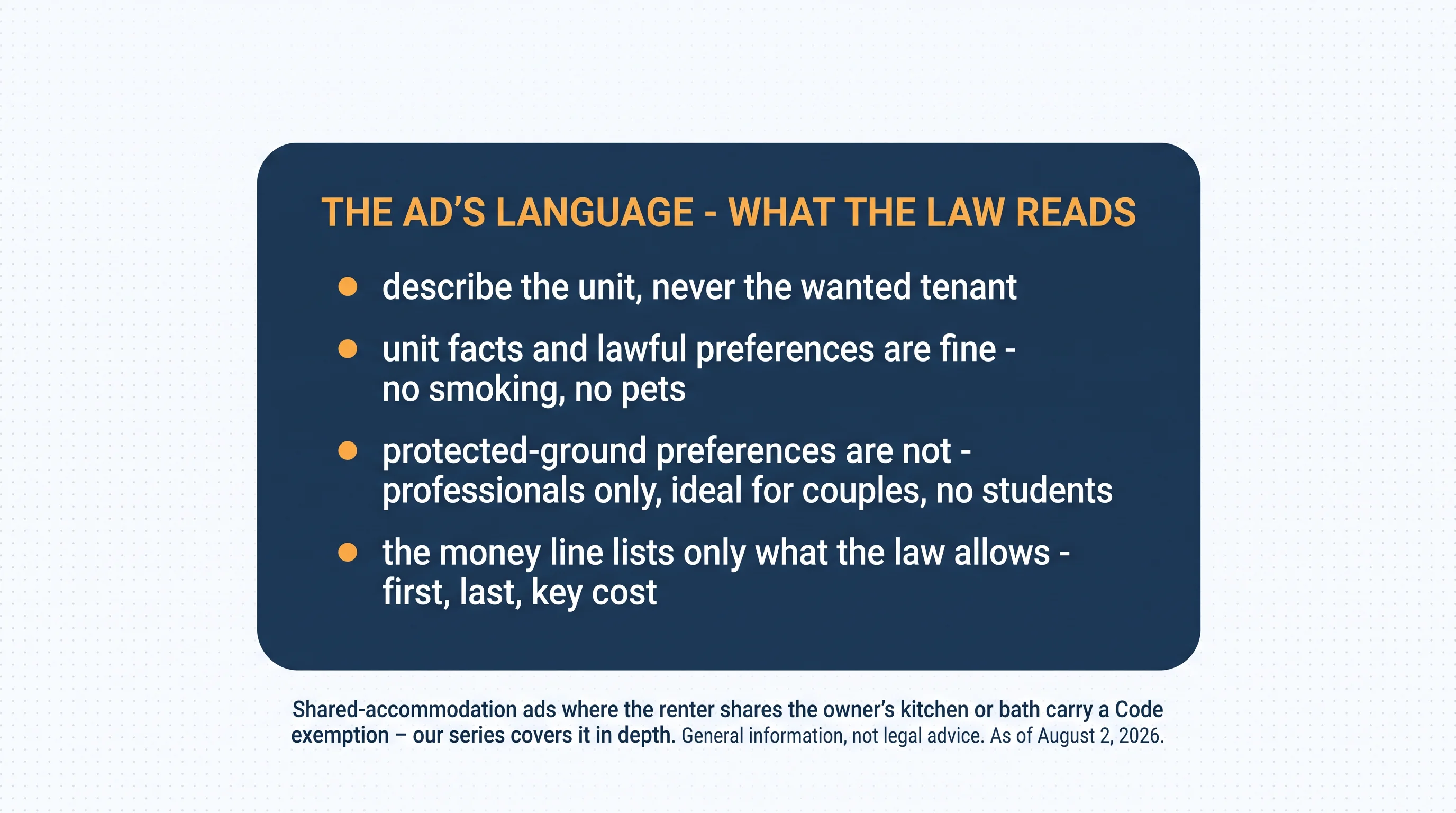
And the language the law reads. A listing cannot state preferences on protected grounds — and the live patterns are everywhere once you know them: "professionals only" and "suitable for a working person" (proxies for the public-assistance ground), "ideal for a couple," "no students," "adult building" (family status and age territory). The fix is always the same move: describe the unit, never the wanted tenant. "Bright two-bedroom near transit" says everything lawful; the applicant screening happens later, through the regulated questions. Here's the part compliance guides never mention: the lawful move is also the better ad. "Ideal for a young professional couple" tells a reader nothing about the unit and quietly repels everyone outside the picture; "quiet top-floor one-bedroom, nine-foot ceilings, two blocks from the GO station" sells the same unit to every lawful applicant it fits. Describing the unit isn't the constrained version of the ad — it's the competent one.
Two precision cuts most guides miss. First: "no pets" is lawful ad copy — stating a lawful selection preference is permitted, exactly as our pets guide explains (service-animal accommodation and condo rules carry their own carve-outs), and the same holds for "no smoking." The Code's ad rules target who the tenant is, not how the unit is kept. Second: the shared-accommodation exemption — where the renter would share a kitchen or bathroom with the owner or the owner's family, the Code carries an exemption, which is why a "female student preferred" line can be lawful in a room-in-the-owner's-home ad and unlawful in a self-contained-unit ad. The full ad-language guide publishes in this series; this is general information, not legal advice.
Step four: choose platforms by audience, not habit
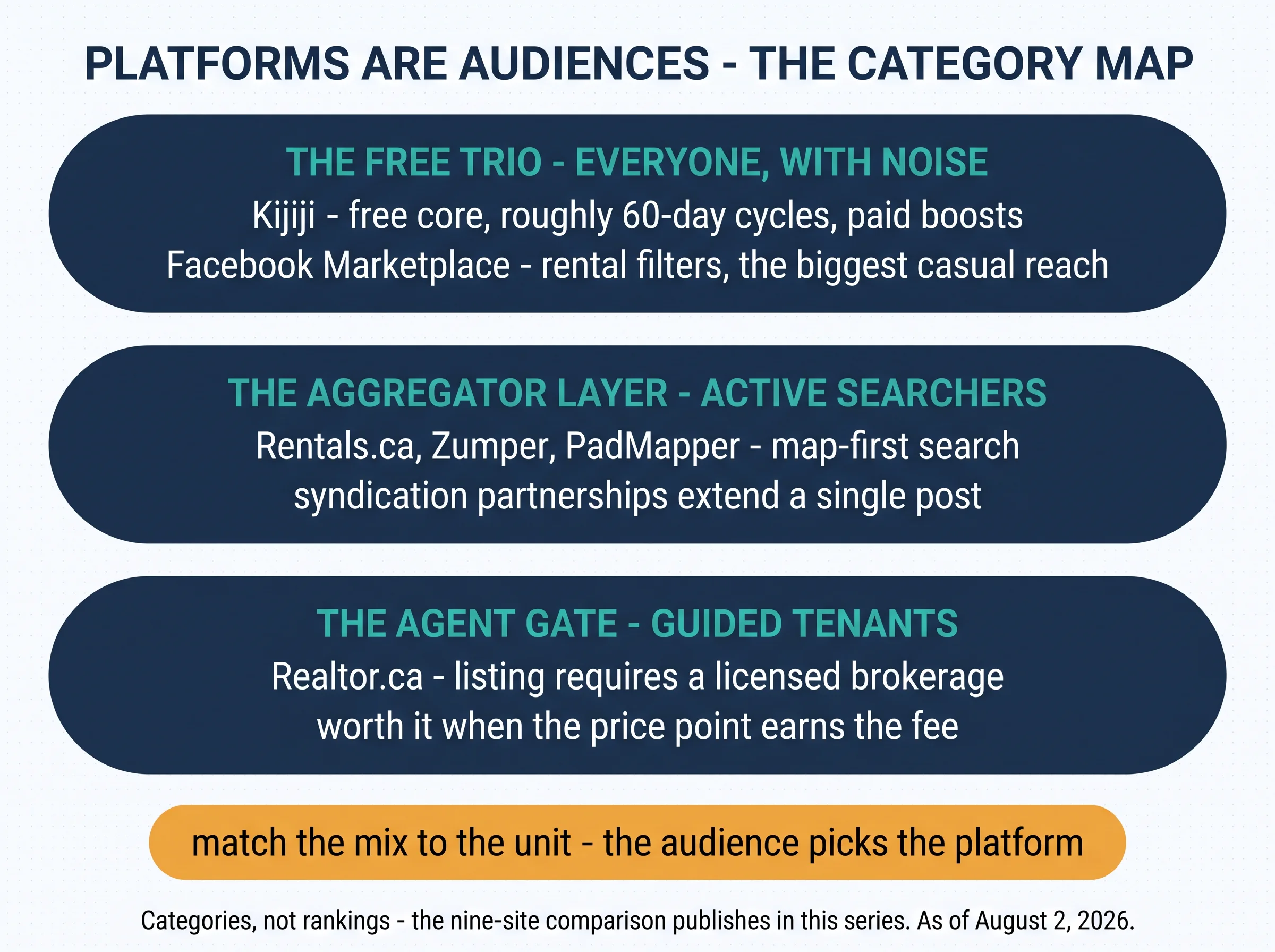
Three categories, not a ranking — the nine-site comparison publishes in this series. The free trio: Kijiji (free core listings on roughly 60-day cycles, paid gallery and highlight boosts, everything through the platform inbox) and Facebook Marketplace (free, proper rental filters, the biggest casual reach in the country) — both carrying the scam-surface caveat, in both directions. The aggregator layer: Rentals.ca, Zumper, PadMapper — map-first platforms where active searchers live, with syndication partnerships that extend a single post's reach. And the agent gate, stated plainly: Realtor.ca is not directly postable — listing there means retaining a licensed brokerage, and whether that trade earns its fee is a price-point question, not a loyalty one.
The category logic, worked: a $3,800 executive rental may genuinely benefit from agent reach and MLS credibility; a $1,900 basement suite is carried perfectly well by the free trio and an aggregator. The audience picks the platform — the unit tells you which audience. One operational note that surprises first-timers: each platform is also an inbox, and three platforms means three places an enquiry can age unanswered. Choose the mix you can actually monitor — two platforms answered in hours beat five answered in days, every time, because reach you can't respond to is reach you've donated to faster competitors.
💡 For property managers: At ten-plus units the platform question becomes a workflow question — one listing template, one syndication pass (multi-platform posting tools market exactly this), one inbox discipline, and per-platform performance notes that survive staff turnover. The 50-unit listing workflow gets its own piece in this series; until then, the rule is simple: never hand-post what a template can carry.
Step five: win the response window — then hand off to screening
The first 72 hours decide most tenancies. The strongest applicants are the ones with options, and applicants with options move first and expect answers in hours — which makes response time the multiplier on every step above. A brilliant listing answered slowly performs like a mediocre one; the response-time piece in this series makes the case in full. The mechanics are worth one concrete beat: a good listing on the free trio can draw dozens of enquiries in its first days, they arrive front-loaded, and the applicant who's viewed three units this week decides among the landlords who answered — not the best units in the abstract. Pre-write two messages before launch (the acknowledgment with the triage three, and the showing invitation with times) and the whole window runs on paste instead of composition.

Triage lawfully: the pre-showing three — move-in timeline, occupant count, and willingness to verify income as part of the full package — are all lawful and filter most noise; the enquiry-management guide in this series covers the system at volume, and showings batch better than they scatter. Defend both directions: the fake-listing economy steals your photos to harvest someone else's deposits (search your own address monthly), and the fake-applicant patterns — overpayment offers, sight-unseen urgency, documents that won't verify — have their own guide coming in this series.
Then draw the boundary and cross it properly: the ad invites; the application interrogates — and the questions are regulated from the first form. What you can and can't ask is the standing reference, the public-orders rules govern the new archive, and the complete screening pillar publishes as this series' companion.
💡 For tenants — reading listings defensively: The scam tells travel together: below-market rent plus urgency plus sight-unseen pressure plus any wire or gift-card request — any two together means walk. Know what ads may not say about you ("no students" isn't lawful; "no pets" is), compare incentive-laden listings in effective-rent terms — a $2,300 with one month free is $2,108 effective over a year, cheaper than a flat $2,150 — and remember: an ad's unlawful term — a damage deposit, a preference line — doesn't become lawful because you replied to it.
💡 The whole sequence is what the listing builder walks: legality prompts before the ad exists, the lawful money lines built in, HRC-safe copy structure, platform-ready output, and the screening hand-off waiting at the end. Free for up to 3 units, tenants free on every tier. Open the listing builder or see current plans.
The Listing Launch Checklist
Five evenings and one launch hour on a single page — the legality checks, the three pricing numbers, the lawful ad language, and the 72-hour response disciplines.
Get Free PDF →And the series map, for orientation: beneath this pillar, the deep dives publish cluster by cluster — the nine-site platform comparison, listing copy and templates, phone photography, showings and enquiry management, scam defence in both directions, the ad-language law in full, basement-apartment legality, and the pricing and screening pillars this guide keeps pointing toward. Each one hard-links back here as it ships; this page is the map that stays current.
Key takeaways
- Advertising matters again: the listing competes with incentive-laden professional inventory — a bad ad is a vacancy subsidy paid weekly.
- Legality first: the city three-check, unit status, and the lawful money list precede any ad — everything downstream inherits that evening.
- Price by source and month, and treat incentives as price — three written numbers before launch: ask, incentive, floor.
- The ad's language is regulated: describe the unit, never the wanted tenant — "no pets" is lawful, "professionals only" is not, and shared-owner-kitchen rooms carry the Code's exemption.
- Platforms are audiences: the free trio and aggregators are direct; Realtor.ca is agent-gated; the unit's price point picks the mix.
- The first 72 hours decide most tenancies — response time multiplies everything, and the hand-off to regulated screening is where the ad's job ends.
Five evenings, one hour, one layer
None of this is hard, and all of it is craft: an evening confirming the unit can lawfully carry an ad, an evening producing three prices instead of one, a day making the listing honest and specific and legally clean, an hour launching it where its audience actually looks, and then the discipline of answering fast and screening properly. The legal layer isn't a burden on the sequence — it is the sequence, run in the right order. The spokes beneath this guide go deep on every step as they publish; the checklist above carries it all on one page. This is general information, not legal advice. As of August 2, 2026.
From empty unit to lawful listing
The listing builder walks the whole five-step sequence — legality prompts, lawful money lines, clean copy structure, and the screening hand-off built in. Free for up to 3 units.
Free for up to 3 units • Tenants always free • See current plans
Related resources
- First and Last Month's Rent — the money the ad may lawfully promise to collect.
- What You Can and Can't Ask a Rental Applicant — where the ad's job ends and screening's rules begin.
- Do You Need a Licence to Rent Out Property? — the legality evening's first question.
- Refusing Tenants With Pets — why "no pets" is lawful in the ad and void in the lease.
- Are Toronto Rents Bottoming Out? — the market this guide prices into.
Frequently asked questions
Where can I advertise a rental in Ontario?
Directly: Kijiji, Facebook Marketplace, and aggregators like Rentals.ca, Zumper, and PadMapper. Realtor.ca requires a licensed brokerage. Choose by audience and price point — our nine-site comparison in this series goes deeper.
What can't I say in a rental ad in Ontario?
Preferences about who the tenant is: "professionals only," "ideal for couples," "no students," "adult building." Unit facts and lawful unit preferences — "no smoking," "no pets" — are fine. Shared-accommodation ads where the renter shares a kitchen or bath with the owner carry a Code exemption. This is general information, not legal advice.
Can I ask for a damage deposit in the ad?
No — Ontario permits only first month's rent, a last-month's-rent deposit, and a refundable key deposit at actual cost. A damage-deposit line advertises an illegal term.
When is the best time to list a rental in Ontario?
Demand peaks July–September (the student cycle) and April–June (the family cycle). Winter listings face thinner demand — price accordingly or time the vacancy toward a peak where possible.
How fast should I respond to enquiries?
Within hours, not days — the strongest applicants have options and move first. State a response-time promise in the ad and keep it; the first 72 hours decide most tenancies.


