As of July 30, 2026. The short answer: Ontario has no provincial licence for renting out residential property. You don't apply to the province, there's no provincial registry of landlords, and nothing in the Residential Tenancies Act requires a permit to become one.
The complete answer is why this question stays confusing: licensing in Ontario is municipal, and three different licence types now share the word. Some cities license ordinary rental operation. Three cities license renovation-related evictions specifically. Many license short-term rentals. Whether *you* need a licence depends on which city the unit sits in and which of those three regimes touches what you're doing — so this piece is the disambiguation, and our city-by-city tracker is the lookup table it routes to.
The Ontario Rental Licence Check
The three licence types, the sixty-second city check, the legality layer, and the two diary entries — one page, date-stampable.
Get Free PDF →Licence type one: ordinary rental licensing — city by city
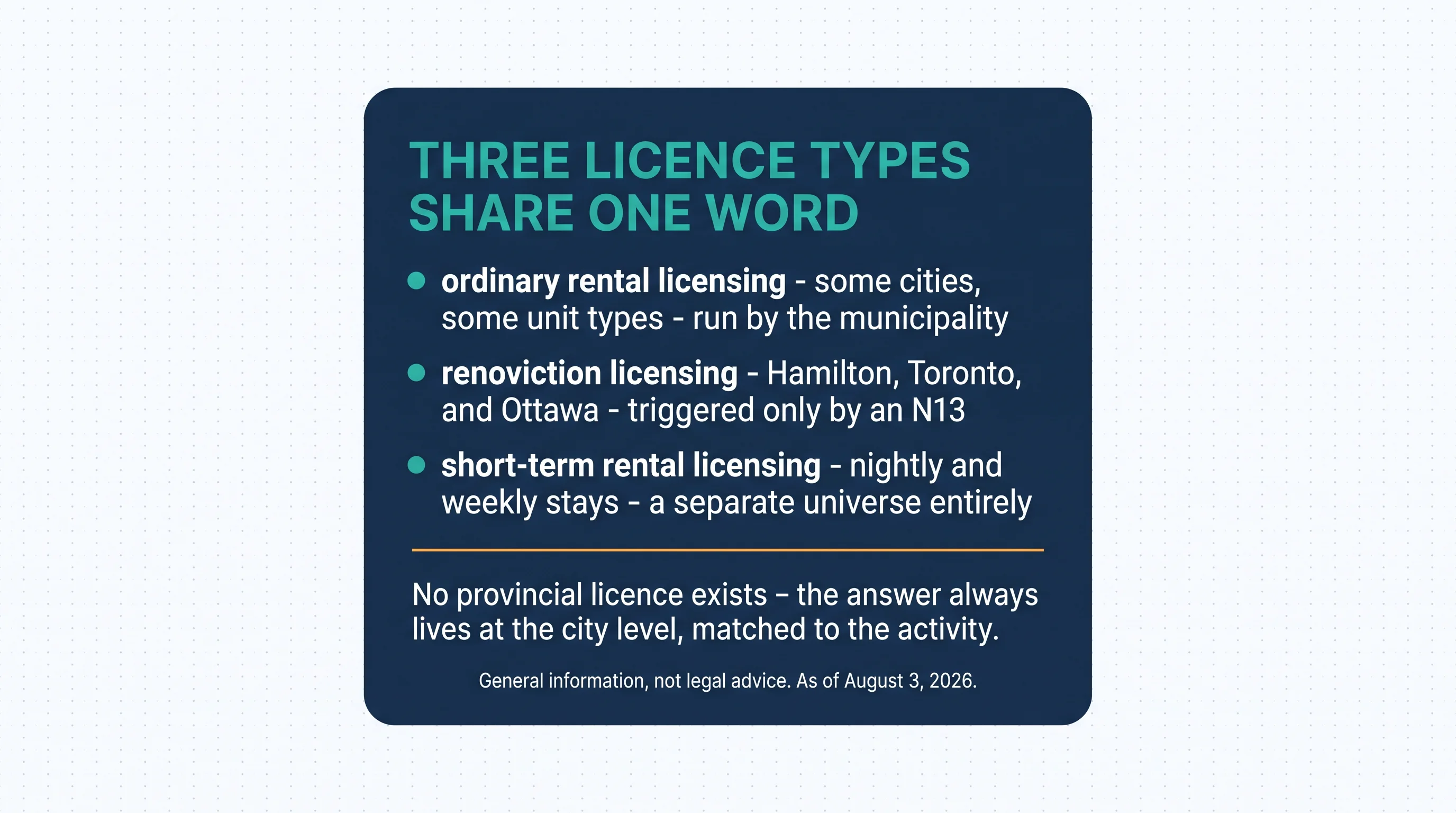
Some Ontario municipalities require a licence simply to operate rental housing — most commonly targeting specific unit types (low-rise rentals, second suites, rentals near campuses) rather than every landlord in the city. The regimes typically bundle inspections, standards compliance, fees, and renewal cycles, and the details differ enough between cities that the only honest general statement is: check your city's own pages before listing. Our licensing tracker maintains the city-by-city table — which cities license, what they charge, and what triggers the requirement — dated cell by cell, revised as councils move.
Two adjacent registrations get mistaken for licensing constantly: second-suite registration (many cities require basement and accessory units to be registered as legal units — a legality question that precedes any listing, covered in our basement-apartment guide) and fire-code and zoning compliance, which aren't licences at all but decide whether the unit can lawfully be rented, licence or no licence.
What an ordinary licensing regime typically asks for, so the shape is recognizable when your city has one: an application with owner and unit details, an inspection or self-certification against property standards, proof of insurance in some cities, a fee with a renewal cycle, and posted or produceable proof of the licence. The regimes exist mostly where councils worried about specific stock — student rentals, low-rise conversions, second suites — which is why two landlords a city apart can honestly give opposite answers to this piece's title question.
Licence type two: renoviction licensing — three cities, one trigger
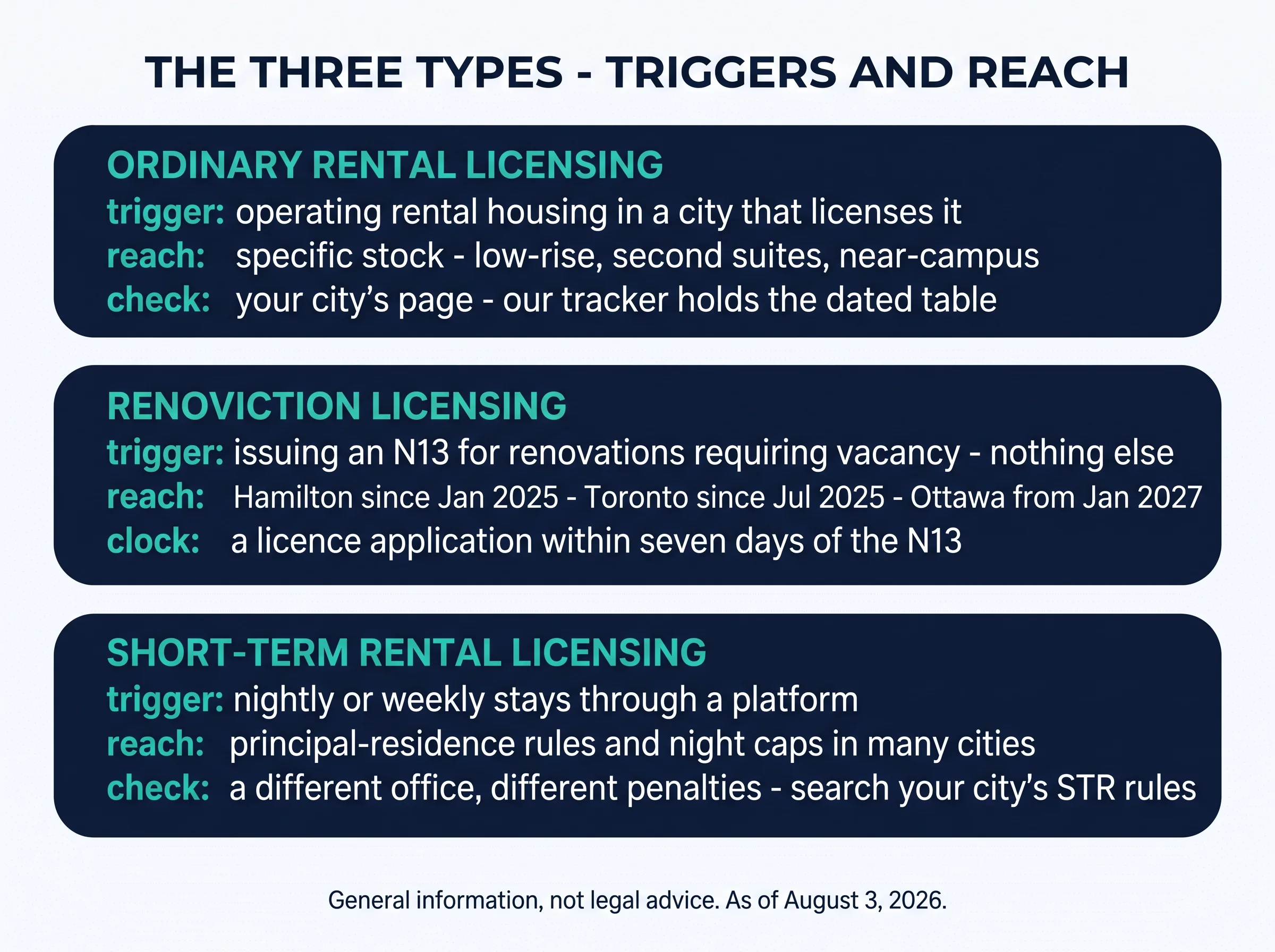
The newest source of confusion, because it made "landlord licensing" headlines all year: Hamilton (since January 1, 2025), Toronto (since July 31, 2025), and Ottawa (from January 1, 2027) license renovation-related evictions — a licence application required within seven days of issuing an N13, with fees, verification, and tenant-protection mechanics that differ sharply by city. This licence has nothing to do with ordinary renting. If you never issue an N13 for renovations requiring vacancy, these regimes never touch you; if you do, they bind precisely and expensively. Our three-city comparison is the standing reference, and the provincial documentation rules layer on top from September 21. The confusion between the two regimes runs both directions, and both versions cost money: a Toronto landlord who thinks the renoviction licence applies to ordinary renting is budgeting $700-per-unit fees they don't owe; one who thinks "I have no landlord licence to get" while issuing an N13 is seven days from a municipal violation. Same word, different triggers — the activity decides.
Licence type three: short-term rentals
Renting nightly or weekly through a platform is its own municipal universe — registration or licensing requirements, principal-residence rules, and night caps in many cities, entirely separate from long-term rental law. If the plan is short-term, search your city's short-term-rental rules specifically; nothing in this piece or the RTA framework covers that activity, and the two regimes are enforced by different offices with different penalties.
The sixty-second decision tree
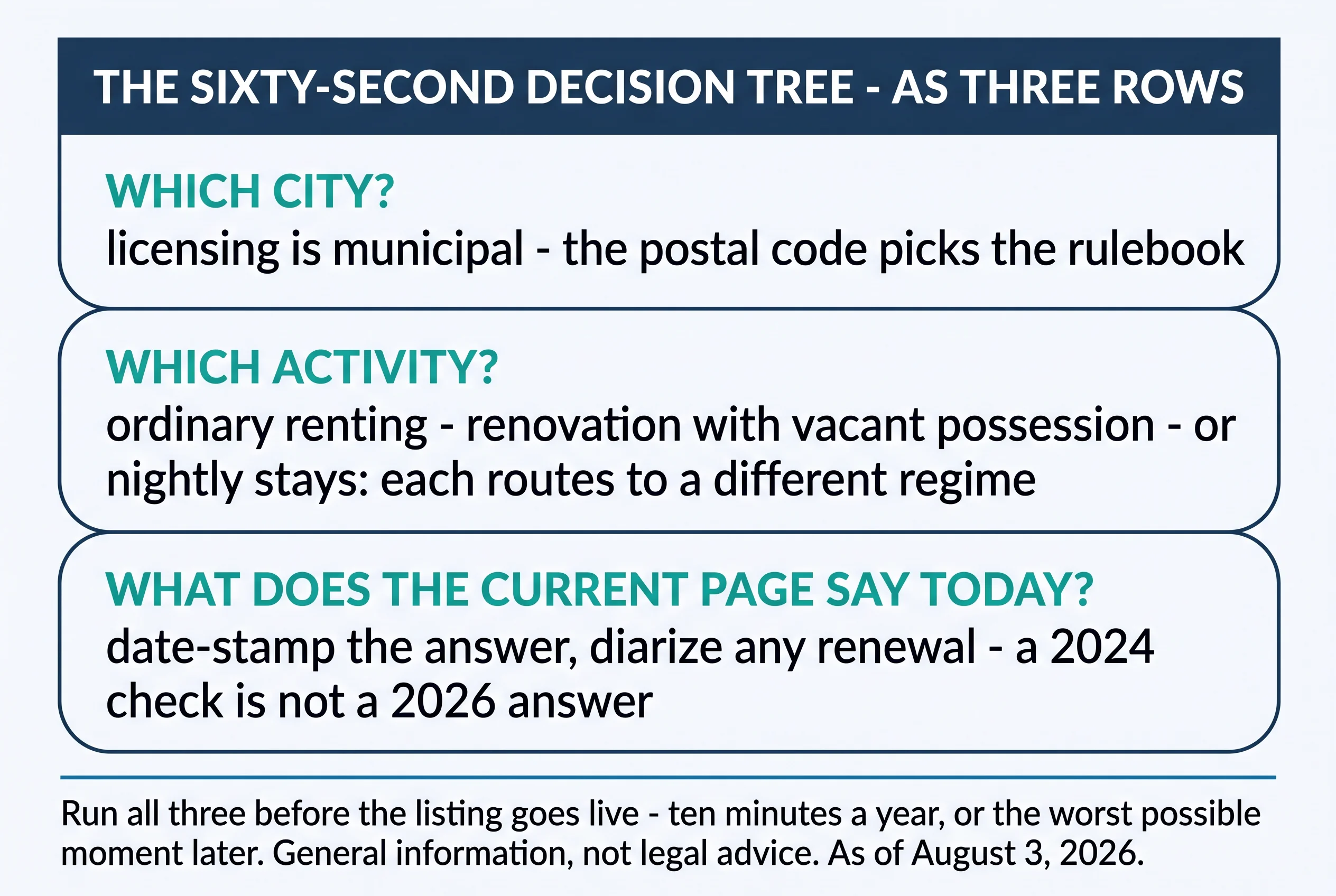
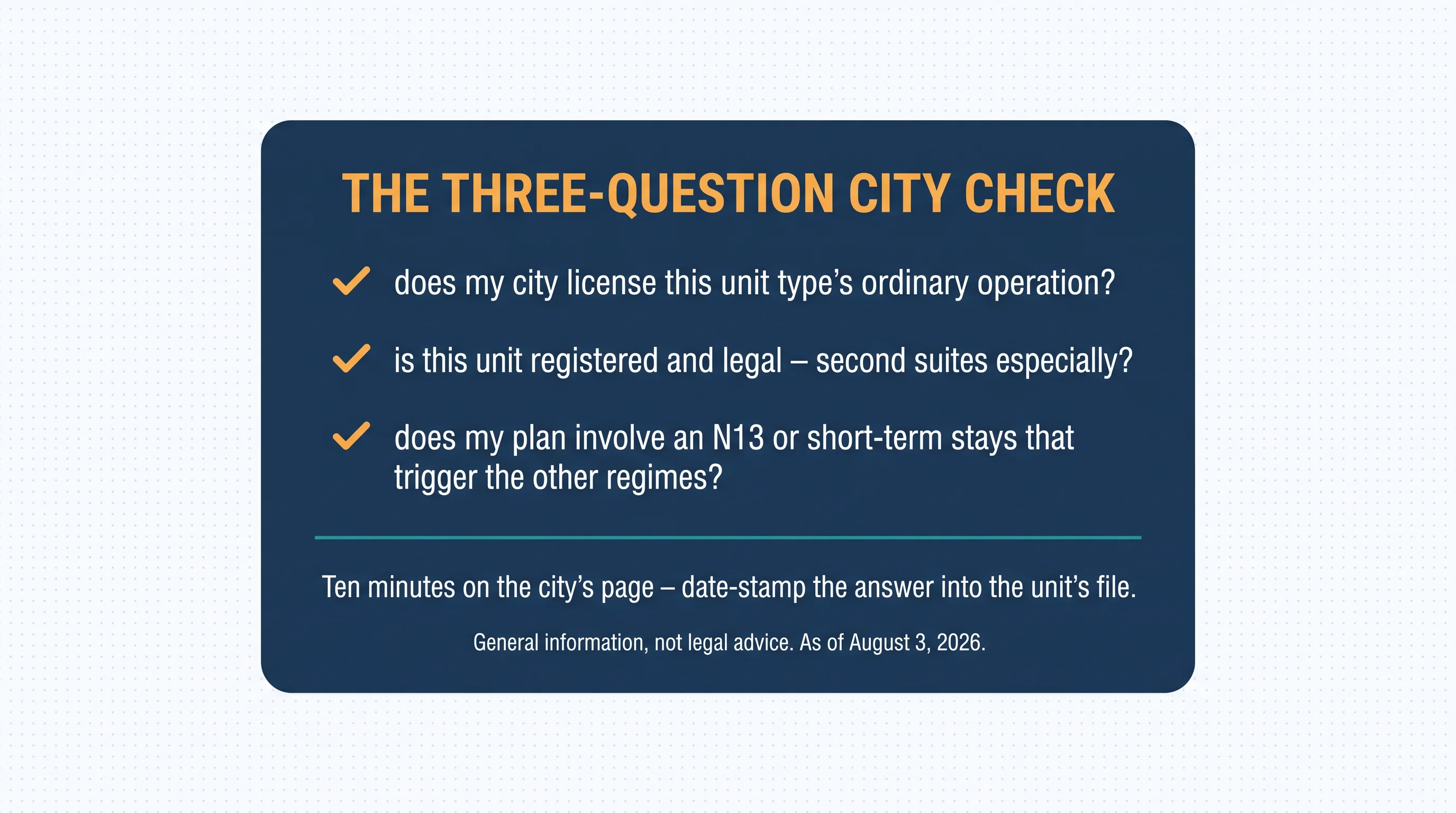
Question one — which city? Licensing is municipal, so the postal code decides which rulebook can even apply. Question two — which activity? Ordinary long-term renting → check the city's rental-licensing and second-suite rules (the tracker's table, then the city's page). Planning renovations that need vacant possession → the N13 triggers the renoviction regimes in Hamilton, Toronto, and (from January) Ottawa, seven-day clock and all. Nightly or weekly stays → the short-term-rental rules, a different office entirely. Question three — what does the current page say today? Date-stamp the answer into the unit's file, diarize any renewal, and the question is closed until the council moves — at which point the tracker moves with it.
Run all three questions before the listing goes live and the licence topic costs ten minutes a year. Run none and it surfaces at the worst moment available — mid-dispute, mid-sale, or mid-N13.
Both chairs, briefly

💡 For landlords: The absence of a provincial licence is not the absence of requirements — the standard lease, the deposit rules, the guideline, and the Board's processes bind every Ontario tenancy regardless of city. Licensing is the municipal layer on top. Confirm your city once, diarize any renewal, and keep the confirmation in the unit's file; "I checked in 2024" is not a current answer in a year when councils keep legislating.
💡 For tenants: Where your city licenses rentals, the licence is checkable — and an unlicensed unit in a licensing city is a signal worth acting on, usually via the city's own complaint route. Either way, your RTA rights don't depend on the landlord's licensing status: an unlicensed landlord is still bound by every provincial rule, and their licensing problem is never your eviction risk by itself.
One more chair — the buyer's: anyone purchasing a tenanted property inherits the licensing question with the keys. The unit's licence (where required) doesn't necessarily travel with the sale, the second-suite registration status is a due-diligence item, and "the previous owner never licensed it" is a history, not a defence. Ten minutes on the city's page belongs on every closing checklist beside the status certificate.
The Ontario Rental Licence Check
The three licence types, the sixty-second city check, the legality layer, and the two diary entries — one page, date-stampable.
Get Free PDF →Key takeaways
- No provincial licence exists — Ontario doesn't license landlords; municipalities do, selectively.
- Three licence types share the word: ordinary rental licensing (some cities, some unit types), renoviction licensing (Hamilton, Toronto, Ottawa — N13-triggered only), and short-term rental licensing.
- The tracker is the lookup: which cities license ordinary operation, at what cost, is a maintained city-by-city table — check it, then check your city's own page.
- Second-suite registration and fire/zoning compliance aren't licences but decide legality first.
- Provincial rules bind everyone regardless — licensing is a layer, never the whole law.
- Date-stamp your check — councils legislated all year; a 2024 answer isn't a 2026 one.
The answer is a lookup, not a law
"Do I need a licence?" has no province-wide answer because the province deliberately left it to the cities — which means the honest response is always the same three steps: name the city, name the activity, check the current page. That's a ten-minute habit standing between you and the only genuinely expensive outcomes here: operating unlicensed where a licence is required, or mistaking one licence regime for another. This is general information, not legal advice. As of July 30, 2026 — the tracker revs as councils move; this piece revs with it.
City checked? List it right.
The listing builder walks the unit to market with the compliance questions built into the flow — legal unit, right deposits, clean ad language. Free to start.
Free for up to 3 units • Tenants always free • See current plans
Related resources
- The Municipal Landlord Licensing Tracker — the city-by-city table this piece routes to.
- Renoviction Licensing by City — the three-city N13 regimes, compared and kept current.
- Advertising a Basement Apartment — the legal-unit question that precedes any listing.
- First and Last Month's Rent — the money rules that bind every Ontario tenancy, licensed or not.
- How to Screen a Tenant in Ontario — the pillar for what comes after the city check.
Frequently asked questions
Does Ontario require a licence to be a landlord?
No — there's no provincial landlord licence. Licensing is municipal: some cities require licences for certain rental types, three cities license renovation-related evictions, and many license short-term rentals. Check your city.
Which Ontario cities require rental licences?
It changes as councils legislate, which is why we maintain a dated city-by-city tracker rather than a list in this piece — several municipalities license specific rental types (low-rise units, second suites, near-campus rentals), each with its own fees and inspection requirements. Check the tracker, then your city's own page.
Is Toronto's renoviction licence a landlord licence?
No — it's triggered only by issuing an N13 for renovations requiring vacancy, as are Hamilton's and (from January 2027) Ottawa's. Ordinary renting in those cities doesn't require it.
Do I need anything to rent out my basement apartment?
Very possibly — many cities require second suites to be registered as legal units, and fire-code and zoning compliance decide whether the unit can lawfully be rented at all. That's a legality layer distinct from licensing; our basement-apartment guide covers it.
What happens if I rent without a required municipal licence?
Municipal enforcement — fees, orders, and fines that vary by city — while every provincial rule continues to bind the tenancy regardless. Tenants' RTA rights never depend on the landlord's licensing status. This is general information, not legal advice.