

Ontario's courts have found a 20-year cottage lease to be a full residential tenancy — and a months-long Airbnb pattern to be no tenancy at all. The line between a holiday guest and a legal tenant is the most expensive line in short-term rentals, and it is not where most hosts think it is.
The folklore says 28 days makes a tenant. That's municipal licensing language, not tenancy law. The real line is drawn by substance — who the occupant is, why they're there, and what the pattern of the stay looks like — and getting it wrong cuts both ways: hosts who accidentally create tenancies they can't end, and occupants told they're "just guests" in what is legally their home. This guide maps the line itself: the actual legal test with the case pattern on both sides, what each side can and can't do on either side of it, the municipal licensing and tax stack (Toronto's API-enforcement era included), and the mid-term lane that escapes licensing by walking straight into tenancy law. Whether you host, book, or rent, the same map applies. General information, not legal advice.
The Line Kit: Holiday Rentals & the Guest-Tenant Line in Ontario — the Substance Test, Both Playbooks, and the Compliance Stack
The line between a holiday guest and a legal tenant isn't drawn by a 28-day calendar — it's drawn by substance, and getting it wrong cuts both ways. This free kit gives Ontario hosts and occupants the actual test (who, what pattern, why and how long), the hotel-grade playbook that keeps the exemption, the licensing-tax-safety-insurance stack in Toronto's API era, and the rights no booking label can remove. Two printable pages for both sides of the line.
Get Free PDF →The Line Itself: the Exemption and the Test That Draws It
Start with the statute. The Residential Tenancies Act simply doesn't apply to "living accommodation intended to be provided to the travelling or vacationing public or occupied for a seasonal or temporary period" in hotels, motels, resorts, lodges, cottage and cabin establishments, B&Bs, campgrounds, and vacation homes — section 5(a), the exemption every holiday rental in the province lives under. The Divisional Court has read the wording as a two-branch test: accommodation is exempt if it's either intended for the travelling or vacationing public or in fact occupied for a seasonal or temporary period. Clear either branch and the RTA — the LTB, rent control, the notice rules, all of it — never attaches.
But here's the part that decides real cases: substance beats labels. Section 202 of the Act directs the Board to determine the true nature of an arrangement — it may disregard the outward form entirely and look instead at the pattern of activities. Calling someone a "guest" or a "licensee" decides nothing. A "booking form" decides nothing. And no written lease is needed for the RTA to apply — written, oral, and implied agreements all count. Which brings us to the folklore that needs correcting: "28 days makes a tenant" is not tenancy law. Twenty-eight days is Toronto's short-term-rental licensing definition (Ottawa's is 30 nights) — a bylaw line that determines when you need a municipal registration, not when a guest acquires RTA rights. Length of stay is a factor in the analysis, never a switch.
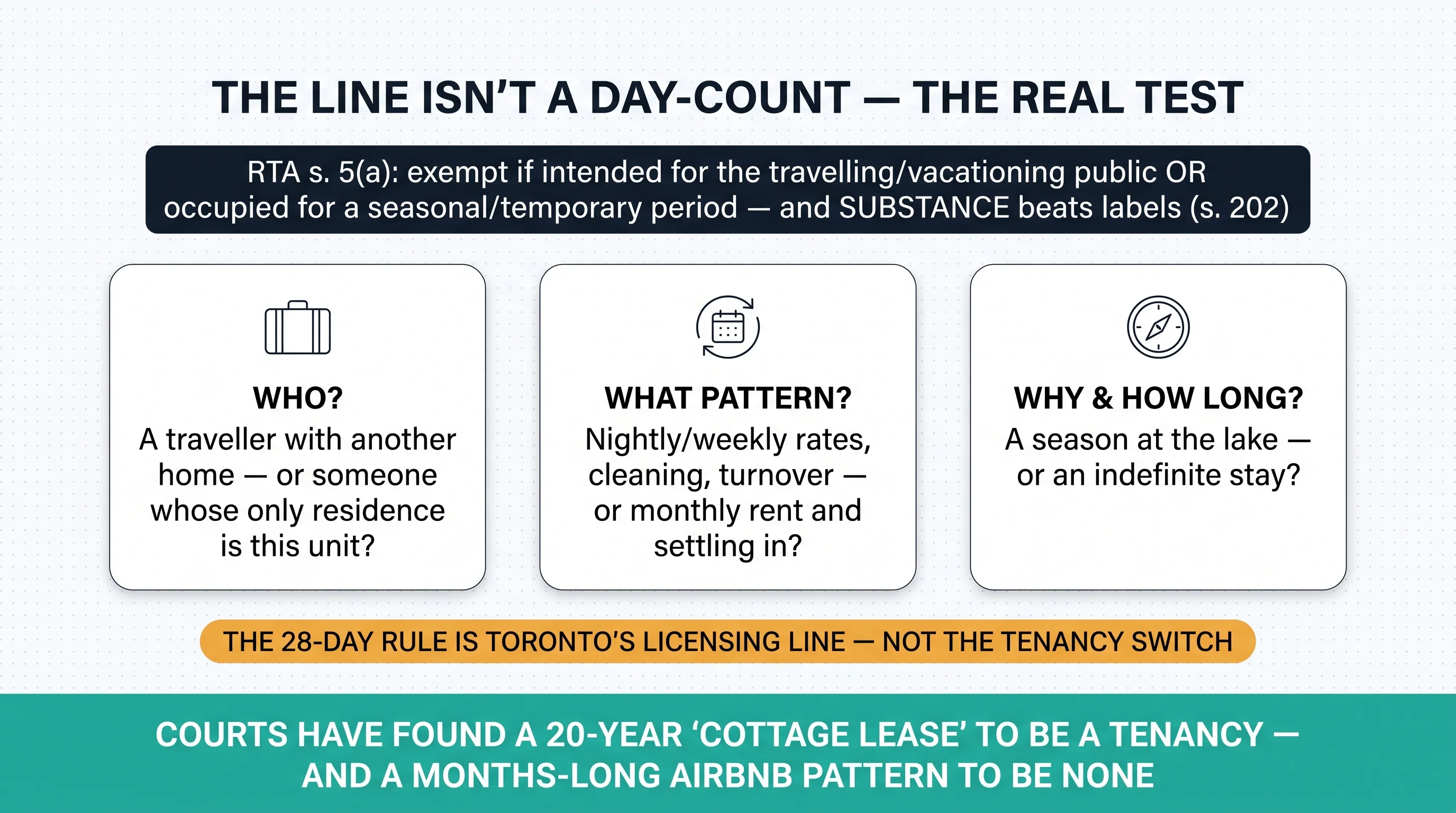
The case pattern runs both directions, and both directions matter. On the exempt side: the Board declined jurisdiction over a genuine Airbnb operation where the occupant claimed tenant status after months of stays — the varying nightly rates, discrete booking periods, and mutual agreements to extend made the pattern "akin to a hotel setting." A beach-resort unit rented in short seasonal stints to the vacationing public got the same result. On the other side: the Board applied the full RTA to a furnished "4-month booking form" — the landlord genuinely intended short-term guest accommodation, but intention alone doesn't establish the exemption; the actual arrangement governs. And at the top of the pile, the Court of Appeal held that 20-year "recreational" cottage land-leases with annual rent were full RTA tenancies — recreational use is still residential use, and two decades is neither seasonal nor temporary.
Distilled, the line test asks three questions. WHO is the occupant — a traveller with another home to return to, or someone whose only residence is this unit? WHAT PATTERN — nightly or weekly pricing, cleaning, linens, and turnover, or monthly payments, arriving mail, and settling in? WHY AND HOW LONG — a vacation or a season at the lake with a defined check-out, or an indefinite stay? No single answer decides alone; the substance of the whole arrangement does. (And if the substance is a tenancy, remember what that means down the road: a fixed term doesn't end anything — more on that below.)
Both Sides of the Line: What Each Side Can and Can't Do
Everything practical follows from which side of the line a stay sits on — so here is each side, plainly.
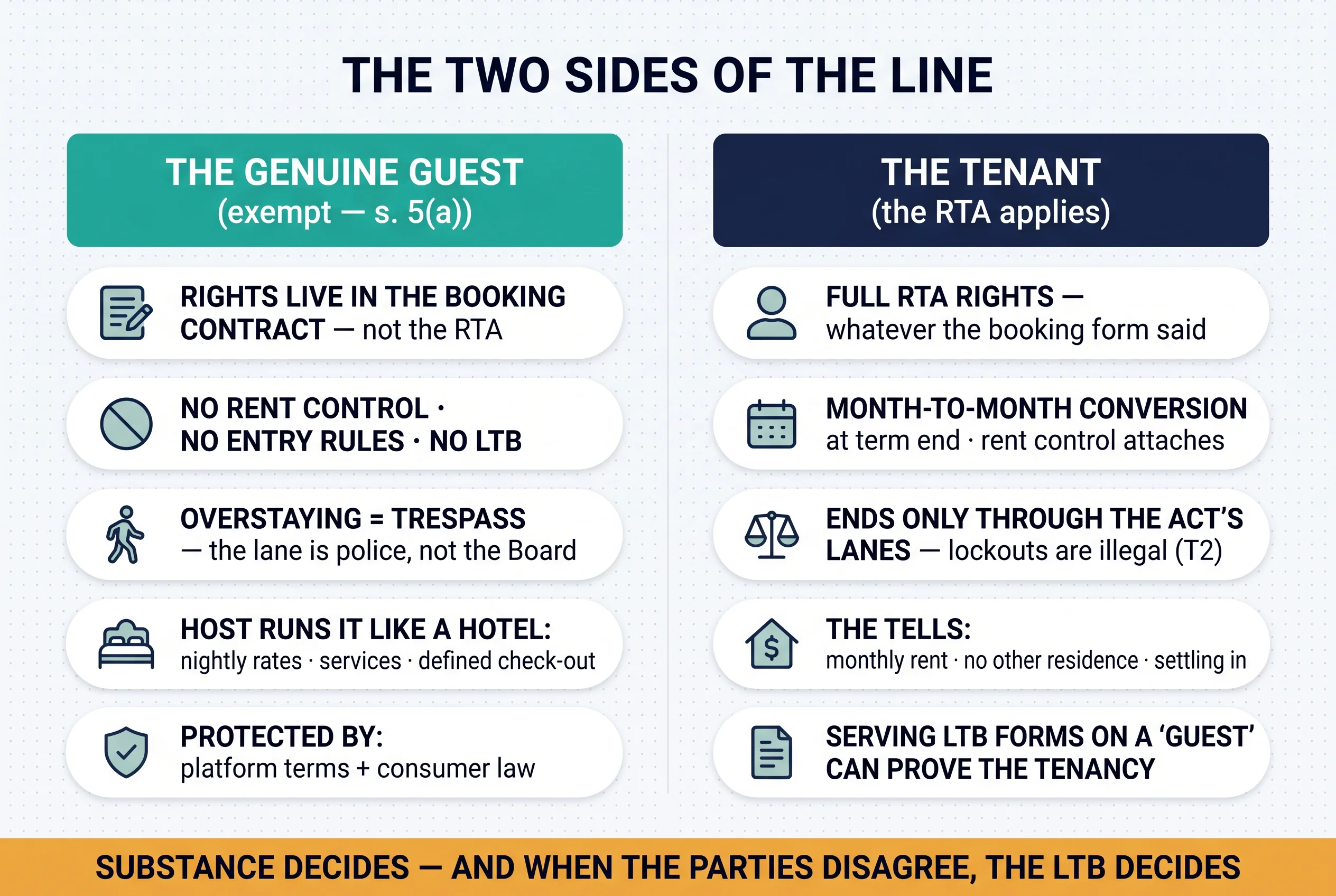
The exempt side. A genuine short-term guest's rights live in the booking contract and the platform's terms — not the RTA. No rent control, no notice-of-entry rules, no LTB process. And when a paid booking ends, an occupant who refuses to leave is a trespasser: the host's lane is trespass law and, if necessary, police — the Board never enters the picture. (For antiquarian flavour: the Innkeepers Act, still on the books, technically entitles an innkeeper to seize a non-paying guest's horse as security. The statute book remembers a different era of travel.)
The tenancy side. If the substance is a tenancy, the whole Act applies — whatever the paperwork was called. The "6-month furnished holiday rental" that's really a tenancy converts to month-to-month when the term ends, rent control attaches, and the arrangement ends only through the Act's lanes — the notices, the applications, the hearings. There is no "checkout date" a landlord can enforce on a tenant.
For hosts, the exemption is kept, not assumed — and the practitioners who defend these cases converge on the same hygiene: use guest, booking, nightly rate language everywhere; define check-in and check-out dates; provide the hotel-like services that prove the pattern (cleaning, linens, turnover); hold the municipal licence; carry short-term-rental insurance; handle HST where it applies. And build one thing most hosts never think of: a deliberate transition process — so when a genuinely long-term guest emerges, they move onto the Ontario Standard Lease with real screening, and a changed relationship becomes a decision instead of an accident.

For occupants, the mirror: if you actually live there — no other home, mail arriving, monthly payments — the label on the booking does not erase your rights. The Board looks at substance, and when the parties disagree about which side of the line they're on, the LTB decides, usually on the occupant's own application. The classic pattern is the winter rental that wouldn't end: a cottage-country owner rents the "holiday home" from September to April at a monthly rate to someone between houses; come spring, the occupant stays — and monthly rent plus sole residence plus eight months adds up to a tenancy. The summer bookings get cancelled, and the exit runs through the Act's lanes, because that's what the arrangement was all along. Occupants navigating this should know their baseline rights — the label "guest" removes none of them if the substance says otherwise.
The Compliance Stack: Licensing, Taxes, Safety, Insurance
Now the layer most guides start with — because even a genuinely exempt holiday rental sits under a full compliance stack. Ontario regulates short-term rentals city by city, and the common threads across Toronto, Ottawa, Mississauga, Hamilton, and Huntsville are consistent: principal residence only (investment and secondary properties are ineligible), registration with the number displayed on every listing, and documentation proving you actually live there. Two private layers sit on top: condo boards can restrict or prohibit short-term rentals regardless of what the city allows, and leases can prohibit tenant-hosts entirely.

Toronto is the template for where enforcement is heading. Registration runs $375 initially and $390 at renewal in 2026; entire-home rentals are capped at 180 nights per calendar year across all platforms combined, while partial-unit rentals (up to three rooms in your home) are uncapped; one registration per dwelling; and annual in-person safety inspections check the alarms, extinguisher, and posted exit plan. The era-defining change arrived in late 2025: the city's platform API, which booking platforms must use to verify registration numbers — unregistered listings aren't warned anymore, they're auto-blocked before publication. The fine range runs $300 to $100,000; operating unlicensed brings a $1,000 fine, delisting, and a 12-month registration ban at the address; blowing past 180 nights costs $700 and a suspension. Ottawa's version: a permit around $100–$110, the same principal-residence rule, a rural cottage-permit exception — and tenant-hosts need written landlord permission to license at all.
Which raises the tenant-host question directly: a tenant listing their rental for weekend stays without consent is in unauthorized-subletting territory — lease-violation ground the Board has upheld N5 and N6 cases on. The composite is familiar: a condo tenant quietly lists the unit for festival weekends, the landlord's search alert finds it, and suddenly three regimes converge on one weekend rate — the N5 lane, a condo-board fine, and the tenant's own insurer walking away. The mirror risk runs the other way too: a landlord who clears a tenant with an N12 and converts the unit to nightly rentals is in bad-faith territory, where awards have exceeded $12,000.
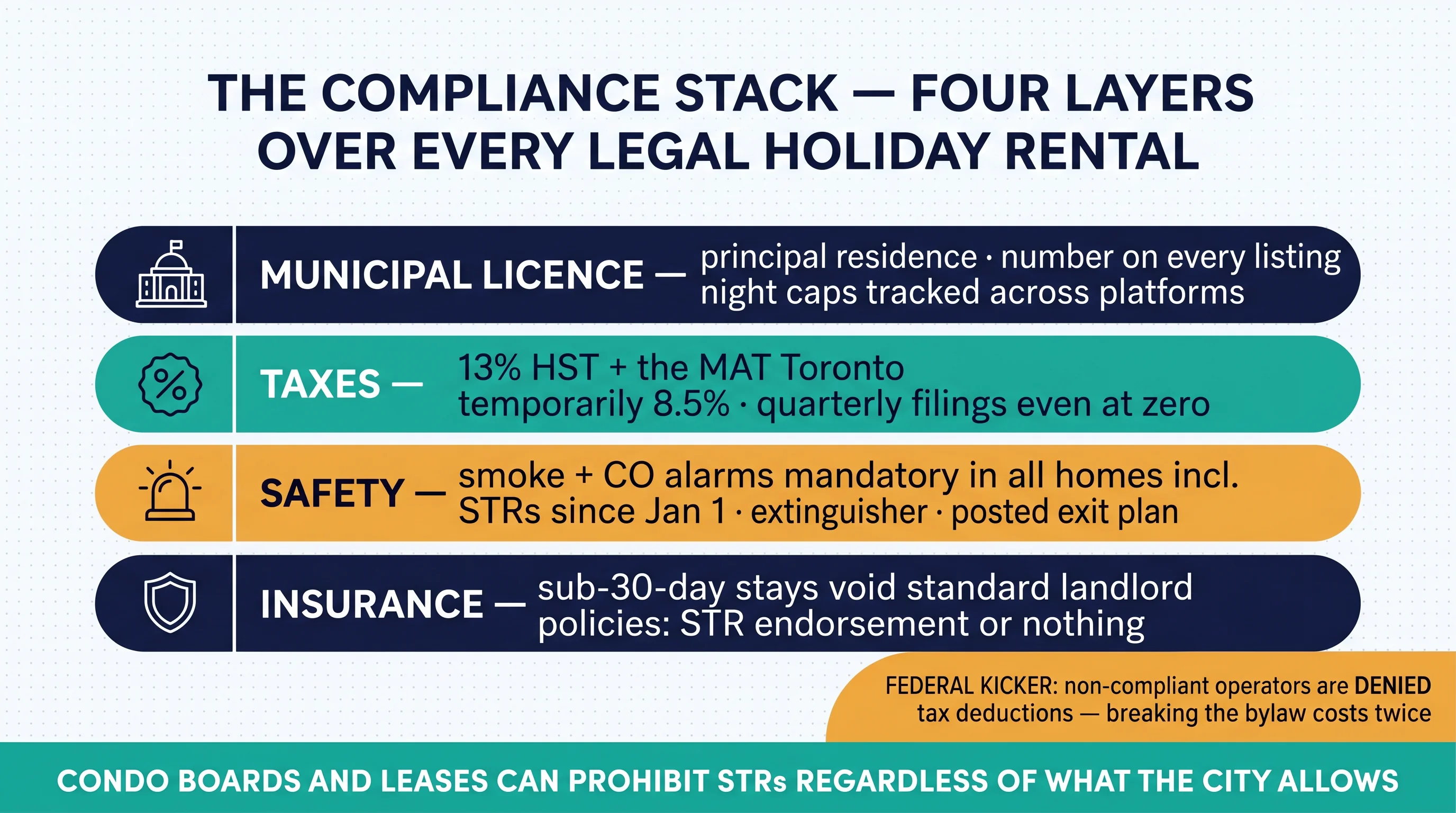
The tax stack has two levels and a kicker. HST at 13% applies to short-term stays (major platforms typically collect and remit it for non-registered hosts). The Municipal Accommodation Tax is a patchwork: Toronto's rate sits temporarily at 8.5% — a World Cup surcharge running through July 31, 2026, scheduled to revert to 6% afterward — while other cities charge 4–6% or flat nightly fees; Toronto hosts file quarterly MAT reports even at zero bookings, and not every platform remits on your behalf. The kicker is federal: since 2024, income-tax deductions are denied to short-term-rental operators whose operations break their municipal rules — non-compliance now costs twice, once in fines and again at tax time. Add the CRA's other edges — rental income is already a top audit focus, and selling a mostly-STR property can trigger change-in-use and HST-on-sale issues — and the record-keeping bar is high. Two more layers finish the stack: carbon monoxide alarms have been mandatory in all Ontario homes, short-term rentals included, since January 1, 2026 under the Fire Code; and sub-30-day stays void standard landlord insurance policies — the STR endorsement or nothing, as our landlord insurance guide covers in detail.
The Mid-Term Lane — and Where This Is Heading
Between the weekend booking and the yearly lease sits the fast-growing middle: furnished stays of 30 days to 6 months — travel nurses, corporate relocations, insurance-displaced households. Mid-term rentals escape municipal STR licensing across the province (they're longer than every city's licensing definition), which is exactly why they're booming in principal-residence-restricted markets. But the licensing escape is a tenancy-law entrance. A furnished 4-month "booking" is very likely a tenancy — the Board has said as much — with month-to-month conversion, rent control, and the full eviction road attached. The lane is legitimate; it just isn't a loophole. Hosts who choose it should choose it knowingly: the Standard Lease, real screening, and a tenancy mindset — because legally, they're landlords.
The direction of travel is unambiguous: API-grade enforcement will spread beyond Toronto, principal-residence rules are hardening, the federal deduction denial has made municipal compliance a tax issue, and MAT rates are in motion (Toronto's reversion is weeks away as of this writing). Meanwhile this year's rental-law changes reshape notices and applications on the tenancy side of the line without moving the line itself. The durable strategy survives all of it: run the exempt side like a hotel, run the tenancy side like a landlord — and never run one disguised as the other.
Practical Takeaways
- Sort every stay by substance before it starts: who the occupant is, what the pattern looks like, why and how long.
- Run the exempt side like a hotel: booking language, defined end dates, services, STR insurance, licence, HST.
- Complete the municipal layer: registered, number displayed, principal-residence rules respected, night caps tracked across all platforms.
- Square the taxes: MAT filed quarterly (rates re-checked), HST position confirmed, records CRA-grade.
- Treat mid-term stays as probable tenancies: Standard Lease and screening, not a booking form.
- Tenant-hosts: written landlord consent first — and check the condo bylaws before anything else.
- Never serve LTB forms on a genuine guest — and never lock out a genuine tenant. Legal advice before either.
The Line Kit: Holiday Rentals & the Guest-Tenant Line in Ontario — the Substance Test, Both Playbooks, and the Compliance Stack
The line between a holiday guest and a legal tenant isn't drawn by a 28-day calendar — it's drawn by substance, and getting it wrong cuts both ways. This free kit gives Ontario hosts and occupants the actual test (who, what pattern, why and how long), the hotel-grade playbook that keeps the exemption, the licensing-tax-safety-insurance stack in Toronto's API era, and the rights no booking label can remove. Two printable pages for both sides of the line.
Get Free PDF →The Bottom Line
The line between guest and tenant isn't drawn by a calendar or a label — it's drawn by substance, and everything follows from which side of it a stay sits on. Genuine holiday rentals live under contract law, municipal licensing, and the tax stack; genuine tenancies live under the RTA, whatever the booking form said. Hosts who run the exempt side like a hotel — nightly language, real services, defined check-outs, the licence and the insurance — keep the exemption. Hosts who drift — monthly rates, indefinite stays, occupants with nowhere else to go — wake up as landlords, sometimes years after it happened. Occupants who actually live there hold rights no label removes, and the Board will look straight through the paperwork to find them. And the compliance era is fully here: the API blocks, the fines stack, and the CRA now reads the bylaws too. Sort by substance first, and both sides of the line stay exactly where everyone can see them.
When a Stay Becomes a Tenancy, Do It On Purpose
The Standard Lease, the screening, and every notice the tenancy side runs on — Tenon10 makes the deliberate transition simple and keeps the paperwork clean on both sides of the line.
Free • No signup required • Updated for the Bill 60 changes in force 21 Sep 2026
Related Resources
- Fixed-Term Leases in Ontario: Why They All Convert to Month-to-Month — what the tenancy side of the line actually means at term end
- Landlord Insurance in Ontario — the sub-30-day exclusion every host needs to know
- Subletting vs Assignment in Ontario — the framework tenant-hosting lives (and dies) under
- The 60-Day Rule: How Landlords Accidentally Create New Tenancies — the occupant-to-tenant sibling of this article's line
- Removing a Tenant Without Eviction — the lawful exits once a stay is a tenancy
- CRA Audits of Rental Income · Becoming a Landlord in Ontario
- Ontario Standard Lease · Ontario LTB Forms Hub
Frequently Asked Questions
When does a guest become a tenant in Ontario?
There's no automatic day-count. The RTA exempts accommodation intended for the travelling or vacationing public, or occupied for a seasonal or temporary period — so the question is substance: is the occupant a traveller with another home, paying nightly or weekly rates with hotel-like services, or someone who has made the unit their residence, paying monthly, with no other home? The 28-day figure people cite is Toronto's short-term rental licensing definition, not tenancy law. The Landlord and Tenant Board decides disputed cases by looking at the true nature of the arrangement, not the labels on it.
Do Airbnb guests have tenant rights in Ontario?
Genuine short-term guests don't — their rights come from the booking contract and platform terms, not the RTA. There's no rent control, no notice-of-entry rules, and no LTB process for a true transient stay, and a guest who refuses to leave after a paid booking ends can be treated as a trespasser. But the exemption depends on the stay genuinely being transient: an occupant who has effectively moved in — long stay, monthly payments, no other residence — may be a tenant regardless of what the platform called them.
What happens if an Airbnb guest won't leave in Ontario?
If the stay was genuinely short-term, the person is a trespasser once the booking ends, and the host can involve police under trespass law rather than the LTB. But hosts should be careful: if the arrangement had tenancy-like features, serving LTB forms (like an N4) can actually undermine the host's own position that no tenancy exists, and a lockout of someone who is legally a tenant is illegal. When a longer "guest" digs in, the right first step is advice from a legal professional who can assess which side of the line the arrangement sits on.
Do I need a licence for a short-term rental in Toronto?
Yes. Toronto requires registration ($375 initially, $390 renewal in 2026), allows short-term rentals only in your principal residence, caps entire-home rentals at 180 nights per calendar year across all platforms combined, and requires your registration number on every listing. Since late 2025, platforms must verify registration through the city's API — unregistered listings are automatically blocked. Fines range from $300 to $100,000, and operating unlicensed brings a $1,000 fine, delisting, and a 12-month registration ban at the address.
Is a 6-month rental a tenancy in Ontario?
Almost always, yes. Mid-term furnished rentals (30 days to 6 months) escape municipal short-term rental licensing, but stays of that length engage the Residential Tenancies Act in most circumstances — the Board has found even a "4-month booking form" to be a full tenancy. That means the arrangement converts to month-to-month when the term ends, rent control applies, and it can only end through the Act's processes. Hosts choosing the mid-term lane should use the Ontario Standard Lease and screen like a landlord, because legally, they are one.


