Run one popular Ontario listing through an honest spreadsheet — a 5% vacancy allowance, real maintenance numbers, a capital-expense line — and a $700,000 duplex that "cash-flows" in the ad loses $1,516 a month. The listing wasn't lying, exactly. It was just showing you one of the three sets of numbers.
Every first rental purchase has three: the financing you actually qualify for (which is not your salary pre-approval), the cash flow the property actually produces (which is not rent-minus-mortgage), and — if tenants come with the building — the tenancy terms you inherit, which were set before you ever saw the listing. Buying guides teach the first layer, sometimes the second, and almost never the third. This guide works all three in purchase order: the 20% rule and the stress test, what lenders actually count of the rent, the honest-spreadsheet method with a fully worked example, the tax lines that surprise, and the tenanted-purchase playbook — the lease that survives the sale, the rent you can't reset, and the vacant-possession process that is law, not a closing date. General information, not financial or legal advice; the first real step is assembling a mortgage broker, lawyer, and accountant before the first offer.
The First-Rental Buyer's Kit: The Three Sets of Numbers — the Financing Reality, the Honest Spreadsheet, and the Tenanted-Purchase Playbook
Every first rental purchase has three sets of numbers — the financing you actually qualify for, the cash flow the property actually produces, and the tenancy terms you inherit with the keys. This free kit gives Ontario first-time investors all three layers in purchase order: the 20% rule and the stress test, the one question to ask every lender, the honest-spreadsheet lines the listing never shows, and the tenanted-purchase diligence that keeps closing day from becoming a surprise. Two printable pages to work before the offer.
Get Free PDF →The Financing Layer: What You Can Actually Borrow
Start with the floor, because it's firm: a rental property you won't live in requires 20% down. Mortgage default insurance simply doesn't exist for non-owner-occupied properties, so there's no 5%-down path and no exceptions. The real cash bill runs higher than the down payment: on a $750,000 property, $150,000 down plus $12,000–$25,000 in closing costs — land transfer tax (billed twice in Toronto, provincially and municipally), legal fees, inspection, adjustments — puts the total around $162,000–$175,000. And note that first-time-buyer land-transfer rebates generally require owner-occupancy: straight investors don't get them.
Then the two rules that shrink your budget before you start. First, the stress test applies to investment mortgages: you qualify at the higher of your contract rate plus 2% or 5.25%, which cuts purchasing power roughly 15–20% versus gross-income math. Second — and this is the one that ambushes first-timers — lenders don't count all the rent. Rental income enters qualification at somewhere between 50% and 80%, through one of two methods: add-back (typically about half the expected rent added to your income — the most common) or offset (rent netted against the property's own carrying costs). Which method a lender uses can swing your real budget more than the interest rate does. The composite plays out constantly: a buyer pre-approved on salary assumes the $4,100 rent counts in full, discovers their lender's offset treatment plus the stress test has quietly removed six figures from the budget, and the file is only saved by a broker who matches lenders on rental-income treatment specifically.
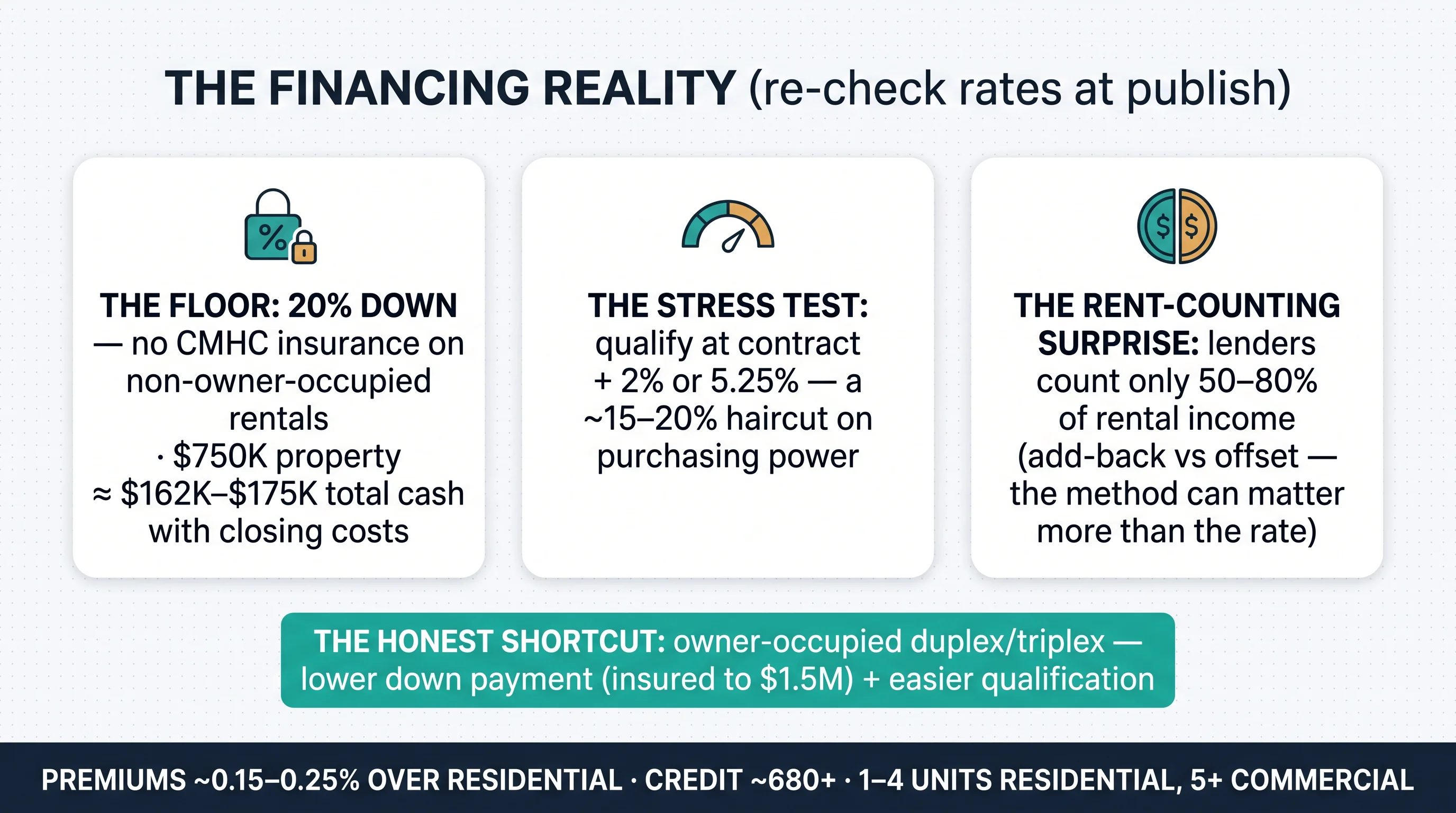
The rest of the pricing picture: investment mortgages carry premiums of roughly 0.15–0.25% over the best residential rates at 20% down; traditional lenders want credit around 680 or better (the best pricing sits above 720); one to four units is residential financing, five or more is a commercial mortgage assessed on the property's own debt-service capacity. And then there's the honest shortcut worth taking seriously: the owner-occupied multi-unit. Live in one unit of a duplex, triplex, or fourplex and rent the others, and the picture changes — insured financing with a lower down payment (now available on homes up to $1.5 million), easier qualification because you occupy the property, and tenants helping carry the mortgage while you get a live-in education in landlording. Broker consensus calls it the most accessible first step, and the math agrees. Three footnotes complete the layer: HELOC-funded down payments are common but stack leverage on leverage — a deliberate choice only; major banks typically cap investors at four or five financed properties, a scaling wall that matters later; and non-Canadian buyers face the 25% NRST plus the federal purchase prohibition currently running to January 2027.
The Honest Spreadsheet: the Numbers the Listing Doesn't Show
The method is one line: cash flow = gross rent − vacancy allowance − operating expenses − mortgage. "Rent covers the mortgage" is not a number; it's a hope, because the mortgage is only one line. Here's the worked example (illustrative figures) that anchors everything:
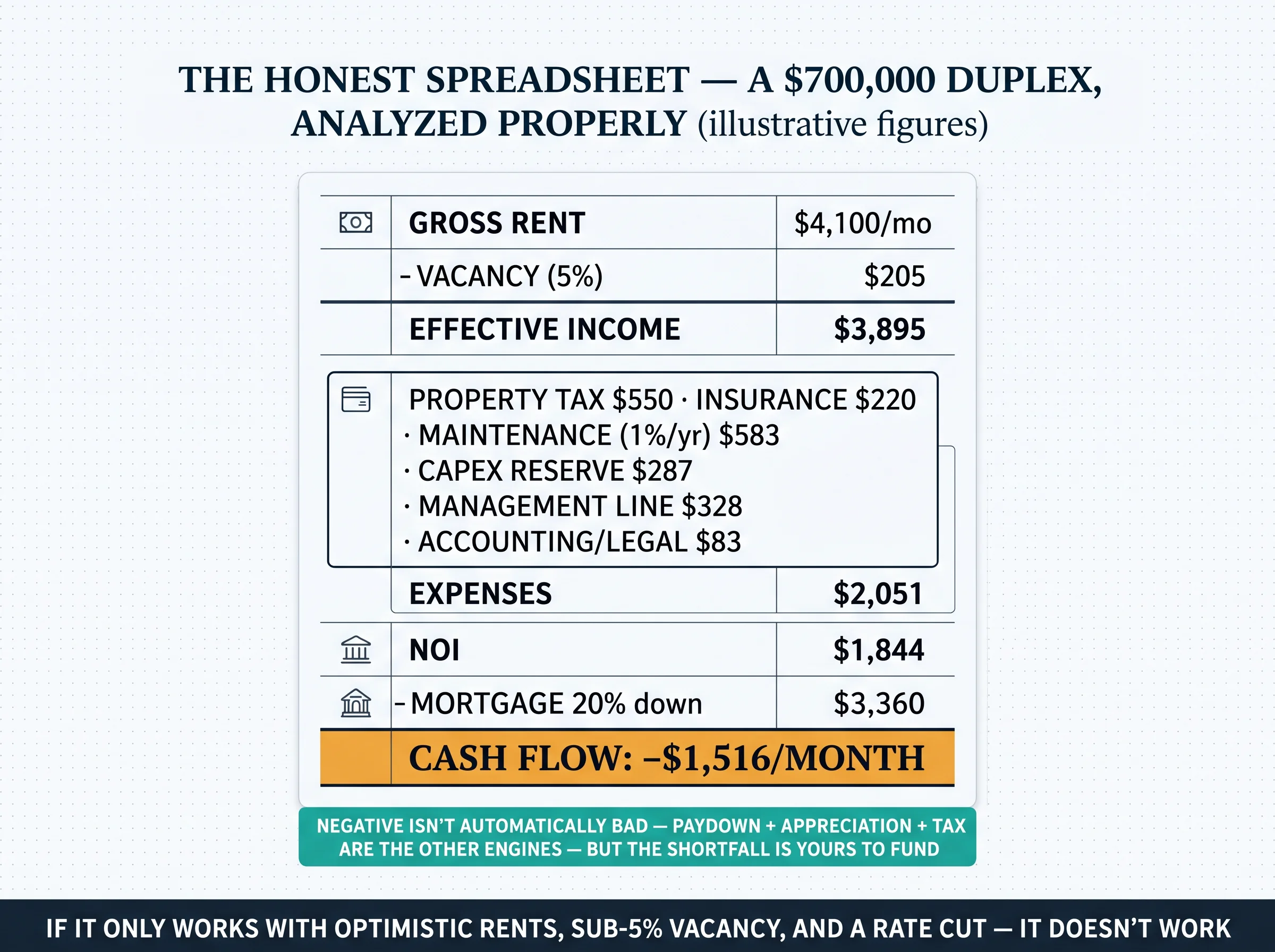
A $700,000 duplex, 20% down, leaves a $560,000 mortgage at 5.25% over 25 years — $3,360 a month. Gross rents of $4,100 lose 5% to a vacancy allowance, leaving $3,895 effective. Then the expense block: property tax $550, landlord insurance $220, a maintenance reserve at 1% of value ($583), a capital-expense reserve ($287), a management line ($328), and accounting/legal ($83) — $2,051 in total. Net operating income: $1,844. Subtract the mortgage, and the honest answer is −$1,516 a month. That's a properly analyzed, realistically rented Ontario duplex at current prices — and it's why the composite of "the listing that said great investment" ends with the buyer either walking or renegotiating, knowing exactly what appreciation has to deliver.
The lines first-timers skip are precisely the ones that flip the sign. Vacancy is never 0%. Maintenance runs 1–2% of property value per year — $6,000–$12,000 on a $600,000 property — whether or not anything visibly breaks. The capital-expense reserve is real (roofs and furnaces don't ask permission). Insurance is landlord-priced at $1,500–$3,000 a year, not homeowner-priced — our landlord insurance guide covers why. And the management line goes in even if you self-manage: your time isn't free, and any future handoff or sale analysis needs the line to exist. Reading the result: cap rate (NOI ÷ price) benchmarks at 6%+ strong, 4–6% moderate, below 4% appreciation-dependent. Negative cash flow isn't automatically a bad deal — principal paydown, appreciation, and tax treatment are the other two return engines — but the shortfall comes out of your pocket every month, so it has to be a strategy you chose and can fund, never one you discover.
The tax layer deserves one honest paragraph. Rental income is taxed at your marginal rate on the T776, and the deductible list is generous — mortgage interest (never principal), property tax, insurance, management, maintenance. The trap is CCA (capital cost allowance): it deducts roughly 4% of the building portion annually, but it can't create or increase a rental loss, every dollar claimed is recaptured as ordinary income when you sell, and claiming it kills the property's principal-residence-exemption eligibility — which is why most advisors say skip it entirely if the property might ever become your home or your child's. Capital gains sit at 50% inclusion, and real estate remains the CRA's single biggest audit focus — records from month one, ideally in software built for the job.

The Tenants Who May Come With It: the Layer No Buying Guide Teaches
Here's the layer that separates prepared buyers from surprised ones. In Ontario, the lease survives the sale. Buy a tenanted property and you step into the seller's shoes as landlord on closing day — same lease (written or not), same rent, same terms, same deposit obligations. Sale does not equal eviction, and there is no reset button. Everything else in this section follows from that one sentence.
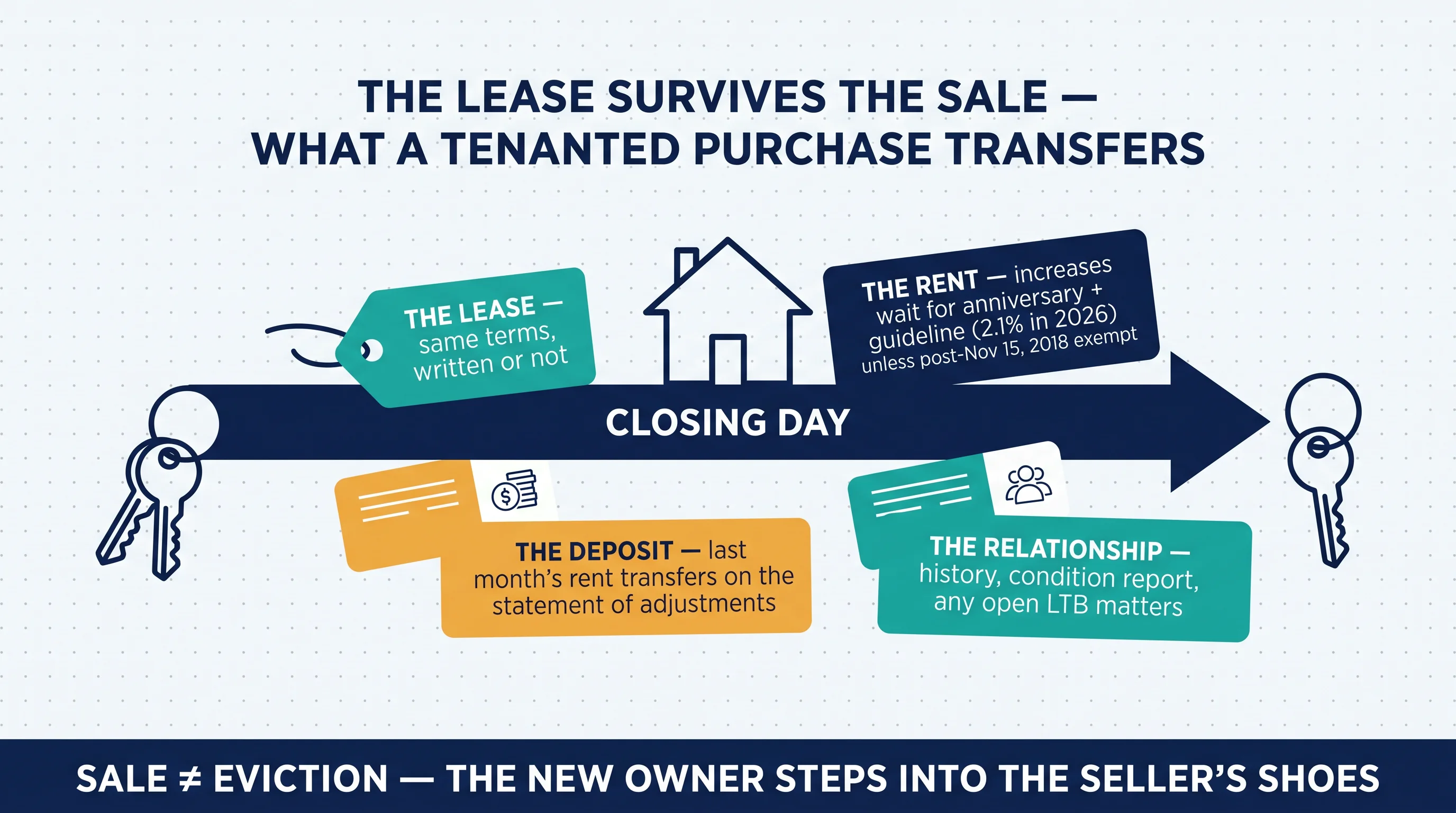
The inherited rent is the rent. No ownership-change increase exists anywhere in the Act. Increases wait for the 12-month anniversary, require 90 days' notice on the N1, and are capped at the annual guideline — 2.1% in 2026 — unless the unit's first residential occupancy came after November 15, 2018, in which case it's exempt from the guideline (increases run on the N2). The composite that teaches this best: an investor buys a triplex with a nine-year tenant paying $600 under market and discovers the anniversary-plus-guideline math closes that gap in decades, not months. The lesson isn't about the tenant — it's that the offer price, not the rent, was the place to fix it. One mechanical note: the last-month's-rent deposit transfers to you at closing on the statement of adjustments, and its interest obligations come with it.
So a tenanted listing presents two lanes — and the lane gets chosen in the Agreement of Purchase and Sale, not after closing. The investor lane: assume the tenancy. Instant income, zero turnover cost, no vacancy gap — in exchange for the inherited rent and the inherited relationship. The diligence happens before you waive conditions: the full lease plus any renewals and side agreements, the deposit and interest status, the move-in condition report, and any arrears or open LTB matters at the address. The end-user lane: vacant possession, because you or an immediate family member genuinely intend to live there. And this lane has actual rules, because vacant possession is a legal process, not a closing date.
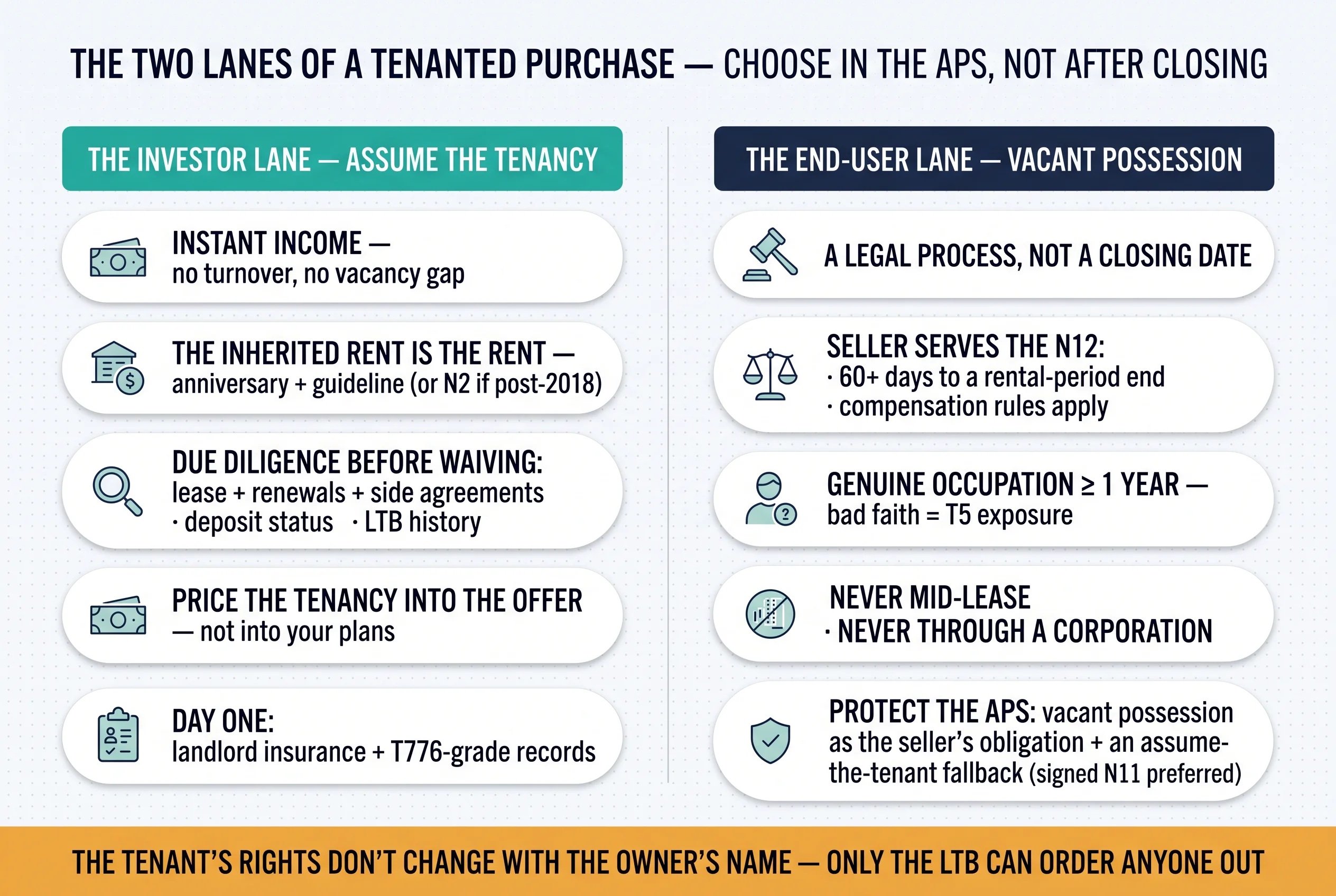
The rules, plainly: after the deal firms up, the seller serves the N12 on the buyer's behalf — minimum 60 days, landing on the end of a rental period, with compensation rules that apply (this fall's Bill 60 changes adjust how compensation and notice trade off, so verify the current state in the rental-law changes hub). The intention must be genuine residential occupation for at least a year — a buyer who "moves in" and then re-rents is in bad-faith territory, where T5 awards run serious. Two absolutes trip buyers constantly: mid-lease N12s don't exist — a fixed term runs to its natural end first — and corporations can't claim personal use, because a numbered company cannot physically live in a dwelling. And if the tenant disputes the notice, only the Landlord and Tenant Board can order an eviction — a hearing on the Board's timeline, not yours. Which is why the composite of the vacant-possession closing that slipped ends the way it does: the buyer who firmed up on a bare N12 clause watches the hearing land months past closing, and the deal is rescued by two pieces of APS craft — vacant possession written as the seller's explicit obligation, and an assume-the-tenant fallback clause. Experienced buyers go one step further and prefer a signed N11 in hand over an N12 promise, often reached through a negotiated agreement — the mechanics live in our guide to ending tenancies without eviction.
The tenant-protective mirror belongs in plain sight: the sale changes the landlord's name, not the tenant's rights. Notice minimums and compensation rules hold, the deposit is protected, the right to dispute at the LTB is real, and showings during the sale still run on the entry rules. Tenants navigating a sale can start with their baseline rights — none of which a change of ownership removes.
Putting It Together: the Purchase Sequence
The whole guide compresses into one sequence. One: team first — a mortgage broker matched to lenders on rental-income treatment, a real-estate lawyer, an accountant. Two: a stress-tested budget with your lender's rent-counting method known in writing. Three: the honest spreadsheet on every candidate before any offer. Four: the lane chosen — investor or end-user — and the APS drafted for it. Five: tenanted due diligence completed before conditions are waived. Six: close ready — landlord insurance placed for the actual occupancy from day one, and CRA-grade records from month one. As for where the market's heading: softer rents and rising vacancy reward exactly this kind of conservative underwriting, the rate environment remains the swing variable the stress test keeps honest, this fall's legal changes touch the notice machinery rather than the math — and for those who continue past property one, the four-to-five financed-property bank cap is waiting as its own discipline. The operating side of landlording — screening included — is the sequel to read before closing day.
Practical Takeaways
- Build the team before the budget: broker, lawyer, accountant — before the first offer.
- Know your lender's rent-counting method (add-back vs offset) in writing before you shop.
- Run the honest spreadsheet on every candidate: 5%+ vacancy, 1–2% maintenance, capex, and a management line.
- Read tenanted listings as inherited terms: the lease, the rent, and the deposit come with the keys.
- Choose your lane in the APS: assume the tenancy, or vacant possession as the seller's explicit obligation with a fallback clause.
- Respect the N12 rules if you're the end-user: 60 days, compensation rules, a year of genuine occupation — never mid-lease, never through a corporation.
- Close ready: landlord insurance from day one, T776 records from month one.
The First-Rental Buyer's Kit: The Three Sets of Numbers — the Financing Reality, the Honest Spreadsheet, and the Tenanted-Purchase Playbook
Every first rental purchase has three sets of numbers — the financing you actually qualify for, the cash flow the property actually produces, and the tenancy terms you inherit with the keys. This free kit gives Ontario first-time investors all three layers in purchase order: the 20% rule and the stress test, the one question to ask every lender, the honest-spreadsheet lines the listing never shows, and the tenanted-purchase diligence that keeps closing day from becoming a surprise. Two printable pages to work before the offer.
Get Free PDF →The Bottom Line
A first rental purchase succeeds on three sets of numbers, in order. The financing layer is stricter than your pre-approval suggests — 20% down, a stress-tested budget, and a lender counting half to four-fifths of the rent. The honest spreadsheet is stricter than the listing — vacancy, maintenance, capex, and management turn "rent covers the mortgage" into the real monthly figure, sometimes negative, which is a legitimate strategy only when it's chosen and funded. And the tenanted layer is stricter than most buyers imagine — the lease survives the sale, the rent is the rent until the anniversary and the guideline say otherwise, and vacant possession is a legal process with rules, timelines, and no guarantees. Buyers who work all three layers before the offer buy with their eyes open. The ones who don't discover the third layer at closing — and it's the only layer that was knowable, in full, from the very first showing.
From the First Honest Number to the First Tenancy
The rent calculators, the Standard Lease, the screening, and every notice the landlord side runs on — Tenon10 takes over the moment the keys are yours.
Free • No signup required • Updated for the Bill 60 changes in force 21 Sep 2026
Related Resources
- Becoming a Landlord in Ontario: The Complete First-Timer's Guide — the operating sequel to this purchase guide
- Ontario N12 Notices: The Complete Own-Use Guide — the full ruleset behind purchaser's vacant possession
- Removing a Tenant Without Eviction — the N11 and cash-for-keys mechanics buyers and sellers actually use
- Landlord Insurance in Ontario — the day-one policy and the gaps that deny claims
- Ontario Rent Increases: The Complete N1 Guide · Rent Increase Calculator
- CRA Audits of Rental Income · Fixed-Term Leases and the Month-to-Month Conversion
- Ontario Standard Lease · Ontario LTB Forms Hub
Frequently Asked Questions
How much down payment do I need for a rental property in Ontario?
For a property you won't live in, the minimum is 20% — mortgage default insurance isn't available for non-owner-occupied rentals, so the floor is firm. On a $750,000 purchase that's $150,000 down plus roughly $12,000–$25,000 in closing costs. The main exception is an owner-occupied multi-unit: live in one unit of a duplex, triplex, or fourplex and rent the others, and insured financing with a lower down payment becomes available (now on homes up to $1.5 million), with easier qualification because you occupy the property.
Do lenders count rental income when qualifying me for a mortgage?
Yes, but never all of it. Most lenders count 50–80% of expected rent, using either an add-back method (typically about 50% of rent added to your income) or an offset method (rent netted against the property's carrying costs). You must also pass the stress test — qualifying at the higher of your contract rate plus 2% or 5.25% — which cuts purchasing power by roughly 15–20%. Which rent-counting method your lender uses can change your budget more than the interest rate does, which is why comparing lenders on this specific treatment matters.
Can I evict the tenants after buying a house in Ontario?
Not simply because you bought it. The lease survives the sale — you inherit the tenancy on its existing terms. If you (or an immediate family member) genuinely intend to live in the unit for at least a year, the seller can serve an N12 notice on your behalf: minimum 60 days ending on a rental-period end date, with compensation rules that apply. A fixed-term lease runs to its natural end first, corporations can't claim personal use, and if the tenant disputes, only the Landlord and Tenant Board can order an eviction — which is why experienced buyers put vacant possession in the purchase agreement as the seller's obligation, with a fallback plan if it isn't delivered by closing.
Can I raise the rent after buying a tenanted property?
Not because ownership changed. Rent increases wait for the 12-month anniversary of the last increase (or tenancy start), require 90 days' written notice on the proper form, and are capped at Ontario's annual guideline — 2.1% in 2026 — unless the unit was first occupied for residential purposes after November 15, 2018, in which case it's exempt from the guideline. If the current rent is well below market, the honest response is to reflect that in your offer price, not in your post-closing plans.
Is buying a rental property worth it in Ontario right now?
It can be — with honest math. At current prices and rates, many Ontario properties run cash-flow negative when properly analyzed (a worked $700,000 duplex example loses about $1,516 a month after all real expenses). That's not automatically a bad investment — principal paydown, appreciation, and tax treatment are genuine returns — but the monthly shortfall comes from your pocket, so it has to be a strategy you choose and can fund. With vacancy trending up and rents soft in 2026, the rule is simple: if the numbers only work with optimistic assumptions, they don't work.