

Every complaint a tenant brings you is two things at once: a problem to fix and a test of whether your word means anything — and here's the uncomfortable part: the test gets graded faster than the problem gets fixed. A furnace can take two days to repair and still earn a renewal; a message that sits unanswered for two days fails a test no repair can retake.
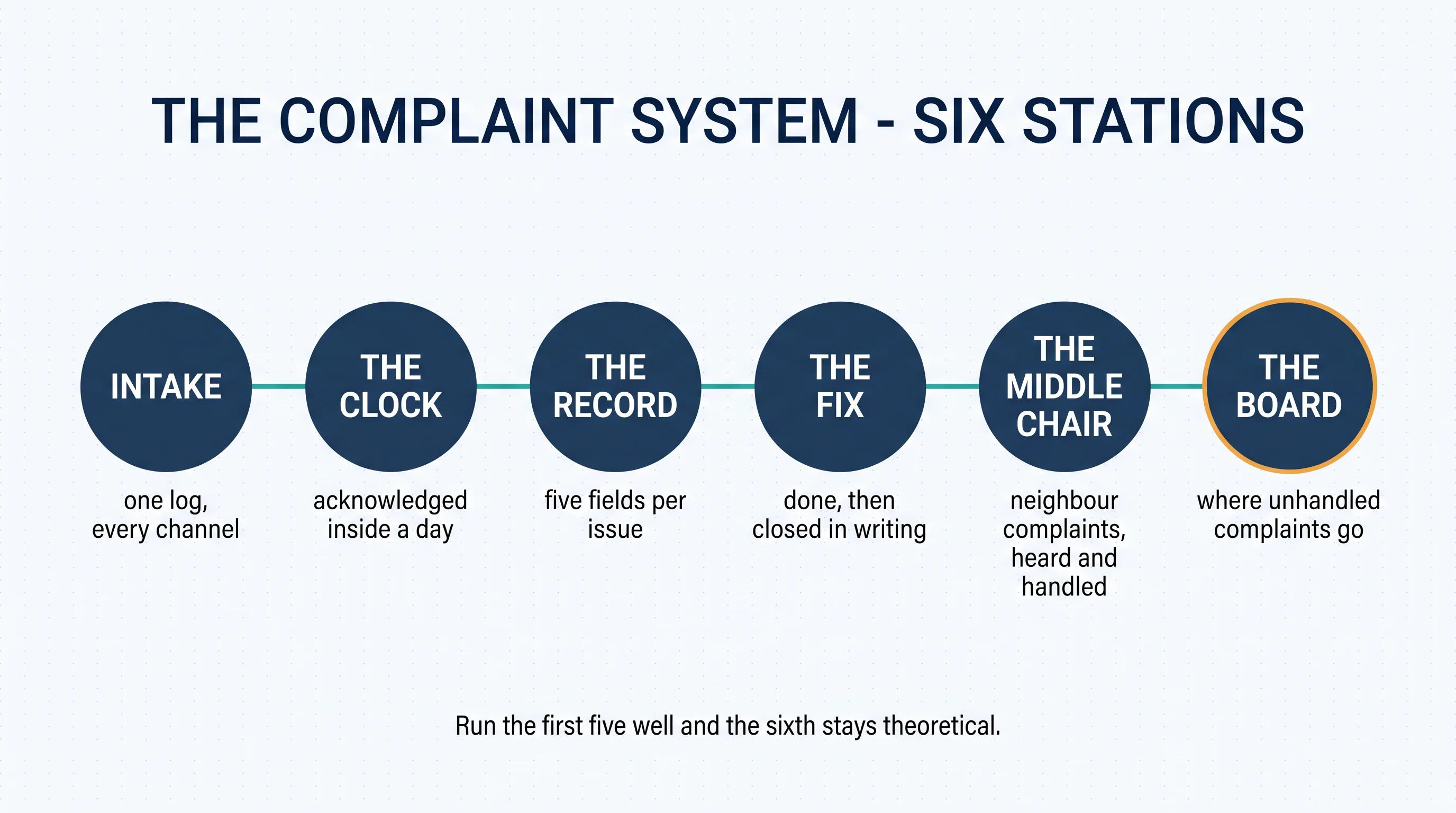
This guide is the complete complaint-handling system for Ontario landlords and property managers, laid out as six stations: intake and the acknowledgment clock, triage, the record, the fix and the close-the-loop, the tenant-about-tenant middle chair, and what unhandled complaints become at the Landlord and Tenant Board. Three terms before we start: the acknowledgment is a separate deliverable from the resolution — "received, here's what happens next" is due long before the fix is; the close-the-loop is the completion message most landlords skip; and the middle chair is where you sit when one tenant complains about another. Run the system well and it does something no marketing can: it turns your most annoyed tenant into your longest renewal.
The Complaint Log: The Intake-to-Close Checklist for Ontario Landlords
A 19-point system for handling every tenant complaint — one log for every channel, the 24-hour acknowledgment clock, five-lane triage, the five-field record, the close-the-loop message most landlords skip, and the middle-chair route for neighbour complaints that keeps everyone's dignity intact. Run the first five stations well and the Board stays theoretical.
Get Free PDF →Two things at once
Start with the reframe that carries everything else: a complaint is not a verdict on the tenancy — it's the building talking. Tenants who report the drip, the draft, and the hallway light are doing exactly what a well-run rental needs them to do, and doing it while it's still cheap. Silence is the worrying signal, not the phone ringing. The fix matters, of course. But the response time and the close-the-loop are what get remembered — the problem is what happened to the building; the handling is what happened to the relationship.
The system matters more in 2026 than it used to, for three measurable reasons. First, fixes are genuinely harder to deliver: 56% of property management firms report difficulty hiring qualified maintenance contractors [Buildium 2026 North American survey] — which means honest communication about timelines is carrying more of the load that speed used to carry. Second, 93% of operations report rising costs [Buildium 2026], so the complaint that's a washer today and a ceiling in four months is a bigger swing than ever. Third, CMHC's June 2026 read has major markets supply-heavy and tenant-favouring: tenants have options, which makes retention the cheapest revenue in rentals — and complaint experience is a renewal driver you control completely.
One more frame before the stations: only 37% of tenants say they read their full lease [Second Nature 2026], which means a meaningful share of what arrives as complaints are really questions wearing frustration — where the garbage room is, whether the rent covers parking, why the entry notice came. The system below treats a question exactly like a complaint, because from the tenant's side the test is identical: I raised something; did anyone answer?
The craft at the moment of intake is worth naming, because it costs nothing and changes everything downstream. The 2026 guidance is consistent: listen without interrupting, take notes, and repeat the issue back — "so the bedroom window won't close fully and it started this week" — which de-escalates frustration and shows the complaint was actually received, not just endured. Resist the defensive reply even when the complaint arrives with heat attached; the tenant is often bracing for a fight that never needs to happen, and the landlord who responds to the issue instead of the tone has already passed the first test.
Stations one and two: intake and the clock
Station one is intake, and its rule is one log. Make reporting easy — text, email, phone, a portal if you run one — but every channel lands in a single complaint log, the same day it arrives. A complaint that lives only in a text thread is a complaint the system can't see: it can't be triaged, it can't be reviewed, and six months later it can't be found — except by the tenant, whose phone keeps everything. The practical move for a small operation isn't expensive software or a single mandated channel — it's a habit: whatever arrives by text or call gets a same-day entry in the log, even one line. Tenants report through whatever's in their hand; the consolidation is your job, not theirs, and the log's value compounds precisely because it's complete.
Station two is the clock, and it has two hands. Published 2026 practice guidance converges on acknowledging every complaint within 24 hours, even when the fix can't come immediately — with one communications guide splitting the standard finer: urgent issues answered within about an hour, non-urgent within 24 to 48. The insight worth underlining: the acknowledgment is a separate deliverable from the resolution. "Received — here's what happens next — here's when you'll hear from me" is a complete message, and it's the one that stops the clock on the test even while the problem is still being worked.
Ontario even has a published benchmark to borrow: Toronto's apartment-standards program requires registered large buildings to answer urgent service requests within 24 hours and non-urgent requests within seven days — our multi-unit compliance guide covers that program and who it applies to. A landlord with one basement suite can simply adopt the same standard voluntarily and be ahead of most of the market with a single decision. One note on the urgent lane's contents: heat, water, and electricity aren't just urgent because they're uncomfortable — vital services sit at the centre of the maintenance duty, and a no-heat January complaint is simultaneously the most human and the most legally serious item that will ever enter your log. The urgent lane exists so that triage never has to be improvised on the day it matters most.
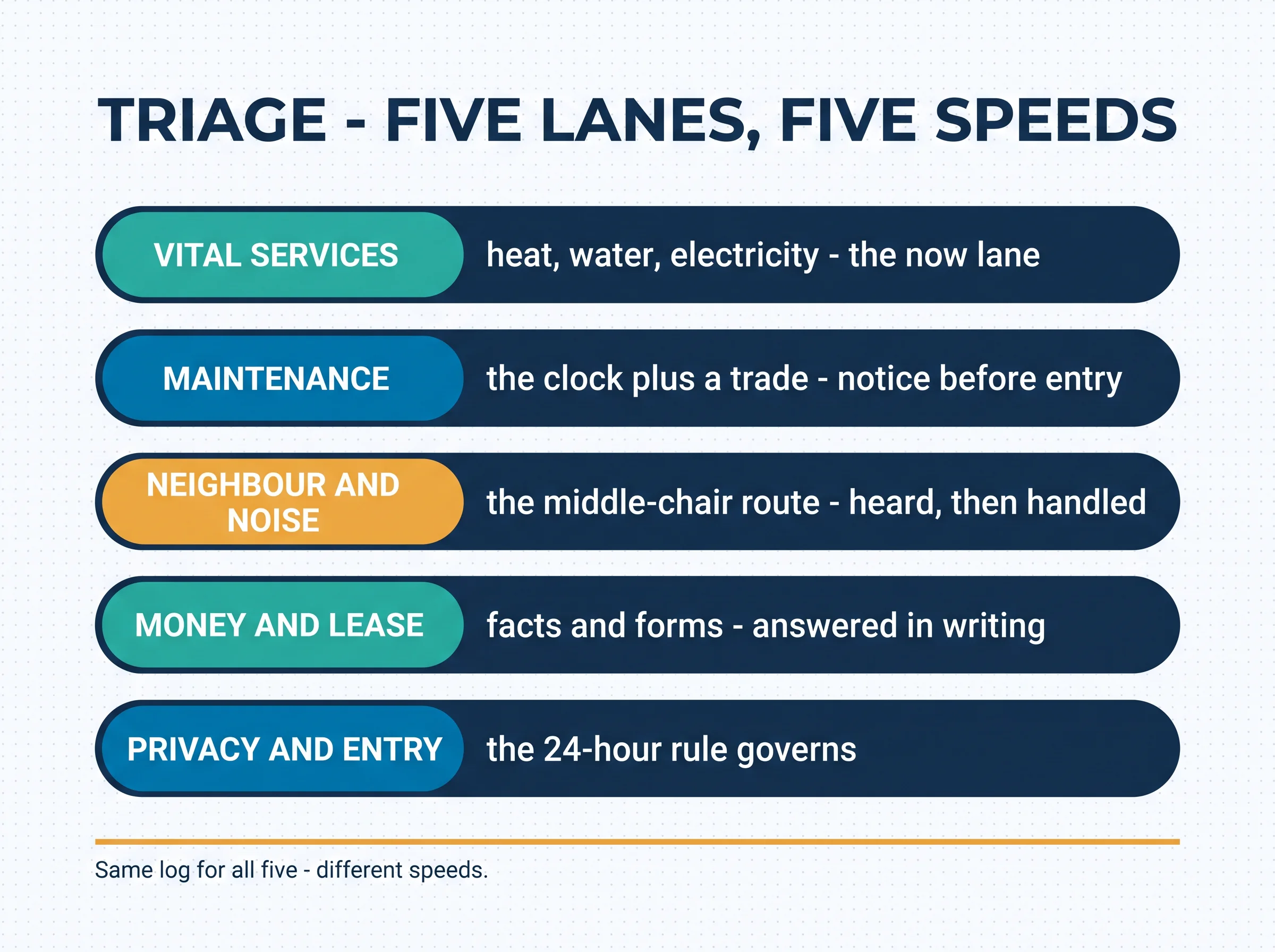
Between intake and the record sits triage: five lanes, five speeds. Safety and vital services — heat, water, electricity — are the now lane, ahead of everything. Maintenance gets the clock plus a trade. Neighbour and noise complaints get the middle-chair route, which is its own station below. Money and lease questions get facts and forms, in writing. And privacy or entry concerns live in the world of the 24-hour notice of entry rule — often the fastest complaints to resolve, because the answer is usually a process correction on your side of the relationship.
For landlords: Write your two clock promises down — the acknowledgment window and the urgent lane — and tell tenants what they are at move-in. A promise made in writing is a system; a habit is just a good month. The promise also does quiet preventive work: a tenant who knows they'll hear back within a day doesn't escalate to three channels by dinnertime.
Stations three and four: the record and the close-the-loop
Station three is the record — five fields, one entry per issue. Published 2026 guidance settles on the same fields worth keeping: the date and time of the complaint; the tenant's contact and unit; a description of the issue; the actions taken, with timelines; and the follow-up communication with the outcome. Updates append to the entry — nothing lives only in memory or a phone. The reasoning in the guidance is worth quoting in spirit: a documented trail protects everyone in a dispute, and it identifies recurring problems that need long-term solutions rather than repeat visits.
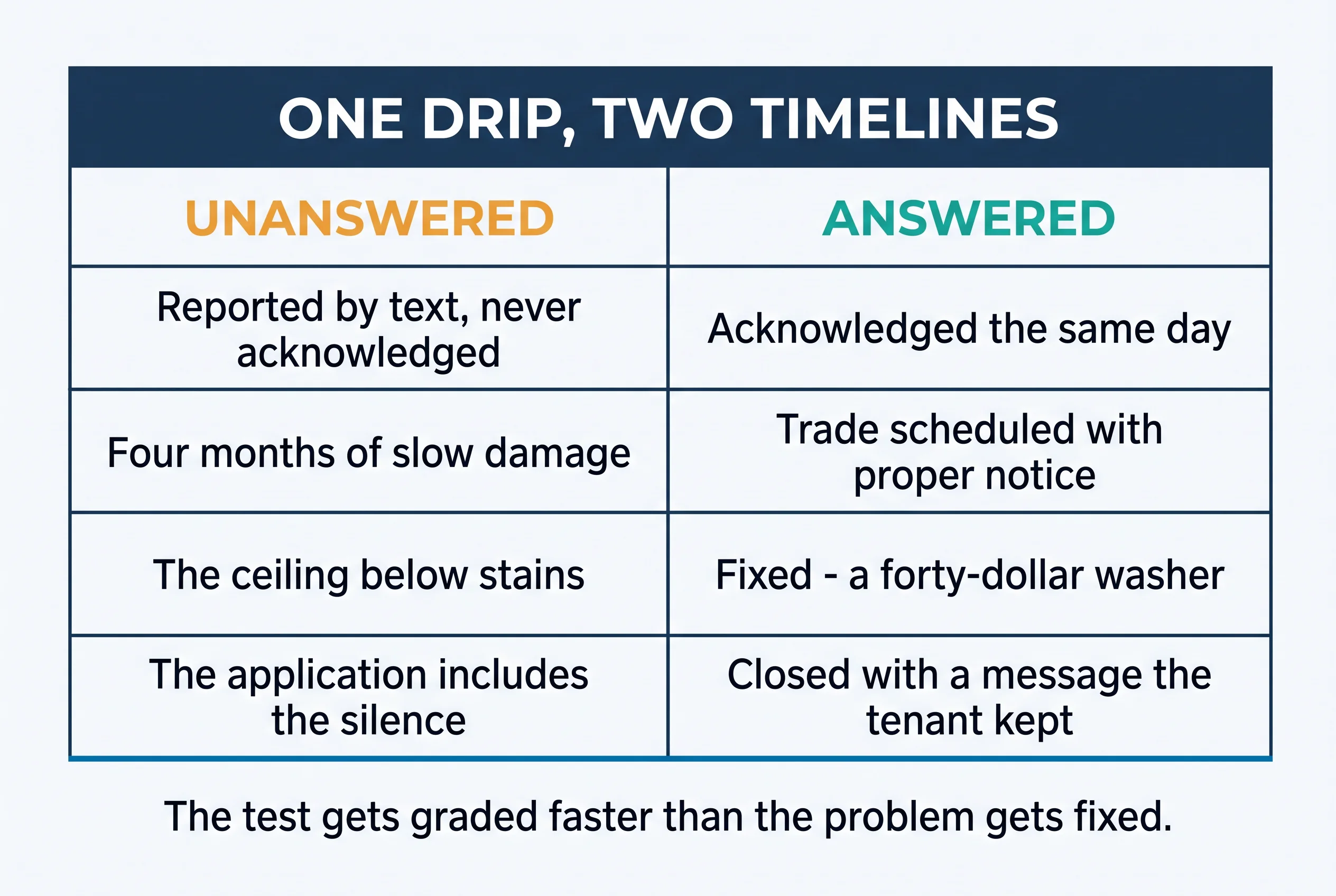
A composite from Ontario maintenance patterns (ours, not a case report) shows what the record is protecting against. The faucet that became a ceiling: a drip reported by text, acknowledged never, fixed never. Four months later the unit below has a stained ceiling, the insurer has questions — 39% of firms already cite rising insurance premiums as a top concern [AppFolio 2026] — and the T6 application the tenant eventually filed included the entire text history, timestamps and all. The handled version of the same story is almost boring: acknowledged the same day, trade in that week with proper notice, close-the-loop message when it was done. A $40 washer.
The economics of that comparison generalize into the cheapest budgeting rule in maintenance: speed on small things is a repair budget you don't have to raise. The published guidance frames it as the leaky-faucet principle — a simple fix today, a costly damage claim if ignored — and the mechanism is always the same: water, wear, and small electrical faults compound quietly, so the price of a complaint rises with every week it sits. A landlord who answers small complaints fast isn't being generous; they're buying repairs at the lowest price those repairs will ever have.
Station four is the fix — and the close-the-loop, which is the station most landlords skip. Two mechanics matter on the fix itself. Scheduling a repair means entering the unit, and entering means proper notice under the 24-hour entry rule, every time — a repair delivered through a process violation converts a maintenance win into a rights complaint. And when the work is done, the completion message goes out: done — here's what was done — flag anything that isn't right. The tenant can't see inside your to-do list; a fix without the message doesn't read as service, it reads as silence that happened to end.
The same station covers the other honest outcome: the expectation-managing no. When the answer is no — the upgrade isn't happening, the cosmetic issue doesn't clear the bar, the timeline is longer than anyone wants — say so, with the why and any alternative. "Not possible, here's the reason, here's what I can do instead" beats the silent maybe every single time. Tenants can plan around a no; nobody can plan around silence — and the guidance is blunt that sometimes what a tenant wants most is simply to be acknowledged and told what happens next, even when the news is imperfect.
Where Tenon10 fits: The log, the five fields, and the message history are exactly what Tenon10 keeps per unit — maintenance requests tracked from report to close, with the communications attached to the tenancy record where they can actually be found later. It doesn't answer the complaint for you — it makes sure nothing you did answer lives only in a phone. The Free plan covers up to 3 units, and tenants are always free; details on the pricing page.
Station five: the middle chair
The hardest category has a shape of its own: one tenant complaining about another. The landlord in the middle can't referee personalities — but can't stay out either. Where behaviour substantially interferes with another tenant's reasonable enjoyment of the unit, the landlord has a duty to act, and "sort it out yourselves" is the answer that ends up at the Board. Our guide to the substantial-interference standard covers where that line actually sits; this station covers how to walk toward it without trampling anyone.
The route, in order. First, the complainant is heard and the complaint is logged — station three applies here with full force, because middle-chair situations are the ones where dates and specifics decide everything later. Second, a calm, informal conversation with the other tenant — and this is where the piece's most important posture lives: dignity in both directions. The complainer is not a nuisance; the complained-about is not a villain. Most middle-chair issues are schedules, thin floors, and information gaps, not malice. Third, if it continues, documentation builds: dates, times, what specifically happened. Fourth, the situation gets measured against the substantial-interference standard. And only then, fifth: the N5 — the last resort, never the first letter.
A composite from Ontario noise patterns (ours): the complaint answered with silence. Footsteps overhead at 2 a.m., every night; the complainant is told "tenants sort noise out themselves." Three months of continuing interference later, the application at the Board isn't against the upstairs unit — it's against the landlord, for failing to act. The handled version of the same building: the complaint heard and logged; one calm conversation upstairs, where it turns out the tenant is a shift worker who had no idea the floors carried; rugs and a small schedule adjustment; close-the-loop messages in both directions. No forms, no hearing — and, two years on, two renewals.
One discipline holds the whole station together: keep the complainant updated at each step. Middle-chair work is often invisible — the conversation happens behind another door, the improvement is gradual — and silence during the process reads as siding with the other unit even when real work is underway. "Here's where things stand" every week or two costs a minute and preserves the trust the process is supposed to protect.
Consistency matters double in this station: the middle-chair route has to run the same way regardless of which tenant is complaining and which is complained about. The long-standing tenant and the new one, the quiet unit and the chatty one — same route, same documentation, same updates. Middle-chair situations are where perceived favoritism does its worst damage, and the written policy from station one is what lets you demonstrate, not just claim, that everyone's complaint rides the same rails.
Station six: when complaints become applications
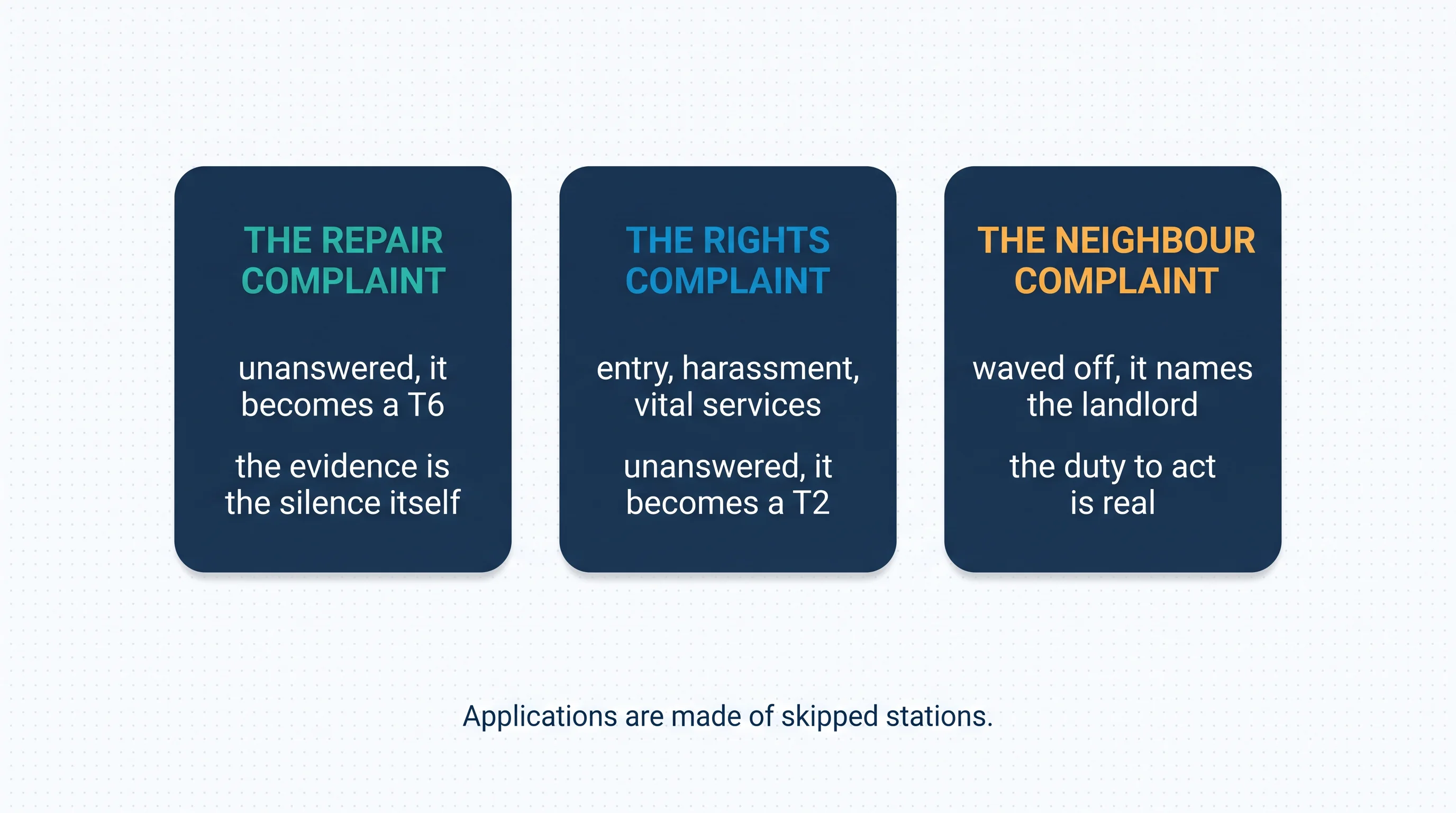
Every complaint that isn't handled climbs a ladder, and the ladder has names. A repair complaint that goes nowhere becomes a T6 — the maintenance application our complete T6 guide covers — and the tenant's strongest evidence is typically your own unanswered message history, presented in order with timestamps. A rights complaint — entry without notice, harassment, vital services — becomes a T2. And the neighbour complaint waved off in station five can arrive as either, naming you. The honest note that reframes all of it: a landlord who runs stations one through five rarely meets station six. Applications are made of skipped stations.
When you're the one escalating — a documented interference situation that conversation didn't resolve, a lease issue that needs formal footing — the craft is the same craft in reverse: writing that is factual and free of emotional language. The issue, the documented dates, the required action, the deadline. Copies kept; delivery confirmations kept. Modern platforms log these communications automatically, which is precisely the point: the file that wins is the file that was boring all along, and boring is a style you can choose months before you need it. Two more habits complete the escalation craft: never write the letter in the same hour as the incident — the factual version and the felt version are different documents, and only one of them helps you — and always state what resolves the matter, not just what's wrong, because a letter with a clear off-ramp reads as problem-solving to everyone who might ever review it.
And because station six deserves a positive ending: a composite from Ontario winter patterns (ours). The January heat complaint — urgent lane, acknowledged within the hour, contractor the same day, and then the message after: "Fixed — here's what it was — tell us if the temperature isn't right by tonight." The tenant's renewal note months later mentioned the message, not the furnace. That's the peak-end pattern our onboarding guide describes doing its quiet work: people remember how an episode ended, and the close-the-loop is the ending you author on every single service interaction.
Complaints as data — and the year ahead
The last station isn't in the per-complaint flow at all — it's what the log becomes in aggregate. Complaints are the building talking, and patterns are its sentences: three units reporting drafts is a capital plan, not three annoyances; two noise threads about the same corridor are an underlay project; the same move-in question asked four times is a welcome package that needs a paragraph. The rhythm that surfaces this: a weekly skim of the open log, and a quarterly scan of the closed one.
Consistency is the other aggregate discipline — and it's protection. One written policy, the same handling for every tenant, every time. Fairness has to be legible from the outside: the tenant who waited four days watches the neighbour get answered in one, and no amount of good intent explains the gap. Consistent handling is also the posture that keeps every individual decision defensible later, because the answer to "why did you do it that way" is "that's how we do it for everyone."
The year ahead extends every line in this piece. Supply-heavy conditions [CMHC, June 2026] keep tenants mobile, which keeps complaint experience compounding into retention or turnover; tracked, logged request systems spread with the broader tooling wave; and the prediction this article stakes: response-time promises start appearing in listings — "urgent issues answered within the hour" as a leasing line — the way published fee schedules and building scores are already becoming marketing surfaces. The landlords who can make that promise will be the ones who wrote it down first.
And the retention math deserves its plain statement, because it's the business case for everything above. A turnover costs weeks of vacancy, turnover work, advertising, and screening; a renewal costs a conversation. In a market where tenants have options, the difference between those two outcomes is very often the service record — not the rent, which the guideline caps for most units anyway, but the answer to "do they fix things and do they tell me." Every station in this system is cheaper than the vacancy it prevents. The complaint log isn't administrative overhead; it's the least expensive retention program a rental business can run.
For property managers: Run the portfolio version of the quarterly scan — complaint categories per building per quarter is the cheapest diagnostic in management. A building whose complaint mix shifts from maintenance to noise is telling you something a rent roll can't; a building that goes quiet after a management change is telling you something too, and it isn't always good news. The scan is also client-advisory material: owners understand "here's what your building said this quarter" instantly.
The system, ready-made: Tenon10 was built for exactly this workflow — requests logged per unit, message history attached, Ontario's rules built into the notices and forms if a situation ever genuinely needs one, and Keya, the built-in AI assistant, to answer the "what does the rule say" questions at station-two speed. Free for up to 3 units, Essentials to 10, Pro to 25 — current rates at tenon10.com/pricing.
The Complaint Log: The Intake-to-Close Checklist for Ontario Landlords
A 19-point system for handling every tenant complaint — one log for every channel, the 24-hour acknowledgment clock, five-lane triage, the five-field record, the close-the-loop message most landlords skip, and the middle-chair route for neighbour complaints that keeps everyone's dignity intact. Run the first five stations well and the Board stays theoretical.
Get Free PDF →Key takeaways
- Every complaint is a problem and a test — and the test is graded on response time and the close-the-loop, not just the fix.
- One log, whatever the channel, with acknowledgment inside 24 hours as its own deliverable: received, what happens next, when you'll hear back.
- Triage five lanes at five speeds: vital services now; maintenance on the clock; neighbour complaints through the middle-chair route; money and lease questions to facts and forms; entry concerns per the 24-hour rule.
- Five fields per record, updates appended — nothing lives only in a text thread, because the trail protects everyone and reveals the patterns worth fixing at the root.
- Close the loop on every fix — the thirty-second completion message is the part tenants remember at renewal.
- In the middle chair: hear, log, converse, document, measure against the substantial-interference standard, N5 last — and keep the complainant updated, because silence reads as siding.
- Run stations one through five well and station six stays theoretical — and when you do escalate, write factually, date everything, set deadlines, and keep copies.
Answered in a day, fixed with notice, closed in writing
That's the whole system, and it's smaller than it looks: a log, a clock, five fields, a message, a route for the hard category, and a quarterly look at what it all says. None of it requires charm and none of it requires perfection — the furnace can still take two days when parts are scarce. What it requires is that your word means something on a schedule the tenant can see: answered in a day, fixed with proper notice, closed in writing. Run it that way and the enforcement ladder stays a diagram, the annoyed tenant becomes the longest renewal, and the complaint log quietly turns into the most useful document your building produces — the one where problems arrive, get answered, and leave a record of a landlord who does what they say. That's the system that turns problems into trust. It starts with the next message you answer.
A log, a clock, and a record that answers for you
Tenon10 gives Ontario landlords and property managers per-unit request tracking, attached message history, and Ontario's rules built into every notice — the complaint system, ready on day one. Free for up to 3 units; tenants always free.
Questions about fit? Talk to us — we'll tell you honestly.
Related resources
- The T6 Application: How Tenants Enforce Repairs at the LTB — what an unanswered repair complaint becomes.
- The 'Substantial Interference' Standard, Explained — where the middle-chair duty to act actually begins.
- N5 Notices in Ontario: A Complete Guide — the last resort, done properly when it's genuinely needed.
- The 24-Hour Notice of Entry Rule in Ontario — because every fix is also an entry.
- Becoming a Landlord in Ontario: The Complete First-Timer's Guide — set the system up before the first complaint arrives.
Frequently asked questions
How fast should a landlord respond to a tenant complaint?
Published practice guidance converges on acknowledging within 24 hours — urgent issues much faster — even when the fix itself takes longer. The acknowledgment is a separate deliverable: received, what happens next, when you'll hear back. Toronto's apartment-standards program sets 24 hours for urgent and seven days for non-urgent requests in registered large buildings, a benchmark any Ontario landlord can adopt voluntarily.
What happens if a landlord ignores complaints in Ontario?
Complaints climb a ladder. Unanswered repair complaints can become T6 maintenance applications at the Landlord and Tenant Board, rights complaints — entry, harassment, vital services — can become T2 applications, and an ignored neighbour complaint can arrive as the complainant's application naming the landlord for failing to act. In every version, the tenant's strongest evidence is typically the unanswered message history itself.
What should I do when one tenant complains about another?
Hear and log the complaint, have a calm informal conversation with the other tenant, document specifics if it continues, measure the situation against the substantial-interference standard, and treat the N5 as the last resort, never the first letter — keeping the complainant updated throughout, because silence during the process reads as siding with the other unit.
How should tenant complaints be documented?
One entry per issue with five fields: date and time, tenant contact and unit, description, actions taken with timelines, and follow-up with the outcome. Updates append to the entry, and nothing lives only in a phone. The trail protects everyone if a dispute ever comes — and long before that, it reveals the recurring problems worth fixing at the root instead of visit by visit.
Can I say no to a tenant request?
Yes — and a clear no with the reason and any alternative beats a silent maybe every time. Tenants can plan around a no; nobody can plan around silence. What a landlord can't do is ignore complaints that touch the maintenance duty or tenant rights — those obligations don't depend on agreement, and the answer to them is process, not preference.


