

As of July 29, 2026. On July 24, the Landlord and Tenant Board did quietly what years of debate had circled loudly: it made its final orders public data. Every non-confidential final order issued from January through May 2026 is now on the Ontario government's Open Data Catalogue, with orders back to 2021 following in phases and new orders publishing monthly from here on.
It's the quietest big change the LTB has made all year — and it's both bigger and smaller than the first headlines suggest. Bigger, because the tribunal that decides Ontario's tenancy disputes now publishes its reasoning for anyone to read, landlord and tenant alike. Smaller, because what shipped is an archive, not a search engine — and that difference matters for every use anyone has planned for it. This guide covers what's actually in the release, how to find and read an order, what it changes for each side of a tenancy, and where the hard limits sit.
The LTB Order Lookup Guide
The seven steps to find any public LTB order, what's in the release and what never will be, the three honest reasons an order might be missing, and how to read an order well from either side of the tenancy — one page, keyed to the official sources.
Get Free PDF →What went public on July 24 — exactly
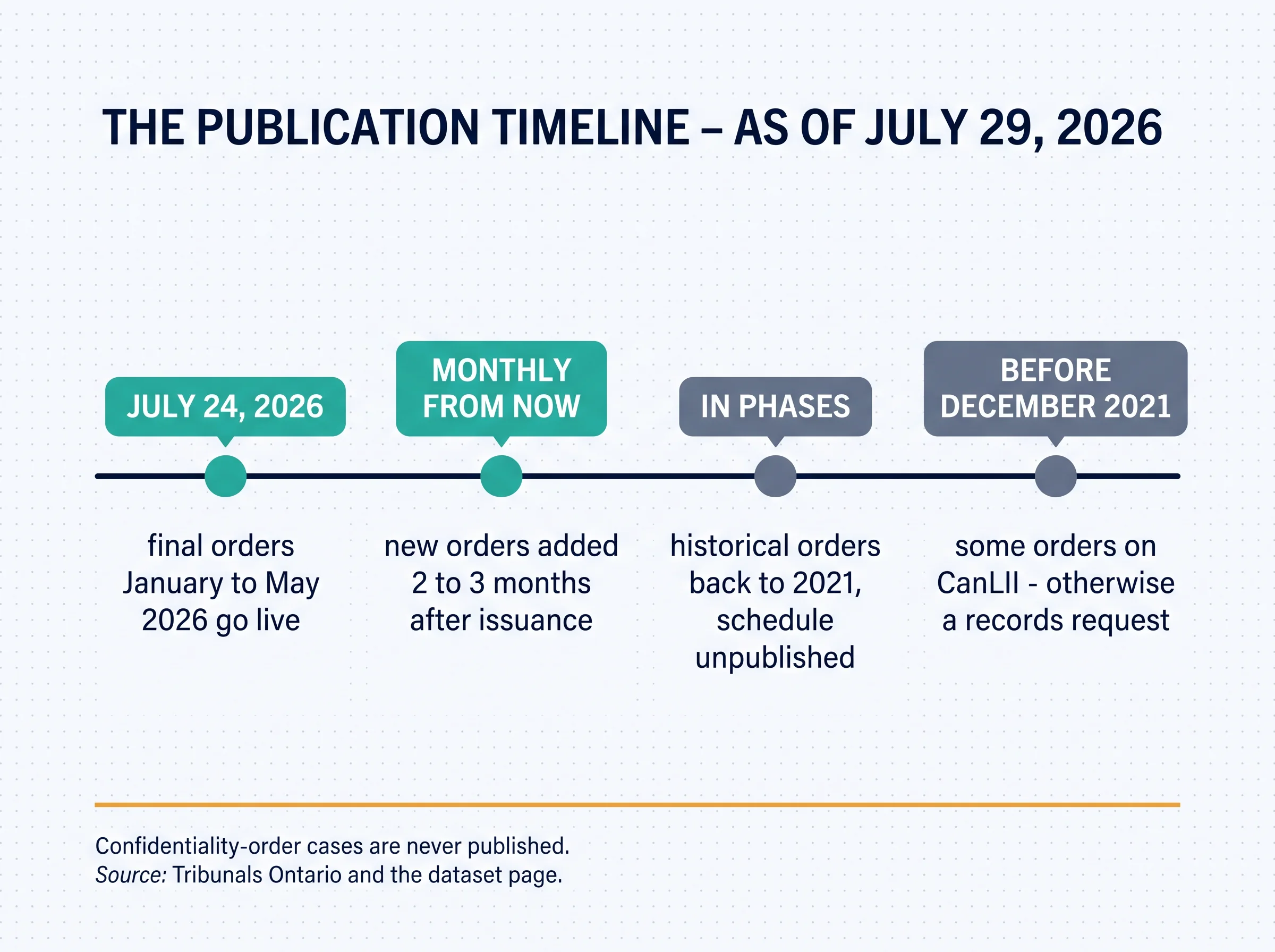
The release, precisely, from Tribunals Ontario's July 24 operational update: the LTB has begun posting final orders issued between January and May 2026 on the Ontario government's Open Data Catalogue. Excluded, permanently: any order subject to a confidentiality order made by an LTB adjudicator. Coming: orders dating back to 2021, published "in phases" and added incrementally, with no completion schedule promised — and current orders posted monthly from now on. For orders issued before December 2021, some are available on CanLII, the non-profit legal database; the rest require a records request to Tribunals Ontario.
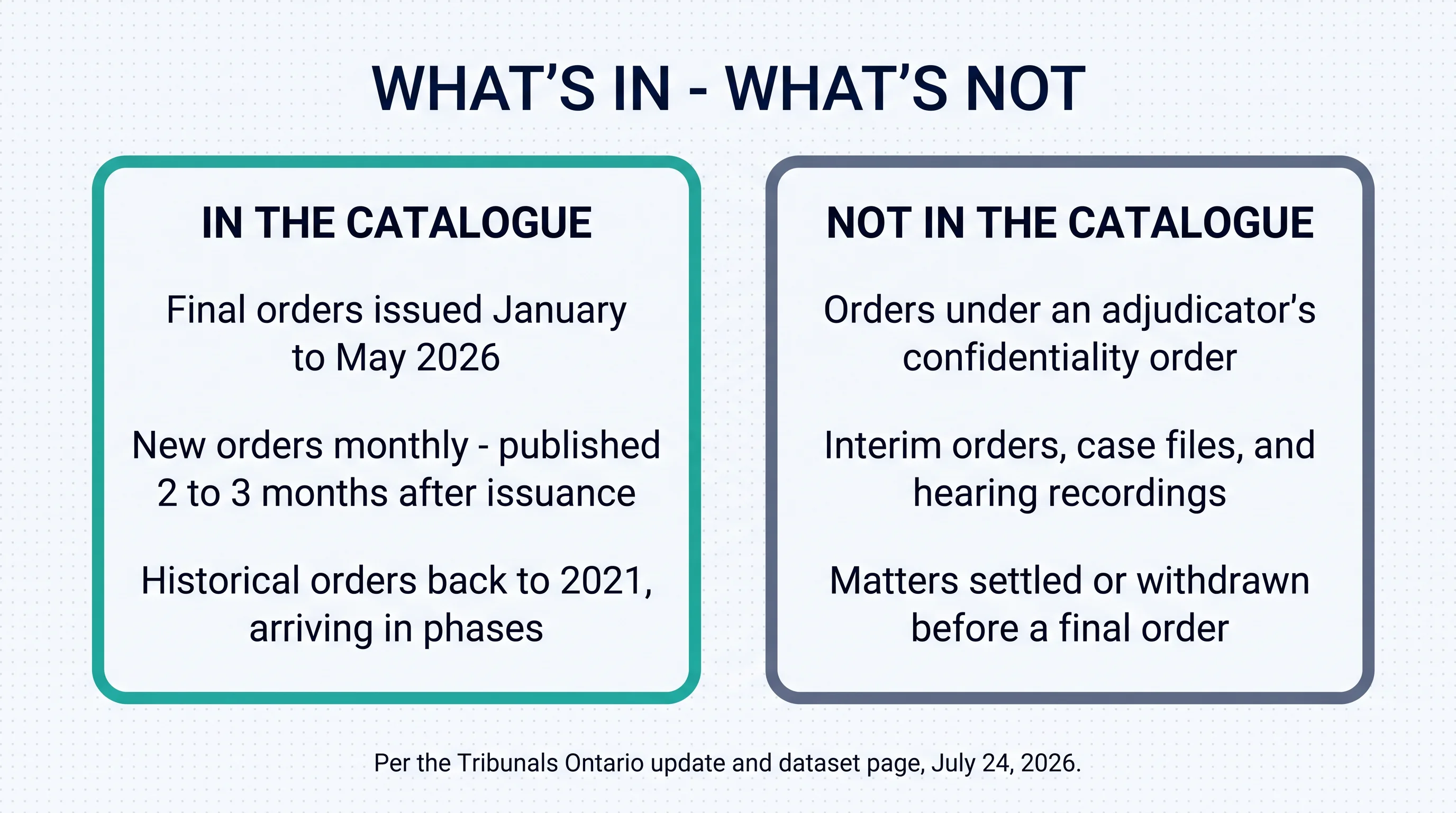
Two scope precisions that save real confusion. First, the dataset is final orders — not interim orders, not case files, not hearing recordings, and not matters that settled or were withdrawn before an order issued. That last exclusion carries a quiet statistical lesson: a large share of LTB files never reach a final order at all — they settle, mediate, or evaporate — so the catalogue shows you how the Board decides, not how often disputes end this way. Reading it as a census of tenancy conflict would over-count the adjudicated and miss the settled entirely. Second, this is not a Bill 60 provision. It arrived in the same modernization season as the two statutory waves we've been covering, but it's a Tribunals Ontario transparency decision under existing authority — a different instrument entirely, which is why you won't find it in any amendment schedule.
An archive, not a search engine
Here's the clarification that should shape every plan anyone has for this data. The catalogue, per its own dataset page, is one CSV report — "LTB Orders: Jan 2026 – Dec 2026, English and French," about 15 MB — that indexes orders and links to PDF copies of them. The official access instructions say it plainly: download the report to your device, then open individual order PDFs from it. There is no name-search box on the government site. What Ontario shipped is the data layer — the public record itself, under the Open Government Licence.
And the lag is structural, in the dataset page's own words: "Orders issued after May 2026 will be published 2 to 3 months after they are issued." An order from last week is not in there. An order from last month is not in there. Monthly cadence, months behind — by design, not by delay.
The search experiences being marketed around this release are third-party services built on that open licence — which is exactly the reuse the licence permits, and a separate thing to evaluate on its own terms. This piece covers the public record itself, because whatever tool sits on top, the record underneath is what the Board actually published: its scope, its lag, and its carve-outs travel with the data everywhere the data goes. It's worth appreciating the design choice, too: publishing the raw layer under an open licence is how a government maximizes transparency while staying out of the product business — anyone can build, everyone can verify, and the record itself remains the one thing no tool can editorialize.
How to find and read an order
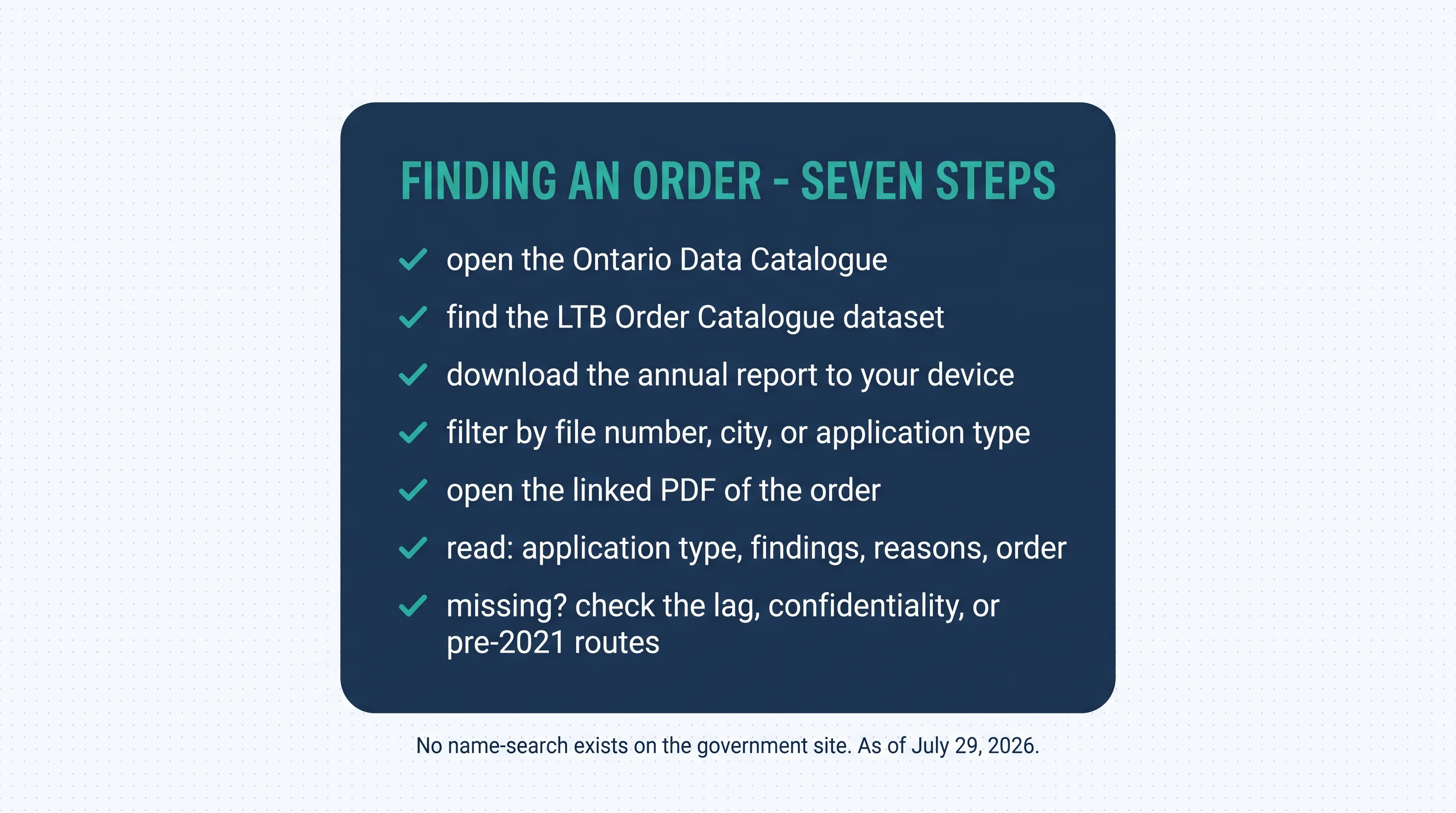
The full walkthrough, start to finish: (1) open the Ontario Data Catalogue at data.ontario.ca — or go via tribunalsontario.ca → About → Open Data; (2) find the "LTB Order Catalogue" dataset, maintained by the LTB under the Ministry of the Attorney General; (3) download the annual CSV report to your device; (4) filter within it — by file number, city, or application type (L1, L2, T2, T6, and so on); (5) open the linked PDF of the order you want; (6) read it structurally — application type first, then findings, then the member's reasons, then the order itself; (7) if you can't find an order, work through the three honest reasons before assuming it doesn't exist: the 2-to-3-month lag, a confidentiality order, or pre-2021 vintage — then CanLII, then a records request, and for a specific missing order, [email protected].
One expectation to set before your first download: this is government open data, which means it favours completeness over convenience. The CSV is large, the columns are utilitarian, and your spreadsheet program's filter row will do more for you than any button on the page. Five minutes of setup — filter by city, then by application type — turns the raw report into your working library, and the setup survives every monthly refresh after that.
Where the value actually lives when you're reading: the reasons. The application type tells you what kind of case you're holding before you read a word of it; the findings tell you what the member accepted; but the reasons tell you why — what evidence carried, what failed, and what the order actually requires of whom. That's the part no summary substitutes for, and it's the part that was functionally invisible to the public until this month. A worked habit for making it useful: when you read an order in your application type, note three things — what document the member cited first, what claim failed for lack of evidence, and what the order required beyond the obvious. Ten orders read that way build a better evidence checklist than any template, because it's built from what actually persuaded the people who decide.

💡 For landlords: The deepest value here is jurisprudential, not personal. Before your L1 hearing, read ten recent L1 orders from your region: what arrears evidence members cite, how payment-agreement breaches read after the July 1 changes, what adjournments cost. Preparation, not prediction — no order predicts your case, but fifty orders teach you the Board's language.
What it changes — for both sides of the tenancy
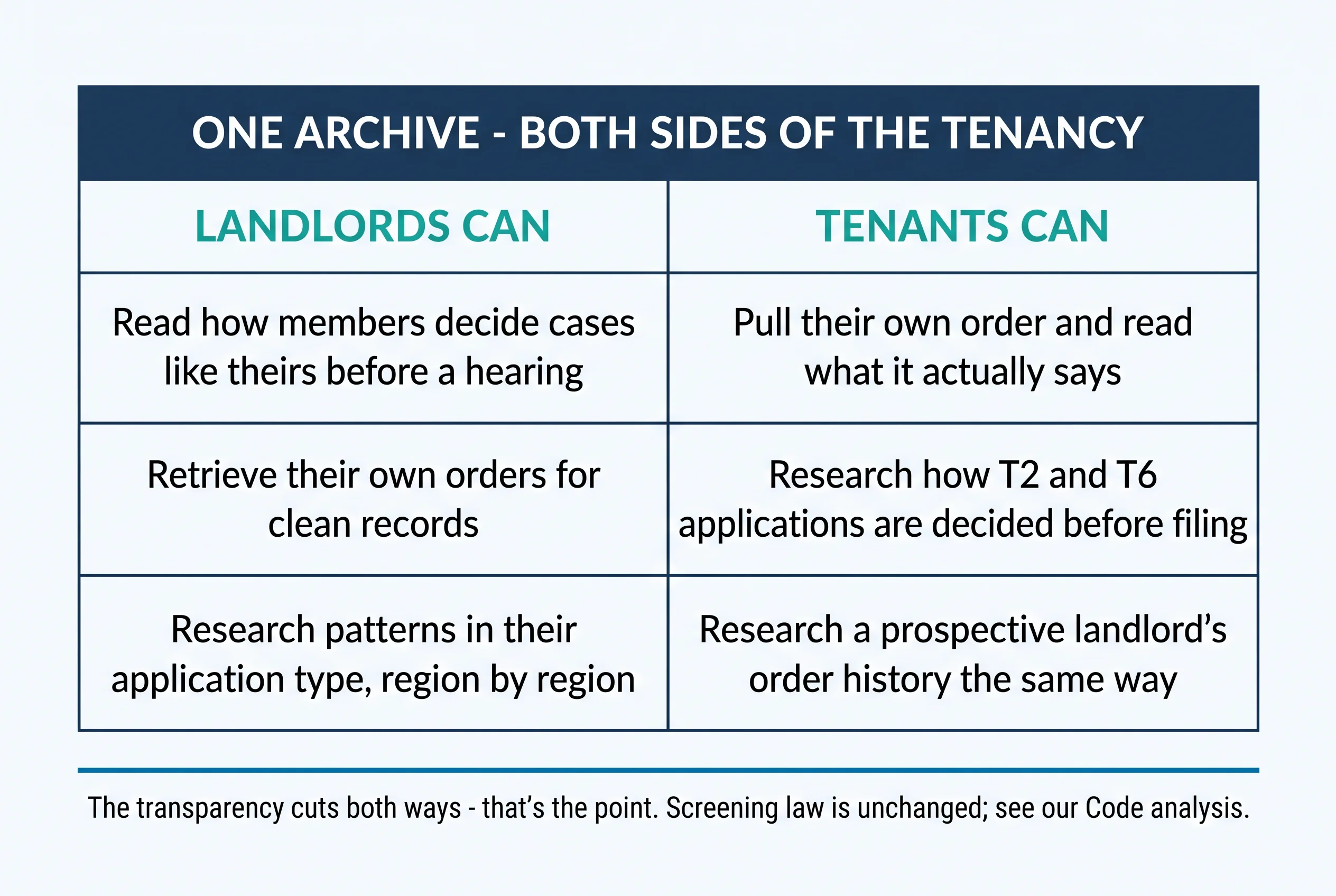
Lead with the symmetry, because it's the release's actual design. Landlords can read how the Board decides cases like theirs before ever filing, retrieve their own orders for clean records, and research patterns in their application type region by region. Tenants can do every one of those things — retrieve their own order and read what it actually says rather than what anyone characterizes it as saying, research how T2 and T6 applications are decided before filing one, and research a prospective landlord's order history exactly the way a landlord might research theirs. The transparency cuts both ways. That's not a side effect; it's the point of publishing.
And there's a records value that quietly ends arguments: when either party cites "the order," the actual document is now a download away. The order says what it says — not what a landlord remembers it saying, not what a tenant was told it says, not what anyone's summary of it claims. In a system where so many disputes are about characterization, a public primary source is its own kind of peace. It also raises the cost of misrepresentation on both sides equally: a landlord who overstates an order to a prospective tenant, or a tenant who understates one to a prospective landlord, is now one download from being read against the original. Systems get more honest when the record is easier to check than to characterize.
💡 For tenants: If you've been told an order exists about you or your unit, pull it. The catalogue — or, for a recent order, a request to the LTB — gets you the actual document, and the actual document is the only version that matters at a hearing, to a new landlord, or anywhere else. Reading how the Board decided cases like yours before you file a T2 or T6 is the same preparation landlords are being advised to do; it's yours too.
💡 For property managers: The professional use is process intelligence at portfolio scale — track how the application types you file most are being decided this year, build your evidence checklists from what members actually cite, and make the monthly report download a standing team habit rather than one person's bookmark.
The screening question — raised, and fenced
Name it plainly, because everyone's thinking it: the moment orders went public, "can I look up a prospective tenant" became a live question — and the criticism arrived before the data did. Housing researchers flagged public tribunal decisions as enabling tenant screening and blacklisting back in March, months ahead of the release. Both the impulse and the critique are real, and neither deserves a one-paragraph verdict from us. The honest shape of the debate: transparency advocates argue that published reasons discipline the tribunal itself and let both parties learn from real decisions; critics argue that the same openness, routed through screening tools, can follow tenants long after a dispute ends — including tenants who filed legitimate maintenance claims and won. Those arguments are about different uses of the same data, which is exactly why the use, not the data, is where the law and the ethics both live.
What does fit in this piece are the two hard cautions that stand no matter where that debate lands. First: a single order rarely tells a whole story — files settle for a hundred reasons, circumstances differ, and a name in a CSV is not an identity. Second: the law governing rental decisions — the Human Rights Code and everything around screening — did not change on July 24. Data availability is not permission.
What to watch from here
The dataset compounds from here, which makes this bookmark-and-return territory. Watch three things: the monthly additions arriving on their 2-to-3-month lag; the 2021 backfill landing in phases (no schedule has been promised — we'll note milestones as they appear); and the LTB's operational updates themselves, which have been running roughly twice a month — the same stream that announced this release, the July 1 changes, and, in the same July 24 update, one small practical item: the Tribunals Ontario Portal's notification emails now come from [email protected] — our short companion piece today covers the spam-filter check that change deserves.
💡 Orders are the end of a paper trail: the stronger your own records along the way — rent ledgers, notices served properly, communications logged — the better any order reads. That's the record-keeping Tenon10 builds as you go: wizards for the notices, ledgers for the rent, a paper trail that assembles itself. Free for up to 3 units, tenants free on every tier. Create a free account or see current plans.
The LTB Order Lookup Guide
The seven steps to find any public LTB order, what's in the release and what never will be, the three honest reasons an order might be missing, and how to read an order well from either side of the tenancy — one page, keyed to the official sources.
Get Free PDF →Key takeaways
- As of July 24, 2026, LTB final orders are public data — January–May 2026 live now, back to 2021 in phases, new orders monthly, confidentiality-order cases never.
- It's an archive, not a search engine: one CSV catalogue linking PDF copies, downloaded to your device — no government name-search exists.
- The lag is structural: orders publish 2 to 3 months after issuance — recent orders simply aren't there.
- The value is symmetric: both sides can read the Board's reasoning, retrieve their own orders, and research the other — that's the design, not a side effect.
- The deepest preparation value is the reasons: read how members decide your application type before your hearing — fifty orders teach you the Board's language.
- Screening law didn't change on July 24 — availability is not permission; read the Code analysis before any order touches an application decision.
The quietest big change of the year
The LTB's orders were always public documents in principle; as of July 24, they're public in practice — downloadable, readable, and growing more complete by the month. What shipped rewards the quietest skill in the rental business: reading. Landlords who read the reasons will walk into hearings better prepared than any guide could make them; tenants who read their own orders will never again argue about what one says; and everyone reaching past the archive toward instant answers will find the lag, the carve-outs, and the law exactly where they've always been. As of July 29, 2026 — we'll track the backfill as it lands, and the Code analysis arrives later this week.
Build the record before anyone needs to read it
Rent ledgers, notices as guided wizards, and a paper trail that assembles itself — so if a file ever ends in an order, the order reads the way your records do. Free for up to 3 units.
Free for up to 3 units • Tenants always free • See current plans
Related resources
- Bill 60 and Bill 97, Six Months In — the statutory waves this release arrived alongside (and doesn't belong to).
- L1 vs L2 Applications — the application types you'll meet most in the catalogue.
- How to Use the N4 Notice in Ontario — where most L1 orders begin.
- Tenant Screening and the Human Rights Code — the standing rules, ahead of this week's full analysis.
Frequently asked questions
Are LTB orders public now?
Yes — as of July 24, 2026, the LTB publishes final orders on the Ontario government's Open Data Catalogue. The initial release covers January–May 2026; orders back to 2021 will be added in phases; new orders publish monthly. Orders under an adjudicator's confidentiality order are excluded.
How do I look up an LTB order?
On data.ontario.ca, find the LTB Order Catalogue dataset, download the annual CSV report, filter it — by file number, city, or application type — and open the linked PDF of the order. There's no name-search interface on the government site. For orders before December 2021, check CanLII or make a records request to Tribunals Ontario.
Why isn't my recent order in the catalogue?
Orders issued after May 2026 are published 2 to 3 months after they're issued, so recent orders simply aren't there yet. If an older order that should be present is missing, it may be under a confidentiality order — or ask the LTB directly at [email protected].
Can landlords use public LTB orders to screen tenants?
The data being public doesn't change what's lawful in a rental decision — the Human Rights Code and screening rules apply exactly as before, a single order rarely tells a whole story, and the newest months of orders aren't published yet. Our full analysis of what the Code allows publishes this week and covers the question properly.
Is this part of Bill 60?
No — it's a Tribunals Ontario transparency decision, separate from the Bill 60/97 statutory amendments (whose second wave took effect September 21, 2026). Same modernization season, different instrument.


