Update, 26 Sep 2026: An earlier version of this article dated the non-payment (N4) notice change to July 1, 2026. That date was wrong: the change took effect on September 21, 2026. An N4 given on or after that date needs a termination date at least 7 days after it is given; one given before it needed 14 days for a monthly or yearly tenancy. The 120-day own-use N12 change took effect the same day, for a landlord's-own-use N12 served on or after it (a purchaser's N12 still owes compensation). July 1, 2026 is still the start date for other changes, such as the 15-day deadline to request a review of an LTB order made on or after that day. Source: the LTB operational update of September 21, 2026.
A purchaser's own-use notice works in a triplex and doesn't exist in a fourplex. Toronto's apartment-standards program switches on at exactly three storeys and ten units. Since January 1, 2026, a building with a monitored fire alarm carries an annual inspection standard that a single-family rental has never heard of. Ontario landlord compliance, in other words, is a staircase wearing a ramp's reputation: it doesn't rise smoothly with your unit count — it steps, at named lines, on published dates, and none of them announces itself at closing.
This guide maps the whole ladder for landlords scaling up and the property managers advising them: what changes at two, three, four, seven, and ten units, the lines that aren't about unit count at all, and the due-diligence habit — we'll call it the ladder audit — that turns every threshold into a budget line instead of a surprise. Three terms up front: a threshold is any point where a new obligation switches on; the ladder audit asks which thresholds a building sits on and which a purchase would cross; and the compliance calendar is where every recurring date lands the day you identify it.
The Threshold Map: Ontario's Unit-Count Compliance Checklist
A 19-point map of every line an Ontario rental portfolio crosses as it grows — the purchaser own-use ceiling at three units, the four-unit floors, Toronto's seven- and ten-unit lines with dates and published fees, the fire-file rules that ignore unit count entirely, and the compliance calendar to draft before closing. Compliance steps — it doesn't slope. Know the map before you buy the building.
Get Free PDF →The floor that never moves — and the staircase above it
Start with the accuracy that frames everything else, because both chairs sometimes assume otherwise: a tenant's rights are identical in a basement suite and a forty-unit building. The rent-increase guideline — 2.1% for 2026 and 1.9% for 2027, per our complete 2026 N1 guide and 2027 N1 guide — applies the same. So do the 90-day notice, the 24-hour entry rule, deposit rules, the standard lease for most tenancies, and the maintenance duty. Scale changes the owner's obligation stack; it never changes the tenant's entitlements. That's the floor — and everything in this article is the staircase built above it.
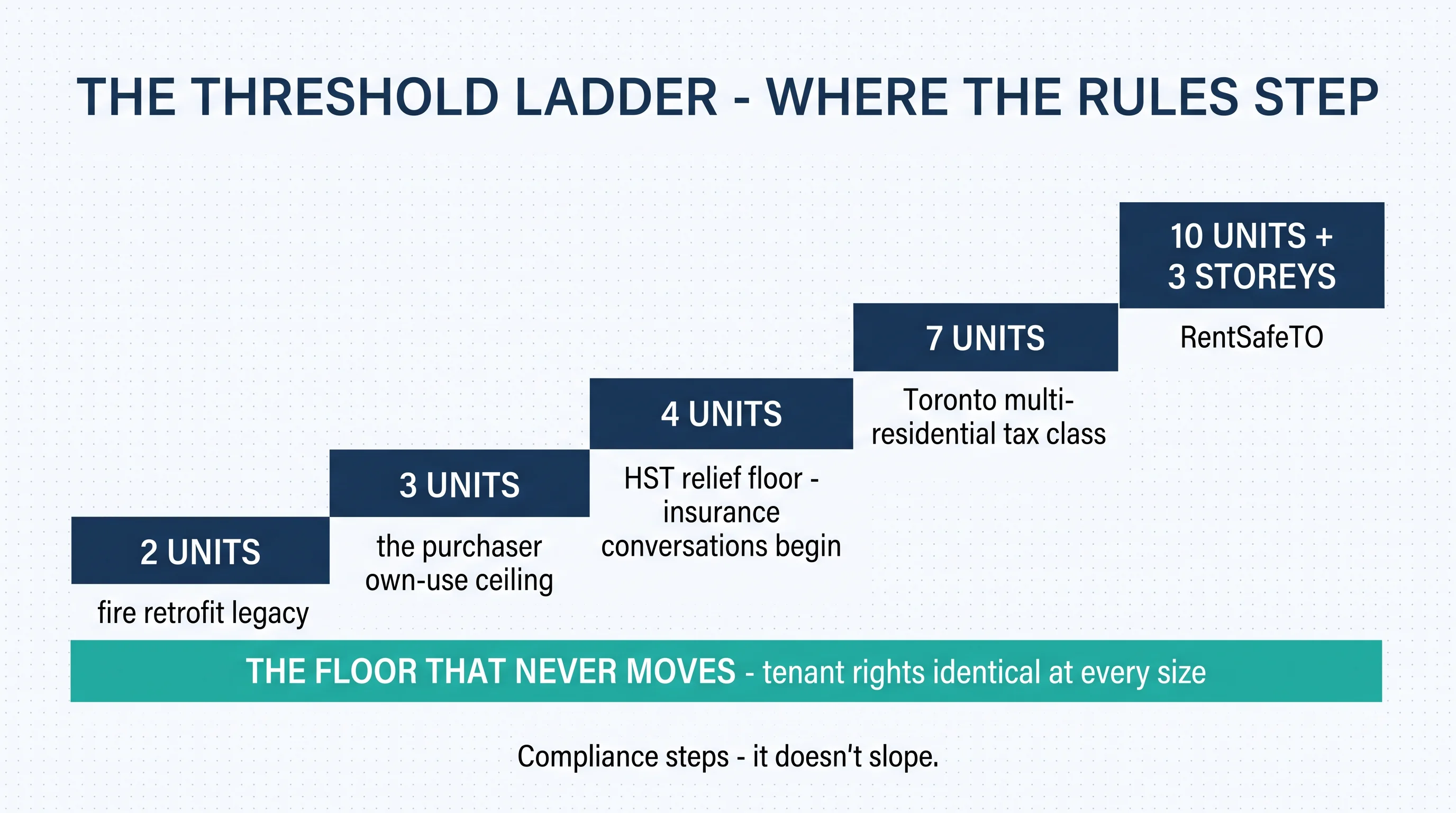
The rungs, previewed: two units (the fire-retrofit legacy), three (the purchaser's own-use ceiling), four (an HST floor and, commonly, the first insurance conversations), seven (Toronto's tax class), and ten-plus-three-storeys (Toronto's registration program) — plus a set of lines that ignore unit count entirely, from monitored fire alarms to municipal licensing.
Why this map matters in 2026 specifically: CMHC's mid-year read has major markets supply-heavy and tenant-favouring (June 2026), and the churn is pushing small landlords up the ladder — TRREB counted 24,012 active condo listings in Q1 2026, up 6% year over year, and a meaningful slice of those investor exits become somebody's multi-unit entry. Meanwhile 93% of property management operations report rising costs [Buildium 2026 North American survey], which means an unbudgeted threshold hurts more than it used to. The thesis in one line: compliance steps — it doesn't slope — and budgets and diligence have to step with it.
One boundary note before the climb: this article maps ordinary residential rental buildings. Toronto's multi-tenant (rooming) house framework is its own licensing world with its own rules, and buildings that rent by the room rather than by the unit should be assessed against that framework directly — a different ladder entirely, not a rung on this one. Everything below assumes self-contained units.
The small rungs: two, three, four
Two units is the oldest step on the ladder. Ontario's Fire Code has long carried retrofit provisions for two-unit houses — fire separations, interconnected smoke alarms, adequate egress — and the second-suite conversion is where most landlords meet building-level fire compliance for the first time. If you're buying a house with an existing second suite, the fire file transfers with the building or gets built by you; there is no third option. Practically, that means asking the seller for the retrofit documentation the way you'd ask for the furnace's service history — and treating "we never needed anything like that" as a due-diligence finding, not an answer. A second suite that was finished without the fire work isn't a bargain; it's a renovation with a tenant in it.
Three units is the purchaser's ceiling. Under Ontario's own-use rules, a purchaser can use the N12 route only where the residential complex has three or fewer units — the full mechanics live in our complete N12 guide. A composite from Ontario purchase patterns (ours, not a case report): a buyer's plan for a fourplex quietly assumes an own-use notice for the basement unit — move in, rent the rest. But a fourplex is four, the purchaser route doesn't exist at four, and the plan needed entirely different math. Flagged in due diligence, that's a price conversation; discovered after closing, it's a year. No villain in the story — the failure is the unaudited assumption.
Four units opens two doors at once. First, the purpose-built rental HST relief has its floor here: new residential projects qualify with a minimum of four private apartment units (or ten private rooms), at least 90% of units held for long-term rental, for construction begun September 2023 through December 31, 2030 — with both the federal and Ontario portions of the tax removed. Second, four is commonly where the first insurance conversations start — which belongs to the next rung down the hall. The HST floor is worth a beat of context: the relief exists to pull new purpose-built rental supply into the market, and its four-unit minimum quietly makes the fourplex the smallest building the program considers "purpose-built." For a landlord weighing a triplex-plus-conversion against a ground-up four-unit build, that line is real money on the construction side — run it with an accountant before the design is fixed, because three-and-a-half units qualifies for nothing.
For landlords: The ladder audit belongs at offer stage, right beside the building inspection. Two questions per listing: which rungs does this building already sit on, and which do I cross by buying it? It's twenty minutes against this article's map — and the alternative is learning the same answers later, from an unbudgeted invoice.
The middle rungs: where the money changes character
Between four units and Toronto's named lines sits a band of thresholds with a shared personality: they're drawn by insurers, lenders, and assessors rather than by one statute — which is exactly why nobody mails you a notice when you cross them.
Insurance first. Insurers commonly draw the personal-lines/commercial line somewhere around four to six units. The same building that renewed for years as a rental extension of familiar coverage starts quoting as a commercial risk — different underwriting, different coverages, different pricing logic. Our landlord insurance guide covers what actually changes inside the policy; the threshold lesson here is simpler: review coverage before crossing the range, not at the renewal after.
Lending moves at roughly the same altitude. Most residential mortgage products end near five units; beyond that, underwriting changes character — amortizations, down-payment expectations, and documentation all shift, and the building starts being appraised on its income rather than its comparables. Ask the lender which box a target building sits in before the offer, because the answer changes the offer.
The N13 pattern belongs here too: compensation obligations under the demolition-and-major-renovation route step up with the size of the complex — the N13 form and its rules carry the specifics, and larger buildings should assume the heavier end of the pattern when modelling any redevelopment plan.
And then Toronto's seven: the City's multi-residential property tax class applies at seven units and up, which changes the operating math of the seventh unit, not just its compliance posture. A landlord modelling a six-to-eight expansion in Toronto is modelling a tax-class crossing, whether or not the spreadsheet says so. (One verification note in the spirit of this article's own advice: tax classes and their boundaries are the assessor's territory and get revisited — confirm the current classification rules against the City's own rate pages when you model, the way you'd confirm a fee schedule before quoting it.)
What unites the middle rungs is who's watching. The statute-based lines announce themselves in legislation and get covered — this site included — every time they move. The insurer's line moves in underwriting guidelines; the lender's moves in product sheets; the assessor's moves in classification rules. All three are knowable, none is broadcast, and together they're why the fourth, fifth, and seventh units deserve more diligence per unit than the tenth: by ten, you know you're running a building. In the middle, it's still possible to believe you're running a big house.
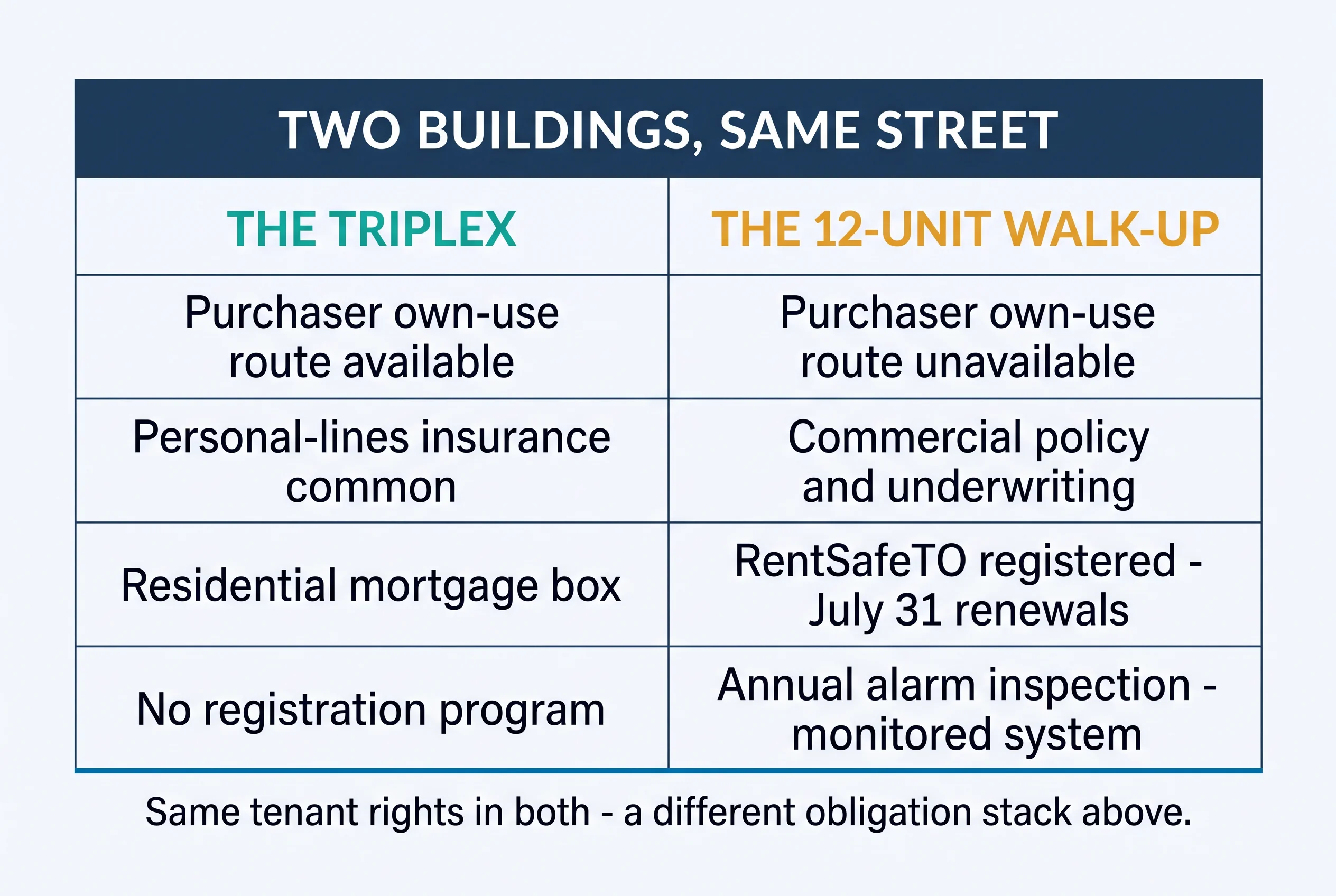
Toronto's loudest line: three storeys, ten units
If the middle rungs whisper, Toronto's biggest line is fully published. RentSafeTO: Apartment Building Standards applies to apartment buildings with three or more storeys AND ten or more units — condos, townhomes, and units in private homes are excluded. In scope means registered: initial registration, then renewal every year by July 31, at published per-unit rates — $26.75 per unit at 2025 rates, adjusted annually under the City's fee policy [toronto.ca].
The program's economics reward exactly one thing: maintenance posture. Registration and City-initiated evaluations are the budgetable side; a building audit — triggered by conditions, not by calendar — bills separately, at roughly $3,016 in administrative fees plus $158.84 per hour, per officer (2025 rates). Registration is a line item; an audit is a consequence. The difference between paying one and paying both is how the building is actually kept.
Registration also changes daily operations: the program sets service-response standards of 24 hours for urgent requests (heat, water, electricity) and seven days for non-urgent ones, and buildings are evaluated roughly every three years with scores published where prospective tenants can read them. "We've always handled things by text" meets a clock at this rung — and the clock is visible from the street. The published-score dimension deserves its own sentence in any leasing strategy: prospective tenants in Toronto can and do look buildings up, which turns a strong evaluation into a quiet marketing asset and a weak one into a question every showing has to answer. At this rung, maintenance isn't only compliance — it's the listing's first review.
A composite from Ontario estate patterns (ours): the inherited walk-up. An estate passes a 10-unit, 3-storey building to a first-time owner, and everything arrives at once — registration, the July 31 renewal, per-unit fees, the 24-hour standard, and a published evaluation history the new owner has never read. The fix wasn't heroic: a week-one ladder audit against a map like this one turned five separate surprises into one checklist, worked top to bottom in a month.
The lines that aren't about count
Some of the ladder's most important lines never ask how many units you own. The biggest is 2026's quietest big compliance date: effective January 1, 2026, by way of O. Reg. 87/25, Ontario's Fire Code adopts CAN/ULC-S536-19 as the annual inspection standard for fire alarm systems. For buildings with monitored systems — which is most multi-unit residential buildings — that means a named annual inspection with battery load tests, monthly logs, documentation for central-station monitoring, and owner sign-off on corrected deficiencies. From the same date, municipalities can issue administrative monetary penalties for Fire Code violations, with amounts set by local bylaw. The threshold here isn't a unit count at all; it's the system on the wall.
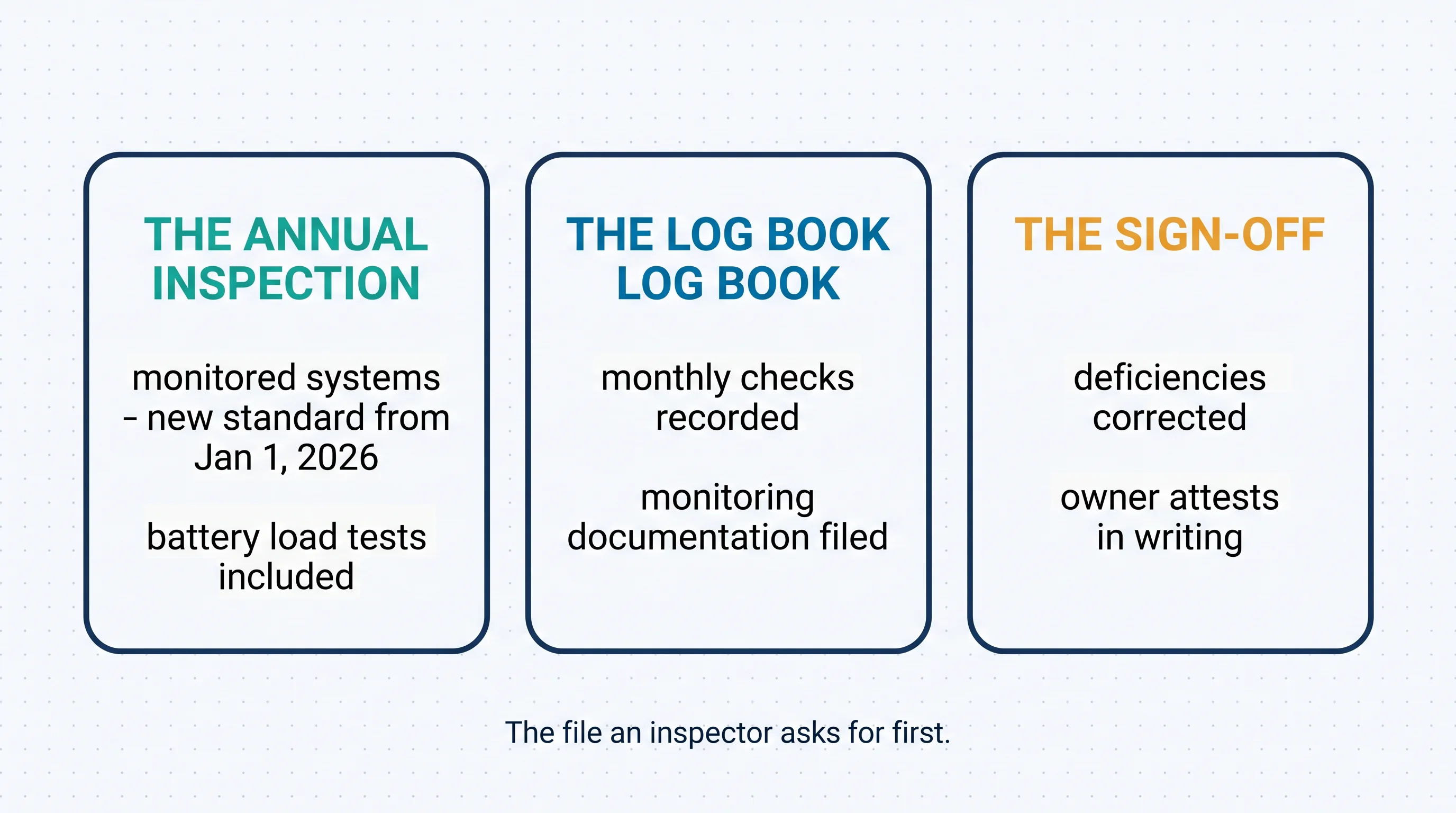
One more composite, and the positive one (ours): the six-plex's new January. Pre-2026 habit: "the panel gets looked at when it beeps." An afternoon with the fire-protection contractor in December 2025 stood up the annual inspection file, the monthly log book, and the sign-off routine — and made January boring. Boring is the goal; boring is what a clean fire file looks like from the inside.
The small-building contrast runs the other way: single-family rentals typically aren't Code-required to provide fire extinguishers, while larger buildings need commercially rated, regularly serviced units in specified locations. Two rules hold at every size: every sleeping room needs an adequate egress window, and exit routes stay clear — a tenant storing bikes in a shared corridor is a violation the owner still answers for, which is worth one calm conversation before it's ever an inspection note.
The rest of the non-count lines, one beat each: elevating devices carry provincial licensing wherever they exist, at any unit count — confirm the licence is current at purchase. The shared-kitchen-or-bath-with-owner arrangement is a scope line, not a size line — it changes whether the ordinary tenancy rules apply at all, per our lease-legality guide. And several Ontario municipalities run rental licensing or proactive fire-inspection programs — Kitchener, Waterloo, and Cambridge fire services all run rental inspection programs, and licensing frameworks vary city by city — so check your municipality before you buy in it, not after. The check itself is a fifteen-minute job — the municipality's licensing and fire-services pages, plus one call if the pages are ambiguous — and it belongs in the ladder audit for any purchase outside a city you already operate in. Programs differ enough between neighbouring municipalities that experience in one is not knowledge of the next; the landlord who assumes their home city's rules travel with them is running someone else's compliance calendar.
Where Tenon10 fits: The thresholds in this article mostly resolve to two habits — records with a home, and dates on a calendar. Tenon10 keeps per-unit files with documents attached (the fire file, the insurance certificate, the licence renewals) and the rent and maintenance history that inspection-era buildings need to show, organized from day one. It doesn't make a building compliant — it makes compliance findable. Plans are on the pricing page.
The scaling playbook — and the year ahead
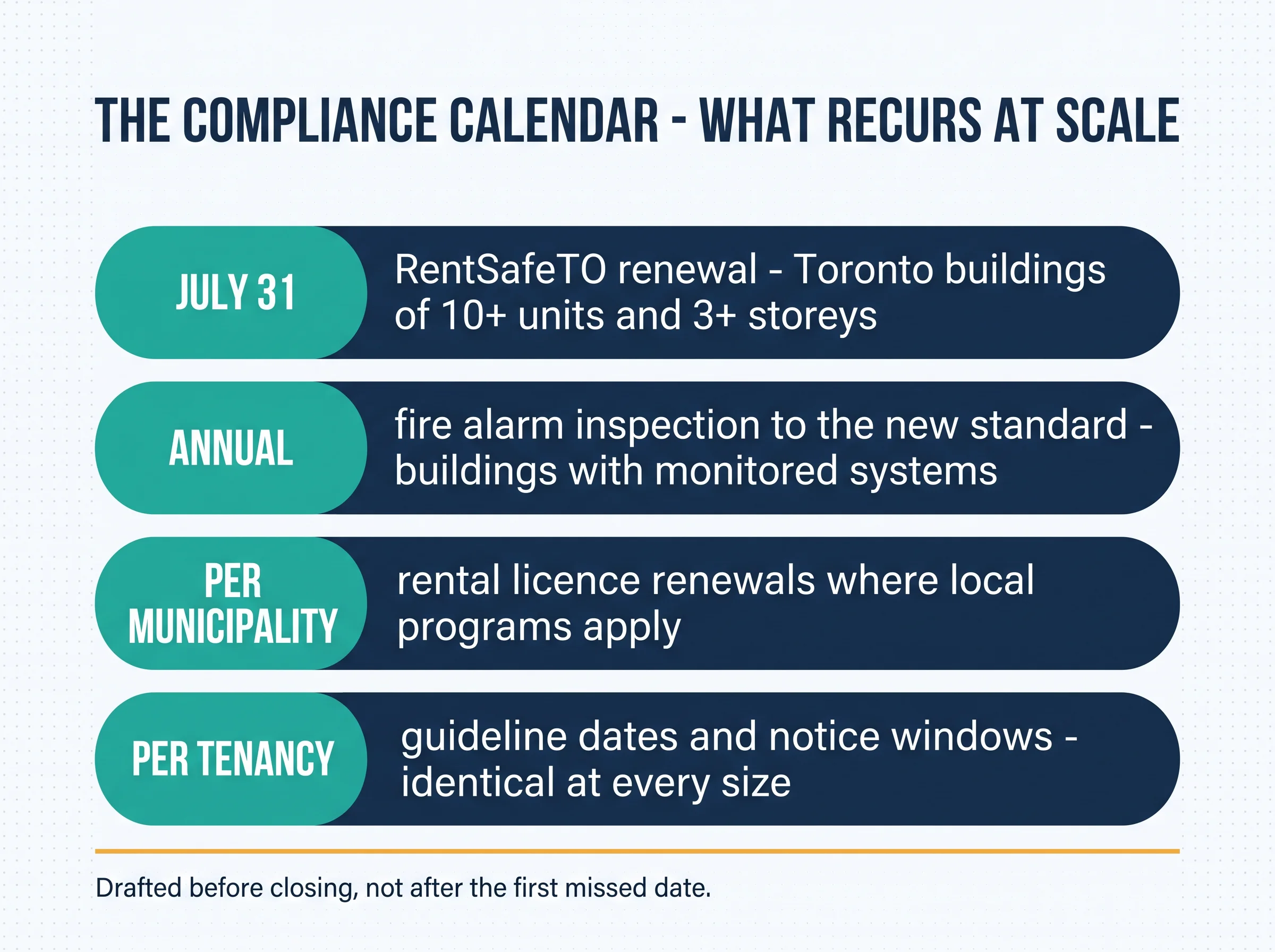
Everything above compresses into three habits. First, the ladder audit at offer stage: which rungs does this building sit on, which do I cross by buying it — asked next to the inspection report, answered before the price is final. Second, the compliance calendar drafted before the keys: July 31 where RentSafeTO applies, the annual alarm inspection where a monitored system exists, municipal licence renewals where local programs run, and the guideline and notice dates that apply at every size. Third, thresholds as budget lines: the day a threshold is identified, it gets a dollar figure and a date — never a mental note. The budget-line habit is the one that compounds: a threshold with a dollar figure attached gets weighed in the purchase price, priced into the rent roll's expectations, and reviewed annually like any other cost — while a threshold that lives as a mental note gets rediscovered, usually in the same week as something else expensive. Most of this ladder is knowable to the dollar in advance; the discipline is simply writing it down where the money planning happens.
Two dates belong on every Ontario calendar this year regardless of portfolio size, both from the current round of legislative change: the 15-day deadline to request a review of an LTB order started on July 1, 2026, and the 7-day N4 non-payment notice period (for notices given on or after that date) and the 120-day own-use notice option took effect September 21, 2026 (a landlord's-own-use N12 served on or after that date with at least 120 days' notice owes no compensation; a purchaser's N12 still does) — the mechanics live in our Bill 60 and Bill 97 guide and our companion piece on how Bill 60 affects Ontario landlords. One reminder that ties this article's smallest rung to its newest date: whatever September changes about own-use economics, the purchaser route still caps at three units. What "buying tenanted" means for a fourplex didn't change.
The year ahead extends every trend in this piece: more municipalities adopting administrative-penalty authority and rental-licensing programs, published scoring in the RentSafeTO mould normalizing compliance-as-marketing (a good evaluation score is already a leasing asset), and supply-heavy conditions [CMHC, June 2026] keeping the small-to-multi pipeline full of first-time building buyers. The prediction this article stakes: within a year or two, the threshold map sits in standard due-diligence kits next to the inspection report — because the buyers who carry one keep outbidding surprises the buyers who don't are still absorbing.
And if this is your first climb — a first suite, a first building — the ladder reads differently but no less usefully: our first-timer's guide to becoming a landlord in Ontario covers the ground floor, and the single habit worth importing from the multi-unit world on day one is the compliance calendar. A landlord with one basement suite and a calendar that knows its guideline date, its lease anniversary, and its smoke-alarm check is already running the system that a twelve-unit building merely runs bigger. Scale changes the number of rows. It shouldn't change the method.
For property managers: Run the portfolio view — one compliance calendar per building, merged into a master with every July 31, every annual inspection, every municipal renewal. And treat the threshold ladder as a client-advisory product: the owner considering a fourth unit deserves to hear about the purchaser line, the insurance shift, and the lending box from you, before their realtor frames the building as "a triplex plus one."
Built for the whole ladder: Tenon10's tiers track the rungs — Free covers up to 3 units, Essentials to 10, and Pro to 25, with Ontario compliance built into the workflows at every level and tenants always free. The records that satisfy a threshold at ten units are the same records worth keeping at two; starting early just means never migrating. Current plans at tenon10.com/pricing.
The Threshold Map: Ontario's Unit-Count Compliance Checklist
A 19-point map of every line an Ontario rental portfolio crosses as it grows — the purchaser own-use ceiling at three units, the four-unit floors, Toronto's seven- and ten-unit lines with dates and published fees, the fire-file rules that ignore unit count entirely, and the compliance calendar to draft before closing. Compliance steps — it doesn't slope. Know the map before you buy the building.
Get Free PDF →Key takeaways
- The floor never moves: tenant rights are identical at every building size — scale changes your obligations, never their entitlements.
- Compliance steps at named lines: two units (the fire-retrofit legacy), three (the purchaser own-use ceiling), four (the HST relief floor and, commonly, the first insurance conversations), seven (Toronto's multi-residential tax class), and ten units plus three storeys (RentSafeTO).
- Some lines ignore unit count entirely: monitored fire alarm systems carry the new annual inspection standard since January 1, 2026; elevators carry provincial licensing; the shared-kitchen-or-bath arrangement is a scope line; and municipal licensing varies by city.
- Run the ladder audit at offer stage — and periodically on buildings you already own.
- Draft the compliance calendar before closing: July 31 where it applies, annual inspections, municipal renewals, and the guideline dates every size shares.
- Budget thresholds as line items — RentSafeTO's 2025 rate of $26.75 per unit is knowable in advance; so is almost everything else on the ladder.
- Watch the two 2026 dates that apply at every size: July 1 (the 15-day deadline to request an LTB review) and September 21 (the 7-day N4 and the 120-day own-use option) — details in our Bill 60 guides.
The rules don't change as you grow — which rules apply to you does
That's the whole map. Ontario doesn't have one rulebook for small landlords and another for big ones; it has one floor of tenant rights that never moves, and a staircase of owner obligations above it that steps at published lines — three units here, ten-and-three-storeys there, a monitored alarm panel somewhere that never counted units at all. None of these thresholds is a trap, because every one of them is knowable in advance: the ladder audit at offer stage, the compliance calendar before the keys, and a budget line for every rung turn the entire staircase into arithmetic. The landlords who scale well aren't the ones who avoid the thresholds — nobody does — they're the ones who meet each threshold on their own schedule, with the file already open. The others meet the same lines later, with interest. Climb with the map.
Records with a home, dates on a calendar — at every rung
Tenon10 gives Ontario landlords and property managers per-unit files, attached documents, and compliance-ready records from the first unit to the twenty-fifth — with Ontario's rules built into the workflows. Free for up to 3 units; tenants always free.
Questions about fit? Talk to us — we'll tell you honestly.
Related resources
- Ontario N12 Notices: A Complete Guide to Own-Use Tenancy Endings — the full rules behind the three-unit purchaser ceiling.
- Ontario Rental Law Changes Coming July 1 and September 21, 2026 — the two dates on every compliance calendar this year.
- Landlord Insurance in Ontario — what changes inside the policy when coverage goes commercial.
- Becoming a Landlord in Ontario: The Complete First-Timer's Guide — the first rung, before the ladder.
Frequently asked questions
Can a purchaser use an N12 in a fourplex?
No — the purchaser own-use route is available only where the residential complex has three or fewer units, and a fourplex is four. Own-use plans for larger buildings run through different routes with different timelines and different compensation math; our complete N12 guide covers the full rules, and any purchase plan that depends on emptying a unit should be checked against them before the offer, not after closing.
Does RentSafeTO apply to my building?
It applies to Toronto apartment buildings with three or more storeys AND ten or more units; condos, townhomes, and units in private homes are excluded. If your building is in scope: register, renew every year by July 31 ($26.75 per unit at 2025 rates, adjusted annually), meet the 24-hour urgent and seven-day non-urgent service-response standards, and expect periodic evaluations with published scores.
What changed for fire compliance in 2026?
From January 1, 2026, Ontario's Fire Code adopts CAN/ULC-S536-19 as the annual inspection standard for buildings with monitored fire alarm systems — annual inspections with battery load tests, monthly logs, documentation for central-station monitoring, and owner sign-off on corrected deficiencies. From the same date, municipalities gained authority to issue administrative monetary penalties for Fire Code violations, with amounts set by local bylaw.
Do tenants have different rights in big buildings than small ones?
No. Every RTA right — the rent-increase guideline, notice rules, the 24-hour entry rule, deposit rules, and the maintenance duty — is identical whether the building has one unit or a hundred. What scales is the owner's obligation stack: registration programs, inspection standards, tax classes, and municipal requirements. Building size changes what an owner must do; it never changes what a tenant is owed.
When does landlord insurance become commercial?
There's no single statutory line — insurers commonly move buildings from personal lines to commercial policies somewhere around four to six units, and underwriting, coverages, and pricing all change character when they do. The practical rule: review coverage before crossing that range, not at the first renewal after, and read our landlord insurance guide for what the commercial conversation covers.