

The service agreement decides the relationship on paper. The next thirty days decide it in practice. Onboarding a new owner client looks like a welcome packet and is actually a compliance transfer: deposits that must reconcile to a ledger, leases that must be audited rather than assumed, occupied units whose condition must be documented before the first week ends, insurance and utilities and accounts landing in the right names — all of it wrapped in a customer experience that either finishes cleanly inside thirty days [Apr 2026 onboarding-systems guide] or quietly sets the wrong pattern for the next five years.
This is the complete 30-day arc for Canadian property managers — day zero through the day-30 review — including the behavioural craft that actually gets setup finished, which turns out to matter as much as the checklist itself. And it's written for the other chair too: if you're the owner being onboarded, these same thirty days are an audition you should want to watch closely, because a firm that runs disciplined intake will run a disciplined tenancy. A few terms up front: the custody intake is everything that changes hands at the start; the takeover condition report documents each unit's state at day one; the lease-file audit verifies what you've inherited instead of assuming it.
The New Owner Intake Pack: The 30-Day Onboarding Checklist
A 20-point, both-chairs checklist for the first thirty days of a Canadian property management relationship — the day-zero verifications, the custody intake received item by item, the week-two audits that assume nothing, the accounts and the one calm tenant letter, and the day-30 review that ends the setup on purpose. The agreement decided it on paper; these thirty days decide it in practice.
Get Free PDF →Thirty days, two chairs
Start with what onboarding actually is, because the welcome-packet framing undersells it dangerously. When a property changes management hands, legal obligations change custodians: someone now holds deposits that belong to tenants, leases that bind everyone, condition histories that will decide future disputes, and money that must move through the right accounts from the very first rent. Onboarding is where all of that transfers — a compliance handover wearing a customer-experience costume. Both halves have to work. A legally immaculate intake that exhausts the client fails; a delightful intake that never reconciles the deposits fails worse.

The arc runs in five moves — day zero (verify and sign), week one (the custody intake), week two (the audits), week three (accounts and systems), week four (the people and the review) — and 2026 is the year to get it templated. CMHC's mid-year read has major markets supply-heavy and favouring tenants (June 2026), which keeps delivering first-time owner clients to management firms' doors; many onboardings this year are run between two first-timers, which is precisely when a written arc earns its keep. Meanwhile 93% of firms report rising operating costs [Buildium 2026 North American survey] — nobody can afford intake rework, chased documents, or a client relationship that starts with an apology.
One line from the onboarding-systems literature deserves to be the section's takeaway: having a checklist is not having a process [Apr 2026 guide]. A process has owners, dates, and an end. In a market of $10.7 billion across 36,011 firms (IBISWorld, May 2026), the difference between those two things is visible to clients from day one — and increasingly, it's what they're choosing between.
Day zero: before anyone signs
Onboarding starts before the signature, with verifications that run both directions. The owner checks the firm: its provincial footing, per our national licensing map's territory, plus references and — where the firm operates as a brokerage — the public registry. And the diligent firm checks itself: confirming its own registration posture for this property, in this province, before taking it on, because the intake that shouldn't happen is cheaper to decline than to unwind.
Two walkthroughs belong at this table, and the cluster has built both. First, the fee schedule, walked through on the owner's own unit — every line a number or "not charged," compared on total annual cost; our complete fee guide owns that discipline and every figure in it, so this article prints none. Second, the agreement itself — our contract anatomy guide's whole territory — signed with the renewal window calendared the same day, and the fee exhibit and handover inventory filed where they can actually be found later. Notice what day zero really is: the last moment when everything about the next five years is still a decision rather than a discovery.
For landlords: Treat what happens after you sign as an audition worth watching. Sequenced document requests with dates are a good sign, not bureaucracy — they're what disciplined operations look like from the outside. And keep one simple scorecard: does the first monthly report land on the exact date the agreement promised? A firm that hits its first promised date will hit the next sixty.
It's worth naming what the owner across the table is quietly worried about, because the published firm FAQs are candid about it: the two documented anxieties are "is this going to be complicated and time-consuming?" and "am I losing control of my own property?" [firm FAQ, Feb 2026]. Good onboarding answers both by design rather than by reassurance. The complication worry dissolves when requests arrive one at a time with dates instead of all at once; the control worry was actually settled at the agreement stage — the contract decided the control settings, and onboarding just installs them. An owner who watches their instructions route cleanly through a named contact in week one stops worrying about control by week two.
Week one: the custody intake
Week one is when everything changes hands, and the operative discipline is a single phrase from the 2026 takeover and handover guides: item by item, never "a box." A box of papers is not an intake; an intake is an inventory with a receipt against every line. Here is what arrives, per the published handover checklists:
- Every lease — for every unit, not "the current ones we could find."
- Keys, access codes, and the tenant-contact inventory — complete, because the first after-hours call doesn't wait for missing phone numbers.
- Deposit records showing the amount held and where it is held — both halves, in writing. This item gets its own audit in week two.
- Vendor contracts — landscaping, snow, pest, HVAC service plans — reviewed for whether they can actually be assigned to the new arrangement.
- The insurance certificate, current, with the management company listed. This is live money in 2026: 39% of property management companies cite rising insurance premiums among their top concerns [AppFolio 2026], and our landlord insurance guide covers why the certificate's details matter more than its existence.
- Warranties and manuals — the furnace's paperwork is worth an hour of anyone's time the first February night it fails.

Alongside the documents travels the financial set [2026 handover guide]: the rent roll with each tenancy's payment status, the security deposit ledger, year-to-date income and expense statements, outstanding maintenance invoices, and reserve balances. Together those five items are the property's financial memory — and a manager who starts without them is managing amnesia.
One discipline threads through all of it: privacy-clean intake. Collect what the work needs, and tell the owner why each item is needed — our tenant privacy guide's whole territory, and the agreement's data-handling commitments practised from the first request. Over-collection isn't thoroughness; it's risk moving in the wrong direction on day one.
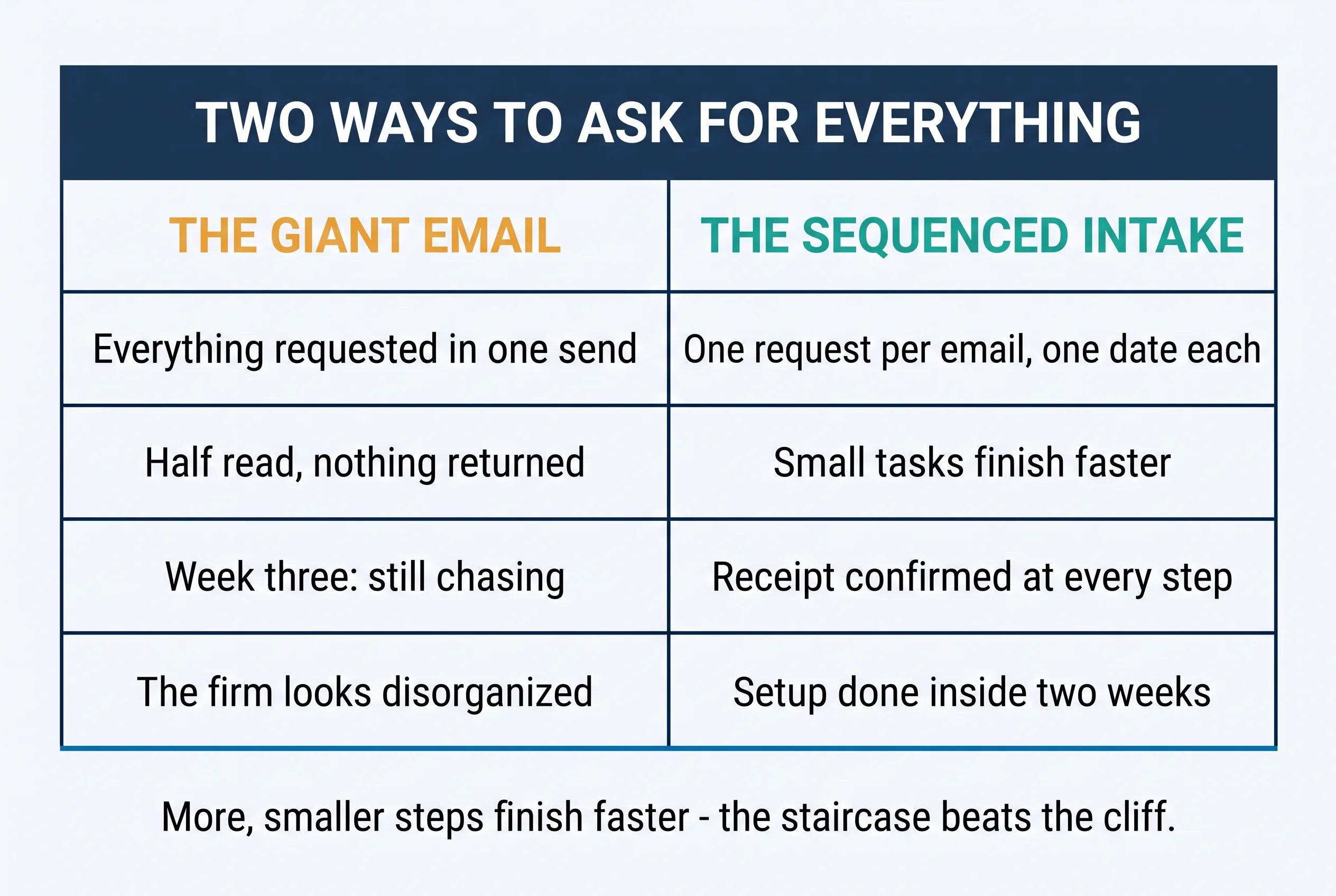
Now the part most firms get wrong — not the list, but the asking. A composite from Canadian intake patterns (ours, not a report's): a firm sends the new client everything at once — intake form, three document requests, portal login, and a scheduling link in a single impressive email. The owner opens it, reads half, and does nothing for a week [the failure pattern the Apr 2026 onboarding-systems guide documents almost verbatim]. By week three the deposit ledger still hasn't arrived and the direct-deposit form is unsigned — and the firm looks disorganized for the client's own incompletion. Rebuilt as five dated micro-requests, one ask per email, the same owner finishes in nine days. That's the counterintuitive finding worth printing in bold: more, smaller tasks finish faster and churn less [Apr 2026 guide]. Every instinct says simplify to one easy send; the field data says the staircase beats the cliff.
Week two: the audits — assume nothing, date everything
Everything that arrived in week one is now verified, because inherited paper carries inherited history. Start with the lease-file audit, a discipline in its own right per the 2026 inspection checklist libraries: every lease located, signed by everyone who should have signed, current, and compliant with provincial requirements — in Ontario, checked against the standard lease per our complete guide. Why audit rather than assume? Because paper can't be assumed: only 37% of tenants report reading their lease in full [Second Nature 2026], predecessor files inherit that whole casual history, and the moment a lease's defects matter is precisely the moment it's too late to fix them. Anything defective gets flagged to the owner with options now — not discovered at dispute time.

Then the deposits, reconciled ledger-to-dollar. Another composite of ours: an intake accepts a handover sheet reading "deposits: $9,400" — a true number with no per-tenancy ledger behind it. In month four a tenant moves out and disputes their amount, and the reconstruction costs a week of correspondence and a season of goodwill. No verdict on anyone in that story; the failure is the missing ledger, not a person. The fix existed at day one and cost twenty minutes: amount, where held, and a per-tenancy ledger, reconciled before the first rent run — the total is not the record; the ledger is.
Third, the item the checklist libraries flag hardest: takeover condition documentation for every occupied unit — move-in-style reports with dated photos, taken at the takeover moment. This is the shield against inherited liabilities: it draws the dated line between what predates the new management and what doesn't. And it earns its keep in the best possible way. One more composite, the positive one: day-6 documentation of an occupied fourplex notes pre-existing water staining under a bathroom window — two photos, one caption, filed. Nine months later, a "new damage" question arrives; it resolves in one email with those two dated photos attached. No hearing, no argument, no invoice disputed. The report paid for itself in nine minutes, nine months after someone spent an afternoon making it.
Round out the week with the unglamorous pair: utilities identified and transfers initiated so nothing lingers in the wrong name, and vendor assignability resolved before the first repair needs a contractor — the mid-emergency discovery that the HVAC contract died with the old arrangement is a discovery nobody enjoys — and it's common enough to plan around, with 56% of firms reporting difficulty hiring qualified maintenance contractors [Buildium 2026]; in that labour market, a transferable service contract is an asset worth an hour of legal reading. For firms building their own template, the published inspection checklist libraries show how deep the discipline goes — one widely-used takeover checklist runs 31 points across six sections, from condition and lease audit through utilities, compliance, financial accounts, and the agreement itself. The point isn't to adopt anyone's 31 points; it's that the professionals who do this weekly found six categories worth separating. Steal the categories. None of this assumes the outgoing manager did poor work; most handovers are cooperative, and the discipline is the checklist, not suspicion. Anything genuinely unresolvable gets documented as found, dated, and disclosed — which is all a clean file ever needs to say.
Weeks three and four: accounts, systems, and the people
With custody taken and audited, weeks three and four install the machinery — and then turn to the only people in the story who didn't choose any of this. Accounts first: where provincial rules require it, trust arrangements are live before the first collected rent arrives, our trust accounting guide's entire world compressed to one sentence — client money never waits in the wrong account while paperwork catches up. Alongside it, the records layer stands up: per-unit files, documents attached where they belong, rent history starting from day one rather than from whenever someone gets around to back-filling.
Then the quietest, cheapest, most underrated move in the whole arc: the reporting rhythm starts on the exact date the agreement promised. Not a day late with an apology, not early with a flourish — on the date. A first report that lands when promised teaches the owner, in the most concrete way available, that promises made to this firm's clients are kept; it's the single cheapest trust-builder in the whole thirty days, and it costs literally nothing beyond doing what was already agreed.
Now the people. Somewhere in these units there are tenants who woke up one morning to a management change they didn't request and can't refuse — and everything they need is one calm letter: who to pay, who to call, and the plain assurance that nothing else changes. Their rights are untouched and their tenancies continue exactly as before, because a change of manager never changes the tenancy — the same continuity principle our contract anatomy guide lands from the owner's side. The letter isn't legal armour; it's courtesy with a compliance function, and it goes out before the first rent date. Confirm the named voices at the same time, both directions — who instructs the manager, who answers for the firm — per our multi-owner guide's one-voice discipline, so the tenants' one letter names one number and that number answers.

The month ends on purpose: the day-30 review call. Fifteen minutes, four beats — what arrived, what was audited, what starts now, and the first report's date confirmed out loud. It's the deliberate end-note of the setup month, and as the next section explains, the end-note is disproportionately what the client remembers.
A note for owners switching managers rather than hiring a first one: the arc is identical, but day zero grows one extra item — the outgoing arrangement's notice terms, served in writing per whatever the old agreement requires, ideally the full 30 days out that the handover guides recommend. Then the custody inventory above becomes your delivery checklist instead of your receiving one: the owner who arrives at the new firm's intake with leases, ledgers, and keys already organized compresses week one into days, and starts the new relationship as the client every manager hopes for. Switching with tenants in place changes nothing about their tenancies — it only raises the stakes on the one calm letter, because tenants who've been through a management change before will judge this one against the last.
Where Tenon10 fits: The records layer this month builds is exactly what Tenon10 is for — per-unit files with leases and documents attached, deposit details recorded where they can be found, and rent history that starts accumulating from the first collected payment. A property onboarded into an organized system on day one is also handover-ready on day one thousand — the custody inventory you'd want to receive is the one your records can produce. Plans and current pricing are on the pricing page.
The craft that makes it finish — and the year ahead
Underneath the checklist sits the craft, and the 2026 onboarding-systems literature is unusually direct about it. Start with the peak-end rule: clients don't average an experience — they remember its peak and its end, and most firms engineer neither [Apr 2026 guide]. The arc above builds both deliberately. The peak is the takeover condition report delivered beautifully — dated photos, clean captions, a one-page summary the owner didn't expect and won't forget (the fourplex composite's real lesson wasn't the dispute it settled; it was the impression it made in week one). The end is the day-30 review. Neither costs more than doing the same work carelessly.
Second: deadlines without villainy. Clear dated steps get owners to finish their part without the firm ever playing enforcer — "the ledger is due Thursday so your first statement can go out on the first" makes the calendar the bad guy, by design, and keeps every human interaction warm [Apr 2026 guide]. Third, the finding that ties this piece to its two predecessors: scope is set in onboarding. The services walked through at kickoff are the services billed forever after, and "by the time you notice scope creep, the pattern is already set" [Apr 2026 guide]. The kickoff walkthrough is where our fee guide's schedule and our anatomy guide's scope section stop being documents and become the lived shape of the relationship — which is why the walkthrough happens out loud, on the owner's own unit, before anything is signed.
The year ahead sharpens all of this. Intake tooling is spreading with the broader automation wave — 58% of firms now report using AI somewhere in operations [Buildium 2026] — and document collection is exactly the kind of sequenced, confirmable work the tooling does well. Expect onboarding experience to become a named competitive differentiator over the next year, the way published fee schedules are becoming one: in a supply-heavy market still delivering first-time owner clients [CMHC, June 2026], the firm that can show its 30-day arc in the sales meeting — stations, dates, and the day-30 review at the end — wins the meeting against the firm that promises to "take great care of you."
For property managers: Template the arc once, then run it every time — owners, dates, and an end. The five stations don't change between clients; only the names do. And the compounding return is referral-shaped: the first client to experience a sequenced, dated, cleanly-ended onboarding will describe it to the next one, in exactly the words you'd have chosen.
One more piece of craft, small enough to skip and too valuable to: hold the day-30 review even when everything went perfectly. Especially then.
Built for the first thirty days: Tenon10's Free tier covers up to 3 units — enough to onboard a first owner client's property, stand up the per-unit records, and run the first months of rent tracking before any paid plan enters the conversation. Ontario compliance is built into the workflows, and tenants are always free. Start at tenon10.com/signup.
The New Owner Intake Pack: The 30-Day Onboarding Checklist
A 20-point, both-chairs checklist for the first thirty days of a Canadian property management relationship — the day-zero verifications, the custody intake received item by item, the week-two audits that assume nothing, the accounts and the one calm tenant letter, and the day-30 review that ends the setup on purpose. The agreement decided it on paper; these thirty days decide it in practice.
Get Free PDF →Key takeaways
- Onboarding is a compliance transfer — deposits, leases, condition records, insurance, and accounts changing custodians. The welcome packet is the wrapper; the transfer is the work.
- Verify registries both directions before anyone signs — the owner checks the firm's provincial footing; the diligent firm confirms its own posture for this property and province.
- Custody arrives item by item, never as a box — every lease, keys and contacts, deposit records with amount and location, vendor contracts checked assignable, the insurance certificate with the manager listed, plus the five-item financial set.
- Deposits reconcile ledger-to-dollar before the first rent run — amount, location, and per-tenancy ledger travel together; the total is not the record.
- Week two assumes nothing and dates everything — the lease-file audit (in Ontario, against the standard lease) and takeover condition reports with dated photos for every occupied unit.
- The people get their due — one calm tenant letter before the first rent date, and a reporting rhythm that starts on the exact promised date.
- Sequence small dated tasks and end on purpose — the giant email is the failure mode, the staircase beats the cliff, and the day-30 review is the note the relationship opens on.
The picture sets in the first days
The service agreement decided the relationship on paper. The thirty days after it decide the relationship in practice — and they only run once. Deposits reconciled to a ledger, leases audited rather than assumed, every occupied unit documented before the first week ends, one calm letter on every tenant's counter, and a first report that lands on the exact date it was promised: none of it is glamorous, all of it is visible, and together it develops into the picture both chairs will look at for years. Handled right in the window, it stays sharp — for the manager whose intake becomes their best sales asset, and for the owner whose audition month told them exactly what they'd hired. Handled carelessly, it fogs, and no amount of year-three effort fully restores it. The window is open for exactly thirty days. Run the arc.
And if you're reading this from the third chair — a tenant whose building just changed managers — the whole apparatus above exists partly for you: the deposit ledger that transfers intact is your deposit, the condition report is your unit's dated protection, and the one calm letter is the only action item you should ever receive from a transition done right. Nothing else changes, because nothing else is allowed to.
Start the file right on day one
Tenon10 gives Canadian landlords and property managers the records layer a clean onboarding deserves — per-unit files, documents attached, deposit details recorded, and Ontario compliance built into the workflows. Free for up to 3 units; tenants always free.
Questions about fit? Talk to us — we'll tell you honestly.
Related resources
- Ontario Standard Lease 2026: The Complete Guide for Landlords — the benchmark every Ontario lease-file audit checks against.
- Landlord Insurance in Ontario: What's Standard, What It Costs, and Where the Gaps Are — why the certificate item on the intake list carries real money.
- Property Management Software Ontario: What to Look for in 2026 — evaluating the records layer the setup month stands up.
- Becoming a Landlord in Ontario: The Complete First-Timer's Guide — the other chair's starting point, before a manager enters the picture.
Frequently asked questions
What documents does a property manager need from a new owner?
The custody inventory: every lease, keys and access codes with a complete tenant-contact list, deposit records showing the amounts held and where they're held, vendor contracts, a current insurance certificate listing the manager, and warranties and manuals — plus the financial set: the rent roll with payment status, the security deposit ledger, year-to-date statements, outstanding invoices, and reserve balances. Received item by item against a checklist, never as one undifferentiated box.
How long does property management onboarding take?
Published 2026 guides frame complete onboarding as roughly the first 30 days from signed agreement to full integration, and recommend scheduling transitions at least 30 days out so notice and document transfer have room. Sequenced well — one dated request at a time — most document intake actually finishes inside the first two weeks, leaving the back half of the month for audits, accounts, and the people.
What happens to tenants when a property changes management companies?
Legally, nothing changes for the tenant: the tenancy continues on the same terms, deposits and records transfer to the new custodian, and every right stays exactly as it was. Good practice is one calm letter before the first rent date covering who to pay, who to call, and the assurance that nothing else changes — tenants are entitled to continuity, not surprises.
How do property managers verify existing leases?
Through a week-two lease-file audit: every lease located, signed by all parties, current, and compliant with provincial requirements — in Ontario, checked against the standard lease. Nothing inherited is assumed, because predecessor files carry predecessor habits; anything defective is flagged to the owner with options while it's still a paperwork question rather than a dispute exhibit.
Why do property managers document unit condition at takeover?
The takeover condition report — dated photos, every occupied unit, filed in week two — is the shield against inherited liabilities. It draws a dated line between what predates the new management and what doesn't, which routinely turns would-be disputes into one-email answers: two dated photos attached, question closed. It's an afternoon of work that protects both the owner and the firm for the life of the file.


