

The day a property manager signs their second owner, one question starts deciding everything: whose money is this? Get it structurally right and the firm can grow to ten, twenty, fifty owners without the answer ever getting harder. Answer it with memory and a spreadsheet, and the business starts to unravel at exactly the moment it starts working.
The stakes are set by fiduciary law, not by software. Money a manager holds for owners is trust money — and the scope surprises people: not just security deposits, but rent collected on someone else's behalf. The rules that follow — segregation from your own funds, a separate ledger per owner, monthly reconciliation — exist whether or not your tools know about them. What varies is whether your system enforces them by structure or leaves them to willpower. This guide covers both halves: the trust-money discipline every Canadian property manager owes their clients, and how Tenon10's owner sub-accounts are shaped around it — per-owner books inside a team-and-organization structure, trust accounting configured to your province's rules, and the accounting engine from our module deep-dive inherited by every owner you manage. Plus the seven questions worth asking on any sales tour, and a downloadable owner-onboarding checklist. General information, not legal or accounting advice.
The Owner Onboarding Checklist: The First Thirty Days Decide the Next Three Years
Eighteen checks that make a new owner's money provably theirs from day one — paper first, per-owner books initialized before the first dollar, the monthly three-way behind every statement, and the ending planned at the beginning.
Get Free PDF →Whose Money Is This? The Trust Rules Every PM Inherits
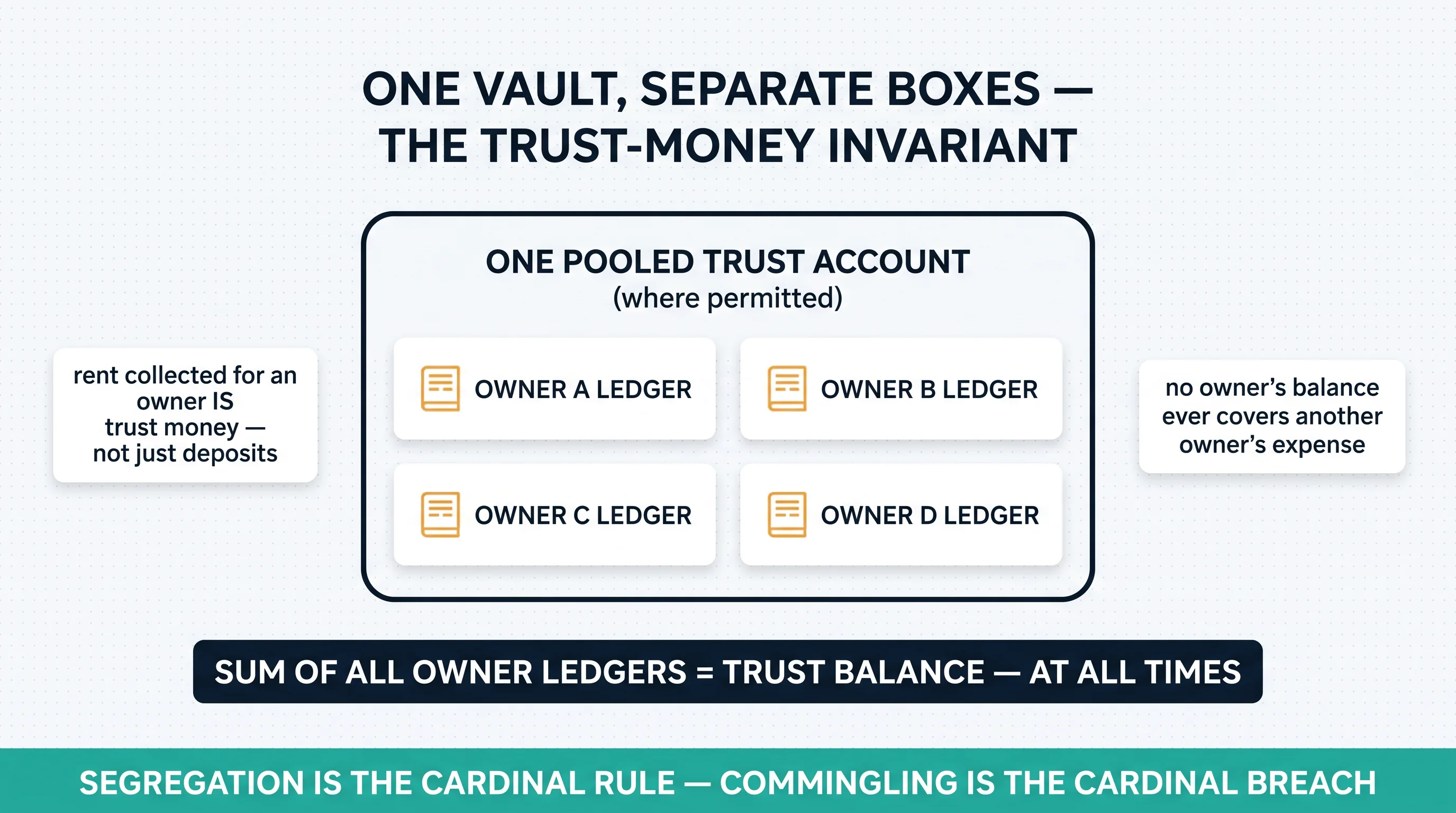
Start with the cardinal rule: absolute segregation. Client money never mingles with the firm's operating or personal funds — across Canadian regulators and regulated-trust regimes, commingling is treated as among the most serious breaches a professional can commit. The picture that makes the rest intuitive is a bank vault full of safe-deposit boxes: a single pooled trust account is acceptable where permitted, but inside it, every owner's money lives in its own box — its own ledger — and the sum of all owner ledgers must equal the trust account balance at all times. When those numbers drift apart, something has gone wrong, whether or not anyone has noticed yet.
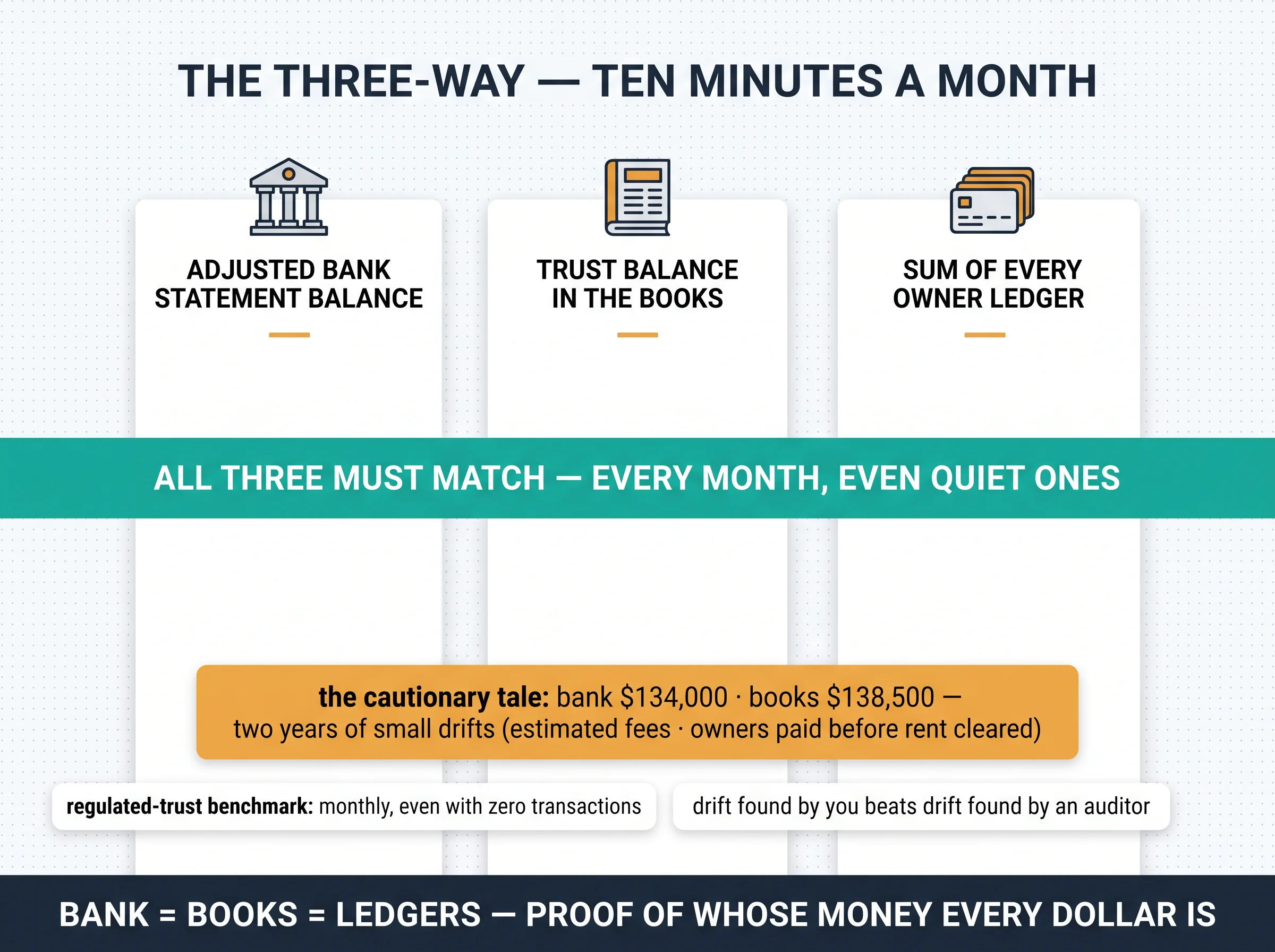
The proof mechanism is three-way reconciliation, monthly: the adjusted bank statement balance, the trust balance in the books, and the sum of every owner ledger — all three must match. Canada's regulated-trust regimes treat this as the monthly benchmark; law-society rules require it even in months with zero transactions, with Ontario's requiring completion within 25 days of the statement period's end. The industry's cautionary tale is the firm whose first-ever three-way check found the bank at $134,000 against books at $138,500 — two years of small, honest drifts: fees taken as estimates, owners paid before rent actually cleared. Consider the illustrative second-owner spreadsheet: a manager's single sheet works fine for their own units, right up until owner #2's first repair gets paid from the wrong pocket and takes three weeks to untangle. That's the moment per-owner books stop being optional — and the records culture behind it is the same one our CRA audit guide describes for the owners you serve.
One more thing, stated carefully because it varies: British Columbia licenses rental property management under the Real Estate Services Act, with brokerages holding client money under BCFSA trust rules — written service agreements, remuneration out of trust only as the rules permit, and negative balances resolved immediately with the regulator notified if not eliminated within ten days. Other provinces regulate differently, and the rules can differ again for condominium versus rental management. Confirm your province's regime — the fiduciary principles apply wherever you hold someone else's money.
The Tenon10 Shape: Per-Owner Books Inside One Platform
Now map the discipline onto the platform. Tenon10's property-manager layer is built in the shape the rules describe. Per-owner books mean each owner's properties and financial history are kept separate by structure — "whose money is this" is answered by the system, not by memory. Teams and organizations give a firm one account with multiple users operating across multiple owners — the layer that lets a small or mid-size firm run many clients without enterprise overhead. And trust accounting is configured per jurisdiction: the same compliance-engine pattern that powers the rest of the platform — the property's address determines the rules — applied to client money, province by province.

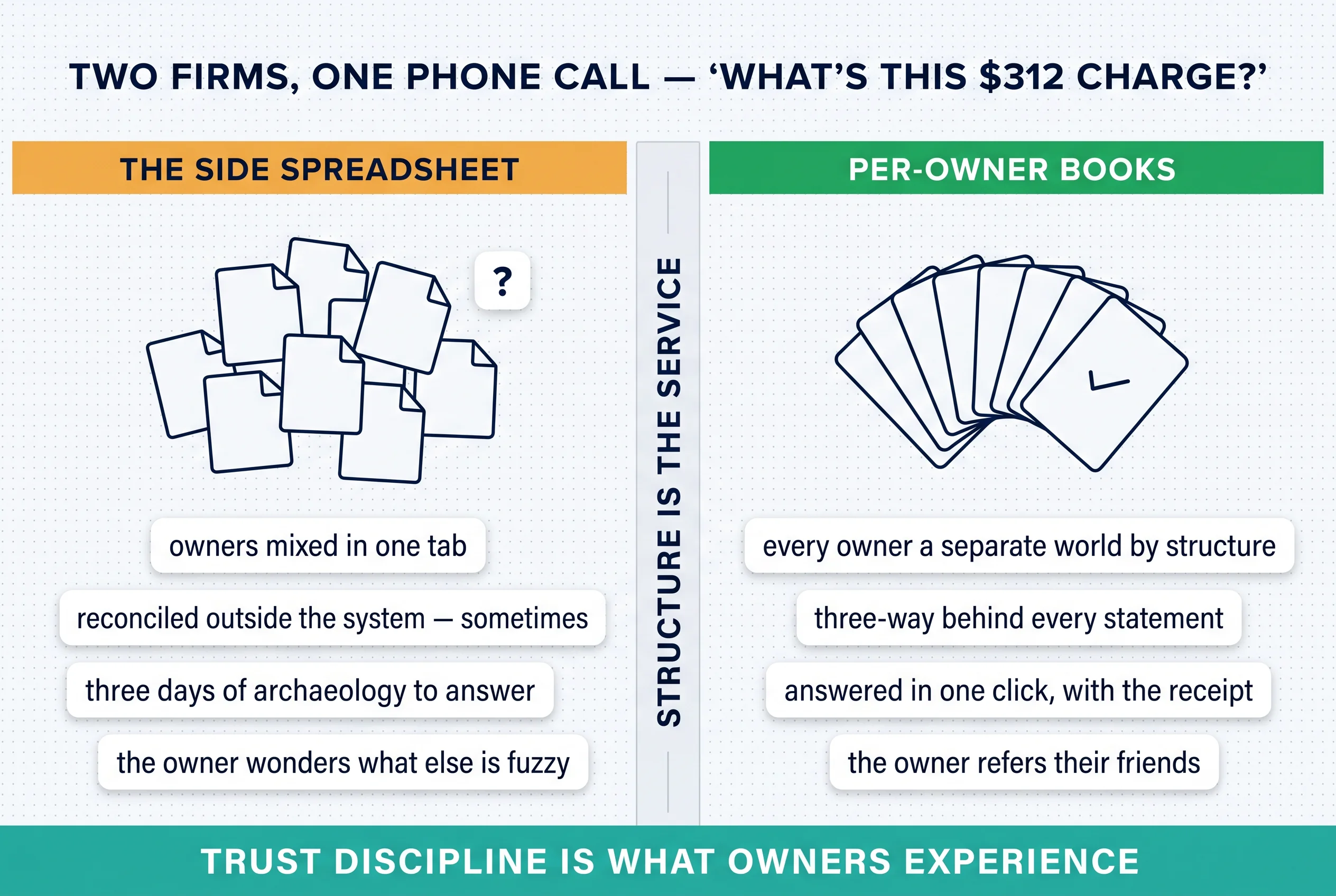
Underneath each owner runs the accounting engine from our module deep-dive: rent collected through the platform — or confirmed offline — books itself as a ledger entry with a receipt; expenses live on the unit they belong to; a real general ledger with bank reconciliation sits beneath; and in Ontario, charges the RTA prohibits simply never post. For a manager, that engine per owner is the difference between discipline as a policy and discipline as a property of the system. The illustrative negative ledger shows why that matters: owner A's furnace fails the same week owner A's rent runs late, and owner B's balance quietly covers it "just for a week." That is the exact violation regulators name — one client's funds used for another client's property — and it's prevented by structure that keeps owners' books separate, not by good intentions at month-end.
Pricing, PM Enterprise, and What to Ask on the Tour
Property managers have their own pricing structure on Tenon10 — a dedicated Property managers tab on tenon10.com/pricing, with a PM Enterprise tier for larger firms and a contact-sales path for specifics. For scale context, the landlord tiers run Free ($0, up to 3 units) → Essentials ($9.99/month, up to 10) → Pro ($49/month, up to 25, with a 30-day trial) — and the public comparison table notes Pro includes "T776 Tax Filing — first full year." Pre-authorized debit costs the lesser of $7 or 1.5% per transaction on every plan, and tenants never pay. Prices change — see tenon10.com/pricing for current rates.
Now the honest limits, because they matter more on a piece like this one. The owner-facing mechanics — how owners are invited, what a statement looks like, how fees flow — aren't publicly documented, and this guide won't pretend to describe screens it hasn't seen. The mobile app is coming soon (the platform lives on the web today); provincial compliance depth is Ontario-complete with other provinces following the same pattern; and no software replaces your professional obligations under your province's trust and licensing regime, or your accountant. What that means practically: take the discipline in this article to a demo, and make the platform show you. Here are the seven questions worth asking on any tour — Tenon10's included:
- How are owners invited, and what do they see?
- What does the owner statement contain, and on what cadence?
- How are management fees calculated, disclosed, and moved out of trust?
- How are owner disbursements timed against cleared rent?
- Can an owner's ledger go negative — and what stops it?
- How does the platform apply MY province's trust rules?
- What's in PM Enterprise, and where's the line versus the landlord tiers?
Owner Onboarding: The First Thirty Days Decide the Next Three Years
Before the first dollar moves: the management agreement signed, with the fee structure and disbursement timing in writing, banking and trust authorizations complete — and the owner's books initialized empty and separate, never "we'll split it out later." Week one: properties, units, leases, and sitting-tenant details loaded; the existing lease imported rather than summarized from memory; opening balances documented with the owner's written sign-off. The standing rhythm: statement cadence agreed in writing, the monthly three-way running behind every statement, and communication boundaries set — what's a phone call, what's the report. And contemplate the ending at the beginning: offboarding terms — records export, final reconciliation, return of the trust balance — belong in the agreement on day one, when everyone's still friends.
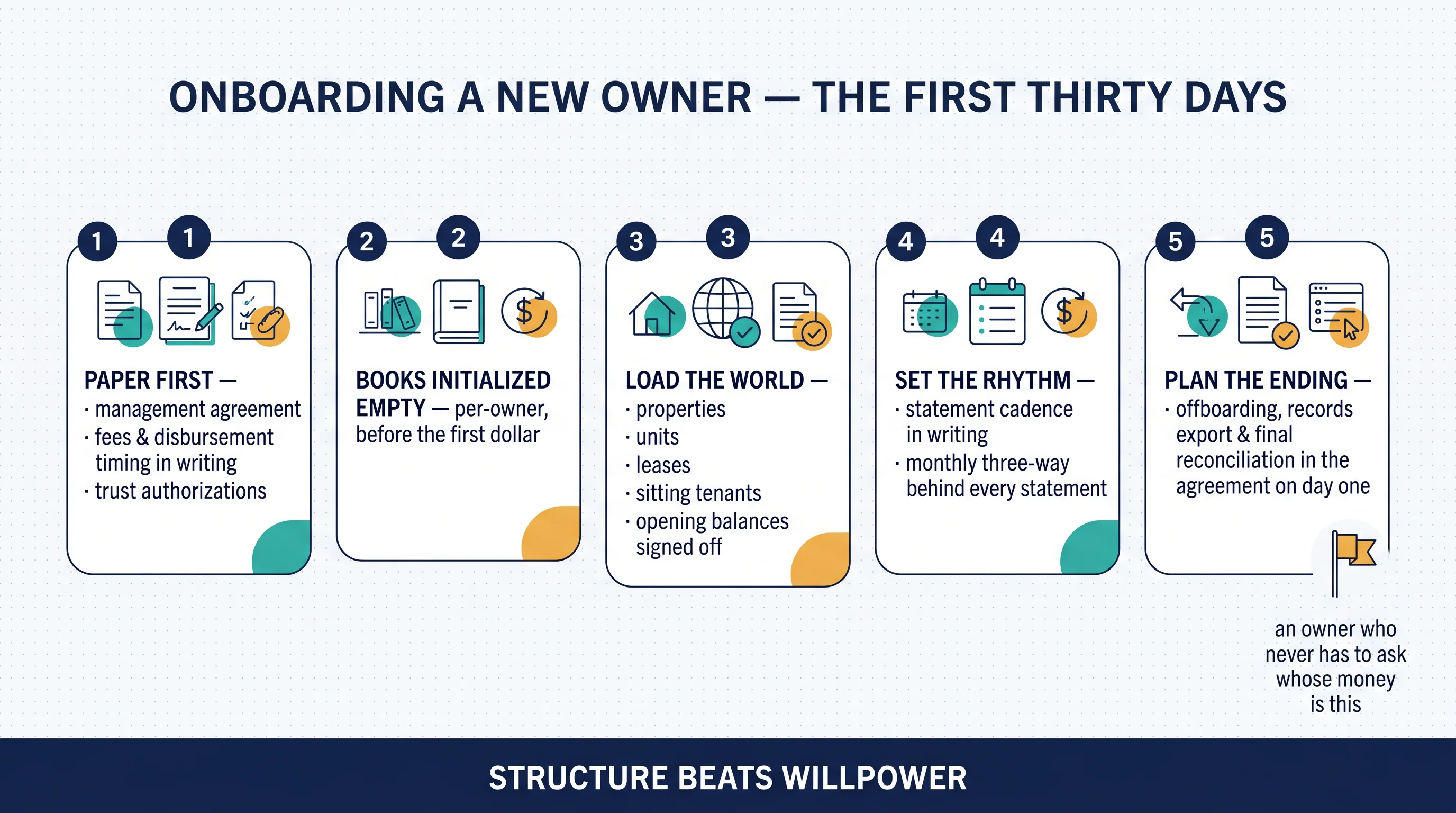
The compounding payoff: an owner onboarded this way never has to ask "whose money is this" — and neither does your auditor. It's the same operating discipline that runs through rent collection at scale, and it's the first thing to evaluate in any platform decision — our property management software guide puts it alongside the rest of the checklist.
Practical Takeaways
- Treat every dollar held for an owner as trust money — rent included, not just deposits.
- One ledger per owner, initialized before their first dollar moves.
- Run the three-way monthly — bank = books = sum of owner ledgers — even in quiet months.
- Never let one owner's balance cover another's expense — a structural block beats a mental note.
- Move earned fees out of trust promptly, per your province's rules — exact amounts, never estimates.
- Time owner disbursements to cleared rent, not promised rent.
- Confirm your province's licensing and trust regime — BC's is explicit; others vary.
Quick win: run your first three-way this week — if the numbers drift, far better that you find it than an auditor. Long-term: onboard every new owner through the same written checklist, every time.
The Owner Onboarding Checklist: The First Thirty Days Decide the Next Three Years
Eighteen checks that make a new owner's money provably theirs from day one — paper first, per-owner books initialized before the first dollar, the monthly three-way behind every statement, and the ending planned at the beginning.
Get Free PDF →Structure Is the Service
"Whose money is this" is the question that scales or sinks a management firm, and the answer has to live in structure: per-owner books, a trust balance that always equals the sum of its ledgers, a monthly three-way, and fees and disbursements that move by rule. Tenon10's PM layer is built in that shape — owners separated by design, teams and organizations for the firm, trust accounting configured to the province, and the same self-building accounting engine underneath each owner. Take the seven questions to the tour, hold any platform — this one included — to the discipline, and let structure do what willpower can't. General information, not legal or accounting advice; trust and licensing rules vary by province — confirm yours, and keep your accountant close.
Every Owner's World, Kept Separate
Per-owner books, teams and organizations, and trust accounting configured to your province — see the Property managers tab, or bring the seven questions to a conversation with sales.
PM Enterprise available • Contact sales for specifics • Tenants always free
Related Resources
The sibling deep-dive: Tenon10 Feature Deep-Dive: The Accounting Module — the engine every owner's books inherit: self-building income ledgers, per-unit history, and bank reconciliation.
The operating layer: Rent Collection at Scale · Property Management Software: What to Look For in 2026 · How to Pay Rent on Tenon10 — the tenant side of every collection.
The records culture: CRA Audits of Rental Income · the Ontario Standard Lease and the full Ontario LTB forms hub for the tenancy paperwork behind every owner's units.
Frequently Asked Questions
What are owner sub-accounts in property management software?
They're the structural answer to "whose money is this": each owner a firm manages for gets their own separated world — their properties, their income and expense ledgers, their financial history — inside the manager's one platform account. On Tenon10, that takes the form of per-owner books inside a team-and-organization structure: the firm's users operate across many owners, but every dollar and document stays attached to the owner it belongs to. The separation matters because money a manager holds for an owner is trust money under Canadian fiduciary principles — rent included, not just deposits — and the foundational rule is that every owner's ledger stays distinct, with the sum of all owner ledgers matching the trust balance at all times. Software that enforces that by structure replaces the spreadsheet-and-memory approach that fails precisely when a firm starts growing.
How do property managers keep owner money separate?
Three disciplines, applied together. First, segregation: client funds live in a trust account, never mingled with the firm's operating money — commingling is among the most serious breaches a regulator can find. Second, per-owner ledgers: even inside one pooled trust account (where permitted), every owner's money is tracked separately, like safe-deposit boxes inside one vault, and no owner's balance ever covers another owner's expense. Third, monthly three-way reconciliation: the bank statement, the books' trust balance, and the sum of all owner ledgers must match — a check worth running even in quiet months, because small drifts (estimated fees, disbursements before rent cleared) compound quietly for years. Requirements vary by province — British Columbia licenses rental property management under RESA with explicit BCFSA trust rules — so confirm your regime; the principles apply wherever you hold someone else's money.
What is three-way reconciliation and why does it matter?
It's the monthly proof that every dollar in your trust account belongs to the right person. You compare three numbers: the adjusted bank statement balance, the trust balance in your books, and the total of every individual owner ledger. All three must match; when they don't, something is wrong — a fee taken as an estimate instead of the exact amount, an owner paid before the tenant's payment cleared, a repair posted to the wrong owner. Canada's regulated-trust regimes treat monthly reconciliation as the benchmark even when nothing moved, and the industry's cautionary tale is the firm whose first-ever three-way found the bank at $134,000 against books at $138,500 — two years of small, honest drifts. Ten minutes a month buys the ability to prove, on demand, whose money every dollar is.
Does Tenon10 support property managers with multiple owners?
Yes — the platform has a property-manager layer built for exactly that shape: team and organization management for multi-user firms, per-owner books so each client's properties and financials stay separate, and trust accounting configured to provincial rules under the same jurisdiction-driven compliance engine that powers the rest of the platform. Property managers also have their own pricing structure — a dedicated Property managers tab on tenon10.com/pricing, with a PM Enterprise tier for larger firms and a contact-sales path for specifics. The owner-facing details — statement formats, portal views, fee flows — are best confirmed on a tour (this guide includes the seven questions to ask), and pricing changes, so verify current rates on the pricing page.
Do property managers need a licence in Canada?
It depends on the province, and the honest answer is: confirm your own regime before you take on your first owner. British Columbia is the clearest case — rental property management is a licensed activity under the Real Estate Services Act, with brokerages holding client money under BCFSA trust rules, written service agreements, and strict handling of negative balances. Other provinces regulate differently, and the rules can also differ for condominium management versus rental management, or for realtors providing management services. Two things are true everywhere: money you hold for someone else carries fiduciary obligations regardless of licensing, and the disciplines in this guide — segregation, per-owner ledgers, monthly three-way reconciliation, documented transactions — are the standard a regulator, an auditor, or an owner's lawyer will measure you against. General information, not legal advice — confirm your province's requirements.
This article describes Tenon10 platform capabilities and Canadian trust-accounting context as of July 13, 2026 and provides general information, not legal, accounting, or licensing advice. Platform features, plan inclusions, and pricing change — see tenon10.com/pricing (Property managers tab) for current details, and confirm owner-facing specifics with the Tenon10 team. Trust-account and licensing requirements vary by province and can change; confirm your regime (for example, BCFSA under RESA in British Columbia) with your regulator, lawyer, and accountant.


