

Every April, thousands of Canadian landlords sit down with a bank statement, a drawer of receipts, and a dawning sense that "I'll remember what that $840 was for" was a lie they told themselves in June. Here's the reframe that makes the whole problem tractable: you don't have an accounting problem in April — you have a records problem all year that becomes visible in April.
The stakes are set by the CRA, not by anyone's software. Rental income and expenses go on Form T776 with your personal return by April 30; the records behind every figure must be kept for six years; and the CRA's guidance is blunt — expenses without receipts or supporting documents may be disallowed. Spreadsheets enforce none of that. Generic accounting software doesn't know what a tenant, a unit, or an N4 is. And US-first tools organize the books around the IRS's Schedule E rather than Canada's T776. This deep-dive walks through Tenon10's accounting module the way a landlord actually meets it: the ledger that builds itself as rent comes in, per-unit expense history, the general-ledger engine with bank reconciliation underneath, the compliance guardrails that keep unlawful charges out of the books entirely — plus what's free, what's Pro, and honestly, what the module doesn't do. General information, not tax advice.
The Canadian Landlord Chart of Accounts + Monthly Close Checklist
CRA-shaped categories for every dollar your rental earns and spends — a formula-live worksheet that totals your year the way the T776 asks for it, plus the monthly close routine that makes April an export instead of an archaeology dig.
Get Free PDF →Why Landlord Books Are Different (and Where They Break)
The destination shapes the books. Canadian rental records exist to feed the T776 — gross rents on line 8141, other income on 8230, expenses by CRA category, personal-use proration where you rent part of your own home — flowing through to lines 12599 and 12600 of your T1. That structure, plus the six-year retention rule, defines what "good books" means for a landlord: every dollar in and out, categorized the way the form asks, with the supporting document attached, kept contemporaneously. Every missing furnace invoice is a deduction at risk, and real estate is among the CRA's most-reviewed sectors — our guide to CRA audits of rental income covers exactly what reviewers ask for.

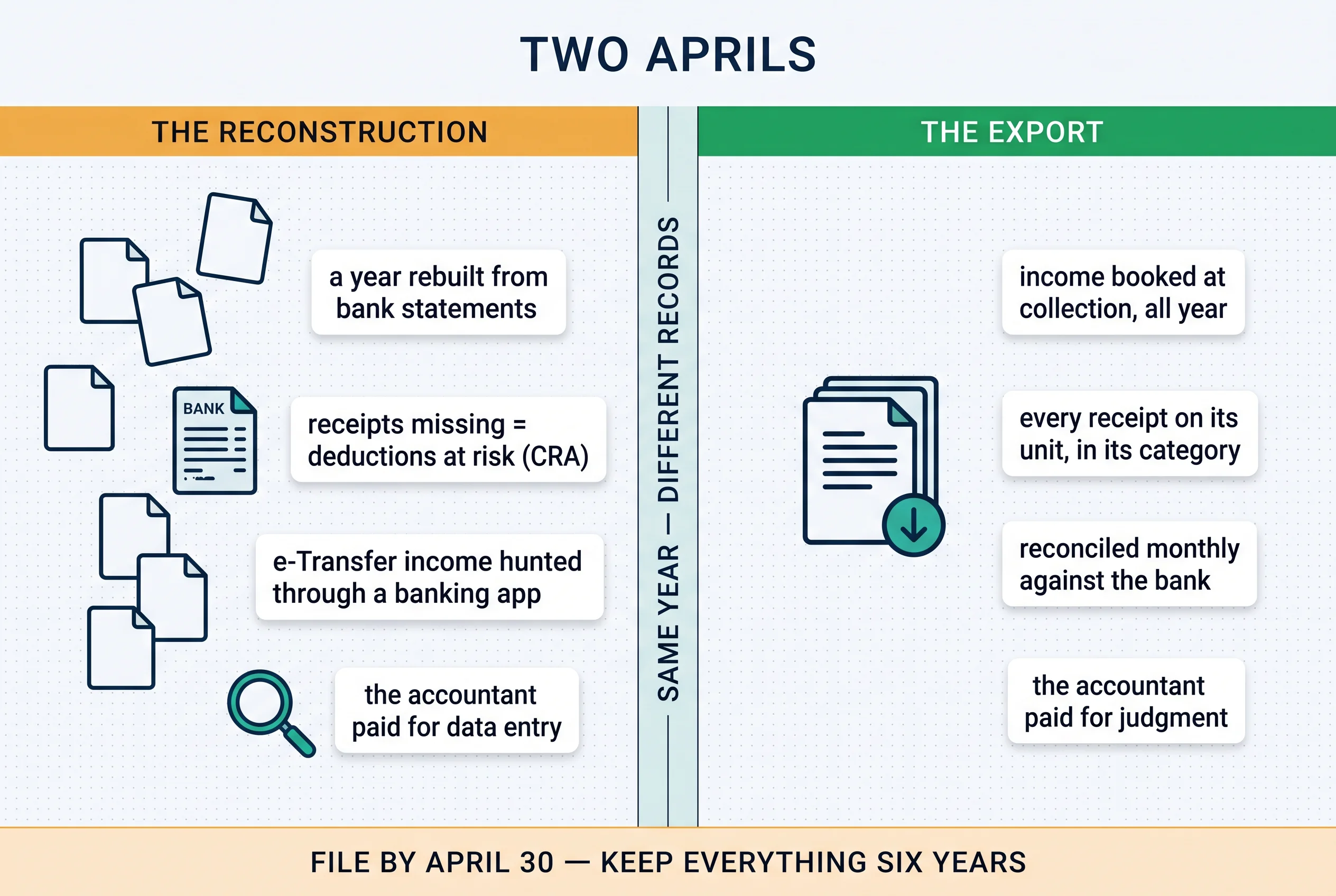
Now look at where the usual setups break. The spreadsheet enforces nothing: e-Transfer income lives in a banking app, receipts live in a drawer, and entry happens when you remember. Generic accounting software is excellent at general business books but has no native idea of units, tenants, leases, or rent rolls — and its categories are shaped for general business, or in US-first tools, for Schedule E. The pattern in category reviews is remarkably consistent: landlords start on spreadsheets, discover missed deductions and the April scramble, and migrate to something purpose-built. Consider an illustrative four-unit landlord — call it the shoebox April: every spring, a full weekend reconstructing a year from bank statements and a receipts drawer, guessing at categories, hunting for the invoice behind a $2,100 charge from last March. The same year, recorded contemporaneously, would have been an export.
The Walkthrough: How the Module Actually Works
1. Income books itself. When rent is collected on Tenon10 — card, bank transfer, or auto-pay, or offline cash, cheque, and Interac e-Transfer confirmed in-app — the receipt and ledger entry land instantly, on both sides. Tenants can even self-report an offline payment for your confirmation. That means the income half of your T776 assembles itself all year, whichever way your tenants pay (the tenant-side view lives in our guide to paying rent on Tenon10). The illustrative contrast is the e-Transfer ghost ledger: rent by e-Transfer with no system of record turns a payment dispute into screenshot forensics; tracked and confirmed in-app, the entry and receipt exist for both parties, timestamped.
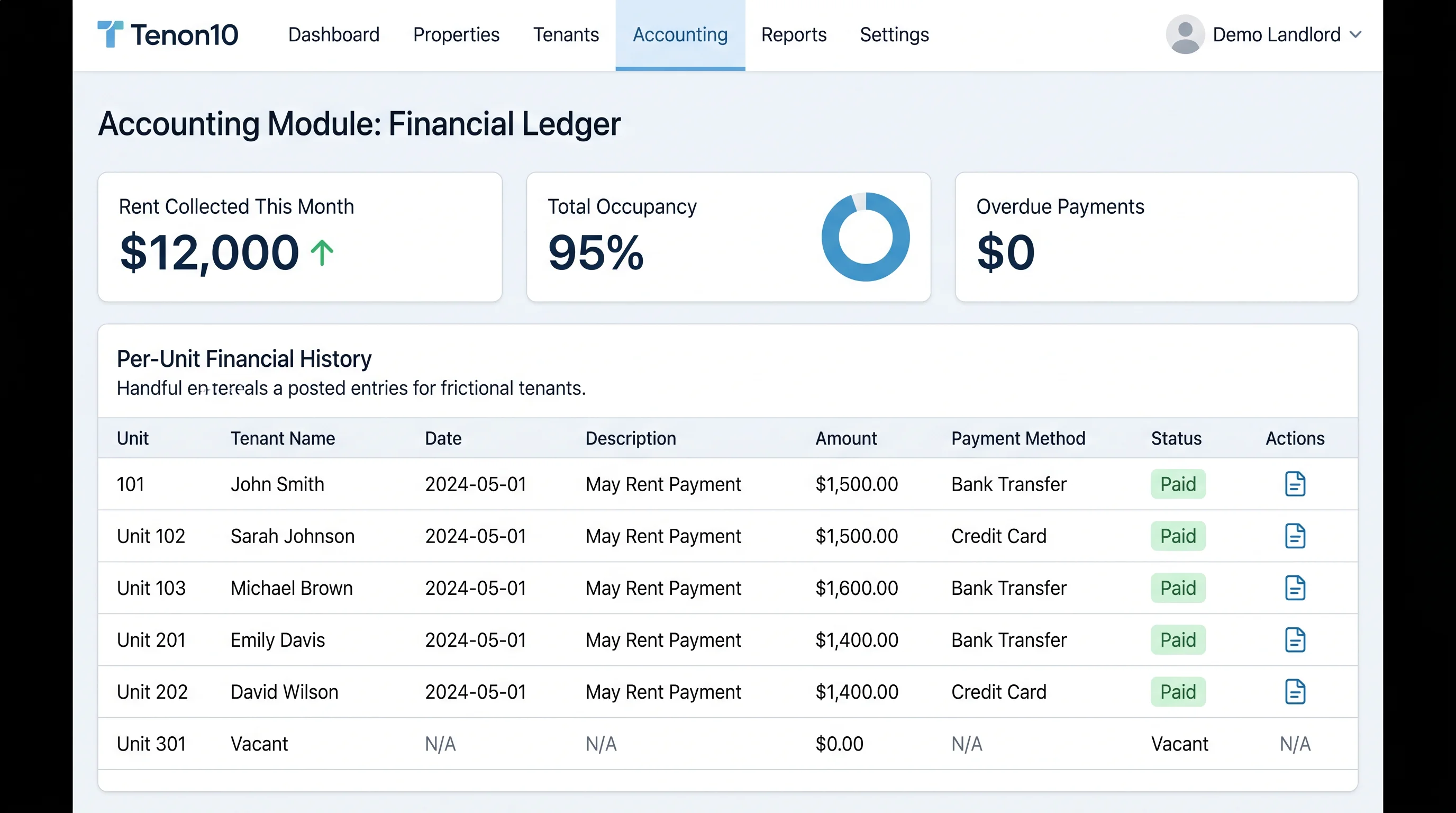
2. Expenses get a home. Per-unit financial history means the furnace invoice lives on the unit it belongs to, in its CRA-shaped category, at its date — the six-year record built contemporaneously rather than reconstructed. 3. A real engine underneath. This isn't a list of transactions wearing a ledger costume: there's a general-ledger engine underneath with proper posting, adjustments, and bank reconciliation — the underrated hero of the whole module. Reconciling monthly means matching the books to the bank while the month is warm; the classic illustrative catch is the rent marked paid whose e-Transfer was never actually accepted, found in week two instead of at year-end. 4. Compliance keeps the books clean. Ontario's rules are enforced in code — no unlawful late fees on rent, NSF charges capped at $20, last-month's-rent deposit only, and the 2.1% guideline for 2026 validated inside N1 increase flows. The payoff is a ledger that never accumulates charges you'd have to explain at the LTB or unwind at tax time — picture the new landlord who tries to add a $75 "late penalty" and is simply refused; months later, there's no unlawful charge history to defend.
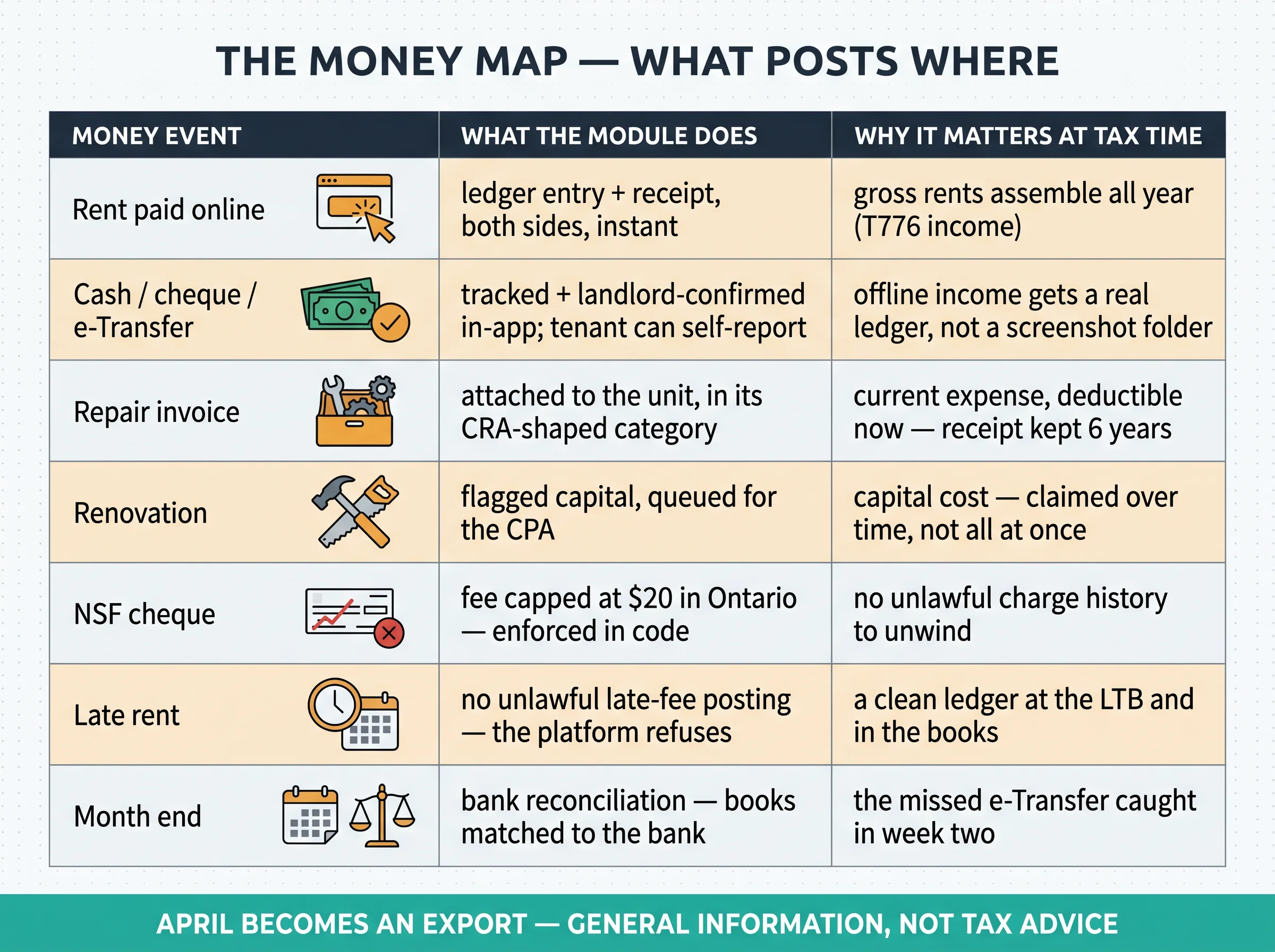
5. April becomes an export. The output is landlord-ready, tax-time financials — income by property, expenses by category, aligned to what the T776 asks — so the accountant conversation gets shorter (and accounting fees are themselves a deductible rental expense). 6. Ask instead of dig. Keya, the platform's AI copilot, answers ledger questions in plain English — the site's own demo is an accounting query: "What's my collection rate this month?" → "$8,400 collected of $9,600 due (87.5%). Three payments still pending." Keya gets its own deep-dive later in this series; for now, know that the books you build here are the books you can simply ask about.
Plans, Pricing, and Honest Limits
Where the accounting features sit: the Free plan ($0, up to 3 units) includes payment collection and tracking — which means the self-building income ledger starts at zero cost. Essentials ($9.99/month, up to 10 units) adds the fuller operating stack, and Pro ($49/month with a 30-day free trial, up to 25 units) is where the complete bookkeeping, tax-filing prep, and analytics & reports live. On payment costs: pre-authorized debit runs at the lesser of $7 or 1.5% per transaction, direct bank transfers are lower, and card fees are variable and always shown before you confirm. Tenants never pay, on any plan. Prices change — see tenon10.com/pricing for current rates.
"I built Tenon10 because Yardi serves institutional landlords and Buildium charges retail landlords $50 a month. The 1-to-25-unit landlord deserved a platform that fit their actual scale — not enterprise software with a small-business price tag."
— Syed Rehman, Founder, Tenon10
And the honest limits, because a deep-dive that reads like a brochure isn't worth your time. The mobile app is coming soon — today, the accounting module lives on the web app. Provincial compliance depth is Ontario-complete, with other provinces following the same jurisdiction-gated pattern. Tenon10 produces tax-ready books, not tax filings — it won't file your return, decide your capital cost allowance, or replace your CPA; it makes the CPA conversation shorter and cheaper. And for property managers: per-owner books and trust accounting exist on the platform and deserve their own walkthrough — that's the next deep-dive in this series.

Making It Stick: A Landlord's Bookkeeping Rhythm
The module removes the heavy lifting, but a light rhythm keeps it airtight. Weekly (about two minutes): confirm any offline payments into the ledger and attach expense receipts to their units the day they happen. Monthly (about fifteen): run bank reconciliation, chase mismatches while they're warm, and sweep per-unit history for anything uncategorized. Quarterly: sanity-check category totals against the chart of accounts (that's the download above) and queue capital-versus-current questions for the CPA now, not in April. Annually: export the financials, hand your accountant the package, file the T776 with your T1 by April 30, and archive the year.
The compounding payoff is that one clean ledger serves three masters at once: it's the audit defence in the sector the CRA reviews most, the evidence trail when a payment dispute reaches the LTB, and the valuation file when you refinance or sell and someone asks for two years of real numbers. Landlords running at scale layer the same discipline across every door — our rent collection at scale guide covers that operating layer, and the property management software guide puts the whole evaluation in context.
Practical Takeaways
- Pick ONE system of record and route all rental money through it — the ledger only builds itself if the money moves through it or gets confirmed in it.
- Attach the receipt the day the expense happens — the six-year rule is easiest kept in real time.
- Reconcile monthly, not annually — mismatches are cheap at thirty days and expensive at twelve months.
- Let the platform refuse unlawful charges — an empty late-fee column in Ontario is a feature, not an oversight.
- Keep categories CRA-shaped from day one — the chart-of-accounts download maps them.
- Separate capital from current as you go and queue CPA questions quarterly.
- At year-end, export — don't reconstruct.
Quick win: this weekend, confirm your last three months of e-Transfers into the ledger and attach the receipts sitting in your camera roll. Long-term: do nothing special — the six-year archive builds itself as a by-product of running the rentals.
The Canadian Landlord Chart of Accounts + Monthly Close Checklist
CRA-shaped categories for every dollar your rental earns and spends — a formula-live worksheet that totals your year the way the T776 asks for it, plus the monthly close routine that makes April an export instead of an archaeology dig.
Get Free PDF →Bookkeeping Shouldn't Be a Second Job
That's the module's whole idea. Collection writes the income ledger, units hold the expense history, the general-ledger engine and monthly reconciliation keep it honest, compliance guardrails keep it clean, and April becomes an export. It won't file your return, it won't replace your CPA, and the mobile app is still on its way — but the drawer of receipts and the January archaeology dig can end this year. Start free (the income ledger starts building at $0 for up to three units), grow into the full books when the portfolio justifies it, and let six years of CRA-grade records accumulate as a by-product of running your rentals. General information, not tax advice — verify pricing and rules at source, and talk to your accountant about your situation.
Let This Year's Books Build Themselves
Collect rent, confirm e-Transfers, attach receipts to units, and reconcile against the bank — with the Ontario Standard Lease, N1s, and every LTB form free alongside.
Free • No signup required • Updated for the Bill 60 changes in force 21 Sep 2026
Related Resources
The tax layer: The T776 Form: How to Report Rental Income — this article's natural companion · CRA Audits of Rental Income — what reviewers actually ask for.
The money layer: How to Pay Rent on Tenon10 — the tenant side of the same ledger · Rent Collection at Scale · Property Management Software: What to Look For in 2026.
Getting set up: Becoming a Landlord in Ontario · the Ontario Standard Lease · N1 and N2 rent-increase notices · the rent increase calculator and the full Ontario LTB forms hub.
Frequently Asked Questions
Does Tenon10 do accounting for landlords?
Yes — accounting is one of the platform's six core landlord workflows. When rent is collected through Tenon10 (card, bank transfer, or auto-pay) or confirmed in-app (cash, cheque, Interac e-Transfer), the receipt and ledger entry are created instantly for both landlord and tenant, so the income side of your books builds itself. Underneath sits a real general-ledger engine with adjustments and bank reconciliation, per-unit financial history holds your expenses, and the output is landlord-ready, tax-time financials aligned to what Canada's Form T776 asks for. Full bookkeeping, tax-filing prep, and analytics live on the Pro plan; payment collection and tracking — the self-building income ledger — start on the free tier. See tenon10.com/pricing for current plans.
What records does the CRA require for rental property?
The CRA expects you to report rental income and expenses on Form T776 with your personal return by April 30, and to keep the records and supporting documents behind every figure — receipts, invoices, lease agreements, bank statements — for six years from the end of the tax year they relate to. Its guidance is blunt: expenses without receipts or supporting documents may be disallowed in part or in full. That's why contemporaneous records beat reconstruction: a ledger entry created the day rent arrived, and an invoice attached to the unit the day the furnace was fixed, are exactly the evidence a review asks for. Real estate is among the CRA's most-reviewed sectors, so clean books are audit defence, not just April convenience. General information, not tax advice — confirm details with the CRA or a CPA.
Can I just use a spreadsheet or QuickBooks for my rentals?
You can, and many landlords start there — the question is what breaks. Spreadsheets enforce nothing: e-Transfer income lives in your banking app, receipts live in a drawer, and April becomes reconstruction. Generic accounting software is excellent at general business books but has no native idea of units, tenants, leases, or rent rolls, and its categories are built for general business (or, in US-first tools, for the IRS's Schedule E) rather than Canada's T776. Purpose-built platforms exist because the rental workflow is specific: income should book itself at collection, expenses should live on the unit they belong to, and the output should match the form you actually file. If your current system gives you all three, keep it; if April keeps hurting, that's the signal.
How much does Tenon10's accounting cost?
The income ledger starts at zero: the free plan ($0, up to 3 units) includes payment collection and tracking, so every rent that moves through or gets confirmed on the platform is booked with a receipt from day one. Essentials ($9.99/month, up to 10 units) adds the fuller operating stack, and Pro ($49/month with a 30-day free trial, up to 25 units) is where the complete bookkeeping, tax-filing prep, and analytics & reports live. On payment costs, pre-authorized debit runs at the lesser of $7 or 1.5% per transaction, direct bank transfers are lower, and card fees are variable and always shown before you confirm. Tenants never pay for the platform on any plan. Prices change — see tenon10.com/pricing for current rates.
Will Tenon10 file my taxes?
No — and that's deliberate. The module produces tax-READY books: income by property, expenses by CRA-shaped category, reconciled against your bank, exportable for your accountant or your tax software, aligned to what the T776 asks. Filing the return, choosing whether to claim capital cost allowance, splitting co-ownership shares, and judging capital-versus-current edge cases remain decisions for you and your CPA — and accounting fees, incidentally, are themselves a deductible rental expense. The realistic division of labour: the platform keeps the year's records complete and contemporaneous; your accountant turns them into the best lawful filing. Landlords who arrive in April with an export instead of a drawer tend to pay their accountant for judgment, not data entry.
This article describes Tenon10 platform capabilities and Canadian tax context as of July 13, 2026 and provides general information, not tax, legal, or accounting advice. Platform features, plan inclusions, and pricing change — see tenon10.com/pricing for current rates. Tax rules are per CRA Form T776 and Guide T4036 and may change; confirm your specific situation with the CRA or a qualified CPA before filing. Ontario compliance references reflect the Residential Tenancies Act as currently in force.


