As of July 30, 2026. This is the question where Ontario rental law does something almost nobody expects, and both sides of the lease routinely get it backwards. The honest answer runs in two stages: at the application stage, a landlord may generally choose not to rent to someone because they have a pet. But once the tenancy exists, a "no pets" clause in the lease is void — section 14 of the Residential Tenancies Act erases it — and a tenant who gets a pet after moving in usually cannot be evicted for the pet's mere existence.
Selection is allowed; prohibition is not. Nearly every bad answer online collapses those two stages into one — and both the landlord who thinks the lease clause protects them and the tenant who thinks refusal was illegal are working from the same collapsed map. Here's the accurate one, including the two exceptions that flip specific cases: service animals and condominium declarations.
The Tenant Screening Checklist
The authorized package, the grounds that never enter a file, and the consistency habit — the lawful way to run every application, pets included.
Get Free PDF →Stage one: the application — selection is generally permitted
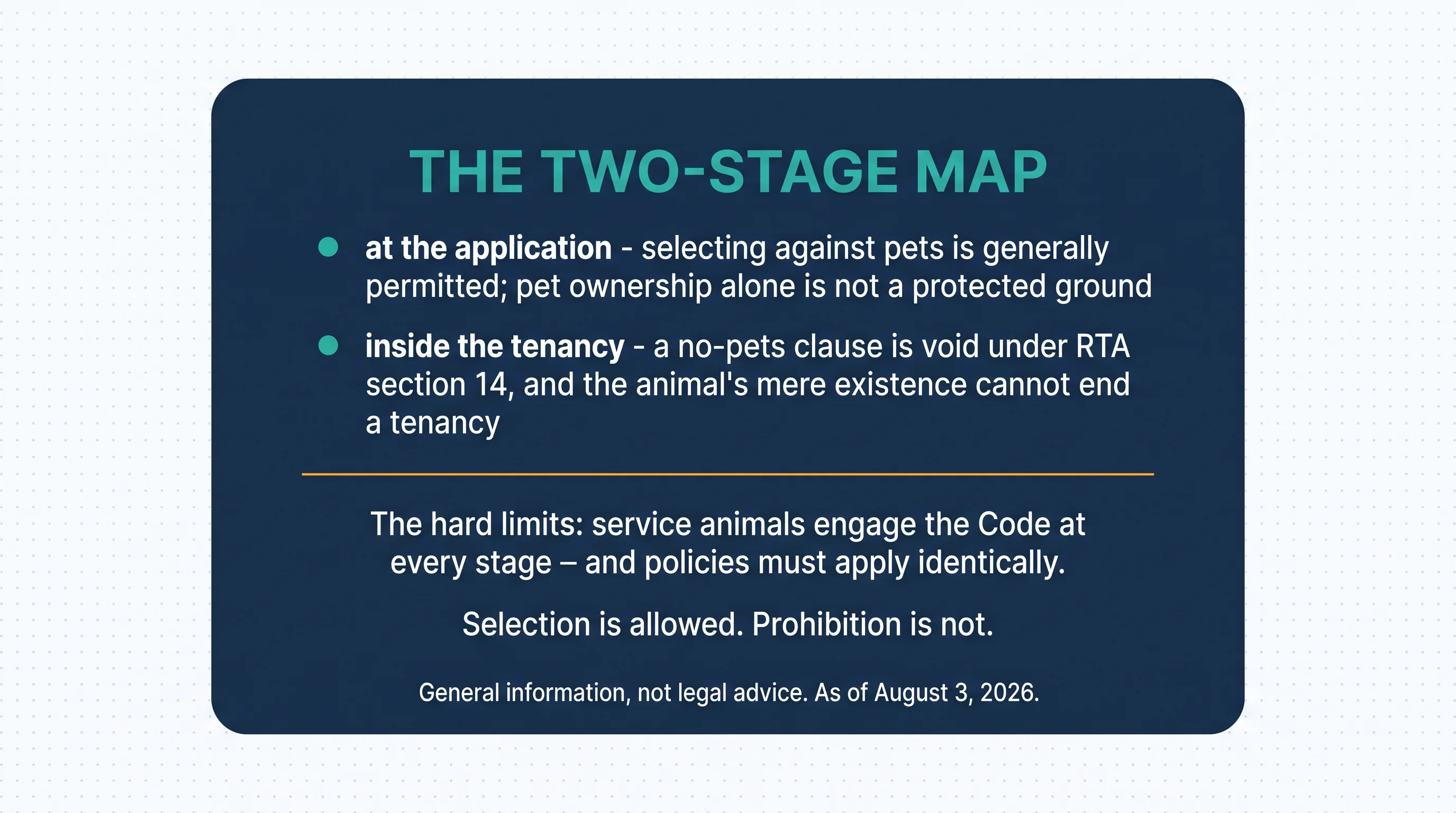
The RTA regulates tenancies, and at the application stage there is no tenancy yet. Nothing in the Act forbids a landlord from preferring a pet-free applicant, advertising a unit as unsuitable for pets, or asking whether an applicant has pets. Pet ownership, by itself, is not a protected ground under the Human Rights Code — "dog owner" is not a category the Code shields the way it shields family status or disability.
Why the law lands here is worth one paragraph, because it makes the rest predictable: the RTA protects homes, not applications. Before a tenancy exists there's no home to protect, so the landlord's ordinary freedom to choose operates; the moment the tenancy begins, the balance flips toward the person now living there — and a clause that would let paper terminate a home over an animal's mere existence is exactly what the Act refuses to enforce.
Two hard limits sit inside that permission. First, the service-animal carve-out: where an animal is connected to a disability — a guide dog, a service animal, an emotional-support animal supported by a genuine accommodation need — refusing the applicant over the animal engages the Code's disability protections, and the duty to accommodate applies at the application stage as much as anywhere. "No pets" can never lawfully mean "no service animals." Second, the proxy guard: a pet policy applied selectively — waived for some applicants and enforced against others in a pattern that tracks a protected ground — stops being a pet policy. Apply whatever policy you hold identically, or it isn't a policy. In practice the accommodation conversation is a documents conversation: an applicant relying on a service or support animal can expect to substantiate the disability-related need (not the diagnosis), and a landlord receiving that substantiation should treat the animal question as closed — pressing past it is where application-stage refusals turn into Code applications.
Stage two: the tenancy — the clause is void
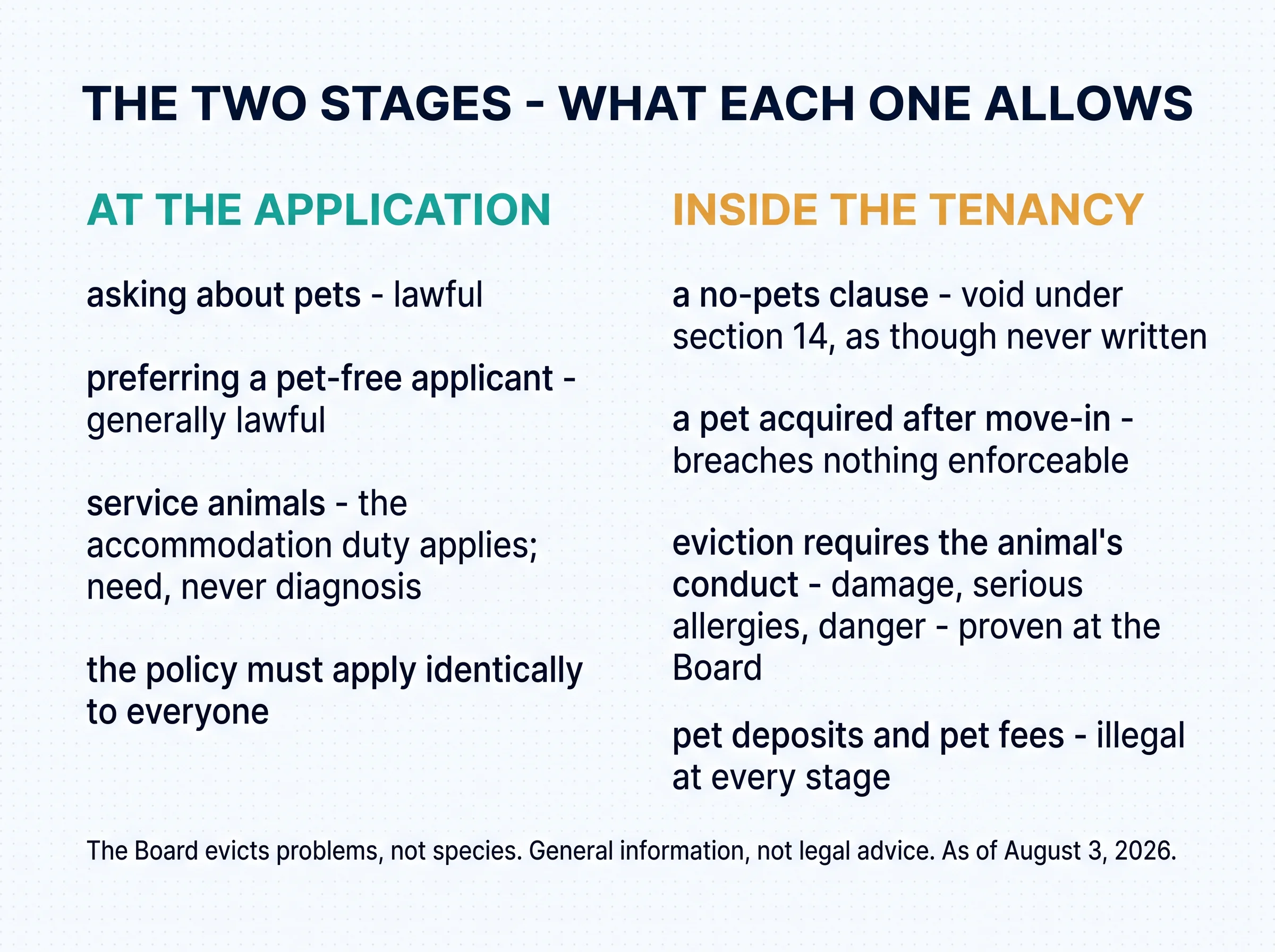
Section 14 of the RTA: a provision in a tenancy agreement prohibiting the presence of animals is void. Not "hard to enforce" — void, as though it were never written. A tenant who signs a lease with a no-pets clause and adopts a cat in month three has not breached anything enforceable, and the clause cannot support an eviction.
What the law targets instead of the animal's existence is the animal's actual behaviour: substantial damage, a serious allergy of another resident, an animal that's inherently dangerous, or substantial interference with reasonable enjoyment — each provable at the Landlord and Tenant Board through the proper notice and hearing, on evidence about this animal, not the category "pets." The Board evicts problems, not species.
The sequence for a genuine problem, sketched so neither side improvises: document the actual issue (the damage with photos and costs; the interference with dates and specifics; the allergy with its reality), serve the correct notice for the ground, and prove it at the hearing — about this animal, in this unit, on this evidence. What never works: citing the void clause, informal ultimatums, or treating the pet's discovery as the event. The event is the harm, if there is one.
The condominium exception
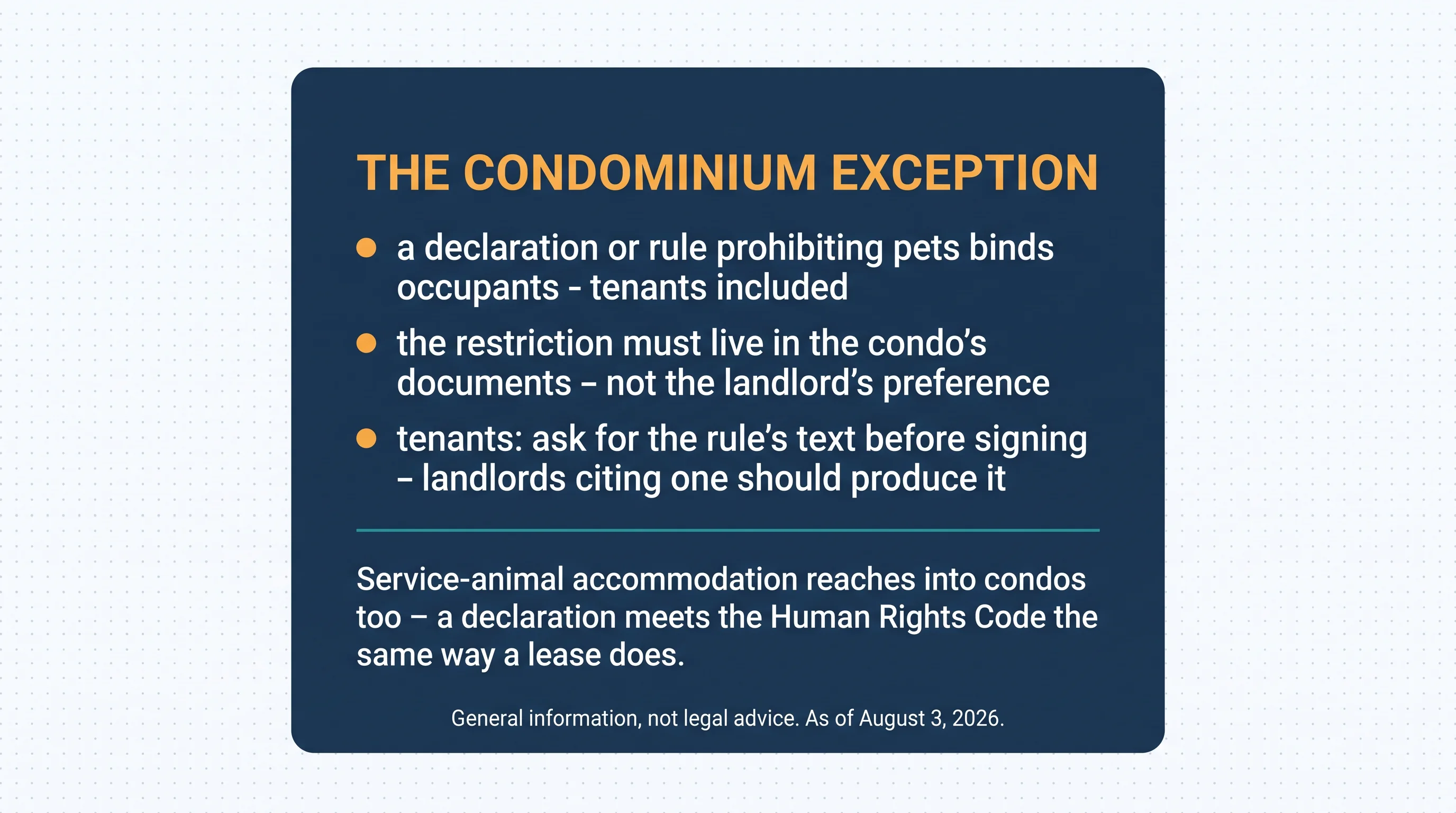
The one setting where a pet prohibition can genuinely bind a tenancy: a condominium whose declaration or rules prohibit pets. Condo governing documents operate under the Condominium Act, sit above the individual lease, and bind occupants — including tenants — so a unit in a genuinely no-pet building can lawfully exclude pets, and the corporation can enforce it. The distinction that matters: the restriction must actually live in the condo's documents, not merely in the landlord's preference wearing a condo costume. Tenants renting in condos should ask for the relevant rule; landlords citing one should be able to produce it. Two adjacent notes complete the condo picture: service-animal accommodation reaches into condos too — a declaration meets the Human Rights Code the same way a lease does — and a tenant weighing a no-pet building should get the rule's text before signing, because "the landlord said" and "the declaration says" are different facts with different futures.
Four scenarios, worked
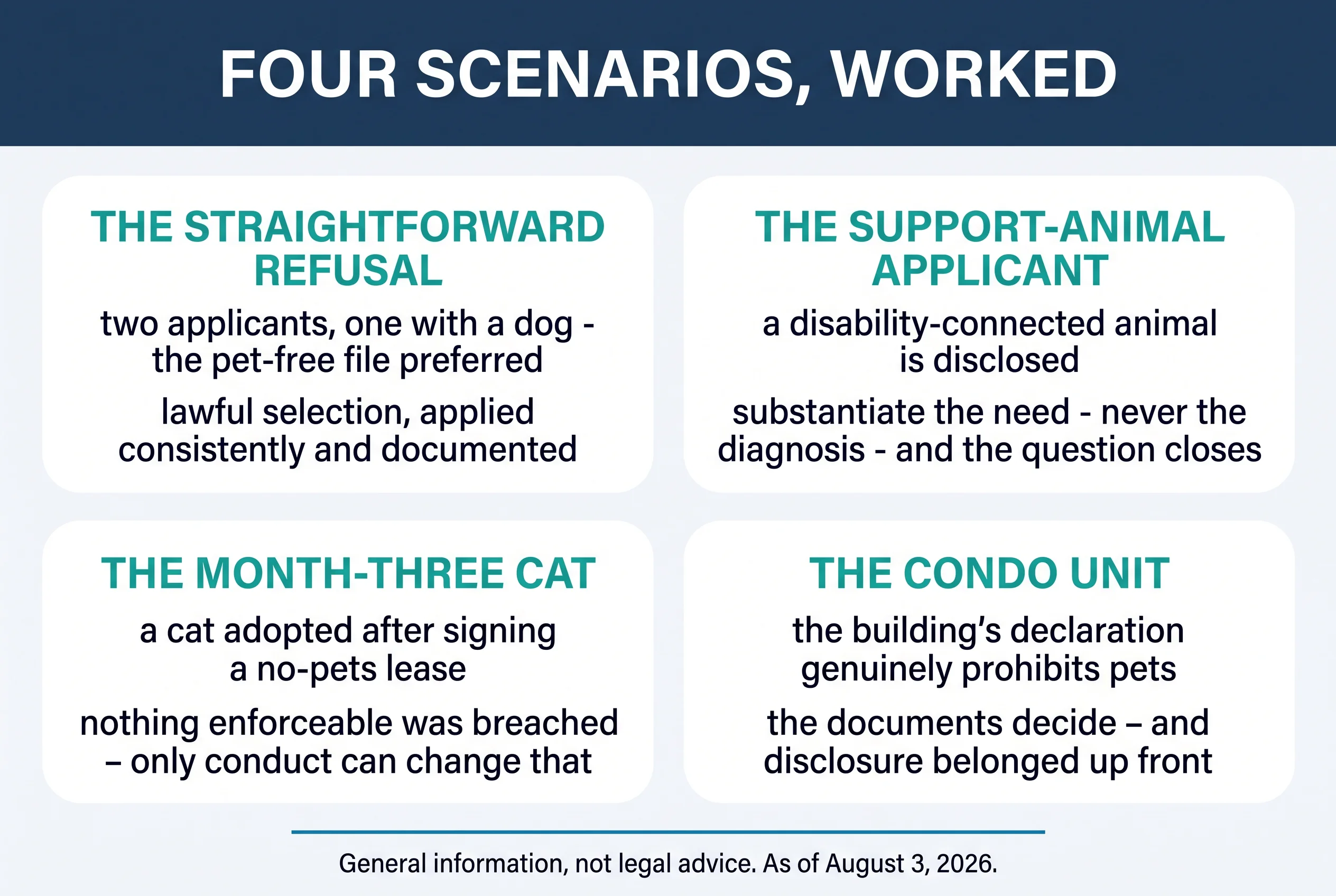
The straightforward refusal: two comparable applicants, one with a large dog; the landlord prefers the pet-free file and says so. Lawful — selection at application, applied as a consistent policy, is the freedom the law preserves. The clean version documents the same decision basis as any other screening call.
The support-animal applicant: an applicant discloses an emotional-support animal connected to a disability. The pet policy yields to the accommodation duty: the landlord may ask for substantiation of the disability-related need (never the diagnosis), and with it, the animal question closes. Refusing anyway converts a lawful pet preference into a Code application with a paper trail.
The month-three cat: a tenant signs a lease with a no-pets clause, then adopts a cat. Nothing enforceable was breached — the clause was void at signing. If the cat causes no problems, there is no lawful lever; if it damages the unit or triggers a neighbour's serious allergy, the Board route on evidence exists and works.
The condo unit: same cat, but the building's declaration genuinely prohibits pets. Now the prohibition binds — the corporation can enforce its documents against occupants, and the tenant's real dispute is with the declaration, not the lease. The landlord's job was disclosure up front; the tenant's was asking for the rule's text before signing.
Both chairs, plainly

💡 For landlords: Your real decision point is the application, because it's the only one you get. Select honestly there if pets don't work for the unit — and if a tenancy begins, plan around the truth that the animal question is now about behaviour and evidence, not clauses. For genuine problems, the Board route with documentation is the only route; self-help never is.
💡 For tenants: Being refused at application over a pet is generally lawful — disappointing, but not a rights violation unless a service animal or a protected ground is in play, in which case put the accommodation need in writing and keep the correspondence. Once you're in, the no-pet clause you may have signed is void — but your animal's behaviour is still your responsibility, and damage or disturbance can end a tenancy the clause never could.
The Tenant Screening Checklist
The authorized package, the grounds that never enter a file, and the consistency habit — the lawful way to run every application, pets included.
Get Free PDF →Key takeaways
- Two stages, two answers: refusing a pet-owning applicant is generally permitted; prohibiting pets inside an existing tenancy is not.
- RTA s.14 voids no-pet lease clauses — a tenant who gets a pet after moving in hasn't breached anything enforceable.
- Service animals are the hard carve-out: disability accommodation applies at every stage, application included.
- Eviction requires the animal's actual conduct — damage, allergies, danger — proven at the Board, not the animal's existence.
- Condo declarations are the true exception: a genuine building-level prohibition binds tenants; ask for the document.
- Pet deposits and fees are illegal — the money list never includes the pet.
Selection, not prohibition
Ontario's pet rule makes sense once you see what it's balancing: landlords keep the freedom to choose at the door, and tenants keep their homes from being governed by unenforceable paper afterward. The landlords who struggle with it are enforcing a clause the Act deleted; the tenants who struggle with it are appealing a refusal the Act permits. Know which stage you're standing in, and the law is actually quite predictable. This is general information, not legal advice — accommodation questions and condo disputes in particular deserve real advice on real facts. As of July 30, 2026.
Screen it once, screen it right
One consistent application process — pets, references, and all — documented the same way every time. Start with the screening workflow, free.
Free for up to 3 units • Tenants always free • See current plans
Related resources
- How to Screen a Tenant in Ontario — the pillar: the whole lawful process, end to end.
- What You Can and Can't Ask a Rental Applicant — the question-by-question companion.
- First and Last Month's Rent — the money rules, including why pet deposits are illegal.
Frequently asked questions
Can a landlord refuse to rent to me because I have a dog?
Generally yes, at the application stage — pet ownership alone isn't a protected ground. The exceptions: service animals and disability-related accommodation needs, where refusal engages the Human Rights Code.
Are no-pet clauses enforceable in Ontario?
No — section 14 of the RTA voids lease provisions prohibiting animals. A tenant who gets a pet after moving in cannot be evicted merely for having one; eviction requires proven problems like damage, serious allergies, or danger.
What about condos with no-pet rules?
That's the real exception: a condominium declaration or rule prohibiting pets binds occupants including tenants and can be enforced. Ask to see the actual provision — the restriction must exist in the condo's documents, not just the landlord's preference.
Can a landlord charge a pet deposit or pet rent?
No — pet deposits and pet fees are illegal in Ontario. The only lawful collections are first month's rent, a last-month's-rent deposit, and a refundable key deposit at actual cost.
Can I be evicted because my pet caused damage?
Yes — that's exactly what the law targets: the animal's conduct rather than its existence. Substantial damage, serious allergies of other residents, or a dangerous animal can support eviction through the Board's process, with evidence. This is general information, not legal advice.