

As of August 13, 2026. Every rental scam guide warns tenants. Almost none tells landlords that the same fraud burns them too — because rental fraud is a triangle: the scammer in the middle, the tenant whose deposit is the target, and the landlord whose listing was the raw material. The cloned ad that takes a student's deposit is built from a real landlord's photos and a real landlord's address — and that landlord finds out on showing day, when someone arrives with a suitcase and a receipt for a unit they never rented.
This page runs both chairs: the five patterns aimed at each side, the ninety-second checks that break them, and the four calls to make the day it happens anyway. One register note before the patterns, because it shapes how to read them: this architecture works on smart people under deadlines. Hot markets, moving dates, and competition pressure are the mechanism — which is why the defence is a checklist, not confidence.
The Two-Sided Scam Check
Tenant column, landlord column — the patterns, the ninety-second checks, the never-lists, and the four calls with the Anti-Fraud Centre's number. One page.
Get Free PDF →The five patterns aimed at tenants
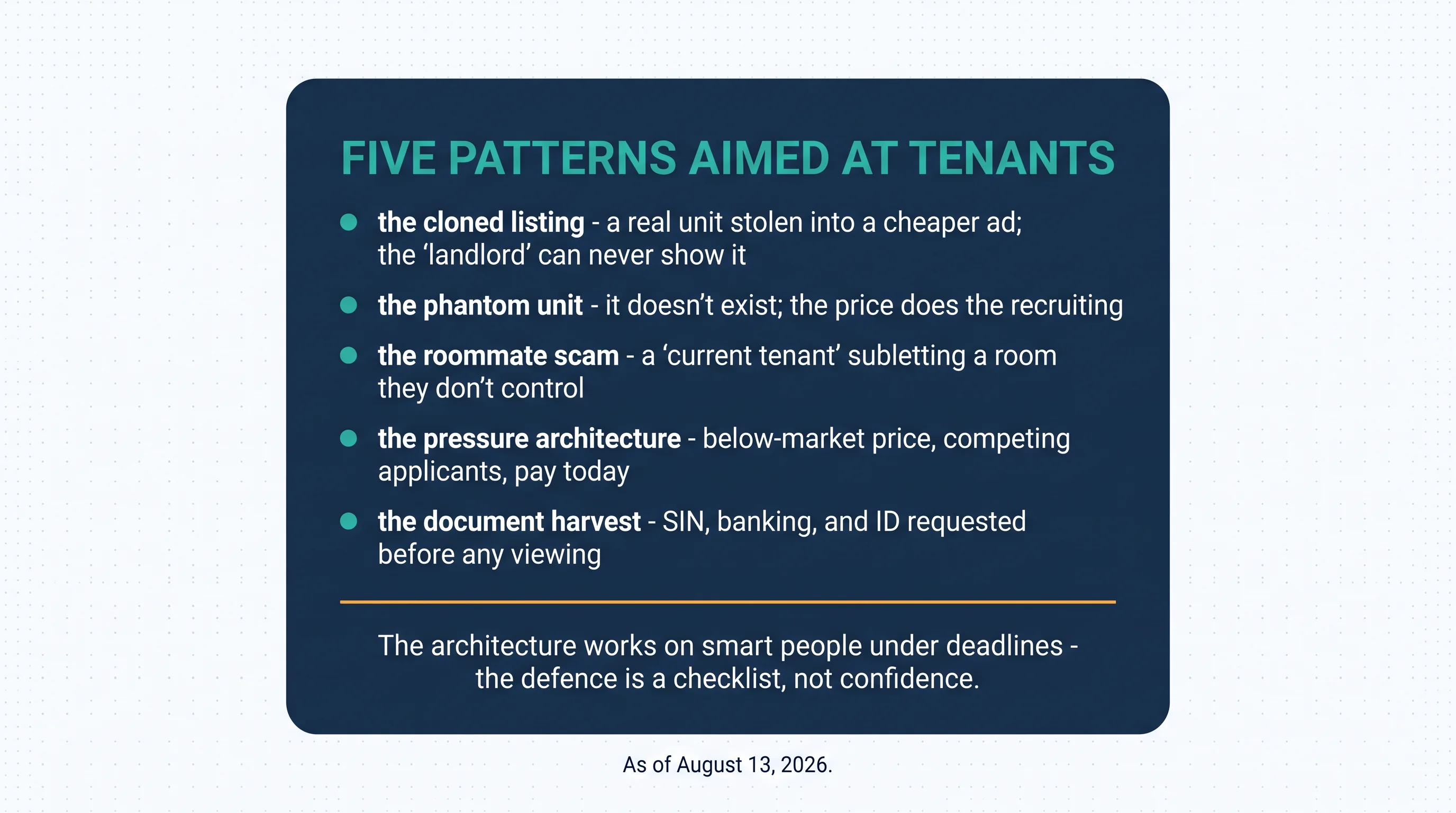
① The cloned listing. A real unit — real photos, real address, often the real ad text — stolen into a new posting at a lower price. Everything checks out because everything is real except the person answering. The tells sit in the process: the "landlord" can never show the unit ("I'm overseas — my agent will courier the keys"), and money is requested before any viewing. The unit exists; your tenancy in it never will.
② The phantom unit. Nothing exists at all — the photos are borrowed from anywhere, the address is real but unavailable, and the below-market price does the recruiting. Phantoms live on urgency: the listing that's "getting so much interest" that only a same-day deposit holds it.
③ The roommate scam. A "current tenant" subletting a room in a unit they don't control — sometimes a stranger to the building entirely, sometimes a short-term guest monetizing an address they'll leave before you arrive. First-and-last for a room, keys "next week," and next week the locks answer to someone who's never heard of them.
④ The pressure architecture. Less a separate scam than the engine inside all of them: significantly-below-market price plus manufactured competition ("three other applicants are viewing today") plus a payment deadline. The price recruits; the deadline converts. A genuine landlord in a hot market doesn't need this machinery — demand does their urgency for them.
⑤ The document harvest. The "application" that wants your SIN, banking details, and photographed ID before any viewing — because sometimes the deposit was never the goal; your identity was. No lawful screening process demands a SIN — which makes the demand itself a detector, covered below.
The scale, honestly stated: a single Peel Regional Police investigation this summer connected at least 17 victims and more than $60,000 in losses — one investigation, one region. Toronto Police logged more than 380 rental-scam reports in 2024, and every agency that tracks this assumes heavy underreporting. Typical individual losses run one to two months' rent — first and last, gone before the viewing that never comes.
The tenant's ninety seconds
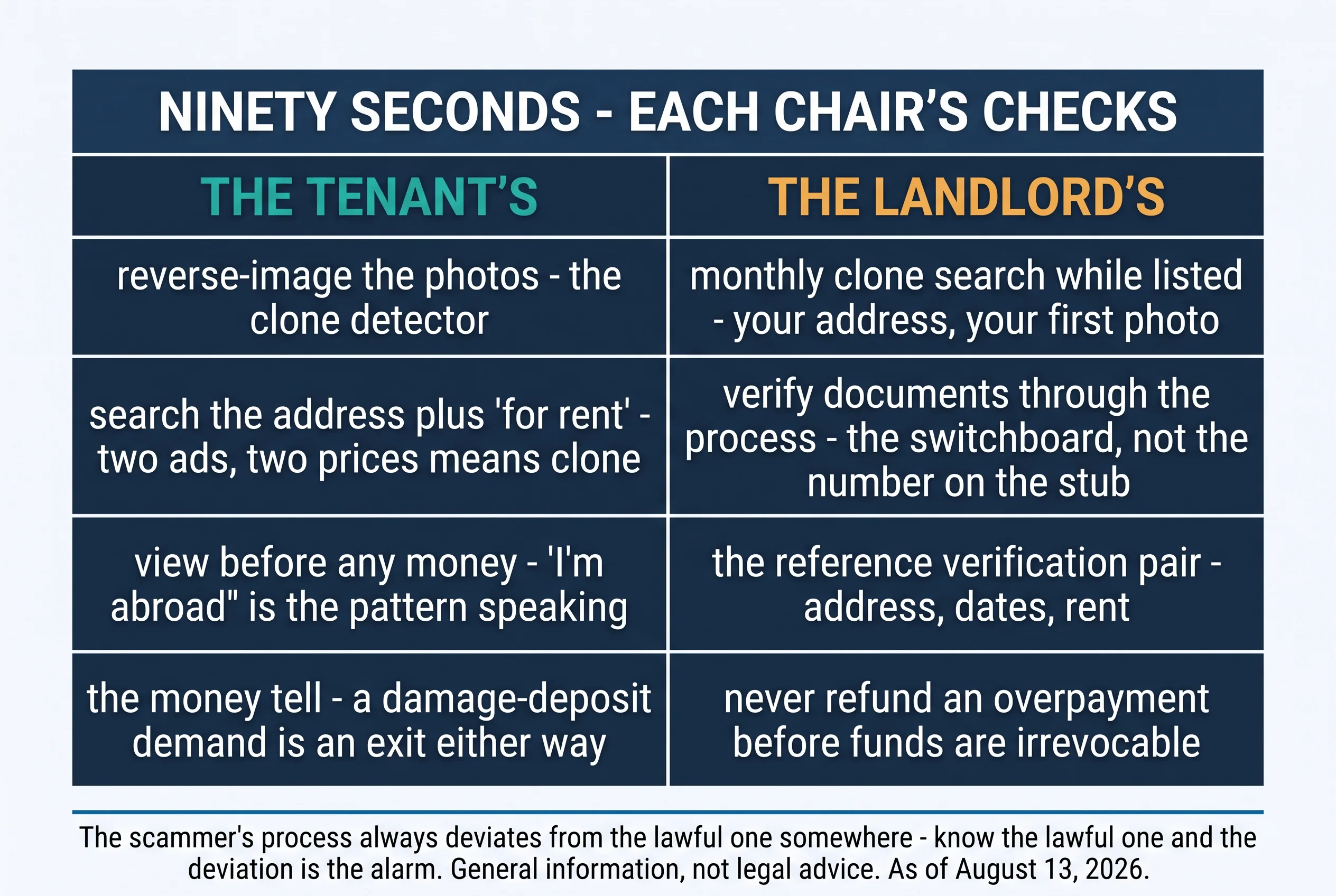
The defence costs less than reading this section. The three searches, before you reply to anything: reverse-image search the listing photos (right-click on desktop, long-press on mobile — a cloned photo surfaces its original in seconds) · search the address plus "for rent" (two live ads at two prices is a clone, and the cheaper one is the trap) · search the landlord's name with the address (mismatches and warnings surface). Ninety seconds, run before first contact — because the pressure architecture can't start on a listing that died at the search stage.
The viewing rule, non-negotiable: no money moves before you've stood inside the unit — or, for remote searches, before a live video walkthrough on a call you initiated to a number you verified. "I'm abroad" is not a circumstance; it's the pattern speaking. Every variation of the story — the agent with the keys, the courier, the lockbox after payment — exists to make paying-before-seeing feel procedural.
The money rules are the detector. Ontario permits exactly three collections at a tenancy's start: first month's rent, a last-month's-rent deposit, and a refundable key deposit at actual cost — after a signed lease. So a "damage deposit" demand is either an illegal landlord or a scammer — and both readings end the transaction. Pay traceably when you do pay: e-transfer to a verified identity, never wire services, never gift cards, never crypto — untraceable is the point of those requests.
For tenants — the abroad-searcher's protocol: Newcomers and students renting sight-unseen are the highest-risk searchers, and the protocol is stricter, not looser: a live video walkthrough on a call you place · a local proxy viewing where any friend-of-a-friend can manage it · payment only after a signed lease to a verified identity · and remember that Ontario's deposit rules travel with the unit — the law doesn't change because you're applying from Lagos or Chandigarh, and neither do the tells.
The five patterns aimed at landlords
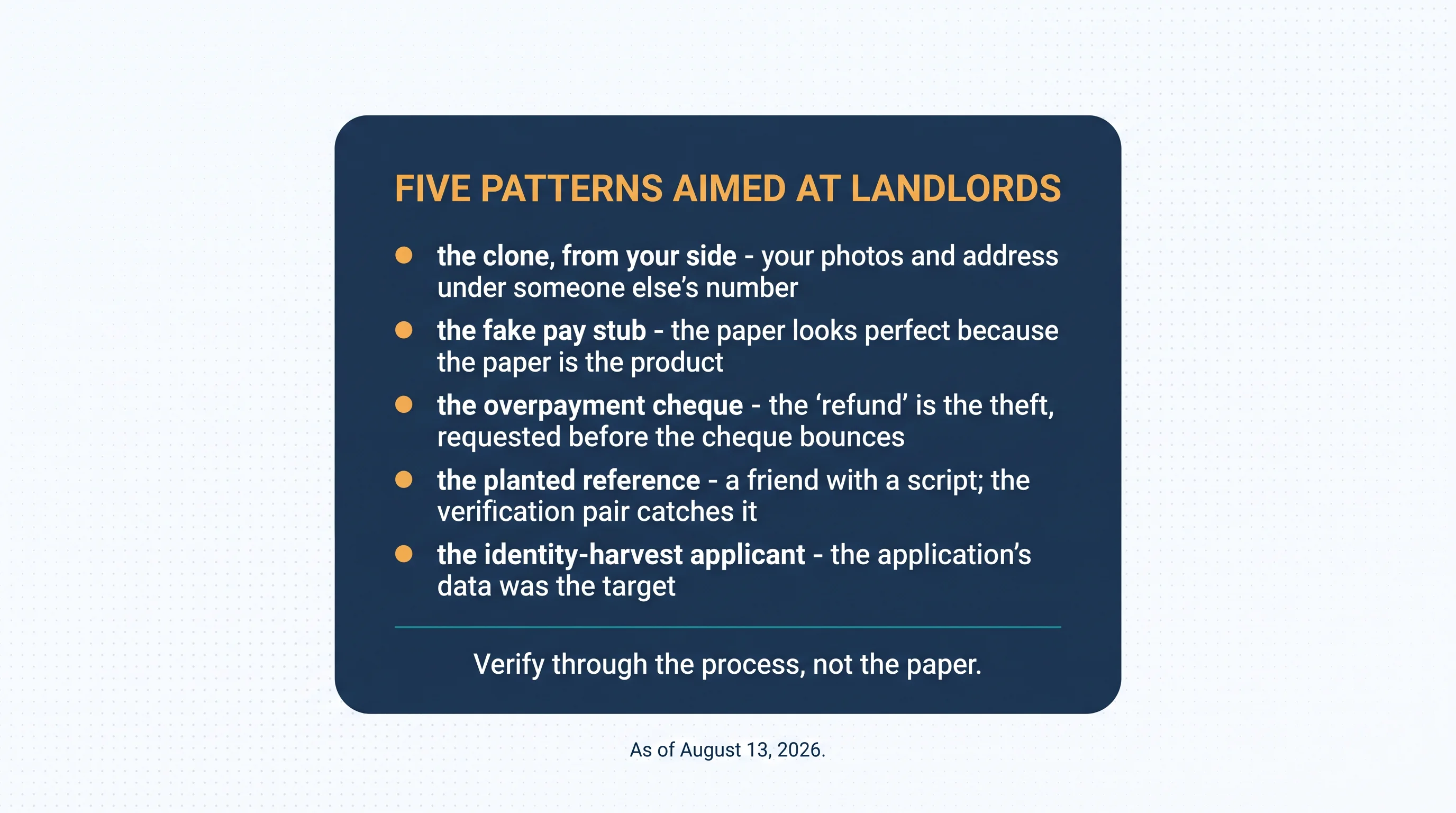
① The clone, from your side. Your photos, your address, your ad text — under someone else's phone number, at a price calculated to pull your applicants sideways. You learn about it the hard way: an applicant mentions "the cheaper ad for this place," or a stranger arrives at your showing having "already paid first and last." What it costs you: the confrontation with a victim who believed they were moving in, the unit's reputation on the platforms, sometimes a police visit to your own address — and applicants who now hesitate on the real listing.
② The fake pay stub. Income documents for a unit the applicant intends to burn — and the paper looks perfect because the paper is the product: polished stubs and employment letters are the fraud's whole craft. The defence isn't better squinting at fonts; it's verifying through the process instead of the paper — the credit-check guide in this series carries the full method.
③ The overpayment cheque. A deposit arrives for more than agreed — "my company's accounting made a mistake, could you e-transfer back the difference?" The refund is the theft: your e-transfer is real and instant; their cheque bounces days later, and you're out the "difference" plus the tenancy you held. Classic, decades old, still running because it works on polite people.
④ The planted reference. The "previous landlord" who's a friend with a script — enthusiastic about the person, rehearsed on the adjectives. The reference-call guide in this series opens every call with the verification pair built for exactly this: address, dates, and rent are facts a real landlord answers instantly and a script fumbles in thirty seconds.
⑤ The identity-harvest applicant. The application's data was the target all along — which is one more reason a lawful form collects no SIN and photocopies no ID: a form that harvests nothing has nothing to steal, and the applicant who pushes to hand over more than the form asks is telling you something too.
The landlord's defence
The monthly clone search, while listed: your address plus "for rent," and your first photo reverse-imaged — ninety seconds on the first of the month, because clones die young when found young: the earlier the takedown, the fewer of your applicants ever saw the trap. Verify documents through the process, not the paper: call the employer's switchboard (found independently — never the number printed on the stub), run the reference verification pair, and let the red-flags method read patterns across the file — paper can be perfect; processes are hard to fake in every direction at once.
The overpayment rule, absolute: never refund an overpayment before the funds have cleared irrevocably — and know that "deposited" and "irrevocable" are different events separated by days; the gap between them is the scam's whole mechanism. An honest overpayer waits a week without complaint. Only the scam needs the refund today.
For landlords: One printed sentence turns your applicants into your clone detectors — in every listing and at every showing: "We never ask for money before a signed lease; any ad for this unit doing so isn't us." It costs a line, protects your applicants, and means the first person to spot your clone is probably someone who was about to fall for it — and now emails you instead.
The day it happens: four calls, in order
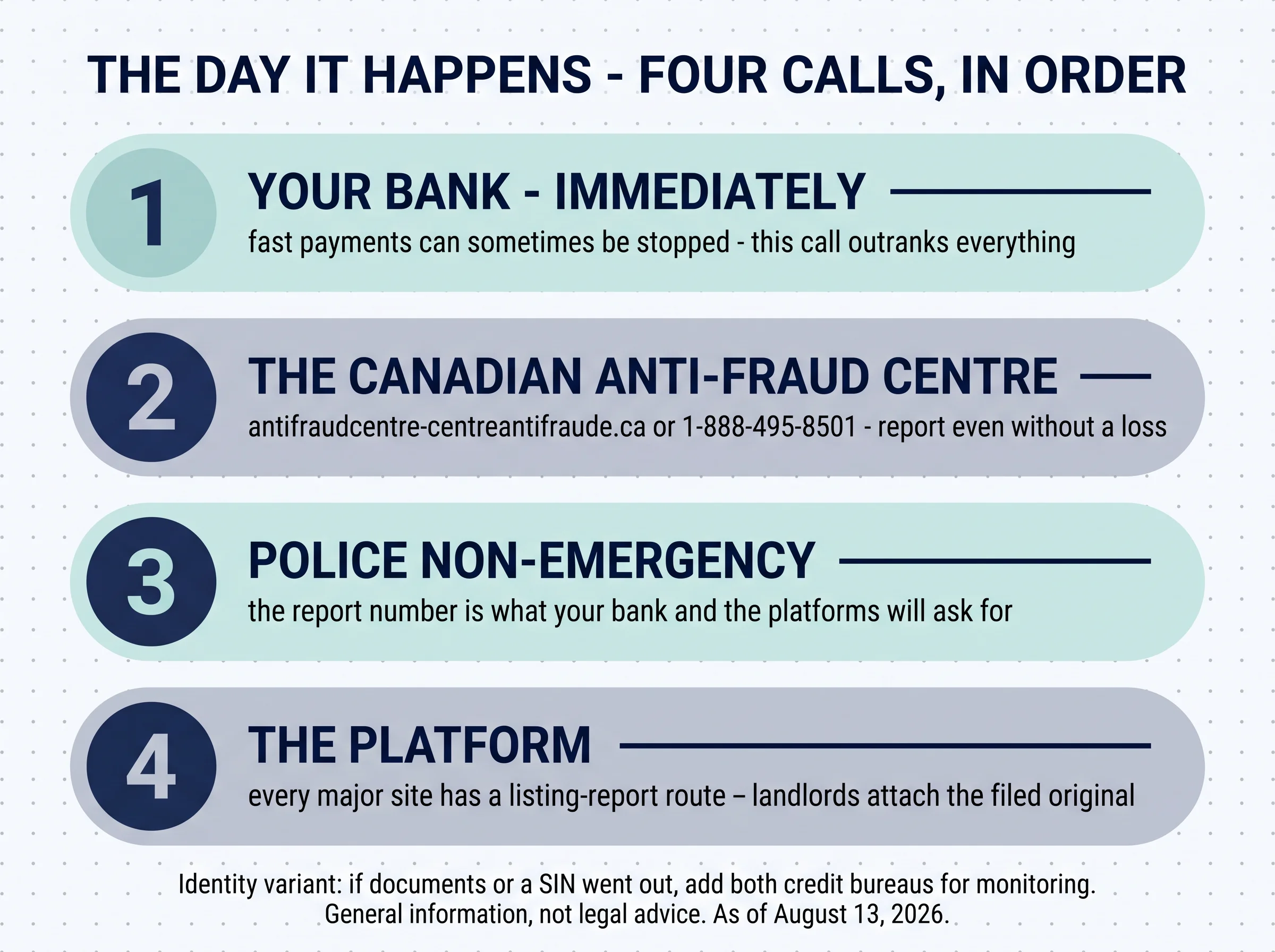
① Your bank, immediately. This call outranks everything, because speed is the only variable you still control: a fast-reported e-transfer or payment can sometimes be stopped or traced, and every hour closes that window further. ② The Canadian Anti-Fraud Centre — online at antifraudcentre-centreantifraude.ca or by phone at 1-888-495-8501. Report even if you lost nothing: pattern reports are how the Centre connects clone networks and issues the warnings that save the next person. ③ Police non-emergency. The report number is the artifact — your bank's fraud team and the platforms will both ask for it. ④ The platform hosting the fraudulent ad — every major site has a listing-report route, and landlords attach the filed original with its date.
The identity variant: if documents, banking details, or a SIN went out, the calls change shape — the bank still comes first, then both credit bureaus for fraud alerts and monitoring, because the deposit was never the goal and the harm arrives on a delay.
Why Ontario's rules are your scam detector
Here's the frame that ties both chairs together: the law's bright lines double as tells. The deposit rules — first, last, and key cost, after a signed lease — mean any other money request is an exit whichever explanation is true. The SIN rule — no lawful process demands one — makes the demand itself the finding. The viewing — a real landlord wants you to see the unit, because the unit is their sales argument — means a process engineered to avoid the unit is describing itself. Even the paperwork tells: a lease PDF proves nothing without a verified landlord and a viewed unit, because the paper is part of some kits.
Which yields the sentence both chairs can carry out of this page: the scammer's process always deviates from the lawful one somewhere — know the lawful one, and the deviation is the alarm. That's why the best scam defence in this series isn't this article; it's everything else in it.

The Two-Sided Scam Check
Tenant column, landlord column — the patterns, the ninety-second checks, the never-lists, and the four calls with the Anti-Fraud Centre's number. One page.
Get Free PDF →Key takeaways
- Rental fraud is a triangle — the tenant pays, the landlord's listing was the raw material, and both honest corners can break it.
- The tenant's ninety seconds: reverse-image the photos, search the address, view before any money, pay traceably.
- The money rules are the detector: a "damage deposit" demand is an illegal landlord or a scammer — both readings end the transaction.
- The landlord's defence: monthly clone search, verify through the process not the paper, never refund before funds are irrevocable.
- The day it happens: bank → Anti-Fraud Centre (1-888-495-8501) → police → platform — in that order, fast.
- Report without a loss — pattern reports kill clone networks and warn the next target; the second-act "recovery agent" is the same fraud returning.
The triangle, broken
The scam economy runs on two assumptions: that tenants won't spend ninety seconds checking, and that landlords won't notice their own listing wearing someone else's number. Both assumptions fail cheaply — three searches on one side, a monthly habit on the other, and the lawful process as the alarm system for everyone. The platform guide covers where to list safely; the deposit rules carry the money law; and the day it happens anyway, the four calls are on the card by your phone. This is general information, not legal advice — for a specific situation, consult a licensed professional. As of August 13, 2026.
Ontario's landlord tools, free
Calculators and trackers built for Ontario landlords — termination dates, rent increases, and more. No account needed.
Free forever • No signup required
Related resources
- Where to List: 9 Sites Compared — platform risk profiles, including where clones concentrate.
- How to Write a Rental Listing — the file-the-ad habit that becomes your takedown evidence.
- First and Last Month's Rent — the deposit rules that double as the money detector.
- What You Can and Can't Ask — why no lawful process demands a SIN.
- Tenant Application Red Flags — the pattern method behind the landlord's defence.
Frequently asked questions
How can I tell if a rental listing is fake?
Run the three searches before replying: reverse-image the photos, search the address plus "for rent," and search the landlord's name. Two ads at two prices is a clone — and a landlord who can never show the unit is the pattern speaking.
What do I do if I already sent a deposit?
Four calls, in order: your bank immediately (fast payments can sometimes be stopped), the Canadian Anti-Fraud Centre at 1-888-495-8501 or antifraudcentre-centreantifraude.ca, police non-emergency for a report number, and the platform hosting the ad.
Someone is using my listing photos — what now?
Report the clone to the platform with your filed original and its post date, warn your active applicants in one sentence, and file the Anti-Fraud Centre report — clones die young when found young.
Is it worth reporting if I lost nothing?
Yes — pattern reports are how the Anti-Fraud Centre connects clone networks and issues warnings, and how platforms link accounts. The report matters without a loss.
Are "too good to be true" prices always scams?
Significantly below market plus urgency is the signature pair — the price recruits, the deadline converts. A genuine deal survives a viewing and traceable payment; a scam can't allow either.


