As of July 30, 2026. Yes — and the reason this question gets answered badly all over the internet is that "first and last" bundles two completely different things. First month's rent is just rent, collected because the tenant is about to live in the unit. Last month's rent is Ontario's only legal deposit — strictly regulated, strictly for rent, and earning interest every year. Asking for both at signing is lawful and standard.
Everything past that sentence is where landlords get into trouble and tenants overpay: damage deposits are illegal, the deposit can never cover repairs, the interest obligation is real and annual, and half the guides online quote an interest rate from the wrong year. Here's the whole picture, precisely.
The Ontario Deposit Rules Card
What's legal, what's illegal, the interest math year by year, and the top-up rule — one page, both sides of the lease.
Get Free PDF →What you can collect at signing — the complete list
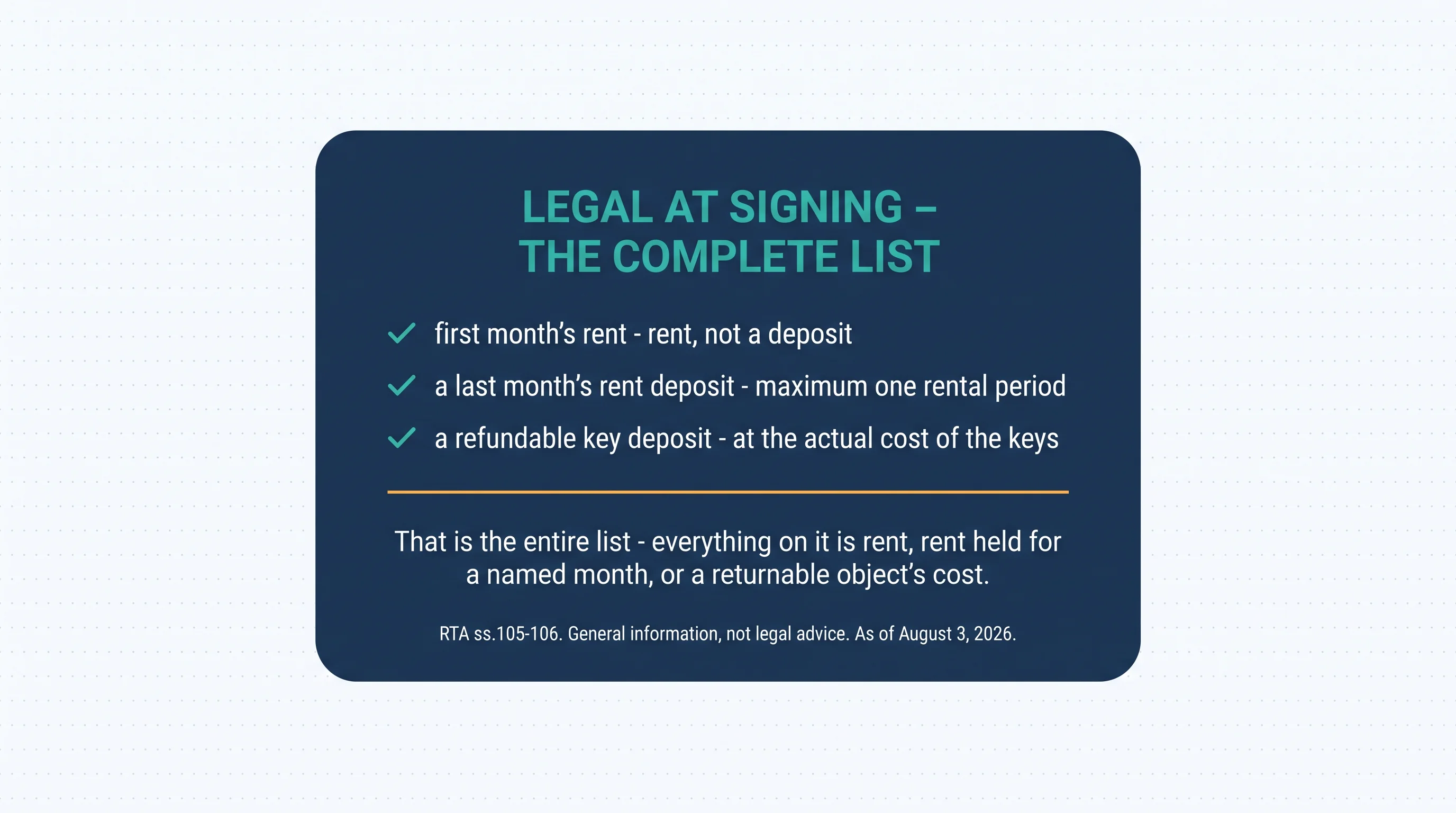
Under the Residential Tenancies Act [ss. 105–106], the complete lawful list at the start of a tenancy is short: first month's rent (rent, not a deposit), a last month's rent deposit of no more than one rental period — one month's rent on a monthly tenancy, one week's on a weekly one — and a refundable key deposit capped at the actual replacement cost of the keys or access devices.
That's the entire list — and notice what makes it coherent: everything on it is either rent itself, rent held for a named month, or the literal cost of a physical object returned at the end. Nothing on the lawful list is "security." That's the design, not an oversight: Ontario chose to make damage a claims process instead of a deduction process, and every deposit rule below follows from that single choice. Damage deposits, security deposits, cleaning deposits, pet deposits, and "move-in fees" are all illegal in Ontario — not discouraged, not grey-area: illegal, and recoverable by the tenant through a T1 application at the Landlord and Tenant Board. Ontario is stricter here than almost every other province, which is exactly why guides written with BC or Alberta in mind mislead people daily. If a lease template mentions a "damage deposit," that's the tell it crossed a provincial border somewhere — and it's worth auditing what else in the document did.
The deposit is for rent — never damages
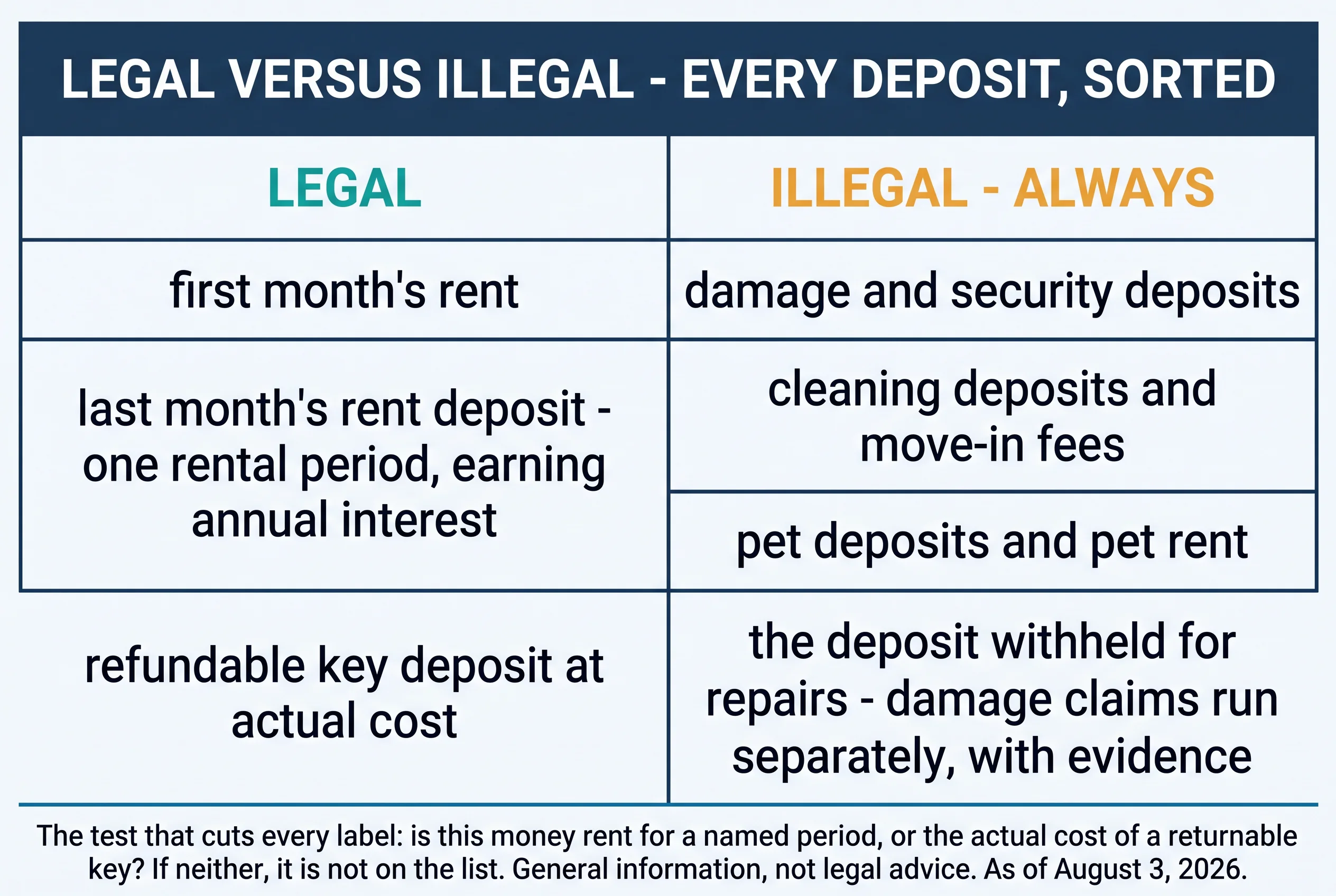
The last month's rent deposit has exactly one lawful use: the rent for the final rental period of the tenancy. When the tenant gives notice, the deposit covers that last month — they don't pay it again. What the deposit can never do is cover repairs, cleaning, or damage, no matter what the lease says or how the unit was left.
Damage has its own lawful route — an application to the Board (or the courts, depending on the situation) with evidence — and it runs entirely separately from the deposit. A landlord who withholds the deposit for damage hasn't shortcut that process; they've created a second dispute they'll lose while still having to run the first one properly.
The claims route, sketched honestly so nobody mistakes the deposit rule for immunity: a landlord with genuine damage documents it (dated photos, invoices, the move-in condition record), and pursues it through the Board's process — or the courts, depending on timing and amount. Tenants aren't off the hook for damage in Ontario; the hook is just a hearing with evidence instead of a unilateral deduction. Both sides behave better under that design, which was the point.
The interest obligation — and the year-matching habit
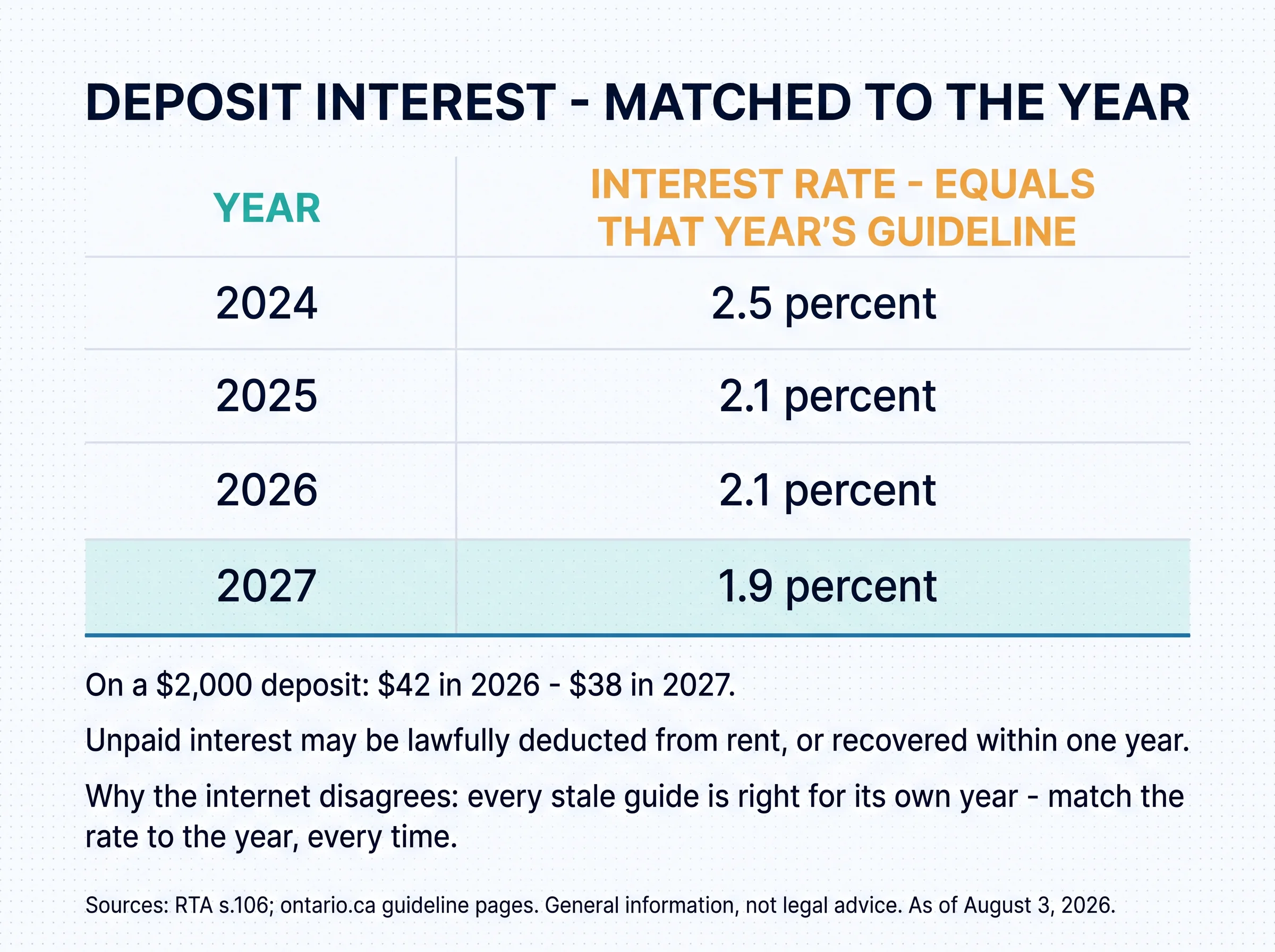
The deposit earns interest, annually, at a rate that changes every year: the interest rate equals the rent increase guideline for that year. That's 2.1 per cent for 2026 and 1.9 per cent for 2027 — and it's why so many online answers disagree with each other: a guide written in 2024 says 2.5, one from last year says 2.1, and none of them is wrong for its year. On a $2,000 deposit, that's $42 for 2026 and $38 for 2027. Match the rate to the year, every time — the same habit our rent-increase coverage teaches for the N1. Multi-year arrears compound the confusion: a landlord who never credited interest since 2024 owes each year at that year's rate (2.5, then 2.1, then 2.1), not three years at today's — the back-math is per-year or it's wrong.
Mechanics worth knowing on both sides: the interest is typically applied as a credit rather than a cheque — and when rent lawfully increases, the landlord may require the deposit topped up to the new rent, with the interest credit commonly netted against the top-up in the same step. If interest goes unpaid, the tenant is entitled to deduct it from a rent payment — a lawful deduction, not arrears — or recover it at the Board, subject to a one-year limitation. The top-up runs the other direction and is just as commonly missed: a deposit collected at $1,900 against a rent now lawfully $2,038 leaves the landlord short for the real last month unless topped up along the way — the annual interest-and-top-up entry handles both sides of the ledger in one sitting.
The move-out month, mechanically

Where the deposit finally does its job, step by step: the tenant serves proper notice (60 days to the end of a rental period, on the N9, in the usual case). The deposit — as topped up over the years — applies to that final period automatically; the tenant pays nothing for the last month, and a landlord requesting that month in cash "with the deposit refunded after" is proposing exactly the arrangement the Act forbids. Any interest accrued in the final partial year settles in the same reconciliation. If the rent rose after the last top-up, the landlord may collect the shortfall between deposit and current rent for that final month — which is why the annual top-up habit exists: it makes the last month a non-event instead of a negotiation.
One structural note that surprises people: on a weekly tenancy, all the same machinery runs at weekly scale — the deposit caps at one week's rent, and it covers the final week. The "month" in "last month's rent" is really "last rental period," and the Act says so.
For tenants: the three checks at signing
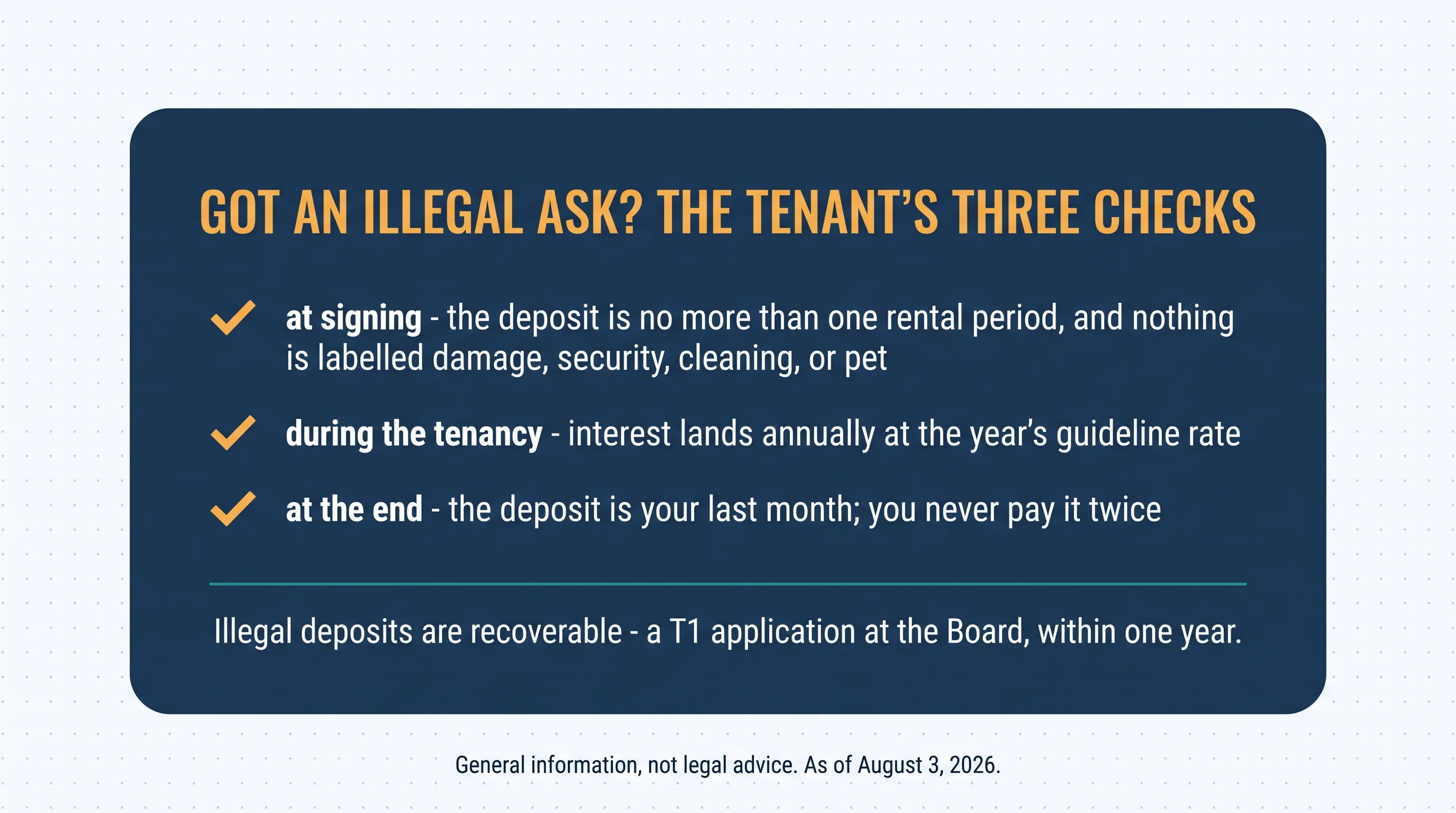
At signing: the deposit is no more than one rental period; nothing on the money list is labelled damage, security, cleaning, or pet; any key deposit tracks the actual cost of the keys. During the tenancy: interest lands annually at the year's guideline rate — and if it never does, you may deduct it from rent or recover it (one-year window). At the end: the deposit is your last month's rent. You don't pay that month and wait for a refund; if a landlord insists otherwise, decline politely and point to the Act.
💡 For tenants: If you've already paid an illegal deposit, it's recoverable — the T1 application at the Board exists for exactly this, and "everyone charges it" is not a defence the Board accepts. Document what you paid and when, and raise it in writing first; most of these resolve without a hearing once the rule is on the table.
Spotting the illegal ask — the phrasebook
Illegal deposits rarely arrive labelled honestly. The working aliases, all of which fail the same way: "damage deposit," "security deposit," "cleaning fee," "move-in fee," "admin fee," "pet deposit," "pet rent," "key money" beyond actual key cost, and the subtler "last month plus a little extra, just in case." The test that cuts through every label: is this money rent for a named period, or the actual cost of a returnable key? If neither, it's not on the lawful list — whatever it's called.
For landlords: the clean setup
💡 For landlords: Collect first month's rent plus the last-month deposit plus (if applicable) a genuinely refundable key deposit at actual cost — and nothing else, whatever another listing in your building asks for. Label the deposit correctly in the lease and your ledger, diarize the interest anniversary, and route any damage concern through the proper application with evidence. The lawful setup is also the simplest one; every "extra" deposit is future liability with interest.
One adjacent note for anyone screening applicants this season: what you may ask for in money at signing is this piece; what you may ask for in information on the application is its own body of law — our companion guide covers it, and the two together are the complete "what can landlords ask" answer.
The Ontario Deposit Rules Card
What's legal, what's illegal, the interest math year by year, and the top-up rule — one page, both sides of the lease.
Get Free PDF →Key takeaways
- Yes — first and last is legal and standard: first month's rent is rent; the last-month deposit is Ontario's only legal deposit (max one rental period).
- Damage, security, cleaning, and pet deposits are illegal — and recoverable via a T1 at the Board.
- The deposit is for the final month's rent, never damages — damage claims run separately, with evidence.
- Interest is annual at the year's guideline rate — 2.1% for 2026, 1.9% for 2027; match the rate to the year.
- Top-ups are lawful when rent increases; unpaid interest is deductible from rent by the tenant.
- A refundable key deposit at actual replacement cost is the only other lawful collection.
The short answer, kept honest
"Can you ask for first and last?" — yes, and almost everything attached to that yes is where the law actually lives: one deposit, one purpose, one interest anniversary, and a hard line through every deposit with "damage" in its name. Set it up cleanly and this is the least eventful money in the tenancy; set it up like another province and it's a T1 waiting for a filing fee. This is general information, not legal advice — for a live dispute, a community legal clinic or a licensed paralegal is the right next step. As of July 30, 2026 — interest figures rev with each year's guideline.
The deposit ledger that keeps itself
Deposits labelled correctly, interest anniversaries diarized, and the year's rate applied automatically — start your listing and lease the clean way.
Free for up to 3 units • Tenants always free • See current plans
Related resources
- What You Can and Can't Ask a Rental Applicant — the information side of "what can landlords ask."
- The N1 Deadline Math — the guideline rates the interest obligation borrows.
- How to Screen a Tenant in Ontario — the pillar this cluster reports to.
Frequently asked questions
Is asking for first and last month's rent legal in Ontario?
Yes. First month's rent is simply rent, and the last month's rent deposit — capped at one rental period — is the only deposit the RTA permits. Both at signing is lawful and standard.
Are damage deposits legal in Ontario?
No. Damage, security, cleaning, and pet deposits are all illegal in Ontario, and a tenant who has paid one can recover it through a T1 application at the Landlord and Tenant Board.
What interest is owed on a rent deposit?
Interest accrues annually at that year's rent increase guideline — 2.1 per cent for 2026 and 1.9 per cent for 2027. On a $2,000 deposit that's $42 and $38 respectively. If it goes unpaid, the tenant may lawfully deduct it from rent or recover it at the Board within a one-year window.
Can the deposit be used for repairs or cleaning?
Never. The deposit's only lawful use is the final rental period's rent. Damage claims run through their own process with evidence — entirely separate from the deposit.
Do I pay my last month and get the deposit back?
No — the deposit is your last month's rent. When you give notice, it applies to the final period; you don't pay that month again. This is general information, not legal advice.