

As of August 13, 2026. The reference call is screening's cheapest instrument and its most badly run. Most landlords skip it, or ask questions that invite rehearsed adjectives, or drift into territory the Human Rights Code governs even on a phone call. The fix isn't effort — it's design: a reference call collects facts about conduct, and every question below is built to make a fact easier to give than an adjective. "Were they a good tenant?" invites a rehearsed yes. "Did rent arrive on time — any exceptions?" invites a record.
Twelve questions, one structure, fifteen minutes per finalist. Our screening method carries the full sequence this call sits inside; the application-form guide in this series covers the fields that collected the references. This page runs the call.
Naming the three failure modes makes the design obvious. The skipped call throws away the file's only free verification. The adjective call collects "great tenant" three times and files nothing weighable. And the drifting call — the friendly one that wanders into kids, origins, and relationships — walks into Human Rights Code territory a form audit would have caught in seconds. The twelve below fix all three at once: they exist, they produce facts, and they have edges.
The Reference Call Script Card
The opener, all twelve questions with their purposes, the never-ask list, and the notes template — one page by the phone.
Get Free PDF →Who to call — and why previous beats current
The instinct is to call the current landlord; the better read usually comes from the one before. The reason is incentive, not accusation: a current landlord with a problem tenant has a reason to polish — a glowing reference moves the problem along — while the previous landlord's tenancy is closed: no motive either direction, and move-out condition is settled memory rather than a prediction. Call both where the history allows. The current landlord's facts still verify (is the rent arriving? was notice given?), but the previous landlord's answer to "would you rent to them again" is the call's most honest moment. And when the two calls disagree — a glowing current landlord, a hesitant previous one — the disagreement itself is the finding: something changed, or someone's polishing, and one factual follow-up to each usually says which.
Two other reference types get scoped, not skipped. Employers verify employment facts — role, tenure, income confirmation where the applicant consented — never character; "is he a good person?" is not a question an HR desk can answer and not one the file needs. Personal references are the weakest instrument: context only, non-family per the form's steer, and never a substitute for a landlord's tenancy facts.
Before you dial: the file-first rule
Reference time is finalist time, not applicant time. The call happens after the application is complete and has survived intake — verifying every applicant's references burns hours and goodwill on files that were never in contention, and the method sequences it deliberately: complete file, then verification, then decision. The references you're calling were provided in order to be called — the applicant listed them on the application knowing why — so the consent context is built in; your job on the phone is to identify yourself and stay inside the tenancy. Practical note on reachability: call from a number that shows caller ID plausibly, leave one clear voicemail with a callback window, and try the previous landlord first — they return calls at nearly the same rate and their answer weighs more.
The twelve questions — grouped, with their purposes
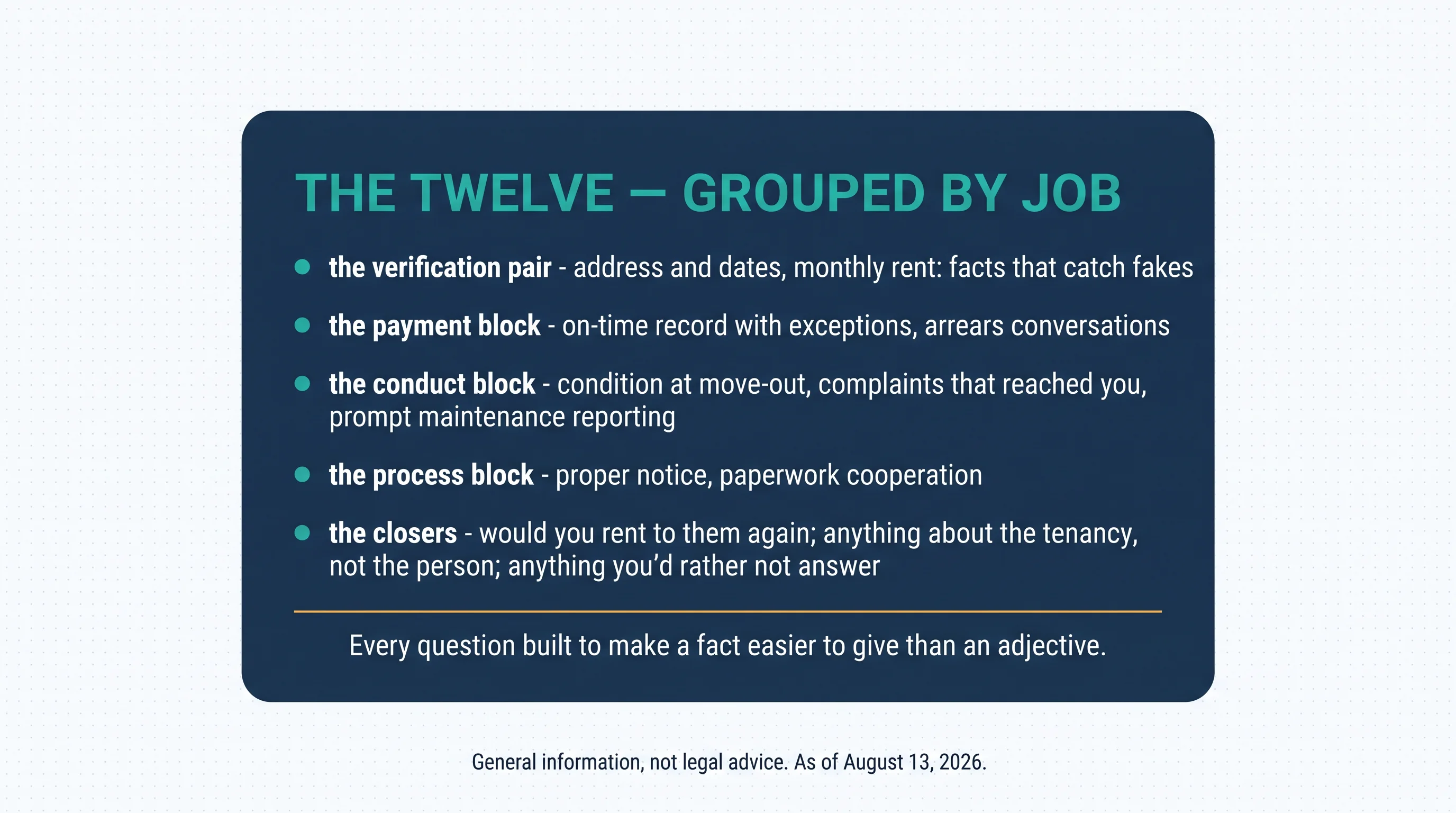

The verification pair — always first, because facts catch fakes:
1. "What address did they rent from you, and over what dates?" — verifies the application's history section, and it's the fake-catcher: a real landlord answers instantly; a planted reference stumbles, hedges, or asks to call back.
2. "What was the monthly rent?" — the same function from another angle; it cross-checks the file, and it's a number a genuine landlord knows cold.
The payment block:
3. "Did rent arrive on time? Any exceptions you remember?" — the record question; "any exceptions" gives an honest reference permission to be precise instead of loyal.
4. "Were there NSF payments or arrears conversations?" — depth on the record in factual form; "conversations" catches the near-misses a yes/no would hide.
The conduct block:
5. "How did they maintain the unit — what did move-out inspection look like?" — condition as facts, anchored to the one moment the previous landlord saw everything.
6. "Any complaints from neighbours or other tenants that reached you?" — interference in factual form: complaints that reached the landlord are events, not impressions.
7. "Did they report maintenance issues promptly?" — the both-ways question: a tenant who reports promptly is a good sign, and the answer also reads the reference's own reasonableness — a landlord who resents being told about leaks tells you how to weight everything else they've said.
The process block:
8. "Did they give proper notice when leaving?" — process conduct; the exit is where habits show.
9. "Was the tenancy's paperwork straightforward — lease signed, insurance provided if required?" — cooperation facts, and a quiet read on how the next lease signing will go.
The closers:
10. "Would you rent to them again?" — the one question a motivated reference can't game safely: an enthusiastic current landlord trying to move a problem along has to either lie outright or hesitate, and hesitation is data — read gently, per the next section. Ask it plainly and then stay quiet; the silence after this question does more work than any follow-up you could script.
11. "Is there anything about the tenancy — not the person — you'd want to know in my position?" — the open door, scoped to conduct; the phrasing does the Code's work inside the question itself.
12. "Anything I've asked that you'd rather not answer?" — the courtesy close: it thanks the reference for candour, and non-answers are also data, recorded without drama.
The Code is on the call
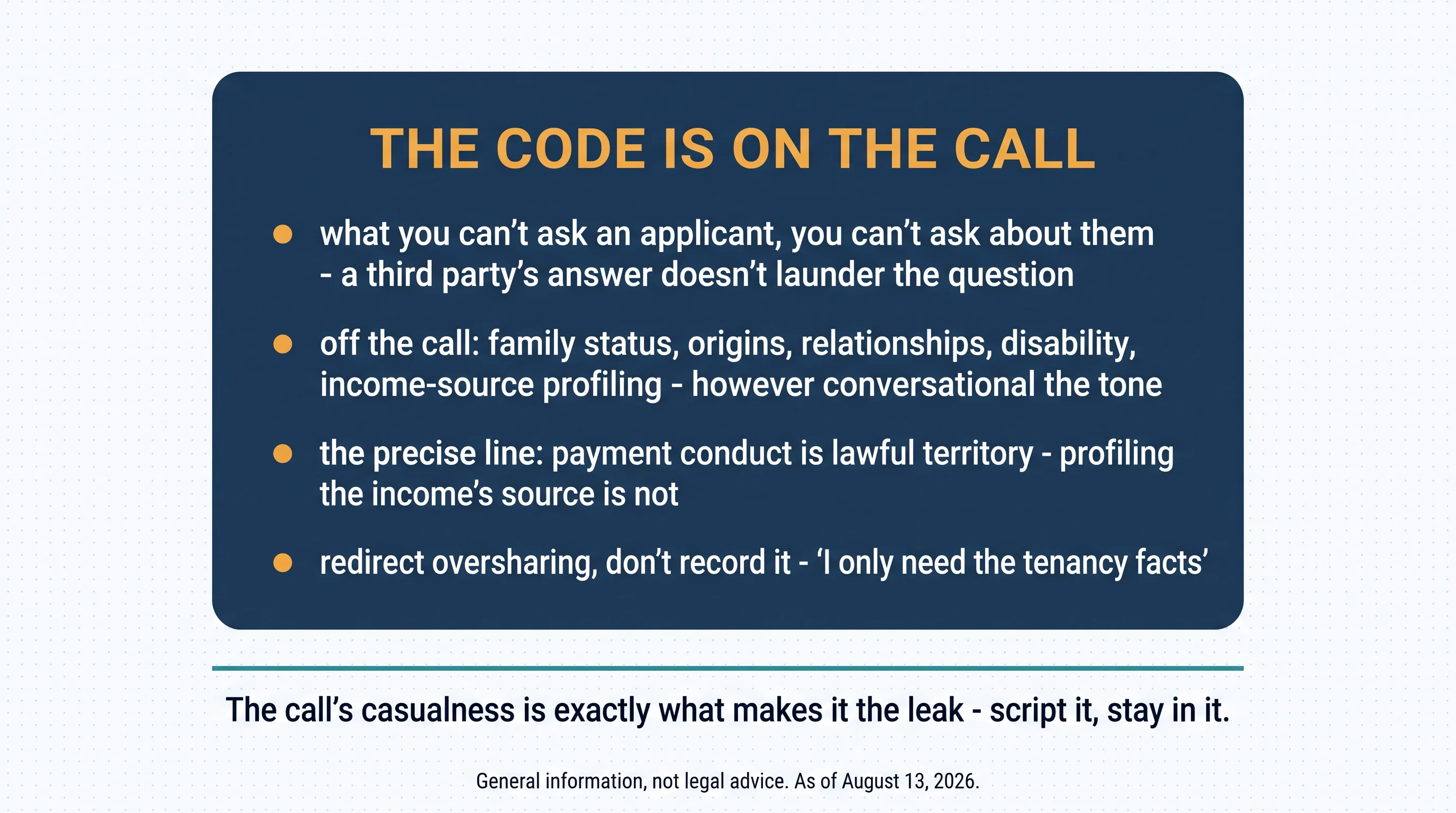
Here's the rule that governs every minute of the call: what you can't ask an applicant, you can't ask about them. Family status ("do they have kids?"), origins ("where are they from, originally?"), relationships ("is it just her?"), disability, income-source profiling — all off the call, however conversational the tone, because a prohibited question doesn't become lawful when a third party answers it. It's the same question with worse optics and a witness. The question-by-question guide maps the full territory; the call inherits every line of it.
The precise boundary is worth one worked example, because it's where careful landlords second-guess themselves: asking a previous landlord "did rent arrive on time?" about a tenant who receives public assistance is entirely lawful — payment conduct is the authorized territory. Asking "is that government money reliable?" is not — that's profiling the income's source, the exact move the Code names. Conduct, always; category, never.
And references overshare — it's the genre. "Well, after her divorce—" gets the redirect, warmly: "I only need the tenancy facts." What was volunteered uninvited doesn't go in the notes; the file holds conduct, and the redirect line is how the call stays inside its own scope without a single awkward moment. It protects the reference too: they didn't sign up to narrate someone's life, and a call that stays on the tenancy is one they can give honestly without wondering afterward what they should have kept back.
Reading what you hear

Facts over adjectives. "Great tenant" is unusable — it can't be weighed, compared, or defended. "Rent e-transferred on the 28th, two years, no exceptions" is a file entry. The twelve are designed to produce the second kind, and the notes should hold answers in the reference's words — your summaries flatten exactly the specifics that made the call worth making. "Paid fine mostly" in your handwriting is a different file entry than "one late payment in March 2025, communicated in advance, caught up within the week" in theirs — and only one of those survives a comparison between finalists, or a question about how the decision was made.
The too-polished pattern. Answers arriving faster than memory works, superlatives without a single specific, and — the tell — the verification pair fumbled: enthusiastic about the person, vague about the address, the dates, the rent. Read it as a pattern, never a verdict: coached and planted references exist, and the red-flags guide runs the full pattern method — conduct and consistency, never identity.
Hesitation, read gently. A pause on "would you rent to them again" is a prompt for exactly one factual follow-up — "is there a payment or condition fact behind that?" — and then the answer, whatever it is, goes into the notes. A pause is not a verdict; sometimes it's a landlord doing the honest work of remembering.
The together rule, applied. The call's output weighs with income, credit, and history — one factor's input, never a verdict alone. A shaky reference beside strong payment history and clean credit is a question to resolve; the same reference beside a thin file everywhere else is a different picture. The method does the weighing at decision time — the call just delivers honest inputs.
The fifteen-minute instrument

The notes close the loop: date, who you spoke to, the number called, the questions asked, the answers in their words — four lines that feed the decision note, written while the call is still warm. Same twelve, same order, every file: consistency on the phone is the same discipline it is everywhere else in screening, and it's what makes two finalists' reference calls comparable at all. The alternative — improvised questions per call — produces incomparable answers by design: one finalist got asked about parties, the other about payments, and the file can't say why. The script isn't rigidity; it's the only way the calls can be weighed against each other.
For landlords: The arithmetic that ends the "references take too long" objection: two calls per finalist — not per applicant — is the whole cost. Fifteen minutes of dialing against a bad tenancy's five-to-twelve-month downside, and it's the only verification in the file that's completely free. The credit-check guide in this series covers the money leg; this call is the tenancy leg, and the file needs both.
For property managers: The script card is the SOP: same twelve, same order, any leasing hand, every building — and the notes template standardized so a file from one property reads like a file from another. Reference calls get their own column in the intake log (called, reached, notes filed), and the annual audit pass that reviews the application form reviews the script in the same sitting.
The Reference Call Script Card
The opener, all twelve questions with their purposes, the never-ask list, and the notes template — one page by the phone.
Get Free PDF →Key takeaways
- Previous beats current — closed tenancies have no motive to polish, and "would you rent to them again" lands honestly there.
- The verification pair opens every call: address, dates, rent — facts catch fakes in thirty seconds.
- Twelve questions, one design rule: every one built to make a fact easier to give than an adjective.
- The Code is on the call: what you can't ask an applicant, you can't ask about them — redirect oversharing, don't record it.
- Hesitation is data read gently; the too-polished reference is a pattern, never a person.
- Answers in their words, into the notes, weighed with the package — one factor's input, never a verdict alone.
The cheapest leg of the file
Fifteen minutes, twelve questions, one structure — and the only verification in the file that costs nothing but the dialing. Run it after the file is complete, keep it inside the tenancy, write down what you heard in the reference's own words, and let the weighed decision do the judging. The method carries the sequence; the card by the phone carries the script. This is general information, not legal advice — for your situation, consult a licensed professional. As of August 13, 2026.
Ontario's landlord tools, free
Calculators and trackers built for Ontario landlords — termination dates, rent increases, and more. No account needed.
Free forever • No signup required
Related resources
- How to Screen Tenants in Ontario — the complete method this call sits inside.
- What You Can and Can't Ask — the question-by-question map the call inherits.
- Tenant Application Red Flags — the full pattern method for reading verification results.
- Screening With LTB Orders — the other verification instrument, with its five risks.
Frequently asked questions
What questions can you legally ask a tenant's reference?
Tenancy-conduct questions: payment record, condition, notice, complaints, cooperation — the same lawful territory as the application. Protected-ground questions are off the call exactly as they're off the form.
Should I call the current or previous landlord?
Both where possible — but weight the previous one: their tenancy is closed, so there's no incentive to polish, and "would you rent to them again" lands honestly.
How do I spot a fake landlord reference?
Open with facts: address, dates, monthly rent. A real landlord answers instantly; a planted reference stumbles — and superlatives without specifics complete the pattern.
What if the reference says something negative?
One factual follow-up, then weigh it with the package — a bad reference is one factor's input, not a verdict, and hesitation gets read gently.
How many references should a tenant provide?
Two landlord references (current and previous) where the history allows, plus employment verification — quality beats count, and non-family beats friendly.


