

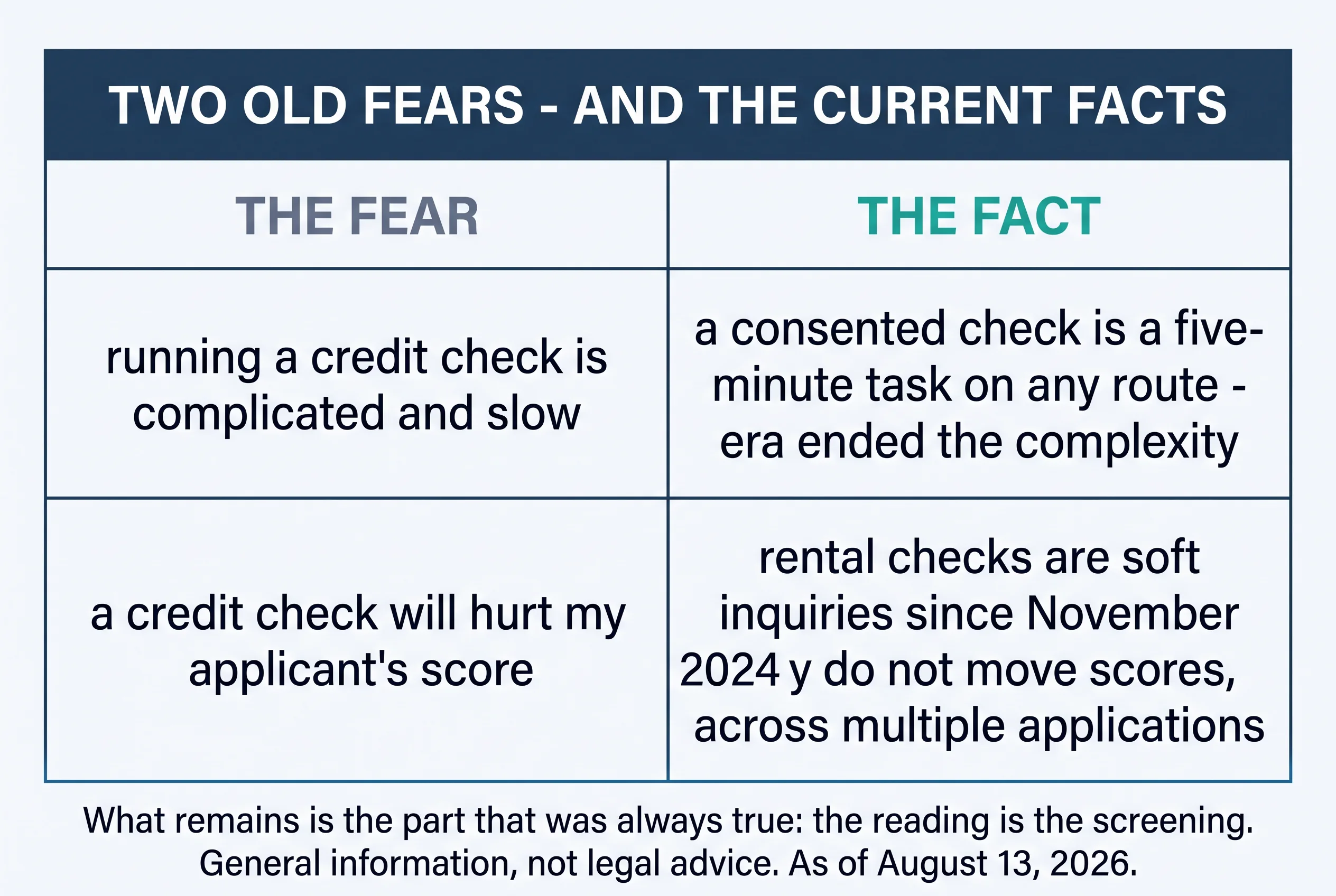
As of August 13, 2026. Two fears keep Ontario landlords from running proper credit checks, and both are out of date. "It's complicated" died when the platform era made a consented check a five-minute task. "It'll hurt the applicant's score" died in November 2024, when rental credit checks became soft inquiries. What's left is the part that was always true and always skipped: the check is the easy half — the reading is where screening happens.
Here's the whole run in five moves: consent confirmed, route chosen, check run, report read lawfully, decision noted. Our screening method carries the full seven-stage sequence this sits inside; the question-by-question guide carries what's askable anywhere. This page runs the check.
Worth naming what the five moves replace: the two failure modes this piece exists to end are the landlord who skips the check entirely ("too complicated, and I liked them") and the landlord who runs it and reads only the score. Both outsource the decision — one to a feeling, one to a number — and both throw away the report's actual information. The five moves cost fifteen minutes end to end and keep the deciding where it belongs.
The Tenant Credit Check Run Sheet
The five moves, the routes with real costs, the four reading rules, and the applicant-facing soft-inquiry line — one page.
Get Free PDF →Before you run anything: consent, identifiers, and the SIN you don't need
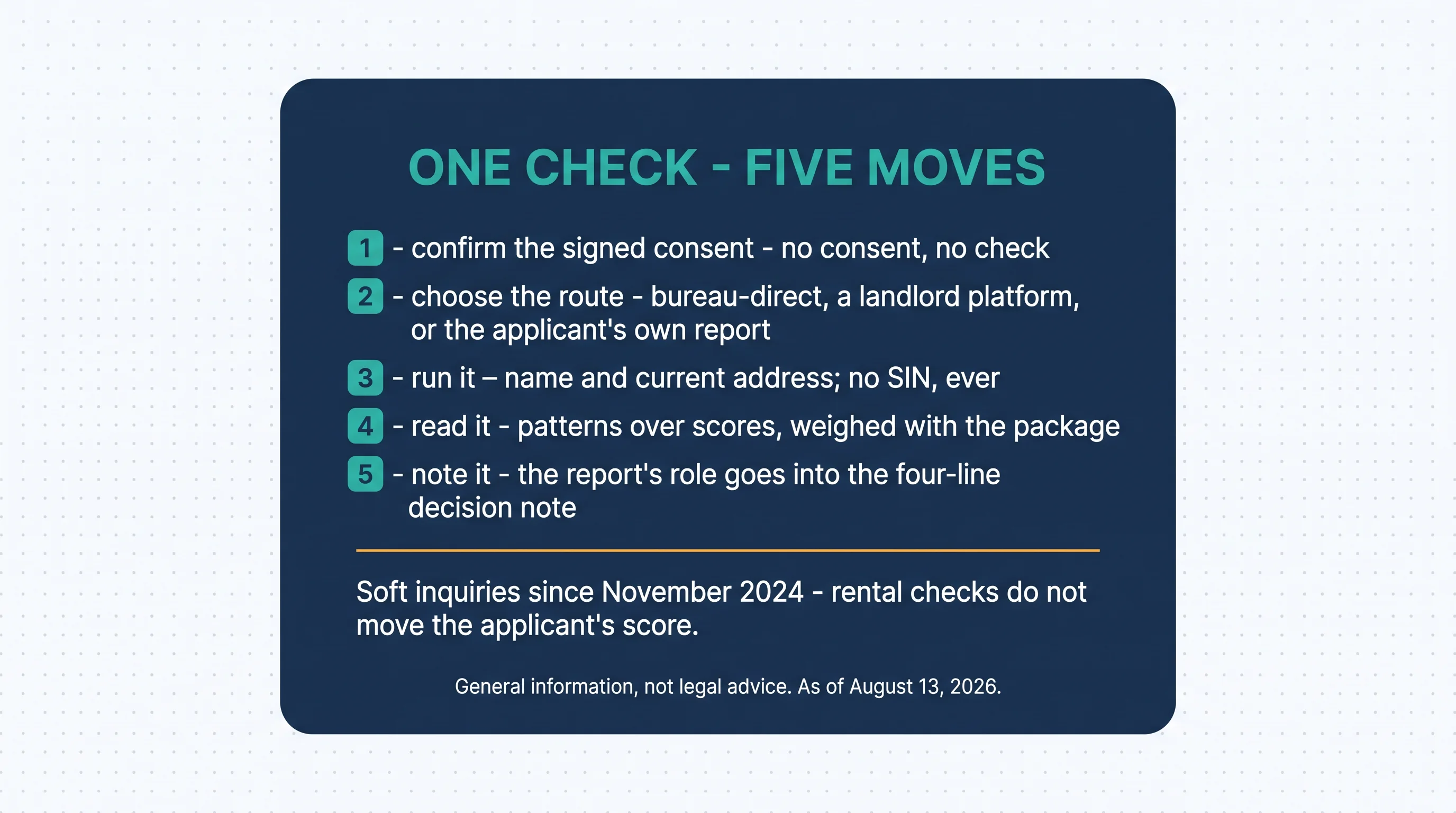
Move one happens before any account gets opened: confirm the signed consent. Consumer-reporting law makes it the switch — no signed consent, no check, no exceptions — and the consent belongs on the application form itself, in its own block with its own signature, so there's never a question about what was agreed to and when. The application-form guide in this series covers that block's design; at run time, your job is one glance: signed, dated, this applicant. Timing note: run checks only on files that survived the completeness pass — verifying incomplete applications wastes report fees, and verifying in received order is the process sentence that keeps the queue defensible.
Move two's paperwork is shorter than most landlords expect. To run the check you need the applicant's full legal name and current address — plus the previous address if they've been at the current one under six months. That's the list. No SIN, ever: a Social Insurance Number cannot be required to screen a tenant, checks run fine without one, and the form shouldn't carry the field. One nuance worth stating cleanly, because it confuses people: the credit bureau matches identity using its own data at its end of the pipe — nothing about that adds fields to your form. You collect the name and address; the bureau does the matching; the report comes back.
The three routes — and what each costs
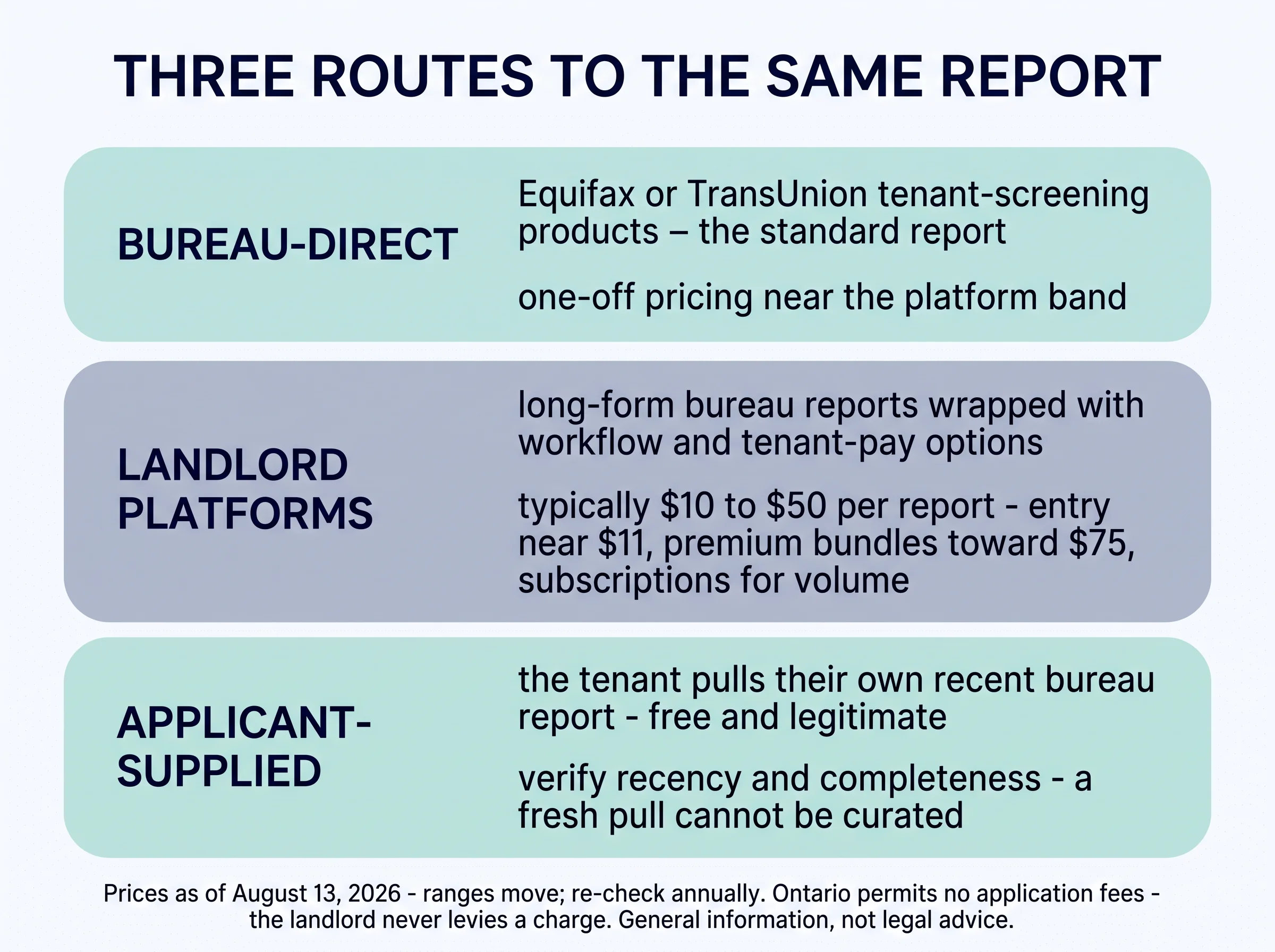
Route one — bureau-direct. Equifax and TransUnion both sell tenant-screening products; you get the standard report from the source, with one-off pricing that lands near the platform band. It's the plainest route: no wrapper, no extras, the bureau's document. Its quiet advantage is longevity — platforms come and go, rebrand, change bundles; the bureaus are the source, and a landlord who learned to read the source document can read any wrapper's version of it.
Route two — the landlord platforms. The class most small landlords end up using: services that wrap a long-form Equifax or TransUnion report in workflow — consent capture, applicant-initiated flows, dashboards. Typical pricing runs $10 to $50 per report (entry points near $11, premium bundles toward $75), with subscriptions that make sense at volume. Two notes keep this route honest. First, some platforms bundle LTB-order cross-checks — that instrument has its own rules, and our public-orders guide carries them. Second, several platforms offer applicant-pays flows; those exist lawfully as applicant-initiated services — but Ontario permits no application fees, so the landlord never levies a charge for the check. If money is moving from applicant to landlord at the application stage, something has gone wrong — the deposits guide maps what's collectable and when.
Route three — applicant-supplied. Every applicant can pull their own report free through the bureaus' consumer portals, and offering the option is both lawful and applicant-friendly. The trade-off gets stated honestly: verify recency and completeness — a fresh pull can't be curated; a dated PDF can. "Your own bureau report from the last 30 days" is the version of this route that works. Verify it the boring way: the bureau's own header, the pull date visible, pages complete — thirty seconds of looking that keeps the free route as reliable as the paid ones.
Choosing between them is mostly a volume question, which the boxes below run — but whichever route you pick, pick one and stay on it: identical report formats across applicants is what makes files comparable, and comparability is the whole game.
Running it: the five minutes
The mechanics barely justify a section, which is the point. On any route: an account (or the applicant's initiated flow), the name and current address from the form, an affirmation that consent is held, and the report arrives — minutes on the platforms, not days. What lands is a document with a consistent anatomy: a score (one number summarizing the bureau's model), tradelines (each credit account with its payment record), payment history (the month-by-month conduct), collections and public records (defaults, bankruptcies, with dates), and inquiries (who's looked recently). That vocabulary matters for the next section, because the score is the least of it. One modern note on the inquiries section: since rental checks went soft, an applicant mid-search may show several recent rental inquiries — that's the system working, not a red flag. Application volume is what a housing search looks like.
For landlords: The volume arithmetic: renting one unit a year, per-report pricing wins and the $10–$50 is a rounding error against a vacancy week. Turning over three or more units a year, subscriptions start beating one-offs — run the multiplication once. Either way, the report cost is never worth skipping the check: it's the cheapest component of the most expensive decision you make per tenancy.
Reading the report — where screening actually happens
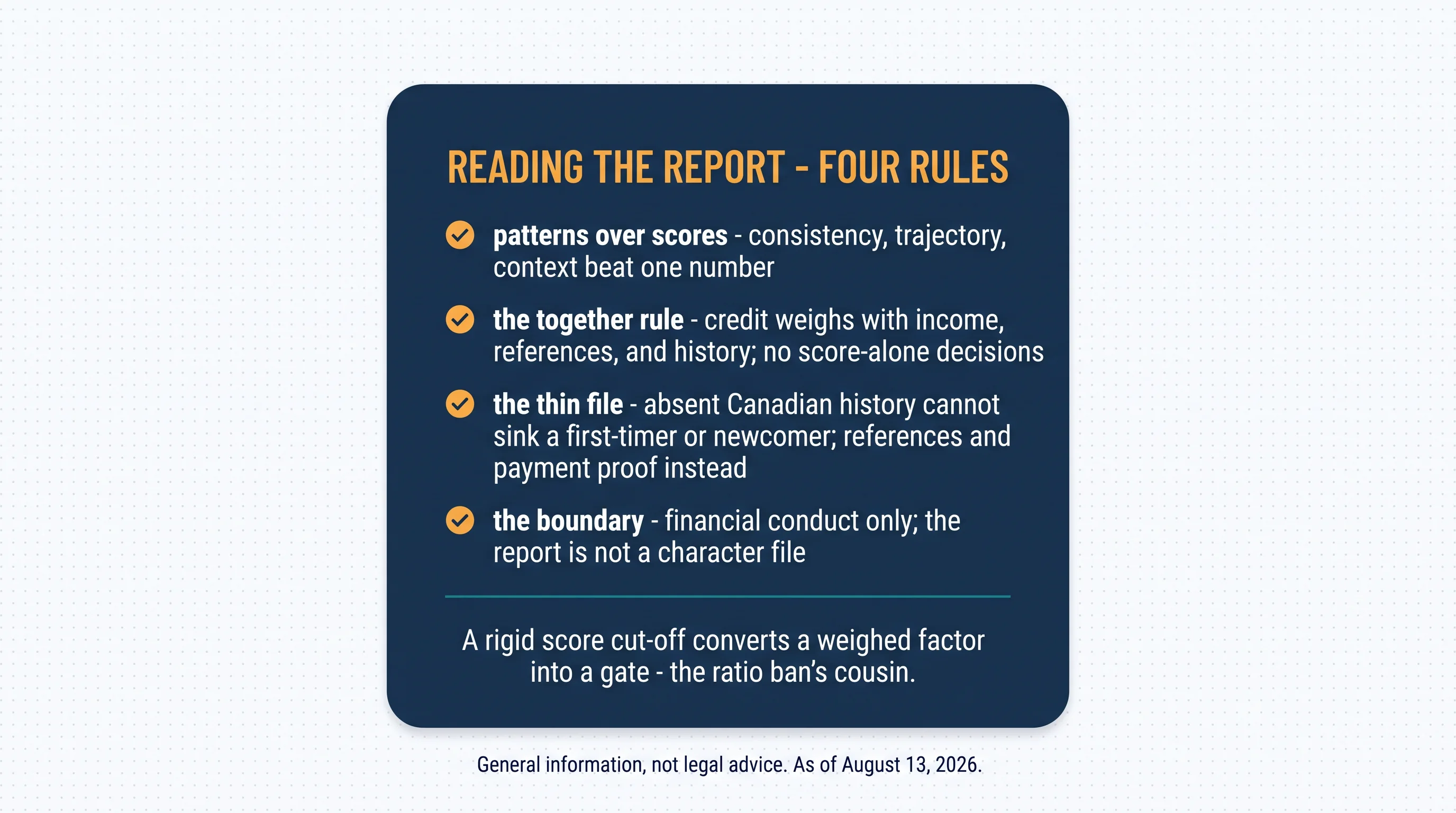
Rule one: patterns over scores. The score is one number produced by someone else's model for someone else's purpose; the report's story is the screening content. Read for consistency (does rent-scale money get paid on time, month after month?), trajectory (a rough 2023 followed by two clean years reads differently than the reverse — direction matters), and context (one dated collection with a plausible story is not the same fact as a live pattern of defaults). A landlord who reads the tradelines learns more in four minutes than the score could ever compress. Two applicants with the same middling score can be opposite files: one carries an old consumer proposal and three years of perfect payments since; the other carries pristine history until four months ago and a fresh cascade of late marks. The score can't tell them apart. The trajectory read can — and it's the second file that needs the harder look.
Rule two: the together rule applies to reading. The report weighs with income, references, and rental history — never alone. Ontario's screening regulation authorizes credit information as one factor in a weighed package, and the method runs that weighing at decision time. Which is why the precise framing of cut-offs matters: a "minimum 700" policy isn't a named offence in a statute — but a score-alone decision is exactly the single-number decision the together rule forbids, and a rigid minimum invites the same adverse-effect analysis that ended rent-to-income ratios. The lawful version reads the whole report and weighs it; the risky version builds a gate and stops thinking.
Rule three: the thin file has a lawful route. A first-time renter or a newcomer to Canada may arrive with little or no Canadian credit history — and that absence cannot, by itself, sink the application: rejecting a newcomer for lacking Canadian history is where adverse-effect discrimination lives. The accommodation is the same one the application-form guide in this series prints on the form: references plus proof of regular payments — rent abroad, utilities, phone plans — stand in for the file that hasn't had time to exist. In practice that's twelve months of rent e-transfers or receipts, a utilities account in good standing, a phone plan paid on schedule — ordinary documents most applicants can assemble in an evening, which is exactly why the accommodation is reasonable to offer and unreasonable to refuse.
Rule four: the boundary. The report is financial conduct — it is not a character file, and it doesn't license adjacent curiosity: record checks aren't a screening instrument in Ontario, and the question-by-question guide maps that whole territory. For reading the application beyond credit — the pressure tells, the too-polished references — the red-flags guide does it on conduct, never identity.
The decision and the file

The report's role lands in the four-line decision note, written at decision time: the factors reviewed, what each showed, the comparison, the call. On the credit line, specificity is the discipline — "credit reviewed: consistent payment history across four tradelines, one 2023 collection with explanation" beats "good credit" in every room that note might someday be read in. Then the file closes properly: credit reports are the most sensitive document screening produces, so the retention promise the application made — unsuccessful applicants' files destroyed on a stated schedule — applies here with extra force.
Declining on credit carries one etiquette rule and one kindness. The etiquette: prompt and professional, with no improvised reasons on the phone — the documented basis lives in the note. The kindness: if the report contained errors (they happen), the applicant can dispute them with the bureau directly — pointing a declined applicant there costs nothing and occasionally changes their next application's outcome.
The applicant's side of the desk
Tenants reading this page: the check runs on your consent — it can't happen without your signature, and a landlord who runs one anyway has a consumer-reporting problem. Rental checks are soft inquiries; your score doesn't move, however many places you apply. You may offer your own recent bureau report instead of a landlord-run check. A thin or absent Canadian file has a lawful route — references and proof of regular payments — and a landlord demanding a SIN is telling you something about their form, not about the law. The full map of what can be asked of you at every stage is the question-by-question guide.
For property managers: One provider, one report format, portfolio-wide — comparability is a portfolio property, not a per-building one. The intake log gains a "report received" date column; the four reading rules go into the SOP verbatim so any leasing hand reads the same way; and the annual audit pass that reviews the application form covers the consent text and the provider decision in the same sitting.
The Tenant Credit Check Run Sheet
The five moves, the routes with real costs, the four reading rules, and the applicant-facing soft-inquiry line — one page.
Get Free PDF →Key takeaways
- Consent first, always — signed, dated, its own block; no consent, no check.
- No SIN, ever — name and current address run the report, and the form shouldn't carry the field.
- Soft inquiries since November 2024 — the score fear is dead; print the line for applicants.
- Three routes, one rule: bureau-direct, platforms at $10–$50 typical, or the applicant's own report — pick one and keep formats identical.
- The reading is the screening: patterns over scores, weighed with the package, thin files accommodated, financial conduct only.
- Specific notes, kept promises: the report's role goes in the four-line note, and the retention schedule applies to credit reports with extra force.
The third leg, never the judge
Run properly, the credit check is the package's third leg — steady, cheap, five minutes — standing beside income and references, weighed with them, deciding nothing alone. The landlords who get burned aren't the ones who skipped the check; they're the ones who outsourced the decision to a number and stopped reading. Five moves, four rules, one honest note in the file. This is general information, not legal advice — for your situation, consult a licensed professional. As of August 13, 2026.
Ontario's landlord tools, free
Calculators and trackers built for Ontario landlords — termination dates, rent increases, and more. No account needed.
Free forever • No signup required
Related resources
- How to Screen Tenants in Ontario — the complete method this check sits inside.
- What You Can and Can't Ask — the question-by-question map, including the no-SIN rule.
- Screening With LTB Orders — the other verification instrument, with its five risks.
- Tenant Application Red Flags — reading the application beyond credit.
Frequently asked questions
Can a landlord run a credit check without the tenant's consent?
No — written consent first, under consumer-reporting law. The consent belongs on the application form itself, in its own block with its own signature.
Do rental credit checks lower the tenant's credit score?
Not since November 2024 — rental checks are soft inquiries, and they stay soft across multiple applications.
How much does a tenant credit check cost in Canada?
Typically $10–$50 per report through landlord platforms (as of August 2026), with bureau-direct pricing near the same band — and free if the applicant supplies their own recent bureau report.
What credit score does a tenant need in Ontario?
That's the wrong shape for the question: a score-alone decision breaches the weighed-package rule. The report's patterns get read with income, references, and history — and a thin or absent Canadian file has a lawful accommodation route.
Can I make the applicant pay for the credit check?
Ontario permits no application fees, so the landlord never levies a charge. Applicant-initiated, applicant-paid platform flows exist — the applicant choosing to run their own report is different from you charging them.


