

As of August 11, 2026. Ontario mandates a lease form — it mandates no application form. The application is yours to design, and that's not a gap in the law; it's the point: the law hands you the table of contents — five authorized information categories, a written-consent requirement, and a short list of lines that can never appear — and the design work is turning that into a document every applicant completes identically.
This is the form, section by section: what each field collects, which screening factor it feeds, and the wording notes where wording is the whole difference. Our screening pillar carries the seven-stage sequence this form serves; the question-by-question guide carries what's askable anywhere. This page is the document itself.
It's worth designing well because the form works three jobs at once: it's the screening instrument (the five factors, collected identically), the consistency evidence (the same page in every file is the cleanest possible answer to "did everyone get the same process?"), and the applicant's first read of how you operate — a clean two-page form with a clear consent box and no SIN line wins trust before a single reference gets called.
The Ontario Rental Application Blueprint
All eight sections with field checklists and wording notes, the consent-block pattern, the never-fields list, and the four habits that keep the form clean. Two pages.
Get Free PDF →The design frame — five factors become eight sections
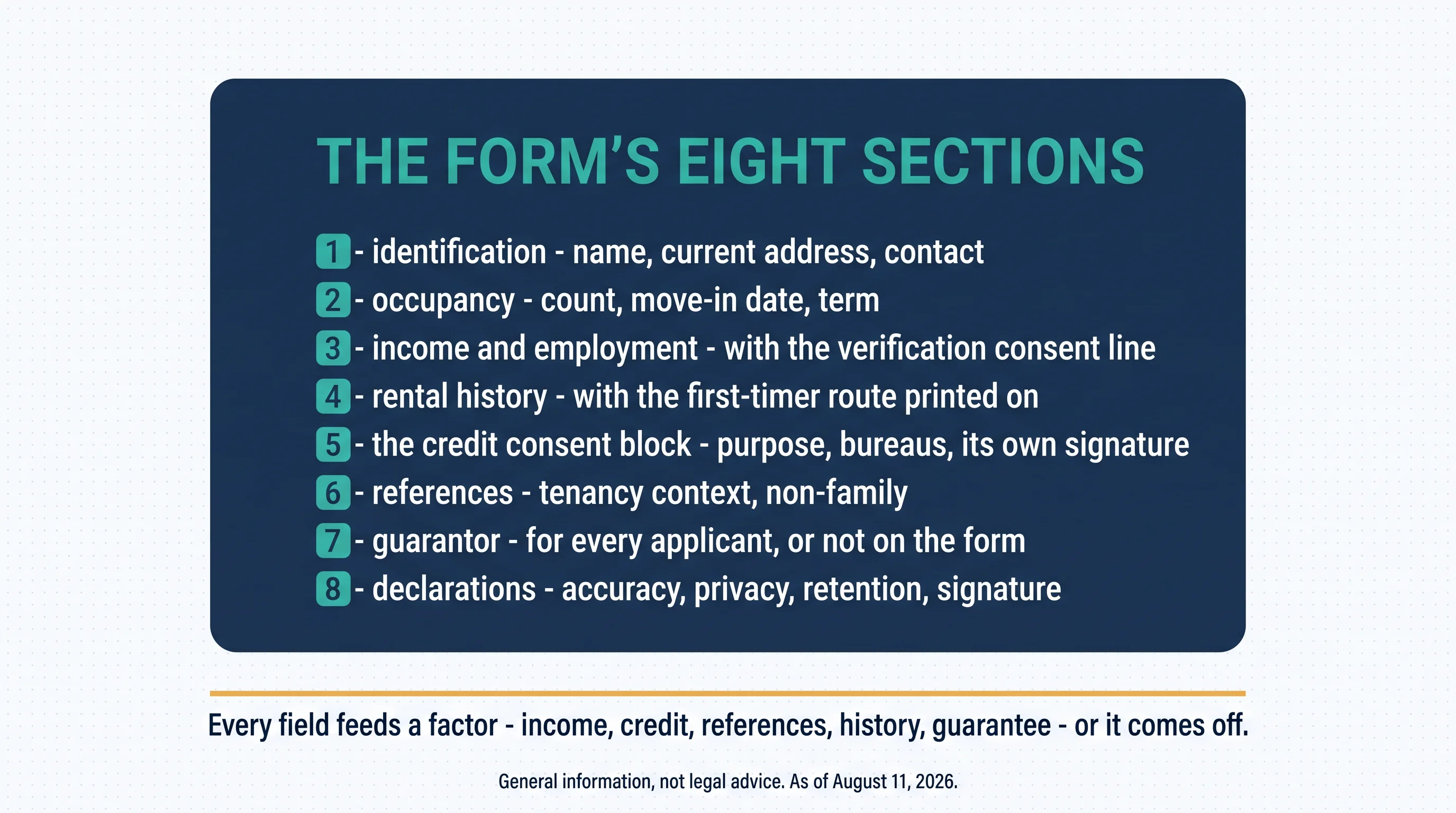
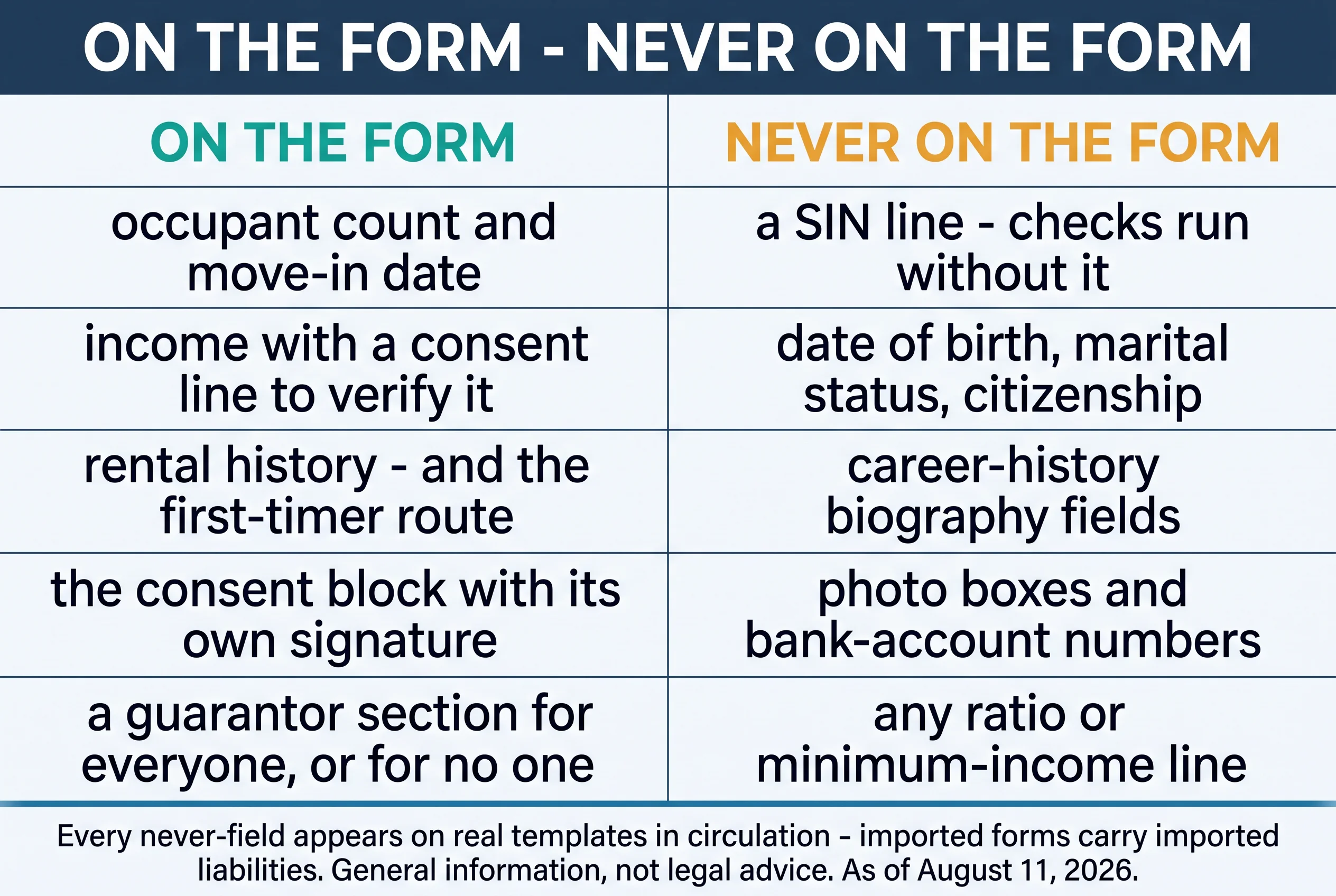
Start with the misconception, because it shapes everything: there is no official Ontario rental application form. The Standard Lease is mandated; the application isn't — which is why the forms in circulation vary so wildly, and why the most common problems arrive by import: a template downloaded from a US site brings its SIN-equivalent line, a BC kit brings its deposit fields, a decade-old Word file brings a marital-status box nobody remembers adding. The form you use is a design decision, and this page makes it deliberately. The audit that follows costs one read of your current form: highlight every field, name the factor it feeds, and strike what can't answer. Most inherited forms lose three to five fields to that pass — and every one of them was a question you were asking applicants for no screening value at some risk.
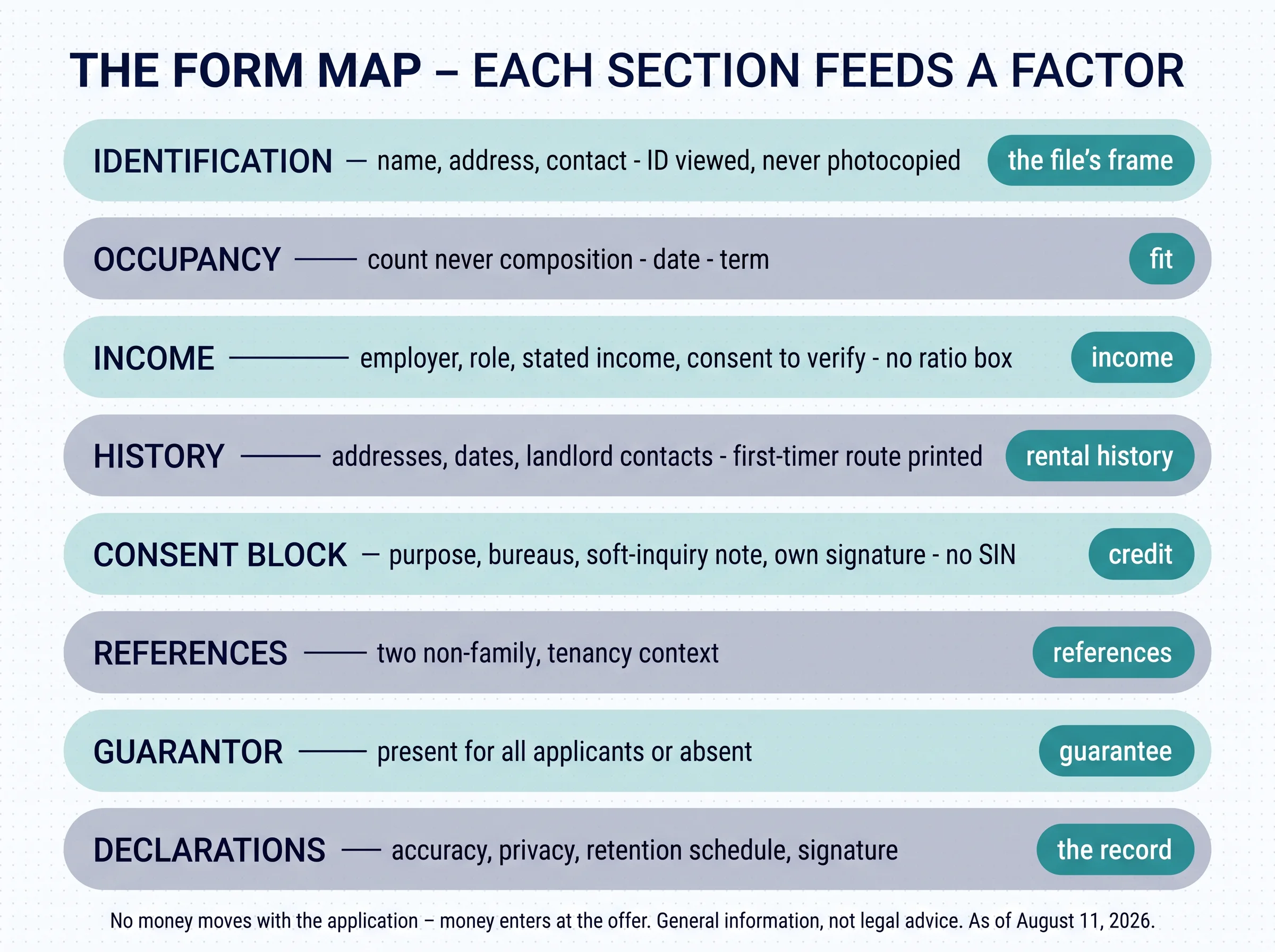
The design rule is one sentence: the application is the five authorized factors — income, credit, references, rental history, guarantees — turned into sections, in the order the weighed-package rule reads them. That gives the document a built-in audit: for every field, ask which factor does this feed? A field that feeds none of the five is dead weight or liability, and the form is better without it either way. It also gives the form its second job, the one property managers care most about: the form is the consistency instrument. "Same questions for everyone" is the Human Rights Code's expectation and the method's discipline — and a designed form is how that stops depending on anyone's memory at a showing.
Sections 1–2: identification and occupancy
§1 — Identification. Full legal name, current address, phone and email — and every adult who'll be a tenant completes their own application, which keeps files comparable and credit consents individual. Two etiquette rules do quiet legal work here. ID is viewed, never harvested: confirm the name against photo ID at the showing, and don't photocopy it into the file or put a photo box on the form — you need the name verified, not a document collection. And there's no date-of-birth field: a checkbox reading "I confirm I am 18 or older" does the only lawful work a birthdate would — capacity to contract — without collecting an age you can't lawfully weigh.
§2 — Occupancy intent. Three fields: total occupant count, requested move-in date, intended lease term. The wording note carries this section: count, never composition. "How many people will live in the unit?" is the lawful form of the question; anything that asks who they are to each other has left the form's job and entered protected-ground territory. The count itself does legitimate work — occupancy standards, utilities planning, by-law compliance — which is exactly why it survives the field audit while composition questions don't: the number feeds real decisions; the relationships feed none you're allowed to make.
Sections 3–4: income and rental history
§3 — Income and employment. Employer, role, length in role, gross income, and the consent line: "I consent to verification of the income stated above." Length-in-role sits on the form as an income-stability fact — not a career-biography prompt — and self-employed applicants get their route stated ("Notice of Assessment or recent bank statements accepted"), which saves everyone a clarification cycle. What this section never contains: a ratio box or a minimum-income line. The form collects the number; the weighed package interprets it — rent-to-income ratios are illegal in Ontario's private market, and a form with a "monthly income must exceed 3× rent" line has written the violation into the stationery. The distinction is worth one more sentence because it decides the section's whole design: the lawful question is whether the income is real and steady — which the fields above establish — never how far it clears an arithmetic bar. Collect, verify, weigh with the package; the form's job ends at collect.
§4 — Rental history. Current and previous addresses with dates, and landlord or property-manager contacts for each. Two design choices define this section. First, the reason-for-leaving field is omitted — by design, and here's the argument: the useful, lawful version of that answer (payment conduct, notice given, condition left) arrives properly through the reference call, where a former landlord speaks to facts; on a form, the field mostly invites oversharing — and the overshared answers ("divorce," "lost my job on mat leave," "needed to be near my treatment") are protected-ground information you're better off never holding in a file. Second, the first-timer route is printed on the form itself: "No rental history? Provide two references and proof of past regular payments instead." The absence-can't-count rule isn't a policy you remember — it's a line of the document. Addresses-with-dates earn their place the quiet way too: gaps and overlaps aren't accusations, they're conversation prompts for the reference stage — and a form that collects clean date ranges makes those conversations short.
Section 5: the consent block — the form's centrepiece
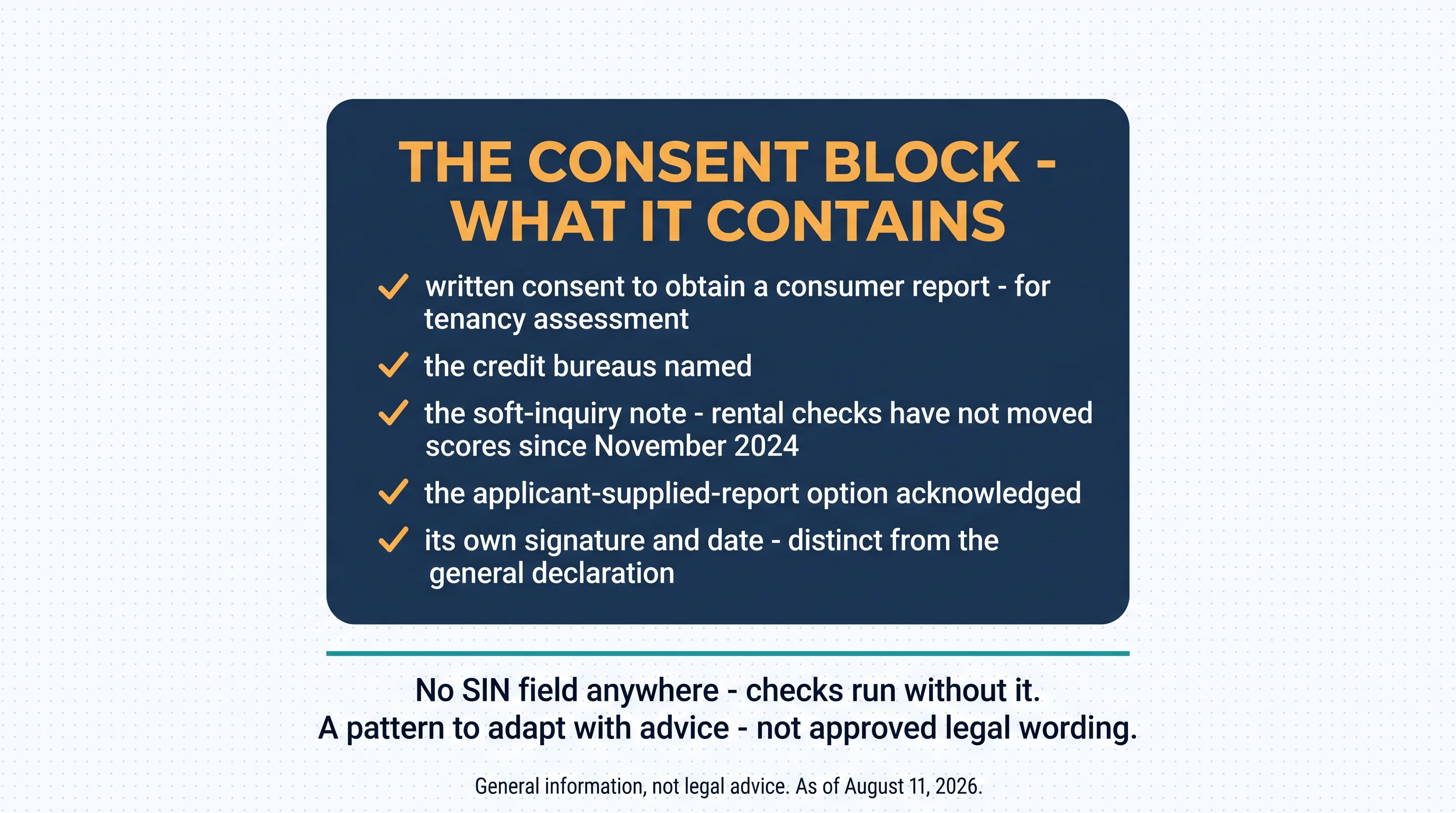
If the application has a centrepiece, it's four lines long. The credit check runs on consent — no signed consent, no check — so the block earns its own bordered box on the form, built on a four-part pattern: what ("a credit check through a recognized credit bureau"), why ("to assess this rental application"), the soft-inquiry note ("rental credit checks are soft inquiries and do not affect your credit score" — true since November 2024, and printing it removes the era's most common applicant objection), and its own signature and date line, separate from the form's general signature, so consent is unambiguous and severable. This is a wording pattern, not legal drafting — have your actual text reviewed once, then never improvise it again. Why the separate signature matters: consent that hides inside a general "I agree to everything above" signature is consent an applicant can plausibly say they never noticed — and a bureau, a hearing, or a privacy complaint will read the form exactly that skeptically. A bordered box with its own dated signature is unambiguous in all three rooms.
And directly beside the consent block belongs the note that saves the most grief: the form asks for no Social Insurance Number. A SIN cannot be required to screen a tenant, and credit checks run fine on name, address, and date-of-birth-free identifiers the bureau collects at its end. The strongest form design doesn't leave an optional SIN line to make applicants nervous — it omits the line entirely and prints why: "No SIN is requested on this form; credit checks do not require one." That sentence does more trust-building than any paragraph about your professionalism.
Sections 6–8: references, guarantor, declarations
§6 — References. Two lines, tenancy-context framed: name, relationship-to-tenancy ("previous landlord," "employer"), contact. The form can lawfully steer quality here — "references who can speak to your tenancy or payment conduct; non-family preferred" — because the reference call is only as useful as the person's actual knowledge of how the applicant rents.
§7 — The guarantor section. The design rule is structural: the section exists for every applicant, or it isn't on the form. A guarantor block that gets activated selectively — for the young, the newcomer, the applicant on assistance — is a proxy with a co-signer, so the form's own wording makes the policy visible: either "a guarantor is required of all applicants" with the fields following, or the section is absent. If present, the guarantor gives the same categories: identification, income, consent — a guarantee is only as strong as its verification. A signed guarantor page with no income or consent behind it is a comfort object, not a factor — if the section is worth printing, it's worth the same verification the applicant gets, and the guarantor should expect exactly that when they sign.
§8 — Declarations and signatures. The closing block: an accuracy declaration ("the information provided is complete and accurate"), the privacy-and-retention line ("information is collected to assess this application, kept confidential, and retained or securely destroyed per our retention practice"), and the general signature and date. One line the strongest forms add: what happens to non-selected applications ("securely destroyed within [X] months") — a retention promise that costs nothing and reads as professionalism to every applicant comparing you against a landlord who photographs IDs into a phone.
The accuracy declaration, meanwhile, isn't decoration: an application that later proves materially false — invented employer, fabricated landlord — is a fact pattern the declaration converts from awkward to documented. You'll rarely need it; the file is better for containing it.
What the form collects no money for: Ontario permits no application fee, and no deposit is collectable at the application stage — the lawful money conversation happens at the offer, and it's exactly three items long. The deposits guide carries that machinery; the application's only job is information.
For landlords: Keep the form to two pages, and keep two versions of nothing. One unit, one form; a portfolio, one form. The moment "the downtown building's form" differs from "the duplex's form," you've built an inconsistency a hearing can read — and you've doubled your maintenance for zero screening value. The form's power is that it's boring: identical, dated, filed.
Running the form: intake to file

The document's lifecycle is short and disciplined. Distribution: the identical package to every showing attendee — the form, the process note ("applications acknowledged within 24 hours; complete files verified in order received"), and nothing else. Distribution is where consistency is easiest to fumble casually — the form emailed to one viewer, handed to another, "just text me your info" to a third produces three different application experiences and one avoidable pattern. Same package, same channel offer, every attendee. Intake: date-stamp, completeness-check, one identical completion request where needed. Verification: the form's consents now do their work — the pillar's stage five runs it, and the red-flags guide covers reading what comes back. Decision and file: the four-line decision note staples to the application; non-selected files enter the retention clock the form itself promised.
For property managers: The form is your portfolio's one enforceable habit: version-controlled, dated, identical across buildings and leasing hands. Pair it with the intake log (application date, completeness date, verification date, decision date) and the portfolio's screening becomes auditable in a spreadsheet — which is exactly the artifact you want to already have on the day anyone asks how decisions get made.
The Ontario Rental Application Blueprint
All eight sections with field checklists and wording notes, the consent-block pattern, the never-fields list, and the four habits that keep the form clean. Two pages.
Get Free PDF →Key takeaways
- No official form exists — the application is a design decision, and the law writes its table of contents: five factors, a consent requirement, a never-fields list.
- Eight sections, one audit: every field feeds income, credit, references, history, or guarantee — or it comes off the form.
- The consent block is the centrepiece: what, why, the soft-inquiry note, its own signature — and no SIN line anywhere, with the reason printed.
- The wording carries the law: count-never-composition, the 18-or-older checkbox, the first-timer route printed on, the guarantor section for all or none.
- Reason-for-leaving stays off by design — the reference call gets the lawful version; the form field invites the oversharing you don't want to hold.
- No money moves at the application — no fees, no deposits; the lawful money conversation belongs to the offer.
The form, kept boring
A great rental application is a boring document: eight predictable sections, four unglamorous lines of consent, the same page handed to everyone, filed with a date on it. That's the design — because every interesting thing a form could add is either a factor it already collects or a liability it shouldn't. Build it once from the sections above, version it, and let the seven-step method do the rest. The payoff structure is the same as every designed process: the form costs an evening once, then pays it back every vacancy — in faster intake, comparable files, applicants who trust the document in their hands, and a paper trail that was compliant before anyone thought to ask. This is general information, not legal advice — have your form's final wording reviewed for your situation. As of August 11, 2026.
The form, already built
Tenon10's screening workflow runs a compliant Ontario application end to end — the five factors, the consent capture, the intake log, and the decision record, identical for every applicant.
Free to start • Built for Ontario landlords and property managers
Related resources
- How to Screen a Tenant in Ontario: The 7-Step Method — the sequence this form serves, stage by stage.
- What You Can and Can't Ask — the question-by-question map behind every field decision.
- First and Last Month's Rent — the money conversation that starts only at the offer.
- Tenant Application Red Flags — reading the completed form's verification lawfully.
Frequently asked questions
Is there an official rental application form in Ontario?
No — the Standard Lease is mandated; the application isn't. Landlords design their own, which is why field quality varies so much and why the five-factor structure matters.
Can an application ask for a SIN?
It shouldn't carry the line at all: a SIN can't be required to screen a tenant, and credit checks run without one. The strongest forms omit the field and print why.
Should the form ask why the applicant is leaving their current place?
We recommend omitting it. The lawful, useful version of that answer — payment conduct, notice, condition — comes from the reference call; the form field mostly invites protected-ground oversharing you're better off never holding.
Can I charge an application fee in Ontario?
No — no application fees, and no deposits at the application stage. The lawful collections happen at the offer: first month's rent, a last-month's-rent deposit, and a refundable key deposit at actual cost.
Does every adult need their own application?
Yes — each adult who'll be a tenant completes their own form with their own credit consent. It keeps files comparable, consents individual, and the guarantor logic clean.


