

As of August 11, 2026. A rental listing template earns its place one way: by making the lawful, specific version the easy version. Below are five — basement suite, condo one-bedroom, family house, student unit, executive rental — each built on the six-part method our writing guide teaches, each with Ontario's exact money sentence pre-installed, and each full of brackets that refuse to let you post a guess.
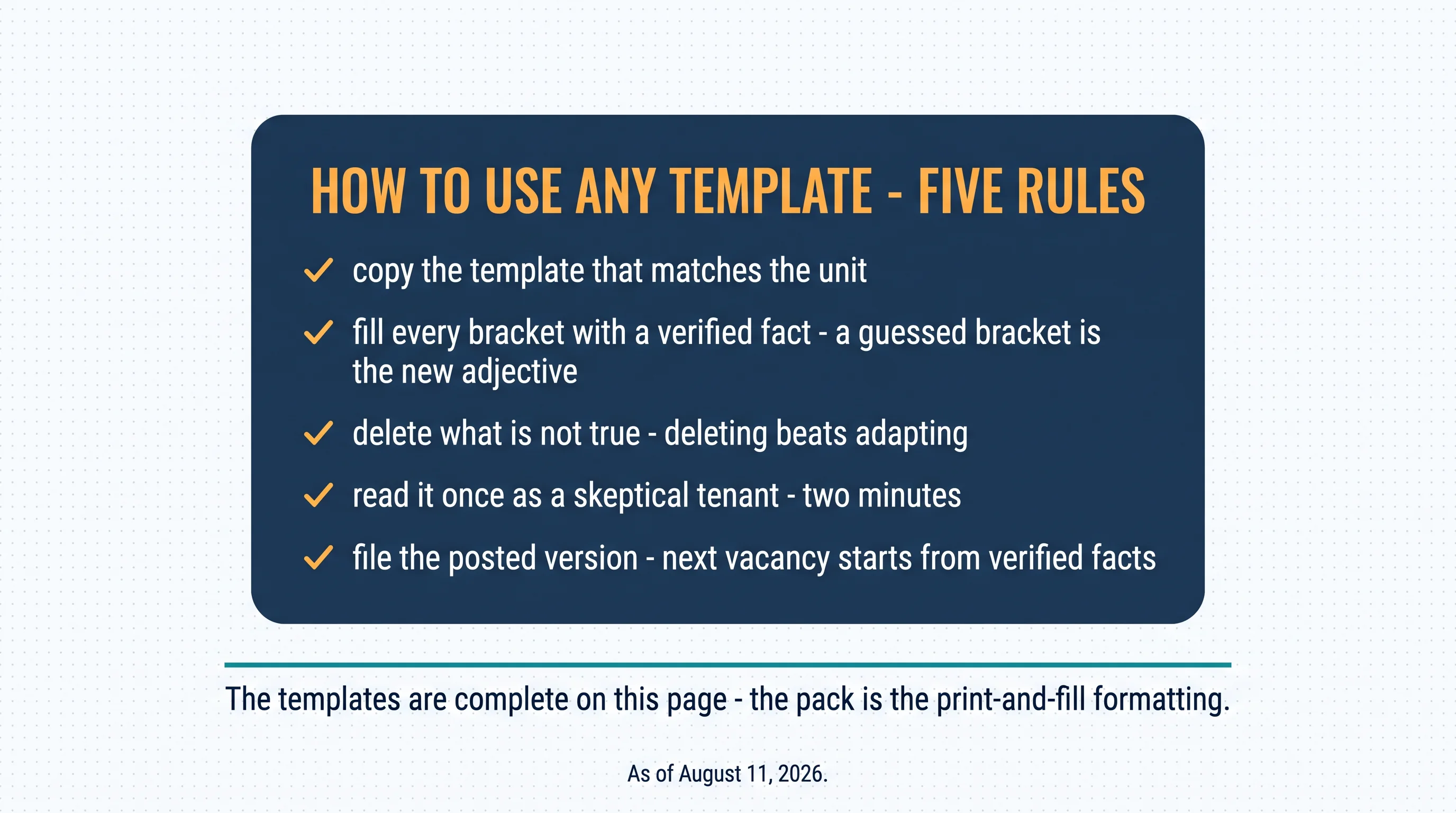
Copy the one that matches your unit, fill every bracket with a verified fact, delete what isn't true, read it once as a skeptical tenant, and post. The templates are complete on this page — the download adds print-and-fill formatting, not withheld content.
The Ontario Listing Templates Pack
All five templates in print-and-fill formatting — real blanks, the skeleton card, and the banned-patterns list. The article below carries them in full.
Get Free PDF →The shared skeleton — read this before any template
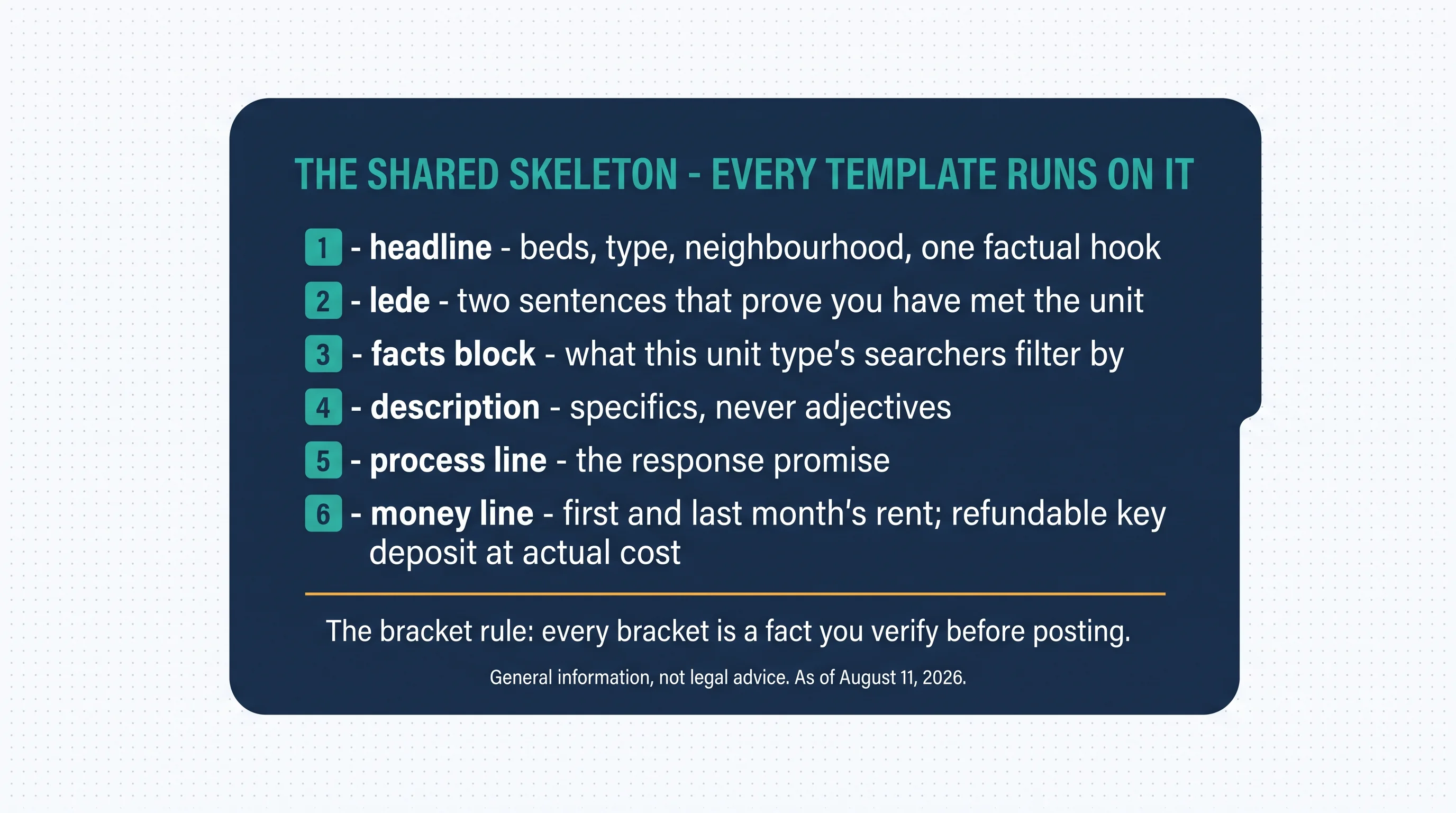
All five templates run on the same six parts, in the same writing order — and the method's full reasoning lives in the writing guide, so here it stays brief: the facts block gets written first (it's what tenants filter by), the headline gets written last (its hook is usually sitting in the facts you just typed), the lede proves you've met the unit, the description trades adjectives for checkable specifics, the process line makes the response promise, and the money line is identical in all five templates because Ontario's law is: "First and last month's rent; refundable key deposit at actual cost" — the only collections the law allows, and a "damage deposit" line is an imported illegal term. The sentence never varies across the five because the law doesn't vary by unit type — the basement suite and the executive townhome carry the identical money sentence, which is itself a quiet credibility signal to tenants who've seen the unlawful versions everywhere else.
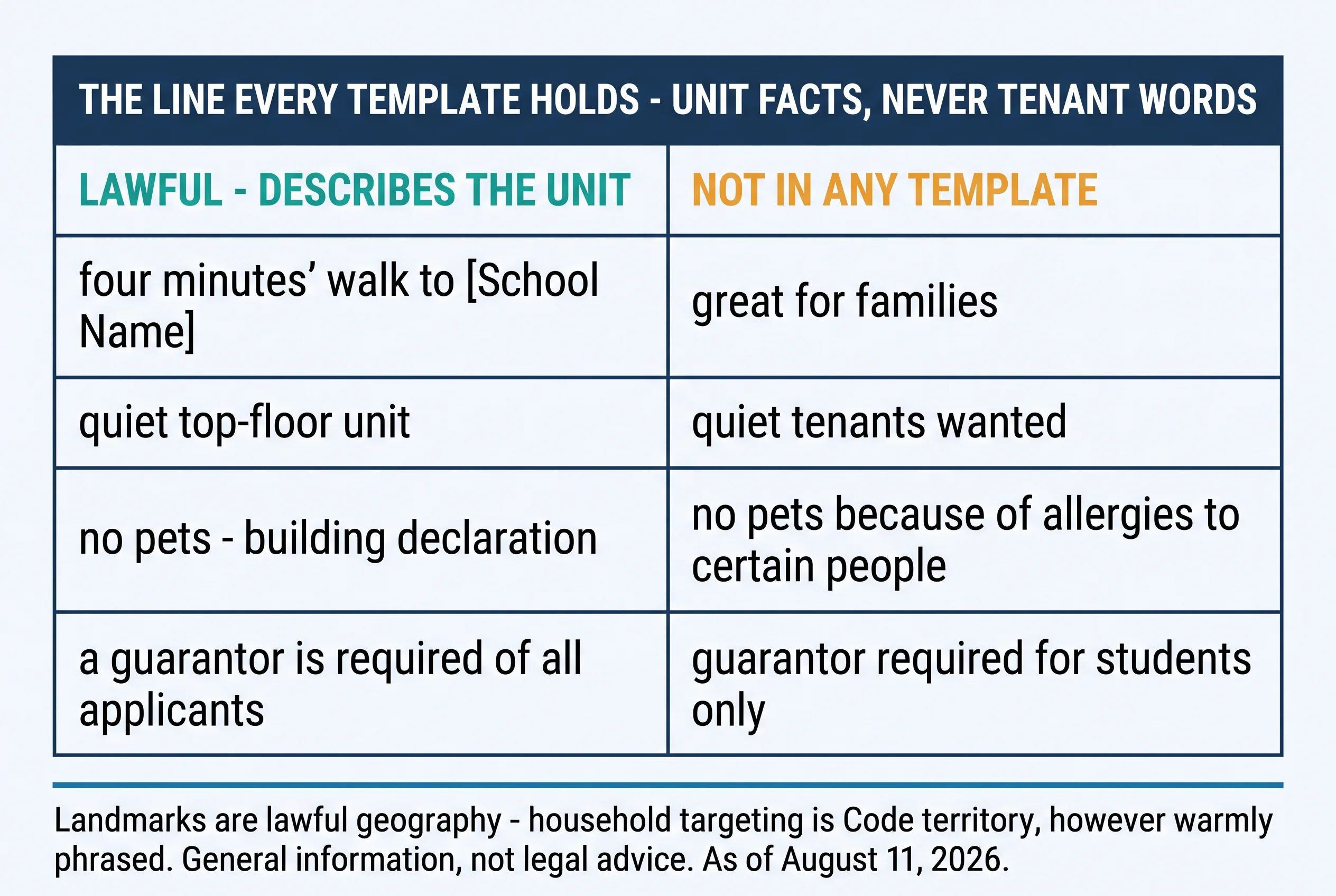
Three patterns appear in no template on this page, ever: tenant descriptions (lines about who should apply rather than what the unit is), illegal money lines (damage, security, cleaning, pet deposits), and urgency theatre ("won't last!!!") — the trained renter reads that last one as a scam tell, per the platform comparison's documentation. And one rule governs every bracket below: a bracket is a fact you verify before posting. Left in, the listing isn't finished; filled with a guess, it's worse — the guessed bracket is the new adjective.
Template 1: The basement suite
HEADLINE: Bright [1-Bed] Lower-Level Suite, [Neighbourhood] — Separate Entrance, [Parking Included]
LEDE: [Three above-grade] windows keep the [living room] bright through [the afternoon]; the [Route #] stop is [4] minutes away on foot.
FACTS: $[Rent]/month · heat [included] · hydro [included/separate] · water [included] · [700] sq ft · [7-foot-6] ceilings · private entrance · laundry: [shared, in-building] · parking: [1 spot, driveway] · storage: [locker under stairs] · pets: [no pets / pets welcome] · no smoking · available [Date] · 12-month lease
DESCRIPTION: Kitchen renovated [Year]: [counters, appliances]. Upper-level owners home [evenings]. Registered second unit.
PROCESS + MONEY: Applications acknowledged within [24] hours; showings [Thursday] evening and [Saturday] morning. First and last month's rent; refundable key deposit at actual cost.
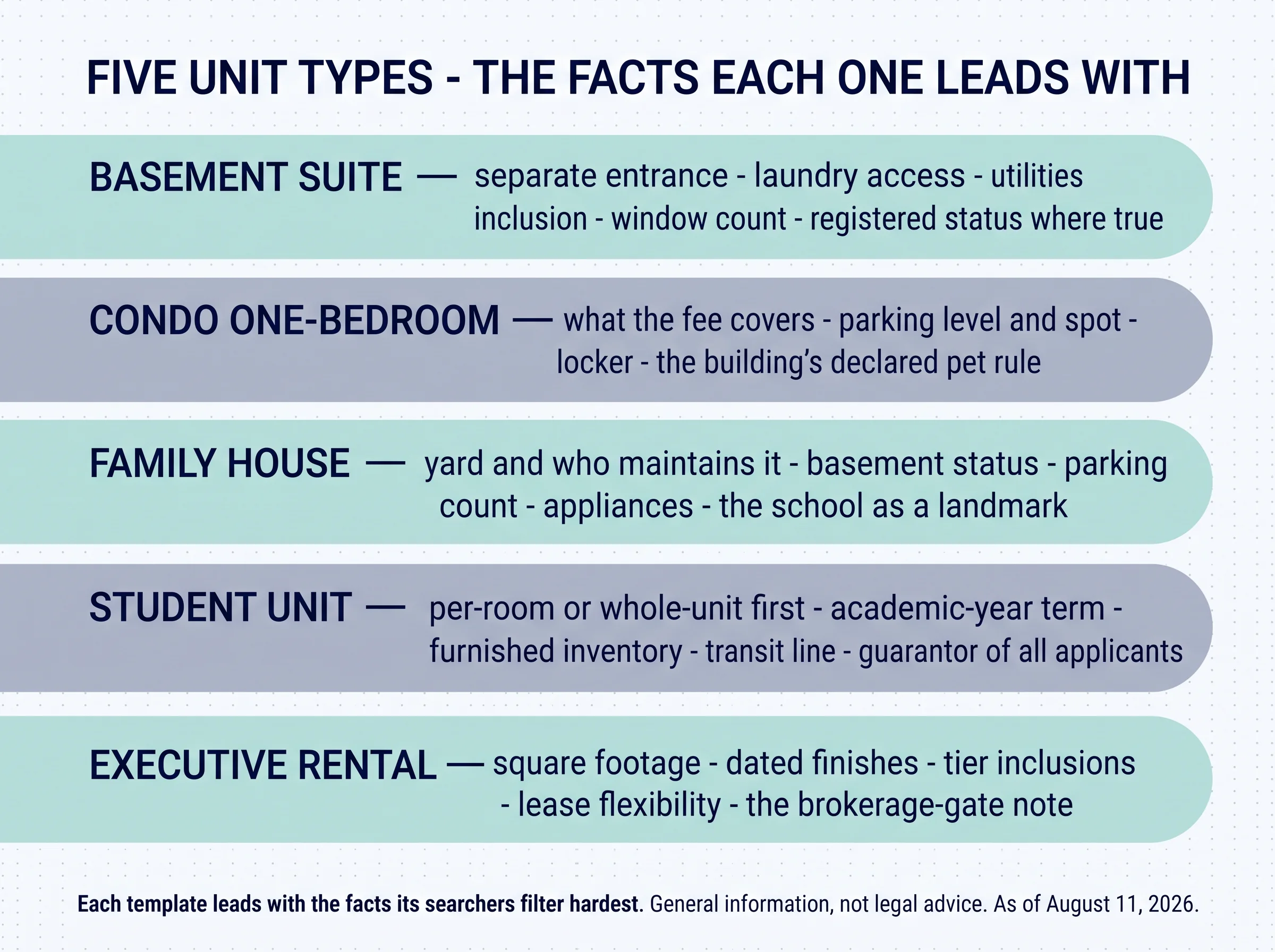
Why these lines: ① Separate entrance, laundry access, and utilities-inclusion are the three facts basement searchers filter hardest — so they lead, itemized, never summarized as "utilities extra." ② Light gets stated as a fact: window count and what stays bright, because "bright basement" asks to be doubted and "three above-grade windows" gets verified at the showing. ③ "Registered second unit" stays in the template only where true — legality is a different question from copy, and the basement-legality guide in this series will carry that layer; delete the line rather than stretch it. One more line worth its bracket: the sound context stated as household fact — "upper-level owners home evenings" tells the reader exactly what shared-building life sounds like, filters honestly, and replaces the unverifiable "quiet home" with something a showing confirms.
Template 2: The condo one-bedroom
HEADLINE: [650] Sq Ft 1-Bed [+ Den], [Building/Neighbourhood] — Parking and Locker Included
LEDE: [South]-facing windows on the [12th] floor; [Station Name] is [6] minutes door to platform.
FACTS: $[Rent]/month · fee covers: heat, water, building amenities · hydro separate · parking: level [P2], spot [#48] · locker: [level B, #112] · gym and pool: [included] · pets: building declaration permits [pets up to 25 lb / no pets] · available [Date] · 12-month lease
DESCRIPTION: Kitchen [Year]: [quartz] counters, [stainless] appliances. Elevator booking required for move-in ([3] days' notice).
PROCESS + MONEY: Applications acknowledged within [24] hours; showings [Wednesday] and [Sunday]. First and last month's rent; refundable key deposit at actual cost.
Why these lines: ① "Utilities included" means something specific in a condo — the fee covers particular things, so the template itemizes which, and leaves hydro's status explicit. ② Amenities render as facts (the parking level and spot, the locker's location) because condo searchers have been burned by "parking available" that meant a waitlist. ③ The pet line quotes the building's declaration, not the landlord's preference — "building declaration permits pets up to 25 lb" is a fact a tenant can rely on, and it's the condo-documents rule executed in one line: the restriction must live in the building's documents, and citing them precisely signals you've actually read them. Even the elevator-booking line earns its place: it's a process fact that costs one bracket, prevents a move-in-day surprise, and quietly tells the applicant this landlord knows how the building actually runs.
Template 3: The family house
HEADLINE: [3]-Bed, [2]-Bath Detached, [Neighbourhood] — Fenced Yard, [2]-Car Parking
LEDE: [6] minutes' walk to [School Name] and [Park Name]; the [Route #] bus is at the corner.
FACTS: $[Rent]/month + utilities · [1,400] sq ft · yard: fenced — tenant mows, landlord [handles snow / tenant shovels] · basement: [finished, included / storage only] · appliances: [fridge, stove, dishwasher, washer, dryer] · parking: [2 spots, driveway] · pets: [pets welcome / no pets] · available [Date]
DESCRIPTION: Roof [Year], furnace [Year]. Kitchen renovated [Year]: [details].
PROCESS + MONEY: Applications acknowledged within [24] hours; showings [Saturday] and [Tuesday] evening. First and last month's rent; refundable key deposit at actual cost.
Why these lines: ① Yard responsibility stated — who mows, who shovels — is the single biggest enquiry-killer on house listings; a missing maintenance line generates the same question forty times. ② Basement status gets its own fact (finished-and-included is a different unit from storage-only), and appliances get inventoried because "appliances included" has meant "some appliances" to too many burned tenants. ③ The mechanical ages (roof, furnace) are the house-tier trust facts — dated, checkable, and exactly what a careful long-term tenant wants to know. House tenancies run longer, so this searcher is underwriting years of living with your furnace — the dated mechanicals answer the question they'd otherwise ask at the showing, or worse, not ask and then churn over.
Template 4: The student unit

HEADLINE: [Room in Shared 5-Bed / Whole 2-Bed] Near [Campus Name] — [8] Min Walk
LEDE: [8] minutes to [the university's] main gate; the [Route #] line runs every [10] minutes at peak.
FACTS: $[Rent]/month · [per room / whole unit] · furnished: [bed, desk, chair, dresser per room] · utilities: [included] · internet: [included] · laundry: [in-unit] · lease: [Sept 1] to [Aug 31] · a guarantor is required of all applicants · available [Date]
DESCRIPTION: Shared kitchen with [two fridges]; bedrooms lock individually. [Study room on the main floor.]
PROCESS + MONEY: Applications acknowledged within [24] hours; group showings [Saturday at 11 and 2]. First and last month's rent; refundable key deposit at actual cost.
Why these lines: ① Per-room versus whole-unit is the structural fact that decides everything downstream — price meaning, lease structure, who's responsible for what — so it appears twice: in the headline and first in the facts. ② The lease term aligns to the academic year because that's the filter this searcher runs, and the furnished inventory itemizes per room. ③ The guarantor line is phrased the only lawful way: "required of all applicants" — of everyone, or of no one; a guarantor demand that activates only for certain kinds of people is a proxy with a co-signer. One structural note: if the room shares the owner's own kitchen or bathroom, a different legal frame applies entirely — the pillar's exemption layer covers it before you write a word. And note the process line's variant: group showings at stated times — the student market's volume makes the open-window format honest and efficient, and publishing the times filters for applicants who can actually plan.
Template 5: The executive rental
HEADLINE: [2,600] Sq Ft Executive [Townhome], [Neighbourhood] — [2]-Car Garage, [Landscaping Included]
LEDE: [West]-facing principal rooms over [the ravine]; [12] minutes to [the GO station / business district].
FACTS: $[Rent]/month · [2,600] sq ft · included: snow and lawn service · monitored alarm · [EV charging] · parking: [2-car garage + driveway] · lease term: [12–24 months, flexible] · pets: [pets welcome] · available [Date]
DESCRIPTION: Renovated [Year]: [quartz] counters, [appliance class], [heated ensuite floors]. Dedicated home office with [gigabit fibre].
PROCESS + MONEY: Applications acknowledged within [24] hours; private showings by appointment [including evenings]. First and last month's rent; refundable key deposit at actual cost.
Why these lines: ① Finishes render as dated facts with class-words that can be photographed ("renovated [Year]: quartz, [appliance class]") — this tier's reader verifies everything. ② The tier's inclusions get stated because they're genuine differentiators at this rent: snow and lawn service, the alarm, EV charging where true. ③ One distribution note from the platform comparison: part of this tenant pool searches through Realtor.ca's brokerage gate — the template still works on every directly-postable site, and it's exactly the document an agent would want from you anyway. Filled properly, this template is the unit's fact sheet — hand it to a brokerage and the MLS listing writes itself from your verified brackets instead of a phone call's approximations.
For landlords: Keep a filled master of your unit's template on file. The next vacancy starts from last year's verified facts plus a twenty-minute update — new rent, new dates, anything renovated — instead of a blank page. And the file-the-ad habit means that when a tenancy question surfaces in February about what the ad said in August, the answer is a document, not a memory.
Read the five together and the system shows itself: the skeleton never changes, the money line never changes, the banned patterns never appear — and everything that does change is exactly the set of facts each unit type's searchers filter by. That's the whole design: fixed law, fixed structure, variable facts. Which is also why the templates age well — when your unit changes, only brackets change.
The Ontario Listing Templates Pack
All five templates in print-and-fill formatting — real blanks, the skeleton card, and the banned-patterns list. The article above carries them in full.
Get Free PDF →Key takeaways
- Five templates, one job: the lawful, specific version made easy — copy, fill, delete, read skeptically, post.
- The brackets are the discipline: verified facts only — a guessed bracket is the new adjective.
- The money sentence is identical in all five, because Ontario's law is: first, last, key cost — nothing else.
- Each unit type leads with its searchers' filter facts: entrance and utilities, fee inclusions, yard duties, room-versus-unit, dated finishes.
- Landmarks are lawful; household targeting isn't — name the school, never the family.
- The templates are complete on this page; the pack is the print-and-fill formatting.
The method's handshake
A template is where the method shakes hands with a Tuesday evening: the six parts already ordered, the lawful lines already written, and nothing left between you and a posted listing except verifying your own unit's facts. Fill the brackets, delete the untrue, run the two-minute skeptical read, and post — then file the master, because next year's vacancy starts from this year's verified facts. The pillar runs the campaign around the listing; the writing guide carries the craft. As of August 11, 2026.
The prompted version of these templates
The listing builder walks these same fields — facts prompted one by one, the lawful money line pre-written, platform-ready output at the end. Free for up to 3 units.
Free for up to 3 units • Tenants always free • See current plans
Related resources
- How to Write a Rental Listing — the six-part method these templates execute.
- Where to List: 9 Sites Compared — where the filled template gets posted, and the mixes by unit type.
- First and Last Month's Rent — the money sentence's complete rules.
- Refusing a Tenant With Pets — why the pet line is a unit fact, and the condo-declaration rule.
Frequently asked questions
Are these templates free to use?
Yes — complete on this page, no signup. The downloadable pack is the same five in print-and-fill formatting with real blanks.
Can I use these templates outside Ontario?
The structure travels; the money line doesn't — it's written to Ontario law, and rules differ elsewhere (damage deposits, for instance, are lawful in some provinces and illegal here). Swap the legal lines before crossing a border.
Do I have to fill every bracket?
Every bracket you keep, yes — with a verified fact. Optional lines are marked by the annotations; delete what isn't true rather than stretching it.
Can I say "no pets" in these templates?
Yes — it's a lawful unit line in Ontario advertising (service-animal and condo caveats apply at later stages). Our pets guide explains why it's lawful in the ad and void in the lease.
What about photos?
The other half of the listing — copy and photos verify each other, and specifics like "renovated [Year]: quartz counters" tell the reader which photo to check. The photography guide in this series covers that half.


