

As of August 9, 2026. The most expensive mistake an Ontario landlord can make isn't a bad furnace — it's a bad tenant approved in a hurry. From a first missed payment to vacant possession can run five to twelve months, and the second most expensive mistake is screening that tenant the wrong way and ending up answering a Human Rights Tribunal application instead. Screening well — and lawfully — is the highest-leverage skill in this business.
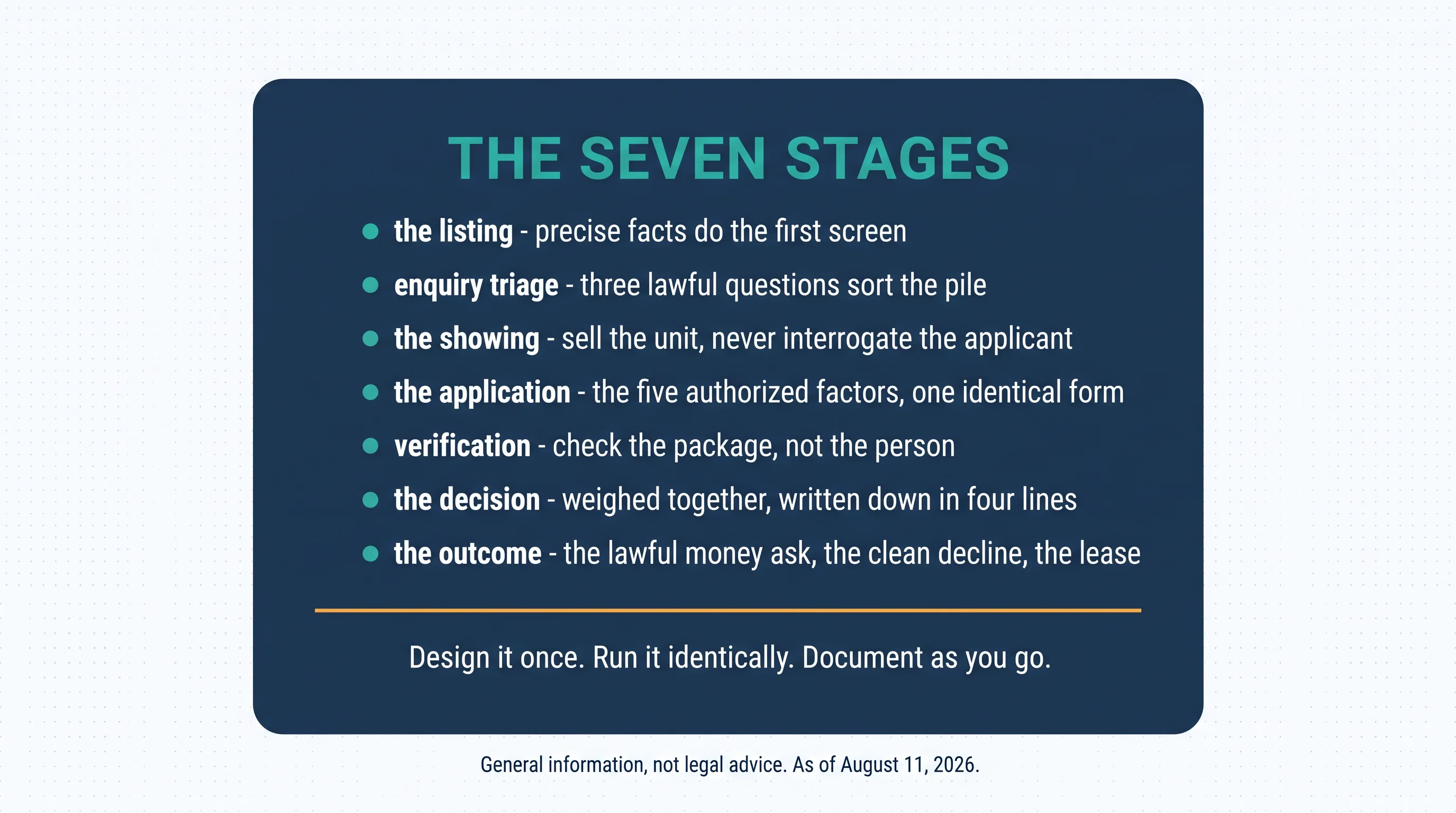
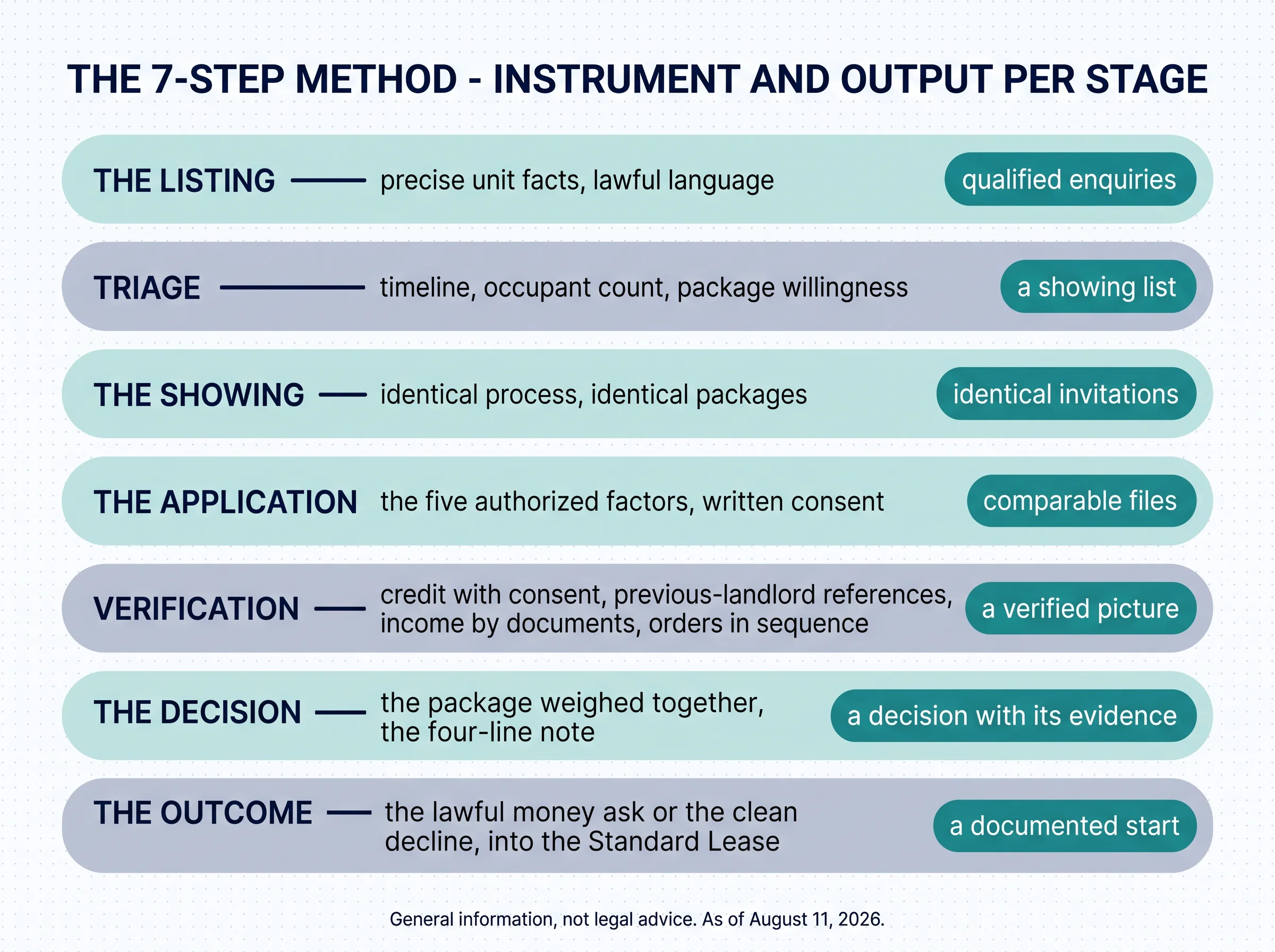
Here's the frame this guide runs on: screening is a process you design once and run identically, not a judgment you improvise per applicant. Ontario's rules are strict but coherent — you're allowed to be selective, you're not allowed to be discriminatory — and the same consistency the Human Rights Code expects is what makes applicant files comparable at all. So this is the method, in seven stages, from the listing to the lease: each stage with its lawful instrument, its output, and its paper trail. The depth on every stage lives in this series — the question-by-question map, the deposit rules, the pet rule, the public-orders guide — this page is the spine they hang from.
This is general information, not legal advice. For a specific situation, consult a licensed paralegal or lawyer, or the Ontario Human Rights Commission.
The Ontario Tenant Screening Checklist
The seven stages, the lawful question map, and the orders-era sequence — one page, Human Rights Code–compliant, run identically for everyone. Newly revised.
Get Free PDF →The legal lane, in one paragraph
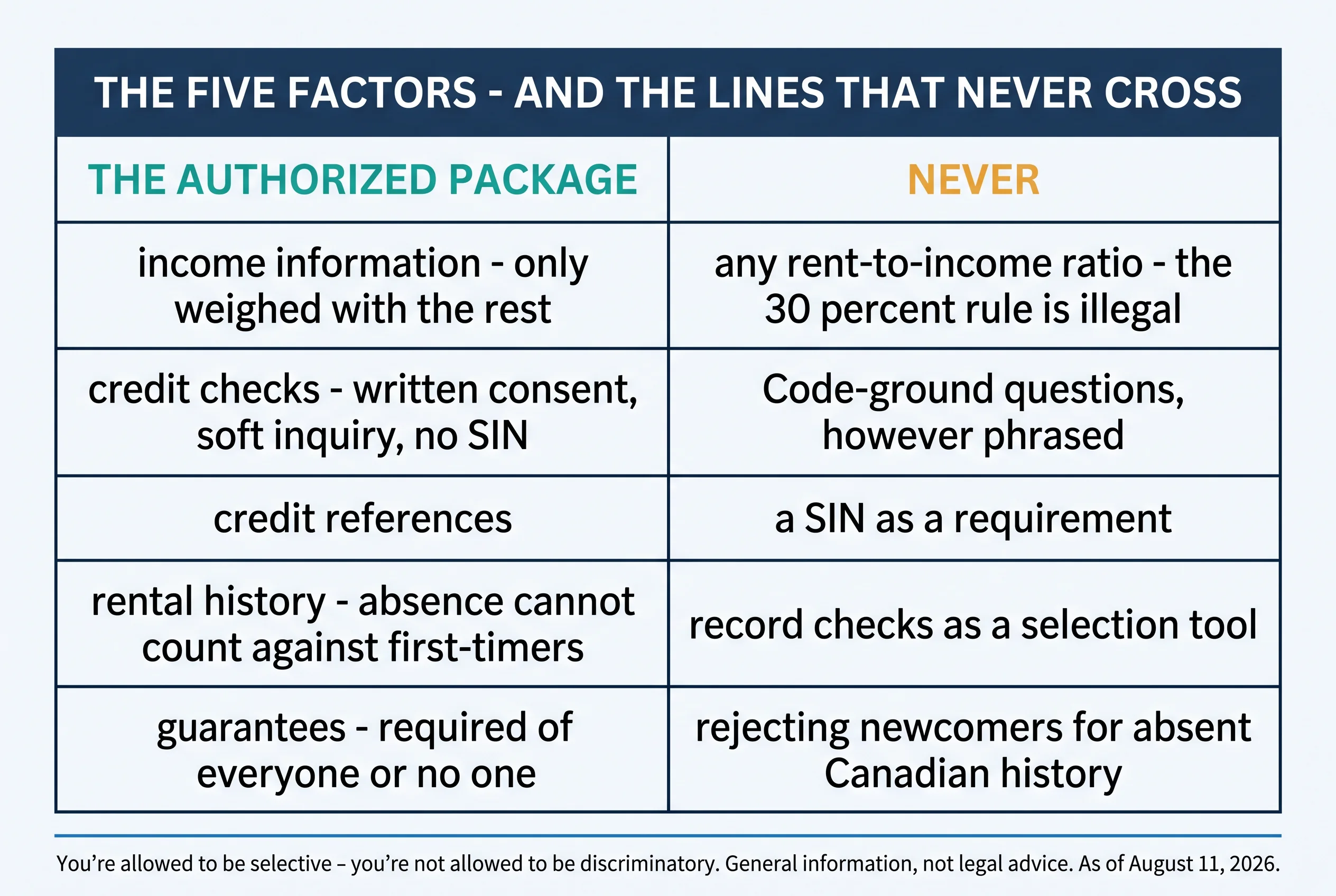
Two instruments govern everything below. The Ontario Human Rights Code prohibits choosing or refusing a tenant on race, ancestry, place of origin, colour, ethnic origin, citizenship, creed, sex, sexual orientation, gender identity or expression, age, marital status, family status, disability, or receipt of public assistance — at every stage, from the ad to the decision, and extending to an applicant's friends and relatives. Ontario Regulation 290/98 under the Code then permits exactly five categories of screening information: income information, credit checks, credit references, rental history, and guarantees — with the rule that makes the whole system make sense: income may only be considered together with the others, weighed as a package; no single number decides. Federal privacy law adds the consent layer. Everything else in this guide is those rules, turned into a sequence.
Stage 1 — The listing screens first
Screening starts before anyone applies, because a precise listing does the first cut by self-selection: state the square footage, the stairs, the parking, the pet position, and the wrong fits opt out on facts — lawfully, before anyone's evening is spent. The ad's language is regulated the same way the application is: describe the unit, never the wanted tenant ("professionals only" and "no students" are Code problems in ten characters), and keep the money line lawful — no "damage deposit," which is both an illegal term and a template imported from another province. The listing-copy method carries this whole stage. Output: qualified enquiries.
Stage 2 — Enquiry triage: the pre-showing three
A well-priced listing can pull dozens of enquiries in a weekend; triage is how the process survives contact with them. Three questions — all lawful, all about logistics and process — sort the pile: the timeline (when do you need to move?), the occupant count (how many people — count, never composition), and process willingness (are you able to provide income verification, references, and consent for a credit check as part of a standard application?). The third does the most work: applicants unwilling to complete any verification self-select out now instead of at stage five. Answer fast — the strongest applicants have options, and response speed is a selection pressure that runs in both directions. Output: a showing list.
Stage 3 — The showing: the interview that isn't a loophole
The showing conversation is governed by the Code exactly as the form is — the chatty version of a prohibited question is the same question with worse documentation. "Whose kids are these?" over coffee is family status; "is that mat leave ending soon?" is family status wearing a finance costume. What the showing is actually for: show the unit honestly, explain the process and its timeline, answer questions about the unit, and hand every interested viewer the identical application package. The question-by-question guide maps every line for this stage and the next. Output: applications invited on identical terms.
Stage 4 — The application: the authorized package, and nothing else
One identical form for everyone, built from the five authorized factors — and audited with one test: what decision does this question's answer feed? Every question should feed income, credit, references, history, or a guarantee; a question that feeds anything else is dead weight or liability, and the form is better without it either way. Two rules from the regulation shape the form's edges: a first-time renter's absent history cannot count against them (accept references and proof of past payments instead — rejecting a newcomer for lacking Canadian credit history can be adverse-effect discrimination), and a guarantor may be required only of every applicant or none — a guarantor policy that activates selectively is a proxy with a co-signer. Include the written-consent line for the credit check on the form itself. Output: complete, comparable files.
Stage 5 — Verification: check the package, not the person
The credit check: written consent first — no consent, no check — run through Equifax or TransUnion, without a SIN (it cannot be required, and checks run fine without it). One 2026 fact that removes a common objection: since November 2024, rental credit checks are soft inquiries — they don't lower the applicant's score, even across multiple applications, and applicants may supply their own report. Read the report for patterns, not a score in isolation — the together rule applies to interpretation too.
The references: call previous landlords, not just the current one — a current landlord has an incentive to move a problem tenant along with a glowing reference. The questions that work are conduct questions: did they pay on time, give proper notice, leave the unit in good shape — would you rent to them again? The Code binds what you ask about applicants exactly as it binds what you ask them. The income verification: pay stubs, an employment letter, or a Notice of Assessment for the self-employed — confirming the income exists and is steady, never ranking applicants by how far above the rent they earn.
The orders era, in one paragraph: LTB decisions are now published and searchable, and reading them is lawful — but deciding on them engages the Code, so the sequence matters: complete the package first, orders last and never first; read the order itself rather than a caption; weigh outcome and recency and invite the applicant's account; then decide on the package with the order's role noted. The full five-risk guide carries this instrument's depth. And for red flags generally — the refusal to consent, references that feel polished, pressure to rush — the red-flags guide reads them properly: conduct and finances, never identity, patterns over single data points. Output: a verified picture per file.
Stage 6 — The decision: weighed together, written down
The package decides as a package — income beside credit beside references beside history — and the decision gets documented at decision time with the four-line note: the factors reviewed, what each showed, the comparison made, the call. Ninety seconds per applicant; and if a decline is ever questioned, the answer already exists, dated, in the file's own words. Run one self-audit before finalizing: would this decision and this policy look identical across protected-ground lines? Gut feel is where proxies hide — if a concern can't be named as income, credit, references, history, or guarantee, it isn't a lawful concern yet: convert it into a package question or discard it. Output: a decision with its evidence attached.

Stage 7 — The outcome: offer, decline, and the hand-off
The offer comes with the lawful money ask and nothing else: first month's rent, a last-month's-rent deposit (Ontario's only deposit — one rental period maximum, earning interest annually at the year's guideline rate, 2.1% in 2026), and a refundable key deposit at actual cost. Damage, security, pet, and cleaning deposits are illegal whatever the label — the deposits guide runs the full machinery, interest math included. The decline is prompt and professional: thank them, confirm the unit went to another applicant, and don't improvise reasons on the phone — the documented basis lives in the file, where it belongs. The hand-off: the application's verified data flows straight into the Ontario Standard Lease — screening's end is the tenancy's beginning, and a documented start is the whole point of the method. Output: a tenancy that started documented — or a file that defends a decline.
For landlords: The seven stages look like process overhead until you run the arithmetic: a designed screen costs an hour or two per vacancy; a bad tenancy costs five to twelve months; and a discriminatory screen costs a Tribunal application on top. Consistency isn't the compliance tax on good screening — it's what makes the files comparable, which is what makes the screening good.
For property managers: The method scales by being written down: one form, one consent text, one reference script, one decision-note format across every building and every leasing hand — so any decision-maker screens the same way, and the portfolio's paper trail reads as one process rather than a dozen habits. Audit the templates annually; the stages don't change, but the instruments (soft-inquiry rules, published orders) have been moving.
The Ontario Tenant Screening Checklist
The seven stages, the lawful question map, and the orders-era sequence — one page, Human Rights Code–compliant, run identically for everyone. Newly revised.
Get Free PDF →Key takeaways
- Screening is seven stages run identically — listing, triage, showing, application, verification, decision, outcome — each with a lawful instrument and a named output.
- Five authorized factors, weighed together: income, credit checks, credit references, rental history, guarantees — and income never decides alone.
- Rent-to-income ratios are illegal in the private market — verify that income is steady; never apply a cut-off.
- The Code attends every stage — the ad, the showing chat, the reference call, and the decision — and guarantors are everyone-or-no-one.
- The orders era adds one instrument with a sequence: package first, orders last, read the order itself, invite the applicant's account.
- Document at decision time: the four-line note is ninety seconds now or an improvised answer later — and the offer's money ask is first, last, and key cost, nothing else.
The method, kept honest
Good screening in Ontario is selective and lawful at the same time, and the two turn out to be the same discipline: a designed process, run identically, documented as it goes. Use the five permitted categories, weigh them together, keep every conversation inside the same lines as the form, and write the decision down while you make it. The spokes in this series go deep on every stage; the advertising pillar runs the campaign that feeds stage one. This is general information, not legal advice — for your situation, consult a licensed paralegal or lawyer, or the Ontario Human Rights Commission. As of August 9, 2026.
Screen every applicant the same way
Tenon10 standardizes your applications, consent, income verification, reference notes, and decision records — so every unit and every decision-maker screens the same, compliant way.
Free to start • Built for Ontario landlords and property managers
Related resources
- What You Can and Can't Ask a Rental Applicant — stages 3 and 4's question-by-question map, with the 30-second rapid-fire list.
- Screening With LTB Orders — stage 5's newest instrument: the five risks and the defensible sequence.
- First and Last Month's Rent — stage 7's money ask, the interest math, and the illegal deposits.
- Refusing a Tenant With Pets — the two-stage pet rule that runs through stages 2, 4, and 7.
- Tenant Application Red Flags — stage 5's pattern-reading, done on conduct rather than identity.
- How to Advertise a Rental Property — the campaign around stage 1.
Frequently asked questions
Can a landlord ask for income information in Ontario?
Yes — but only alongside credit references, rental history, and a credit check, weighed together with them. Income can be considered on its own only when nothing else is available, and even then only to confirm the applicant earns enough to pay the rent.
Is the "30% rent-to-income rule" legal in Ontario?
No. Applying a rent-to-income ratio — a 30% cut-off, "three times the rent," any version — is illegal in the private market. The only exception is subsidized, rent-geared-to-income housing.
Do I need consent to run a tenant credit check?
Yes — written consent before any credit or reference check. Since November 2024, rental credit checks are soft inquiries that don't affect the applicant's score, and applicants can also supply their own report.
What deposits can a landlord collect in Ontario?
Only last month's rent (one rental period maximum, applied to the final month) plus a key deposit at actual replacement cost. Damage, security, pet, and cleaning deposits are all illegal — and the deposit earns annual interest at the year's guideline rate, 2.1% in 2026.
Can I check an applicant's LTB history?
Reading published LTB orders is lawful; deciding on them engages the Human Rights Code. Run the sequence: complete the authorized package first, read the order itself rather than a summary, weigh outcome and recency, invite the applicant's account, and decide on the package with the order's role documented. Our LTB-orders guide covers the five risks in full.
Can I require a guarantor or reject a newcomer without Canadian credit history?
A guarantor may be required only if required of every applicant — never selectively. And rejecting a newcomer for lacking Canadian credit or rental history can be adverse-effect discrimination; accept references and proof of past rent or bill payments instead.


