As of August 3, 2026. A rental listing has one job, and it isn't "maximum enquiries" — it's getting the right people to write to you and the wrong fits to opt out honestly, before anyone's evening is spent. That makes the listing the first screening document you'll ever publish for a unit — and the law and the craft agree completely on how it's allowed to screen: by being precise about the unit, never by describing the wanted tenant.
"Third-floor walk-up, no elevator" filters exactly who it should, by fact. "Young professionals preferred" filters by identity — unlawfully, and it's worse copy anyway. This is the writing method, in six parts, with a full before-and-after at the end. Our advertising pillar carries the whole campaign; this is the writing hour.
The Listing Copy Checklist
The six parts in writing order — facts block first, headline last — plus the five failure patterns and the two-minute skeptical-tenant read. One page.
Get Free PDF →The listing's real job — self-selection, by fact
Enquiries are not the metric; qualified enquiries are. Every wrong-fit enquiry costs two people time, and every wrong-fit showing costs a Saturday slot a right fit didn't get. So the listing's job is a filter's job — and the only lawful filter is precision about the unit itself. Square footage, stairs, parking, the pet position: state them plainly and readers self-place. The one who needs an elevator opts out at "third-floor walk-up." The one with a car opts out at "no parking." Nobody's evening was spent, and every message that does arrive is already half-qualified. Run the arithmetic once and the method sells itself: a showing evening holds perhaps six slots; every slot burned on someone who needed parking you don't have was purchasable for one line in the facts block. The listing's precision is literally buying back your weekend.
One guard sentence, printed early because it matters: self-selection means fit-by-fact — it is never a euphemism for signalling who should apply. The moment copy describes the wanted tenant instead of the unit, it has left both the law and this method, and no amount of friendly phrasing brings it back. The pillar carries the full language layer; this piece will apply it line by line.
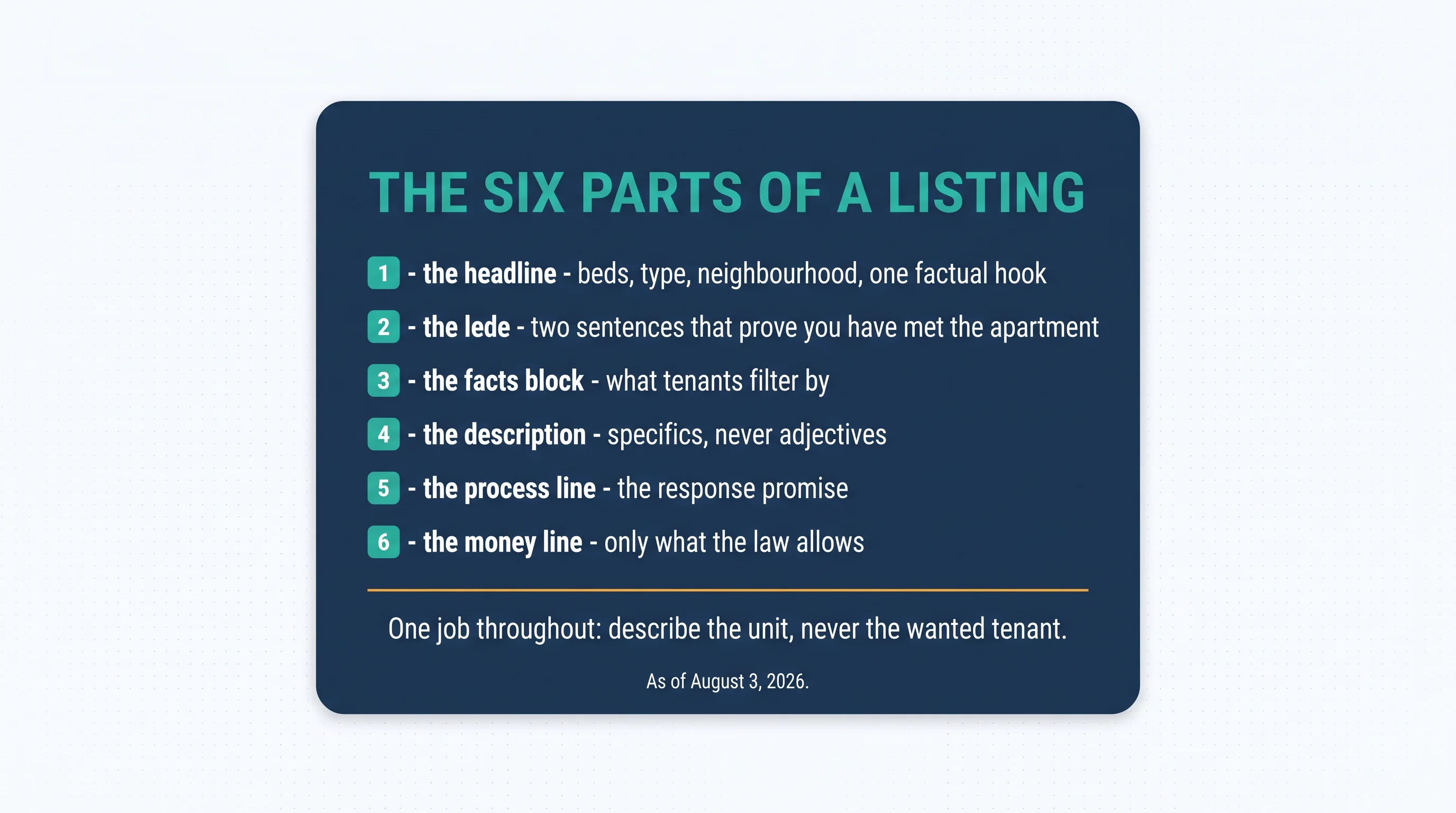
The headline and the lede — earn the click, then the read
The headline formula: beds/type + neighbourhood or anchor + one genuine hook. "Bright 2-Bed Upper Duplex, Westboro — Private Deck, Parking Included." The rules inside the formula: the hook must be a fact ("Private Deck" outworks "Stunning!" because one can be photographed and one can only be doubted); the neighbourhood does more work than any adjective, because it's the first filter every tenant runs (where the neighbourhood name is weak currency — a rural route, an unnamed subdivision — anchor to what tenants actually search: "10 minutes to the university," "across from the hospital"); and no ALL-CAPS, no "won't last" — urgency theatre now reads as a scam tell to renters trained by the fake-listing economy our platform comparison documents.
The lede — two sentences that prove you've met the apartment. What living there is actually like, concretely: "South-facing windows keep the living room bright until dinner; the No. 7 stop is at the corner." Then run the any-unit test: could this lede describe any unit in the city? If yes, rewrite until it can't. "Great location, lots of light" fails the test; the sentence above passes it, and the difference is the whole craft. The lede is also doing quiet trust work: in a market where clone listings harvest strangers' photos, two sentences only someone who's stood in the unit could write are a small authenticity signal no scammer bothers to fake.
The facts block — what tenants filter by before they read
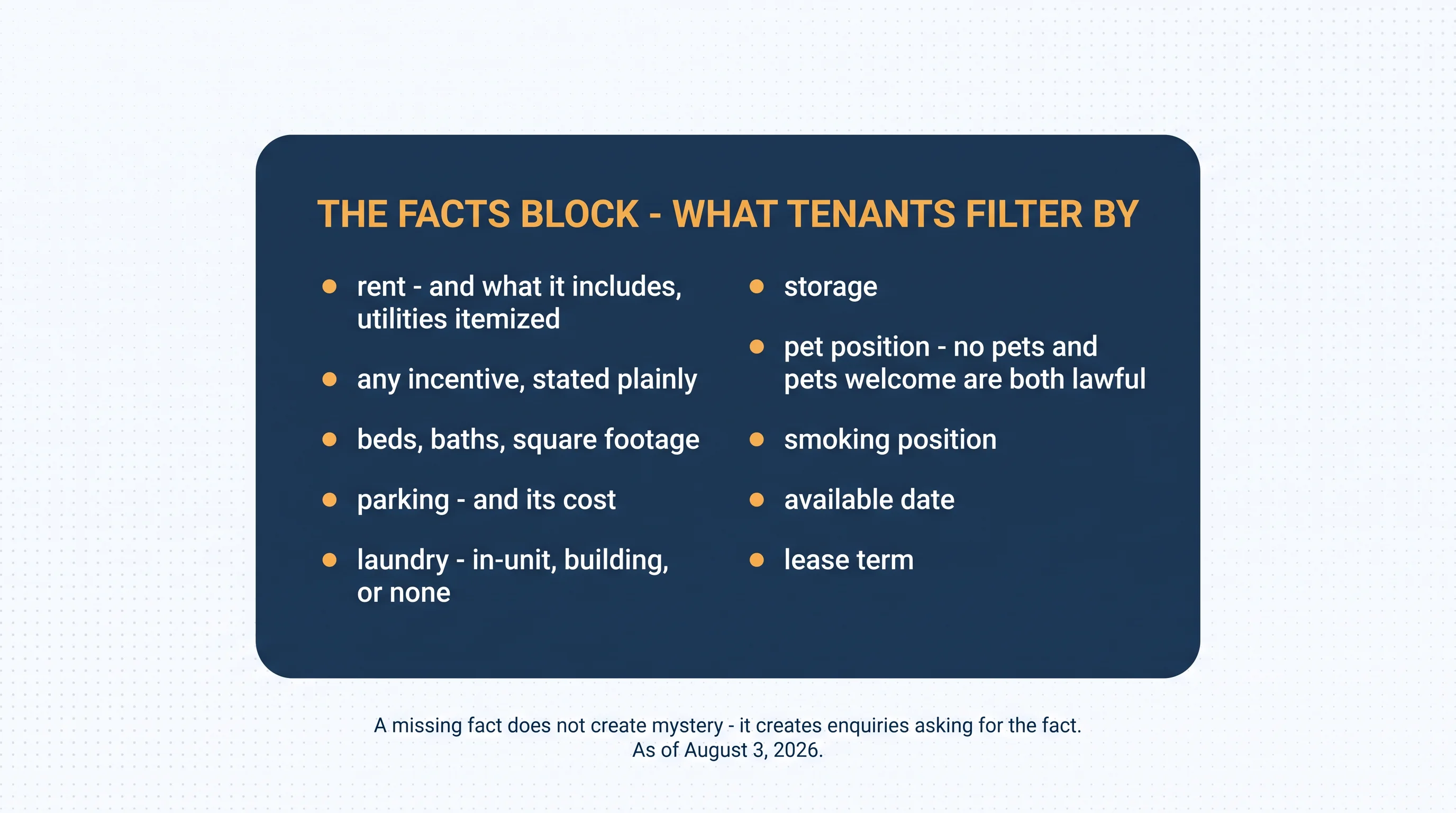
Tenants filter before they read — the platforms taught them to with literal filter menus — so the facts block is the listing's working core. The inventory, complete: rent and what it includes, utilities itemized (heat, hydro, water — "utilities extra" is a mystery, not a fact) · any incentive, stated plainly — in this market the free month is a price, and clarity is strategy, as the market check explains — "one month free on a 12-month lease" in the facts block beats the same concession revealed at the showing, because the effective-rent shopper comparing you against the tower's advertised incentive never got far enough to hear it · beds, baths, square footage · parking and its cost · laundry — in-unit, building, or none · storage · the pet position — and note the precision: "no pets" and "pets welcome" are both lawful unit lines, per our pets guide · the smoking position · the available date · the lease term.
The mechanism, stated once: a missing fact doesn't create mystery — it creates enquiries asking for the fact. That's the free band's noise problem, self-inflicted, one omission at a time. And on platforms that allow ordering, the facts block goes above the description: the reader qualifies themselves first, then reads because they're already interested. This is also why the checklist runs the parts in writing order rather than reading order — facts block first, headline last: every later part quotes the facts block, so writing it first means the lede, the description, and the headline all have something true to reach for.
💡 For landlords: The facts block is also your future self's record — rent, inclusions, and positions stated once, publicly, dated. When a tenant asks in February what the ad said in August, the filed listing answers; the pillar's file-the-ad habit exists for exactly that conversation. Facts you publish are facts you've committed to, which is one more reason to get them right the first time.
The description — specifics beat adjectives
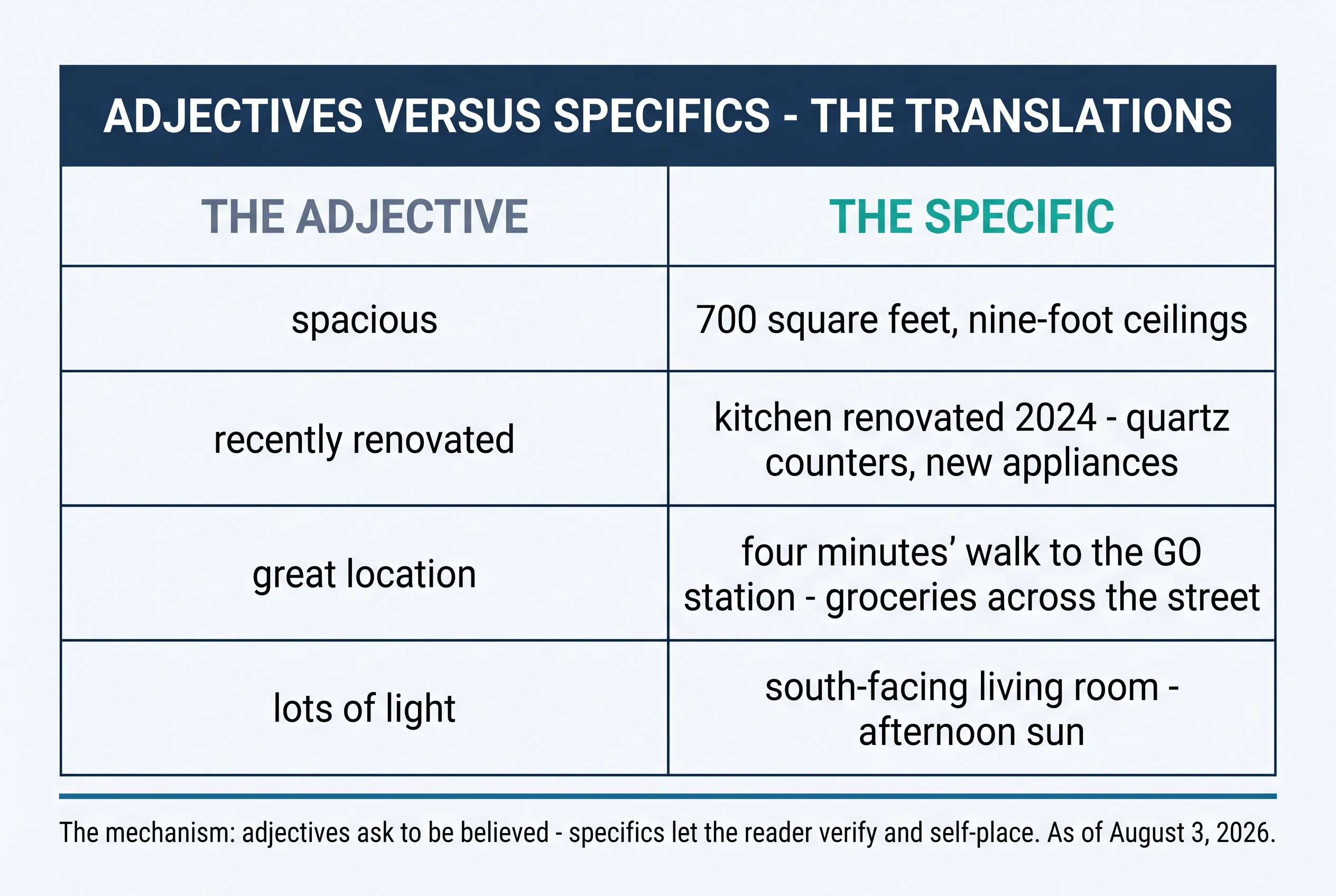
The translations, worked: "spacious" → "700 square feet, nine-foot ceilings." "Recently renovated" → "kitchen renovated 2024 — quartz counters, new appliances." "Great location" → "four minutes' walk to the GO station; groceries across the street." "Lots of light" → "south-facing living room, afternoon sun." Same unit, same truths — but the left column asks to be believed while the right column lets the reader verify and self-place. And a reader who has self-placed arrives at the showing already half-decided, which is the entire point of the exercise. Notice too how specifics chain with the photos: "kitchen renovated 2024 — quartz counters" tells the reader which photo to check, and the photo confirms the sentence — copy and images verifying each other is what listing credibility is actually made of. (The photo half of that partnership gets its own guide in this series.)
Honesty is the conversion strategy, not the tax on it. An oversold line buys showings that convert to nothing — the most expensive traffic there is. Flaws framed as facts with context do the opposite work: "cozy 480 square feet — right-sized for one" pre-filters honestly, saves everyone's Saturday, and earns credibility for every other claim in the ad. Concealed flaws don't disappear; they just choose to surface at the showing, in person, at the worst moment for the sale.
The process line and the money line — the listing's contract with the reader

The process line does three jobs in one sentence: "Applications acknowledged within 24 hours; showings Thursday evening and Saturday morning." It signals a professional process to the strong applicants who have options, it filters the mass-blast enquiries that never read ads, and it commits you to the response discipline the pillar's 72-hour window demands anyway. Add what to prepare — and route yourself to the lawful application package, because the questions are regulated from the first form onward.
The money line, Ontario-exact and one sentence long: first month's rent, a last-month's-rent deposit, and a refundable key deposit at actual cost — the only collections the law allows, and nothing else. A "damage deposit" line advertises an illegal term, in writing, with your name on it — and it's the single most common unlawful line in Ontario listings, usually imported from another province's template. That import pattern is worth one more sentence: BC and Alberta lease kits circulate freely online, damage deposits are lawful there, and every Ontario listing that copies one inherits the illegal line wholesale — which is why the money sentence should be written from the law, once, and reused, never borrowed from a search result.
One more reason the discipline pays: the listing is read by two audiences with opposite errors. Tenants discount what they can't verify; tribunals notice what describes people. The same edit — swap every belief-request and tenant-line for a unit fact — satisfies both readers at once, which is why this method needs no separate "compliance pass": written properly, the ad was compliant the whole way through.
The before and after — one ad, rebuilt
Before, in full — constructed for teaching, though you've seen its cousins everywhere: "Spacious 2 bedroom apartment in great area!!! Recently renovated, close to everything. Perfect for young professional couple. No pets no parties. $2,200 + damage deposit. Serious inquiries only!!!"
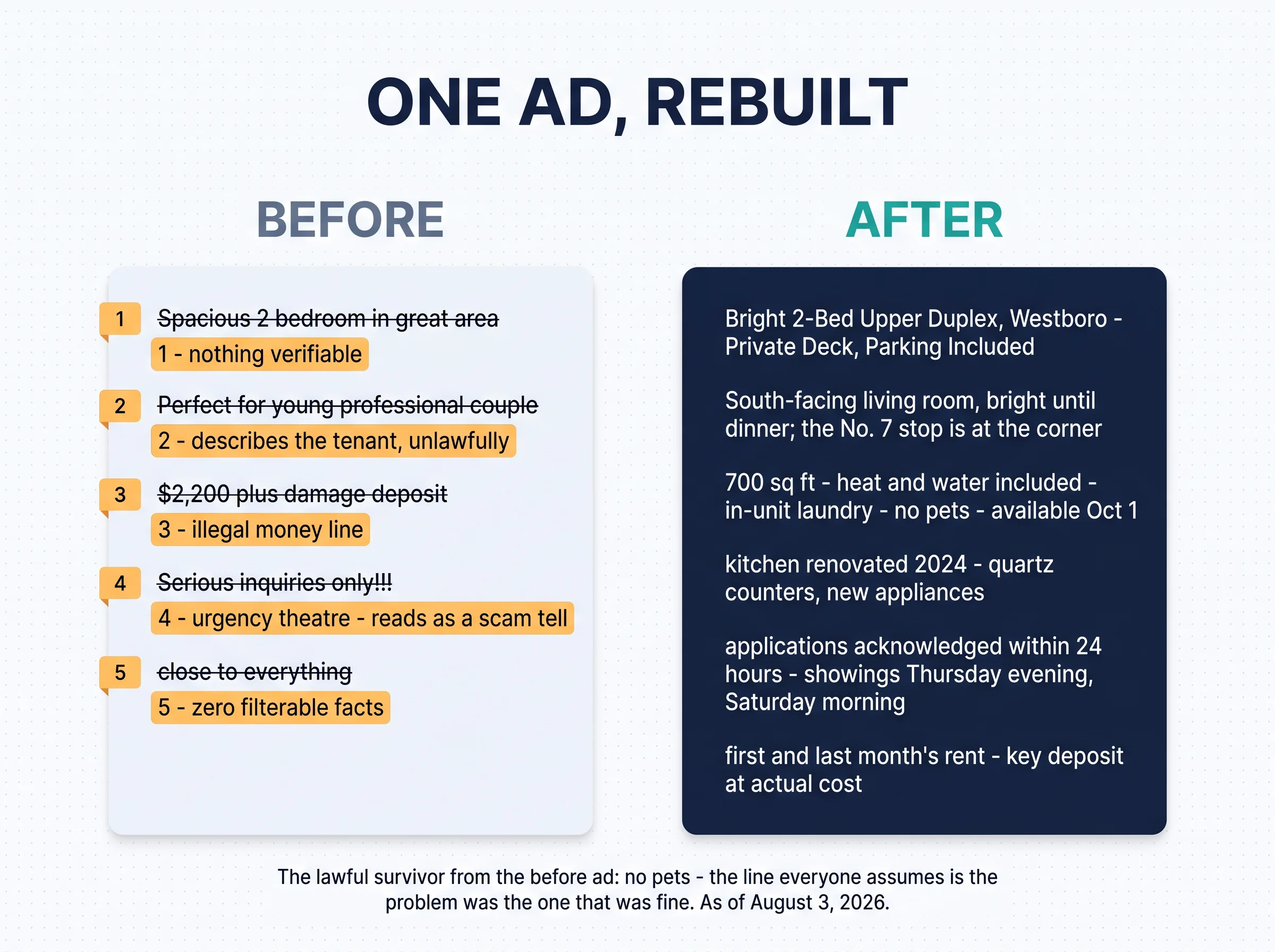
The five failures, named: ① adjective soup — "spacious," "great area," "close to everything": nothing a reader can verify. ② A tenant-description line — "perfect for young professional couple" is protected-ground territory (family status, and an income proxy besides), and it repels every lawful applicant outside its picture. ③ An illegal money line — the damage deposit. ④ Urgency and gatekeeping theatre — "serious inquiries only!!!" reads as a scam tell to exactly the careful renters you want. ⑤ Zero filterable facts — no inclusions, no parking, no laundry, no dates: every one now an enquiry asking for it.
And the annotation most readers miss: the one lawful survivor from the wreckage is "no pets." The line everyone assumes is the problem was the one that was fine — a unit preference, stated plainly, exactly as the two-stage pet rule allows at the advertising stage.
After, in full: "Bright 2-Bed Upper Duplex, Westboro — Private Deck, Parking Included. South-facing living room, bright until dinner; the No. 7 stop is at the corner. 700 sq ft · heat and water included · in-unit laundry · no pets · available Oct 1. Kitchen renovated 2024 — quartz counters, new appliances. Applications acknowledged within 24 hours; showings Thursday evening and Saturday morning. First and last month's rent; key deposit at actual cost." Same unit. Every claim checkable. The wrong fits self-select out on the third floor, the pet position, and the dates — and the messages that arrive are already half-qualified.
Worth noticing what the rewrite didn't do: it didn't make the unit sound better than it is. The before ad and the after ad describe the same 700 square feet — the rewrite just replaced belief-requests with checkable facts and deleted the lines the law and the reader both distrust. Better copy here isn't embellishment; it's specificity plus lawfulness, which happen to be the same edit.
💡 This six-part structure is exactly what the listing builder scaffolds: the facts block prompted field by field, the money line pre-written lawfully, the language checks in the flow, and platform-ready output at the end — the writing hour, guided. Free for up to 3 units, tenants free on every tier. Open the listing builder or see current plans.
The Listing Copy Checklist
The six parts in writing order — facts block first, headline last — plus the five failure patterns and the two-minute skeptical-tenant read. One page.
Get Free PDF →Key takeaways
- The listing is the first screening document you publish — and it screens lawfully one way only: precision about the unit, never description of the tenant.
- Headline formula: beds/type + neighbourhood + one factual hook — and write it last, after the facts exist.
- The facts block does the filtering: itemize inclusions, parking, laundry, pets, dates — missing facts become noise enquiries.
- Specifics beat adjectives because they let readers verify and self-place; honesty converts, and concealed flaws surface at the showing anyway.
- The process line signals professionalism and commits you to speed; the money line carries only what Ontario allows.
- "No pets" was never the problem line — "perfect for young professionals" was.
Facts that filter, specifics that verify
The writing hour sits inside a bigger campaign — the pillar runs legality, pricing, platforms, and the response window around it — but the hour itself comes down to one discipline applied six ways: say true, checkable things about the unit, in the order tenants actually use them, and let the facts do the filtering the law won't let adjectives or preferences do. Write the ad a skeptical stranger would trust, and the right strangers will write back. This is general information, not legal advice. As of August 3, 2026.
The writing hour, guided
Facts block prompted field by field, the lawful money line pre-written, language checks in the flow — build the listing once, properly. Free for up to 3 units.
Free for up to 3 units • Tenants always free • See current plans
Related resources
- How to Advertise a Rental Property in Ontario — the pillar: the campaign around this writing hour.
- Where to List a Rental: 9 Sites Compared — where this master listing gets posted.
- First and Last Month's Rent — the money line's complete rules.
- Refusing Tenants With Pets — why "no pets" is lawful in the ad and void in the lease.
Frequently asked questions
What should I write in a rental ad?
Six parts: a factual headline, a two-sentence lede about living there, a complete facts block (rent and inclusions, beds/baths/size, parking, laundry, pets, dates), specific description lines instead of adjectives, a process line with a response promise, and the lawful money line. The method above walks each in writing order.
Can I say "no pets" in a rental listing?
Yes — it's a lawful unit preference in Ontario ad copy (with service-animal and condo caveats at later stages). What you can't write are tenant descriptions: "professionals only," "ideal for couples," "no students."
How long should a rental listing be?
The facts block is non-negotiable everywhere; description depth flexes by platform — classifieds reward completeness, marketplace cards truncate, so front-load. One master version, adapted lightly, beats improvising per site.
Why is my rental listing not getting responses?
Usually one of four: the price is off the market (check by source and month), the facts block is incomplete (tenants filter out on mystery), the photos undersell, or the platform mix misses the unit's audience. Our pricing, photo, and platform guides in this series each cover one.
Should I mention the unit's flaws?
Frame them as facts with context — "cozy 480 square feet, right-sized for one" — because concealed flaws don't disappear; they surface at the showing and cost the conversion. Honest pre-filtering saves everyone's Saturday.