

Every turnover playbook a Canadian operator can find assumes roughly 45% annual turnover. Ontario runs about a quarter of that. CMHC puts Toronto turnover between 7.9% and 12.1% depending on rent quartile, with Ottawa at 14.0% to 21.8%.
Which means a 200-unit US portfolio produces about ninety turns a year, and a 200-unit Toronto portfolio produces about twenty.
That single fact breaks every ROI calculation in the category — and it cuts both ways. Fewer turns means the volume argument for turn efficiency is weaker than the American content claims. But it also means each turn carries far more weight, because under vacancy decontrol a turnover is the only moment an Ontario operator can reset rent to market. A turn here is simultaneously the largest cost event in the tenancy and the only revenue-reset opportunity in it.
This guide, current as of August 2026, covers the Ontario-corrected portfolio arithmetic, the legal window Ontario law opens and almost nobody uses, where the recoverable days actually hide, a notice-triggered turnover timeline, and the entry-compliance rules that make an aggressive leasing push expensive if you get them wrong. Every US figure is labelled as US. It is general information rather than legal advice.
The Notice-Triggered Turnover: An Ontario Operator's Vacancy Playbook
Most turnover playbooks were written for a market that turns over four times as often as Ontario does. This free playbook gives you the sequencing change that costs nothing, the sixty-day legal window almost no operator uses, and the portfolio arithmetic in a form you can put in front of an owner.
Get Free PDF →Why the benchmarks you've read don't apply here
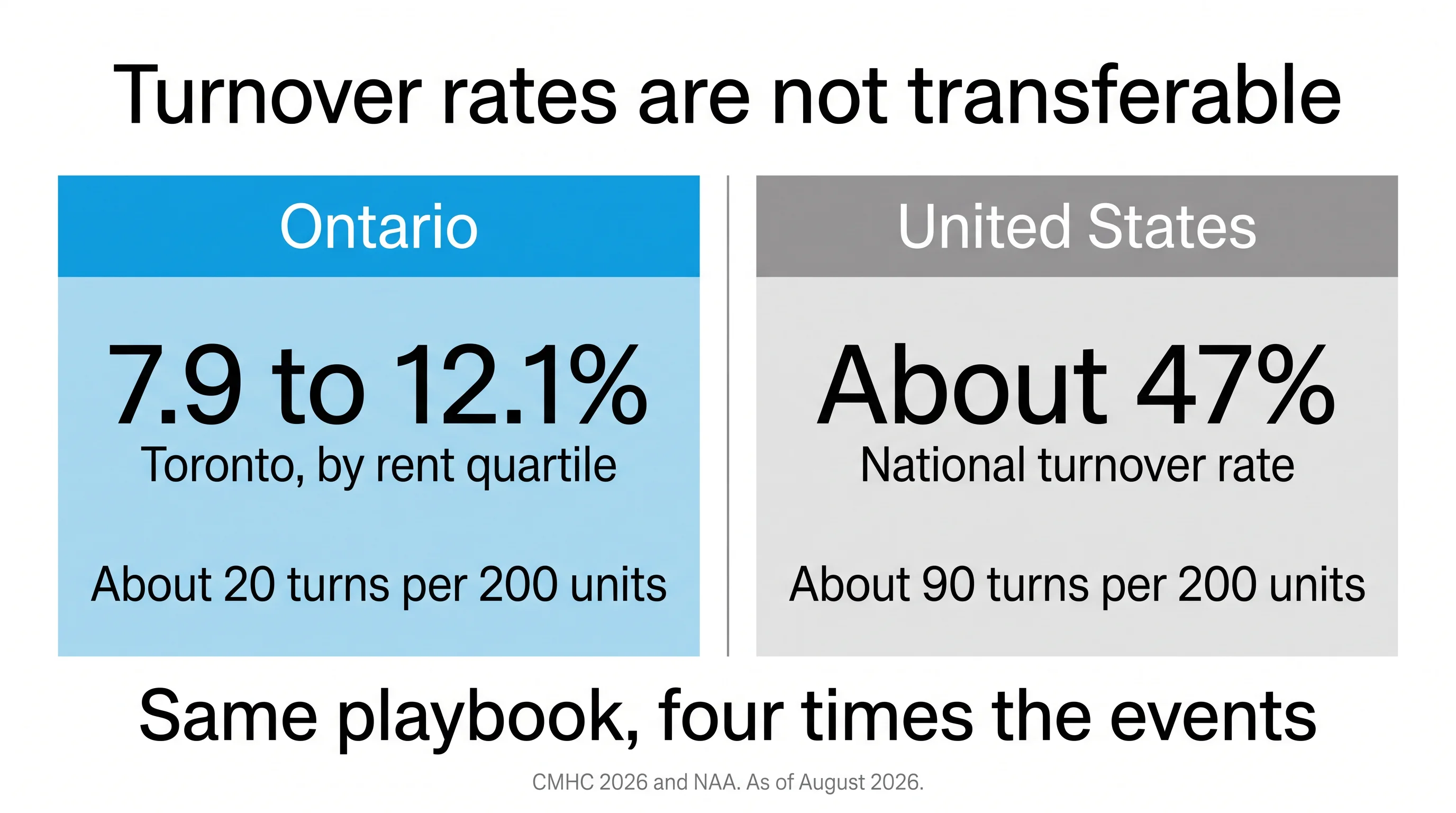
The US baseline every playbook rests on is roughly 47% annual turnover (NAA Income & Expense Survey — US data), with Zego's 2026 figures putting resident retention at 57%, meaning 43% of units turn each year. Against that, CMHC's Ontario data puts Toronto at 7.9% in the lowest rent quartile and 12.1% in the highest (CMHC 2026 Mid-Year Rental Market Update, June 9, 2026).
Work the correction all the way through
It is not enough to note the difference. Follow it into the business case, because that is where operators get misled.
The US framing: a 250-unit community at 45% turnover is about 112 turns a year. Seven avoidable vacant days per turn is roughly 784 vacant unit-days — the equivalent of holding more than two units permanently empty (Renova One, July 2026 — US).
The Ontario version: a 250-unit Toronto portfolio at around 10% turnover is roughly 25 turns. Seven avoidable days each is 175 unit-days — about half a unit held empty all year. At $85 per vacant day, that is roughly $14,875 annually.
Real money, and a quarter of what the imported figure implies. Say the number honestly when you take this to an owner; the first person who checks the turnover assumption will otherwise discredit the whole case.
The second Ontario difference, which nobody writes about
Under vacancy decontrol, the advertised rent on a vacant unit is unregulated — and it becomes the base every future guideline increase builds from. The 2026 guideline is 2.1%; the 2027 guideline is 1.9%.
So in Ontario a turn is not purely a cost centre. It is the only repricing event you get. That changes the optimisation entirely: speed and pricing accuracy trade against each other, and the trade should be made deliberately rather than by default. The American content treats speed as an unqualified good because in a 45%-turnover market with different rent regulation, it very nearly is.
Two definitions that make everything else usable
- Days vacant — move-out to move-in. This is the KPI.
- Make-ready or turn time — the physical work. A sub-metric, and a small one.
The distinction matters more than it sounds. A property with a five-day make-ready and a forty-five-day total vacancy is bleeding rent somewhere else in the lifecycle entirely, and only the days-vacant number catches it. Our guide to how long it takes to rent a unit in Ontario derives the outer clock this all has to fit inside — GTHA condo inventory clearing in roughly 27 days at 0.9 months of supply.
The sixty-day window Ontario law gives you
This is the single most valuable operational fact in the piece, and it appears in no turnover content anywhere.
Under the Residential Tenancies Act, once the landlord and tenant have agreed the tenancy will end — or either has given notice of termination to the other — the landlord may enter the unit without written notice to show it to prospective tenants, provided the entry happens between 8 a.m. and 8 p.m. and, before entering, the landlord informs or makes a reasonable effort to inform the tenant of the intention to do so.
Why that matters operationally
Ontario's standard N9 notice for a monthly tenancy is 60 days. So from the day notice lands, you have roughly two months in which you can market, show, screen and sign — with the showing friction deliberately lowered by statute.
Meanwhile, 78% of property managers wait until the unit is move-in ready before listing it (NAA — US data, but the behaviour is universal). Set those two facts side by side and the conclusion writes itself: Ontario operators have a legally protected two-month head start that most of them are not using.
The distinction that creates liability if you blur it
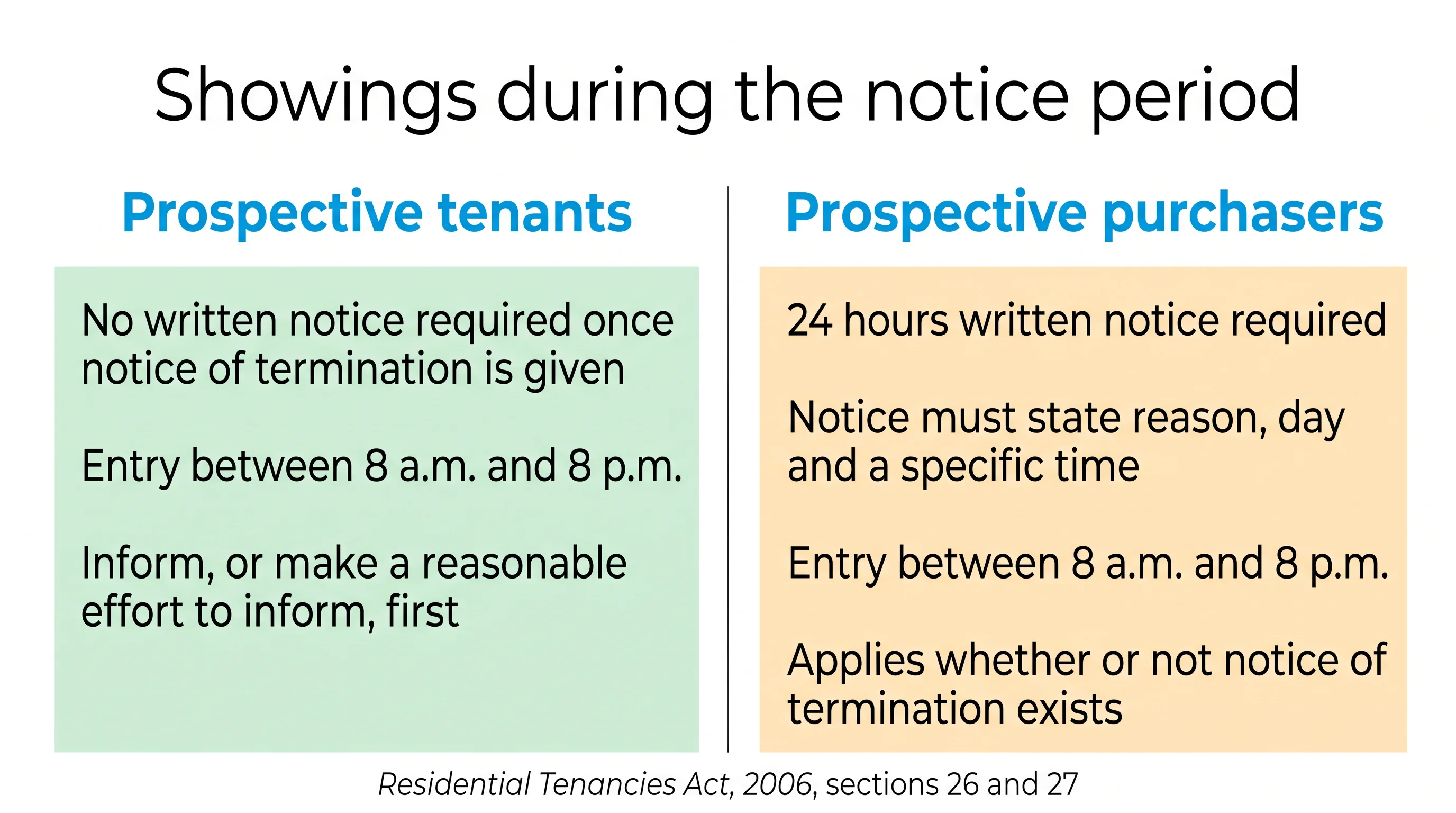
The exemption is for prospective tenant showings only. Showings to a prospective purchaser require 24 hours' written notice specifying the reason, the day, and a time of entry between 8 a.m. and 8 p.m. — whether or not a notice of termination exists.
Two different rules for two different situations. Firms that run one process for both will eventually run the wrong one, and the consequence lands on the firm rather than the agent.
What still needs 24 hours' written notice
Make-ready work during occupancy. Entry to carry out a repair or replacement or do work in the unit requires written notice at least 24 hours ahead — which is exactly why the pre-walk should be scheduled once, early, with proper notice, rather than repeatedly throughout the notice period.
And the notice has to be specific. The Divisional Court in Wrona v. Toronto Community Housing Corporation found that a nine-hour entry window did not comply with the requirement to specify a time of entry; eight-hour windows have been found non-compliant too. Our guide to the 24-hour notice of entry rule covers the notice requirements in full.
Where the days actually hide
The physical work is not the problem and never was. The make-ready labour is not what makes a turn expensive — the calendar is. A standard turn's physical work fits inside a week; the largest cost driver is whichever line item forces the unit to sit longer.
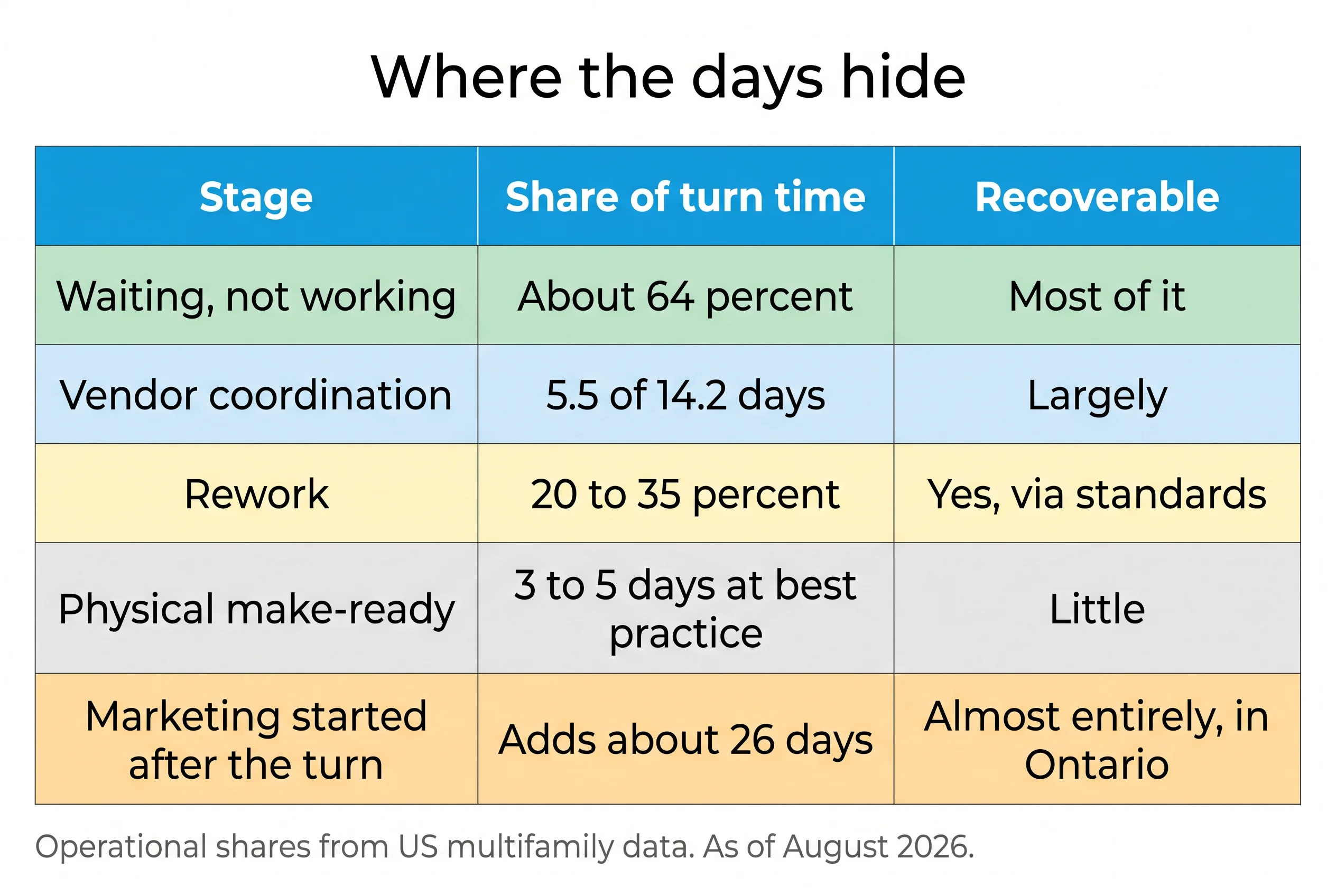
| Where the time goes | Share | Recoverable? |
|---|---|---|
| Waiting, not working | 64% of turn time | Most of it |
| Vendor coordination specifically | 5.5 of 14.2 turn days | Largely |
| Rework — work not done right the first time | 20–35% of turn time and materials | Yes, via standards |
| Actual physical make-ready | 3–5 days at best practice | Little |
| Marketing started after the turn | Adds about 26 days | Almost entirely, in Ontario |
Operational shares from US multifamily data. The proportions travel; the volume arithmetic does not.
Vacant units lose inside your own maintenance queue
The structural insight most operators recognise instantly: maintenance teams juggle active resident work orders alongside time-sensitive make-readies, and because current residents escalate and empty units don't, turns fall to the bottom of the list. Backlogs form and become progressively harder to clear.
The fix is capacity, not exhortation. A floater or a retained trades package through the April-to-July peak. Asking the same team to prioritise differently does not work, because the incentive structure that deprioritises vacant units is real.
Vendor coordination, not vendor speed
More than a third of the turn clock is spent waiting on trades. Fix: book during the notice window, not after move-out. Standardise scopes, materials and pricing so each turn stops being re-decided from scratch.
Rework is invisible because nobody codes it
A fifth to a third of turn time and materials, and it appears in no standard report. Fix: a consistent quality standard and an evidence-based ready declaration. A unit should be declared ready based on evidence, not assumption — skipping the final standard produces complaints, post-move-in work orders, and another round of access coordination.
Every turn runs differently
When each manager or maintenance lead runs turns their own way, quality goes inconsistent, steps get skipped, timelines vary, and accountability becomes impossible. Fix: one documented sequence with a clear exception path.
The peak arrives all at once
Ontario leases cluster to expire April through July, so a portfolio's turns land together — precisely when trades are busiest. Fix: stagger deliberately by offering slightly off-cycle terms at renewal. This is a structural lever available to portfolio operators and completely unavailable to individual landlords, which makes it one of the few genuine advantages of scale in this business.
The notice-triggered turnover
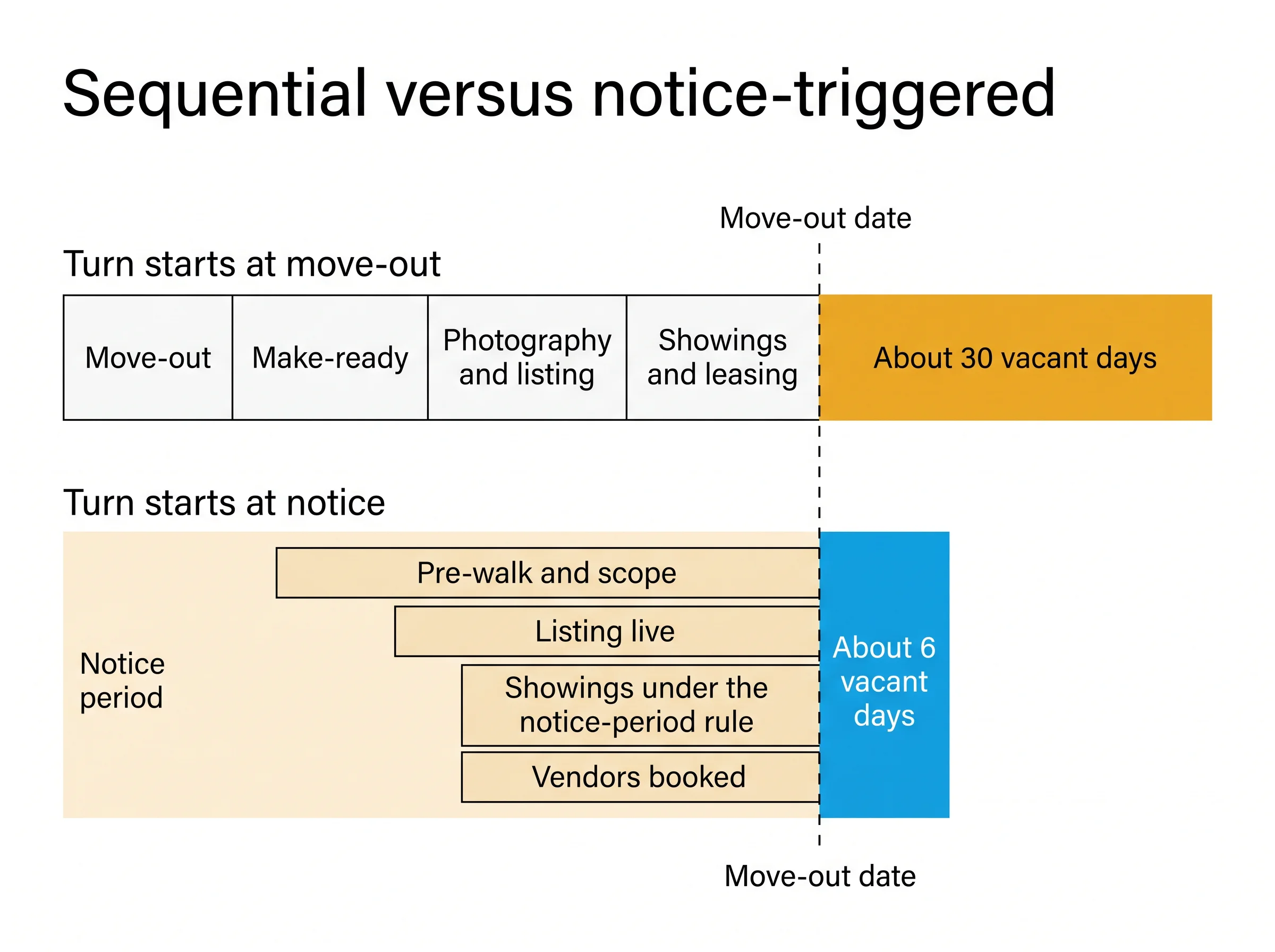
One rule reorganises everything: start the turn at the notice date, not the move-out date. That change converts 30 to 60 days of dead calendar into planning time for inspection, material ordering, vendor scheduling and — uniquely in Ontario — leasing.
| Day from notice | Action |
|---|---|
| 0 | Notice received. Log it. Trigger the workflow. This is the change. |
| 1–3 | Pre-walk with 24 hours' written notice. Scope the make-ready. Order long-lead materials |
| 3–5 | Book vendors for the post-move-out window. Set the reset rent against current comparables |
| 5–7 | Listing live with an availability date. Photography from the pre-walk |
| 7–55 | Show under the notice-period rule — batched, 8 a.m. to 8 p.m. Screen and approve |
| ~55 | Lease signed for a start date days after move-out, not weeks |
| 60 | Move-out. Make-ready begins with vendors booked and materials on site |
| 60–65 | Make-ready complete. Evidence-based ready declaration |
| 65–67 | New tenant moves in |
| Total vacancy | About 5 to 7 days, rather than 25 to 35 |
The comparison figure is stark: post-turn marketing produces 32.5 total vacancy days against 6.8 for notice-triggered pre-marketing — a difference of 25.7 days per unit (US data). The sequencing change is worth more than any efficiency gain available inside the make-ready itself.
Which leads to an investment rule most turn budgets get backwards: the savings from squeezing $200 out of a paint scope are almost always smaller than the savings from removing three days of vacancy. Our full model on what an empty unit actually costs you per day shows why the fully loaded figure runs well above the rent alone.
The counterweight, and this one is Ontario-specific
Speed is not an unqualified good here. A turn rushed so hard that the reset rent lands $100 below market costs $1,200 in year one and compounds under the guideline for the length of the tenancy — which under rent control may be years, not months.
And a tenant who moves into a unit with visible defects renews at materially lower rates. In a province where a unit turns roughly once a decade and a turn costs $3,000-plus fully loaded, buying four days by shipping poor work is a bad trade twice over.
What it's worth, and what's coming
Here are the numbers to put in front of a principal.
- Cost of the sequencing change: effectively zero. It is a workflow decision, not a purchase. Lead with that.
- Cost of dedicated make-ready capacity: one floater or a retained trades package through peak.
- Value at 250 units, 10% turnover: roughly $14,875 a year from seven recovered days per turn. At 500 units, roughly $29,750.
- The larger number nobody calculates: setting the reset rent $100 above where a rushed turn would land, across 25 turns, is $30,000 in year-one revenue — and it compounds under the guideline for the life of each tenancy.
- The downside of getting aggressive: T2 exposure at $500 to $2,000 per finding, plus administrative fines and the time cost of a hearing.
Which produces the sentence to build the owner conversation around: in Ontario, the pricing gain is worth more than the speed gain — and starting at notice gets you both.
What's coming over the next year
- Toronto turns get easier to fill, harder to price. Supply at 0.9 months and listings down roughly 6% year over year mean less vacancy risk per turn and more pressure to set the reset rent correctly.
- The 905 and Ottawa stay operationally demanding. Ottawa availability sits at 6.5% with heavy incentive use; where demand is softer, turn efficiency genuinely determines vacancy length.
- Peak compresses further around the April-to-July cluster.
- Turnover automation moves down-market. Tools built for 500-unit US portfolios are reaching 50-unit Canadian firms — but rebuild the ROI case on Ontario turnover rates before anyone signs anything.
- Bill 60's N4 and N12 changes took effect September 21, 2026, for notices given on or after that date; the N12 change covers only a landlord's own use, not a purchaser's. The N4 notice period drops from 14 days to 7, and N12 own-use with 120 days' notice no longer requires compensation. Both change how quickly a unit becomes vacant, which is upstream of everything here — our guide to the 2026 rental law changes covers the full set.
Practical takeaways
Seven changes, in order of value:
- Move the turnover trigger from move-out to notice received. Everything else depends on it.
- Pre-walk once, early, with 24 hours' written notice and a narrow time window. Scope everything in one visit.
- List the unit at notice, not at ready, with an availability date.
- Batch showings under the notice-period rule: 8 a.m. to 8 p.m., reasonable effort to inform, grouped rather than ad hoc.
- Book vendors and order long-lead materials during the notice window.
- Set the reset rent deliberately against current comparables — it is your only repricing event.
- Report days vacant per turn to owners, not occupancy.
Quick wins: trigger at notice on your next three turns, brief agents and contractors on the two showing rules in writing, batch your next set of showings, and code rework separately so you can see it. Longer-term: build one documented turn sequence with a clear exception path, add dedicated make-ready capacity through the peak, stagger lease end dates at renewal so the peak flattens, and standardise paint, flooring and fixture specs so scoping stops being a per-unit decision.
The Notice-Triggered Turnover: An Ontario Operator's Vacancy Playbook
Most turnover playbooks were written for a market that turns over four times as often as Ontario does. This free playbook gives you the sequencing change that costs nothing, the sixty-day legal window almost no operator uses, and the portfolio arithmetic in a form you can put in front of an owner.
Get Free PDF →Frequently asked questions
Can I show a rental unit before the current tenant moves out in Ontario?
Yes. Once either party has given notice of termination — or both have agreed the tenancy will end — you may enter to show the unit to prospective tenants without written notice, provided you enter between 8 a.m. and 8 p.m. and inform, or make a reasonable effort to inform, the tenant beforehand. This is the most under-used provision in Ontario turnover operations. Note that it applies to prospective tenants; showing to a prospective purchaser still requires 24 hours' written notice.
How many days should a unit turnover take?
The physical make-ready fits in three to five days at best practice. Total days vacant is the number that matters, and with a notice-triggered process — listing, showing and signing during the notice period — five to seven days between tenants is achievable. Operators who start the process at move-out typically see 25 to 35.
Do US turnover benchmarks apply to an Ontario portfolio?
Not directly. They assume roughly 45% annual turnover; CMHC puts Toronto between 7.9% and 12.1% depending on rent quartile. Any ROI calculation built on the US rate overstates the Ontario opportunity by roughly four times. The operational lessons travel; the volume arithmetic does not.
What does one vacancy day actually cost?
On a Toronto condo at $2,577 a month, roughly $85 a day in rent alone — more once carrying costs are included. Across a 250-unit portfolio at 10% turnover, seven avoidable days per turn is about $14,875 a year.
How do I cut turn time without hiring more maintenance staff?
Most of the recoverable time is not labour. Around 64% of turn time is waiting rather than working, and vendor coordination alone accounts for more than a third of the clock. Booking vendors during the notice window, standardising scopes and materials, and coding rework separately so you can see it will recover more days than additional headcount.
The bottom line
The turnover playbooks in circulation were written for a market that turns over four times as often as Ontario does. Corrected for local turnover rates, the volume case for turn efficiency is real but modest — roughly $15,000 a year on a 250-unit portfolio. The larger opportunity is the one the imported content cannot see: a turn is the only repricing event Ontario's rent control allows, so getting the reset right is worth more than getting the turn fast.
And the biggest single lever costs nothing. Ontario law opens a sixty-day window at notice in which you can market, show and sign, with showing friction deliberately reduced by statute — while most operators wait until the unit is empty and painted before they list it. Moving the trigger from move-out to notice is a workflow decision, not a purchase, and it is worth more than every efficiency gain available inside the make-ready combined.
Next steps: move the trigger, brief the team on both showing rules in writing, and start reporting days vacant per turn instead of occupancy.
Listing at notice only works if the listing is ready to go
Tenon10's listing builder covers the facts tenants filter by, Human Rights Code-safe language and the lawful money lines — so the ad can go live the day notice lands, not the day the paint dries.
Free • No signup required • Updated for the Bill 60 changes in force 21 Sep 2026
Related resources
- What an Empty Unit Actually Costs You Per Day — the full vacancy-cost model behind the $85-a-day figure.
- How Long Does It Take to Rent a Unit in Ontario? — where the 27-day outer clock comes from.
- The 24-Hour Notice of Entry Rule in Ontario — the notice requirements in full, including what makes a notice non-compliant.
- How to Write a Rental Listing That Attracts Good Tenants — so the ad is ready the day notice lands.
- Where to List a Rental in Ontario: 9 Sites Compared — platform by platform, honestly costed.
- How to Screen a Tenant in Ontario: The 7-Step Method — the screening sequence to run during the notice window.
- Ontario Rental Law Changes 2026: Bill 60 and Bill 97 — what changes on September 21 and what it means upstream of your turns.
This article is general information, not legal advice. All figures are current as of August 2026 and carry their original source and date. Operational benchmarks marked US are American multifamily portfolio data and are labelled as such throughout. Verify current rules at ontario.ca, tribunalsontario.ca, or with the Landlord and Tenant Board before changing your entry or turnover practices.


