

A landlord who writes "quiet building, ideal for professionals" in one ad has made one mistake. A firm with that phrase sitting in a master template used across fifty units has not made fifty mistakes. It has an organizational practice.
That distinction is not rhetorical. The Ontario Human Rights Commission defines systemic discrimination as patterns of behaviour, policies or practices that are part of the social or administrative structures of an organization, which may appear neutral on the surface but nevertheless have an exclusionary impact — and it holds that housing providers have a positive obligation to ensure they are not engaging in it.
A master listing template is, precisely, an administrative structure of an organization. It is a policy, applied systematically, documented in writing, and timestamped across every syndication platform it reaches.
Which produces the uncomfortable fact this guide is built on: at fifty units your template is simultaneously your biggest efficiency gain and your biggest compliance liability, and it is the same artifact. This piece, current as of August 2026, covers the three-layer template architecture, the phrases that must never appear in it, an honest assessment of whether syndication tooling actually reaches Ontario renters, the approval-layer arithmetic to put in front of a principal, and a quarterly audit most firms have never run. General information, not legal advice.
The Portfolio Listing Audit: A Compliance Checklist for Ontario Operators
At fifty units your listing template stops being a shortcut and becomes an organizational practice — which is a different legal object entirely. This free checklist gives you the three-layer template architecture, the banned-phrases list to distribute to your team, and the quarterly audit almost no firm has ever run.
Get Free PDF →Why a template is a different legal object than a listing

The same words carry different legal weight depending on where they live.
| Where the phrase lives | What it is |
|---|---|
| One ad, one landlord | An individual act of discrimination |
| A firm's master template | An organizational practice with exclusionary impact |
| A template plus a documented approval process | A practice the firm can be shown to have adopted deliberately |
That third row deserves a moment. Documentation is normally your defence. Here, if the documented process is what produced the phrase, the documentation is the evidence.
Intent does not help you
Malicious intent is not required. A policy that unintentionally screens out people on social assistance — what the Code calls constructive or adverse effect discrimination — remains entirely actionable. The OHRC's framing is worth reading directly if you run a leasing team: sometimes a rule or practice unintentionally singles out particular people and results in unequal treatment, and this type of unintentional discrimination may create significant systemic barriers.
"Nobody meant it that way" is not a defence. It is a description of how constructive discrimination works.
Pattern evidence carries the case
OHRC policy documents a prima facie case of housing discrimination established by a pattern of refusals rather than any single incident. A firm-level template produces exactly that pattern — and produces it in writing, which an individual landlord's inconsistent behaviour does not.
The limitation period offers less protection than firms assume
An application must be filed within one year of the alleged discrimination — or, in a pattern of related events, within one year of the last event. For a template in continuous use, each publication is arguably a further event in that pattern. The window does not close while the template is live. It closes a year after you stop using it.
The three-layer template architecture
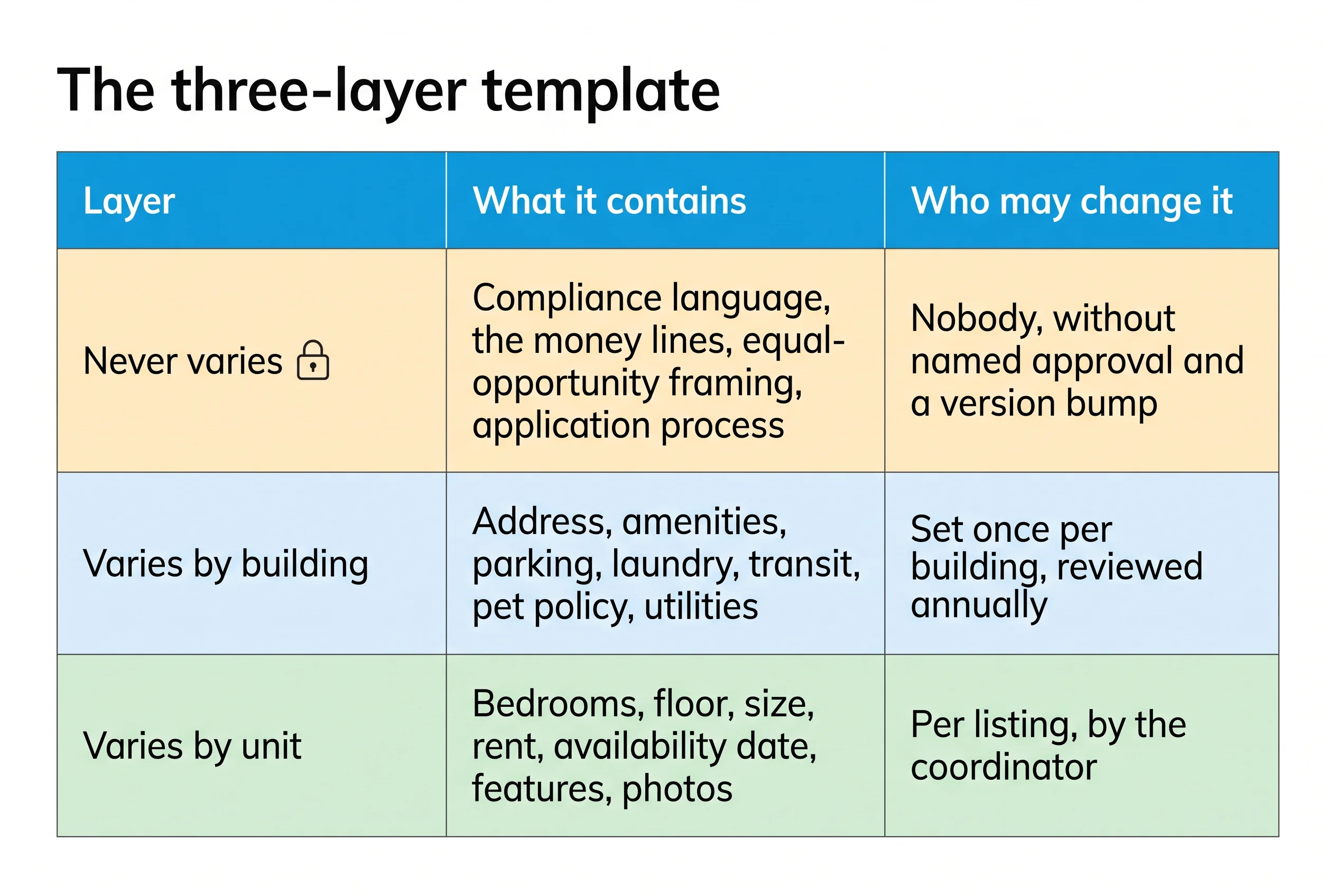
Most firms have one template and treat every field as editable. The fix is to sort the fields by who is allowed to change them, and then enforce that sort technically rather than by policy.
The never-varies layer
Compliance language, the money lines (first and last month's rent only), the equal-opportunity framing, and the application-process description.
Who may change it: nobody, without named approval and a version bump. And the rule that makes the whole architecture work — this layer should be locked technically, not merely discouraged. If a coordinator can edit the compliance language in a hurry at 5 p.m., eventually one will, and that edit is the firm's publication.
The varies-by-building layer
Address, building amenities, parking, laundry, transit, pet policy, utilities included. Set once per building, reviewed annually.
Most portfolio-scale listing errors live here, and they are quiet ones: a building's parking arrangement changes and forty listings keep saying otherwise for eighteen months.
The varies-by-unit layer
Bedrooms, floor, square footage, rent, availability date, unit features, photos. Per listing, by the coordinator. This is the only layer that should be touched routinely — and it is deliberately the layer with no compliance surface.
The banned-phrases list
Written down, distributed, acknowledged in writing. Not held in anyone's judgement. The list:
- "Adults only" · "not suitable for children" · "no kids"
- "Quiet building" · "quiet professional building"
- "Professionals preferred" · "working professionals only"
- "Ideal for a mature couple" · "suits a single person"
- "No students"
- Any rent-to-income ratio — a 30% cut-off or a 3× rent rule is unlawful outside subsidized housing under Reg. 290/98
- "Must have verifiable rental history" — treating an absence of rental history the same as a negative one is discriminatory where that absence relates to a Code ground
- Any question about income source, age, sex, marital status, number of children, religion or health
For the reasoning behind each phrase at the level of a single ad, our guide to the Human Rights Code and rental advertising goes through them individually. This piece extends the same rules to the organizational level.
Syndication, and the destination problem nobody mentions
Fifty active vacancies is a real operational boundary. Across a portfolio of that size, manual listing maintenance overhead becomes significant and platform inconsistencies are close to inevitable. Centralized syndication reduces the work to editing the unit record once.
But before you buy anything, check where the tool actually publishes.
Most tooling publishes where Ontario renters aren't
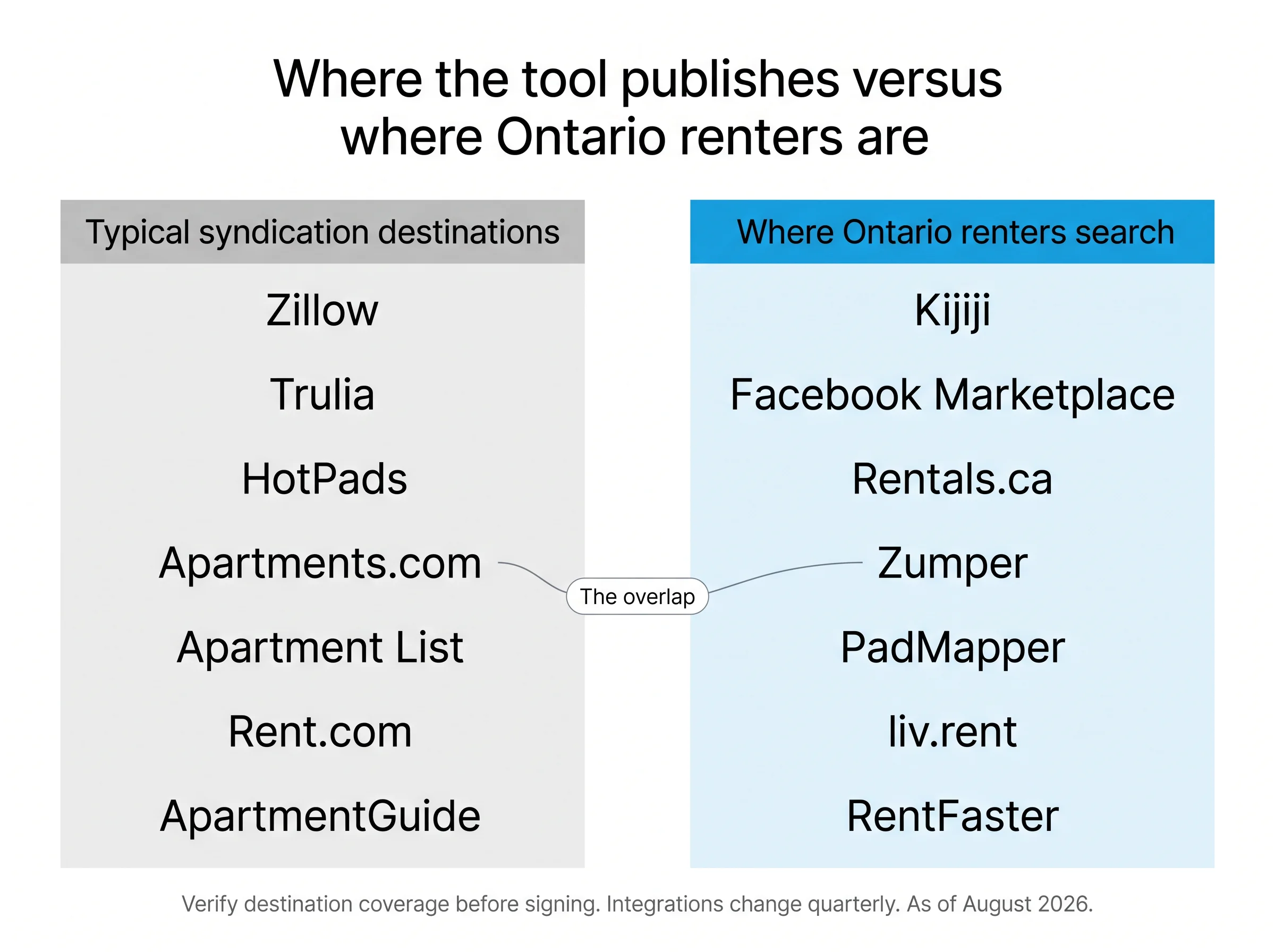
Read the syndication vendor material closely and the destination lists are strikingly consistent: Zillow, Trulia, HotPads, Apartments.com, Apartment List, Dwellsy, RentPath, Rent.com, ApartmentGuide, Rentals.com.
Ontario renters use almost none of them. The channels that matter here are Kijiji, Facebook Marketplace, Rentals.ca, Zumper, PadMapper, liv.rent and RentFaster. Zumper is essentially the only overlap.
To be fair to the category, some tools do syndicate to Kijiji and Facebook Marketplace, and there are Canadian ILS distribution products built for this market. But verify destination coverage against Canadian platforms before signing or renewing anything — a tool that syndicates flawlessly to the Zillow Rentals Network is, for an Ontario operator, an expensive way to reach nobody. And re-check at every renewal, because vendor integrations change quarterly. Our comparison of where to list a rental in Ontario covers which of those channels actually produce enquiries.
One source of truth, or nothing works
Availability should live in one place, and "rented" should propagate outward from there rather than requiring a separate update on each channel. Systems that trigger a status change at the property-management-system level and push it out are more reliable than workflows depending on someone remembering to log into each site on a Friday afternoon.
The duplicate-source failure
One of the most common reasons listings fail or display wrong details is duplicate sources — two systems publishing the same address or unit. A firm that adopts syndication without decommissioning manual posting creates exactly this, and then spends months wondering why the rent is wrong on one platform.
Decommission on the same day. Not eventually.
Per-platform formatting is the hidden work
Each platform has different character limits for descriptions, different photo count limits, and different amenity classification systems. So "one template" is really "one master plus per-platform derivations." Worth knowing too that publication is not instantaneous — some platforms take up to roughly 24 hours to process a syndicated listing, which matters when availability changes.
Photo libraries, built once per unit type
Listings with virtual tours receive 49% more qualified applications than photo-only listings, and video walkthroughs add around 31% more engagement (RentCafe — US data). Built once per unit type and version-controlled, that is a fixed cost with a recurring return.
It also removes the photography scramble that stops listings going live during the notice period — which is the argument our guide to cutting vacancy days makes from the operations side, arriving here from the media side.
Where this guide disagrees with the category

US operations guidance on this is explicit and near-universal: for most units, auto-publish without manual review; route only premium or unusual listings to a manager; keep the approval step optional and defaulted to auto-publish.
Why that is right on efficiency
At US turnover rates a 200-unit portfolio publishes roughly ninety listings a year. Five minutes of review on each is 7.5 hours annually. Wanting that time back is entirely reasonable.
Why it is wrong for Ontario
Three reasons, in order of weight.
First, the thing being auto-published is the thing that creates systemic exposure. A template here is an administrative structure, and pattern evidence establishes a prima facie case. Auto-publishing is auto-publishing the pattern.
Second, the volume assumption doesn't hold. CMHC puts Toronto turnover between 7.9% and 12.1% depending on rent quartile — not 45%. So the same 200-unit portfolio publishes roughly twenty listings a year, and five minutes each is 100 minutes annually.
Third, at the scale this article is about, the number becomes trivial. Fifty units at around 10% turnover is about five listings a year. The approval layer costs roughly 25 minutes a year.
The arithmetic to put in front of a principal
| Cost of the control | Cost of the exposure |
|---|---|
| About 25 minutes per year at fifty units | Free for an applicant to file · free legal support available to them · $2,000–$10,000 typical damages in rental matters · Tribunal orders compelling policy change and training |
There is no version of that trade that favours skipping the review. And the remedies are the part firms underestimate: the damages are the smaller half, while an order requiring you to rebuild your process under supervision is the expensive half.
One more point that makes this a firm problem rather than an individual one: a firm is responsible for its agents' conduct. Your coordinator's edit is the firm's publication, which is why the control belongs at the publishing step rather than in a briefing document nobody reads twice.
The quarterly audit
Firms know what they published. What is currently live is a different question, and almost no operator can answer it.

Most operators running this for the first time find three things: listings on platforms they forgot they were connected to, units advertised at superseded rents, and at least one unit that rented months ago and is still showing.
What to record, per live listing
Unit · platform · rent shown · availability date shown · template version · date last published · date verified.
The four checks
- Does every live listing correspond to an actually available unit?
- Does the rent match across every platform?
- Is every listing running the current template version?
- Is anything live on a platform nobody is monitoring?
Cadence: quarterly, plus immediately after any template change.
What's coming over the next year
- AI listing copy at scale, carrying the compliance problem described above into every draft.
- Canadian syndication coverage improves slowly. Kijiji and Facebook Marketplace integration remains the line between tools that work here and tools that don't.
- Toronto listing volume keeps falling — listings were down roughly 6% year over year in July 2026 — so per-listing quality matters more, not less.
- The 905 stays competitive, rewarding media-rich listings and consistent cross-platform data.
- HRTO systemic remedies remain available, and a firm-level complaint produces process orders that cost considerably more than the damages attached to them.
Sequence matters, and most firms get it backwards: audit first, rebuild the template second, choose tooling third. Buying a syndication product before fixing the template just means distributing a non-compliant listing more efficiently, to more platforms, with better timestamps.
Practical takeaways
Seven changes, in order:
- Audit every live listing across every platform you have ever connected — before changing anything else.
- Rebuild the template in three layers, and lock the never-varies layer technically.
- Write the banned-phrases list down, distribute it, and get acknowledgement from everyone with publishing access.
- Verify Canadian destination coverage before selecting or renewing any syndication tool.
- Put a named approver on every listing, with a five-minute review.
- Build the photo library per unit type, not per vacancy, so listings can go live at notice.
- Keep a publication log: unit, platforms, template version, date.
Quick wins: run the audit this week, strip any income ratio from every template and platform profile, write the banned list, and name the approver. Longer-term: version-control the template with dates and approvers, decommission manual posting the day syndication goes live, review the varies-by-building layer annually, re-check platform coverage at every renewal, and treat AI-drafted copy as requiring more scrutiny rather than less.
The Portfolio Listing Audit: A Compliance Checklist for Ontario Operators
At fifty units your listing template stops being a shortcut and becomes an organizational practice — which is a different legal object entirely. This free checklist gives you the three-layer template architecture, the banned-phrases list to distribute to your team, and the quarterly audit almost no firm has ever run.
Get Free PDF →Frequently asked questions
What words cannot be used in a rental ad in Ontario?
Anything describing the tenant rather than the unit. "Adults only," "not suitable for children," "quiet building," "professionals preferred" and "ideal for a mature couple" all screen on family status, age or receipt of public assistance. Also out: any rent-to-income ratio such as a 30% cut-off or a 3× rent rule, and any requirement for verifiable rental history — treating an absence of rental history the same as a negative one is discriminatory where that absence relates to a Code ground.
Does a listing template reduce our compliance risk?
At scale it concentrates it. The OHRC defines systemic discrimination as patterns of practice that are part of an organization's administrative structures and have an exclusionary impact even where they appear neutral. A master template distributed to a leasing team and applied across a portfolio fits that description exactly. A single landlord with a bad phrase has made one mistake; a firm with that phrase in its template has an organizational practice, in writing, repeated across every unit.
Do syndication tools work for Canadian rentals?
Check the destination list before you sign anything. Most products distribute to Zillow, Trulia, HotPads, Apartments.com, Rent.com and ApartmentGuide — platforms with effectively no Ontario rental audience. The channels that matter here are Kijiji, Facebook Marketplace, Rentals.ca, Zumper and PadMapper. Some tools do cover Kijiji and Facebook Marketplace; most do not, and integrations change quarterly.
Who should approve a listing before it publishes?
A named person with authority to change the template, reviewing anything that departs from the standard. US guidance recommends auto-publishing by default — sound on efficiency, wrong for Ontario. At fifty units and roughly 10% turnover you publish about five listings a year, so a five-minute review is twenty-five minutes annually, set against exposure that is free for an applicant to file.
How do we audit our live listings?
Pull every listing currently visible across every platform you have ever connected — not the ones you think you published. Record the unit, platform, rent shown, availability date and template version. Most firms find listings on forgotten platforms, superseded rents, and at least one unit that rented months ago. Do it quarterly, and immediately after any template change.
The bottom line
At fifty units the template stops being a convenience and becomes an organizational practice. The OHRC's definition of systemic discrimination describes it exactly: a policy embedded in an administrative structure, appearing neutral, applied systematically. Which means the artifact that makes listing fast is the same one that makes it defensible — or doesn't.
The efficiency argument for a template at Ontario volumes is real but modest: twenty listings a year on a 200-unit portfolio, not ninety. The compliance argument is not modest at all, and it costs about twenty-five minutes a year to satisfy. Lead with the second when you take this to a principal. Any operator who has read the American playbooks has already been sold the efficiency case. Almost none of them have been shown the other one.
Next steps: run the audit, rebuild the template, name the approver.
A compliant template is only useful if everyone publishes from it
Tenon10's listing builder holds the never-varies layer in place — Human Rights Code-safe language, the lawful money lines, and the facts tenants filter by — so a coordinator can move fast on the fields that should vary and cannot touch the ones that shouldn't.
Free • No signup required • Updated for the Bill 60 changes in force 21 Sep 2026
Related resources
- The Human Rights Code and Rental Advertising — the phrase-by-phrase reasoning at the level of a single ad.
- How Property Managers Can Cut Vacancy Days — the matched operations piece, including why listings should go live at notice.
- How to Write a Rental Listing That Attracts Good Tenants — the craft version, for the listing your template produces.
- Where to List a Rental in Ontario: 9 Sites Compared — which Canadian channels actually produce enquiries.
- Free Rental Listing Tools for Ontario Landlords — the honest toolkit for each job in the workflow.
- What You Can and Can't Ask a Rental Applicant in Ontario — the boundary at the application stage.
- Rent Control and What You Can Advertise — why the advertised rent is yours to set, and what it commits you to.
This article is general information, not legal advice. All figures are current as of August 2026 and carry their original source and date. Benchmarks marked US are American data and are labelled as such throughout. Verify current rules at ohrc.on.ca, ontario.ca, or with the Human Rights Tribunal of Ontario before changing your advertising practices.


