As of August 14, 2026. Here's the rent-control fact most Ontario landlords have backwards: the law doesn't limit what rent you can advertise. Vacancy decontrol means a new tenancy's rent is set freely — the number in your ad is yours to choose, and no regulator prices it. What the law governs is everything after: the moment a tenant signs at that number, it becomes the base every future increase builds from — capped at 2.1% for increases taking effect this year, with 1.9% announced for 2027 — for as long as the tenancy runs.
Rent control doesn't limit the ad; it prices the future. This page is the listing-stage view: the freedom, the commitment, the exemption handled honestly, the ad claims that help or hurt, and the one decision the guideline makes semi-permanent. This is general information, not legal advice.
The backwards belief persists for an understandable reason: the guideline is the part of rent control that makes the news every year, so landlords absorb "increases are capped" and generalize it to "rents are capped." The design is subtler — and knowing exactly where the cap starts is worth real money at the one moment you control completely: the ad.
The N1 Pre-Flight Checklist
Five gates before any rent increase flies — covered or exempt, the base, the window, the dated figures, and the service math. One page.
Get Free PDF →Vacancy decontrol: the freedom at the ad
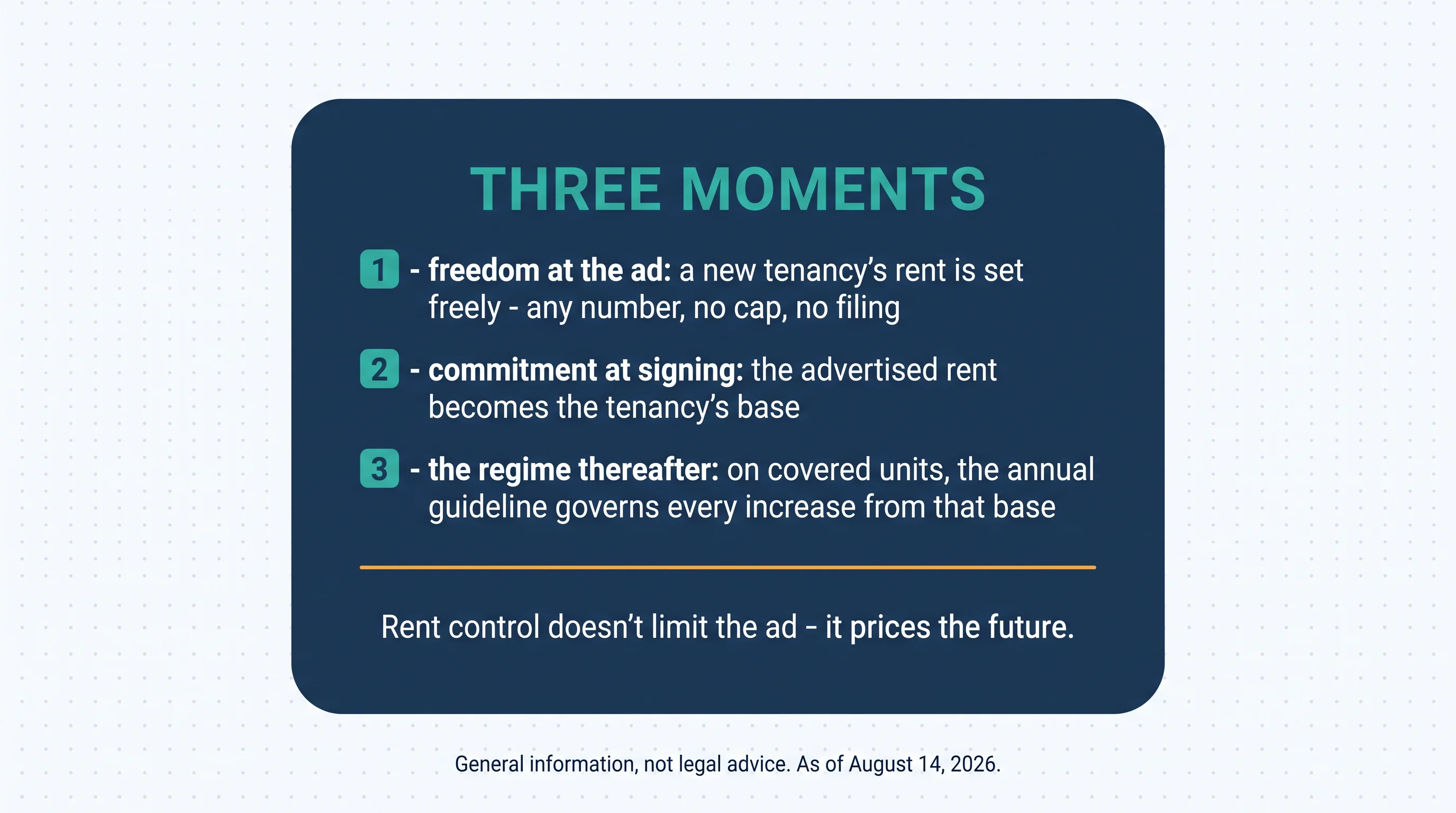
The precise statement first: between tenancies, the unit's rent is set freely for the new tenancy. Any number, no cap, no filing, no approval. This isn't a gap in the law — it's the design: Ontario's regime decontrols at vacancy and controls within tenancies, which is why the same unit can lawfully advertise at whatever the market answers while its neighbour's sitting tenant is protected by the guideline. Practically, "no filing" means the listing-stage paperwork is zero: no registration of the new rent, no approval to wait for — the market conversation between your ad and your applicants is the entire pricing process.
Three things the freedom doesn't touch, because they're different laws doing different jobs: the money you may collect at signing stays exactly first, last, and a key deposit at cost — vacancy decontrol frees the rent, never the deposits. The ad's language rules are unchanged — the ad-language guide in this series carries that layer. And the unit itself must be lawful to advertise at any price — the basement-legality guide in this series carries that one. Freedom over the number; everything else as it was.
The arc this page walks, in three moments: freedom at the ad → commitment at signing → the regime thereafter.
The commitment at signing: your number becomes the base
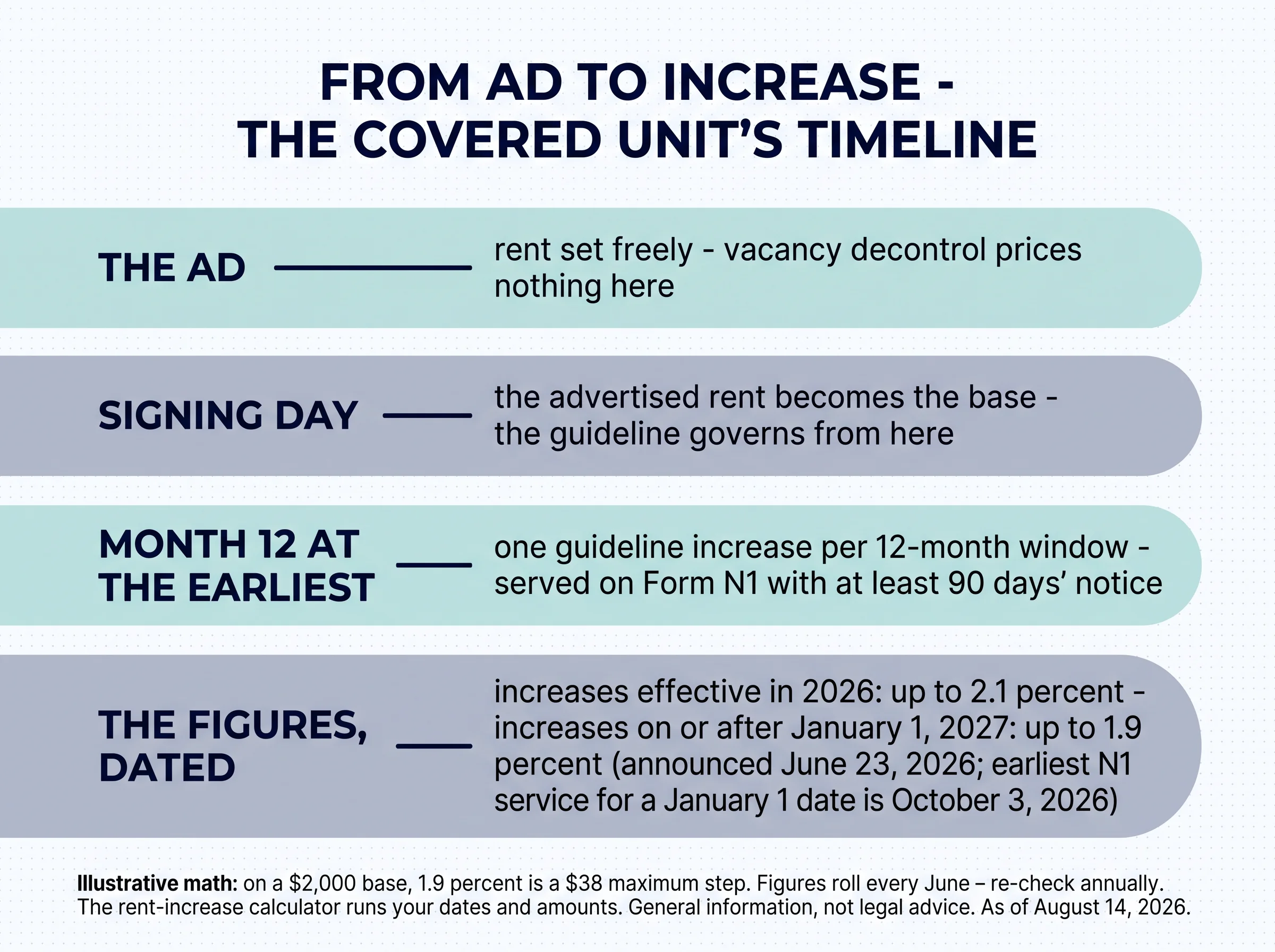
Now the turn. The day a tenant signs, the advertised rent stops being your choice and becomes the tenancy's base — and on a covered unit, the guideline governs every increase from there. The figures, dated: increases taking effect in 2026 are capped at 2.1% (the lowest guideline in four years); increases taking effect on or after January 1, 2027 are capped at 1.9%, announced June 23, 2026 on the province's official pages — no standalone news release this year — with October 3, 2026 the earliest an N1 can be served for a January 1 effective date. Worked and illustrative: on a $2,000 base, 1.9% is a $38 maximum step. "Semi-permanent" is the honest word for what signing does: the base isn't forever in the absolute sense — it resets at the next vacancy — but tenancies run long in a market where moving costs more, and a base you set carelessly can outlast your renovation plans, your rate term, and occasionally your ownership.
The mechanics in one paragraph, because they're their own guide in this series: the increase is served on Form N1, with at least 90 days' written notice, and a unit can receive one guideline increase in any 12-month window — the effective-date guide in this series runs the complete method, and the rent-increase calculator computes your dates and amounts in seconds. One sentence on the exception: above-guideline increases exist for covered units (capital expenditures and security, capped at 3% above the guideline per year), LTB-approved and nothing to do with the ad.
The exemption, honestly: which side of November 15, 2018
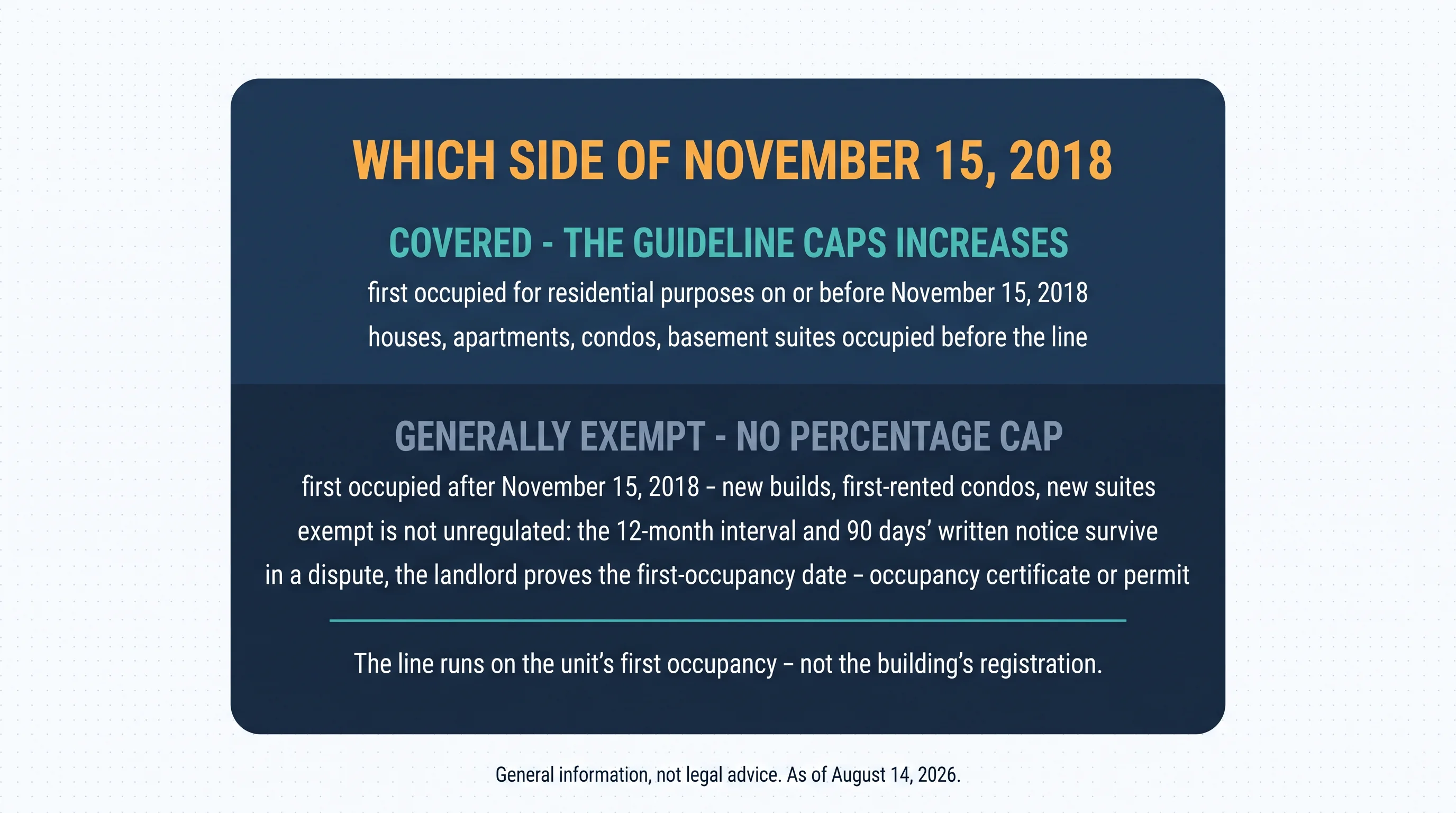
The dividing line runs on a date: units first occupied for residential purposes on or before November 15, 2018 are covered — the guideline caps their increases. Units first occupied after that date are generally exempt from the percentage cap: new purpose-built rentals, condos rented for the first time, basement suites completed after the line (a suite that's lawful to rent in the first place — the basement-legality guide in this series carries the stack).
Two honesty clauses complete the picture, and both get skipped in most coverage. First: exempt is not unregulated. The 12-month interval and the 90 days' written notice survive exemption — notice commonly runs on Form N2 for exempt units — so "any amount" never means "any time, any way." Second: the burden of proof is yours. In a dispute, the landlord proves the first-occupancy date — an occupancy certificate or building permit dated after November 15, 2018 — and the nuance matters: the line runs on the unit's first residential occupancy, not the building's registration. A tower registered in 2020 can hold units first occupied before the line, and those units are covered. Both clauses matter commercially, not just legally: the landlord who serves an exempt-style increase on a covered unit has served an invalid notice, and the one who can't document an exemption when challenged doesn't have one for practical purposes — the file is the status.
For landlords — finding your side of the line: Resolve it before the ad, with documents: the occupancy certificate, the permit history for the address, the first lease's records. Every later answer — the ad claim, the increase form, the tenant's direct question — depends on which side you're on, and the day anyone disputes it, the file answers or you don't.
"Rent-controlled" as an ad claim: fact, decoration, or false
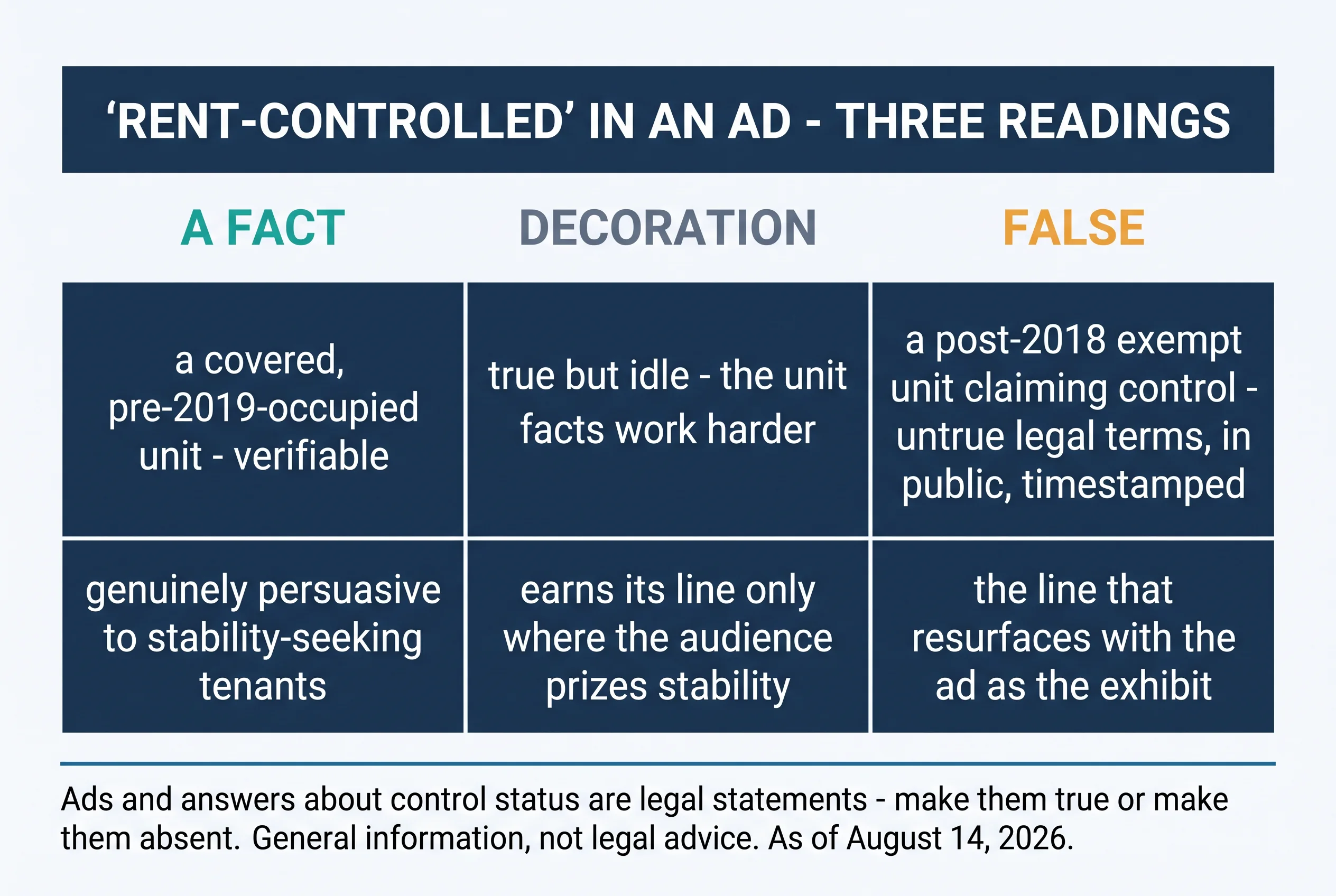
Because the phrase shows up in listings, it deserves its own section: "rent-controlled" in an ad has exactly three readings. A fact: on a covered, pre-2019-occupied unit, it's verifiable — and genuinely persuasive to stability-seeking tenants, one of the rare cases where a legal status is also marketing. Decoration: true but idle — most ads work harder carrying the unit facts, and the phrase earns its line only where the audience prizes stability. False: a post-2018 exempt unit advertising "rent-controlled" is an untrue statement about the tenancy's legal terms — in public, with a timestamp, in exactly the medium that archives itself.
The mirror case is quieter but worth stating: nothing requires an exempt unit's ad to announce the exemption. The honest shape is silence in the ad and truth on request — the Standard Lease and any tenant's direct question get the real answer, and the lease guide covers where the tenancy's terms actually live.
The pricing intersection: the one decision the guideline makes semi-permanent
Here's where rent control quietly rejoins the listing series. On a covered unit, the ad's number carries a multiplier most pricing debates miss: a $50-a-month underprice isn't a one-lease promo — it re-bases the tenancy. Every guideline increase thereafter compounds from the lower number for as long as the tenant stays; worked and illustrative, a tenant who stays five years never closes the gap, because the guideline applies to both numbers and the discount rides along, widening slightly each year. The cheap week you bought at the ad can cost a percentage of every year the tenancy runs.
The symmetric honesty, because the arithmetic cuts both ways: overpricing has its own cost. An empty month chasing $100 extra runs the vacancy arithmetic — the vacancy-cost piece in this series prices it to the day — against a base you may reset freely at the next vacancy anyway. Neither error is free; only the arithmetic is. And what the right number is belongs to the pricing pillar in this series — this page's contribution is what the number commits: on covered units, the commitment is the tenancy's lifetime. There's a constructive reading of the same fact: because the base compounds, the number you get right is also semi-permanent — a well-priced covered unit with a long-staying tenant is the most predictable revenue in the portfolio, which is precisely what the stability sell below offers the other side of the table.
The listing-stage checklist

Before the ad goes up, five checks — each one a sentence here and a gate on the pre-flight sheet: your unit's side of the November 15, 2018 line, resolved with documents · the lawful money line — first, last, key cost, whatever the control status · the ad's number chosen with the base-forever frame (covered units compound from it) · control-status claims true or absent · and the increase horizon diarized at signing — 12 months out, minus 90 days, into the calendar while the file is open. Then the annual habit: the guideline rolls every year (announced by late June for the following January), which is why every figure on this page carries its date.
For landlords — the stability sell: On covered units, "rent-controlled" is a genuine selling line to long-horizon tenants — retirees, families planting roots, anyone pricing predictability above square footage. Pair it with the unit facts and you get the honest version of targeting: describe the unit and its legal stability, and attract exactly the tenants who value both. It's the rare corner of this series where a legal status closes better than a granite countertop.
The N1 Pre-Flight Checklist
Five gates before any rent increase flies — covered or exempt, the base, the window, the dated figures, and the service math. One page.
Get Free PDF →Key takeaways
- Rent control doesn't limit the ad — vacancy decontrol sets a new tenancy's rent freely.
- The commitment lands at signing: your advertised number becomes the base the guideline governs — 2.1% for 2026 increases; 1.9% announced for on-or-after January 1, 2027.
- The exemption runs on the unit's first occupancy vs November 15, 2018 — and exempt ≠ unregulated: the 12-month interval and 90-day notice survive.
- You carry the burden of proving an exemption — resolve your side of the line, with documents, before the ad.
- "Rent-controlled" in an ad is a fact, decoration, or a false legal claim — make it true or make it absent.
- On covered units, the ad's number is semi-permanent — price what you're willing to compound from.
The ad is free; the base is forever
Three moments, one discipline: the rent is yours to set at the ad, committed at the signature, and governed thereafter — so the listing-stage work is knowing your unit's side of the line, choosing a number you can live with compounding, and keeping every control-status claim true or absent. The advertising method around the number is the pillar's; the pricing method is its own guide in this series; and the increase, when its horizon arrives, flies through the pre-flight and the calculator. This is general information, not legal advice — and the figures here are dated because they roll every year. As of August 14, 2026.
Run your increase math in seconds
The free rent-increase calculator handles the guideline, your dates, and the 90-day service window — built for Ontario landlords.
Free forever • No signup required
Related resources
- How to Advertise a Rental Property in Ontario — the campaign around the number.
- How to Write a Rental Listing — the facts the ad carries beside it.
- First and Last Month's Rent — the money line vacancy decontrol never touches.
- The Ontario Standard Lease — where the advertised number becomes a term.
Frequently asked questions
Can I advertise any rent for a new tenant in Ontario?
Yes — vacancy decontrol means a new tenancy's rent is set freely, with no cap and no filing. What's governed is everything after signing: on covered units, the guideline caps each later increase from the base you advertised.
Does rent control apply to new tenancies?
Not to the setting of the rent — it applies within the tenancy. Once signed, a covered unit's increases follow the guideline: 2.1% for increases effective in 2026, and 1.9% announced for increases on or after January 1, 2027.
Is my unit exempt from rent control?
If it was first occupied for residential purposes after November 15, 2018, generally yes — but the 12-month interval and 90-day notice still apply, and in a dispute you must prove the first-occupancy date with documents.
Can I say "rent-controlled" in my listing?
Only if it's true — a covered, pre-2019-occupied unit. On an exempt unit it's a false statement about the tenancy's legal terms, in public. True or absent; nothing in between.
What happens if I underprice a covered unit?
The discount becomes the base: every guideline increase compounds from the lower number for the tenancy's life. Price covered units asking "what am I willing to compound from?" — the pricing method itself is its own guide in this series.