As of August 31, 2026. Every Ontario landlord knows an N13 runs on the province's clock — the notice period, the compensation, the tenant's right to return. From September 1, 2026, serving one in Mississauga also starts a second clock the province doesn't run: within seven days of issuing the notice, you must apply to the City for a Rental Repairs and Renovations Licence — and no work starts, and no tenant leaves, until both the building permit and the licence are in hand.
The City's own framing for the licence is "in addition to": it doesn't replace the N13 process, it sits on top of it. This guide is the municipal layer on its own terms — who it covers, the seven-day window, what the City licenses and what it pointedly doesn't decide, what tenants are owed under the by-law, and the sequencing that keeps a Mississauga renovation on both clocks at once. This is general information, not legal advice.
The Mississauga N13 Licence Timeline
Both clocks on two pages — the five-stage sequence, the seven-day window with date blanks, the tenant-money budget line, and the six mistakes to avoid.
Get Free PDF →What changes on September 1, 2026
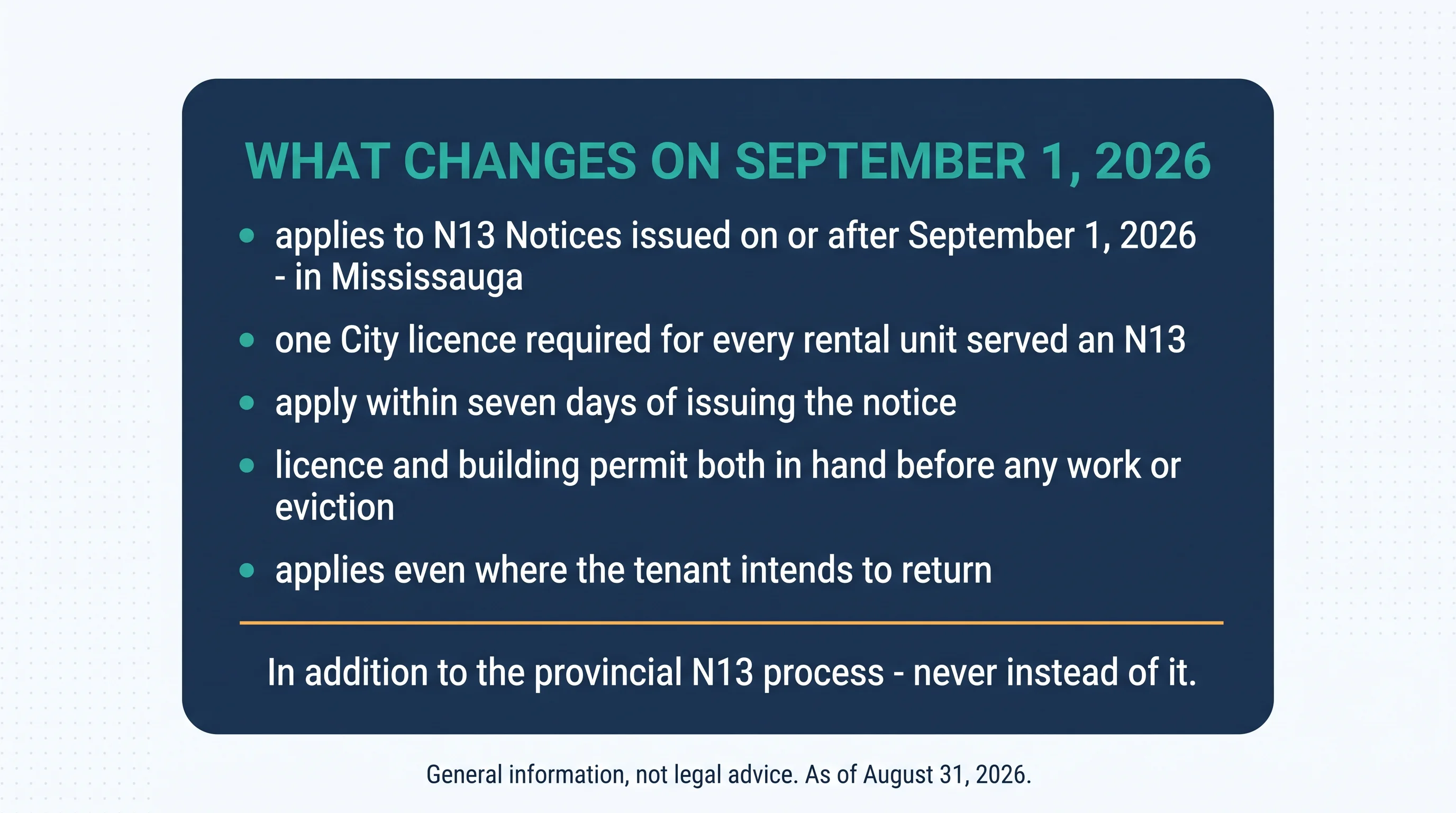
The Rental Repairs and Renovations Licensing By-law was approved by Council on April 1, 2026 and comes into force on September 1, 2026, applying to N13 Notices issued on or after that date. With it, Mississauga joins Toronto, Hamilton, Ottawa, and Kitchener among Ontario municipalities running their own renoviction regimes — same instinct, different rules, each city's own.
The scope, precisely: a City licence is required for every rental unit in Mississauga that has been served an N13 — one licence per unit, not per building or per project. It applies even where the tenant intends to return after the work. And it's required before the landlord can evict the tenant or start any work — the licence isn't paperwork that follows the renovation; it's a gate that precedes it.
For scale: tenant-advocacy tracking cited by CBC puts Mississauga ninth among Ontario's top-10 cities for N13 notices between 2017 and 2023, with 68 notices — against Toronto's 950. This is a targeted regime, not a mass-market one, which is exactly why the landlords it touches tend to be the ones who've never heard of it. The frame to carry through this whole guide: two authorities, two files, one renovation.
The seven-day window: the clock most landlords will miss
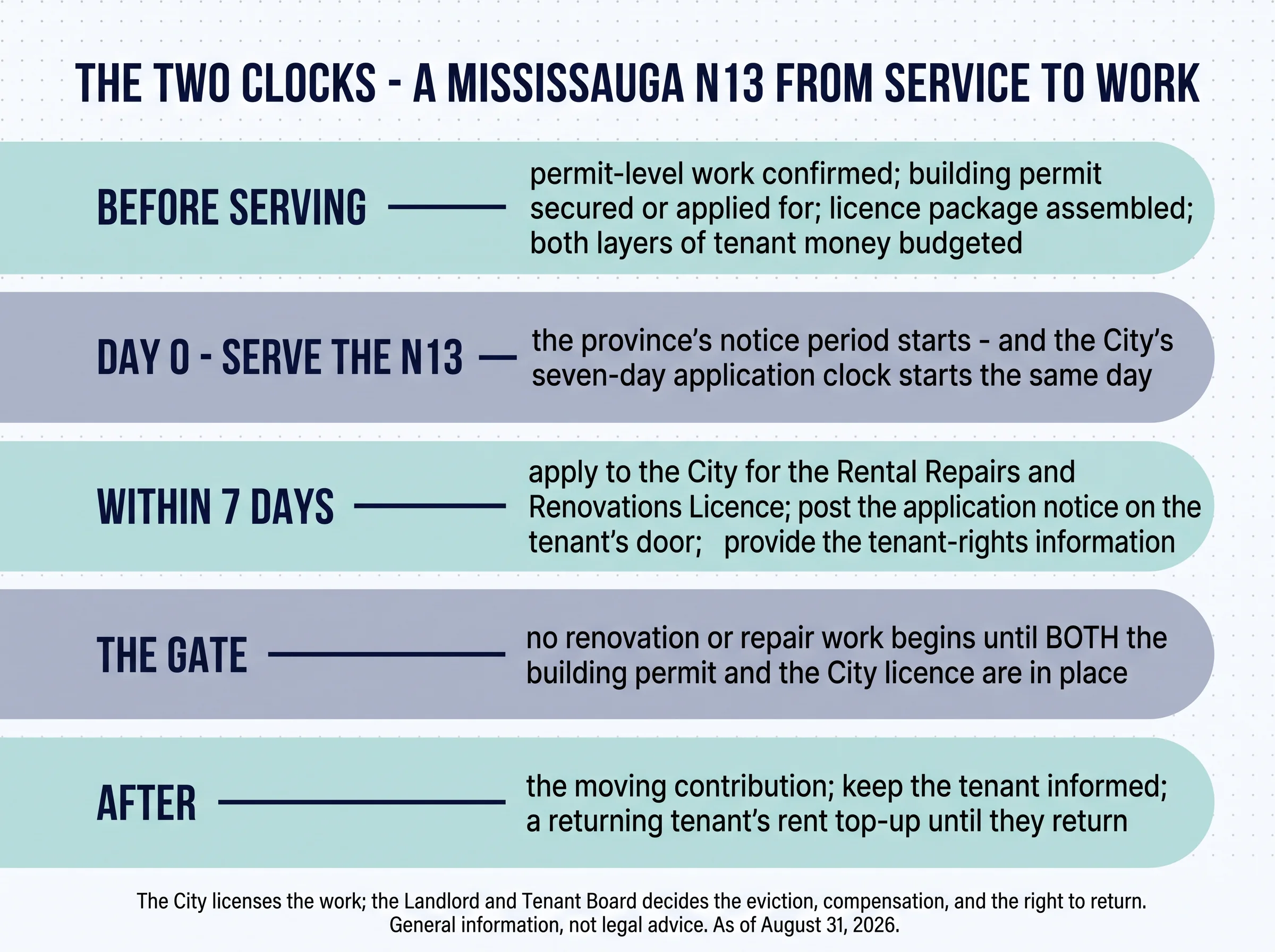
Here's the rule as the City states it: landlords who issue an N13 must apply for the licence within seven days of issuing the notice. The clock starts the day you serve — not the day the tenant leaves, not the day the permit arrives. Serve on a Monday and the application is due the following Monday, whatever else that week holds.
The application asks you to show the work qualifies and the process is real: that the repair or renovation is necessary and requires the unit to be empty — significant, building-permit-level work, not cosmetics — and that you hold a valid building permit. Inside the same window sit the tenant-facing duties: posting notice of the licence application on the tenant's door and providing the tenant-rights information the by-law requires. The fee is set by your estimated work duration — tiers for three, six, or twelve months of work — reported by CBC at up to 00; confirm the current schedule on the City's application page when you file.
Why the window is the trap: an N13 served on the strength of a plan — permit not yet issued, scope not documented, notices not drafted — puts the landlord on a seven-day sprint the notice period never warned about. The N13's own timeline is measured in months; the City's opening move is measured in days, and it lands first.
What the City licenses — and what it doesn't decide
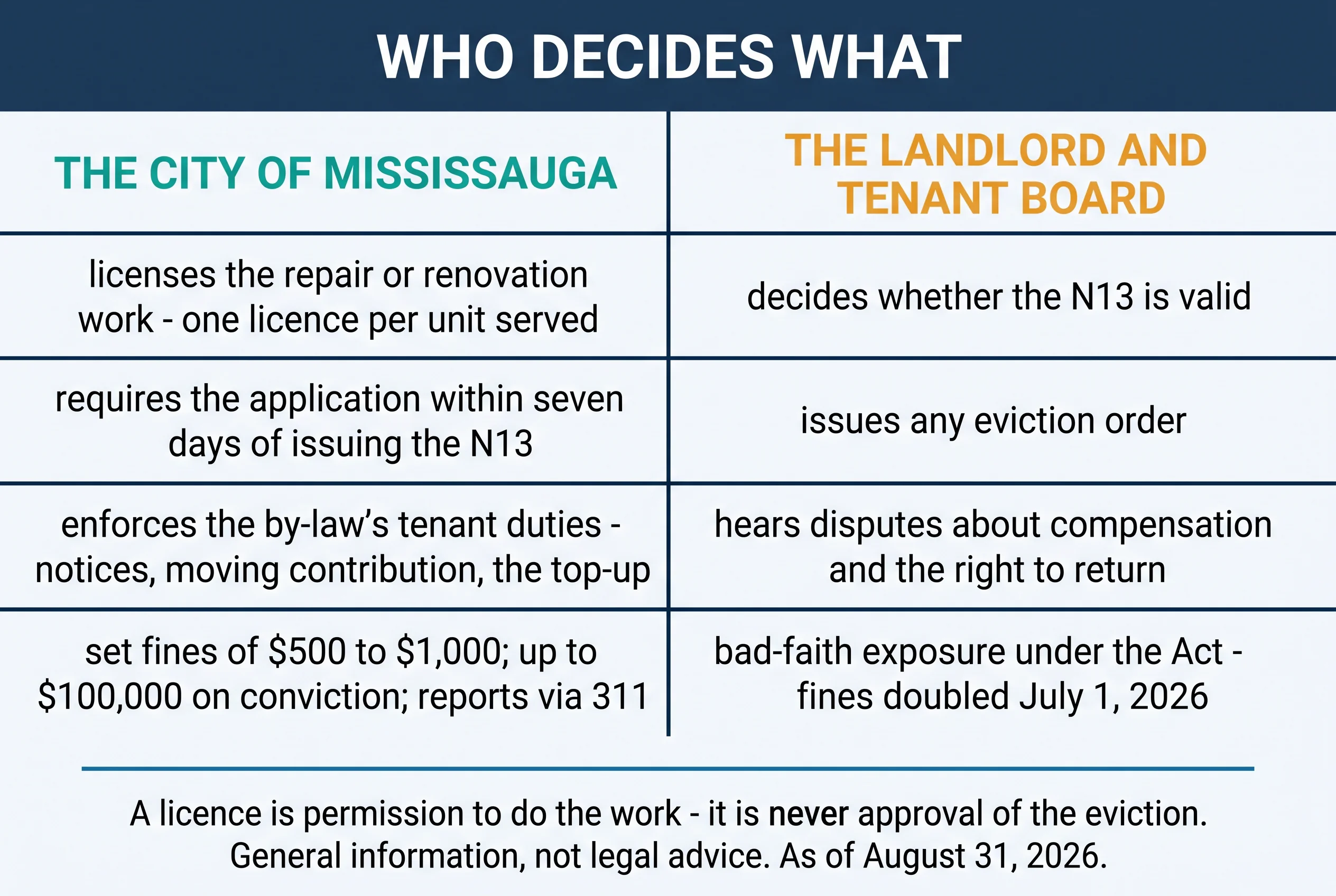
The licence gates the work: no renovation or repair begins until both the building permit and the City licence are in place. A permit alone is no longer enough in Mississauga; the two documents travel together, and the second one is new.
Now the paragraph that keeps this guide honest, drawn from the City's own description: the City does not issue eviction orders, does not decide whether an N13 is valid, and does not hear disputes about compensation, the right to return, or other rights under the Residential Tenancies Act. All of that remains the Landlord and Tenant Board's. A licence is permission to do the work once the province's process runs its course — it is never approval of the eviction, and holding one proves nothing at a Board hearing about whether the notice was genuine.
The provincial layer, meanwhile, is unchanged and runs in parallel — the N13's own requirements are covered in the renovictions guide in this series: the building permit before work requiring vacant possession, compensation of one or three months' rent depending on building size (or a suitable alternative unit), and the tenant's right to return. And a third layer arrived three weeks later: on September 21, 2026, province-wide right-of-return rules from Bills 60 and 97 took effect. If a tenant gives written notice on or after that date that they want to move back, the landlord must tell them in writing, without delay, the estimated completion date and any change to it, and then that the unit is ready; where the work is finished on or after that date, the tenant also gets 60 days' notice to move back in. If the landlord skips those steps, the LTB presumes on a T5 application that the right of first refusal was denied, unless the landlord rebuts it at the hearing. Those rules have their own guide in this series, and they stack on top of everything here.
What tenants are owed under the by-law
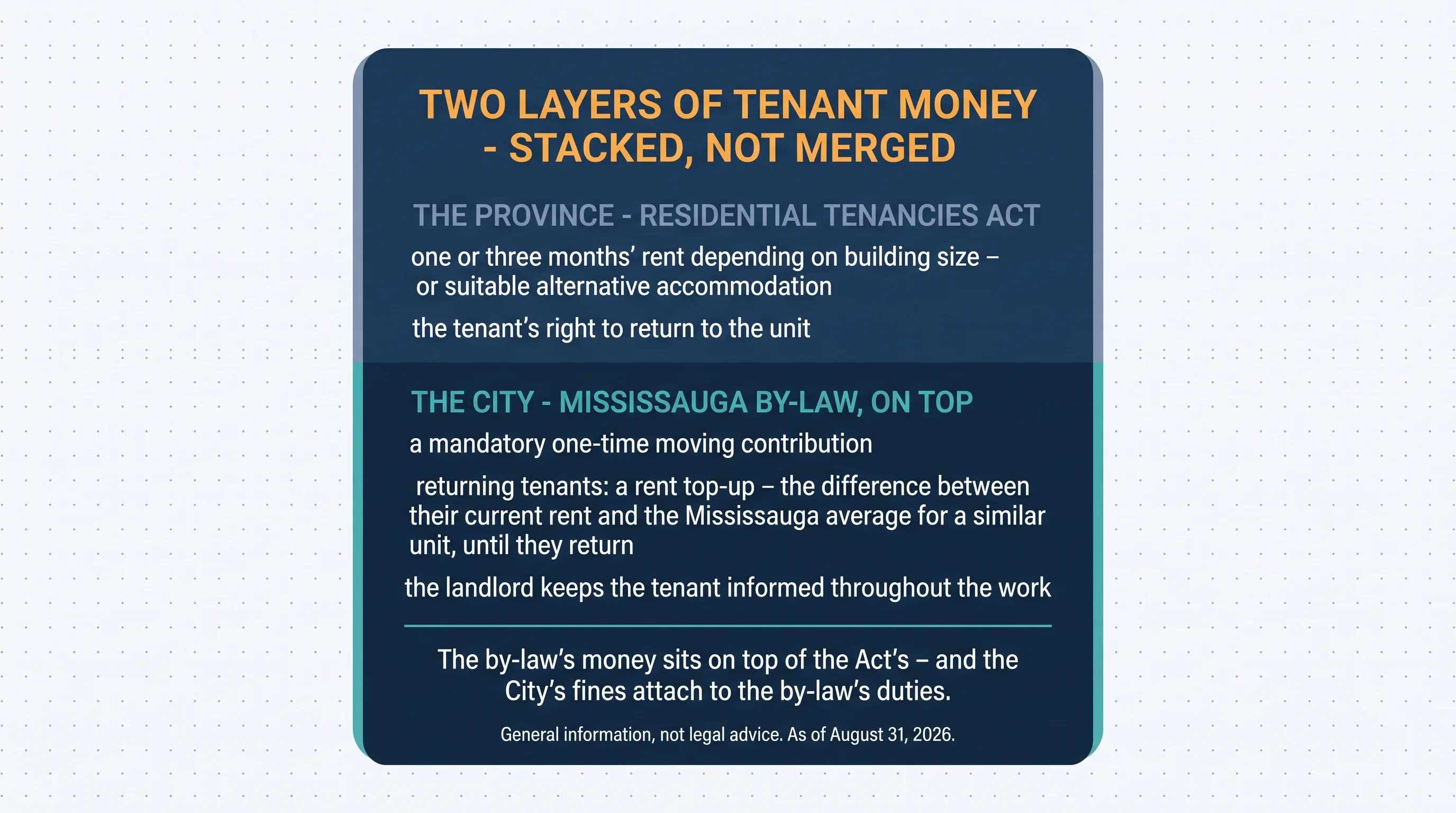
The by-law's tenant protections stack on the Act's — they never merge. The provincial layer stands exactly as before: the compensation, the right to return. On top of it, Mississauga adds its own money and duties:
The moving contribution: a mandatory one-time payment toward the tenant's moving costs. The rent top-up for returning tenants: where a tenant exercises the right to return and faces a higher rent, the landlord pays a top-up after any RTA compensation — calculated as the difference between the tenant's current rent and the average rent for a similar unit in Mississauga, payable until the tenant returns. And the kept-informed duty: the licensed landlord must keep displaced tenants informed throughout the repair or renovation. Further provisions apply where a tenant chooses not to return and an alternative unit was offered — the by-law text itself, linked below, carries those details.
For landlords — the two-file discipline: Keep a City file and an LTB file, separately and completely. The City file: the application, the permit, the fee receipt, a dated photo of the door notice, the tenant information provided, progress updates sent. The LTB file: the N13 itself, the compensation record, the right-of-return correspondence. Two authorities will read two different files — and the day either asks, the answer should be a folder, not a reconstruction.
Before you serve an N13 in Mississauga: the sequence
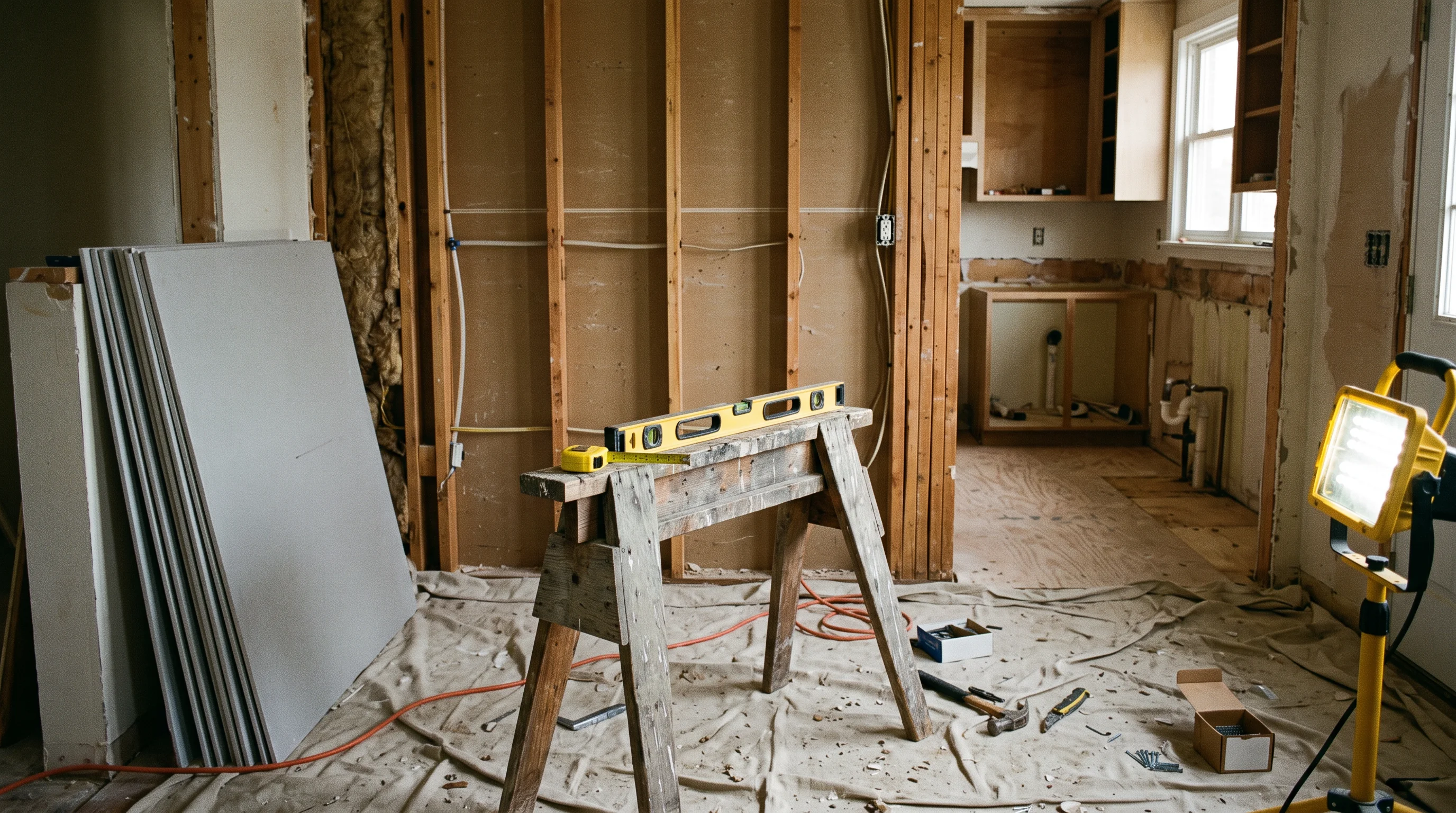
Run the steps in this order and both clocks stay honest:
① Confirm the work qualifies — permit-level, and it genuinely requires the unit to be empty. If it doesn't, there's no N13 and no licence; there's just a renovation scheduled around a tenancy. ② Secure the building permit — issued, or applied for and tracked. ③ Assemble the licence package: work scope, permit status, your duration estimate (it sets the fee tier), and the tenant notices, drafted. ④ Budget the tenant money on both layers: the Act's one or three months (or the alternative unit) plus the by-law's moving contribution plus a returning-tenant top-up estimate. ⑤ Run the N13's own requirements — the renovictions guide in this series walks them. ⑥ Serve — and the City's seven-day clock starts. ⑦ File within the week; post the door notice; provide the tenant information. ⑧ Wait for the gate: no work until the permit and the licence are both issued.
For property managers — the portfolio arithmetic: One licence per unit served means a building-wide renovation is N units × the fee × N seven-day clocks × N door notices. Calendar it per unit, not per project — and stagger service dates so the application week doesn't land on every door at once. A six-unit walk-up served on one afternoon is six City files due the same day next week.
The mistakes the seven-day window creates — and the rest of Ontario
Six mistakes, one sentence each. Serving before the permit exists — the sprint you can't win. Treating the licence as approval of the eviction — it isn't; the Board decides. Starting work on the permit alone — both documents, before any work. Missing the door notice — a by-law duty that lives inside the window. Forgetting the top-up when setting the post-renovation rent — a returning tenant's difference-to-average is yours to pay until they're back. Assuming the by-law's money replaces the Act's — it stacks.
And the boundary note for multi-city landlords: a municipal rule is not a provincial one. Toronto, Hamilton, Ottawa, and Kitchener each run their own regimes with their own windows, fees, and duties — a landlord with units across the GTA needs each city's rule, not Mississauga's applied everywhere. What is province-wide arrives September 21: Bill 60's renoviction-documentation requirements, which stack onto whichever municipal regime your unit sits in.
The Mississauga N13 Licence Timeline
Both clocks on two pages — the five-stage sequence, the seven-day window with date blanks, the tenant-money budget line, and the six mistakes to avoid.
Get Free PDF →Key takeaways
- From September 1, 2026, an N13 served in Mississauga starts a second clock: apply for the City's Rental Repairs and Renovations Licence within seven days of issuing.
- One licence per unit served — and no work, no eviction, until both the building permit and the licence are in hand.
- The licence is "in addition to" the RTA: the City licenses the work; the Board decides the eviction, compensation, and the right to return.
- The by-law adds tenant money on top of the Act's: a moving contribution, and a rent top-up for returning tenants measured against the Mississauga average.
- Serve only when the application package is assembled — the seven-day sprint is the trap.
- The City's fines and the Act's doubled bad-faith exposure stack; a licence never cures a bad-faith notice.
Two clocks, one renovation
Sequence first, serve second: confirm the work qualifies, hold the permit, assemble the package, budget both layers of tenant money — and then start the clocks knowing you can beat them. The provincial process is the renovictions guide's territory in this series; the 2026 law changes are mapped in the Bill 60 and Bill 97 guide; and the official rules live with the City — the Rental Repairs and Renovations Licence page carries the application, the fee schedule, and the by-law text. This is general information, not legal advice — the by-law is new, and the City's pages are the source of record. As of August 31, 2026.
Serving an N13? Start with the form done right
The guided N13 walks the notice requirements, dates, and compensation fields — free, validated, no account needed.
Free forever • No signup required
Related resources
- Ontario's 2026 Rental Law Changes: Bill 60 and Bill 97 — the provincial map this municipal rule sits inside.
- The 7-Day N4 — the other seven-day rule of 2026, for non-payment.
Frequently asked questions
Do I need a licence to serve an N13 in Mississauga?
For N13s issued on or after September 1, 2026, yes — one City licence per unit served, applied for within seven days of issuing, and required before any work or eviction.
How long do I have to apply for the licence?
Seven days from issuing the N13 — the clock starts the day you serve, not the day the tenant leaves.
Can I start renovations with just a building permit?
Not in Mississauga after September 1: both the building permit and the City licence must be in place before any work begins.
Does the City decide whether my N13 is valid?
No. The City licenses the work and enforces its by-law; N13 validity, compensation disputes, and the right to return are the Landlord and Tenant Board's.
What does the licence cost, and what happens if I ignore the by-law?
The fee is tiered by your estimated work duration (three, six, or twelve months); CBC reports up to $600 — confirm the schedule on the City's page. The City has described set fines of $500 to $1,000, and up to $100,000 on conviction for serious offences — and anyone can report to 311.