As of September 2, 2026. For twenty years, one of Ontario's grounds for ending a tenancy ran on a word nobody had defined. "Persistently failed to pay rent on the date it becomes due" — paragraph 1 of s.58(1) of the Residential Tenancies Act, the N8's first ground — meant whatever the Board's caselaw said it meant, pattern by pattern. In one reported decision, rent on time twice in eleven months was persistent; in others, the line sat wherever the evidence put it.
On September 21, 2026, the province writes a floor under the word. Under new s.8.1 of O. Reg. 516/06, rent counts as late for this test only when it's unpaid more than seven days after the due date — and three such occasions within any six-month period make the pattern persistent. The test is now countable, and the counting is stricter than the folklore. This guide reads the new test from the text itself, fixes three errors already circulating in coverage, and untangles the confusion the province scheduled for the same day: a second, unrelated 7-day clock on the N4. This is general information, not legal advice.
The Late-Payment Ledger Sheet: The Columns the Floor Reads
The test quoted from the regulation, the counting rules, a blank ledger with the exact columns, the two clocks kept apart, and the tenant's mirror. Free PDF.
The new test, from the text
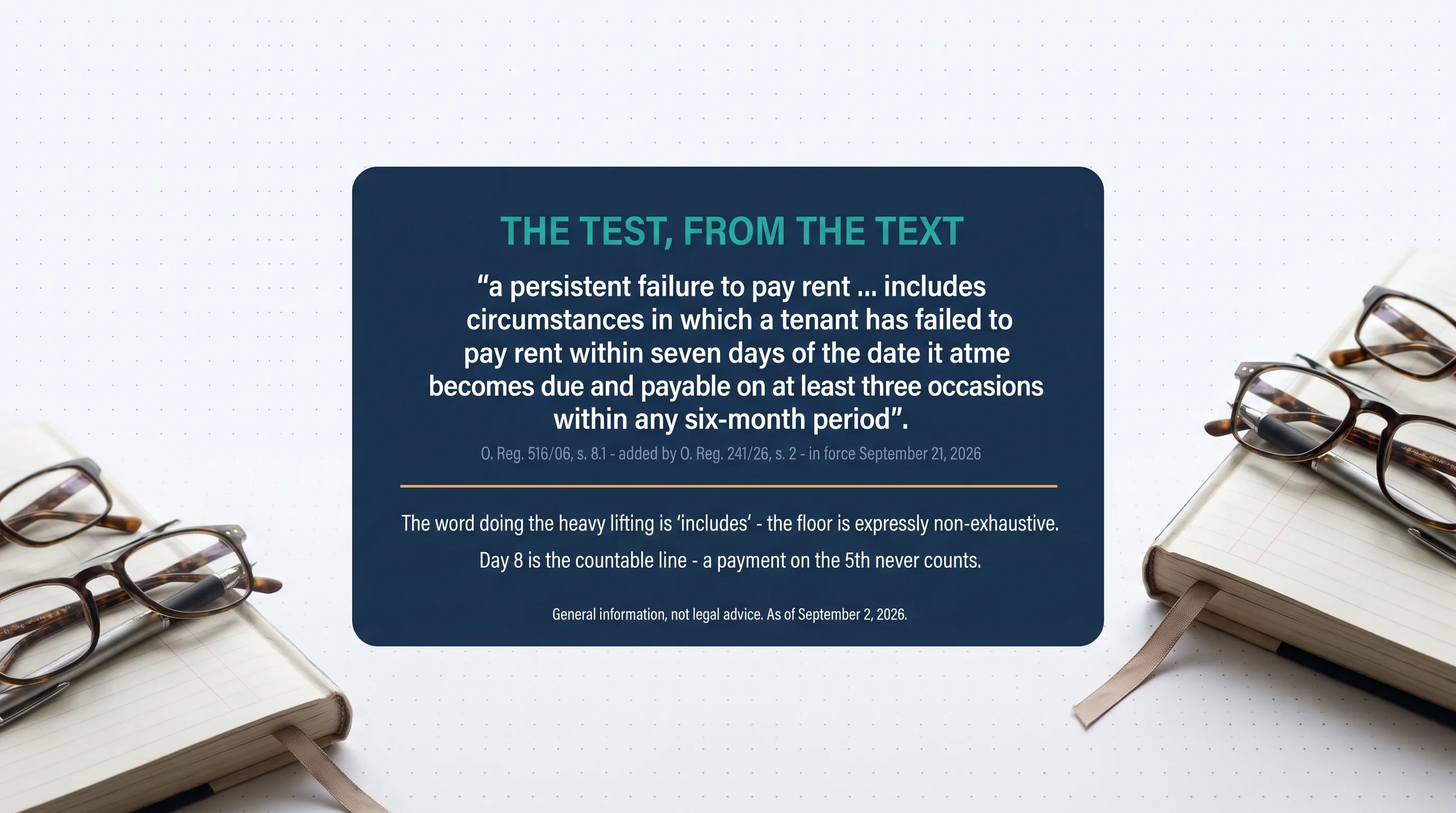
Here is the provision, in its own words: a persistent failure to pay rent on the date it becomes due and payable "includes circumstances in which a tenant has failed to pay rent within seven days of the date it becomes due and payable on at least three occasions within any six-month period" — O. Reg. 516/06, s.8.1, added by O. Reg. 241/26, s.2, in force September 21, 2026, defining paragraph 1 of s.58(1) of the RTA.
Two halves, both countable. What's "late": rent still unpaid more than seven days after the due date — day 8 is the countable line. What's "persistent": at least three such occasions inside any six-month window. And the corollary the folklore misses: a tenant who pays on the 5th every month is never late for this floor's purposes. Annoying is not persistent — and the threshold says so in numbers.
The word doing the heavy lifting is "includes." The floor is expressly non-exhaustive: three-in-six suffices, but the Board's older pattern-reasoning survives beneath it — a longer arc of lateness, chronic bounced payments, fewer-but-longer delays can still be found persistent on the reasoning the caselaw built. A floor, not a ceiling — and that's the statute's word choice, not our opinion.
The two 7-day clocks — same number, opposite jobs
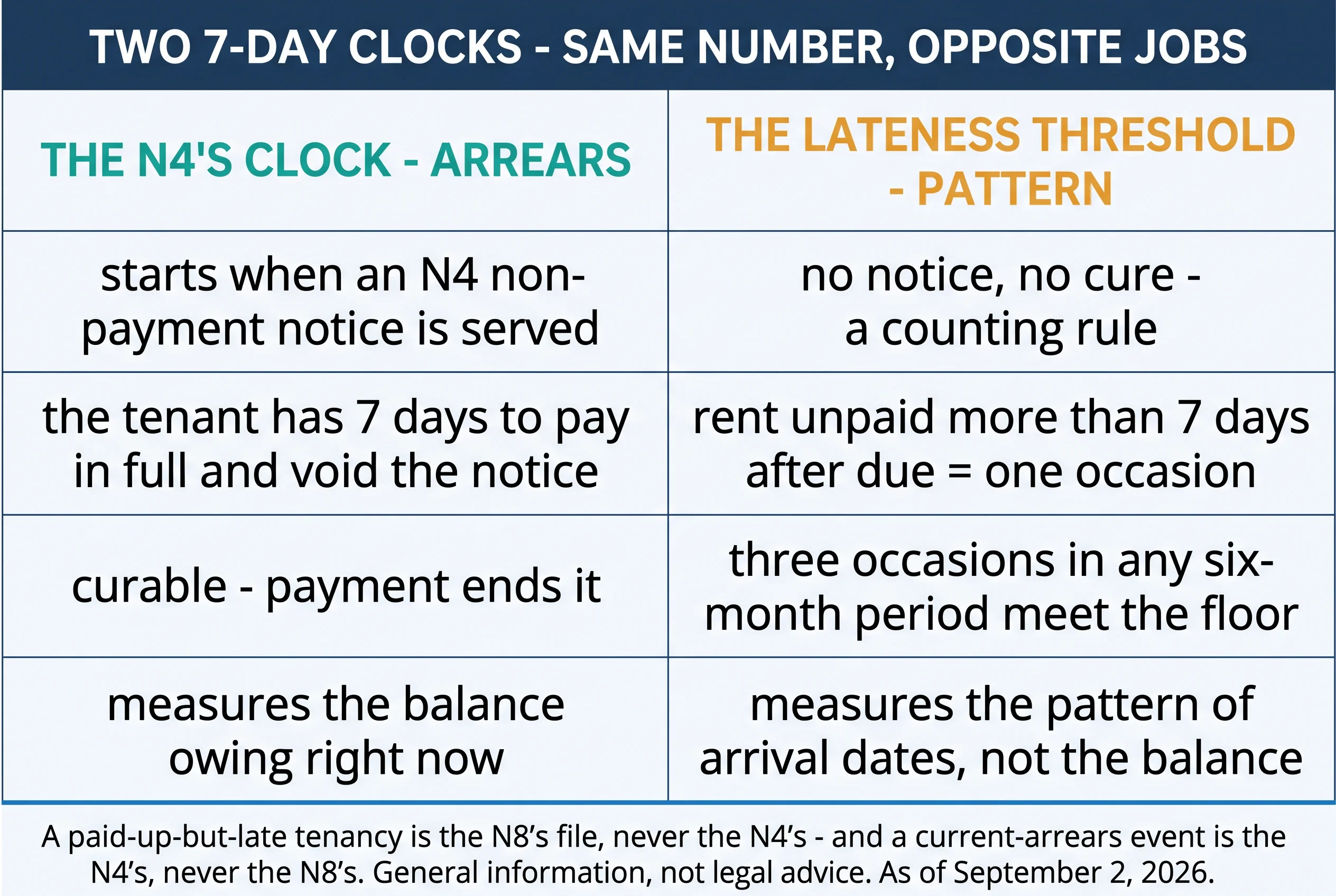
September 21 delivers two seven-day rules at once, and they could not be more different. The N4's clock belongs to an arrears notice: serve for non-payment, and the tenant has seven days to pay in full and void it — down from fourteen the same day, as our 7-day N4 guide covers end to end. Curable, balance-based, voidable by payment.
This clock cures nothing, because it isn't attached to a notice at all. It's a counting rule inside a pattern ground: did the rent arrive within seven days of the due date? If not, that's one occasion toward three-in-six. It measures the pattern of arrival dates, not the balance owing — which is why the consequence our L1-vs-L2 guide has taught all year still holds: a paid-up-but-chronically-late tenancy is the N8's file, never the N4's — and a current-arrears event is the N4's, never the N8's.
Three corrections to what you may have read
The September 21 wave produced a lot of fast coverage, and three details drifted. Each one matters in a filing, so here they are, fixed kindly.
① "It's a new section 58.1" — no. The hook is paragraph 1 of subsection 58(1) — a ground that has sat in the Act all along. The regulation gives that existing ground content; it doesn't create a section. The label "s.58.1" appears in some coverage and belongs nowhere in a notice or pleading. Practical stake: because the ground is the old one, nothing about the N8's process changes — only what the ground means firms up.
② "Three lates in six consecutive months" — not quite. The regulation says any six-month period: the window rolls. Late in January, March, and June? Those three sit inside one six-month span and meet the floor together — the word "consecutive" describes neither the months nor the latenesses.
③ "See O. Reg. 240/26" — wrong neighbour. That regulation is the same day's N12 move-in rule. The persistent-late test is O. Reg. 241/26. One digit apart, two different laws — and a pleading that cites the wrong one imports someone else's error into your file. Check the text; cite the text.
Why write a floor at all? The same logic as the rest of the wave: predictability. Under the discretion era, neither chair could say in advance where "persistent" began — landlords served on hope, tenants defended on argument, and hearings litigated the meaning of a word. A countable floor converts that argument into arithmetic for the clear cases, and leaves the Board's judgment for the genuinely unusual ones — which is what "includes" preserves.
Counting it right: the rolling window, worked
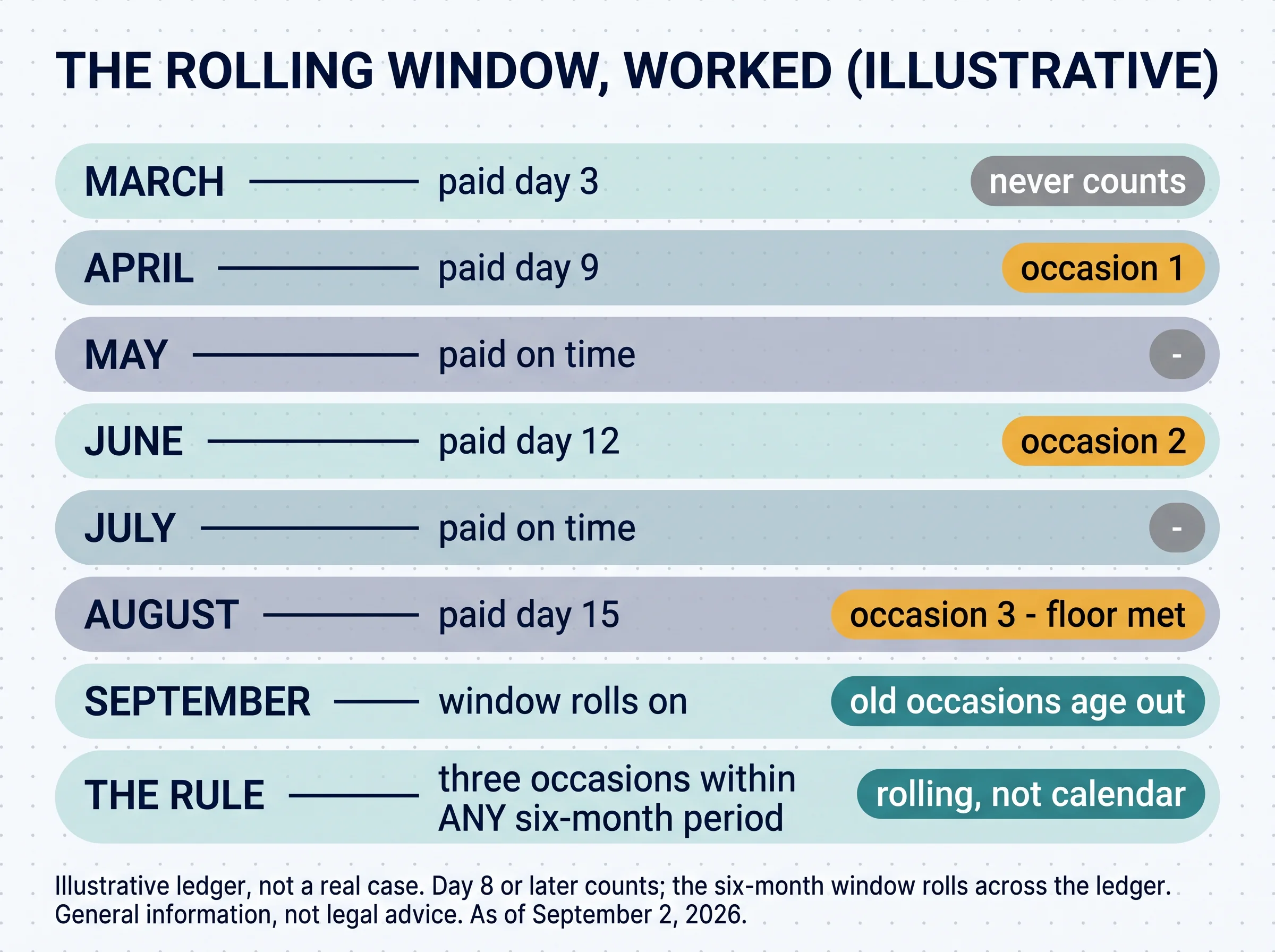
An "occasion" is one rent due date where payment hadn't arrived by day seven — counted per due date, not per reminder or per NSF letter. Run an illustrative ledger (a constructed example, not a real case): March paid on day 3 — never counts. April paid day 9 — occasion one. May on time. June paid day 12 — occasion two. July on time. August paid day 15 — occasion three, and the April-through-September window now holds all three: the floor is met in August. Then the window keeps moving — as months pass, old occasions age out and the tally re-runs, which is what "any six-month period" means in practice.
What resets or complicates the count: an agreed change to the due date — the seven days run from the due date as agreed, so a documented arrangement moves the line for both parties. A payment plan does similar work. Partial payments are the careful edge: the provision speaks of failing to pay rent within seven days — treat shortfalls conservatively and take advice before building a count on them.
From pattern to notice: what the floor does — and doesn't — hand you

Meeting the floor makes the ground available. The notice built on it is unchanged: the N8 still runs 60 days to the last day of a rental period or fixed term, it is not voidable by payment — the pattern, not the balance, is the ground — and the L2 follows within 30 days of the termination date, with the evidence and hearing mechanics the L1-vs-L2 guide walks in depth.
And the honest landing: the Board keeps its s.83 relief discretion, and the reported pattern in persistent-late files is real — conditional orders (pay on time for twelve months, with the s.78 fast-track if the condition breaks) are a common outcome, not eviction on first crossing of the floor. The new test changes what a landlord must prove, not what a member may weigh. And it cuts the other way too: a landlord arriving with a clean five-column ledger showing three fresh countable occasions has done the proving before the hearing starts — which is precisely why the discipline below matters more than the notice itself.
The same proclamation brings the rest of the wave — the 7-day N4, the 50%-of-arrears requirement before raising issues at L1 hearings, and the renoviction-documentation duties — mapped change by change in our Bill 60 and Bill 97 guide.
The ledger discipline — both chairs
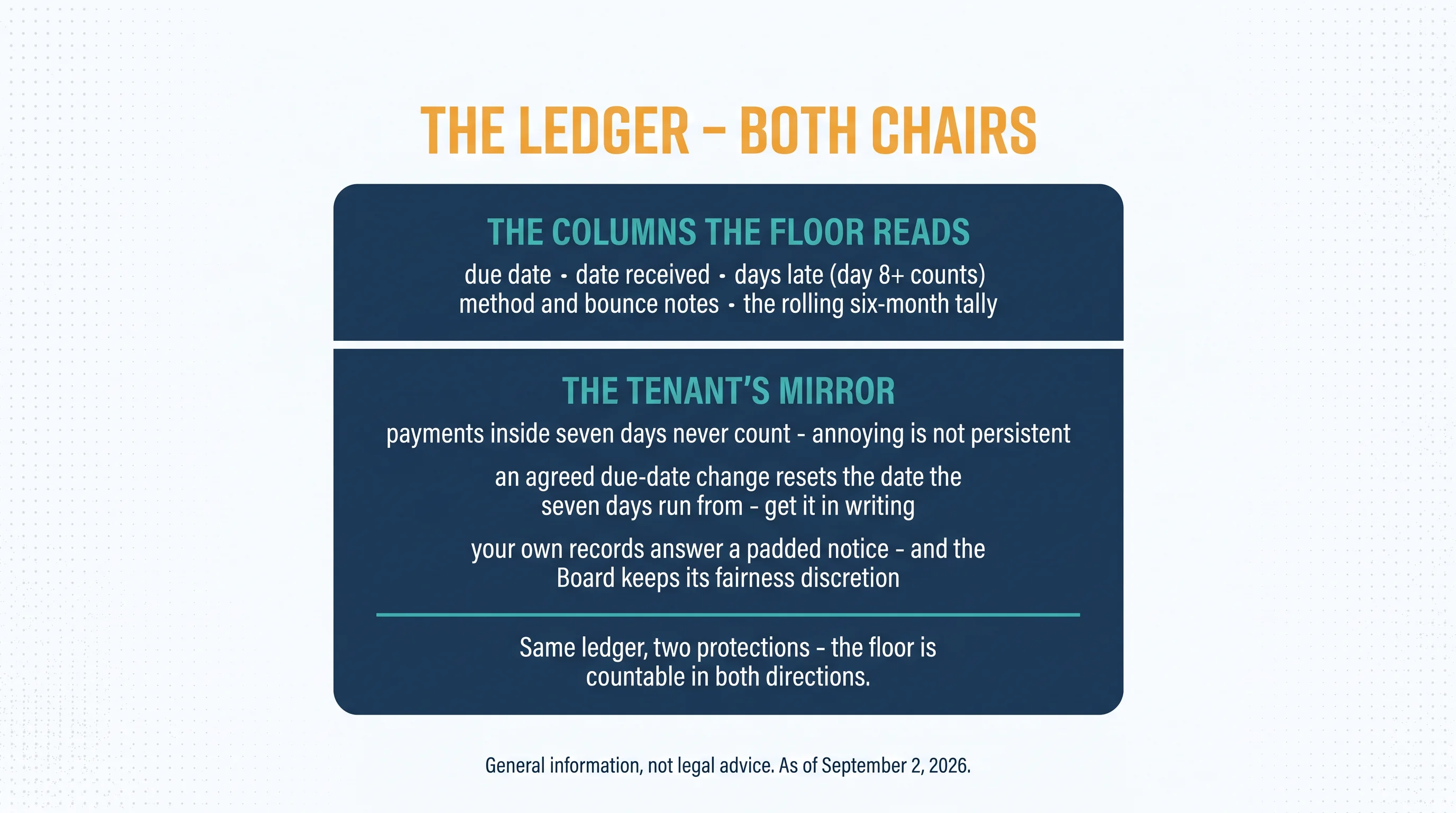
The new floor reads exactly five columns: due date · date actually received · days late (day 8+ = countable) · method and bounce notes · the rolling six-month tally. Not a new system — a discipline inside whatever already holds the rent record, updated on receipt day rather than reconstructed later.
For property managers — the evidence spine: From September 21, the ledger is the N8's case: a Board reading a countable floor will ask for countable columns. Keep it per-tenancy, updated on receipt day, exportable — a record reconstructed at hearing time reads exactly like what it is. And run the client conversation now: which tenancies in the book already show two countable occasions in the current window, and what does the file say about why.
For tenants — the floor protects you too: Payments inside seven days of the due date never count toward this test — annoying is not persistent, and now that's written down. An agreed change to your due date resets the date the seven days run from — get the agreement in writing. Keep your own payment records; they answer a padded notice, and the Board's fairness discretion runs in both directions. And if an accommodation need sits behind a payment pattern, document it and raise it early — that conversation is the discretion era's surviving territory.
Practical takeaways
- From September 21, 2026, "persistent" has a statutory floor: rent unpaid more than 7 days after the due date, on at least 3 occasions within any six-month period.
- The floor is non-exhaustive — "includes" is the statute's word; older pattern-reasoning survives beneath it.
- Day 8 is the countable line — a payment on the 5th never counts, for either chair.
- Don't conflate the clocks: the N4's 7 days cure an arrears notice; these 7 days count occasions inside a pattern ground.
- Cite it right: s.58(1) paragraph 1 and O. Reg. 516/06 s.8.1, added by O. Reg. 241/26 — not the labels circulating in fast coverage.
- The N8's process is untouched — 60 days, period-end, L2 within 30, s.83 relief — and the ledger is now its evidence spine.
The Late-Payment Ledger Sheet: The Columns the Floor Reads
The quoted test with its citation, the counting rules, a blank eight-row ledger, the two clocks kept apart, and the tenant's mirror — two pages.
The word got a floor
The floor got a window, and the window rolls. From September 21, persistence is countable — three day-8-or-later occasions inside any six months — while everything around the count stays familiar: the N8's timeline, the Board's discretion, and the quiet rule that a pattern is proven from a ledger kept live, not assembled under deadline. Serve on the right clock, cite the right text, and keep the five columns the test now reads — and whichever chair you sit in, remember the floor counts in both directions: it makes real patterns provable and padded ones checkable. As of September 2, 2026 — confirm the provision on e-Laws before relying on it. This is general information, not legal advice.
Serve the right notice for the rules in force
Tenon10 generates current Ontario notices, validates termination dates against the rules in force, and keeps the payment record with the tenancy.
Free • No signup required • Bill 60 aware
Related resources
- The N8 Notice in Ontario — the notice this ground fires.
- L1 vs L2: Understanding the Difference — the application mechanics.
- The 7-Day N4 — the other clock, end to end.
- Bill 60 & Bill 97: The Complete Guide — the whole September 21 wave.
Frequently asked questions
What counts as persistent late payment in Ontario after September 21, 2026?
A statutory floor now exists: rent unpaid more than seven days after the due date, on at least three occasions within any six-month period — and the provision is expressly non-exhaustive, so older pattern-based findings remain possible.
Is rent "late" after 7 days in Ontario now?
For this test, rent counts as late only when it's still unpaid more than seven days after the due date — a payment on day 5 never counts toward the floor.
How many late payments before a landlord can serve an N8?
Three countable occasions within any rolling six-month period meet the new floor. The N8 then runs as always: 60 days to a period or term end, and it isn't voided by payment — though the Board keeps its relief discretion, and conditional orders are a common outcome.
Is this the same as the new 7-day N4 rule?
No — same number, different laws. The N4's seven days are a cure period on an arrears notice; this seven-day threshold is a counting rule inside the persistent-late ground.
Does the new rule change the N8 form or process?
No. The regulation defines the existing ground in s.58(1) paragraph 1 — notice length, the period-end date rule, and the L2 timeline are untouched. Watch for any LTB form or guidance updates near the date.