Since the Residential Tenancies Act began, the non-payment hearing has doubled as the tenant's courtroom. A tenant facing an L1 for arrears could raise their own issues inside the same hearing — maintenance failures, illegal entry, harassment — as "section 82 issues," with no financial precondition: give advance notice, or satisfy the Board at the hearing that you couldn't have.
From September 21, 2026, that door gets a gate. Under Bill 60's rewrite of s.82 — confirmed for that date in the LTB's June 30 operational update — the Board shall permit those issues only if the tenant meets new requirements: advance notice of the issues, and payment of at least 50% of the arrears claimed in the application, at least seven days before the hearing. The right to complain doesn't vanish — a tenant's own T2 or T6 application still carries no financial gate — but the defence-inside-the-hearing now has a price. This guide covers the gate from both chairs: what changed in the statute, the three elements and their deadlines, what the gate doesn't touch, and the strategy each side should run from the day the rule lands. This is general information, not legal advice. As of September 3, 2026.
The Section 82 Decision Sheet
The gate from both chairs — the tenant's decision tree with the gate math and the voiding math, and the landlord's mirror. Two pages, free.
The old door and the new gate
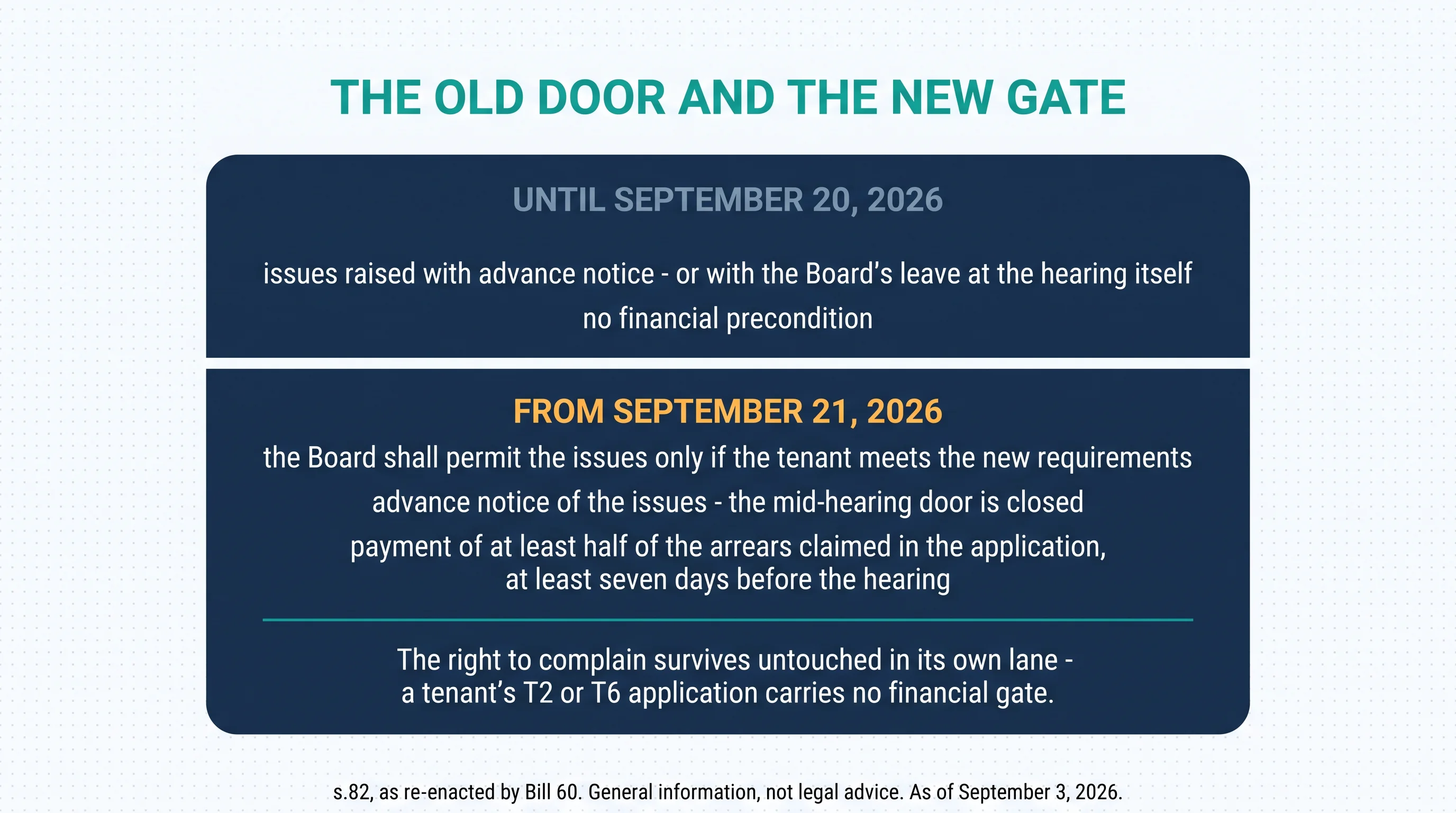
The old law fits in one paragraph. There was no financial precondition; a tenant gave advance notice of the issues, or asked the Board's leave to raise them at the hearing itself — and the LTB has itself recognized that Code-related issues sometimes surface for the first time mid-proceeding. That flexibility was the design.
The surgery, from the Bill 60 text: s.82(1) is re-enacted — at a hearing of a landlord's application on a non-payment notice, the Board "shall permit the tenant to raise any issue that could be the subject of an application... if the tenant complies with the requirements set out in subsection (2)" — and the old clause allowing a tenant to satisfy the Board at the hearing is removed. New paragraphs 4 and 5 of s.82(2) carry the added requirements, including the requirement to pay half of any arrears that were claimed in the application. In one line: the discretion-era door — knock and explain — becomes a gate with two keys, the notice and the payment.
The three elements — and the wave's third seven
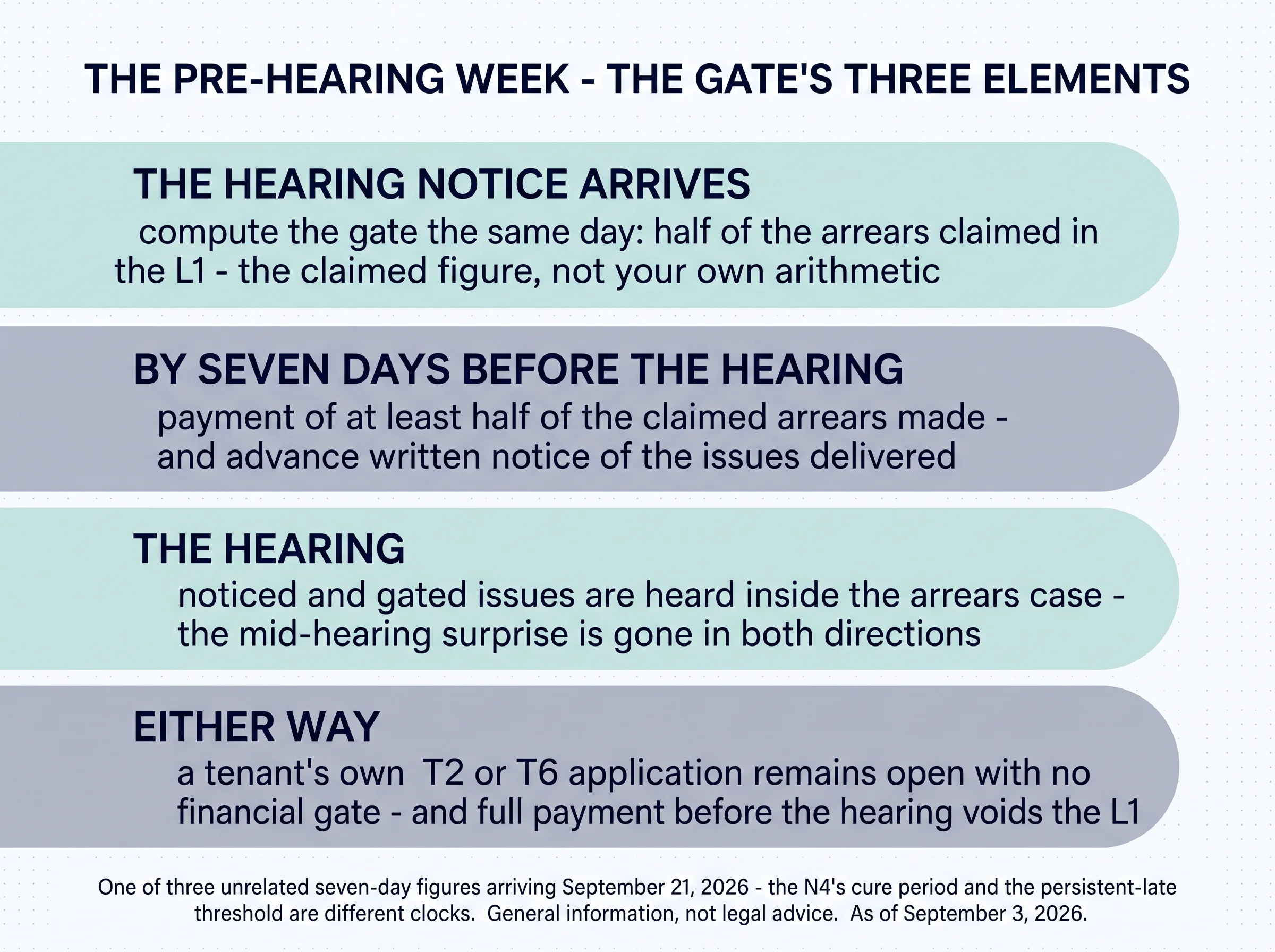
Element one — 50% of the arrears claimed. The gate is computed from the figure in the landlord's L1, not from the tenant's own arithmetic — which is why the claimed figure now matters intensely to both sides, as the landlord's playbook below explains. Element two — at least seven days before the hearing. The deadline that makes the pre-hearing week the file's decisive week. Element three — advance notice of the issues, in writing, ahead of time: the mid-hearing surprise is gone in both directions.
And one disambiguation, once: this is the wave's third unrelated seven. The N4's seven days are a cure period on an arrears notice. The persistent-late test's seven days are a counting threshold inside a pattern ground. These seven days are a pre-hearing deadline. Three clocks, three laws, one number — never mix them.
What the gate doesn't touch
The ungated lane. A tenant's own T2 (tenant rights) or T6 (maintenance) application proceeds with no financial precondition — the issues live on, on the tenant's own file and the tenant's own clock. The gate prices one venue; it doesn't price the claim.
The voiding math, kept distinct. Paying 100% of the arrears — plus the $186 filing fee — before the hearing voids the L1 entirely. That's a different threshold with a different effect than the 50% gate: half unlocks the issues; everything ends the case. And sometimes the two figures are closer than they look.
The discretion that survives. Section 83 relief remains — now "subject to any prescribed limitations and conditions," the sibling amendment in the same package — and conditional orders remain the common landing on first-arrears files, as our L1-vs-L2 guide walks in depth.
The tenant's playbook
The strongest move is now early filing. A T2 or T6 filed before or immediately after an N4 puts the issues on the record with no gate, on your own schedule — the strategy the new rule quietly rewards. If the issues are real, they don't need the L1's stage; they need a file number.
If raising inside the L1: compute 50% of the claimed arrears the day the hearing notice arrives; arrange the payment at least seven days out; send the advance notice in writing; and keep proof of all three. On the payment's mechanics — including whether payment can be made into the Board rather than to the landlord — the statute leaves room for regulation: confirm the current process against LTB guidance before the deadline rather than assuming.
Run both numbers. The gate unlocks the issues; 100% voids the case. With partial savings, a payment plan, or help from a rent bank, the voiding math sometimes beats the gate math — and it ends the application instead of arguing inside it. And if Code-related circumstances or an accommodation need sit behind the arrears, raise them early and in writing: the concern about this rule is precisely that such issues surface late, and the practical answer is to surface them first.
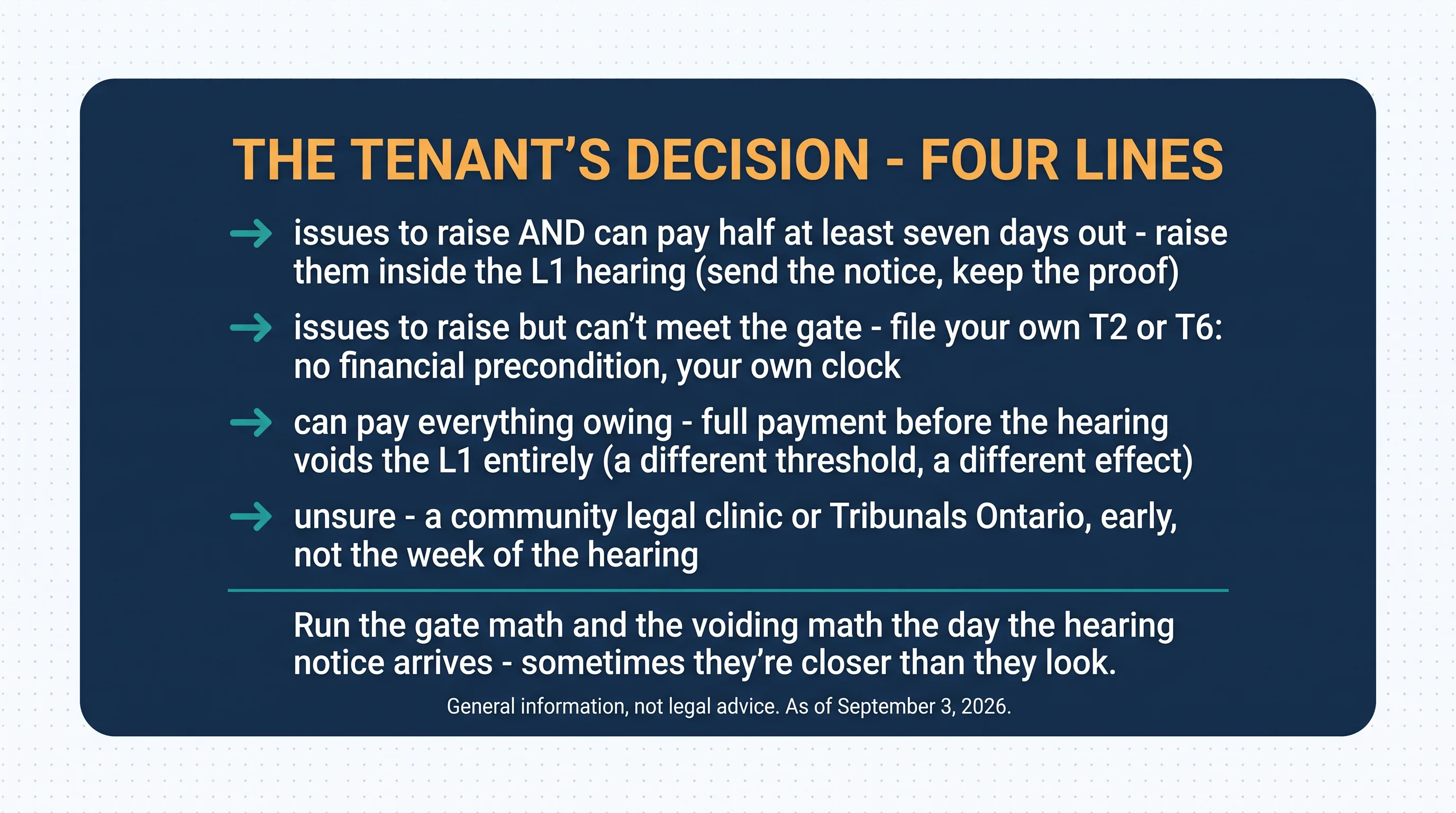
For tenants — the decision in four lines: Issues to raise and you can pay half at least seven days out → raise them inside the hearing (send the notice, keep the proof). Issues to raise but you can't meet the gate → file your own T2 or T6 — no financial precondition, your own clock. Able to pay everything owing → full payment before the hearing voids the L1 entirely. Unsure → a community legal clinic or Tribunals Ontario, early — not the week of the hearing.
The landlord's playbook

The claimed figure now serves double duty. The arrears figure in the L1 has always had to be right; from September 21 it also sets the tenant's gate. A rent-only ledger — no utilities, parking, or fees in the arrears box — protects the application and keeps the gate's arithmetic clean. A padded or mixed figure invites challenge and distorts a number the statute now builds on.
Answer the notice; don't adjourn on it. Advance notice of s.82 issues means hearings arrive prepared. The delay this rule targets is the adjournment — the new allegation the landlord couldn't answer that day — and the landlord's half of that bargain is showing up ready to answer exactly what was noticed, documents in hand.
Budget the other lane. The gate moves ungated claims into T2 and T6 files that arrive on their own schedule. The issues don't disappear; they relocate — and a portfolio that treats the gate as the end of tenant claims will meet them again with less context and a separate hearing date. And remember s.83 survives: a gate-cleared hearing is still not an automatic eviction.
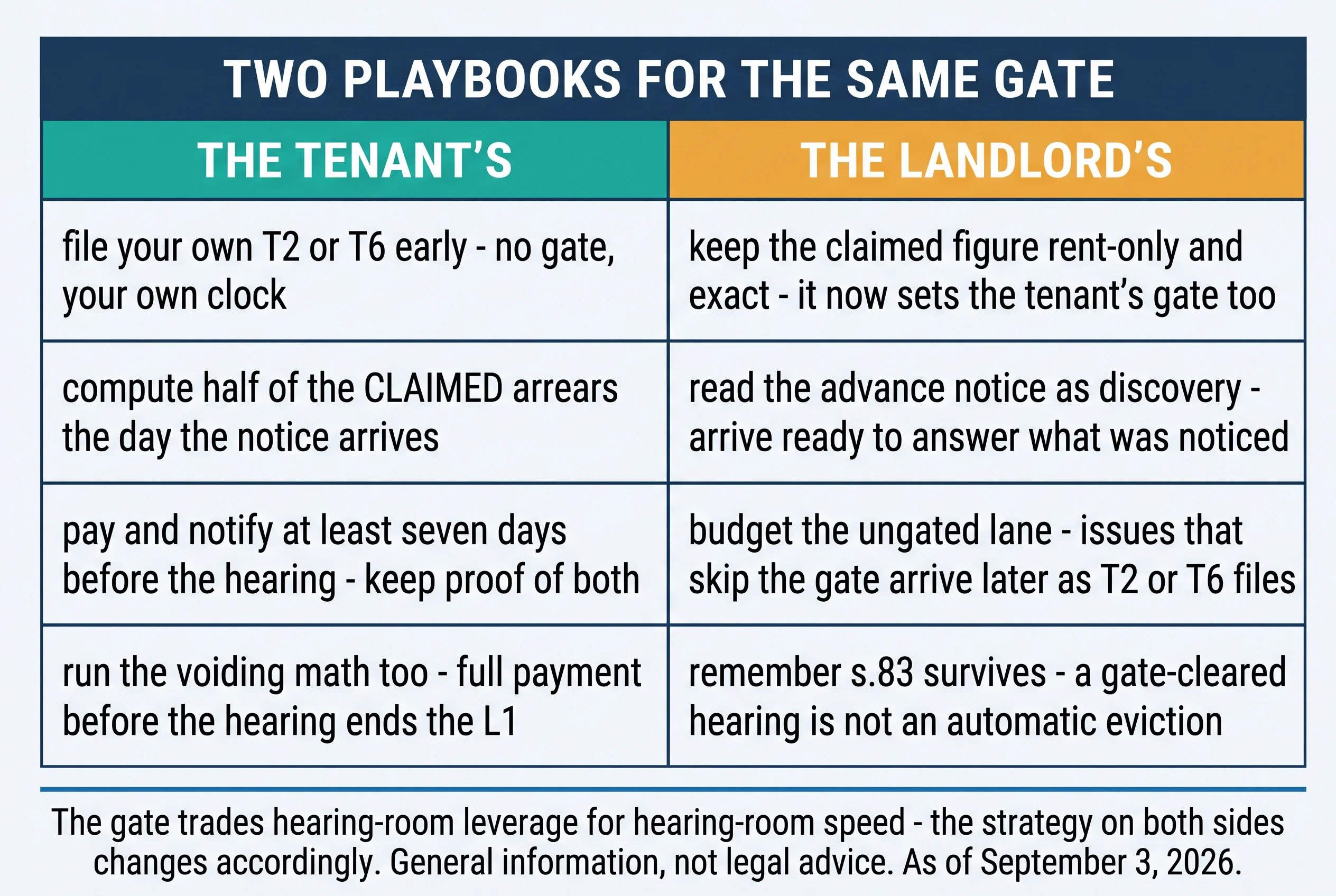
For property managers — the two-clock pre-hearing week: The week before every L1 hearing now holds two deadlines — the tenant's pay-and-notify date (hearing minus seven) and your evidence-prep date. Calendar both per file, and reconcile the claimed-arrears figure against the ledger before the week begins, not during it.
The fair fight over the rule
The rationale, as its supporters put it: s.82 issues raised cold at the hearing forced adjournments — new allegations the landlord couldn't answer that day — and the gate cuts delay-only tactics, keeping arrears hearings about the arrears claimed. One practitioner framing: it makes it harder to use grievances as leverage, "or, if one is more cynical, delay tactics."
The critique, as the Ontario Human Rights Commission and tenant advocates put it: the OHRC's submission warned that Code-related issues may first arise during eviction proceedings, and adjudicators cannot weigh accommodation if the law bars the issue; that tenants without early legal advice identify issues late; and that hardship, illness, and caregiving sit behind many arrears files. The Advocacy Centre for Tenants Ontario adds the maintenance-standoff point: some tenants withhold rent precisely because conditions are uninhabitable — and the gate prices that defence. Conditioning the defence on payment lands hardest on the low-income tenants whose issues are most relevant.
Both readings are real, and this guide takes no side beyond accuracy: the playbooks above are what each chair does about the rule either way.
Practical takeaways
- From September 21, 2026, raising s.82 issues at an L1 hearing requires advance notice and payment of at least 50% of the arrears claimed, at least seven days before the hearing.
- The statute's pivot is "shall permit... if the tenant complies" — the mid-hearing flexibility is gone.
- T2 and T6 applications remain fully open with no financial gate — early filing is now the tenant's strongest move.
- The 50% gate and the 100% voiding are different thresholds with different effects — run both numbers the day the hearing notice arrives.
- The claimed figure now serves double duty — landlords keep it rent-only and exact; tenants compute the gate from it, not from memory.
- Three unrelated sevens land the same day — the N4's cure, the lateness threshold, and this pre-hearing deadline. Never mix them.
The Section 82 Decision Sheet
The decision tree, the gate checklist with dollar and date blanks, the two maths, the landlord's mirror, and the three sevens — two pages.
The door still opens — it just has keys now
The notice, and the half. Tenants: run the gate math and the voiding math the day the hearing notice arrives, remember the ungated lane, and file early when the issues are real. Landlords: keep the claimed figure clean, answer what's noticed, and budget the lane the gate doesn't reach. The rest of the September 21 wave — the 7-day N4, the persistent-late test, the no-compensation N12 — is mapped in our Bill 60 and Bill 97 guide. As of September 3, 2026 — confirm the transition rules and any mechanics regulation at use. This is general information, not legal advice.
Serve and file on the rules in force
Tenon10 generates current Ontario notices, keeps the rent ledger clean and rent-only, and tracks the deadlines that now decide hearings.
Free • No signup required • Bill 60 aware
Related resources
- L1 vs L2: Understanding the Difference — the application this gate lives inside.
- The 7-Day N4 — the first of the wave's three sevens.
- The Persistent Late Payment Test — the second.
- Bill 60 & Bill 97: The Complete Guide — every September 21 change, mapped.
Frequently asked questions
Can tenants still raise maintenance issues at a non-payment hearing after September 21, 2026?
Yes — with advance notice of the issues and payment of at least 50% of the arrears claimed in the L1, at least seven days before the hearing. Without the gate, the same issues can still be filed as a separate T2 or T6 application, which carries no financial precondition.
Does paying 50% of the arrears stop the eviction?
No — the 50% only unlocks the right to raise s.82 issues inside the hearing. Paying 100% of the arrears (plus the filing fee) before the hearing voids the L1 entirely — a different threshold with a different effect.
Who does the tenant pay the 50% to?
The statute leaves the mechanics to regulation — legal analyses note that payment into the Board, rather than to the landlord, is contemplated. Confirm the current process against the regulation and LTB guidance before your deadline.
Is this the same 7-day rule as the new N4?
No — three unrelated sevens arrive the same day: the N4's cure period, the persistent-late test's lateness threshold, and this pre-hearing payment deadline. Same number, three different laws.
Does the rule apply to hearings already scheduled before September 21?
That's transition-rule territory under s.82(4) and (5) — don't assume either way. Confirm against the transition provisions and any LTB practice direction for your file's dates.