On July 24, 2026, the Landlord and Tenant Board did something Ontario's rental market had wanted for years and prepared for not at all: it started publishing its final orders to the province's Open Data Catalogue — free, no login, updating monthly, with history filling back toward December 2021. Within weeks, screening platforms rebuilt their pipelines around the feed, and third-party indexes passed forty thousand searchable records.
Transparency arrived. Discipline didn't ship with it. An order is a record of a proceeding — an application, the facts a member found, the evidence that carried them, and the reasons — and reading one as a verdict on a person is how a useful public record becomes a lawsuit-shaped mistake. This guide is the discipline: what the catalogue actually contains and what it never will, the four-step reading method that gets you the reasoning instead of the caption, the Human Rights Code and privacy rails that govern using it in screening, and the mirror most coverage skips — landlords are in there too, and tenants are already looking. This is general information, not legal advice. As of September 6, 2026.
The Public-Orders Reading Sheet
The four-step reading method, the lawful-use rails, the tenant mirror, and the six-line screening routine — two pages, free.
What launched — and what a "final order" actually is
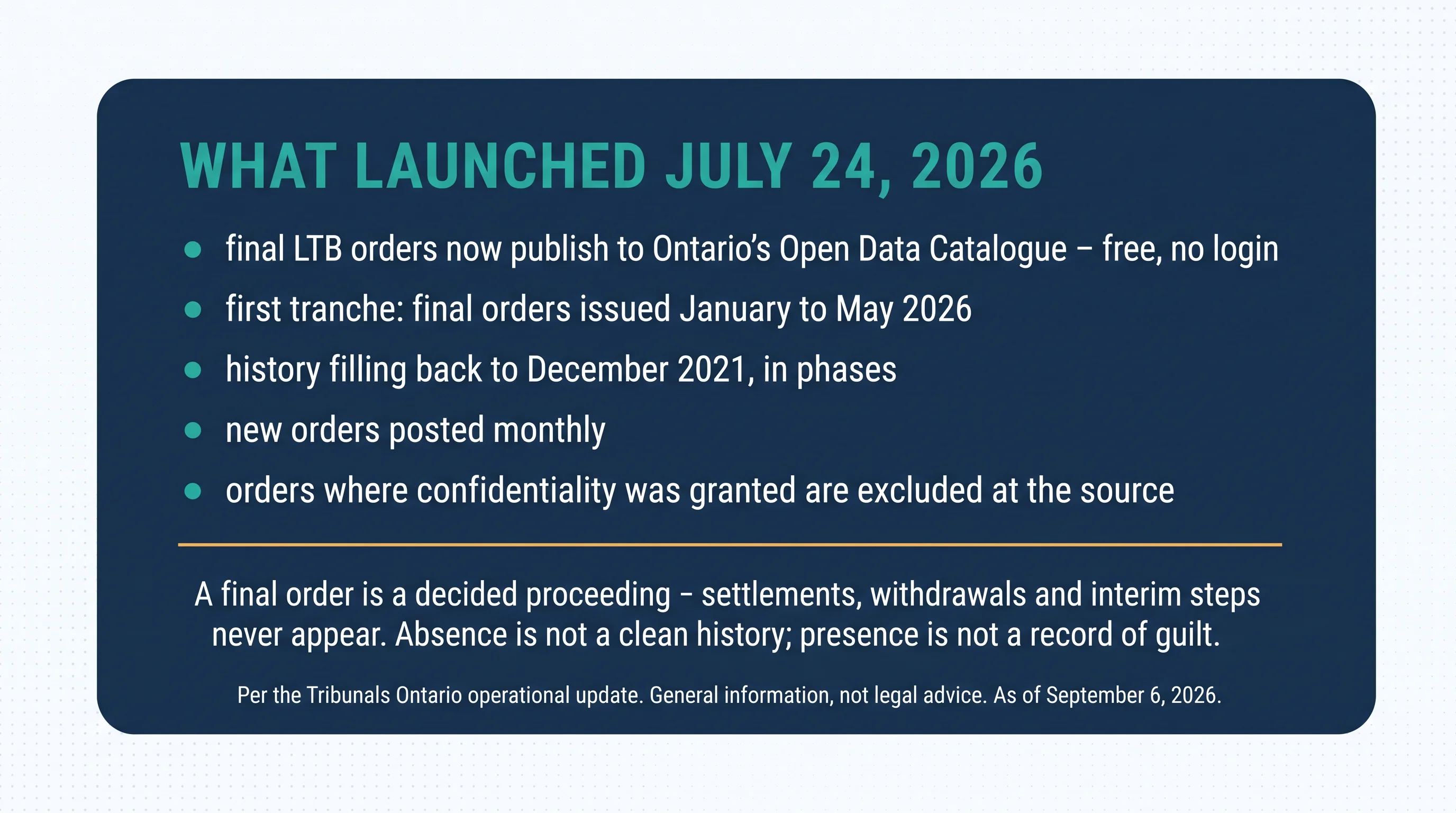
The facts, from the Tribunals Ontario operational update: since July 24, 2026, the LTB has been posting its final orders to the Ontario government's Open Data Catalogue. The first tranche covers final orders issued January through May 2026. Orders where confidentiality has been granted are excluded — the Board can restrict access where, for example, intimate personal or health information grounds it. Historical orders are being added in phases, back to December 2021, and new orders post monthly. Some orders from 2002 onward also live on CanLII — a partial, non-profit collection — and anything unpublished remains reachable only by a records request.
Now the precision that governs everything downstream. A final order is the Board's decision disposing of an application. It is not the application itself, not an interim step, not what happened at mediation — and it never includes the disputes that settled or were withdrawn before an order issued. Which yields the line to keep taped above any search box: absence is not a clean history; presence is not a record of guilt.
What the catalogue can't tell you — and the ecosystem growing on top of it
The structural gaps, plainly. Settlements and withdrawals leave no order, so the resolved disputes — often the majority of a person's history — are invisible. Confidential orders are excluded at the source. The backfill is in progress, so a quiet search result may simply mean the tranche for that year hasn't landed yet. And context — the job loss, the completed repair, the repayment plan honoured for twelve straight months — lives in the reasons, or nowhere.
Meanwhile, an ecosystem is already growing on top of the feed. One screening platform has retired user-uploaded orders entirely in favour of the official catalogue, citing cleaner provenance and privacy boundaries — confidential orders "excluded at the source." Third-party indexes report 43,000 to 45,000-plus searchable records, with search by tenant name, city, or order number. That shift is worth naming for what it is: the catalogue is becoming the rental market's shared record — which makes the discipline of reading it correctly everyone's problem, not a lawyer's. Our stance in one sentence: the official catalogue is the source of record; any index built on top inherits its gaps and adds its own — read the order itself, always.
The reading method: four extractions, in order
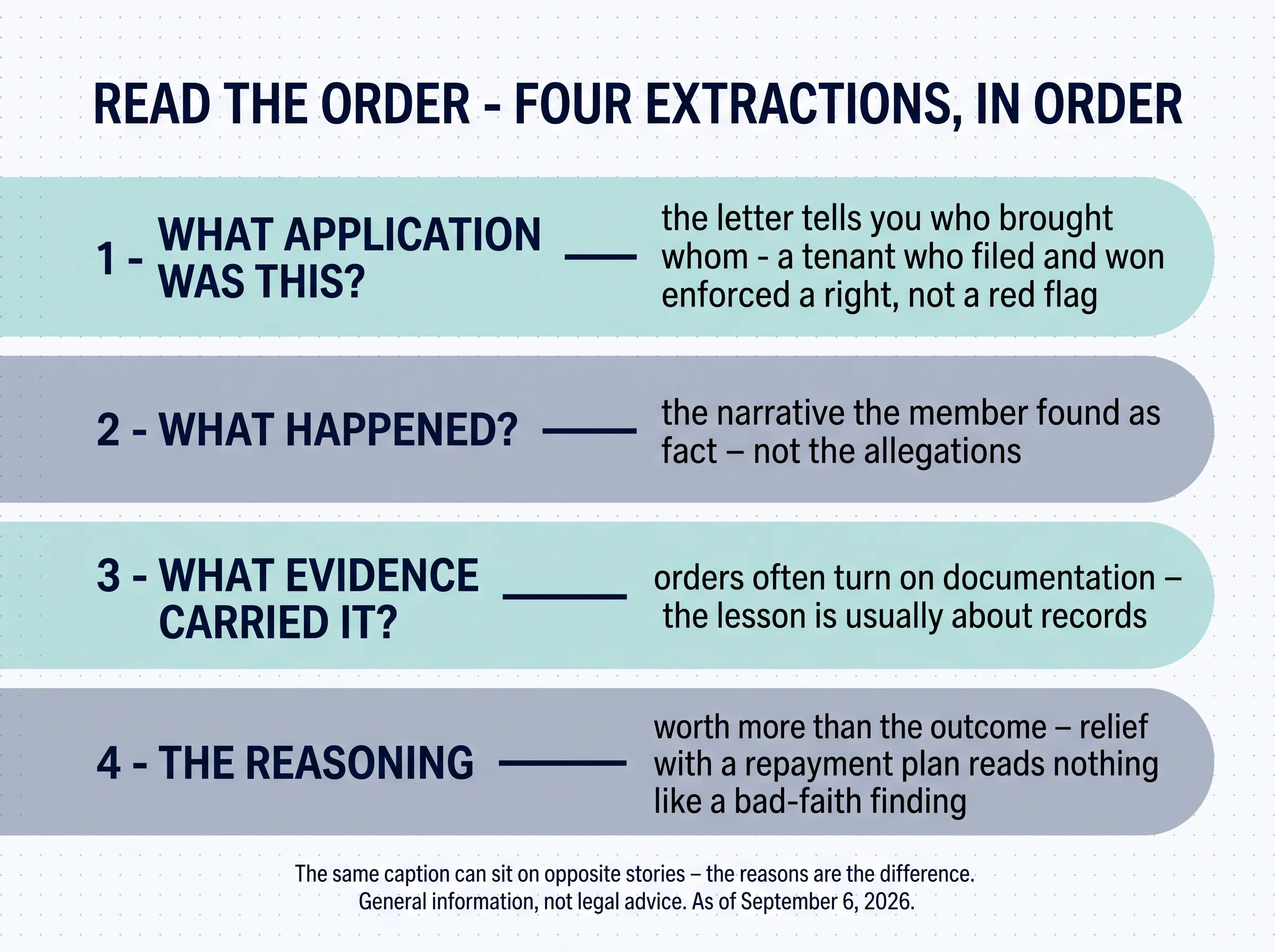
① What application was this? The letter tells you who brought whom, and why: an L1 is a landlord's arrears file; a T6 is a tenant enforcing the maintenance floor; a T2 is a rights application — our L1-vs-L2 guide maps the alphabet. And note what follows: a tenant who filed a T6 and won enforced a legal right. That is not a red flag.
② What happened? Read the narrative the member found as fact — not the allegations either side made on the way in. ③ What evidence carried it? Orders turn on documentation quality more often than on anything else; the transferable lesson in most orders is about record-keeping, whichever side you sit on. ④ The reasoning — worth more than the outcome. An arrears order granted with relief and a repayment plan reads completely differently from a bad-faith finding — and both are "an LTB order against" someone if you only read the caption.
Run a constructed illustration (not a real case): the same tenant name appears on a 2022 L1 resolved by conditional order during a job loss, and on a 2025 T6 the tenant won over unrepaired heating. A caption-reader sees "two LTB appearances" and reaches for a conclusion. A reader of reasons sees a tenant who paid on a plan through a hard year and enforced the Code's floor when it mattered. Same records, opposite stories — the method is the entire difference.
The lawful-use rails: one input, never a blacklist
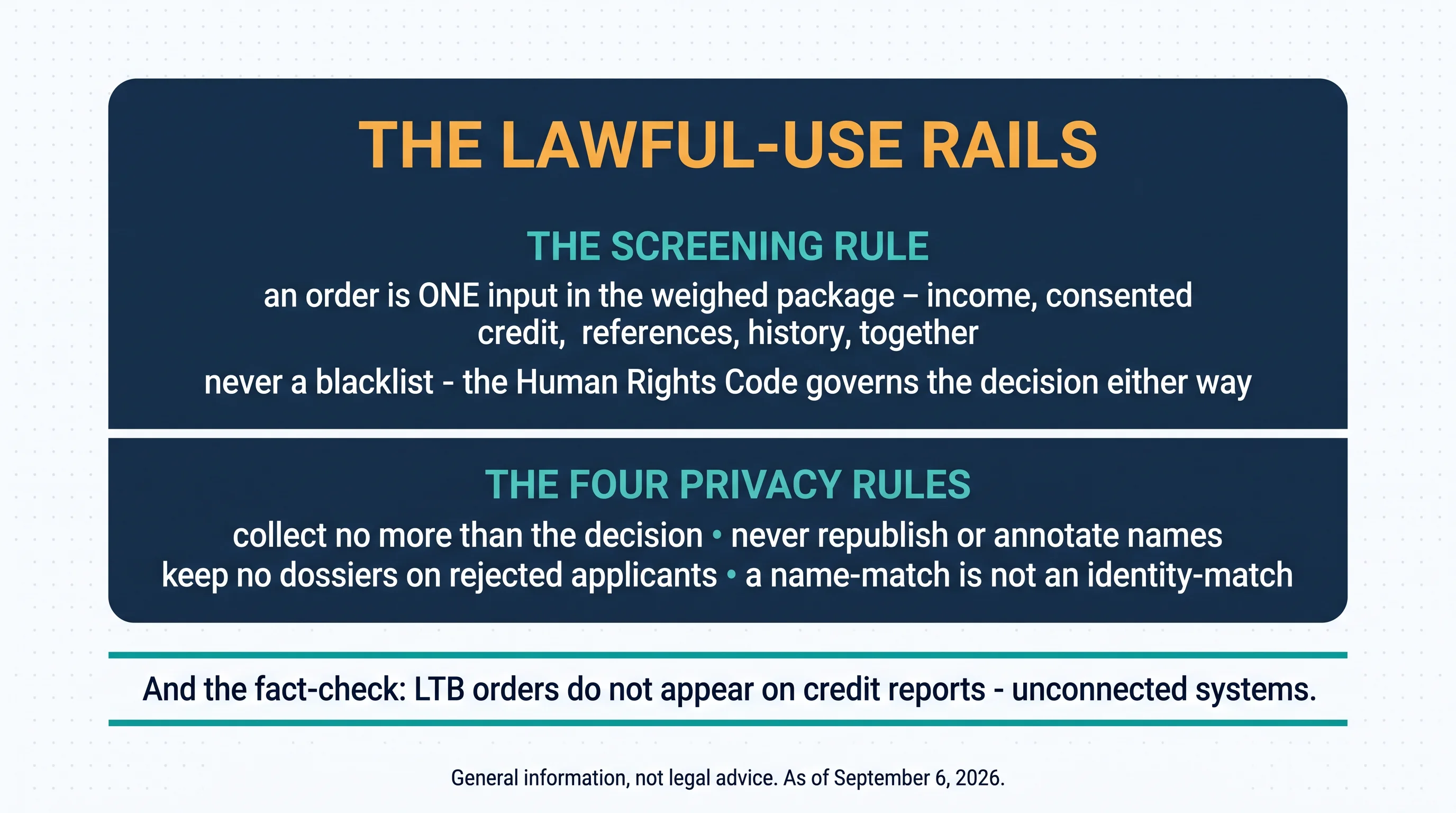
Ontario screening already runs on a settled frame: the weighed package — income, consented credit, references, rental history, guarantees — considered together, never one factor alone, as our question-by-question guide maps in detail. An order is, at most, one more input in that package. Not a gate, not a verdict, and never a blacklist.
The anchor for that caution isn't our opinion — it's the publisher's. The Board's own Interpretation Guidelines on human rights and tenant rights frame how carefully Code territory must be handled around its proceedings: accommodation, privacy, the protected grounds. The institution releasing these orders is the same one telling you the Code governs what you do with them. And the traps are concrete: an arrears order that discloses a disability accommodation, a family-status dispute, or receipt of public assistance is an order whose misuse walks a screening decision straight into protected-ground territory.
The privacy discipline, in four rules: collect no more than the decision · never republish or annotate applicant names · keep no dossiers on rejected applicants · and never treat a name-match as an identity-match — verification comes first, as our verification guide walks end to end. One fact-check to retire a persistent myth: an LTB order does not appear on a credit report. The catalogue and the bureaus are unconnected systems — the credit check is its own input with its own rules.
The tenant mirror: you can read them too
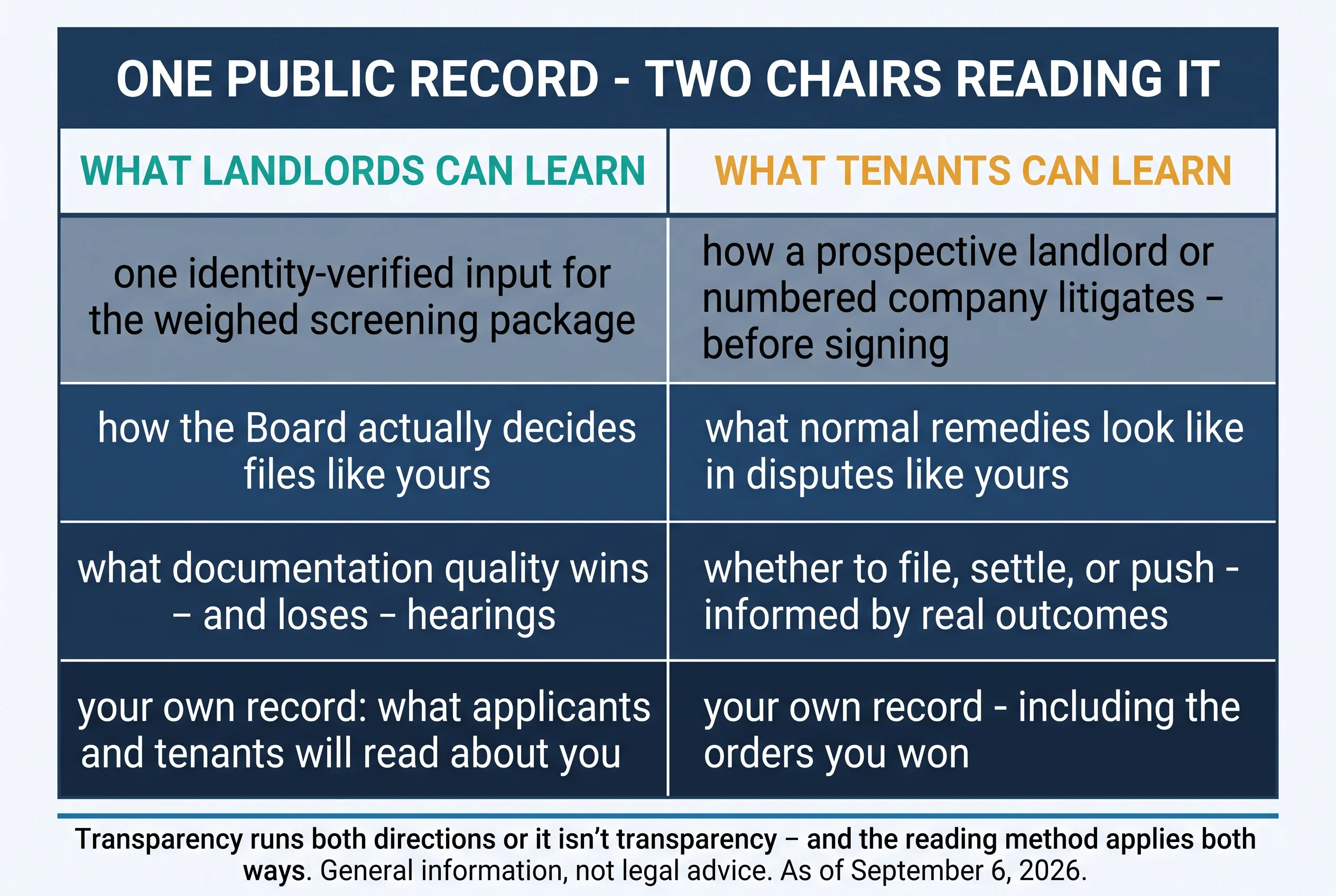
Landlords and their corporations are equally searchable. T2 and T6 outcomes, entry and harassment findings, maintenance orders — a prospective tenant can read how a landlord litigates before signing a lease, and increasingly will.
The tenant's three uses are worth spelling out, because almost nobody has. Check a prospective landlord — search the person and the numbered company on the lease. Read outcomes in disputes like yours before deciding whether to file, settle, or push: the catalogue is the first honest picture of what "normal" remedies look like for a given situation. And know your own record — your final orders are public, including the ones you won. The fairness point, stated once: transparency runs both directions or it isn't transparency — and the reading method applies in reverse, too. One T6 loss with the repair completed is not a slumlord; a pattern of findings is a pattern.

For tenants — the mirror in four lines: Search the landlord and the numbered company on the lease before you sign. Read the reasons, not the captions — in both directions. Your own final orders are public; know what they say. And an order you won enforcing your rights is nothing to explain away.
Where it fits: the routine — and the rest of the country
For landlords, the catalogue slots into the screening method in a specific place: after identity verification and references, weighed with the package — never as step one, and never as the whole step. The reference call still tells you things no order ever will.
For landlords — the lawful-use routine in six lines: Verify identity first. Search the applicant's name. Open and read any order in full. Extract the four things, in order. Weigh it with the package — one input among several. Document what you relied on.
And the rest of the country, honestly: tribunal transparency isn't new nationally. Several provinces' residential tenancy decisions have long been publicly searchable — British Columbia's Residential Tenancy Branch posts anonymized decisions, Quebec's tribunal decisions are public, and CanLII has carried tribunal rulings across Canada for years. Ontario's shift is notable for its scale, the official open-data channel, the named parties, and the monthly feed — which is exactly why the discipline matters more here.
Practical takeaways
- Since July 24, 2026, the LTB's final orders publish to Ontario's Open Data Catalogue — monthly, with history filling back to December 2021 in phases.
- A final order is a decided proceeding — settlements, withdrawals, and confidential orders never appear: absence isn't a clean history, and presence isn't guilt.
- Read every order in full, in four extractions — the application type, the facts found, the evidence, and the reasoning, which is worth more than the outcome.
- In screening, an order is one input in the weighed package — never a blacklist — and the Code governs the decision either way.
- Verify identity before weighing anything: a name-match in a 45,000-record index is a guess, not a fact.
- The mirror is real: landlords and their corporations are searchable too — and tenants are already looking.
The Public-Orders Reading Sheet
The method with fill-in blanks, the rails, the in/never-in card, the tenant mirror, and the six-line routine — two pages.
Read the reasons
The catalogue tells you what a hearing decided — never what a person is. Read to the reasons, weigh with the package, verify before you conclude, and remember you're in the record too. The coverage will keep growing month by month; the discipline is the part that's yours. As of September 6, 2026 — the backfill and monthly tranches are ongoing, so check the dataset's current range before drawing conclusions from silence. This is general information, not legal advice.
Screen lawfully, file correctly
Tenon10 generates current Ontario notices and keeps the screening file — consents, checks, and what you relied on — with the tenancy.
Free • No signup required • Bill 60 aware
Related resources
- How to Screen a Tenant in Ontario: The 7-Step Method — where the catalogue slots in.
- How to Run a Tenant Credit Check — the unconnected system.
- How to Verify an Applicant Is Real — the identity gate.
- L1 vs L2: Understanding the Difference — what the application letters mean.
Frequently asked questions
Are LTB orders public in Ontario now?
Yes — since July 24, 2026, final orders publish to the province's Open Data Catalogue, starting with orders issued January–May 2026, backfilling to December 2021 in phases, updated monthly. Confidentiality-granted orders are excluded, and some older orders remain on CanLII.
Do LTB orders show up on credit reports?
No — the catalogue and the credit bureaus are unconnected systems. A credit check and an order search are separate inputs, each with its own rules.
Can landlords use the catalogue for tenant screening?
As one input in a Code-compliant weighed package — read in full, identity-verified, weighed with income, credit, references, and history — never as a name-search blacklist. A rejection built on a caption is a human-rights complaint waiting to happen.
How far back does the catalogue go?
The first tranche covers final orders from January–May 2026, with historical orders back to December 2021 being added in phases — so a quiet search result may just mean the backfill hasn't reached that year yet.
Can tenants look up a landlord's LTB history?
Yes — landlords and their corporations are equally searchable. Read the reasons the same way: one adverse order with a completed repair is context; a pattern of findings is a pattern.