Two months ago, the clock to challenge a Landlord and Tenant Board order was cut in half. Most coverage reported that and stopped — which means most people are working from half the story.
Since July 1, 2026, a Request to Review must be filed within 15 days of the order's issue date rather than 30, under new s.209(3) of the Residential Tenancies Act. But the same package also replaced s.209(2), making the Board's power to review its own orders "subject to any prescribed limitations or conditions" — and O. Reg. 178/26, Limits on Board's Review Powers, closed the list of grounds. The review didn't just get faster. It got narrower, and enumerated.
This guide is the mechanism in full: what actually changed, the grounds that now qualify, the two-stage process, the stay you have to ask for separately, the amend-versus-review fork that can save you fifteen days and $58, and the order-day habit that keeps all four clocks visible — from both chairs. This is general information, not legal advice. As of September 7, 2026.
The Order-Day Action Sheet
Pick the lane, fill in four deadlines from the issue date, and file the review properly — triage, checklist, and the stay. Two pages, free.
What actually changed on July 1 — both halves
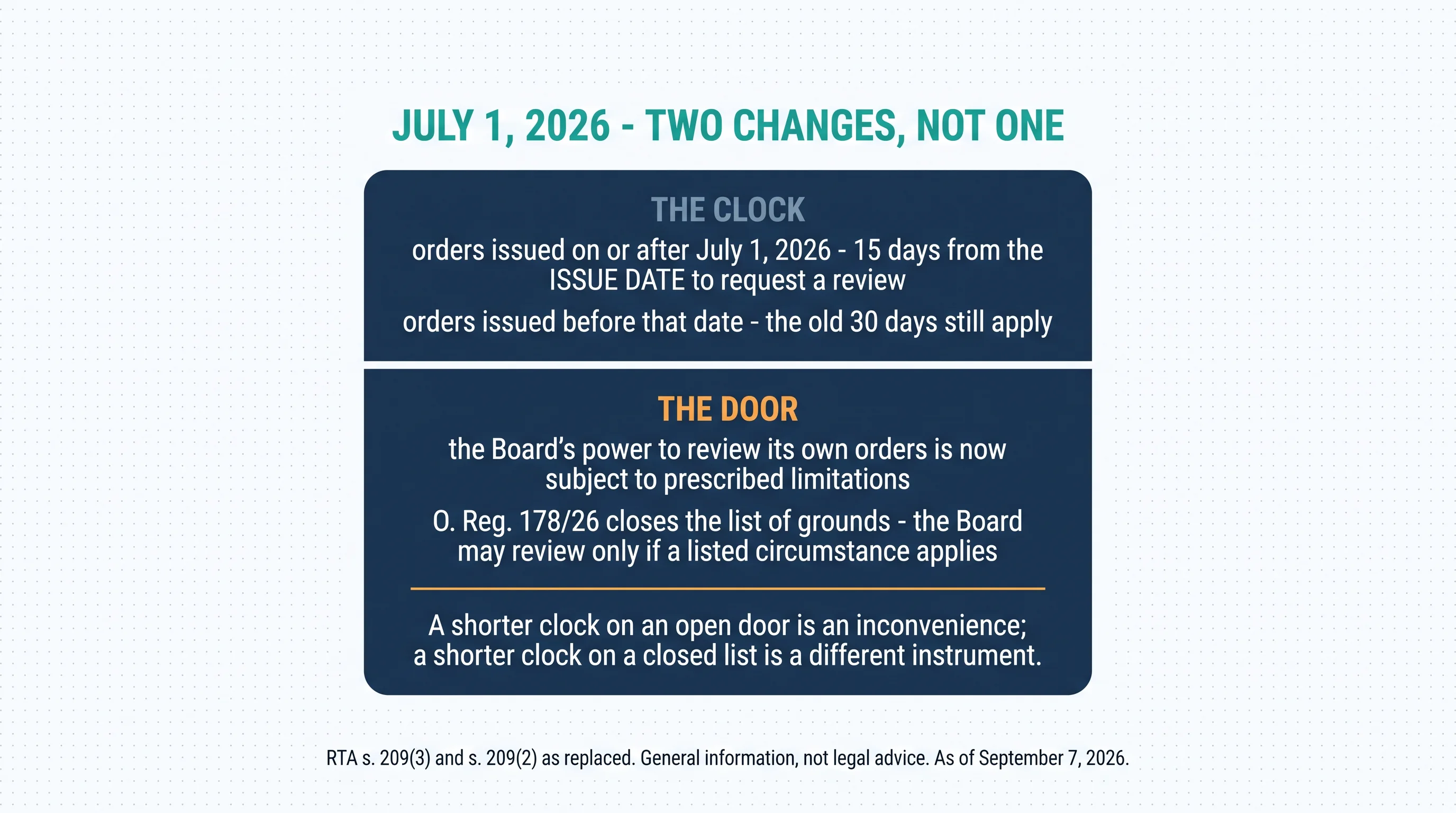
Change one — the clock. Orders issued on or after July 1, 2026 carry fifteen days from the issue date; the Board's Rules 26.4 and 26.5 draw the same line, with 26.5 tying the fifteen days expressly to s.209(3). Orders issued before that date keep the old thirty. Note what the line turns on: the date the order was issued — not the day it reached you, and not the day you got around to reading it. Files from June are still living on the old thirty days well into the fall.
Change two — the door. With s.209(2) replaced, the Board's review power now runs subject to prescribed limitations, and O. Reg. 178/26 sets out when the Board may review at all. The Board's own Interpretation Guideline 8 puts it in the language that matters: it may exercise the discretion to review a final order only if satisfied that one or more of the listed circumstances is present.
Why both halves matter together: a shorter clock on an open-ended door is an inconvenience. A shorter clock on a closed list is a different instrument. Plan from both, because half the coverage out there reports only the first.
The grounds, closed by regulation
Three circumstances, in plain language. ① You were a party but weren't reasonably able to participate — because you didn't receive adequate notice of the hearing or of the issues to be decided, or because your inability to participate was wholly or partly attributable to the Board itself. ② The order resulted from a serious error. ③ There's new evidence that couldn't reasonably have been obtained earlier and would likely have changed the result.
And the thing that doesn't qualify, stated plainly because it's where most requests die: a review is not an appeal on the merits. The Board's own guidance is blunt that simply asserting the order is wrong usually isn't enough — "the member weighed the evidence differently than I would have" is not a ground. Merits and questions of law belong to the Divisional Court: thirty days, automatic stay, counsel territory.
Two boundaries worth knowing before you start. Who can ask: any party to the proceeding — and any other person directly affected by a final order; the Guideline's own example is a residential complex with two owners where only one was named and participated. What's reviewable: final orders, and interim orders that make a final decision about a party's rights (Rule 26.1). An interim order terminating a tenancy qualifies; orders about evidence disclosure, interim payments, or adding a party don't — the application mechanics behind those sit in our L1-vs-L2 guide.
The two stages — and the stay you have to ask for
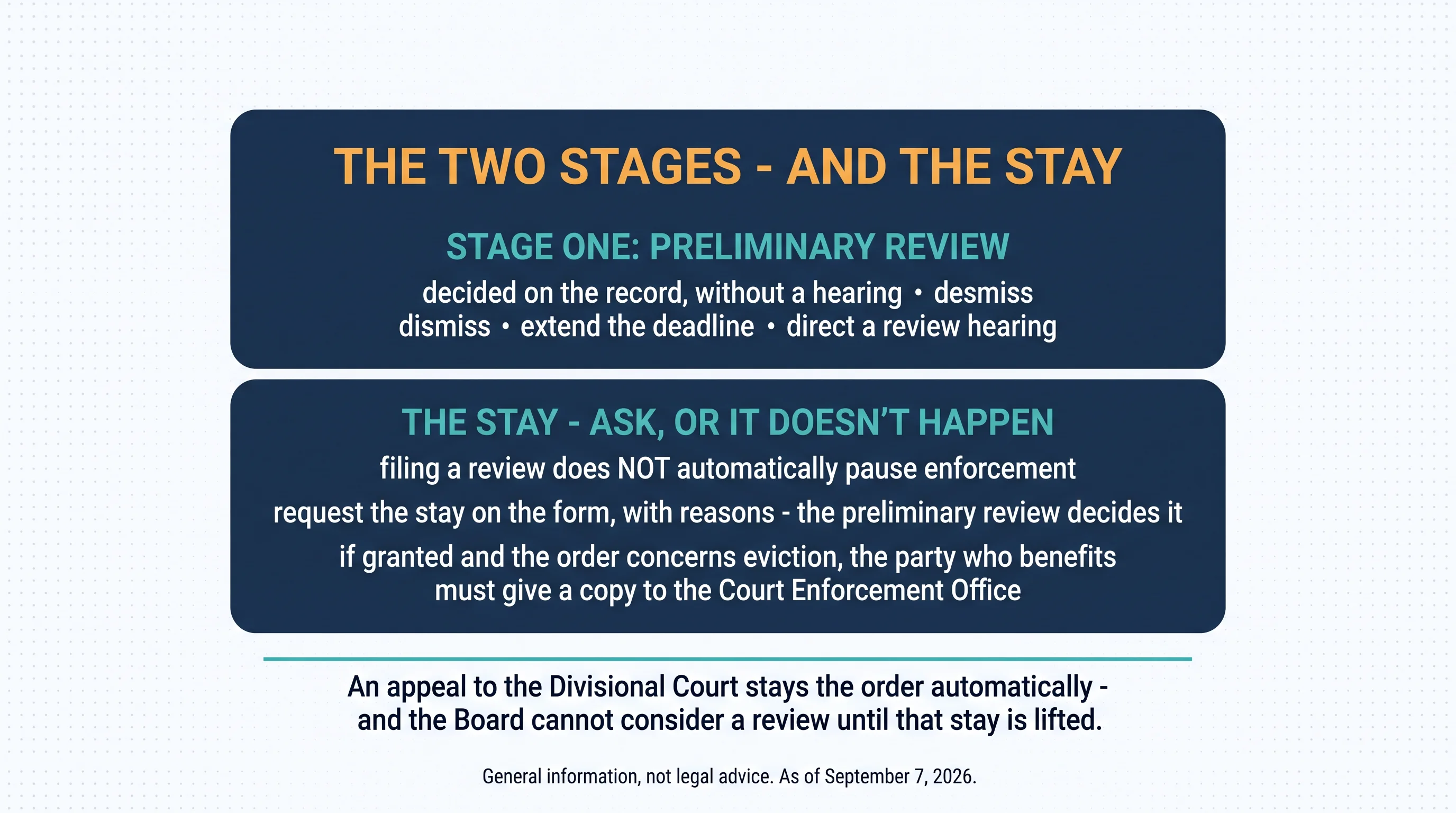
Stage one is the preliminary review, and it happens without a hearing — decided on your request and the Board's own record. At that stage the Board can dismiss the request (filed late, or the grounds aren't made out), extend the filing deadline where appropriate, direct a review hearing — stage two — or make interim orders. It also decides the stay question, which brings us to the second thing most people get wrong.
Filing a review does not automatically stay enforcement. The stay is a separate ask: you request it on the form, in the space provided, with reasons. The preliminary-review adjudicator decides it, and where a stay is granted it holds until the review is decided unless the Board decides it's no longer appropriate. Then comes the operational detail almost nobody prints: where the order concerns eviction, the party who benefits from the stay must give a copy of the stay order to the Court Enforcement Office — the Sheriff (Rule 25.3). Board staff may also notify the Sheriff where enforcement is imminent, but the obligation sits with the party, not the system.
The Divisional Court interaction is worth stating precisely, because it's often muddled: an appeal automatically stays the order — and while that stay is in place, the Board cannot consider a review request unless it first decides to lift it. The review form asks whether an appeal has been filed and why the Board should lift the stay. Filing both without thinking about the order of operations is how files stall.
Three mechanics that trip people at the counter: the fee is $58, payable at filing unless a fee waiver is granted — and where the request is granted after a hearing, the Board may refund it (confirm the current amount with the LTB before you file). The Board may refuse to accept a request that's missing required information (Rules 26.7–26.8.1). And the request isn't served on the other parties unless the Board directs it.
The fork: amend, review, or appeal
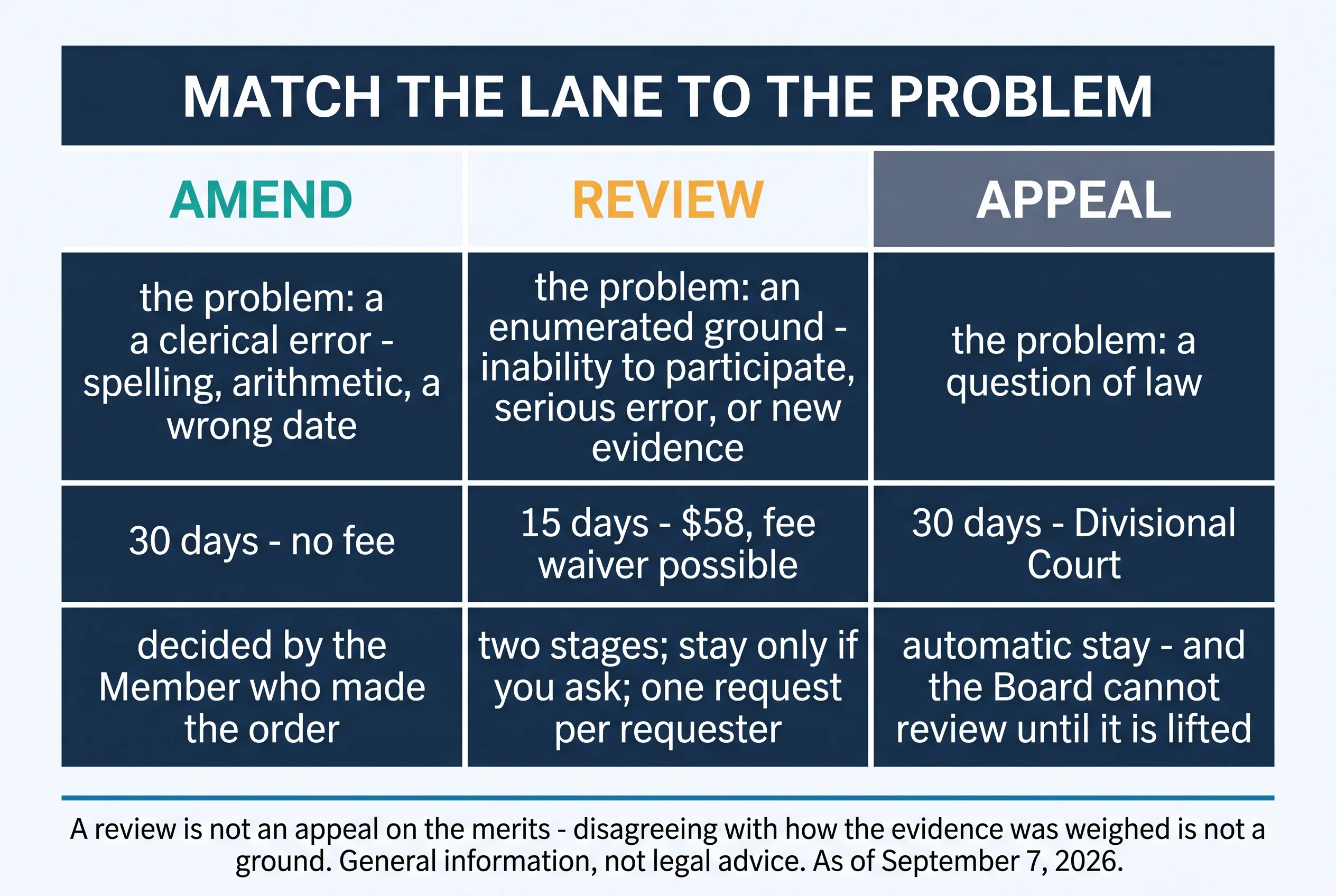
Amend is for clerical errors and nothing else — a spelling mistake, a miscalculation, a wrong date. Thirty days, no fee, decided by the Member who made the order; the amended order replaces the original. Review is for the enumerated grounds: fifteen days, $58, two stages, stay on request, one request per requester. Appeal is for questions of law: thirty days to the Divisional Court, automatic stay, and it locks the review lane until that stay is lifted.
The order-day habit

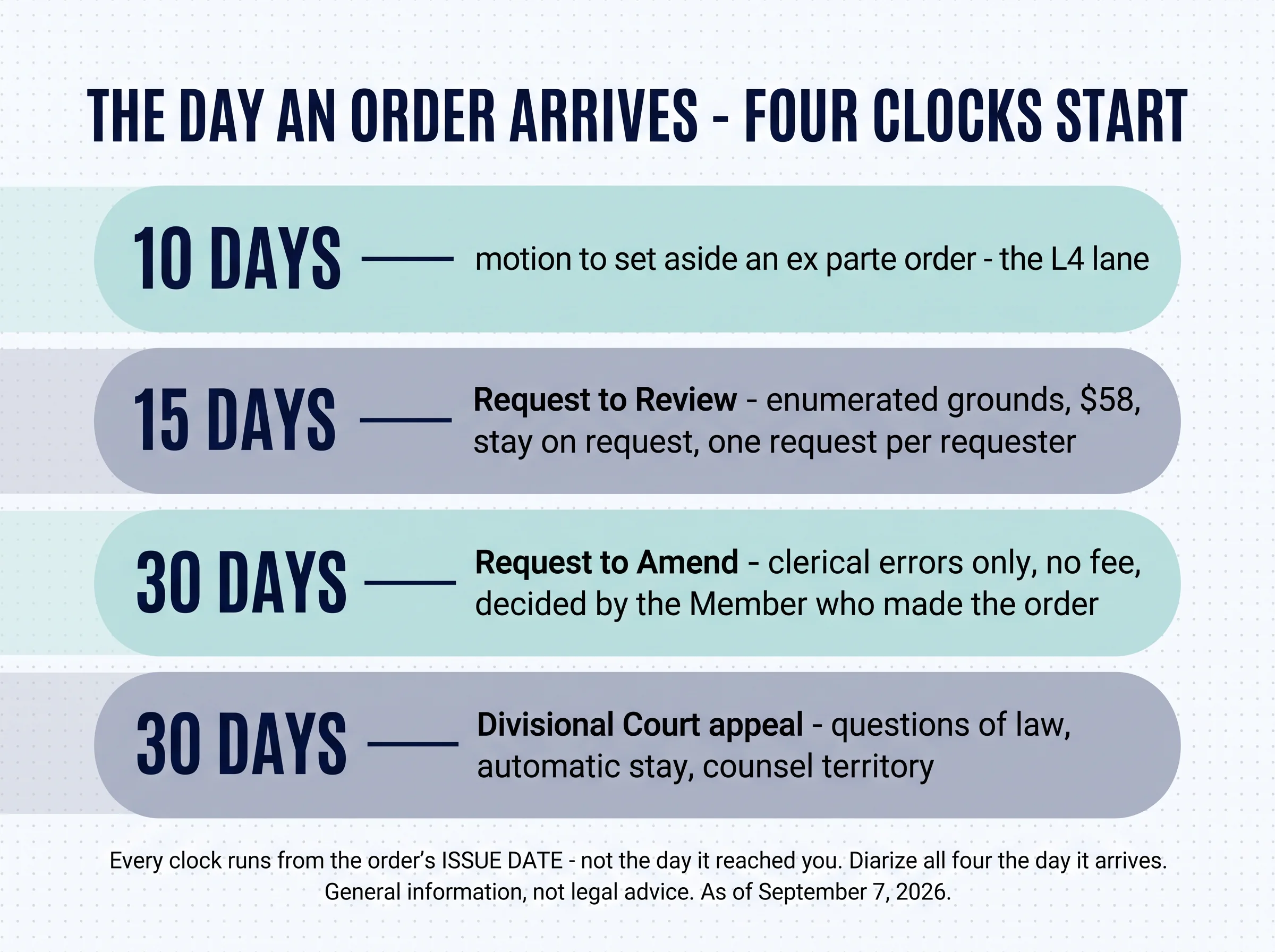
The habit is one line: read the order the day it arrives, diarize all four dates from the issue date, and decide the lane inside forty-eight hours.
Four clocks start when an order lands — fifteen days for a review, thirty for a Divisional Court appeal, thirty for an amendment, and ten days to move to set aside an ex parte order in the L4 lane. Our end-to-end LTB process guide walks the whole journey from first notice to enforcement; this is the part that runs fastest.
Why forty-eight hours rather than "sometime this week": the preliminary review is decided on the record, so the request has to carry its own evidence — declarations, correspondence, whatever shows the ground. Assembling that properly takes days, not hours. A request filed on day fourteen with nothing attached is a dismissal with a $58 receipt. And because Rule 26.18 gives you one request, "file something now, supplement later" isn't a strategy — make it complete the first time: ground identified, evidence attached, stay requested if enforcement is live.
From both chairs
For landlords: A review filed against your order is no longer an automatic delay — the grounds are closed and stage one is decided on the record. But read every document that arrives after the order: a stay changes enforcement entirely, and the party who benefits from it is the one who must get it to the Sheriff. And when a decision goes against you on a real ground — you weren't notified of a rescheduled hearing, say — the fifteen days are yours too.
For tenants: The shortened clock lands hardest on unrepresented parties. If you didn't get adequate notice, or the Board's own process kept you out of your hearing, that's an enumerated ground — move the same week, ask for the stay explicitly if enforcement is live, and get help immediately: a community legal clinic, duty counsel, or Tribunals Ontario's own guidance. The extension exists, but it has to ride with the review and it needs a reason.
One line of context for both chairs: this was the first tranche of Bill 60's changes — our Bill 60 guide maps the package, and the September 21 tranche brought the rest, including the 7-day N4.
Practical takeaways
- Since July 1, 2026, a Request to Review must be filed within 15 days of the order's issue date; orders issued before that date keep the old 30.
- Two changes, not one: the clock (s.209(3)) and the closed grounds (O. Reg. 178/26, via the replaced s.209(2)).
- Three grounds qualify: inability to participate (inadequate notice, or attributable to the Board), a serious error, or new evidence that would likely have changed the result.
- A review is not an appeal on the merits — questions of law go to the Divisional Court within 30 days.
- Filing does not stay enforcement. Ask for the stay; if it's granted and the order concerns eviction, get a copy to the Sheriff.
- Match the lane to the problem: clerical → amend (30 days, free); enumerated ground → review (15 days, $58, one shot); question of law → appeal.
The Order-Day Action Sheet
The five-way triage, the four-clock table you fill in once, the review checklist, the stay, and the five mistakes that end reviews — two pages.
The shortest clock is the one most people need
An order that arrives today starts four of them, and since July the one people reach for most often runs half as long — through a door that's also narrower. So read it the day it lands, diarize from the issue date, pick the lane on the merits of what's actually wrong, and ask for the stay if enforcement is live. The whole journey from first notice to enforcement sits in the process guide; the wave that produced these changes is mapped in our Bill 60 and Bill 97 guide. As of September 7, 2026 — confirm the regulation text, the current fee, and Guideline 8's wording before you file. This is general information, not legal advice.
Know your deadlines before they know you
Tenon10 generates current Ontario notices and keeps the dates, documents, and file history with the tenancy — so the order-day clocks are already on the calendar.
Free • No signup required • Bill 60 aware
Related resources
- The LTB Process End to End — all seven stages, and where the order sits.
- The 7-Day N4 — the September 21 tranche.
- How Bill 60 Affects Ontario Landlords — the package in full.
- L1 vs L2: Understanding the Difference — the applications behind the orders.
Frequently asked questions
How long do I have to request a review of an LTB order?
Fifteen days from the order's issue date, for orders issued on or after July 1, 2026. Orders issued before that date carry the old thirty-day deadline. If the deadline falls on a weekend or a day the Board is closed, it moves to the next business day.
Does filing a review stop an eviction?
No. A stay must be requested — on the form, with reasons — and it's decided at the preliminary review stage. If a stay is granted and the order concerns eviction, the party who benefits from it must provide a copy to the Court Enforcement Office.
What are the grounds for a review now?
Under O. Reg. 178/26: you were a party but couldn't reasonably participate (inadequate notice of the hearing or the issues, or an inability attributable to the Board), the order resulted from a serious error, or there's new evidence that couldn't reasonably have been obtained earlier and would likely have changed the result. Disagreeing with how the evidence was weighed is not a ground.
What if I miss the 15-day deadline?
You must file a Request to Extend Deadline together with the review request — the Board won't consider an extension filed separately — and explain the delay. Extensions aren't automatic.
Can I request a review twice?
No. The Board won't consider a further request on the same order from the same requester, or a review of the review order. A different party or directly affected person with different interests may request a review on different grounds.