A renoviction runs on paper. The notice, the permit, the tenant's letter, the landlord's offer — and the gap between a right that exists and a right you can prove is where most of them are lost.
From September 21, 2026, there's more paper, and almost all of it is on the landlord's side. Bill 97 amends s.54 of the Residential Tenancies Act so that once a tenant has preserved the right of first refusal, the landlord picks up a written-notification chain that runs the length of the renovation: an estimated completion date, written notice every time that date changes, a notice when the unit is ready, and at least 60 days for the tenant to take it.
The right itself isn't new. The N13's 120 days aren't new. What's new is the record. This guide is the whole paper trail from both chairs — what the tenant must send before vacating, what the landlord must send during the work, what rent a returning tenant pays, and what the municipal by-laws add on top. This is general information, not legal advice. As of September 7, 2026.
The Renoviction Paper Trail
Both halves of one file: the tenant's preserve-the-right checklist and the landlord's fillable notification log. Two pages, free.
The N13, and everything that stays exactly the same
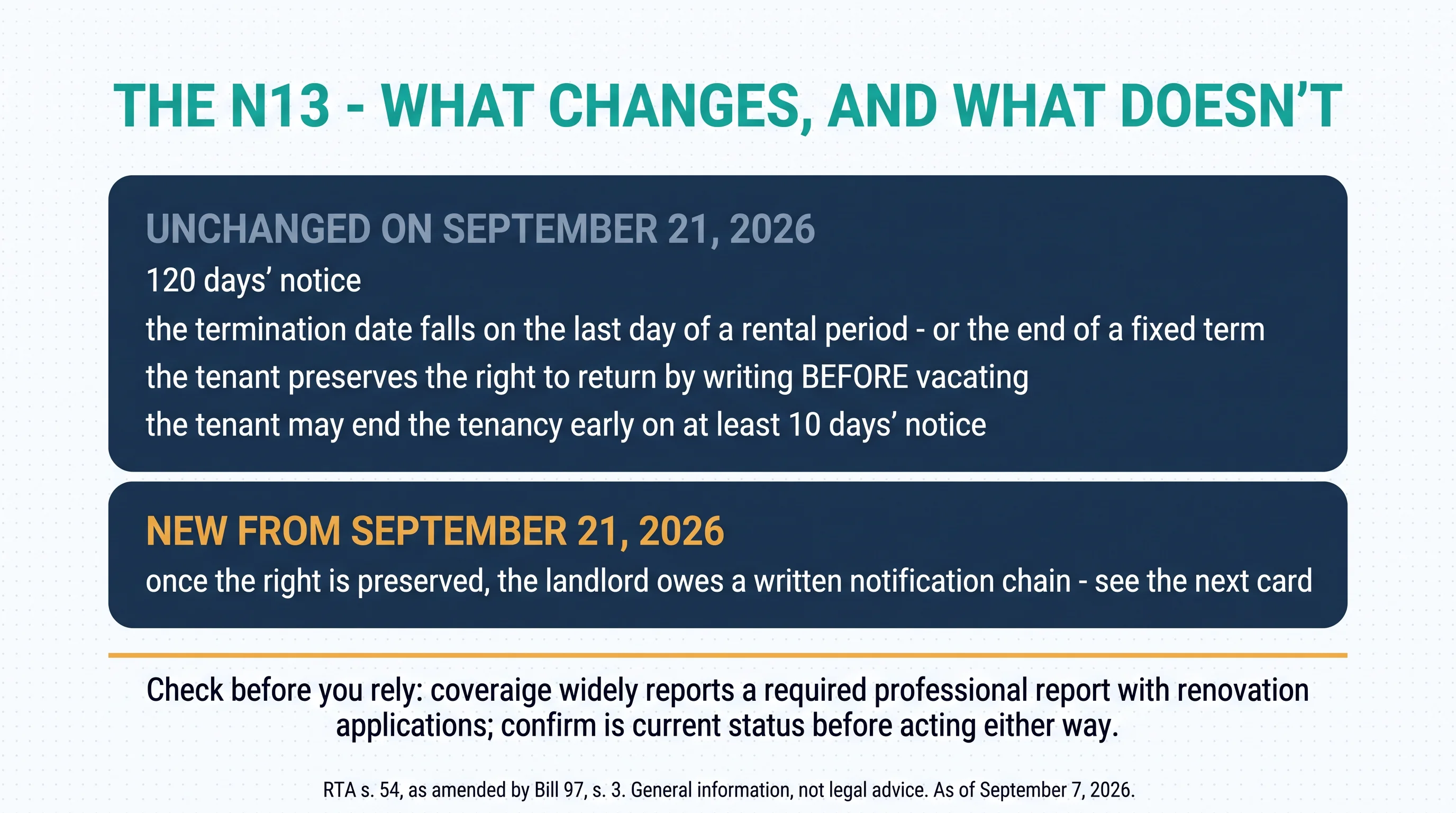
The N13 is the notice for demolition, conversion to non-residential use, or repairs and renovations so extensive that a building permit is required and the unit must be vacant. That last part is the gate: if the work doesn't need the unit empty, the N13 isn't the instrument.
Four things are exactly what they were before September 21. 120 days' notice. A termination date that falls on the last day of a rental period — or, for a fixed term, the end of the term. The tenant's obligation to give written notice of intention to return before vacating, and to keep the landlord updated in writing of any change of address. And the tenant's option to end the tenancy early on at least 10 days' notice after receiving the N13, even if the term would otherwise run longer.
One item to check rather than assume: coverage widely reports that N13 renovation applications must include a report from a qualified person confirming the unit must be vacant for the work. At least one current implementation tracker lists that particular Bill 97 amendment as not yet shown in force. Whichever chair you're in, confirm the current requirement with the LTB before you rely on it — either way.
The right, and its three boundaries
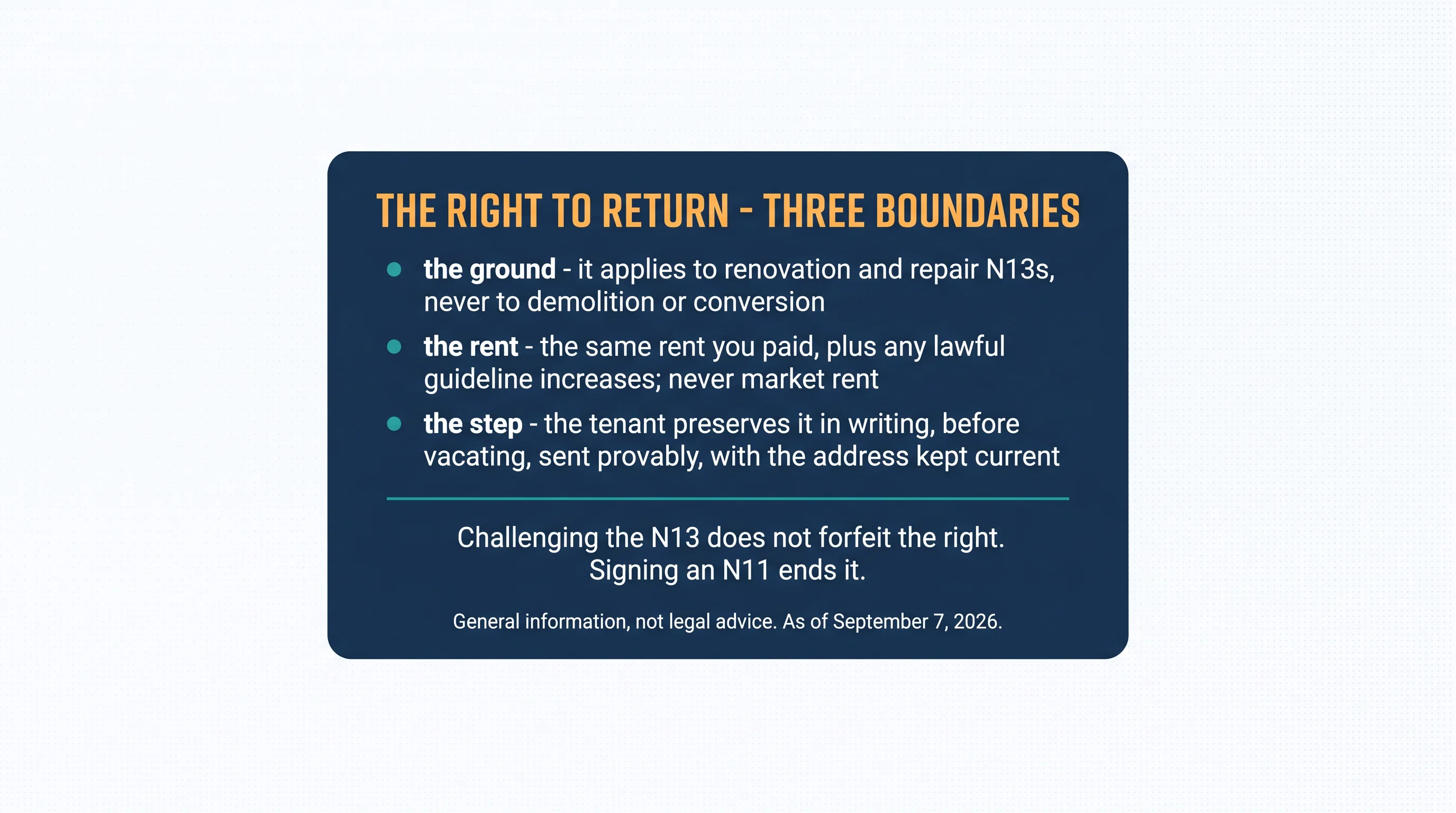
Boundary one — the ground. The right of first refusal attaches to the renovation and repair N13. Not demolition. Not conversion. A tenancy ended so the unit can be torn down or turned into something other than housing leaves nothing to return to — which means the common shorthand that "N13 tenants can move back" is wrong a good share of the time.
Boundary two — the rent. A returning tenant pays the same rent they were paying, plus any lawful guideline increases that would have applied — never market rent — and the pre-renovation terms carry over. For tenants that's the most valuable sentence on this page. For landlords it's the most expensive misunderstanding in the whole process: a renovated unit with a valid right attached is not a re-pricing opportunity.
Boundary three — the step. The right is preserved by the tenant, in writing, before vacating, with a delivery method that produces proof — and with written address updates afterward, so the notices the landlord now owes can actually reach you. Two clarifications the community-legal guidance is blunt about: challenging the N13 does not forfeit the right, and signing an N11 ends it.
What September 21 adds: the notification chain
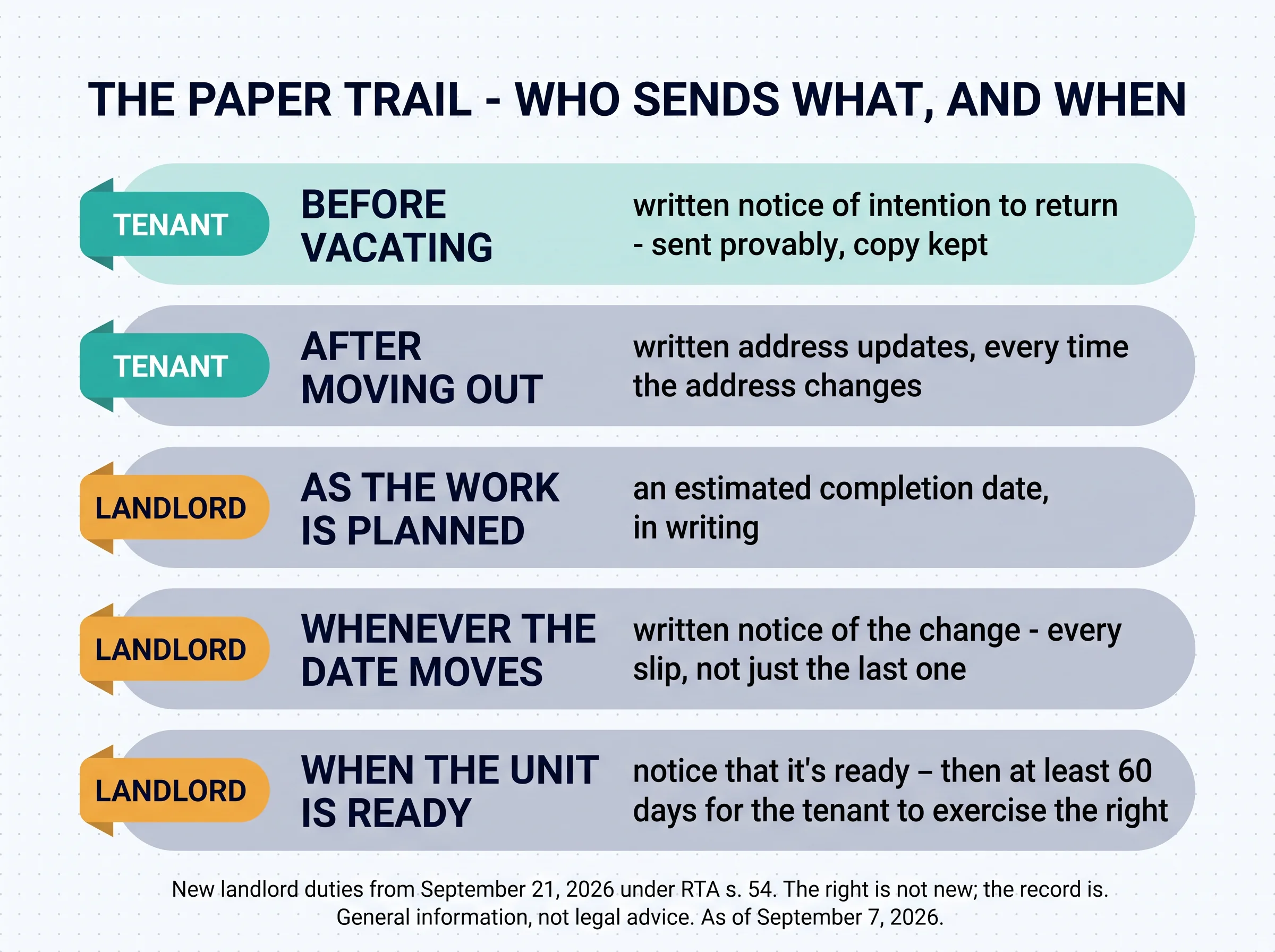
Once the right is preserved, the amended section puts four duties on the landlord: an estimated completion date · written notice whenever that date changes · notice when the unit is ready · and at least 60 days for the tenant to exercise the right once it is.
The second duty is the one that changes lives. Renovations slip — that's not cynicism, it's construction — and before this amendment the slip was invisible to the person waiting to come home. A tenant who can't be told when the unit will be ready can't plan a lease around it, or a move, or a school year. A duty to re-notify on every change turns a silent nine-month delay into a documented one.
Keep the sixty days in its own lane: this is the tenant's window to take the unit after the landlord says it's ready. It is not the N12's 60-day move-in deadline, which lives in a different section and does a completely different job — our N12 guide covers that one. Same number, unrelated rules.
One more piece, flagged honestly: the amendment also affects the time certain former tenants have to bring right-of-first-refusal claims. That detail rests on a single source as this is written — confirm the current limitation against the statute before relying on it in either direction. The design read of the whole package, though, is clear enough: the amendment doesn't create the right; it creates the record that proves it.
The tenant's half of the file
The sequence is short and unforgiving. Write before you vacate — a letter saying you intend to return to the unit when the work is done. Send it provably and keep the receipt. Update your address in writing every time it changes afterward. Keep copies of everything, starting with the N13 itself. And if the matter reaches a hearing, tell the Board you intend to enforce the right.
Then watch what arrives — and what doesn't. The estimated completion date, the updates when it moves, the ready notice: those are now owed to you. If they never come, that silence is part of your record too. Note the dates you'd have expected them and keep the file growing.
For tenants — preserve it in four lines: Write before you vacate. Send it provably and keep the receipt. Keep your address current, in writing, every time it changes. And never sign an N11 without understanding that it ends the right to return.
The landlord's half of the file
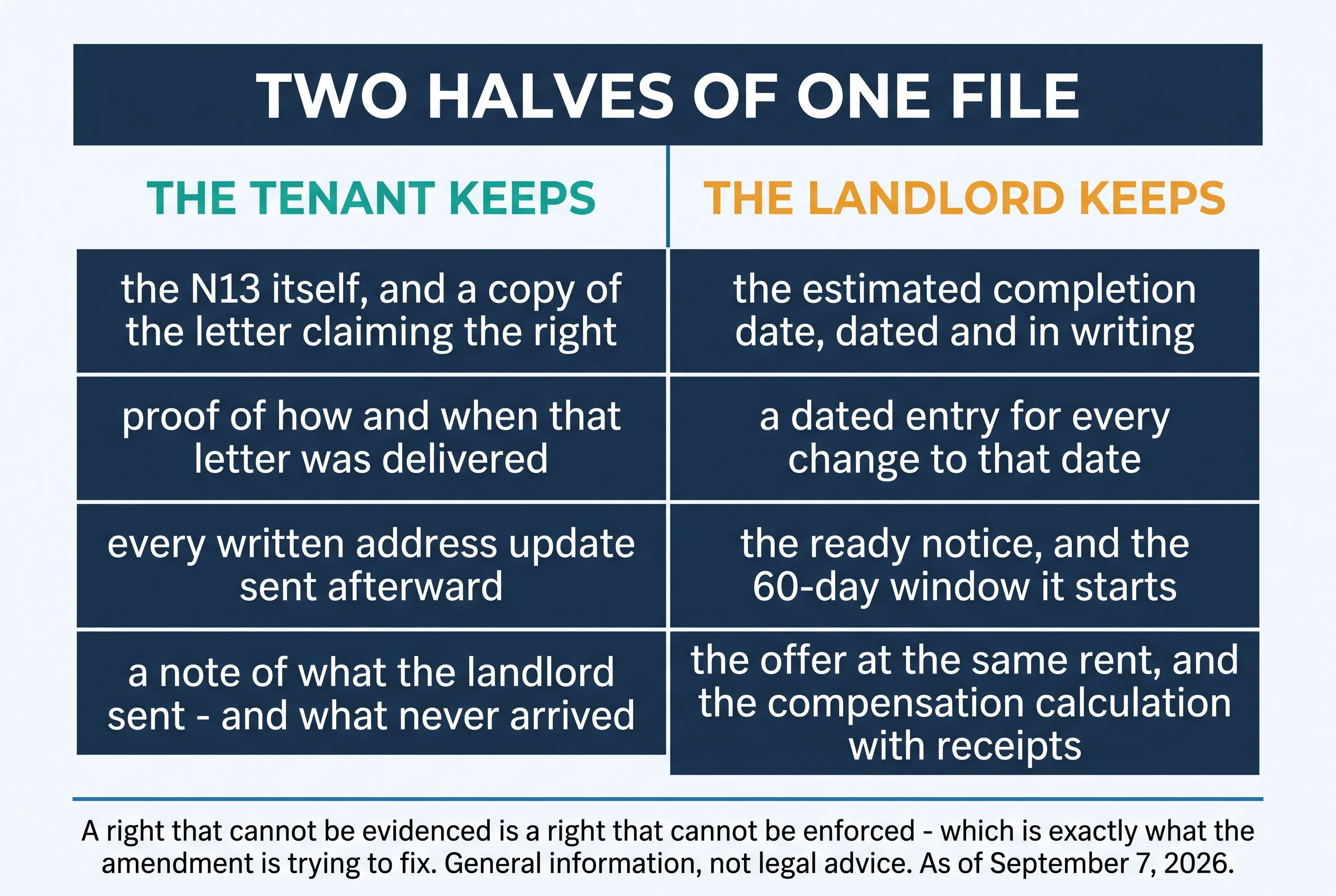
The log, in the order it happens: the estimated completion date, in writing · every change to it, in writing, each time · the ready notice · the 60-day window, honoured and dated · the offer at the same rent · and the compensation calculation with the payment record attached.
On compensation, be careful with numbers. The amount depends on the reason for the N13, the size of the residential complex, and whether the tenant intends to return — and in defined circumstances an acceptable alternative unit can substitute. The pattern in the published guidance: in complexes of five or more units, a tenant exercising the right is entitled to compensation equal to the rent for the work period or three months' rent, whichever is less, with smaller complexes and non-returning tenants running on different rules. Confirm the current tier against the statute and the LTB's own materials before you calculate — this is exactly the figure people quote from memory and get wrong.
For property managers — the log in five lines: One file per unit. A dated entry for every notice sent. The delivery method recorded beside it. The tenant's current address on file and checked before each mailing. And the compensation math kept with the receipts, not in someone's head.
The municipal layer — and what happens when the right is ignored

The RTA sets the floor; the by-law can add a storey. Municipal renoviction rules impose duties before an N13 can issue — licences, tenant-information packages, moving allowances. Mississauga's regime has been in force since September 1 and is covered end to end in our Mississauga guide; Toronto, Hamilton, Waterloo and others run their own versions. Check the municipality before the notice goes out, not after — a provincially perfect N13 can still be unlawful in a city that required a licence first.
And the enforcement reality, stated as the community-legal literature states it: in practice, the right of first refusal is frequently ignored. The remedies live in the former-tenant applications — our bad-faith guide walks how the Board approaches those findings — and the fine ceilings behind them doubled on July 1, 2026 to $100,000 for individuals and $500,000 for corporations, which our doubled-fines guide prices out. Which is the whole argument of this page from both chairs: the file is the case — for the tenant claiming the right, and for the landlord defending the renovation.
Practical takeaways
- From September 21, 2026, a landlord whose tenant has preserved the right must give an estimated completion date, written notice of every change to it, notice when the unit is ready, and at least 60 days to exercise.
- Nothing else about the N13 changes: 120 days, the period-end termination date, and the tenant's write-before-vacating step all stand.
- The right applies to renovation and repair N13s — not demolition, not conversion.
- A returning tenant pays the same rent plus lawful guideline increases — never market.
- Challenging the N13 doesn't forfeit the right; signing an N11 does, and a stale address forfeits it in practice.
- Compensation depends on the reason, the complex size, and whether the tenant returns — confirm the tier before calculating, and keep the payment record with the file.
The Renoviction Paper Trail
The tenant's checklist with date and address blanks, and the landlord's notification log with a row for every change — two pages.
The right is not new; the record is
The right of first refusal has always been real and rarely provable. From September 21 the province fixes the provable half — a chain of written notices that turns "I said I'd come back" into a file. Tenants: write before you vacate, send it provably, keep your address current. Landlords: log the date, log every change, honour the sixty days, and keep the compensation math with the receipts. Municipal rules may add duties before any of it starts, and the rest of the wave is mapped in our Bill 60 and Bill 97 guide. As of September 7, 2026 — confirm the amended s.54 text, the compensation tiers, and the professional-report question before you act. This is general information, not legal advice.
Keep the notice — and the file — right
Tenon10 generates current Ontario notices, validates termination dates, and keeps the correspondence and dates with the tenancy where they belong.
Free • No signup required • Bill 60 aware
Related resources
- Mississauga's Renoviction Licence — the municipal layer, in force since September 1.
- Bill 60 & Bill 97: The Complete Guide — every change and effective date.
- Ontario N12 Notices — the own-use path, and its own 60-day rule.
- Bad-Faith Notices: How the LTB Decides — what happens when the plan wasn't genuine.
Frequently asked questions
Does the right of first refusal apply to every N13?
No. It attaches to N13s for repairs and renovations. A tenancy ended for demolition or conversion to non-residential use has no unit to return to.
What rent do I pay if I move back after the renovation?
The same rent you were paying, plus any lawful guideline increases that would have applied. The renovated unit cannot be offered back to you at market rent.
How do I keep my right to return?
Tell the landlord in writing, before you vacate, that you intend to return — send it provably and keep a copy — and update the landlord in writing every time your address changes.
What does the landlord have to tell me during the work?
From September 21, 2026: an estimated completion date, written notice whenever that date changes, and notice when the unit is ready — after which you have at least 60 days to exercise the right.
Does challenging the N13 cost me the right to return?
No. Challenging the notice doesn't forfeit the right. Signing an N11 to end the tenancy by agreement does — read anything you're asked to sign before signing it.