

Eleven landlords in the Greater Toronto Area ran the check almost every screening guide recommends. They searched their applicant's name online. Nothing came back — no judgments, no charges, no history. So they signed the leases. The applicant then turned single-family homes in Richmond Hill and Markham into illegal rooming houses for up to twenty people each and stopped paying rent, and he was later charged with eleven fraud-related offences for allegedly using fake identification on those applications. The name they had searched was not his.
That case, whose allegations were not proven in court, contains the whole problem in one sentence. Most screening advice teaches document inspection — spot the mismatched font, the suspiciously round pay figure. That advice is roughly a decade out of date. Template-generated documents pass visual review routinely now, and a synthetic identity can carry a genuine credit score. Meanwhile Ontario landlords face a second constraint almost no guide mentions: PIPEDA binds every for-profit landlord in this province, and the Human Rights Code governs who you check as tightly as it governs how.
This guide, current as of August 2026, covers the distinction between verifying a document and verifying a person, a seven-step sequence with real time costs, the boundary between verifying someone and investigating them, and the exact wording to decline when verification fails.
The 90-Minute Applicant Verification Checklist for Ontario Landlords
A fake pay stub gets caught by a phone call. A borrowed identity doesn't. This free checklist gives you the seven-step verification sequence, the exact wording to decline safely, and the PIPEDA and Human Rights Code boundaries most Ontario landlords cross without knowing it.
Get Free PDF →The question most screening advice never asks
There are two different questions hiding inside the word "verification," and conflating them is why competent landlords still get caught.
Document verification asks: is this piece of paper genuine? Identity verification asks: is this person who they claim to be?
Nearly all published advice addresses the first. Nearly all serious losses come from the second. A fake pay stub gets caught by one phone call to the employer. A borrowed or fabricated identity sails through every check you run, because every check is being run against the name you were handed.
Why document inspection stopped working
The tooling changed faster than the advice did. Template farms and generative tools now produce clean, professional-looking pay stubs, bank statements and employment letters carrying none of the sloppy artefacts that used to give fakes away. Screening industry data from the United States puts fraud in roughly one in eight rental applications, and — more tellingly — reports that detection has moved backwards: property managers caught about 90% of altered applications before the pandemic and roughly 75% now. Those are American figures and Canadian rates may differ, but the direction of travel is the same on both sides of the border, because the tools are.

It helps to name the four patterns separately, because they fail different controls:
- Altered documents — a real template with edited numbers. Caught by independent confirmation, not by looking harder.
- Borrowed identity — a real person's file presented by someone else, often a relative with better credit.
- Synthetic identity — real fragments assembled into a person who never existed, with a credit history built up deliberately over months or years.
- Coordinated references — friends or family answering the phone as previous landlords, sounding entirely convincing.
The Canadian numbers, honestly framed
The Canadian Anti-Fraud Centre recorded over 112,000 fraud reports and more than $704 million in reported losses in 2025 — the highest annual total on record — with identity fraud the single most-reported category at 8,403 cases. The CAFC also estimates that only 5% to 10% of frauds are ever reported at all.
Those figures are all-category, not rental-specific, and it is worth being plain about that: no Ontario rental-fraud-specific statistic is published. The closest Ontario-grounded number available is one brokerage reporting fraud present in almost 15% of the applications it receives. Anyone quoting a precise Canadian rental fraud rate to you is extrapolating.
Why this matters more in a softening market
Toronto asking rents are tightening while several 905 municipalities — Brampton, Mississauga, Oakville, Oshawa and Markham — were still posting annual declines above 7% as of July 2026. Landlords carrying longer vacancies are the ones most tempted to skip a step on an applicant who looks perfect. That is the whole mechanism. The fraud that succeeds is the fraud that arrives at the moment you most want to say yes.
What you may lawfully verify in Ontario
This is the part almost every guide skips, and it belongs before the method rather than after it — because the legal frame determines the shape of the process, not just its footnotes.
The five authorized factors
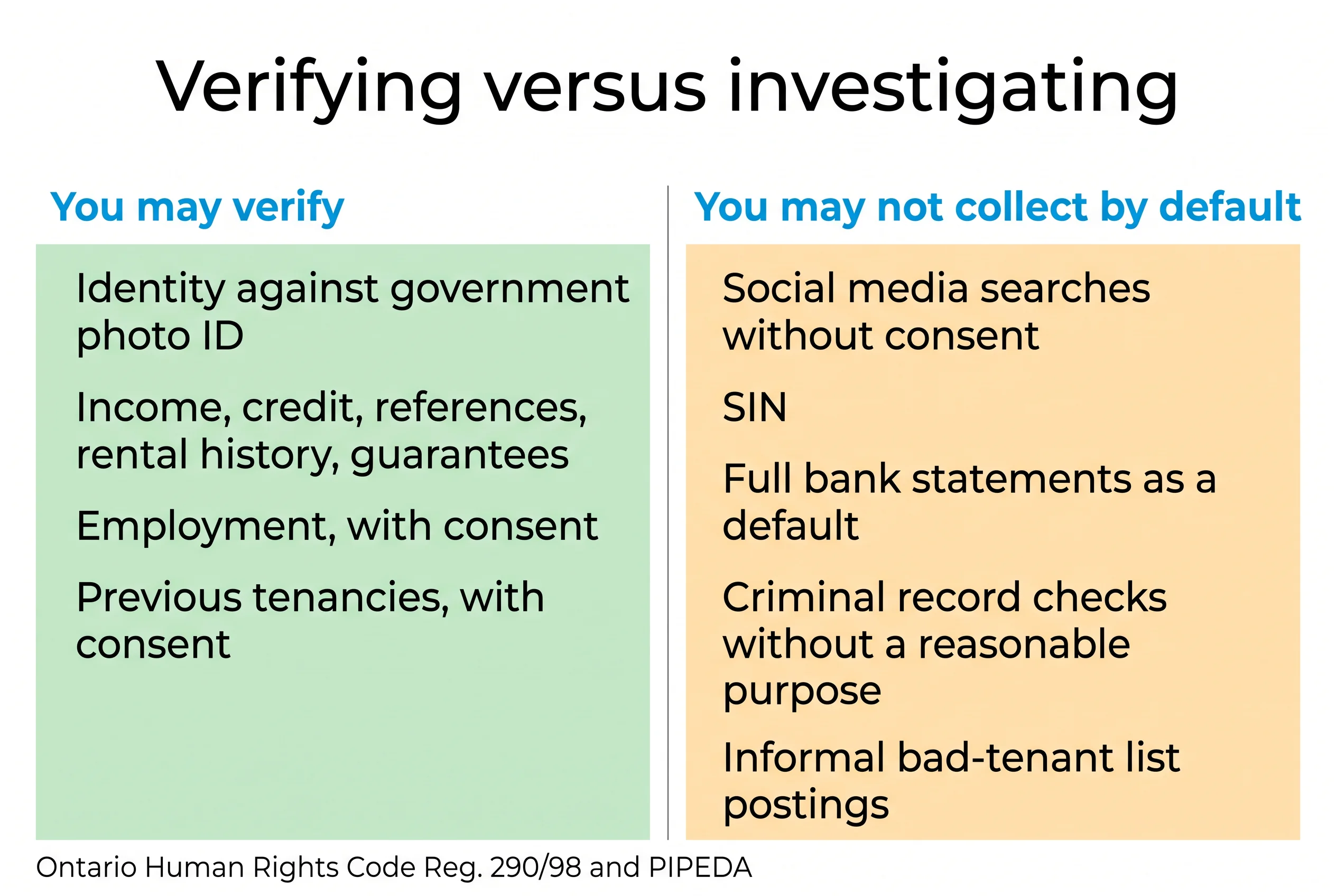
Regulation 290/98 under the Ontario Human Rights Code permits landlords to use income information, credit checks, credit references, rental history and guarantees when selecting tenants. Income information may be requested only if you also request credit references, rental history and credit checks, and it must be weighed together with everything else — never used alone. Rent-to-income ratios such as a 30% cut-off are illegal outside subsidized housing. And a lack of rental or credit history should not count against an applicant, which matters enormously for newcomers who have no Canadian credit file at all.
PIPEDA applies to you, whoever you are
Ontario has no supervening provincial privacy legislation, which means the federal Personal Information Protection and Electronic Documents Act binds every for-profit landlord in the province — a single-property owner renting a basement suite as much as a firm managing four thousand units. Most Ontario landlords do not know this.
The practical obligations: obtain consent before you collect, use or disclose personal information; identify the purpose before or at the moment of collection; limit what you collect to what a reasonable person would consider appropriate; safeguard what you hold; and use it only for the purpose you stated.
The line between verifying and investigating
Here is the boundary, drawn by the regulator rather than asserted by us. The Office of the Privacy Commissioner treats informal checks — viewing an applicant's Facebook page, or ringing another landlord to ask about them — as a collection of personal information. Done without knowledge and consent, you would have to demonstrate which statutory ground applies and why a less invasive method could not have achieved the same purpose. The OPC's guidance advises against turning to social networks for background checks at all.
Two related points worth knowing: a SIN is not required to screen an applicant or to sign a lease, and the OPC has found that landlords have no right to disclose information such as poor payment history to informal "bad tenant" lists.
Why selective verification is itself the violation
This is the most important compliance point in the piece, and it inverts how most landlords think about screening.
Applying verification steps to some applicants and not others is a Human Rights Code problem regardless of your intent. If you run identity checks only on applicants whose names are unfamiliar to you, or whose accent you noticed on the phone, then the check is the discrimination — and the inconsistency in your own records is exactly what an applicant would point to. The Commission has specifically noted that telephone inquiries reveal an applicant's name and manner of speech, and that people make fairly accurate racial attributions from linguistic cues alone.
The design rule that follows is simple and load-bearing: decide your verification steps in writing before you list the unit, and run all of them on everyone. Consistency is simultaneously your fraud control and your legal defence. That is not a coincidence, and the rest of this guide is built on it.
The verification sequence
Roughly ninety minutes per approved tenancy. The order is not arbitrary: every downstream check is worthless if it is being run against a borrowed name, which is exactly how the GTA case worked.
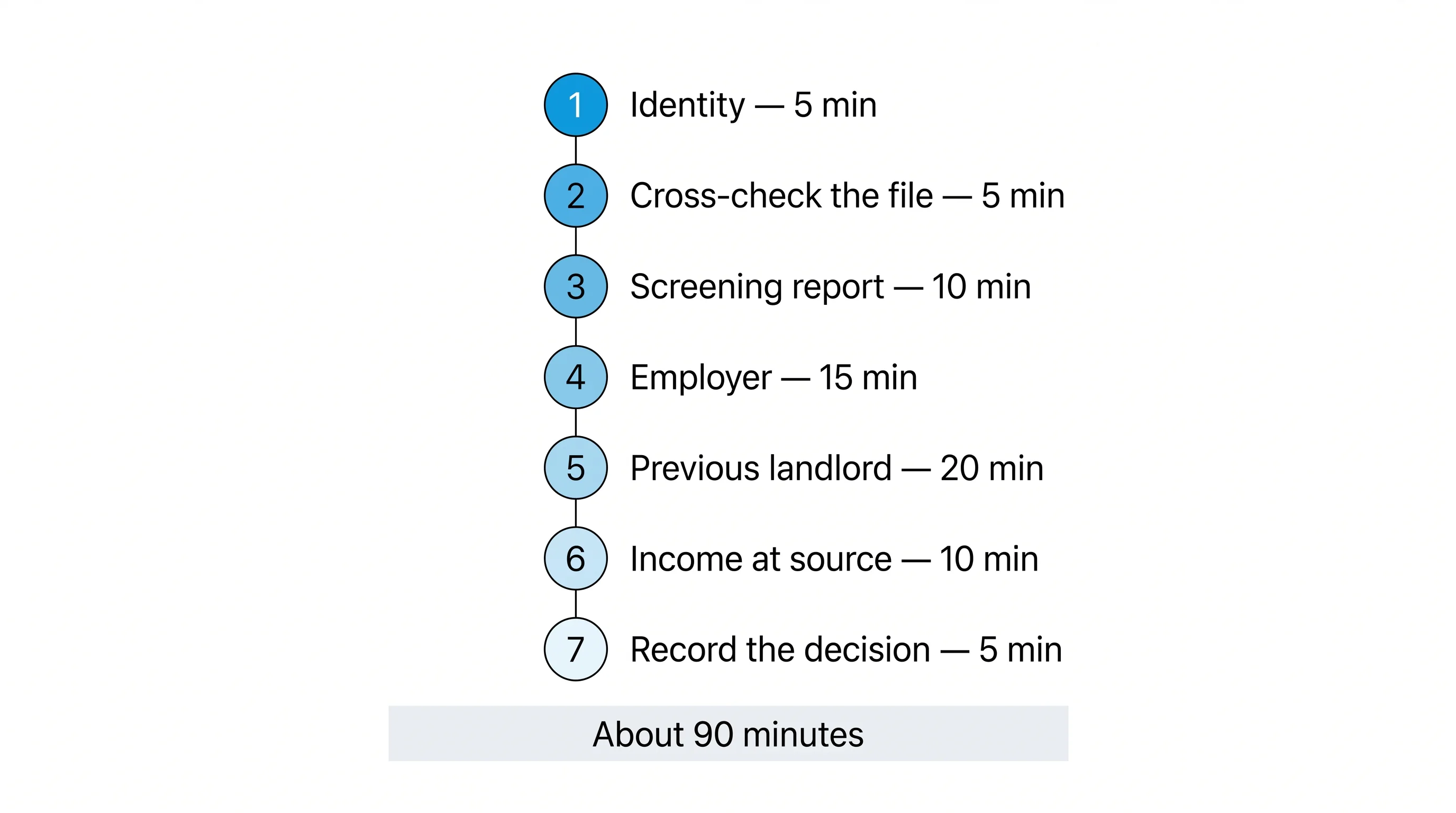
Step 1 — Identity first, always (about 5 minutes)
Check government photo ID against the person, in person or on a live video call. Confirm the expiry date. Confirm the address is consistent with the rental history on the application. One honest caveat: AI-generated identity documents and deepfake video have made this check weaker than it was two years ago. It remains necessary. It is no longer sufficient on its own, which is why the other six steps exist.
Step 2 — Cross-check the file against itself (about 5 minutes)
Name, date of birth, address history, employer, length of employment — do they agree across the ID, the application, the pay documents and the references? Most amateur fabrication falls apart here, in five minutes, before you have spent a dollar.
Step 3 — Order your own screening report (about 10 minutes)
With written consent, and ordered by you — never accepted from the applicant. Screening reports and credit reports are both being forged now, which is why some providers have started printing verification QR codes on their own output so a landlord can confirm the document at source. Budget roughly $30 for a single-bureau report and $45 for dual-bureau. Our guide to running a tenant credit check in Ontario covers the consent requirements in detail.
Step 4 — Employment, via a number you found yourself (about 15 minutes)
Never the number printed on the pay stub or the letter. Look the employer up independently, call the main line, and ask HR or payroll to confirm the person works there and the role matches. This single step catches the most common fraud type in the data. For applicants without conventional pay documents, our guide to income verification for self-employed tenants covers what to accept instead.
Step 5 — The previous landlord, with specifics only they would know (about 20 minutes)
Prefer the previous landlord to the current one, who may have an incentive to speak generously about a tenant they want gone. Ask what only a real landlord could answer: the exact rent, the exact lease dates, the name of the person who handled a specific repair. Our piece on tenant reference check questions that actually work has the full script.
Step 6 — Income at the source, not on the page (about 10 minutes)
Use bank-verified income data, or cross-check stated pay against actual deposits. The shift away from uploaded documents toward source data is the most significant change in screening practice this cycle, and it is the one control that a forged document cannot defeat.
Step 7 — Write the decision down (about 5 minutes)
Four lines against your stated criteria, in the identical format for every applicant — including the ones you decline. This is your Human Rights Code defence, and it takes five minutes. Our 7-step screening method sets out the wider sequence this verification layer sits inside.
What it costs, and what it prevents
Under $100 and about two hours of your time. Against that: a fraudulent tenancy in Ontario means months of arrears, LTB delay measured in quarters rather than weeks, legal or paralegal fees, turnover costs and possible damage. In one documented Ontario matter, a landlord went to two hearings over $13,000 in back rent accumulated across seven months. Verification costs a fraction of a percent of what it prevents, and the arithmetic is not close.
What each document actually proves
This table is the most useful thing in the article to keep somewhere you can see it, because it reframes every document in your file as evidence of something narrower than you assumed.
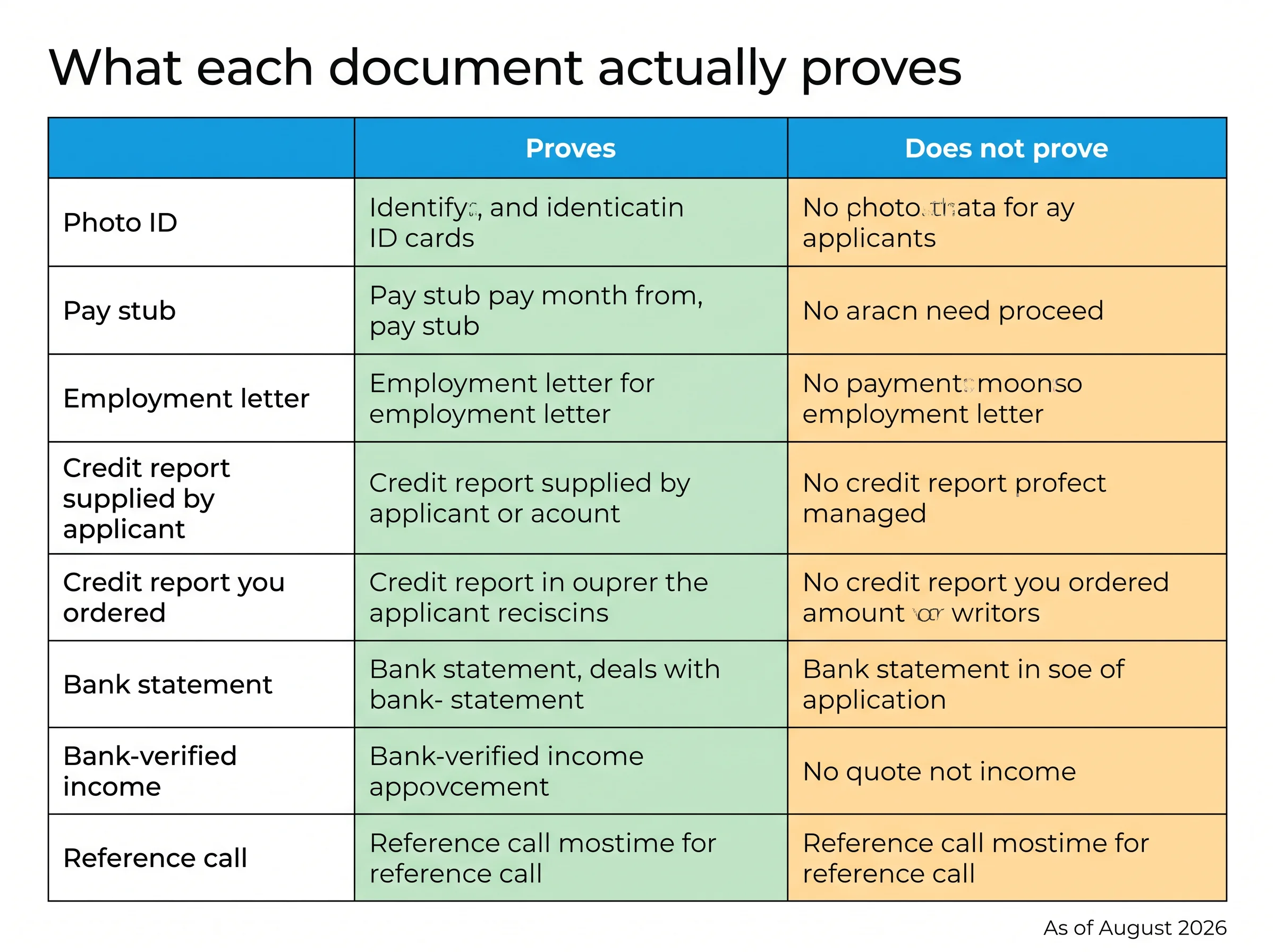
| Document | Proves | Does not prove |
|---|---|---|
| Photo ID | A document exists bearing this name and face | That the document is genuine, or that the identity is not stolen |
| Pay stub | Someone produced a pay stub | Employment, or income |
| Employment letter | Someone produced a letter | That the employer exists or knows the applicant |
| Credit report supplied by the applicant | Nothing reliable — order your own | Anything |
| Credit report you ordered | A file exists for this name and date of birth | That the applicant is that person |
| Bank statement | Someone produced a statement | That the deposits are real or the account is theirs |
| Bank-verified income | Deposits into a real account | Employment stability |
| Reference call | Someone answered a phone | That they are who they claim, unless you test specifics |
Patterns beat single red flags
No individual oddity proves fraud. One inconsistency is usually a clerical quirk. Three pointing the same direction is a file that does not hold together.
A worked example that comes up constantly: an applicant says they started a job six weeks ago, but the year-to-date figure on the stub implies they have been there since January. That might be a payroll system carrying over prior earnings. It might be edited paperwork. Either way, the question costs you nothing and the answer tells you something — and an applicant who cannot explain their own pay stub has told you a great deal.

Completeness is not verification
A Toronto landlord agreed a condo lease on the basis of stellar credit reports, personal and professional references, and healthy-looking pay stubs. He later alleged to the Landlord and Tenant Board that the identification, references and credit reports were all falsified, that no rent had been paid for seven months, and that he had been refused entry even after giving proper notice.
Every category of document was present. Every category was wrong. A complete file and a verified file are not the same thing, and the first is much easier to assemble than the second.
The withdrawal tell
Ontario property managers report this pattern consistently: an applicant volunteers several months of rent upfront — which sounds like enthusiasm and functions as pressure to skip checks — and then disappears the moment you request independent verification.
That withdrawal is your process working. It is not a lost applicant; it is a prevented tenancy, arriving at the only stage where prevention is cheap.
When verification fails: how to decline safely
You will rarely have proof of fraud, and you do not need it. What you need is a defensible reason to decline.
Decline on the ground that the application could not be verified — never on an accusation. An accusation you cannot prove creates defamation exposure you have no reason to take on, and "could not be verified" is both accurate and sufficient.
The decline script: "Thank you for your application and for your time. We weren't able to complete our standard verification steps on this file, so we're not able to proceed. We run the same checks on every application, and where we can't complete them we don't move forward. I'd be glad to confirm what we were unable to verify if that would be useful for future applications."
Every element of that wording is doing work. "Weren't able to complete verification" is provable and makes no allegation. "The same checks on every application" states your Human Rights Code defence to the applicant at the exact moment it matters. And the offer to explain is genuine rather than decorative — a legitimate applicant with a thin file, a newcomer without Canadian credit history, or someone whose employer simply never returned your call all benefit from knowing what fell down.
Keep your notes on what you could not confirm, in the same format you use for every other applicant. Do not post the applicant to any informal landlord list.
Why the LTB is not your backstop
This is the argument that should change how you sequence your leasing, and it is barely known.
In the GTA rooming-house matter, criminal fraud charges did nothing to help the landlords recover their properties. Police could pursue the fraud but could not evict. The Board could evict but declined to consider evidence of the criminal charges or the other cases involving the same tenant, on the basis that they did not relate directly to the individual eviction application in front of it. One landlord's application was dismissed outright because the alleged illegal act — providing forged documents — had happened a few weeks before the tenancy officially began, and so fell outside what the Board would weigh.
Read that again, because it is the practical heart of this guide: fraud committed in order to obtain a tenancy may sit outside the Board's reach once the tenancy exists.
The Criminal Code does address this conduct — false pretences under section 361 and fraud under section 380, with knowing assistance by a third party also chargeable. But outside rent-geared-to-income cases, reported convictions for providing misleading information on a tenancy application appear to be vanishingly rare. Real in principle; rare in practice. Plan accordingly.
What's coming, and how to prepare
Four developments worth planning around over the next twelve months:
- Bank-verified income is becoming the default control. Screening that relies on uploaded documents is unlikely to survive this cycle, because the documents are the weakest link and everyone now knows it.
- Detection rates will probably keep falling before tooling catches up. Document generation is improving faster than manual review, and the gap is widening rather than closing.
- Federal policy is moving. The Government of Canada launched consultations on the country's first National Anti-Fraud Strategy in March 2026, with comments closing in April. Watch for outcomes.
- Softening suburban markets mean more pressured landlords, and pressure is historically the condition under which fraud succeeds.
Preparation is unglamorous: write your sequence down now, move income verification to source data, and stop relying on visual document review as a primary control.
Practical takeaways
Seven things to change before your next listing goes live:
- Write your verification steps down before you list, and run every step on every applicant — not just the ones who give you a feeling.
- Capture written consent before any credit check and before contacting employers or previous landlords.
- Collect the least sensitive proof that answers the question, never the most complete file available.
- Look employer numbers up yourself. Never call the number printed on the document.
- Move income verification to source data rather than uploaded files.
- Ask every reference one question only a real reference could answer.
- Record every decision, including declines, in the same four-line format.
Quick wins: order your own screening report instead of accepting one, look up the employer's number independently, add one specific question to your next reference call, and stop asking for SINs. Longer-term: build the sequence into a documented workflow so consistency stops depending on anyone's memory, adopt bank-verified income, set a retention and destruction schedule for application documents, and keep a written record of your stated criteria so a Code challenge has an answer waiting.
The 90-Minute Applicant Verification Checklist for Ontario Landlords
A fake pay stub gets caught by a phone call. A borrowed identity doesn't. This free checklist gives you the seven-step verification sequence, the exact wording to decline safely, and the PIPEDA and Human Rights Code boundaries most Ontario landlords cross without knowing it.
Get Free PDF →Frequently asked questions
Can an Ontario landlord ask for photo ID?
Yes. Government-issued photo identification is a reasonable request for confirming an applicant is who they say they are. What matters is asking every applicant for the same thing, stating why you are collecting it, and storing it securely. Under PIPEDA, collect the least sensitive proof that answers the question — viewing the ID and recording that you verified it is usually enough, and carries less risk than keeping a photocopy indefinitely.
Can I look at a rental applicant's social media?
The Privacy Commissioner treats informal checks — including viewing an applicant's Facebook page or consulting another landlord about them — as a collection of personal information under PIPEDA. Without knowledge and consent you would have to show which statutory ground applies and why a less invasive means would not achieve the same purpose. The OPC advises against using social networks for background checks.
Do I need an applicant's SIN to screen them?
No. A SIN is not required to run a credit check with consent, and it is not required to sign a lease. Asking for one collects a highly sensitive identifier you do not need and creates a safeguarding obligation you would rather not have.
How can I tell if a pay stub is fake?
Formatting and arithmetic checks still catch careless forgeries — round numbers, inconsistent fonts, net pay that does not follow from gross. But template-generated documents pass visual inspection routinely now. The reliable method is not inspecting the document at all; it is confirming the underlying fact another way, by calling the employer on a number you looked up yourself or using income verification drawn from bank data.
Will a credit check hurt the applicant's score?
No. Since November 2024 both Equifax and TransUnion classify rental credit checks as soft inquiries. They do not affect the applicant's score and are not visible to lenders, even if the applicant is screened several times in a short period. Worth telling applicants who object — the objection is usually based on outdated information.
If a tenant lied to get the unit, can I evict them for it?
Not reliably. In one documented Ontario case an eviction application was dismissed because the alleged illegal act — providing forged documents — happened weeks before the tenancy officially began, and so fell outside what the Board would consider. Criminal charges do not evict either. This is precisely why the verification has to happen before the lease is signed.
The bottom line
Document verification and identity verification are different problems. Inspecting paper catches careless forgeries and nothing else; confirming that a real person stands behind the file is what prevents the losses that actually hurt. In Ontario that work runs inside two frames at once — PIPEDA governs what you may collect, and the Human Rights Code governs the fact that you must check everyone the same way.
Ninety minutes, run identically on every applicant, is the whole method. It is also, not coincidentally, your defence if anyone ever asks why you declined someone. The consistency that protects applicants from discrimination is the same consistency that protects you from fraud — which is a rare and useful alignment, and worth building your process around.
Next steps: write your sequence down, move income verification to source data, and add one specific question to your next reference call.
Verification only works if you run it the same way every time
Tenon10's screening workflow builds the sequence into the process — consent captured before the check, the same steps for every applicant, and the decision recorded where you can find it if anyone ever asks why.
Free • No signup required • Updated for the Bill 60 changes in force 21 Sep 2026
Related resources
- Rental Listing Scams in Ontario — the scam patterns themselves, running in both directions.
- How to Screen a Tenant in Ontario: The 7-Step Method — the full lawful sequence this verification layer sits inside.
- What to Include in an Ontario Rental Application — the form built around the five authorized factors, with the consent block.
- How to Run a Tenant Credit Check in Ontario — written consent, where to run it, and how to read the report lawfully.
- Tenant Reference Check Questions That Actually Work — the twelve questions that get facts instead of adjectives.
- What You Can and Can't Ask a Rental Applicant in Ontario — the question-by-question map.
- Income Verification for Self-Employed Tenants — what to accept when there is no pay stub.
This article is general information, not legal advice. All figures are current as of August 2026 and carry their original source and date. Where cases are described, the allegations were not proven in court unless stated. Verify current rules at ontario.ca, priv.gc.ca, or with the Landlord and Tenant Board before making decisions about your own screening process.


